

The troubled song of the sand dunes

Doing science in the desert is difficult at the best of times. Whether studying its exotic flora and fauna or sniffing out oil wells using sophisticated sensors, researchers have to endure extreme heat and cold, not to mention choking dust and sandstorms. But for physicists who are trying to solve one of the most enduring mysteries of the desert – the eerie phenomenon of “singing” sand dunes – the temperature has been rising for altogether different reasons. Indeed, the disagreement between two French researchers over the mechanism responsible for this weird acoustic effect is so virulent that they can no longer work in the same organization.

On plugging a pair of headphones into a computer to listen to some of their recordings and movies from the Sahara, it is easy to see what all the fuss is about. The low-frequency drone produced by a dune as sand cascades down its face is as unnerving as it is beautiful. It is no wonder that Marco Polo, who was one of the first people to document the phenomenon some 700 years ago, attributed it to evil spirits. A modern traveller, however, is more likely to mistake a singing dune for a low-flying aircraft. For physicists, the challenge of explaining how such a remarkable – and very loud – sound is produced by a simple pile of sand is too tempting to resist. In particular, singing dunes offer the chance to uncover a completely new way of generating sound that is different to the mechanism on which most musical instruments are based. But in rising to this challenge, two physicists and former colleagues in Paris have fallen out bitterly, in an episode that reveals the very human process of developing scientific theories.

In the field

Dunes are mounds of sand produced by the action of the wind. Up to hundreds of metres high and existing in a number of different shapes, dunes display complex dynamical behaviour that has kept earth scientists busy for decades. But despite being part of desert folklore for hundreds of years, singing or “booming” sand dunes have remained a mystery.

Singing dunes can be heard in more than 30 locations worldwide, each of which has its own characteristic frequency or note. It has long been known that the sounds – which can last up to several minutes and can be heard more than a kilometre away – come from sand that has accumulated at the top of the dune and that spontaneously avalanches down the dune face. The difficulty has been in explaining precisely how this process can generate such a powerful, monotonous note.

The current controversy surrounding this mechanism can be traced back to 2000, when Stéphane Douady, then at the laboratory for statistical physics at the Ecole Normale Supérieure (ENS) in Paris, heard a geologist talking about his research into the shape and motion of sand dunes. After visiting some dunes in the US, Douady secured funding to work on the problem along with his former PhD student Bruno Andreotti, and the pair was joined by new PhD student Pascal Hersen.

In early 2001 the group set off to explore the physics of crescent-shaped dunes known as barchans in Morocco. But while walking along the dunes one day, the researchers accidentally set off avalanches that were accompanied by loud booms. Having read about this phenomenon in Scientific American some years before, Douady immediately knew what he was hearing. Moreover, based on his research experience with avalanches, he had already come up with his own explanation for the effect based on the “stick–slip” motion of sand grains moving down the slope as a single block. However, faced with the incontrovertible sight and sound of sand grains flowing freely down the dune, he realized there was more to the phenomenon than he had initially thought. “It was exciting to have to come up with a new explanation,” recalls Douady. “Bruno, Pascal and I played on the dunes all afternoon, making sound and trying to find the reason for its creation.”

The first thing the team discovered was that avalanches triggered manually generate exactly the same sound as those that occur naturally, ruling out the role of the wind. Similarly, the researchers realized that the sound was not produced by the whole dune resonating – i.e. in a similar way to how musical instruments produced sound – because its frequency was the same (about 100 Hz) for different-sized dunes. Indeed, Douady found that he could make sounds simply by moving piles of sand with his bare hands. These observations pointed to the same conclusion: the song of the dunes is produced by the motion of the sand grains themselves, and not by global characteristics of the dune.

The mystery deepens

After seven long days in the desert the team returned to its Moroccan hotel, where Andreotti thrashed out a more detailed explanation for how the motion of sand grains might produce sound. Based on some earlier work he and Douady had carried out on grain avalanches, he expected that the frequency of the sound produced would be inversely proportional to the square root of the grain diameter. But when he plugged in the data, he found that the dunes the team had been studying did not seem to follow this simple model.

The plot thickened when the researchers returned to Paris. Hersen trawled the scientific literature and found about 10 papers relating to the acoustic emission of sand dunes. But despite some articles also predicting that the sound comes from the relative motion of sand grains, none offered a convincing explanation of how this happens. So whenever the researchers found the time in the following months – after all, their main research activity involved the shape of the dunes, not their acoustic properties – they worked on their own explanation for the song of the dunes.

The first thing the team decided was that the frequency of the sound produced is the same as that of the collision rate of grains in the “shear” layer of sand moving down the dune face. Then, recalling a movie made by a colleague that showed aluminium beads collectively switching from a hexagonal to a square arrangement as they flowed down a channel, Douady realized that some of the grains must become synchronized in order to emit sound. Singing dunes, he thought, were the result of air being pushed in and out between the synchronized grains.

Andreotti agreed that the synchronization of sand grains was responsible for the song of the dunes. But rather than being the result of squeezed air, he reasoned that the sound was due to the vibration of the surface of the avalanche – effectively turning it into the membrane of a powerful loudspeaker. Douady eventually accepted that this was a better explanation of the source of the sound – the loudness of which he discovered to his detriment when he buried his ear into a dune face during an avalanche. However, during discussions about the mechanism that actually causes the grains to synchronize, scientific opinions began to diverge.

Douady’s idea was backed up by another observation made during the time in Morocco: sound is only produced when layers of sand above a certain thickness slide over one another. This, he reasoned, means that the sound must arise from a resonance within the shear layer itself, whereby grains bump over each other at the same frequency and set up standing waves that, in turn, synchronize the grains. Andreotti turned this logic round, arguing that the collisions between grains excite waves outside the shear layer on the dune surface that then synchronize the collisions via a mechanism called wave–particle locking.

“The problem with Stéphane’s mechanism”, explains Andreotti, “is that it requires the existence of some sort of coupling wave that travels at speeds lower than 1 m s-1, which is 40 or 50 times less than the measured speed of elastic waves in sand dunes.” Douady says that although it is not yet clear why waves would propagate so much slower in the shear layer than they do in the rest of the dune, he has “similar difficulties” in understanding how random grain collisions in Andreotti’s wave–particle mechanism could excite a coherent wave in the dune in the first place. Realizing that they were asking different research questions, Douady and Andreotti started to work on the problem separately.

Out of synch

In the spring of 2002 Douady gave a brief presentation about his synchronization mechanism at a conference on statistical physics in Paris. This led to an article in the journal of the French national research council (CNRS), which Douady offered to enhance by providing a CD of desert recordings. This was well received and generated lots of media coverage. But Andreotti expressed concerns about releasing interpretations about the source of the song before they had appeared in a peer-reviewed article.

Over the next year or so, the French researchers undertook their own field trips: Douady with Hersen, who had inevitably been drawn into the fight, and Andreotti with a new Moroccan PhD student Hicham Elbelrhiti. Both groups were keen to gather as much data as they could about the speed and volume of sound-producing avalanches so that they could develop their hypotheses about grain synchronization. Andreotti , for instance, reached a proper understanding of the importance of surface elastic modes in the propagation of acoustic waves, while Douady visited dunes at other locations around the world and started to realize that the size of the grains does play a role after all – as do their surface characteristics.

Douady was also keen to reproduce the song of the dunes in his laboratory. So, remembering the way he had made sound with his hands during his first trip, he developed a “moving-blade” experiment in which known volumes of sand can be moved at different speeds in a controlled way. Being able to produce any note desired across an entire octave, this experiment proved that the song of the dunes is produced by the relative motion of the grains and that in fact no dunes are required. Towards the end of 2003, these experiments also enabled Douady to demonstrate the threshold condition vital to his synchronization theory.

Some three or four years after their first trip, it was now time for the researchers to submit for publication the considerable amount of knowledge they had amassed about the song of the dunes. By this time, however, the disagreement between Douady and Andreotti over the synchronization mechanism had intensified.

“Because of the bad relationships, I called a group meeting in spring 2004 during which the overall ENS group leader suggested I write a paper about the song of the dunes with all our names on it,” recalls Douady. “But it soon became clear that this wasn’t going to work.” According to Douady, he found out during this meeting that Andreotti had been making measurements of the velocity of elastic waves during his field trips that contradicted Douady’s synchronization mechanism, although Andreotti insists that his work was no secret. So Douady wrote a draft paper without any mention of Andreotti’s measurements.

Refusing to put his name to an explanation he did not believe, Andreotti decided to publish his own paper on the subject of singing dunes. And shortly afterwards the pair separated for good, with Andreotti joining the laboratory for hydrodynamics and mechanics at the Paris research centre the ESPCI – just one street away.

The story of how their respective papers got published is interesting in its own right. After having an initial draft rejected by Science, Douady submitted a polished version of his paper to Nature in December 2004. But it was sent back on the grounds that the subject of singing dunes had already had enough attention, the reason being that Andreotti’s paper had just been published in Physical Review Letters (93 238001). Feeling the need to demonstrate that he had been doing similar work at the same time, Douady immediately posted his paper onto the arXiv preprint server. This, however, turned out to be a mistake, since a few months later another journal called Geology – which had quickly accepted Douady’s submission – rejected it at the last minute on the grounds that it had been published already. The paper finally ended up in the same journal as Andreotti’s earlier this year, minus any mention of the sound velocity (Phys. Rev. Lett. 97 018002).

Physics in motion

These days Douady and Andreotti tend to avoid one another, which is not easy when working in such a small field. “This episode has destroyed several years of my life,” says Douady. “But it has also taught me that science can be done in very different ways – either by sudden intuitive jumps that appear to be unjustified, or cautiously and methodically.” Andreotti has also learned from the experience. “I am now more confident than ever that peer review is the best, or least worst, system in which to work,” he says. “When scientists start to use the media to make scientific claims, things start to get troublesome”.

But the stormy tale of the singing dunes does not end here. In fact with two or three other groups about to publish their own explanations of the effect, none of which requires the sand grains to be synchronized, the controversy may well be about to blow up again.

“Neither Douady’s nor Andreotti’s analysis explains why some dunes do not sing,” says Melany Hunt at the California Institute for Technology (Caltech), who together with co-workers has made extensive measurements of singing dunes using techniques such as radar. “Because we have not observed any dependence of the frequency on grain diameter, and because we can physically feel the sound over a large area of the dune, we have concluded that the sound depends on the dune itself and not on individual grains.” In particular, Hunt and her colleagues have found that dunes have a layered structure that they say causes a dune to act as a waveguide, in which certain frequencies are preferentially propagated. “As for Douady’s moving-blade experiment, we don’t agree that pushing sand in this way is the same physical phenomena as what one finds in the desert,” she adds.

Meanwhile, the fight between Douady and Andreotti, which spilled over to other members of their research groups, has not prevented either researcher from continuing to work on the problem. In fact, in Andreotti’s latest work he claims to account for the threshold effect that is so central to Douady’s synchronization mechanism, as well as supporting the Caltech group’s findings (arXiv.org/abs/cond-mat/0601584). Meanwhile, Douady – who is waiting to move into a new lab in Paris for materials and complex systems – is currently trying to understand how the coating of sand grains affects the sound produced. This, he hopes, may explain the hotly debated issue of the low coupling velocity required by his model.

Sand-dune science may not dominate the research-funding agenda, but unravelling the mystery of the singing dunes offers a valuable insight into how science is done. With motivations for tackling particular problems varying between individuals, and personal relationships lying at the core of any scientific research, only the most hardened positivist can claim that science proceeds by some idealistic hypothetico-deductive process devoid of all human influence.

“I’m sure this kind of story is repeated many times in other laboratories around the world,” remarks Douady. “It’s just that most people don’t realize it.” Indeed, 10 or 15 years from now – when researchers have solved the mystery and textbook chapters have been written – the physics of singing dunes will doubtless be recast as the product of a sequence of logical steps, all other accounts having gradually been buried like skeletons in the sand.
Where passions run deep

The media coverage of this year’s Nobel prize underlined the excitement that cosmology generates, but passions can run just as deep in more down-to-earth subjects too. This is perfectly illustrated by our cover story this month about the strange sounds created by “singing sand dunes”, a phenomenon that was first reported by Marco Polo and other travellers some 700 years ago. Several groups of physicists are now vying to explain how these strange, low-frequency drones are produced by nothing more than piles of sand.

It sounds like a fun question to tackle, but the scientific battle over what causes sand dunes to sing has become so intense that the two physicists at the heart of the dispute can no longer bear to work in the same laboratory. The full story (see “The troubled song of the sand dunes”) dramatically illustrates how emotion and tension are central to science. And while it is absurd to argue that the laws of physics are only human inventions that do no reflect an underlying truth, as some sociologists of science like to argue, the sand-dune story shows that scientific progress has a very human side.

Mobile-phone network reveals the ties that bind

Most technological and biological networks collapse when strong ties are removed. A gel, for example, loses its mechanical strength when enough bonds between neighbouring molecules are broken. However, Jukka-Pekka Onnela of Oxford University and the Helsinki University of Technology along with collaborators in the US and Hungary have concluded that weak ties between individuals play a much more crucial role in social networks.

The study, which used 18 weeks of call records from a European mobile phone network, assumed that two users were “tied” if they both phone each other at least once. The strength of that tie is then defined as the total duration of all calls between two users. This reveals a social network, in which a significant number of individuals are linked together (see figure “Ties that bind”).

The researchers removed ties between individuals in rank order from weakest to strongest. To their surprise, the network did not remain intact, but underwent a “percolation” phase transition splitting into a collection of unconnected islands, in which individuals were linked to only a small number of other phone users. However, if ties were removed in rank order from strongest to weakest, there was little effect on the network (see figure “Ties that bind”).

According to Onnela, weak links could be important because they tend to be “long-range” interactions that link individuals in different social groups. Conversely, strong ties tend to be “short-range”, linking individuals in the same social group. As a result, the removal of the weak links had a much greater effect on the overall structure of the network.

The results of the study could find application in epidemiology because many infectious diseases tend to spread via social networks. It could also be used in the study of how rumours and other social phenomena move through a social group.

New particles turn up in the US

Baryons are particles containing three “quarks”, which are fundamental building blocks of matter. There are six different types, or “flavours”, of quark: up, down, strange, charm, bottom and top (u, d, s, c, b and t). Up and down quarks are the lightest and can be found in protons and neutrons.

The strange, charm, bottom and top quarks are heavier and are not found in ordinary matter. However, they can be created fleetingly in high-energy collisions at particle accelerators or in interactions between cosmic rays and atoms in the atmosphere. Scientists also believe these particles were present in the very early universe, just moments after the Big Bang

The CDF work was done using Fermilab’s Tevatron collider. Currently the world’s most powerful particle accelerator, it collides together protons and antiprotons moving at close to the speed of light. Out of the billions of collisions produced each second over the last five years, the CDF researchers identified 103 sigma-b particles containing a u-u-b configuration of quarks and 134 sigma-b particles containing a d-d-b configuration. The particles are extremely short-lived and decay within a tiny fraction of a second.

The sigma-b particles are the first baryons to be discovered that contain a bottom quark and are in an excited spin state. “These particles are like rare jewels that we mined out of our data,” says Jacobo Konigsberg of the University of Florida and a spokesperson for the CDF collaboration. “Piece by piece, we are developing a better picture of how matter is built out of quarks and learning more about the subatomic forces that hold quarks together and tear them apart.”

According to Konigsberg, the two distinct sigma-b particles were produced in two different spin combinations, which represent a ground state and an excited state. Their discovery provides further confirmation of quark theory.

Meanwhile, two new “xi” baryons containing “charm” and “strange” quarks have been discovered on the other side of the world by the BELLE collaboration at Japan’s KEK Laboratory (Phys. Rev. Lett. 97 162001).

On the case of the “missing” helium

The helium-3 isotope — together with hydrogen and lithium — is one of the very few elements to have been synthesised in the Big Bang. Further quantities of helium-3 are also produced by low-mass stars (about one to two times as heavy as our Sun) when they burn up the hydrogen in their cores.

But once a low-mass star has spent all its hydrogen, it expands and cools to become a red giant, during which the outer layers of the star become turbulent. Scientists believe that any helium-3 inside the star becomes mixed up into these layers by convection. The helium is then carried away from these surface layers into space by winds.

The flaw with this model, however, is that it predicts that there should be a lot of helium-3 in the universe, whereas astronomers have only detected about a tenth of that value, which is just the amount that was produced in the Big Bang.

Eggleton and co-workers may now have solved this problem by modelling a red giant star in 3D. The simulations show that turbulence at the base of the star’s convection layer causes deep “hydrodynamic” mixing that destroys the helium-3 so none of it can be released into space. The helium-3 is converted into another helium isotope, helium-4, and hydrogen.

“The apparent problem with the Big Bang has been solved,” says team member John Lattanzio of Monash University. “The helium-3 in the universe comes from the Big Bang, and low mass stars — although they produce helium-3 — do not release any into the universe because they destroy it.”

3D solar satellites blast off

CMEs come about because the Sun’s equator rotates more quickly than its poles. This differential rotation twists the magnetic field created in the centre of the Sun, causing the field lines to become entangled. When these field lines become so entangled that they reach breaking point, they release huge amounts of energy in the form of a CME, which can eject billions of tonnes of plasma laced with magnetic field lines into space at millions of kilometres per hour.

This plasma can create havoc in two ways. Firstly, it compresses the Earth’s magnetic shield, known as the magnetosphere, which can allow high-energy particles to penetrate the casing of geosynchronous satellites and disrupt their electronics. Secondly, the field lines within the plasma connect with those in the magnetosphere, setting up strong electric currents that can also affect satellites as well as damage power supplies on the Earth’s surface.

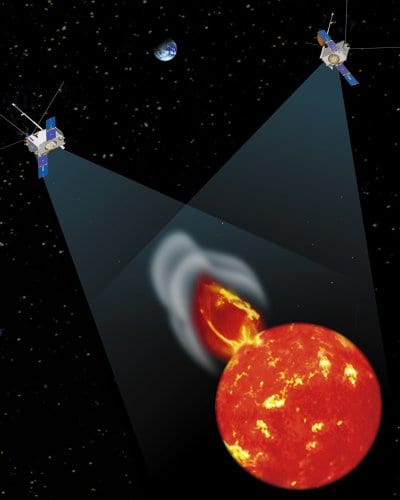
Currently, NASA’s Advanced Composition Explorer satellite (ACE) can warn of a geomagnetic storm about an hour before it strikes. According to STEREO’s project scientist Michael Kaiser, the newly launched mission will increase this notice period to about two days. STEREO’s satellites will contains nearly identical suites of visible, ultraviolet and radio detectors to track the direction and speed of CMEs from their origin at the solar surface, through the Sun’s atmosphere and then across the interplanetary medium.

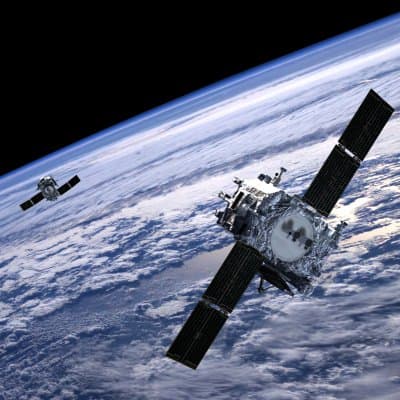
The twin satellites will create their 3D images just as a pair of eyes does – by virtue of being slightly separated in space. Launched together, the spacecraft will fly in an eccentric orbit around the Earth and pass by the Moon in about three months’ time. At this point the satellites will be just far enough apart that the Moon’s gravity can fling them off in different directions – one will enter into an orbit around the Sun and the other will curve back on itself to fly past the Moon again six weeks later before entering a new solar orbit. The end result is that one spacecraft ends up in a solar orbit slightly head of the Earth while the other trails behind the Earth.

Underwater sound breaks the surface

The simple ray theory of acoustics predicts that any sound produced underwater will be reflected at the surface, rather than transmitted into the air. As a result scientists had assumed that sound from the oceans are not transmitted into the air above.

Oleg Godin of the University of Colorado’s Cooperative Institute for Research in Environmental Sciences (CIRES) has discovered that ray theory breaks down when used to describe low-frequency noises that are produced near to the surface of water. Or more precisely, when the wavelength of the sound is comparable to (or longer than) the depth of the source. By applying a more sophisticated theory of acoustics, Godin has shown that under these conditions sound is almost entirely transmitted to air.

Godin has proposed that water-to-air transmission at low frequencies involves two independent mechanisms. The first involves evanescent sound waves, which are generated by the source in addition to the more familiar plane waves of ray theory. The intensity of evanescent waves decreases exponentially with distance from the source and are normally extremely weak upon reaching the surface. However, for a shallow source, at a depth of a fraction of wavelength, the evanescent waves do not attenuate strongly and are transmitted to air. According to Godin, the sound is then transmitted as a plane wave in air because of the refraction that occurs at the water/air interface.

The second mechanism involves interference between the incident and reflected plane waves in the water, which occurs as the source nears the surface. According to Godin, the nature of this interference ensures that almost all of the sound is transmitted into the air.

Three research groups – two in the US and one in Europe – could soon be verifying Godin’s predictions in laboratory experiments, using acoustic waves in the kilohertz range.

According to Godin, his theory could be used to develop techniques for the detection of low-frequency sounds associated with the testing of nuclear weapons. It could also make marine biologists take a fresh look at how marine birds locate underwater prey and avoid underwater predators.

Microparticles feel the pinch

The refractive index (RI) is a fundamental property of how light interacts with matter and knowing its value for microparticles is vital to a wide range of scientific research. Although several measurement techniques are currently available, they all have serious drawbacks including incompatibility with other common laboratory tools — such as conventional microscopes – that are used to study microparticles.

The RI of a single spherical microparticle (1-5 micrometre diameter) was measured in a laser trap, which used one beam of laser light in an optical “tweezers” system that confines the microparticle to a small focal point. The RI was determined to within 1% accuracy from the “stiffness” of the trap, which is a measure of the forces required to keep the microparticle under confinement. The stiffness was determined by measuring the particle’s thermal motion using light from a second laser and a photodetector.

Queensland’s Greg Knöner told PhysicsWeb: “This is the first time that an individual microparticle’s refractive index has been measured in a laser trap and, as an added bonus; the measurement technique is relatively simple”. Indeed, unlike other methods that rely on the capture of scattered light using rotating stages and/or an array of detectors, this new technique can be implemented on a standard microscope by the addition of two mirrors.

An advantage of the new technique is that the particles do not have to be suspended in special liquids, which could damage biological specimens such as single cells or alter crystalline growth. Another unique feature of the new technique is that it can be used to study polydisperse solutions, which contain particles of different sizes. Together, these features could be exploited in automated systems that rapidly test microparticles for desirable pharmacological or other properties.

The group is now extending the technique so it can be used to study non-spherical objects. “This involves the development of new measuring techniques that account for the orientation of a non-spherical particle in the trap as well as the development of new models to simulate the interaction between the laser beam and the object,” explained Knöner.

Invisibility cloak unveiled in the US

David Smith and colleagues at Duke University in North Carolina have used specially-structured materials called metamaterials to create a device that can make an object almost invisible to the microwave radiation used in some radar systems. Based on a design by the physicist John Pendry of Imperial College, the cloak bends microwave radiation around the object, like water flowing around a smooth stone. This makes both the cloak and object invisible to an observer because the radiation does not appear to be scattered or absorbed by cloak or object.

The cylindrical cloak has a radius of about 6 cm and surrounded a copper cylinder (the object). The arrangement was exposed to microwave pulses at about 10 GHz and a moveable antenna was used to study how the cloak interacted with the radiation. Although the cloak did absorb and scatter some of the microwave radiation, the pulses did bend around the object and reform on the other side.

The cloak is a cylindrical arrangement of split-ring resonators (SRRs), which are made out of thin strips of copper and resemble a square-shaped ring that is partially split into two rectangles. The SSRs were arranged in ten concentric rings, each three resonators tall.

By varying the shape, size and arrangement of the resonators, the researchers were able to engineer the electrical permittivity and magnetic permeability at any point within the cloak. The theory of transformation optics was used to determine which permittivity and permeability values would steer the microwave radiation smoothly around the object. Transformation optics is a new and expanding field of physics that has been made possible by the development of metamaterials.

The cylindrical nature of the cloak means that it can only shield in two dimensions and the current design only works within a relatively narrow microwave frequency band. The researchers are currently working on a spherical device that could cloak in all directions. However, an invisibility cloak that works with visible light will remain science fiction for the time being, because it would require much smaller and more intricate structures that have yet to be devised, say the researchers.

Researchers discover element 118

This time, however, element 118 — and its slightly lighter counterpart element 116 — is here to stay, pushing back the boundaries of the periodic table and helping researchers to understand why some nuclei are more stable than others (Phys Rev C 74 044602).

The world is made up of about 90 naturally occurring elements, but since the 1940s physicists have been able to produce heavier, less stable elements. Such elements are vital for testing models of the nucleus, and to date researchers have amassed data on 29 “super-heavy” nuclei with atomic numbers between 104 and 118.

The definitive discovery of element 118, which is expected to be a noble gas that lies right below radon in the periodic table, was a collaborative effort between researchers at the Livermore lab and the Joint Institute for Nuclear Research (JINR) in Dubna, Russia. Based on data taken early last year in experiments at the JINR cyclotron, in which a target of californium (atomic number 98) is bombarded with a beam of calcium-48 ions, the team observed alpha decay chains that could only occur if element 118 exists. In these decay chains, previously observed element 116 is produced via the alpha decay of element 118.

“Element 118 is the last one in a series of superheavy elements produced in nuclear reactions with calcium-48,” says Dubna team-leader Yuri Oganessian. “So far all the experimental data point to the existence of an ‘island of stability’ in the region of superheavy elements, as theory says it should.”

As well as providing a clear ending to a rather unsavory chapter in physics, the discovery of element 118 brings to five the number of new superheavy elements discovered by the Livermore–Dubna collaboration (113, 114, 115, 116 and 118). Next year the team plans to look for element 120 by bombarding a plutonium target with iron isotopes.

Copyright © 2026 by IOP Publishing Ltd and individual contributors