A singularity occurs when one or more of the physical parameters in a system approaches infinity. In bubble formation, this occurs at the moment of pinch-off, when the stress and pressure become very large. Physicists had thought that this pinch-off would always occur in a highly symmetric manner, regardless of the initial conditions of bubble formation.
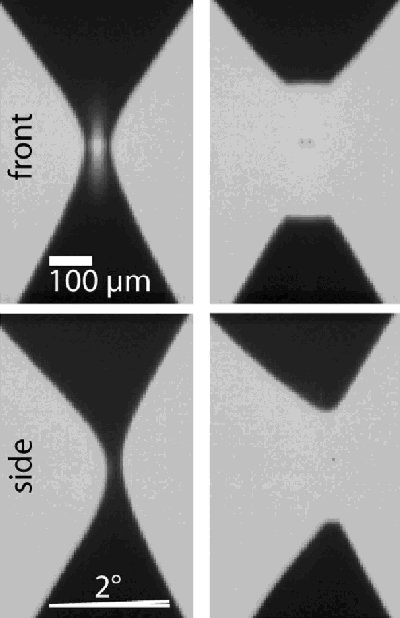
But now the Chicago research group led by Sidney Nagel has used high-speed photography to reveal that the physical appearance of the singularity is influenced by the shape, size and angle of tilt of the nozzle.
The group used a syringe to release air quasistatically (i.e. very slowly) through nozzles between 1.5 and 4.1 mm in diameter. A digital camera photographed the resulting bubbles up to 130,000 times a second. The nozzles could also be tilted, effectively altering the shape of the aperture, to see if an asymmetric formation had any affect on the dynamics near the singularity.
By measuring the radius of the neck of air joining the nozzle to the bubble as a function of time, they found that the neck collapsed so rapidly (following a power law) while approaching the singularity that surface tension could not erase any asymmetry present from the outset. Varying the tilt confirmed that the asymmetry was not erased: for small angles of less than a degree the neck branched out into “satellite” bubbles, and the pinch-off was shifted laterally away from the direction of tilt. At two degrees, the satellite bubbles moved upwards and away from the direction of tilt, indicating an asymmetry in fluid velocities.
Chicago researcher Nathan Keim told PhysicsWeb that this asymmetry is a “memory” of the initial conditions of formation. He believes that this phenomena may not be limited to air bubbles and that other singularities such as black-hole formation could involve the retention of some aspects of the initial conditions. “In that way, the question of what a singularity can remember goes far beyond our table-top experiment,” explained Keim.
Some water drops splash into multiple jets after striking a solid surface while others remain intact – and physicists have been successful at predicting this behaviour using surprisingly simple equations. These equations have been adapted by Thomas Deisboeck of the Harvard-MIT Center for Biomedical Imaging in the US and colleagues at Italy’s University of Turin, who observed that this splash/no splash behaviour is exhibited by some cancers. Tumours either send out multiple (and often deadly) invasive tentacles into surrounding healthy tissue, or they do not.
The researchers defined a tumour “invasion parameter” by modifying the fluid-dynamical equations that predict which drops will splash and how many jets will result. The invasion parameter is a function of three variables: the confining pressure exerted on the tumour by surrounding tissue (analogous to the impact pressure in a drop); the radius of the tumour; and the surface tension of the tumour. Greater pressure and larger radii favour invasive tentacles, whereas greater surface tension inhibits invasion.
In order to minimize this invasion parameter, Deisboeck and colleagues have made two recommendations to oncologists treating potentially invasive tumours. The first is to boost tumour surface tension by using drugs to increase the adhesion of cancer cells to the surface of the tumour. The second is to reduce the pressure exerted on the tumour by surrounding tissue, again through the use of drugs.
Deisboeck told PhysicsWeb that he was “hesitant at first” to pursue the splash/tumour analogy “since [the] research areas and underlying processes seem quite distinct”. However, he added that a number of experimental cancer studies support the group’s conclusions and their multidisciplinary approach.
While chemists routinely use lasers to control reactions, some light is absorbed by the target molecules – a process that has permanent and unwanted effects on the chemistry. No light is absorbed in this new technique called dynamic Stark control (DSC), which makes it similar to a traditional chemical catalyst.
The method was developed by Albert Stolow and colleagues at Ottawa’s Steacie Institute for Molecular Sciences and Queen’s University in Kingston, Ontario (Science314 278). The group used the electric field associated with an ultrafast laser pulse to modify the molecular energy levels that dictated how a chemical reaction proceeded.
Traditional catalysts are highly specialized chemicals that modify the outcome of a chemical reaction by altering molecular energy levels. They can be very difficult to develop and implement. By contrast, DSC is delivered via ultrafast laser pulses that can be modified to suit a particular reaction. Stolow explained that this will allow chemists to adjust energy levels on time scales similar to the duration of a chemical reaction. As a result, DSC could revolutionize the field of catalysis.
“By being able to apply electrical forces at will to reacting molecules, and adjusting them dynamically on the time scale of chemistry itself, we can gain new insight into the nature of the electrical forces which govern chemical reactions”, explained Stolow.
According to Stolow, DSC will become and important component of a “quantum control toolbox” for manipulating matter at the molecular level. He believes that DSC could be used to control molecular switches in quantum information systems, sharpen optical images of single cells or even to perform molecular-scale surgery on single cells.
Stolow and colleagues directed a 150 femtosecond infrared laser pulse at IBr molecules, which were dissociating into iodine and bromine atoms. The bromine atoms are produced in two different atomic states and the researchers observed a change the relative abundance of the two states after the laser pulse. The molecules absorbed no laser light because the intensity of the pulse was kept below the threshold to ionize the chemical constituents.
Planetary scientists had believed that the entire surface of Titan was engulfed in an ocean of liquid ethane one kilometre deep. That is until the European Space Agency’s Huygens lunar probe landed on Titan in 2005 and found a surface covered in a sand-like material – not liquid ethane. Recent calculations by Donald Hunten from the University of Arizona, USA suggest that instead of accumulating in liquid form after being produced in Titan’s upper atmosphere, the ethane condenses onto thick smog that envelops the moon’s surface (Nature443 669).
This process forms a smog-and-dust-like material that Hunten calls “smust”. The idea came to Hunten while he was analysing the vertical distribution of ethane in Jupiter’s atmosphere. “Jupiter has smog particles too, and it occurred to me that they are very spongy and have lots of sites that would be good for ethane to adhere to. The same process should work on Titan.” Indeed, Hunten has calculated that Titan could be covered in a layer of smust 2.6 km thick that could support dune-like structures. Such dunes have been observed on Titan by the ESA’s Cassini planetary probe, which launched Huygens and continues to monitor Titan.
The atmosphere of Titan is expected to contain vast quantities of ethane that has built up over time from photochemical reactions in the upper atmosphere. Similar reactions produce heavier hydrocarbons, which are responsible for Titan’s dense, orange-brown smog.
According to Hunten’s calculations, condensation onto the smog is the only explanation for the observed mixing ratio (a measure of the relative abundance) of liquid ethane at the bottom of Titan’s stratosphere. “There is a deep minimum of the mixing ratio that coincides with the coldest region [of the stratosphere] near the tropopause. This suggests condensation, but it is not cold enough for the ethane to condense by itself.”
Unfortunately it is unlikely that Hunten’s proposal will be verified in the near future. “One never knows what Cassini might find,” said Hunten, “but I don’t expect anything that will point directly to the presence of smust particles.”
Since Charles Bennett and his team first proposed quantum teleportation in 1993, science fiction enthusiasts have had to be content with frustratingly prosaic examples of the principle. However, at the University of Copenhagen in Denmark, physicists have passed a milestone that will help to bring some practical applications of teleportation within sight (Nature443 557).
“This is the first time teleportation has been achieved between the ‘flying’ medium of light and the ‘stationary medium’ of atoms,” said Eugene Polzik of Copenhagen. “Such teleportation could serve as a main building block of a quantum network connecting distant quantum processors.”
Quantum teleportation cleverly evades one of the best known peculiarities of quantum states – their inability to be measured precisely. Only some of the information of a quantum state can be learned in a single measurement, and once that measurement is made, the quantum state is effectively destroyed.
To get around this problem, which prevents communication in the classical manner, quantum teleportation makes use of a pair of entangled states. One half of the pair is kept by the sender (affectionately known as “Alice” to quantum physicists), while the other is taken by the receiver (“Bob”) on his travels.
When Alice wants to transmit the quantum state of new particle to Bob, she performs a joint measurement, called a “Bell measurement”, on both it and her half of the entangled pair. She then sends the result over to Bob using any classical means available (telephone, homing pigeon, etc.). Then, by using his half of the entangled pair, he can “reconstruct” an exact copy of the initial state.
In Polzik’s experiment, a beam of light was shone through an ensemble of caesium atoms, possessed by Bob, becoming entangled through a quantum-mechanical version of the Faraday effect, in which the polarization of light rotates as it passes through a medium. The light travelled half a metre to Alice’s location, where it was mixed on a beamsplitter with the object to be teleported – a weak laser pulse. The amplitude and phase of the combined light was then measured on each of the two outputs of the beamsplitter respectively (the Bell measurement), and then sent through a classical channel to Bob.
“The result is that the pure state of the light state is recovered in the atoms,” explained Polzik. “More importantly, our experiment has involved a macroscopic atomic object – something that can, in fact, be visible.”
While the number of atoms in the ensemble may not be quite up to the expectations the science fiction enthusiasts (1012 atoms, as opposed to about 1027 in a small person), the fact that the cloud of caesium is an observable object is a major step towards feasible quantum communication. Large ensembles of atoms could, in the future, serve as “memory nodes” by storing quantum states, using photons for the transmission.
“In free space [teleportation] could be over tens or hundreds of metres,” said Polzik. “We want to do long distance teleportation of a macroscopic object.”
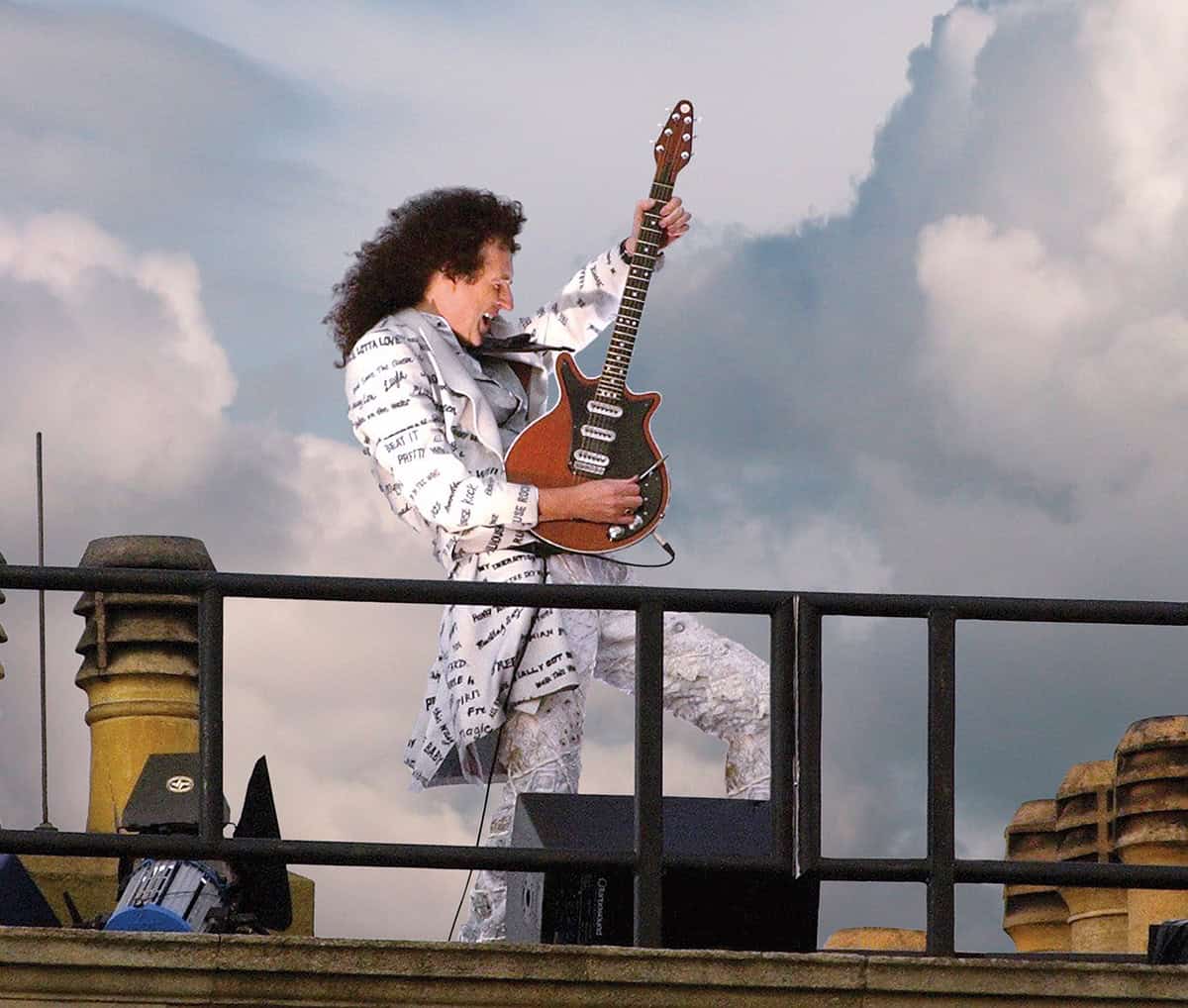
Sitting on the terrace of Brian May’s Surrey mansion on a sunny late summer’s day, at times it is easy to forget how May made his name. Aside from his trademark long, curly locks, there is little to suggest that this is the guitarist in one of the world’s most famous and flamboyant rock groups – Queen – and the writer of hits such as “We will rock you” and “Fat bottomed girls”. Chatting to Physics World in a quiet, unassuming way, he talks about a wide range of topics, from his fascination with Victorian stereo photography and his fondness for archiving, to speculation about the origins of life on Earth. He also discusses another life-long passion, and the reason for the visit from this magazine: astronomy.
Together with veteran astronomy popularizer Sir Patrick Moore, and Chris Lintott – Moore’s sidekick on the television programme The Sky at Night – May has written Bang! The Complete History of the Universe, published by Canopus Books and due out later this month. This modestly titled book is designed to be a layperson’s guide to cosmology – a chronological account of the development of the universe from its extremely brief but ultrarapid “inflationary” expansion, through the development of stars, planets and life, and finishing with its likely fate – a cold, featureless death.
I wanted it to be a book that people would read and feel in some sense that they understand the whole story of creation.
Brian May
Having spent most of his life strutting around on stage in front of adoring fans, May, 59, seems an unlikely person to have written such a book. But in fact he graduated in physics and went on to do most of a PhD in astronomy, and has retained an interest in science ever since. Indeed, he has been keen to ensure that the book is genuinely informative, and that it is not some glossy cop-out. “I wanted it to be a book that people would read and feel in some sense that they understand the whole story of creation,” he says. “I did not want it to be something that you just buy and stick on your coffee table.”
Don’t stop me now
It was Moore who sparked the young May’s interest in astronomy. From the age of about seven, May used to beg his parents to be allowed to stay up and watch The Sky at Night. For him, the subject matter seemed mysterious and exciting, and he hung on to every word that Moore uttered. “I remember trying to put stars on my ceiling and fitting my cupboards out so that it felt like you were in space when you put your head in them,” he recalls.
May’s scientific bent took him to Imperial College in London, where he graduated in physics. He stayed at Imperial to do a PhD on the motion of interplanetary dust particles, and got as far as writing up his thesis and drawing the accompanying figures. But it was then that his other great passion – music – caught up with him. Having started rehearsing with Roger Taylor and Freddie Mercury in a group that was to become Queen, May realized it was now or never for his music. So he ditched his PhD and went off to become a rock star. “It was probably good for the scientific community that I did this,” he adds modestly. “I was known in the department for being a bit erratic. I tended to work during the night rather than the day, which meant I missed lots of meetings.”
In person: Brian May
Born: London, 1947
Education: Imperial College, London (degree in physics and unfinished PhD in astronomy)
Career: guitarist and songwriter in Queen, and a solo artist
Family: married to actor Anita Dobson, has three children from his first marriage
For years May never really imagined that he could make a career out of his music, but ironically it is the security that he has acquired from being an extremely successful rock star that has, years later, allowed him to return to astronomy. He spends many an hour staring up at the skies through his portable telescope, and more occasionally uses the 10 inch telescope located inside the miniature observatory he has built on his considerable back lawn. He even hopes to finish his PhD, using data from a telescope on Tenerife that his astronomer friend Garik Israelian, based at the Canaries Institute of Astrophysics, will help him obtain.
May’s involvement in Bang! Followed a trip to Scotland with Moore to view an annular eclipse in May 2003. While in Scotland, Moore suggested they get together to write a book on cosmology. Although May at first thought he would have little to contribute to the project, Moore persisted and eventually managed to win him round. A few months later the two discussed the nuts and bolts of the book at Moore’s Sussex house. Lintott, who is doing a PhD in astronomy at University College London, also happened to be at the house at the time, and the three realized that together they could make a powerful team – Moore with his panoramic view of astronomy, Lintott with the up-to-date knowledge of cosmology research and May, as it turned out, the one best suited to ensuring the book remained clear and understandable to the non-expert. Plus there was the prospect that May’s name was likely to do no harm to the sales figures.
Once the meeting was over, Moore sat down at his old typewriter and within a week had bashed out the first draft. Then followed two years of rewriting, and plenty of heated disputes over single words and sentences. For May, it was vital that the book retained the linear narrative they had consciously opted for in preference to the now more conventional approach of packing in plenty of human anecdotes. “Brian kept us focused on the task in hand,” recalls Lintott. “He was also extremely rigorous in finding the right analogies – at times the process felt to me rather like a three-year-long viva with a particularly tenacious examiner,” he says of May.
I want it all
One of the issues that the three co-authors profoundly disagreed about was the issue of whether life exists elsewhere in the universe. May believes that the life found on Earth could exist elsewhere, its seeds having been carried throughout the universe on the back of meteorites, as proposed by the late astronomer Fred Hoyle (a “fantastically original thinker” according to May). But, unlike Moore, he does not think that life could have started independently in many different parts of the universe. “The idea is that given a particular paint box a Picasso will emerge. I don’t believe it,” he says.
To be honest, I would probably kill someone if I saw them torturing a cat.
Brian May
May has strong views on a wide range of other subjects, to which a continually updated stream of comments on his website testify – be they the evils of capitalism, the folly of the Iraq war or gripes with his new laptop computer. He also believes that scientists must take greater notice of their ethical responsibilities. For example, he is deeply opposed to drug testing on animals and also questions the right of scientists to smash objects into comets. “My objections to this kind of project are slightly tongue in cheek,” he says. “But to be honest, I would probably kill someone if I saw them torturing a cat.”
Guitar maestro From an early age May wanted to be either an astronomer or a musician. (Courtesy: Arthur Edwards)
An obvious question that springs to mind when talking to May is how he manages to fit in all he does. In addition to his music, his astronomy, spending time with his family and updating his online soap box, he also acts as producer and musical director to the Queen musical We Will Rock You (currently on stage in London and cities overseas), writes the odd score for other theatrical productions, and campaigns for Aids sufferers. “I try to get a a balance in my life,” he says. “It’s still very hard because I do so much, but I like it that way. I’ve learned a lot about dividing time and allowing yourself to be helped by other people.”
One activity that he devotes significant time to is photography, and in particular studying and archiving the work of Victorian 3D photographer T R Williams. For May, Williams is a hero. “He was an amazing technician and a perfectionist, but at the same time a complete artist,” he says. “And he was also commercially successful.”
This ability to combine fulfilment with commercial success is one that fascinates May (who admits that he too suffers from the “perfectionist disease”). “If you have just one of those, life can be a bit bleak,” he says. “You can do great art that no-one ever sees, you can do great science but there is nothing to apply it to, or else you can be commercial and crass and have nothing to say.”
The “little dividing line” that links these elements is, says May, where he tries to put himself. Having made his millions by writing and playing songs in Queen, he has arguably proved himself in the world of the arts. He now hopes he can find some success with his foray into the world of science.
The work was done by researchers at the University of California, Los Angeles (UCLA), who claim that the result could find application in the development of bio-compatible electronics (Nature Nanotechnology1 72).
In recent years researchers have exploited the unique selectivity of biomaterials by nanostructuring biological molecules with inorganic materials for applications such as biosensing. The UCLA researchers have taken this idea one-step further with a hybrid biological system that can store digital information.
“We have developed an electronic device, fabricated from the tobacco mosaic virus conjugated with nanoparticles, which exhibits a unique memory effect,” Yang Yang, the group’s lead researcher at the University of California, told physicsweb.org. “This device can be operated as an electrically bistable memory device whose conductance states can be controlled by a bias voltage. The states are non-volatile and can be digitally recognized.”
The TMV is a 300 nm tube consisting of a protein capsid (outer shell) and RNA core. According to the researchers, the TMV’s thin, wire-like structure makes it suitable for attaching nanoparticles. In this case, it allowed them to add an average of sixteen positive platinum ions per virion. The device works by transferring charge, under a high electric field, from the RNA to the Pt nanoparticles with the TMV’s surface proteins acting as an energy barrier, stabilising the trapped charges.
“The TMV’s surface makes it an ideal template for organizing the nanoparticles, which can bind to the specific carboxyl or hydroxyl sites on the surface,” said Yang. “The RNA core in TMV is likely to serve as the charge donor to the nanoparticles with the coat proteins acting as the barrier to the charge transferring process.”
The TMV hybrid, says the team, has an access time ( the delay between a call for storing data and for data storing to begin) in the microsecond regime. This is comparable to today’s flash memory. In addition, the device is non-volatile, which means that data is retained once the computer’s power is turned off.
The researchers say the device still needs to be scaled-down to a smaller size to increase storage density and to include more circuitry. “There will be issues involving retention time, power consumption, and integration of drivers required to write and read each bit, which we need to consider in order to optimize the system,” said Yang.
In the long term, these devices could one day be integrated in biological tissues for applications in therapeutics or biocompatible electronics.
Steven Weinberg’s The First Three Minutes was the first book I ever read about cosmology, and it was largely responsible for me deciding to work in this field. You might argue that Weinberg has a lot to answer for, but the book is still a masterpiece.
Coming of Age in the Milky Way by Timothy Ferris is a hugely enjoyable history of astronomy. Although written by a professional popular-science writer, it treats its readers intelligently and is very thoroughly researched.
When I was at school, my physics teacher warned me off biology (and all other subjects that involved the use of coloured pencils). The Selfish Gene by Richard Dawkins showed me that there is real intellectual depth to go with the crayons.
What science books are you currently reading?
I am between science books at the moment. I recently finished Parallel Worlds by Michio Kaku, which I thought was badly written, misleading and full of historical inaccuracies. By way of compensation, I next plan to investigate Lisa Randall’s Warped Passages.
What else are you reading?
I have just started Simon Schama’s Rough Crossings, which is a fascinating account of why the American Revolution really happened – not to promote individual liberty, but to protect the profits of slave-owners in the face of the British emancipation movement.
Which popular-science book have you never read, but feel you ought to have tackled, and why?
I should read Roger Penrose’s The Road to Reality because the author is such an important figure in science and the scope of the book is so vast. It is over 1000 pages long, however, and I have never summoned up the energy to lift it off my study floor. Still, at least I am not so pretentious as to leave it on the coffee table.
In Bertolt Brecht’s The Life of Galileo, the ongoing conflict between rationalism and religious authority is portrayed through Galileo Galilei’s epic battle with the might of the Vatican. The play depicts the later years of the Italian astronomer’s life as he struggles to promote the ideas of Copernicus in the face of fierce opposition from the Catholic Church. In the 17th century, claiming that the Earth rotates around the Sun was tantamount to heresy; as the Italian philosopher Giordano Bruno found out to his cost in 1600, when he was burned at the stake for refusing to recant his heliocentric beliefs. According to Brecht’s Galileo, Bruno’s only mistake was that he had no proof.
Brecht (1898–1956) penned The Life of Galileo while exiled from Germany just before the outbreak of the Second World War. His purpose was to voice opposition to the fascist movement in his home country. Himself a communist, Brecht drew a parallel between the persecution of Galileo for his legitimate dissent and that of his comrades-in-arms, who bore the brunt of Hitler’s earliest purges. He later revised the play, in the light of the bombing of Hiroshima, to include more about scientists’ social responsibility. Brecht’s script was adapted and made more accessible by David Hare in 1994, and it is this version that has now been modified by director Howard Davies for a four-month run at the National Theatre in London.
In Davies’ production, the characters wear modern attire, which emphasizes the contemporary importance of the play’s major themes. Four centuries after Galileo, and 50 years since Brecht’s death, the relationship between faith and reason continues to be a difficult one, making the play as relevant as ever. Debates in the US courts over intelligent design and stem-cell research, as well as the realignment of religion and politics in the Islamic world, underline this.
Watching The Life of Galileo today, it is also hard not to draw parallels with the case of David Kelly, a scientist who, in voicing his expert opinion on Iraq’s weapons, was called before the political establishment of the day and forced to explain himself. Even today, we are reminded how the relationship between science and the political establishment can be a matter of life and death.
As a pure spectacle, The Life of Galileo is a fantastic advertisement for the joy of discovery. Despite his short and stout appearance, Simon Beale’s ranting and obsessive Galileo dominates the stage and the play. Galileo’s fanatical support for reason, and his frustration at the religious authorities, are expressed energetically by Beale. His explanations for observations of sunspots and mountains on the Moon have a verve and enthusiasm that makes one wonder why fewer pupils today are studying physics – particularly in the opening scene of the play where Galileo demonstrates the Copernican system to his housekeeper’s young son.
Besides this captivating central performance, the play is also an exciting audio-visual experience, benefiting from an impressive revolving set and atmospheric incidental music. There is also plenty of light relief, with a number of musical-style dance numbers dotted throughout the play, as well as some humour. Altogether, this makes for three hours of compulsive, compulsory viewing.
Perhaps the weakest point of the play is its ending. Despite being dramatically played out, the real consequences of Galileo’s recantation of the Copernican system in 1633 are not dealt with fully. In submitting to the Church, it is clear that Galileo placed a higher value on his own life than on the truth. If he had not backed down, he would have faced mortal agony, like Bruno before him; the horror of physical pain was enough to force Galileo to declare he was wrong. Perhaps only Galileo himself really understood the consequences of his recantation – the play leaves this stone unturned and the audience doubtful as to whether Galileo was ultimately a hero or, in the words of one his students in the play, “a selfish coward” who sold out his beliefs.
Freud once said that the distinguishing characteristic of scientific revolutions is their ability to knock human arrogance from a high pedestal to a lower one. But in The Life of Galileo, we watch how one individual, in possession of a revolutionary truth, is ultimately humbled by political authority. As the play depicts, in this case the truth did make it into the public domain, thanks to Galileo’s followers. Galileo’s most important book, Discourse on Two New Sciences, was smuggled out of Italy in 1638, while he was under house arrest.
The real value of The Life of Galileo, however, is that which Brecht intended: a reminder that however bleak the prospects, progress is only possible if dissenting spirit in the face of authoritarianism is continually renewed. In the words of Galileo himself: “In questions of science, the authority of a thousand is not worth the humble reasoning of a single individual.”
• The Life of Galileo runs until 31 October at the National Theatre, London. For further details see nationaltheatre.org.uk
US particle physicists, along with their funding agencies, are anxiously anticipating what is in store for the 14 TeV Large Hadron Collider (LHC). Discovery expectations are extremely high – in particular the prospect of finding the Higgs boson or evidence for supersymmetry. The LHC was an opportunity that opened up in Europe after a similar US programme – centred on the 40 TeV Superconducting Super Collider (SSC) – was cancelled by the US Congress in 1993 after about $2bn had already been spent building the $8.25bn machine. That decision, while devastating, was mitigated by the ability of US physicists to go to CERN, help build the LHC and harvest the physics discoveries.
Additional mitigating factors were the discovery of the top quark – the sixth and final quark of the Standard Model – at Fermilab’s Tevatron collider in 1995 by the CDF and D0 experiments, and the co-discovery by researchers at the Stanford Linear Accelerator Center (SLAC) and at KEK in Japan of CP violation in the bottom-quark system. Indeed, until the LHC switches on late next year, Tevatron remains the highest energy accelerator in the world, colliding protons and antiprotons at energies of about 2 TeV.
Physicists at Fermilab are highly focused on finding evidence for the Higgs particle or even supersymmetry, both of which have a small chance of being found at the Tevatron in the next two or three years. Indeed, European colleagues tell me they are quite nervous about being scooped. Of course, once the LHC experiments present their first physics results, the Tevatron will probably be turned off, although no precise date has been set yet.
Joining forces
The formal move to join the LHC began in 1994 when a committee of the US High Energy Physics Advisory Panel, chaired by SLAC’s Sidney Drell, released a report on the future of US particle physics. Based on its recommendation, the US government promised over $500m to the LHC accelerator and detectors, and has fully delivered on its financial commitments. Today, more than a fifth of the members of the ATLAS and CMS collaborations – the LHC’s two main experiments – come from the US, forming a significant fraction of the entire US high-energy-physics community.
CERN is also reaching out to the world for help in developing the LHC and performing research for future upgrades. The US has responded by creating the LHC Accelerator Research Program (LARP) and by sending accelerator physicists to CERN, many of whom have valuable experience with superconducting colliders, such as the Tevatron and Brookhaven’s Relativistic Heavy Ion Collider. LARP is essential for attracting and training young US physicists at a frontier accelerator. A fellowship programme has also been set up to allow young US accelerator physicists to be trained at the LHC.
LHC is reciprocity: many young European particle physicists were trained at US facilities, while the LHC was being planned and built. Indeed, about half of the people working on CDF and D0 at Fermilab, as well as on the BaBar experiment at SLAC, are from outside the US, mainly from Europe. Particle physics will rely on this cost- and resource-sharing model even more in the future.
Tricky times
The US is, however, facing a critical phase over the next two or three years. The Tevatron will be turned off, Stanford’s linear accelerator is transforming into a major light-source facility, while Cornell’s Electron Storage Ring is winding down. As my European colleagues often remark, a lack of investment in particle physics by the world’s largest economy would send ominous signals to science-policy leaders in Europe and Asia that particle physics is no longer an essential science.
Fortunately, the recent EPP2010 report released by the National Academy of Sciences (NAS) has given a significant boost to particle physics in the US. It was drawn up by a diverse committee, about half of whom were non-particle physicists, chaired by eminent Princeton University economist Harold Shapiro. “Leadership in science remains central to the economic and cultural vitality of the US,” the report says, adding that the US would pay too high a price if it forfeited its leadership in particle physics.
That theme was echoed in the widely acclaimed NAS report “Rising above the gathering storm”, which has been a major impetus for President Bush’s American Competitive Initiative (ACI). The ACI aims to double the budget of the Department of Energy’s Office of Science and the National Science Foundation, which includes high-energy physics. Although high-energy physics is not an explicit part of the ACI, it has benefited from the initiative, the first instalment of which was in the president’s 2007 budget request to Congress. However, the US particle-physics budget would need to double over the next 7–10 years if the US is to host a major facility such as the International Linear Collider (ILC).
Unlike the SSC, the ILC is a truly international project. The US particle-physics community is strongly aligned behind this global approach and is working closely with Asia and Europe to bring the ILC to fruition. As the EPP2010 report rightly points out, significant investment in accelerator research will be needed over the next few years to optimize its design.
The LHC was conceived at CERN, and it was CERN that decided to move forward with the project. The ILC, in contrast, is an opportunity for the global community to support the next major project no matter where it is located. This model of global co-operation is critical if we are to answer the compelling scientific questions sure to be raised by the discoveries at the LHC.