

Stresses determine the shape of life

Jim Valles and Jay Tang at Brown University, have worked out that physics is behind the patterns formed by microtubules – proteins that play a fundamental role in cell division and organism development. “What’s exciting is that this finding may provide insight into how the shapes that make up the human body are created,” said Valles.

Microtubules are shaped like long, thin straws and are found in all cells – whether that’s the humble amoeba or a human brain cell. They perform many functions, including forming the structure that pulls the chromosomes apart during cell division and serving as the “train tracks” to transport proteins around cells. They also form the scaffolds that give cells their shape.

During the study, which was funded by NASA, the researchers investigated solutions of microtubules grown in the lab. The presence of a magnetic field or convective flow in the solution prompted the microtubules to align side by side and join to form a series of bundles. These bundles eventually buckled coherently with their neighbours to form a wave pattern.

“There is no direct evidence for how this pattern affects the formation of biological structures, but it suggests a mechanism for pattern formation – it could produce ripples in a cell or spatial variations in a protein,” Valles told medicalphysicsweb.

The Tang-Valles team – with contributions from two graduate students, Yifeng Liu and Yongxing Guo – has spent two years studying this particular pattern, and finally it has the answer to how it forms. Rather than being solely generated by chemical reactions, as was previously suspected, the waves are produced by a combination of protein polymerization and mechanical buckling. “We suggest that the bundles buckle to relieve compressional stress that builds up because of internal MT [microtubule] polymerization forces,” noted the researchers in their Proc. Natl Acad. Sci. paper.

The breakthrough will most likely increase basic understanding of several natural systems. Microtubule patterns similar to those created by the Tang-Valles team in the lab are seen in frog eggs and fruit-fly cells during early development, where they play a critical role in shaping the body of the organism that eventually emerges. Although the team didn’t study any other patterns, there are a range of other possible structures that microtubules can form and physical forces are likely to underlie these as well.

Right now, it is impossible to say whether the Brown findings will have any medical implications. The pattern-formation mechanism is not genetically related, so it won’t affect fields such as cloning, stem-cell research and reproductive medicine. “It could maybe affect tissue engineering as it is a force-generating mechanism – a distorting system,” Valles speculated.

The team would now like to look more closely at the structure of the microtubule bundles. “We’re interested in how easily they slide past each other. Our experiments have indicated that they are held together laterally but that they can move longitudinally,” said Valles.

The researchers eventually want to be able to control the buckling effect. “Interest from groups in biology and medicine who could come up with applications for this work would also be very welcome,” added Valles.

• This article originally appeared on medicalphysicsweb
Magnet falls freely in superconducting tube

Faraday’s and Lenz’s laws can be demonstrated by dropping a powerful neodynium magnet through a copper tube. The magnet takes about 25 s to fall through a two-meter-long tube — compared to less than 1 s for a non-magnetic object.

Many students are probably left wondering how the magnet would behave in a superconducting tube. Yan Levin and Felipe Rizzato at Brazil’s Federal University of Rio Grande do Sul have the answer: The magnet will fall freely as long as it is about one pipe-radius into the pipe, otherwise it does feel a force due to boundary effects (arXiv.org). But actually doing the experiment could be tricky because the calculations suggest that work must be done to get the magnet inside the tube in the first place.

Levin explained that the magnet induces electrical currents within the walls of the superconducting tube, which in turn create a magnetic field inside the tube. However, the symmetrical nature of the magnetic field means that it exerts no force on the magnet. This is true even when the the magnet is moving because the lack of electrical resistance in the tube means that the symmetrical magnetic field can simply follow the magnet as it falls with zero dissipation of kinetic energy.

Levin told physicsweb.org that free fall will occur in tubes made of ideal conductors and superconductors – which have fundamentally different magnetic properties. Levin admitted that “in the case of normal type II superconductors there will be some other effects such as flux pinning of the magnetic field, which we have not taken into account in our calculations”. These effects could result in a small braking force.

Free fall appears to contradict previous calculations by the Brazilians, which suggest that the magnet should not move at all inside a pipe made of superconducting material (Am J Phys 74 815). For tubes made of conventional conductors such as copper, the braking force on a magnet is proportional to its velocity and the magnet very quickly reaches its terminal velocity inside the tube. The calculations also predict that the terminal velocity is proportional to the electrical resistivity of the pipe. Superconductors have zero resistivity, and therefore the magnet should stay put.

“The physics of the two systems are very different”, explained Levin, “As the resistivity of the metal goes down, the induced currents will no longer decay quickly and the self-induction effects can no longer be ignored — as was done in our Am J Phys paper”. Indeed, the terminal velocity should reach a minimum value as the tube crosses over from being a normal to an ideal conductor.

Levin and Rizzato have also concluded that a superconducting tube of finite length is a excellent magnetic shield, which could be exploited in the design of superconducting quantum interference devices (SQUIDs).

Impossible supernova confounds astronomers

Type Ia supernovae occur when the mass of a white dwarf approaches the Chandrasekhar limit of 1.4 solar masses — usually by the accretion of matter from a nearby star. These explosions usually have the same brightness and, as a result, serve as ‘standard candles’ for measuring distances in the Universe.

“We’ve found a supernova that is so bright that it ought to have been impossible,” University of Toronto astronomer Andy Howell, lead author of the study, told physicsweb.org. “Now we have to take a hard look at our theoretical understanding of Type Ia Supernovae and figure out how this could have happened.”

According to Howell, although it should not be possible for a white dwarf’s mass to break the Chandrasekhar limit, this event has shown that “nature has found a way”. The researchers estimate that such extreme events are rare, happening no more frequently than in 1 out of 500 supernova Ia events. However, the concern is that other supernovae, not as extreme as SNLS-03D3bb, could contaminate a large sample of blasts.

“We’d still get roughly the right measurements, but it might not be as precise as it could be; especially when it comes to determining the nature of the dark energy that is driving the acceleration of the universe,” said Howell. “Any knowledge of the extremes in which the ‘candles’ work and don’t work will be essential for the kind of ultra-precise satellite missions that are being planned.”

The authors speculate that there are two possible explanations for the existence of the apparently massive white dwarf that lead to the explosion. The first is that the white dwarf was spinning rapidly, so that the outward centrifugal force prevented the star from collapsing in the usual manner. The second of these explanations suggest that the blast was the result of two smaller white dwarves merging, such that the body was briefly more massive than the Chandrasekhar limit before imploding.

The authors say that their results should not undermine the results obtained using supernovae as standard candles, such as with the discovery in 1998, by Saul Perlmutter from the Lawrence Berkeley National Laboratory and Alex Filippenko of the University of California, that the Universe’s expansion was accelerating.

The team suggests that as a remedy, future studies should “screen out” such super-bright supernovae and monitor type Ia supernovae from young populations of stars, where more luminous supernovae are produced, to see whether their luminosity profiles are similar to other type Ia supernovae.

The group carried of the research as part of the 5-year Supernova Legacy Survey, a joint venture between Canada, France and Hawaii to precisely measure several hundred high-redshift supernovae.

Newton, Einstein and a monstrous calf

The archive contains classic scientific papers from the likes of Isaac Newton, Edmond Halley, Michael Faraday, Albert Einstein, and Francis Crick. At the same time, the journals provide a direct glimpse into the fascinating history of science; particularly Philosophical Transactions, which in earliest years published papers on a wide variety of subjects and blurred the distinction between science and everyday reportage.

“The journals in question were for some time the most significant of their kind in the world, and certainly the most important publications in Anglo-American science until the prominence of Science, Nature and other journals,” said Rob Iliffe, reader in the History of Science at the UK’s Imperial College, and Editorial Director of a project, which aims to make all Newton’s writings freely available online.

In the first 1665 issue of Philosophical Transactions, Robert Boyle describes the experiments made into the nature of ‘cold’ in a paper titled “The Experimental History of Cold” (Phil Trans 1 8). Later in the same issue, Boyle also relates an story, this time from a butcher in Hampshire who had come across a deformed calf, titled “An account of a very odd monstrous calf”.

Another report published in 1681 describes the experiences of sailors off the north-east coast of North America. They discovered that after their ship was struck by and heavily damaged by lightning their compasses underwent a complete change in polarity (Phil Trans 14 520). “The North point was turned clear South…As for the other [compass] the North point stood West…The seamen were at first puzzled,” wrote Edward Lad, master of the Abermarle.

In the midst of such miscellany, a letter from a Professor of the Mathematics in the University of Cambridge, made its way into publication in 1671. Representing his earliest contribution to the history of knowledge, Isaac Newton describes the invention of a reflecting telescope in a letter containing his “New Theory about Light and Colors” (Phil Trans 6 3075).

Over the centuries, as semblances of the modern scientific disciplines emerged, from 1887 the Philosophical Transactions divided into two series: Series A (Mathematics and Physical Sciences) and Series B (Biological Sciences). “Early on, [Philosophical Transactions] was addressed to an educated and genteel audience, but later — in the late 18th and early 19th century, it became more technical and the audience changed accordingly,” Iliffe told physicsweb.org.

Those interested in the history of science are hoping that more historical publications are made available. “The question for historians at present is firstly, how much of these and other resources will be made freely available over a longer period of time, and secondly, how can we continue to build up complementary resources by digitizing manuscripts and information about instruments,” said Iliffe.

Until now, the Royal Society’s online collection only extended back to 1997. The new archive makes every journal published by the Royal Society accessible vian the Internet.

Pulsars prove Einstein right (nearly)

Michael Kramer at Jodrell Bank Observatory and colleagues carried out four separate tests on the pair of rotating neutron stars, verifying general relativity to an astonishing accuracy of 99.5% (Science 313 1556). The team now hopes to improve the precision so that they can eventually probe the internal structure of these superdense stars and perhaps even see the first hints of quantum gravity.

The double pulsar PSR J0737-3039A/B, which was discovered by the Jodrell Bank team in 2003, lies some 2000 light-years away from Earth. It consists of two compact neutron stars, each a mere 20 km across yet weighing more than the Sun and separated by only a million kilometres. Given the tiny size, high mass density and very short orbital period of just 2.4 hours, the double-pulsar system has a gravitational potential 100,000 times that of our Sun — higher than anything else in the universe, apart from black holes

Relativistic effects in this system are therefore much more pronounced and space-time is far more curved than under normal conditions that exist in our solar system. This makes the double pulsar an excellent “laboratory” for testing general relativity, particularly because both stars send out regular beams of radio waves, which can be captured by large telescopes and used to probe the curved space-time around such a system. Such measurements can reveal whether general relativity applies only in the weak-field conditions of our own solar system and if there are deviations in places where gravity is very strong.

Using the Lovell Telescope at Jodrell Bank — as well as the Parkes Radio Telescope in Australia and the Robert C Byrd Green Bank Telescope in West Virginia, USA — the team measured five mathematical parameters that describe relativistic effects as corrections to the simple Keplerian motion of stars. One is the rate at which the pulsars are slowing down and spiralling in towards each other as they lose energy by emitting gravitational waves. Another parameter is the rate at which pulses from one star are being slowed by the other star’s gravitational pull and by the curved space-time around them.

The team also measured the mass ratio of the two stars to be 1.07. This number is important because it can be used with the measured value of one of the five parameters to determine the individual masses of the two pulsars. These masses can then be plugged into the equations of general relativity to calculate theoretical values for the other four parameters, which can then compared be with what their instruments actually measure to see how accurate the theory is.

The conclusion from these four independent tests of GR is clear — the pulsars are behaving as predicted, to an unerring accuracy of 99.5%. Intriguingly, the measurements also suggest the second pulsar was formed from a star of probably less than two solar masses. This is much lower than deemed necessary for supernova explosions, raising new questions about how stars evolve.

Kramer now wants to improve the precision of his measurements still further. “Eventually, we know general relativity should fail, as it does not describe nature on small scales,” he says. Such more precise measurements will put tighter limits on alternative theories of gravity and could eventually show new pulsar interactions, casting light on their superdense internal structure.

Slow death for a hot topic

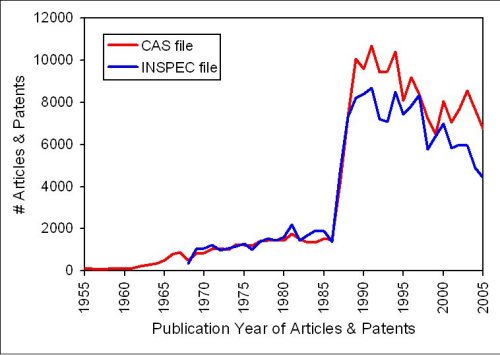
The new study was carried out by Andreas Barth from the FIZ Karlsruhe and Werner Marx from the Max Planck Institute for Solid-State Research in Stuttgart, who examined the number of papers listed in the INSPEC and Chemical Abstracts Service databases with words like “superconductivity” or “superconductor” used in the title or listed as “keywords”.

By plotting these as a function of time, they found that the numbers shot up rapidly in the late 1980s, following the unexpected discovery of high-temperature superconductors by Georg Bednorz and Alex Müller at IBM’s Zurich lab in 1986. The numbers in the INSPEC database reached a peak of about 8500 a year in 1990, but have been slowly falling and now stand at about 4400 (figure 1). A simple linear fit to the data reveals that the numbers will reach zero by 2010-2015.

The researchers say this stark finding applies to the entire field of high-temperature superconductivity, including work on the 30::000 or so “alkaline-earth rare-earth” copper-oxide superconducting compounds, such as the specific lanthanum-barium-copper-oxide material that Bednorz and Müller discovered (Figure 2). Research on magnesium diboride — a much simpler material that was unexpectedly found to be a superconductor in 2001 — will also fall to zero between 2010 and 2015.

The same is true for copper-oxide superconductors in which the rare-earth element (such as lanthanum) has been replaced by one like bismuth or mercury. Barth and Marx call this finding “astonishing” because these compounds have the highest known transition temperatures to date. HgBa2Ca2Cu3O8, for example, becomes superconducting when cooled to just 133K under ambient conditions and to 160 K under pressure.

Barth and Marx add, however, that an unexpected groundbreaking discovery could kick-start the field. This could include the discovery an entirely new type of superconductor, a material with a “significantly higher” transition temperature than anything measured to date, or a “satisfactory” theoretical explanation of the high-temperature superconductivity.

The German researchers give a number of reasons why the field is dying out. They blame the fall in papers on an absence of new discoveries and theoretical progress and say that researchers are increasingly being attracted to “more promising” fields, such as nanoscience. Indeed, they found that the scientific “impact” of papers on high-temperature superconductors — the total number of times that they are being cited by other papers — is decreasing “significantly faster” than the impact of papers on nanotubes.

Quantum back-action has a cooling effect

According to Newton’s third law, for every action there is always an equal and opposite reaction. With similar inevitability, this time in quantum physics, for every measurement there is always a perturbation of the object being measured. This phenomenon, known as quantum back-action, could now be put to practical use, say researchers at the University of Maryland.

The team, lead by Keith Schwab, electrostatically coupled a superconducting single-electron transistor (SSET) with a resonating silicon nitride beam (oscillating like a guitar string) by applying a voltage between them.

Since changes in the position of the beam altered the SSET conductivity, current measurements in the SSET (the ‘observer’) provided a probe of the resonator’s position (the ‘observed’). At the same time, the researchers found that intrinsic random charge fluctuations in the SSET lead to a back-action force which changed the frequency, position and damping rate of the resonator.

In a “counter-intuitive” development the team described how by applying a voltage at a value corresponding to a quantized energy state of the electrons passing through the SSET, they found that damping in the resonator mode causes a temperature drop from 550 mK to 300 mK. In this situation, the SSET became the absorber rather than the source of heat.

This finding, say the researchers, has opened up the possibility of using the quantum back-effect to cool down components of nanoscale mechanical devices.

The experiment was performed at the University of Maryland in the US, with the help of theoretical physicists at Nottingham and McGill Universities and Dartmouth College.

Superlens microscope gets up close

The resolution of conventional optical microscopes is restricted by near-field effects; as a result, they are unable to image objects below approximately a wavelength in size and this limits their use. This is because the near-field portion of the light — which contains the object’s sub-wavelength spatial details — decays or evanesces quickly with distance compared to the “far-field” portion, which is easily refocused by a conventional lens.

Scanning near-field optical microscopes (SNOMs) are able to probe beneath this limit, by operating in close proximity to the surface of the sample. This has, however, limited SNOMs to surface studies and (in for example the case of fragile biological samples) risked mechanical contact.

Now researchers at the Nanophotonics group at Germany’s Max Planck Institute for Biochemistry, working with physicists at the University of Texas, have obtained direct sub-wavelength images of objects by fitting a conventional SNOM with a superlens.

“We have demonstrated, for the first time, that the image created by a superlens can be recorded by an optical method instead of using lithographical recording, as reported previously,” lead researcher, Rainer Hillenbrand of the Max Planck Institute, told physicsweb.org. “Thanks to the superlens, near-field optical microscopy is no longer restricted to surface studies. It opens up new applications since the probe no longer has to be in such close proximity to the object.”

The experiment also provides further insight into how superlenses work: showing, for the first time, the amplitude and phase of the optical field distribution from a superlens and directly quantifying the resolution enhancement.

Possible applications cited by the team include the imaging of biological objects in their natural environment. In addition, an infrared superlens could find application in the semiconductor industry where it could probe metallic interconnects buried under layers of glass or other dielectrics.

The SiC superlens is 880 nm thick and comprises a 440nm SiC crystal sandwiched between two 220 nm thick SiO2 layers. The superlens was located between the tip of a scanning infrared SNOM and the objects, which consisted of a gold film patterned with holes of different diameters. The researchers carried out infrared illumination and detection from the same side of the superlens and found that the setup could resolve a 540 nm hole using light with a wavelength of about 11 μm (the hole being approximately one twentieth the size of the incident wavelength).

“We were able to image objects that could previously only be imaged if the tip of the near-field optical microscope (NSOM) was within 50 nm or so from the object. In our experiment, by using a superlens we increased the separation between the tip and the object to almost 1 μm,” Gennady Shvets, based at the University of Texas, told physicweb.org.

The researchers now want to develop thinner superlenses to increase the resolution and also apply the method to the visible light regime by using silver superlenses.

Bubbles collapse without weight

Cavitation is a problem in industry because the collapsing bubbles that form during this process focus energy to very small volumes, creating temperature “hotspots” and emitting liquid jets and shockwaves. Cavitation does, however, have a good side, being used to kill bacteria, destroy kidney stones and clean surfaces.

Recent studies have shown that the behaviour of single bubbles depends strongly on any nearby surfaces — for example, whether they collapse next to flat or curved rigid surfaces. Researchers are now keen to see how bubbles behave inside spherical drops of water and interact with closed spherical surfaces. Unfortunately, it is impossible to do this in the lab for centimetre-sized drops, because gravity forces the surface between the liquid and air to be flat.

Philippe Kobel from the EPFL in Lausanne, Switzerland, and co-workers have got round this problem by creating such bubbles in space. They put their experiment on board a special European Space Agency aircraft, which flew in parabolic arcs, climbing and falling to create near-weightless conditions within the aircraft for 20 seconds at a time.

The experiment involved slowly expelling the drops through a special tube and generating bubbles inside the drops by a spark discharge between two thin electrodes immersed in the drop. These microgravity conditions allowed them to create centimetre-sized spherical drops of water, which were then studied using a high-speed CCD camera.

Kobel’s team made several unusual findings. In particular, they discovered that a bubble that is formed not exactly in the centre of the drop — but to one side — collapses with toroidal symmetry and generates two liquid jets that escape from the drop in opposite directions. This is the first direct visualization of two bubble-induced jets escaping from a steady liquid volume.

The researchers have also studied the “mist” of tiny, sub-millimetre “microbubbles” that are often created within bubbles in cavitation experiment. They reckon these microbubbles are themselves cavities, created because the primary shock wave (emitted by the spark triggering the bubble growth) excites microscopic impurities and dissolved gas in the liquid.

The researchers have even been able to extend current theory to estimate shockwave energies and calculate bubble lifetimes in small liquid volumes that can appear in industrial systems. Their experiment may also cast light on spherical collapse and shock-wave phenomena in supernovae, as it provides a simplified situation of shockwaves propagating inside fluid spheres.

Spin Hall effect detected at room temperature

David Awschalom and colleagues at the Center for Spintronics and Computation at the University of California, Santa Barbara observed the current-induced spin-polarization of electrons and the spin Hall effect in thin surface layers of ZnSe.

Observations were made in the 10 to 295K temperature range using Kerr rotation (KR) spectroscopy. The team, which also included researchers from Pennsylvania State University, will report their findings in an upcoming issue of the journal Physical Review Letters.

The spin Hall effect was first observed in GaAs at 20K by Awschalom and Yuichiro Kato in 2004. It consists of a spin current flowing in a transverse direction to the charge current in a non-magnetic material and in the absence of an applied magnetic field. The result is a measurable accumulation of “spin up” and “spin down” electrons at opposite edges of the conducting channel.

The effect could be of use in the growing field of spintronics, in which the intrinsic spin of the electron (in addition to its electrical charge) is exploited in the development of logic devices. The spin Hall effect could provide a source of spin-polarized electrons for injection into semiconductor devices. Such electrons could carry information based on the state (up or down) of their spin polarization.

According to Awschalom, the unique advantage of using the spin Hall effect is that it does not require a magnetic field or magnetic materials to generate and separate spins in the solid state.

In this experiment, the spin Hall effect was observed in thin films (1.5 μm thick) of the semiconductor material ZnSe. At higher temperatures the researchers noticed a reduction in the spin Hall effect, the spin coherence time (how long electron spin states remain coherent) and the spin polarization. The spin polarization at 20K was about ten times stronger than at room temperature and the spin diffusion length decreased from 1.9 to 1.2 μm over the same temperature range.

The researchers are now working on ways to boost the spin polarization to levels where nearly all electrons are polarized. In previous GaAs experiments performed at Santa Barbara, one electron in 10 000 were spin-polarized by the spin Hall effect.

Copyright © 2026 by IOP Publishing Ltd and individual contributors