Earth-like planets form in the wake of giants

Giant migration is believed to be a very common phenomenon and some astronomers think that it suppresses the formation of Earth-like planets by either capturing protoplanetary material or causing the material to be ejected from the habitable zone. Instead, the simulations suggest that migration could further the creation of Earth-like planets by concentrating water and heavier materials into the habitable zone.

The process involves a large Jupiter-like planet forming some distance from a star and then migrating inwards. This takes it through a belt of protoplanetary material, which is coalescing into larger solid objects and ultimately planets like Earth. Astronomers are currently aware of at least 200 planetary systems containing giant planets – 40% of which may have undergone a migration. As a result, more than one third of all known planetary systems could include Earth-like planets.

Sean Raymond of the University of Colorado, Boulder and Avi Mandell of Pennsylvania State University simulated the migration of a Jupiter-sized planet through a disk containing 17 earth masses worth of protoplanetary material. The disk extended from 0.25 to 10 astronomical units (AU) from a star. Earth’s orbit is 1 AU from the Sun.

The migration process lasted 100 000 years, beginning with the giant at 5 AU and ending at 0.25 AU. The simulation covered a further 200 million years with the giant orbiting at 0.25 AU as a “Hot Jupiter”. Four simulations were performed and two resulted in the formation of a planet about the same size as Earth and orbiting within the habitable zone (0.8-1.5 AU) where life is possible. These planets have a much higher water content than Earth, and would have oceans several kilometres thick.

The simulations also resulted in the formation of other planets outside of the habitable zone, including so-called “Hot Earths”, which are much closer to the star than Earth is to the Sun. A Hot Earth was discovered by astronomers in 2005

Both NASA and the European Space Agency will be launching new space telescopes designed to search for Earth-like planets. The simulation results could help astronomers find suitable targets within known giant planet systems.

Superconducting qubits get entangled

In the weird world of quantum mecahnics, particles can be “entangled” so that they have a much closer relationship than allowed by classical physics. For instance, two photons can be created in an experiment such that if one is polarized in the vertical direction, then the other is always polarized horizontally. By measuring the polarization of one of the pair, we immediately know the state of the other, no matter how far apart they are.

This “spooky action at a distance”, which has no classical analogue, could allow multiple bits of information to be processed at the same time in a quantum computer. Such a device could therefore outperform a classical computer by many orders of magnitude. There are currently many rival ways of entangling particles, for example by trapping ions at ultra-low temperatures and manipulating their internal energy states with lasers

However, demonstrating entanglement is hard. In particular, the particles, or qubits, have to be sufficiently isolated from the environment so that the fragile entangled state exists for long enough to allow a calculation to be carried out. Various other conditions also have to be met — together known as the “DiVincenzo criteria” — such as being able to measure both qubits at the same time.

Now, however, a team from the University of California, Santa Barbara, has successfully entangled two superconducting qubits for the first time. Electrical circuits made from superconductors are promising candidates for a working quantum computer because they can be made from thin films using conventional microchip fabrication technology. Coupling can be achieved simply by electrical connections between qubits – far easier than the trapped ion approach, where ions need to be shuttled about so they can interact.

Matthias Steffen and colleagues at Santa Barbara were able to entangle two qubits, each made from a Josephson tunnel junction, that meet the DiVincenzo criteria completely with a precision of 87% of theoretical values. The researchers used a delicate method known as “quantum state tomography” to confirm the entanglement, whereby a series of different parameters are measured for the two particles and used to reconstruct the quantum state, much as image “slices” are captured and combined into a three-dimensional picture in tomographic medical imaging.

Although physicists have been able to entangle up to eight ions at the same time — whereas the present work entangles just two quibits — Steffen insists superconducting qubits are a viable approach towards quantum computing. “Substituting some of the materials in the fabrication process should translate to a straightforward improvement of our results and in the long run, continued materials research should also help improve qubit performance,” he says.

The work was done by Santa Barbara’s Quantum Computation research group, which is led by John Martinis.

Grand deuterium challenge unveiled

Deuterium — an isotope of hydrogen with an extra neutron — is a key substance in understanding how the elements were created during the first few minutes of the universe. This process, known as Big Bang nucleosynthesis, is believed to have fixed the ratio of deuterium to hydrogen (D/H) that we see in the universe today. It also created the primordial “baryonic soup”, consisting of light atoms from which stars emerged.

According to the Caltech researchers, the D/H ratio can be calculated by measuring how the CMB radiation was absorbed by the neutral gas that existed during the “cosmic dark ages”, which began roughly 400,00 years after the Big Bang. Hydrogen and deuterium absorb CMB photons at different wavelengths, and the technique would involve looking for tiny fluctuations in those absorptions caused by variations in the density of the two gases at different points in space. For example, regions of the Universe with a higher density of hydrogen atoms will absorb more CMB photons than regions of lower density.

Because the D/H ratio is very small, seeing the individual correlations between these wavelengths in a given pixel will not be possible, says Steven Furlanetto, who carried out the study with Kris Sigurdson. “However, if we average over many pixels on the sky it may be possible to see the overall correlation strength, and this number is simply proportional to D/H,” he adds.

Until now, cosmologists have only been able to determine the D/H ratio indirectly. They have done this by using the standard model for Big Bang nucleosynthesis together with constraints on the total density of the nuclei as measured from the CMB by satellites such as NASA’s Wilkinson Microwave Anisotropy Probe. The new technique would instead allow the ratio to be measured directly using radiotelescopes.

The Caltech team claims their technique would allow the primordial D/H ratio to be determined to an accuracy of better than 1%. This, in principle, would improve the constraints on the baryonic density of the Universe and could shed more light on the nature of non-baryonic dark matter. “The key advantage of our approach is that it’s direct and model-independent,” says Furlanetto.

Moreover, other direct measurements for D/H are all made after stars and galaxies have formed. “Since deuterium is destroyed by stars, our method of measuring deuterium before the stars formed is the only way to be 100% sure you are observing the primordial deuterium abundance,” adds Furlanetto

One of the main obstacles facing any experimentalist seeking to take up the challenge will be background noise. This interference comes from terrestrial sources, distortion from the ionosphere (which absorbs and refracts the cosmological signal) and other astronomical sources – such as the galactic synchrotron background.

“Beating down the noise and these huge backgrounds will require much more powerful telescopes and probably more sophisticated data analysis algorithms,” Furlanetto concludes.

NMR goes optical

Most NMR experiments involve placing a sample in a magnetic field, which encourages the spin of the nuclei to point in the same direction as the field. The frequency with which the spins wobble or “precess” about this direction provide useful information about the local molecular environment. But because the magnetic moment is too small to be detected individually, the spins are deliberately driven out of alignment by applying a radio-frequency pulse to a metal coil. As they return to equilibrium, the nuclei create a bulk magnetization that induces an oscillating electric current in the coil.

The new technique developed by Romalis and colleagues is completely different. Rather than measuring the frequency shifts of signals in an NMR spectrum, it involves shining a plane-polarized visible laser beam on a sample and measuring how the nuclear spins rotate the plane of polarziation of the beam. Romalis has been able to demonstrate the technique, which is known as nuclear-spin optical rotation (NSOR), for both liquid xenon and water.

There could be several advantages to the new technique. In particular, it works with small, tightly focused laser beams which could allow samples to be studied at micrometre resolution in real time. Obtaining even 100-micrometre resolution in Magnetic Resonance Imaging (MRI), in contrast, is difficult. The technique is also particularly suitable for heavy nuclei, which usually have poor spectra in traditional NMR. It could even be used to create three-dimensional maps of tissues because near-infrared light can penetrate into such material.

One problem with the technique is that it is currently not as sensitive as conventional NMR. It also only works for transparent samples.

Photonic crystals go magnetic

Photonic crystals are nanostructured materials in which periodic variations of some property – usually, the material’s electric permittivity – produce a “photonic band gap”. This affects how photons propagate through the material. This effect is similar to how a periodic potential in semiconductors affects the flow of electrons by defining allowed and forbidden energy bands. In particular, photons with wavelengths or energies in the photonic band gap cannot travel through the crystal, which allows scientists to control and manipulate the flow of light by introducing carefully selected defects.

Until now, all photonic crystals operating with visible light have worked by modifying a material’s electric permittivity – a measure of the extent to which a material concentrates electrostatic lines of flux. Although the same effects are expected for periodic modulations of the magnetic permeability (μ) – which is a measure of how a material responds to a magnetic field – all known natural substances have a μ of 1 for visible light. This means that researchers have not been able to make photonic crystals that operate through variations in the magnetic permeability.

Now, however, Linden and colleagues have found a way round this problem by using “metamaterials”. These are composite structures made from tiny rods, ensembles of metal rings and the like, in which the individual components act as “artificial atoms”. Metamaterials therefore have very different properties from their component parts, including values of μ not equal to 1.

In the current work, the researchers used pairs of gold wires a mere 220 nanometres wide and 100 micrometres long, separated by a 50 nanometre thick layer of magnesium fluoride, to create a one-dimensional periodic lattice of artificial “magnetic atoms”. This was then placed on a quartz-based slab, which acts as a waveguide to channel light along certain paths, to create a 1D “magnetic” photonic crystal.

“Our findings are a proof of principle for the concept of a magnetic photonic crystal,” says Linden. “However, there still is a long way till we can utilize it as a real-world application.”

The ability to use both electrical permittivity and magnetic permeability will give physicists more design freedom. It could even lead to new effects such as three-dimensional photonic bands – a prerequisite if photonic crystals are to fulfil their potential – made of stacks of one-dimensional magnetic photonic crystals. The team is now trying to fabricate 3D metamaterials based on its 1D structures.

Shelf life: Peter Woit


What are the three best popular-science books?

The Second Creation by Robert Crease and Charles Mann is the best popular book about the history of how the Standard Model of particle physics came to be, and Abraham Pais’ Inward Bound is another great account of the birth of modern physics. The End of Science by John Horgan is a very provocative, if extreme, thesis. He was perhaps the first popular-science writer to get the story of string theory right.

What science books are you currently reading?

I’m having one of my periodic attempts to keep up with the “loop quantum gravity” approach to the problem of quantizing gravity with Carlo Rovelli’s very readable Quantum Gravity. I’ve also started Out of the Crystal Maze by Lillian Hoddeson and co-authors. It is a history of solid-state physics, which is a field I would like to know more about, especially the theory of superconductivity.

What else are you reading?

The Baltic by Alan Palmer; my father was born in Riga and I’d like to learn some more about the history of this part of the world. I’ve just begun Henry Adams and the Making of America by Garry Wills; Adams was a historian and one of the more fascinating characters of 19th-century America.

Which popular-science book have you never read, but feel you ought to have tackled, and why?

The Eighth Day of Creation: Makers of the Revolution in Biology by Horace Freeland Judson – one really should know something about molecular biology these days, and all I’ve ever done is read James Watson’s The Double Helix, which is not enough.

• Woit’s book Not Even Wrong: The Failure of String Theory and the Continuing Challenge to Unify the Laws of Physics was published recently by Jonathan Cape (see “String theory gets knotted”)

New and newer

Stephen Hawking’s inaugural lecture as Lucasian Professor of Mathematics at Cambridge University in 1980 caused quite a stir. Its title – “Is the end in sight for theoretical physics?” – raised the prospect of a unified “theory of everything”. Hawking suggested that there was a good chance of resolving the remaining inconsistencies between the two big “theories of something” – quantum mechanics and general relativity – before the turn of the century.

My first impression on reading The New Physics for the Twenty-First Century, a collection of essays edited by science journalist Gordon Fraser, is that a theory of everything may still be attainable by the turn of the century. However, there is now 20 times more of everything in the universe than there was in the past century, 95% of which no-one has ever actually seen, or had even heard of until a few years ago – as summarized in articles by Wendy Freedman, Edward Kolb and Ronald Adler. Despite this, Michael Green describes amazing developments in string theory that could tie everything together, if one could just figure out which, if any, of the apparently infinite varieties of string theory applies to our world, and why.

The New Physics for the Twenty-First Century is the successor to The New Physics, edited by Paul Davies and published in 1989, which is still in print and well worth a read. Despite the cosmological conundrums painfully laid out in the new book, there is much good news in it for those of us still working on the 5% of everything that we can see. Since 1989 there has been a renewed and productive emphasis on uncovering the secrets of familiar systems in the domain of atomic, molecular and optical physics, and condensed matter viewed on the nanometre scale.

The signature themes of this modern research are quantum information and nanotechnology, represented by seven of the 19 articles in the new book, compared with four of 18 in the previous book. This shift reflects new tools for observation and control of nano-scale systems that have been developed over the past two decades, such as scanning-probe microscopy and laser cooling and trapping.

As for specific points of comparison, the two books have no editors or authors in common but both groups are eminent. The new book contains two articles co-authored by Nobel laureates, Claude Cohen-Tannoudji and William Phillips, and many others by acknowledged leaders of research fields, such as Artur Ekert, Anton Zeilinger and Yoseph Imry. A wide range of styles of presentation is displayed in the two books, ranging from Malcolm Longair’s extraordinary 105-page review of astrophysics in the 1989 book (containing material comparable to an academic review paper) to Henry Hall’s account of superfluids in the new book, which combines scientific erudition with poignant personal memoirs of key participants.

My impression is that the new book is more accessible to a general readership. To some extent this is down to the freshness of the technical material, but it also presents topics that can be usefully pondered by those with little background in physics – for example the articles on e-science, by Tony Hey and Ann Trefethen, and physics and society, by Ugo Amaldi. It gives one pause to think that when The New Physics was published in 1989 the arXiv.org preprint repository was unknown, but today it is one of the main vehicles of communication in physics and its mode of presentation has transformed scientific publishing. Amaldi’s article also evokes unpleasant memories of a period of notorious fraud in physics publications just a few years ago. I have yet to understand what motivates physics fraudsters since they seem certain to be exposed, as they were in these cases by the ordinary functioning of the peer-review process. Yet Amaldi’s essay raises interesting points about the social dynamics of scientific fraud.

The two books are well worth perusing in parallel. But to conclude with comments on the current book alone, it is written at a level that can be digested by eager undergraduates but will also be instructive to experienced physicists. It is lavishly produced and good value – several physicist colleagues have passed on unsolicited praise of the level of presentation. I also tried it out on an eminent retired chemist, who first learned physics as a canonical recitation of established facts. “Things sure have changed,” he said.

Indeed they have. Physics has accomplished much in 400 years, solving some of the hardest problems while revealing even harder ones. The message of The New Physics for the Twenty-first Century is that the most fundamental problems remain elusive, but the magnificent tools that have been developed during the past decade have opened up new vistas on subjects once thought to be familiar.

What’s in and what’s out

It is easy to obtain the 100 most common non-trivial words used in any book simply by going to amazon.com. This means you can compile a list of words that appear often in The New Physics for the Twenty-First Century but not in its predecessor.
What’s in: laser, molecule, membranes, string, neutrino, materials, information, standard, measurement, gravity
What’s out: proton, neutron, charge, colour, galaxies, strong, hole, equation, length, gravitational

Almost certain escape from a black hole

You wake up in a hospital bed feeling a little groggy but otherwise okay. All your bits and pieces seem to be present, but you have no idea why you are there. The last thing you remember was waking up in the morning in your own bed at home and looking out of your window to find nothing but a black void. To your dismay, you realized that overnight your house had been swallowed by a black hole – an object so dense that not even light can escape from it. You remember saying to yourself “uh oh” as you looked up to find that you were plunging directly towards the singularity at the centre of the hole, where the density of matter and energy become infinite and all known laws of physics break down. Then you remember beginning to feel queasy as the tidal forces induced by the intense gravitational field of the hole began to tear you apart.

Settling back into your hospital bed, you feel relieved that the whole episode was just a bad dream. But that still does not explain what you are doing there. Just then, a doctor comes to your rescue. “One of our space ambulances found a black hole that was evaporating,” she states. “In accordance with the Hippocratic oath, which requires us to help anyone who might have fallen into a black hole, we collected the radiation that was emitted as the hole evaporated. By carefully decoding the information contained in that radiation, we were able to reconstruct you in the state you were in before you were sucked into the singularity.”

“But that’s impossible!” you yell. “I thought nothing could escape from a black hole – not even light.”

While fictional, this futuristic scene serves to highlight of one of the most important questions in physics: can information escape the gravitational pull of a black hole? For almost two centuries people have thought the answer was “no”, but recent research has forced us to revise this view.

A chequered history

The idea that any object could be so dense that light cannot escape from it was proposed by the English clergyman John Michell in 1783. A decade later, the great French mathematician Marquis Pierre Simon de Laplace used Newton’s laws of gravitation to calculate just how dense a star would have to be for this to occur. If light is made of particles, Laplace reasoned, they could move at a velocity less than the escape velocity for the star. So, just like a rock thrown from the surface of the Earth, light could be insufficiently speedy to escape the star’s gravitational field. Then in the early 20th century, the German physicist Karl Schwarzschild used Einstein’s general theory of relativity to identify the point of no return beyond which nothing can ever escape the pull of gravity: the “event horizon”. In Einstein’s theory, space actually curves around to prevent light, or anything else, from escaping.

But in the 1970s, glimmerings began to emerge that suggested something might be able to escape from a black hole after all. These glimmerings arose from the study of quantum mechanics, the branch of physics that describes things at their smallest scales. In 1974 Stephen Hawking of Cambridge University in the UK, building on earlier work by Jacob Bekenstein at the Hebrew University of Jerusalem, showed that when you include quantum mechanics in the description of the quantum fields surrounding a black hole, the hole is not entirely black. Instead, it appears to radiate particles into its surroundings. These particles constitute what became known as Hawking radiation and, crucially, they demonstrated that a black hole can evaporate.

Hawking’s work was immediately seen as a major breakthrough, being the first precise application of quantum mechanics to black holes. Hawking originally said that the radiation emerging from a black hole was completely random and therefore contained no useful information about the stuff inside the hole. This led to a famous wager in 1997 between Hawking and Kip Thorne of Caltech on one side and John Preskill of Caltech on the other: Hawking’s view was that information could not escape, while Preskill bet that it could. Two years ago, however, Hawking conceded that he was wrong and paid up, offering Preskill an encyclopedia of baseball in accordance with the terms of the original bet!

A question then arises: if the radiation emitted by a black hole is random, how is it possible to recover the information encoded in it? Returning to your unfortunate predicament in a hospital bed, how were the medical staff able to reassemble your constituent electrons, protons and neutrons to retrieve you from the random particles emerging from the black hole?

Vacuum rules

In order to understand how information can escape from a black hole, we first need to know what causes a black hole to radiate in the first place. In quantum mechanics, empty space is not really empty at all but full of pairs of “virtual” particles that suddenly spring in and out of existence. The particles appear in pairs because the vacuum contains no electric charge. So if a virtual electron, which has a negative charge, appears, then it must do so in conjunction with its antiparticle – a positively charged, virtual positron. In quantum mechanics, such perfectly anticorrelated states are said to be entangled, which means that the state of one particle completely determines the state of the other.

Near the event horizon of a black hole, virtual particle–antiparticle pairs are being created all the time. Every now and then, half of one of those pairs falls into the hole and cannot get out to recombine with its partner. If the partner outside the hole has sufficiently high energy, it can escape the gravitational pull of the hole and thus create the illusion that the hole is radiating. Entanglement then demands that the partner that does not escape the black hole has negative energy. Because of Einstein’s relation between mass and energy, E = mc2, the negative-energy partner effectively has a negative mass, so when it falls into the hole it causes the mass of the hole to decrease.

As the black hole evaporates, what happens to the information that it contains? It has been known since the latter part of the 19th century that every elementary particle contains information. Information is measured in “bits”, which represent the distinction between two possibilities: yes or no, true or false, 0 or 1. Photons, for example, can be polarized such that their electric field oscillates vertically or horizontally. If we identify horizontal polarization with a “0” and vertical polarization with a “1”, the polarization of the photon registers a bit of information.

Hawking’s original mechanism suggested that no information about what is going on inside the hole escapes during the evaporation process. But that mechanism does not take into account what happens inside the hole. Beyond the event horizon both the original matter that formed the black hole, which hurtles inexorably to the singularity at its centre, and the in-falling, negative-energy Hawking radiation are present.

At first, you might think that what happens to the matter inside the black hole has nothing to do with the Hawking radiation that has already escaped. In 2003, however, Gary Horowitz of the Institute for Advanced Study in Princeton and Juan Maldacena of Harvard University showed that whether or not information escapes from the hole depends on what kind of weird quantum events happen inside the hole (J. High Energy Phys. 0402 008). In particular, they reasoned, it depends on what happens at the singularity.

Journey to the centre of nothing

The singularity at the centre of a black hole is a strange and extreme place, where the energy density is apparently infinite and where the known laws of physics are almost certain to break down. At the singularity, space–time essentially ceases to exist, and all the information and quanta that inhabit it must therefore cease to exist too. At first it might therefore seem that all bets are off at the singularity – how can we even speculate about what happens when the laws of physics break down?

Well, that depends on just how badly those laws break down. At the singularity, something (i.e. particles or information) turns into nothing (i.e. no space or no time). That sounds bizarre, but we already have some experience where something (Hawking radiation) arises out of nothing (the vacuum). When something arises out of nothing, the laws of conservation of charge, spin and energy imply that the things that arose are entangled particle–antiparticle pairs. But suppose that the same laws still hold for the reverse process, so that the only way that something can turn into nothing is if that something also consists of entangled particle–antiparticle pairs.

Next, suppose that a particle of the in-falling Hawking radiation meets up at the singularity with a particle of the matter that formed the black hole in the first place. Let us assume that the only way in which these two particles can turn into nothing is to be in an entangled state – that is, the particle of matter that formed the hole is the opposite of the particle of Hawking radiation with which it hits the singularity. That particle of Hawking radiation is itself the opposite of the particle of outgoing Hawking radiation with which it was created. But the opposite of the opposite is the same. In other words, the particle of matter that formed the hole and the particle of outgoing Hawking radiation must have exactly the same properties.

When Horowitz and Maldacena proposed this mechanism for escape from black holes, Preskill, along with Daniel Gottesman of the Perimeter Institute in Canada, raised doubts about whether it could work (J. High Energy Phys. 0403 026). The Horowitz–Maldacena mechanism, they pointed out, was fragile because it required that the state in which incoming matter and Hawking radiation are annihilated at the singularity takes a highly specific form. Earlier this year, however, the present author showed that entanglement-induced escape from a black hole is robust after all: almost every single bit of information escapes (Phys. Rev. Lett. 96 061302).

The reason for this robustness lies again in the counterintuitive properties of entanglement. Almost all quantum states are within half a bit of what is called their maximal entanglement: their pieces are highly correlated. Applied to the Horowitz–Maldacena mechanism, the ubiquitous nature of entanglement implies that for almost all possible states in which the incoming matter and Hawking radiation can be annihilated, almost all the information in the incoming matter escapes from the black hole, albeit in a processed form. So if you do ever find yourself lying in a hospital bed having just been rescued from a black hole, you can rest assured that the laws of physics do not in themselves prevent you from an almost full recovery.

Fanciful as the notion of escaping from a black hole might seem, it is conceivable that black-hole evaporation could be probed experimentally. Under certain circumstances it might be possible, for example, to create miniature black holes in particle accelerators such as the Large Hadron Collider at CERN. In this case, the amount of information that escapes from a black hole could be measured experimentally.

From a theoretical point of view, the intimate connection between the evaporation of a black hole and entanglement suggests that a solution to the outstanding problem of finding a quantum theory of gravity may be found in the burgeoning field of quantum information. Until such experimental and theoretical investigations have been performed, however, you might want to hold off from jumping into a black hole.

Burying climate change for good

The existence of climate change is no longer up for debate. The scientific consensus is that the Earth is warming due to human activity: the level of carbon dioxide – the principal “greenhouse gas” that traps solar radiation in the atmosphere – has risen by more than 50% since the industrial revolution (figure 1). Burning fossil fuels in power stations accounts for about 40% of all human carbon-dioxide generation, but with the insatiable demand for energy and desire for security of supply, many countries are sticking with coal and gas. Indeed, China has plans to build over 500 coal-fired power stations in the next 10 years, 100 more are planned in the US, while India intends to double its electricity-generating capacity by 2015.

If we continue down this road, humankind’s annual emissions of carbon dioxide (CO2) will double in the next 50 years. But computer simulations show that in order to stabilize the concentration of CO2 in the atmosphere by 2055, and thus prevent climate change from spiralling out of control, we must restrict emissions to the current level of 7 Gt of CO2 per year. Reducing the amount of energy we use is clearly the best solution, and is sure to be increasingly adopted as the price of energy rises. Meanwhile, there is a vigorous debate over the relative merits of renewable sources and nuclear power as ways of producing energy without releasing CO2.

But between reducing the demand for energy and making its supply more “green”, there is a third way. Carbon capture and storage (CCS) is a way of extracting the carbon dioxide generated from the burning of fossil fuels so that it cannot enter the biosphere. This could allow us to continue burning fossil fuels while minimizing the impact on climate change. There is already a working CCS scheme in Norway and a huge worldwide research and development effort in capture and storage technology. Ironically, one of the main commercial incentives for developing CCS is that “waste” carbon dioxide can be used to help extract oil more efficiently from depleted fields.

The ABC of CCS

Carbon capture and storage involves three stages: capturing the carbon dioxide, transporting it, and storing it permanently and safely. The most obvious approach to capturing carbon dioxide is to burn the fuel as normal and then chemically “scrub” the carbon dioxide out of the emissions – a technique that has been used for years in petrochemical plants. To do this the emissions are passed through two reaction towers in sequence: firstly an absorber, which contains droplets of a solvent such as monoethylamine (MEA) in which the CO2 dissolves; then a stripper, in which the MEA is recovered by heating the mixture to release concentrated CO2. The major advantage of this process is it can be retro-fitted to almost all existing fossil-fuel power plants, though at a significant cost.

An alternative method is to capture the carbon dioxide before combustion, by mixing the fossil fuel with steam and air to generate CO2 and hydrogen gas. The hydrogen can be collected and used as a clean fuel, both in power stations and in internal combustion engines – the other main source of greenhouse gases. There is also a third capture scheme whereby the fossil fuel is burnt in the presence of oxygen, producing almost pure CO2 and water, which are easy to separate. However, the higher temperature of combustion in oxygen presents major technical problems.

Once captured, transporting the carbon dioxide is relatively straightforward: we already transport gases in pipelines over thousands of kilometres. As long as any water is removed from it, carbon dioxide poses no particular mechanical or corrosion hazard and is much safer to transport than potentially explosive hydrocarbon gases. Storing the carbon dioxide underground in such a way that little finds its way back to the surface, however, is another matter.

Oil and gas have been trapped underground in hydrocarbon fields for tens of millions of years, so it is reasonable to assume that carbon dioxide injected into fields that we have already depleted will be contained for millennia. But if CCS is widely adopted, these fields will be filled within a few years, so we must also consider alternative underground repositories. By far the greatest capacity is offered by “saline aquifers” – underground reservoirs of water with a high salt content that makes them unsuitable for use as drinking water. The problem is that saline aquifers are not as well understood as hydrocarbon fields.

Encouragingly, we in the oil industry already have considerable experience of storing fluids underground. This is because many countries use depleted hydrocarbon fields and salt caverns to store surplus gas and oil produced in the summer for the high demand in the winter. In the US, for example, the Strategic Petroleum Reserve uses huge salt caverns along the Gulf Coast to store over 700 million barrels of crude oil – worth $50bn at current prices. A similar scheme operates in the UK, using depleted gas fields in the North Sea. Currently, however, European Union (EU) regulations on waste disposal prohibit the burial of carbon dioxide under the sea. But the UK and Norwegian governments are now working with the EU to modify these regulations to allow CCS.

Once a suitable site has been chosen, the mechanics of storing carbon dioxide are not too difficult – it just involves a few pipes, some injection wells and equipment to compress the carbon dioxide before it is stored. The main issue is to ensure that once injected, the carbon dioxide will not find its way back to the surface in any significant amounts. The most likely leak path is through wells, both active and abandoned. Furthermore, when water and carbon dioxide mix they form carbonic acid, so new sealing methods must be developed using cements that are resistant to this chemical attack. Long-term monitoring for leaks will be needed too – a responsibility that must be borne by governments since no commercial organization would take on such an open-ended commitment. While the lifespan of a typical oilfield is between 20 and 50 years, monitoring of CO2 leaks may be needed for millennia.

The main disincentive to wide-scale adoption of CCS is the expense. It is estimated that CCS will cost between $25 and $50 per tonne of CO2, of which 80% is the cost of capture. To get a feel for this, consider that each tonne of coal burned produces about three tonnes of CO2, and that a typical 1 GW coal-fired power station produces 6 million tonnes of CO2 per year. The energy required to operate an effective capture scheme at a power plant would therefore significantly reduce its operating efficiency. Although it should be possible to reduce the cost of CCS by 20–30% in the next decade, further savings will depend on the adoption of the technology together with on-going research and development. In the mean time, a tax on carbon-dioxide emissions would certainly make CCS more economically attractive.

Storage at Sleipner

Carbon storage is not just wishful thinking: there is already a successful CCS scheme operating in Norway. The Sleipner gas field was discovered in 1974 and is one of the largest gas producers in the Norwegian sector of the North Sea. However, the gas in the field contains 4–10% carbon dioxide, while typically less than 2.5% is required to ensure the gas will burn properly. In almost any other country, the oil company would have removed the excess carbon dioxide from the gas and vented it into the atmosphere. But under Norway’s environmental laws, Statoil – the state oil company – would have faced an annual carbon-tax bill of about $50m for this option. Instead, Statoil researchers investigated storing the carbon dioxide in a nearby geological formation: the saline aquifer called Utsira that lies above the Sleipner field. Utsira is a massive formation: at some 500 km long, 50 km wide and 200 m thick, it has the capacity to store 100 times the annual volume of carbon dioxide emitted from all Europe’s power stations.

After several years of experimental study, a commercial plant was installed on the Sleipner platform in time for the start of production in 1996. Two MEA absorber columns were installed that reduce the CO2 content of the gas to 2.25%. Four compressors – standard items of equipment on most oil and gas platforms – are then used to pressurize the nearly pure excess carbon dioxide to 80 × 105 Pa, before it is injected into the base of the Utsira aquifer 1 km below. The high pressure is significant because carbon dioxide has a “critical point” at a temperature of 31 °C and a pressure of 74 × 105 Pa, beyond which it exists in a “supercritical fluid” state with a density of about 700 kg m–3. Since injecting CO2 will raise the pressure in the aquifer, the CO2 remains in this fluid state.

Although much denser than a gas, the supercritical CO2 is less dense than water so it will start to migrate upwards. Understanding where and how this fluid moves is the main issue for ensuring long-term capture, and one that is being addressed by teams of geologists, geophysicists and reservoir engineers employed by oil companies to unravel the structure of underground reservoirs.

One method is to generate sound waves at the surface and use them to probe the rock strata beneath. Some fraction of the wave is reflected at the interfaces between the different strata, and the energy received back at the surface can be measured with very sensitive microphones. The resulting data may run to terabytes, and processing it using fast-Fourier-transform techniques requires massive computing power. Indeed, a one-off seismic survey like this typically costs $3–5m, but can only resolve underground objects bigger than about 25 m. By also drilling a test well we can accurately measure a cross-section through the rock strata, which can be input into the computer model to allow researchers to develop a more precise 3D picture of the reservoir.

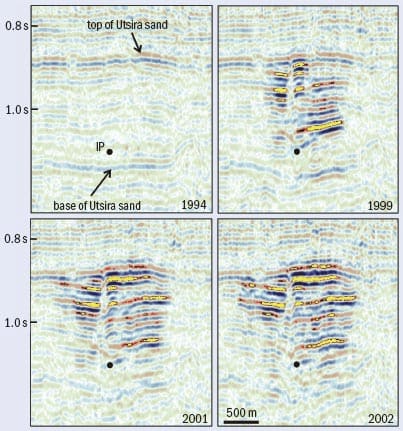
At Utsira, Statoil has carried out regular seismic surveys in order to reveal the movement of the injected carbon dioxide over time, clearly showing that it travels upwards and spreads laterally (figure 2). The seismic monitoring is supplemented by other measurements, including those of CO2 detectors on the sea floor and measurements of local gravity. Working with researchers at the University of San Diego and the US Department of Energy, Statoil scientists have developed a gravimeter that can monitor changes in the Earth’s gravitational field of 1 part in 200 million, as well as small vertical movements of the sea floor. Additional monitoring is employed at the wells, where leaks are most likely. When the injection of CO2 finally stops, the wells will be plugged using CO2-resistant cements.

A major concern when storing carbon dioxide in saline aquifers is that the natural seal at the top of the formation – a layer of non-porous rock – could be broken during CO2 injection. So far, this seal has remained intact at Utsira, but if it does eventually break, the hope is that a series of shallower seals will minimize the amount of carbon dioxide that will escape. Furthermore, it is believed that over a period of about 1000 years carbon dioxide will dissolve in the brine inside the aquifer, producing a CO2–brine mixture that is heavier than unsaturated brine. The saturated brine will thus move downwards, helping to lock the carbon dioxide away. Longer term still, on geological timescales, it is believed that chemical reactions will turn the CO2–brine mixture into a mineral, locking the carbon dioxide permanently into the Earth’s crust.

Since the Sleipner project began 10 years ago, around 1 Mt of carbon dioxide per year has been injected into Utsira. The initial investment was $80m, most of which was the cost of the capture equipment. Statoil has given no indication of the operating costs, but it is planning a similar project at the Snøhvit field in the far north of the Norwegian Sea. Here the gas produced will be brought onshore via a 143 km pipeline for processing on a small island just outside Hammerfest, from where some 700,000 t of carbon dioxide per year will be sent back to a saline aquifer lying about 60 m below Snøhvit. Statoil is also working together with BP and the Algerian state oil company Sonatrach on a third major project at the In-Salah field in the Algerian desert.

Recovering oil

The Sleipner project only made financial sense because of the Norwegian government’s environmental taxation. However, there is a positive commercial incentive for CCS too: injecting carbon dioxide can help to extract the remaining oil from a flagging oilfield through a process known as enhanced oil recovery. In fact, this procedure, whereby the addition of CO2 makes the oil less viscous, is already used at many oilfields worldwide and much of the carbon dioxide used remains permanently trapped in the pores in the reservoir rock.

Enhanced oil recovery (EOR) is only necessary towards the end of an oilfield’s lifespan. In the initial phase of this lifespan – the “primary” recovery period – high pressure drives fluid into the oil wells and retains hydrocarbon gas dissolved in the oil. This gas swells the volume of the oil and acts as a lubricant, thereby reducing the oil’s viscosity. But as production continues and the pressure falls, the gas bubbles out of solution and the oil becomes more viscous. At this stage, called secondary recovery, water is usually injected to help maintain the reservoir pressure and also act like a piston, pushing the viscous oil ahead of it towards the wells.

As the fraction of water in the fluid rises, so does its density, and hence the pressure needed to get the fluid to flow to the surface increases – requiring the use of pumps, such as the familiar nodding donkeys. Furthermore, the water will eventually find a layer of permeable rock that allows it to bypass the oil and flow quickly between the injectors and wells. The fraction of water in the fluid produced can reach 95% or more, which is separated from the 5% of oil at the surface and then re-injected – an inefficient cycle known as the “washing-machine effect”. A well-managed secondary-recovery scheme can recover 50% of the original oil in the field, but the 50% left behind is a valuable resource, which is where tertiary production, or EOR, comes in.

Carbon-dioxide injection is just one of many EOR methods. Others include using water-soluble polymers that make the injected water more viscous, detergents that reduce the oil’s tendency to adhere to the reservoir rock, or the injection of hot pressurized steam. But for typical crude oils in fields that have previously been flooded with water, carbon-dioxide EOR is usually the best technique. When mixed with depleted oil, CO2 mimics the hydrocarbon gas that was originally dissolved in the oil by re-swelling it and thus reducing its viscosity. Some of the injected carbon dioxide returns to the surface along with the oil, but as CO2 is a major cost of the scheme it is usually stripped out and re-injected.

Carbon-dioxide injection has been widely used for over 30 years throughout the Permian Basin of western Texas and eastern New Mexico, and is responsible for about 15% of the one million barrels of oil per day produced in this region. A network of pipelines over 2000 km long carries the CO2 at a typical cost of $1–2 per tonne per 100 miles with no significant effect on the environment.

As oil prices rise, carbon-dioxide EOR projects are being pursued in many other areas of the US. Most of the carbon dioxide used comes from natural reservoirs of almost pure CO2, but industrial producers are now realizing that their waste CO2 is a valuable resource, valued at $15 to $20 per tonne. For example, carbon dioxide produced at the Great Plains Synfuels coal-gasification plant in North Dakota is now being transported 330 km across the Canadian border, where the oil company EnCana is using it to extend the life of the Weyburn oilfield by 25 years. During this time, the firm hopes the field will produce an additional 130 million barrels of oil and sequester 14 Mt of CO2, equivalent to a year’s emissions from 3.2 million cars.

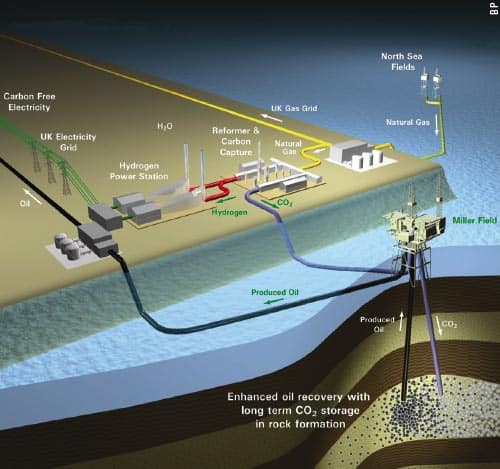
So far, no-one has tried carbon-dioxide EOR offshore, but that will change in the near future. BP is planning a project called Decarbonised Fuel-1 in the UK sector of the North Sea that will combine pre-combustion CO2 capture with EOR (figure 3). North Sea gas will be converted to hydrogen and CO2, with the hydrogen to be burnt in a power station on the Aberdeenshire coast and the CO2 sent offshore to be used to recover oil from the near-depleted Miller field. The plan is to begin injection around the end of this decade for a period of about 20 years.

Meanwhile, Statoil and Shell have announced plans to use CO2 in the Norwegian Sea. Statoil has long been refused permission to build a gas-fired power station in Norway because its emissions would break the government’s Kyoto commitments. By employing CCS in the form of EOR, Statoil can now go ahead and build the plant. If the EU carbon-trading initiative – a scheme that caps nations’ carbon emissions but allows them to buy unused credit from other countries – is given real financial teeth, this may kick-start a similar set of projects across the continent.

The thin end of the wedge

Carbon capture and storage is an extremely active area for researchers from academia, government and industry. Chemical engineers and materials scientists are working to improve capture techniques and reduce their cost; while geologists, geophysicists and engineers are investigating storage methods. Speculative research is even being carried out into storing carbon dioxide in the deep oceans as a heavy CO2–brine mixture that would sink to the seabed. Much of the funding for research and development is being provided by governments eager to meet international agreements like Kyoto, while the rest comes from oil companies and power utilities. For the oil companies there is clear short-term financial gain from EOR, but in the long term there could be a whole new business in sequestering other people’s carbon dioxide. Meanwhile, the threat of carbon-emission taxes is the main driver for fossil-fuel-burning power companies.

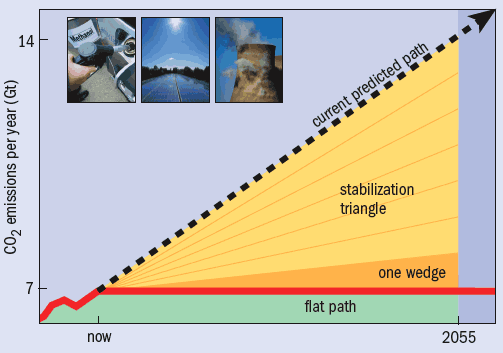
The possible contribution of CCS to minimizing climate change has recently been put into perspective by the Carbon Mitigation Initiative (CMI) at Princeton University, a joint project between Princeton, BP and Ford aimed at finding solutions to global warming. It has proposed a simple way to visualize the target of maintaining CO2 emissions at 7 Gt per year rather than the increase to 14 Gt per year predicted by 2055. The target is divided into seven “stabilization wedges”, each of which contribute a saving of 1 Gt per year by 2055 (figure 4). Different schemes can then be compared using the number of wedges they would save. For example, using the most efficient lighting, electrical appliances and insulation in all new and existing buildings would save two wedges. On the supply side, a 50-fold increase in wind power would save one wedge, as would tripling current nuclear power production.

In comparison, carbon capture could save a wedge if it was introduced at coal-fired power stations producing 800 GW of power – equivalent to about two-thirds of today’s production. And if the production of hydrogen from coal and gas as a clean fuel takes off as it is expected to, another wedge could be saved by using CCS at the hydrogen-production plants. Putting these options into practice would require a massive expansion in storage – equivalent to 3500 Sleipner projects per wedge saved – but with the US, China and India heading for a huge increase in new coal-fired power stations, CCS might just be the option that could save the planet.

At a Glance: Carbon capture and storage

  • The Earth is warming due to humankind’s activity, and the biggest contribution is emissions of carbon dioxide from power stations
  • Carbon dioxide emitted by burning fossil fuels can be captured and stored underground, ensuring that it will not reach the atmosphere
  • A large-scale carbon capture and storage scheme is already operating in the North Sea, storing millions of tonnes of carbon dioxide per year
  • Carbon dioxide is already used to help recover oil from depleted oilfields, providing a commercial incentive for oil companies to adopt carbon capture and storage
  • Storing the carbon dioxide from 800 coal-fired power stations would reduce carbon emissions by the same amount as increasing wind power 50-fold

More about: Carbon capture and storage

www.ipcc.ch – Intergovernmental Panel on Climate Change report on “Carbon dioxide capture and storage”
www.princeton.edu/~cmi/resources/stabwedge.htm – introduction to the Carbon Mitigation Initiative’s idea of stabilization wedges


Science as drama

In his famous 1962 book The Two Cultures, the British physicist and novelist C P Snow recounts meeting people who think they are cultured yet are totally unembarrassed by their lack of scientific knowledge. But to Snow, asking if someone can describe the second law of thermodynamics is like asking if they have ever read a work of Shakespeare. It should be equally shameful for any cultured person to say “no” to either question.

My thoughts on this subject are even more radical. I think that the second law of thermodynamics is actually Shakespearean. Its story involves high drama and powerful characters, and it has fundamental implications for human life. This is no better illustrated than through the story of Ludwig Boltzmann, whose life ended abruptly 100 years ago this month when he committed suicide after suffering from depression (see pp34–37).

Yet the full plot is richer still. Here I offer a tentative summary of how one version of that drama might go.

Prologue: Europe, late 1700s

A new mechanics is on the horizon. The steam engine and other technologies have drawn attention to phenomena relating to heat. This “force” cannot be explained by Newtonian pushes and pulls, and it is only crudely framed by the “caloric” theory that treats heat as an invisible and weightless fluid. Several scientists – whose motives range from curiosity and professional duty to pride and ambition – decide to investigate this force. However, they are soon embroiled in a conflict about conservation and conversion, the resolution of which will be the key to the new mechanics.

Act one: Paris and Munich

Scene 1: Paris, 1803
Lazare Carnot (1753–1823), a military engineer whose particular talent is uncovering and eliminating administrative and mechanical inefficiency, publishes a treatise on water-powered machines. Follow the water, he writes: the maximum power depends on how great a distance it falls. Track down and eradicate sources of waste to make your machine work better.

But Carnot cannot pursue these insights. He is forced back to military duties; then he seduces a woman betrothed to another and ends up in jail. He is released as the French Revolution begins and joins the revolutionaries, who nickname him “Organizer of Victory” for the innovative way he mobilizes, trains and supplies troops.

Scene 2: Munich, 1797–1798
Count Rumford (1753–1814), soldier of fortune and amateur scientist, is in Munich, momentarily between courtships of wealthy widows. Keen to reveal the mysteries of heat, he puts a six-pound brass cannon in a vat of water, inserts a drill bit driven by a winch, hitches up a horse to the winch, and finds that enough heat has been generated through the drilling to boil the water in two-and-a-half hours. He concludes that the caloric theory – formulated by Antoine Lavoisier, a former husband of one of Rumford’s mistresses – is wrong, because the heat is obviously a form of motion coming from the friction between the bit and the cannon.

Reporting his findings to the Royal Society, Rumford implicitly likens himself to Newton, saying that the laws of heat are as important as those of gravity. But Rumford is no Newton; his arguments are not entirely convincing and he has no overall theory. Yet his idea that one can quantitatively compare motive forces lays the ground for the looming conflict between conservation and conversion.

Act two: Paris, Manchester and Oxford

Scene 1: Paris, 1823
Sadi Carnot (1796–1832), a quiet engineer, returns from his father Lazare’s deathbed. Determined to carry on his father’s work, he composes Reflections on the Motive Power of Heat. Follow the heat, he writes. Caloric in a heat engine, like water in a water engine, is conserved as it flows from hot to cold, and the maximum power depends on the magnitude of the temperature drop. The most efficient machine is modelled by an ideal cycle of expansion and compression in which the engine works reversibly, the caloric being conserved in going back and forth between the two temperature endpoints with no heat loss due to friction or dissipation. This is a key insight, but Reflections is almost totally ignored. He publishes nothing more, then catches scarlet fever, brain fever and cholera, before dying, aged 36, in an asylum.

Scene 2: Manchester, 1840s
James Prescott Joule (1818–1889), who as a youth built a home lab in his parents’ brewery, obtains highly accurate measurements of various conversions of heat and electrical, mechanical and chemical energy into each other, such as the temperature increase that rotating paddles produce in water by friction. Joule determines the mechanical equivalent of heat: 772 foot-pounds of work lead to a 1 °F rise in 29 cubic inches of water.

Scene 3: Oxford, 1847
The conflict between conservation and conversion comes to a head. Young William Thomson (1824–1907), later known as Lord Kelvin, travels to Paris, where this polymathic, trilingual and far-sighted son of a mathematics professor reads the only published comment on Sadi Carnot’s work. He is so impressed that he tries to find a copy of the original but he fails to do so. He then attends a conference in Oxford, where he hears Joule speak. Joule is treated badly by the conference organizers, who instructed him to be brief. But Joule’s words jolt Kelvin. How can heat be converted into something else when Carnot’s spectacular work relies on the amount of caloric in an engine being constant? Joule’s work must have “great flaws” and Kelvin resolves to find them.

Act three: 1840s-1860s

Scene 1: Kelvin gets another jolt
Kelvin reads a paper by German physicist Rudolf Clausius (1822–1888), who has also noticed the Carnot–Joule conflict. Clausius says that it arises because two principles are in play. One involves the conservation of something (not heat, soon called energy) in exchanges of heat and mechanical work. The other involves the conversion of heat into energy, and the property that heat cannot flow spontaneously from colder to warmer bodies. Kelvin, inspired, studies the new heat-mechanics and in 1854 names it “thermodynamics” after the Greek for heat and force.

Some heat in every engine, Kelvin writes, “is irrevocably lost to man, and therefore ‘wasted’ although not annihilated” – his version of the second of Clausius’s two principles. In 1865 Clausius names the tendency of the energy-transfer process to occur spontaneously as “entropy”, from the Greek for transformation. In 1867 Kelvin and his collaborator Peter Tait compose their massive Treatise on Natural Philosophy, the Principia of thermodynamics. In 1872 Clausius formulates what become known as the two laws of thermodynamics: “The energy of the world is constant; the entropy of the world strives toward a maximum.”

Scene 2: Priority battles erupt
In 1847 German physician Robert Mayer (1814–1878) reads a paper by Joule on the conversion of heat into mechanical energy and says that he discovered it first. Some seven years previously, as a doctor on a Dutch ship in the East Indies, Mayer had realized that the unusual redness of the blood of the crew, meaning that it was oxygen-rich, was due to the fact that the human metabolism is slower in the tropics. This inspired him to write a paper on the interchangeability of mechanical work and heat – but it had been treated as a crackpot letter by the journal that he sent it to. After not receiving a reply, Mayer revised the paper and published it elsewhere.

Depressed when Joule disputes his priority, Mayer flings himself out a third-floor window of his house and is later committed to an asylum in a straitjacket. Meanwhile, another German physicist, Hermann von Helmholtz (1821–1894), also becomes a contender for discovering the first law, thanks to an 1847 paper on “the conservation of force”. Tait and Clausius battle over who discovered various principles of thermodynamics, slinging mud at each other in journals and books.

Act four: 1870s

Scene 1: Another battle breaks out, this time over which of the two laws is more important
The first law (conservation of heat/energy) implies that processes are reversible, while the second (heat cannot be completely turned back into work) implies irreversibility, or what is later known as the “arrow of time”. The problem comes to a head with Clausius’s speciality – the kinetic theory of gases. For a gas is a macroscopic object, governed by irreversible processes and the second law, yet is made of microscopic atoms and molecules that obey reversible Newtonian principles.

James Clerk Maxwell (1831–1879) concludes that the second law is statistical, applying not to individual atoms or molecules but only to massive numbers of them. But it is still not clear why reversibility is not possible – why heat cannot sometimes flow from a cold to a hot body. Maxwell demonstrates this point with a thought experiment involving a tiny creature (or “demon”, in Kelvin’s mocking term) that opens and shuts a little door to make slightly faster atoms flow from a cold to a hot space.

Scene 2: Graz, 1870s
Ludwig Boltzmann (1844–1906) extends Maxwell’s work, proving the second law in a novel way that addresses how entropy increases with time. But Kelvin and others criticize it for not having explained the relation between the second law and the first: if big systems are made of little reversible systems, why are big systems not sometimes reversible?

In 1877 Boltzmann replies that, when a big state corresponds to many equally probable little states, its probability is related to the number of little states. This all but forces big states to evolve in the direction of its more probable states. An explicitly probabilistic interpretation of entropy, it proves the centrality of irreversibility to thermodynamics. Newton’s laws plus objects made of myriads of pieces plus the laws of probability equals the arrow of time. On large scales, you play dice, and statistics rule. But Boltzmann became vulnerable to depression late in life, and in 1906, on vacation near Trieste, he hangs himself while his wife and daughter are out swimming.

Act five: 1890s

Scene 1: Berlin, early 1890s
Physicist Wilhelm Wien (1864–1928), an introvert who is repeatedly thwarted in his attempts to become a farmer like his parents, extends Boltzmann’s ideas about the second law of thermodynamics and produces a law mapping radiation’s dependence on temperature. Wien’s law says that the energy emitted increases with temperature, though the increase is not equally distributed across all wavelengths but shifts towards shorter ones.

Scene 2: Berlin, late 1890s
Max Planck (1858–1947), a reluctant revolutionary, tries his hand at reconciling the two laws of thermodynamics, revising Boltzmann’s work and reformulating Wien’s law – hoping to tie all of the loose ends of thermodynamics, statistical mechanics and electromagnetic theory together. But the neat package comes at a cost. In 1900, to make the law fit experimental data on black-body radiation, he is forced to introduce a new constant, now called Planck’s constant.

Neither he nor anyone else realizes that, in completing the foundations of thermodynamics, they have given birth to an entirely new conception of energy and arrived at the threshold of a radically new world.

In 1900 Kelvin warns that there are two clouds shadowing the 19th-century theory of heat and light: one is the difficulty of conceiving the Earth as moving through ether; the other understanding black-body radiation. These two clouds develop into 20th-century hurricanes: relativity and quantum mechanics. But these are dramas for another time.

The critical point

Other versions may differ in detail and scope, and number and size of roles, but this drama, I claim, is Shakespearean. The cast involves powerful human beings who dedicate themselves, body and soul, to their work. The action unfolds as these individuals are troubled – sometimes deeply and tragically – by differences between what they find and their expectations, and try to make greater sense of the world by intervening in it. Has any drama ever had such finely drawn and unique characters, or more profoundly reshaped our understanding of ourselves and the world?

Copyright © 2026 by IOP Publishing Ltd and individual contributors