A sensitive approach to frescoes

Frescoes are works of art that were directly painted onto walls during the Renaissance, which ran from the late 1300s to the start of the 17th century. Found in churches and chapels across Italy, these paintings are continually being attacked by moisture from the atmosphere and salts in the plaster of the walls. Knowing the moisture and salt content is important for restorers so that they can decide on the best way of saving a painting. Until now, however, this was only possible by drilling holes through the painting to obtain a sample of the plaster.

Now, Olmi and co-workers claim to have found a solution to this problem. Their technique involves scanning the surface of the painting with a portable sensor device that fires microwaves at the wall. If water and salt molecules are present in the plaster, they absorb the microwaves and send a signal to a computer that then determines how much moisture or salt is present. This is calculated by measuring the material’s dielectric constant, (a material’s ability to store electrostatic energy), which changes depending on the content of the plaster. The tool is called SUSI (sensore di umidita e salinita integrato), — that is, an “integrated sensor for humidity and salinity”.

The scientists have tested their technique on the Paradise Wall frescoes in the Santa Maria Maddalena de Pazzi chapel and the frescoes in the cloisters of St Antonino at the Convent of St Mark, both in Florence. “We have also started to refine the device for use on other types of art,” says Olmi. “For example, we have used SUSI to measure the humidity and salt content of the famous Robbiane ceramics in the sanctuary of La Verna in Arezzo. However, paintings and old parchment are too thin for the device at the moment and we will need to refine it before we can use it on these kinds of works.”

The researchers have also patented their measuring device.
Superconducting wire breaks record

Superconductors are materials that lose their electrical resistance when cooled below a certain temperature. Most superconductors have transition temperatures of just a few Kelvin, but in the mid-1980s a new class of high-temperature superconductors with transition temperatures of up to 100K was discovered. These high-temperature “cuprate” superconductors conduct electricity without resistance simply by cooling them with liquid nitrogen.

First-generation HTS wires — made from bismuth, strontium, calcium copper oxide (BSCCO) — have been on the market for some time and can carry up to 100 times the current in standard copper wire of the same size. But because these wires cost more than 100 times as much to make, they have not been a huge success in the marketplace.

Second-generation wires, first invented by researchers in Japan and the US over 10 years ago, have been more promising. Unfortunately, YBCO is not an easy material to work with because it forms an array of grains as it is deposited on a substrate, the boundaries between which have to line up exactly so that pairs of electrons can flow from one grain to the next.

American Superconductor has now been able to make ribbon-shaped YBCO wires that are 100 metres long and just 4-mm wide. It made them by depositing YBCO onto a substrate of nickel alloy, which has highly aligned grains that the YBCO grains can in turn follow. The firms says its wires can carry a current of up to 140 Amperes when cooled with liquid nitrogen — about 150 times as much as a standard copper wire of the same dimension. “Just one of these wires would be able to carry enough power to serve the needs of approximately 1000 homes,” says Alex Malozemoff, the firm’s chief technical officer.

The new wires could be used for power transmission and distribution cables, propulsion motors, power regulators and fault current limiters as well as in prototype power cables, maglev trains and MRI. The company says it has already shipped nearly 3000 metres of the new wire to its customers this year and expects to scale up production to 10,000 metres by the end of 2007.

Laser could create dark-matter particles

The proposed experiment at DESY follows the discovery earlier this year by the PVLAS collaboration in Italy that the polarization of a light beam through a vacuum can be rotated by setting up a magnetic field in the vacuum. According to quantum mechanics, vacuums are full of activity, with particle–antiparticle pairs continually being created and destroyed within them. Magnetic fields interact with these particles and disturb the vacuum, causing light to twist as it passes through. The PVLAS results cannot, however, be explained by standard quantum theory. This has led some scientists to hypothesize that a fraction of the photons in the experiment were converted to axion-like particles.

In the DESY experiment, the laser beam would be sent through a vacuum in the presence of a magnetic field and then into a wall. The idea is that a fraction of the laser photons will transform into the new particles, which then pass through the wall because they interact so weakly with other matter. Another magnetic field located on the other side of the wall will then transform some of these new particles back into photons – apparently regenerating photons out of nothing (arXiv.org/abs/hep-ex/0606058). Ringwald and colleagues plan to run an initial experiment towards the end of 2006, and then, if they do discover axions, carry out a second experiment to investigate the detailed properties of the particle in autumn 2007.

PVLAS spokesman Giovanni Cantatore of the University of Trieste in Italy is impressed with the DESY plans. “The proposed set-up is not limited to checking the PVLAS results, but potentially can cover a large portion of the free parameter space for axion-like particles,” he says.

Organic transistors act as sensors

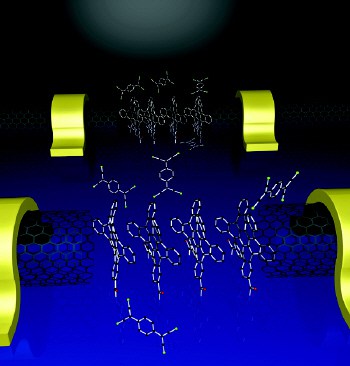
Nuckolls’ device consists of a silicon substrate on which a single-walled metallic carbon nanotube has been grown using chemical vapour deposition. The tube is then cut in half using an ultrafine lithographic technique, leaving a very small gap of 2 to 6 nm. Large metal pads are then attached to the other ends of the nanotube to act as the source and drain of the transistor, with the silicon surface acting as the gate. When a voltage is applied to the electrodes, a current flows between the source and drain (figure 1).

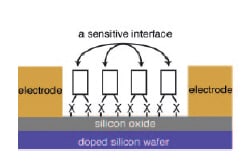
Nuckolls and co-workers then self-assembled a layer of polycyclic aromatic hydrocarbons, just one molecule thick, between the source and drain. The hydrocarbons arrange themselves in a line between the ends of the nanotube (figure 2). Since the electrical conductivity of the molecules depends on the local chemical environment, the device can be used as a sensor.

For example, when the device was exposed to electron-deficient molecules such as tetracyanoquinodimethane (TCNQ), the conductivity of the hydrocarbons was found to increase so much that the current passing through the transistor goes up by an order of magnitude. This produced a clear electrical signal that could be easily measured. Although the scientists are not entirely sure why the conductivity changes, they think the TCNQ probably acts a dopant by accepting π-electrons through charge transfer between the electron-deficient TCNQ and the electron-rich hydrocarbons. They also say the device could be used to detect chemicals in air or even be immersed in liquids.

New look for graphene

Graphene — a novel type of material with good electrical properties — can be made by rubbing tiny pieces of its precursor, graphite, against a hard surface to detach flakes of the carbon material. However, this is not an easy process because the individual sheets tend to clump together. Moreover, graphite, is soft and flaky and so does not have the high mechanical strength of carbon nanotubes.

One way of making graphene more useful is to embed the graphene in a polymer matrix. However, this has not been easy because the individual sheets attract each other so strongly that they cannot be properly dispersed in a polymer solution. Rodney Ruoff at Northwestern University in Illinois and colleagues have now devised a new technique to overcome these problems.

The team began by converting graphite into graphite oxide in an aqueous solution. This familiar process adds oxygen-based chemical groups to the graphite surface and leads to the bulk graphite being completely separated into single sheets. The sheets remain separate because they repel each other thanks to the oxygen-based chemical groups, which have an excess negative charge.

The researchers then “tuned” the surface of the graphite by adding certain chemical gropus so that it disperses in solvents routinely used to dissolve polymers. In this way, different polymers can be added to the solvent-graphite oxide mixture to make a composite material. The solvent is eventually removed to leave just the well-dispersed graphene sheets and polymer.

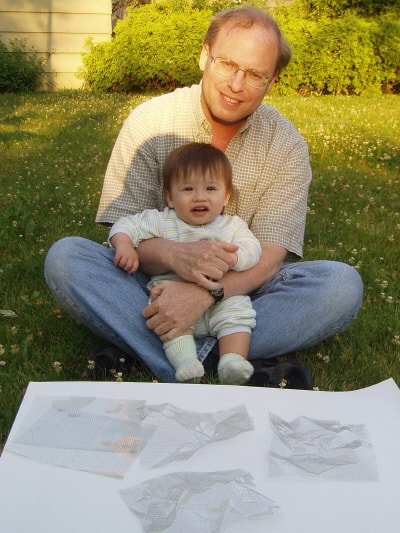
Using electron microscopy, Ruoff and co-workers observed that the polystyrene-graphene composite resembles a block of ice containing pieces of crumpled paper (figure 1). He believes the new material, which is light but stiff and tough, could be used to make fuselages for aircraft, as well as in electronics and potentially in paints and coatings.

Physicists solve pebble mystery

Most attempts to describe the shape of a pebble have involved measuring the “aspect ratios” — that is, the ratio of the longest to the shortest axis — of pebbles. However, such methods cannot distinguish one shape from another and do not give geologists any idea about the erosion processes that led to the creation of the pebble. Geologists are interested in such processes because it would let them work out if, say, a layer of rock containing that pebble was formed from a lake, a river, an ocean shore or a desert.

In their experiment, the France-US team simulated erosion in the lab with artificial pebbles made of 5-mm thick slabs of clay that had been moulded into various shapes, such as squares, triangles and other polygons. The researchers took photos of these pebbles and looked at how the shape of the pebbles changed as they tumbled around in a spinning metal pan. They found that once the corners had been eroded away, the pebble reached a nearly round shape that progressively got smaller in size. Moreover, the final shapes of all the pebbles were similar and therefore only depend on the erosion process itself say the scientists.

The team then calculated the distribution of curvatures around the circumference of each eroded pebble. They then plotted this distribution as a graph and found that it followed a nearly Gaussian, or bell-shaped, curve. Pebbles are unlike regular objects such as spheres, which have an equal curvature over the entire surface.

According to group member Carlos Marques from the University of Strasbourg, he and his colleagues have now found a mathematical tool that can “decode” flat pebble shapes and link these to the erosion process the pebbles underwent — regardless of what shape they originally had.

Towards frictionless nanomachines

Friction is a big problem in nanosized devices because they have huge surface-to-volume ratios, which means that their surfaces quickly wear out and seize up. Traditional lubricants are useless in such machines because they become thick and sticky when confined in such tiny enclosed spaces. Scientists therefore need to learn how to conquer friction if nano- and microscale devices are ever to become a commercial reality.

In the Swiss experiment, Anisoara Socoliuc of the University of Basel in Switzerland and colleagues formed a contact between a sharp silicon tip and an atomically flat surface made of sodium chloride. When the salt crystal is moved, the tip sticks and slips in a series of instabilities. However, when the researchers applied a sinusoidally varying tensile force between the tip and the crystal, the instabilities were surpressed, reducing friction by more than a 100 fold (Science 313 207). This is because the varying force reduces the peaks and troughs in the potential-energy landscape between the tip and the surface.

In the other experiment, Jeong Young Park and co-workers at the Lawrence Berkeley National Laboratory in California dragged a microscope tip over a silicon substrate that has well defined n- and p-doped regions (Science 313 186). They found that applying a voltage of +4V to the surface doubled the amount of friction in the p-doped region. Although friction went up, not down, the researchers say the effect could still be a useful control mechanism in real nanoscale devices, where it is easy to apply voltages of this size. However, the team does not know why the increase occurs.

Singing to the tune of sand

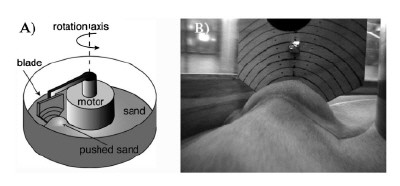
Singing dunes are one of the most puzzling and impressive natural phenomena. The sounds produced can be heard up to 10 kilometres away and resemble a drum, a low-flying jet or even an organ.. The sounds can be as loud as 105 decibels and have frequencies between about 65 and 110 Hertz depending on where the sand comes from. Using sand shipped from the Ghord Lahmar region in Morocco to their lab, Douady and colleagues found they could produce notes from the sand simply by pushing the sand grains together by hand or using a metal blade (figure 1). This means that the sounds are nothing to do with the dune itself but are produced by the motions of the sand grains — not from the entire dune resonating.

According to Douady, what happens when sand avalanches is that the grains bump over each other at different frequencies and set up standing waves in the flowing sand layer. These waves then reinforce one another and make the layer vibrate. Moreover, only a thin layer of between about two to three centimetres is needed to set up this resonance.

The CNRS team also found that the sand grains have to be moving at or above a speed of 0.45 metres per second before they can emit a sound. The researchers confirmed this finding by carrying out velocity measurements directly on a singing dune in the region of Morocco where their sand had come from. The team also found that the sound emitted depends on the surface state of the grains. Grains that sing are round with a smooth coating of silica gel, while grains that are wet or don’t have this layer do not emit a sound.

Shedding light on biomaterials

Alwin Kienle and Raimund Hibst at the University of Ulm came to the surprising conclusion that light can be guided by scattering by looking at how laser light scatters off the faces of cubes of dentin varying in thickness from 20 microns to 1 mm. Using an optical microscope, the researchers observed that almost all of the light was transmitted from one of the faces perpendicular to the first face but that very little light was transmitted from the other faces (figure 1).

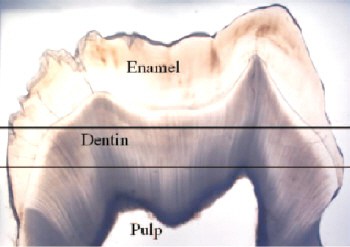
According to the team, this anisotropic light propagation is due to multiple scattering from the microstructure of dentin, which is made up of “tubules” — cylindrical channels that run from the pulp to the enamel-dentin junction in a tooth (figure 2). The team confirmed this result by studying exactly how the light was transmitted using a CCD camera and comparing these measurements to computer simulations of light propagation through dentin.

“This light-guiding effect could be important for therapeutic and diagnostic applications of light in medicine because many tissues exhibit a similar elongated, cylindrical microstructure as dentin — for example, muscle, skin, tendon, bone, enamel and ligaments,” explains Kienle. He also thinks that this effect could be seen in biomaterials other than human tissue. For example, nature could be using it as an ‘inexpensive’ way to harvest light in seeds, leaves, or plants. Kienle believes the effect could even be used to focus sunlilght and generate solar power.

Are you reading the news?

Physicists like Barabási are interested in studying the World Wide Web because it is an example of a “complex network”, with a topology that changes as new documents and links are continually added. His team pictures a typical news web site as a series of circular blobs, or “nodes”, each of which corresponds to an individual news story, with a line joining each node if the two stories are connected by a hyperlink (see figure). The area of each blob is proportional to the logarithm of the number of visits to each document.

Their model reveals that a typical news site has a relatively stable “skeleton” — corresponding to the overall organization of the site — along with nodes (that is, actual stories) that are only temporarily linked to the main structure before being deleted from the site or not linked any more. In this sense, the network resembles a biological cell’s regulatory network, whose “wiring” can change rapidly during a cell cycle. It is also a bit like social networks: we each have a relatively stable core network of friends and acquaintances but the number of people we interact with can vary drastically from one day to the next.

To get a fuller understanding of such networks, Barabási and colleagues decided to study the visiting patterns on a popular Hungarian news and entertainment portal (origo.hu). Thanks to automatically assigned “cookies”, the scientists were able to reconstruct the browsing history of about 250,000 visitors to the site over the course of a month.

The researchers found that the documents belonging to the skeleton of the website receive an approximately constant stream of visitors, which means that the cumulative number of visitors accessing these documents increases linearly in time. In contrast, the news documents receive the most hits directly after their release, and decrease with time. Thus, the cumulative numbers of visits here reach saturation after just a few days.

Barabasi’s team calculated the “half-life” of a news document, which corresponds to the period in which half of all visitors that eventually access it have visited. The researchers found that the overall half-life distribution follows a power law, which indicates that most news items have a very short lifetime, although a few continue to be accessed well beyond this period. The average half-life of a news item is just 36 hours, or one and a half days after it is released. While this is short, it is longer than predicted by simple exponential models, which assume that web page browsing is less random than it actually is.

The short life of a news item — combined with random visiting patterns of readers — implies that people could miss a significant fraction of news by not visiting the portal when a new document is first displayed, which is why publishers like to provide e-mail news alerts. The results also show that people read a particular web page not just because it looks interesting but because it can be accessed easily.

Although the average half-life varies for different types of sites, the decay laws identified are likely to be generic because they do not depend on content, but are manly determined by a user’s visiting and browsing patterns.

“Such quantitative approaches to online media not only offer a better understanding of information access, but could have important commercial applications as well – from better portal design to understanding information diffusion, flow, and marketing in the online world,” say the researchers.

Copyright © 2026 by IOP Publishing Ltd and individual contributors