Extinction gets synchronized

Scientists now know that over 99% of the species that ever existed on Earth have already gone extinct. Dinosaurs, for example, are thought to have been wiped out around 65 million years ago when an asteroid hit our planet. However, such global extinctions remain strange: intuition tells us that isolated communities of a species should survive, but this is not the case.

Now, Ravindra Amritkar of the Physical Research Laboratory in Ahmedabad in India and Govindan Rangarajan at the Indian Institute of Science in Bangalore have tried to shed light on this puzzle. The researchers analysed existing data on populations of voles that had been preyed upon. This data was obtained in a Norwegian survey in 2000, which looked at the fate of 481 voles in different locations that had been tagged with a radio-marker. By measuring the growth rates of these populations, these results showed that the predators had a “synchronising” influence on the voles (that is, the growth rates of voles in different places began to decline in step).

Amritkar and Rangarajan then used techniques from nonlinear dynamics to simulate future behaviour and concluded that, provided there is a common forcing, separated communities of a species will synchronise together before becoming extinct. The synchronising mechanism can be likened to two grandfather clocks falling into step though subtle vibrations in the floorboards, say the researchers. These vibrations link the two clocks so they tick in phase.

Finally, the Indian scientists calculated that the likelihood of a species becoming extinct can be expressed numerically using a single parameter, which is part of a quadratic equation in the new model. The other terms in the equation refer to the population of a species, the external forcing that interacts with the populations in different locations, and the interactions between the organisms themselves. If this parameter is greater than zero, the species will die out and if it is less than zero, the species will survive. Although there are many reasons for this, one important factor is competition between animals in a species: if the animals compete, then the value of the parameter is likely to be more than zero but if the animals cooperate, it is likely to be less than zero.

Amritkar and Rangarajan say they could test for the value of this parameter in an experiment in which food is progressively taken away from a confined population of voles (or other animals, like insects). “We would then observe whether the synchronisation persists and whether the extinction is simultaneous,” they say.

Giant “starshade” could reveal new exoplanets

While more than 175 extrasolar planets have been found in the last 11 years, only two of them have ever been observed directly — by the infrared light that they emit. Extrasolar planets are very difficult to detect because the light coming from them is swamped by that of their parent star. One solution is to place a light-blocking shield called a “coronagraph” inside a telescope — a technique that is routinely used to study our Sun. However, the wave nature of light leads to diffraction and some starlight “bleeds” around the edge of the shield, which swamps the image of any surrounding planets.

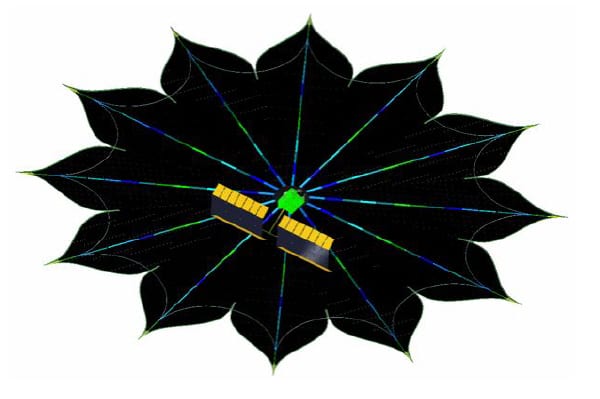
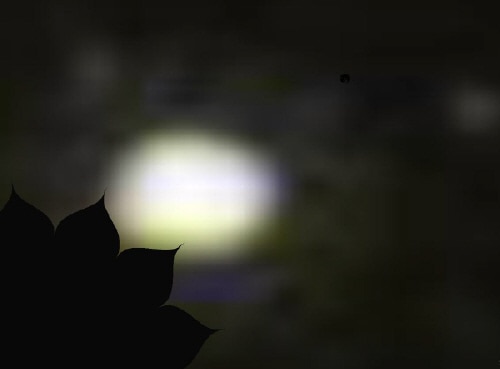
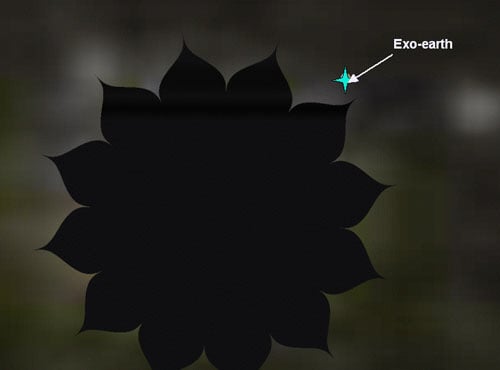
Cash has now proposed a new method that places the shield outside the telescope. His technique completely blocks the light coming from a star, therefore allowing surrounding planets to be seen (figures 1 & 4). Cash calculates that a flower-shaped shield about 30 to 50 metres across would allow Earth-sized planets around stars 30 or more light years away to be seen with existing or planned space telescopes (like the James Webb Telescope, for instance).

The telescope and starshade — dubbed the New Worlds Observer — would be launched into space together into an orbit about one million kilometres from Earth, with the telescope trailing thousands of kilometres behind the starshade. Scientists would be able to remotely control the starshade, opening and closing it as well as moving it into the lines of sight of nearby stars thought to harbour planets using “thrusters” (figures 2 & 3).

“We would use the starshade as a giant hand to suppress the light emanating from a central star by a factor of about 10 billion,” says Cash. The starshade could even allow astronomers to identify features like oceans and continents on the exoplanets as well as the presence of molecules like oxygen and methane using back-up spectroscopy measurements. This could potentially provide the first evidence of life outside our Solar System, says Cash.

The New Worlds Observer design received $400,000 in funding last October by NASA’s Institute for Advanced Concepts.

The retirement problem for physicists

I have, on more than one occasion, needed to discuss an issue with an elderly physicist in his 80s or 90s. When I call him at home, the person who answers the phone is puzzled. “He’s still in the office, of course,” they reply.

Physicists, I have found, do not like the thought of retiring. What’s the point? They have interesting colleagues. They find their work exciting. And physicists feel that they still have valuable experience that they can impart to others.

But having staff who do not want to retire can be a problem for institutions anxious to make way for young blood and cheaper salaries. One increasingly popular solution has been for universities to create special “retirement communities” for their staff. There are now more than 60 such facilities across the US, with the most expensive to date having been built at a cost of $425m by the Hyatt Corporation on land owned by Stanford University in Palo Alto, California.

However, universities that sponsor such communities are not being entirely altruistic, for these centres are a terrific way to maintain contact with alumni and hence potential donors.

Of special interest to physicists is a retirement community that was set up near Cornell University in Ithaca, New York, in 1996. Known as “Kendal at Ithaca”, it has been home to the now-deceased Nobel laureate Hans Bethe, as well as the accelerator physicist Robert Wilson and numerous other scientists and engineers. The joke around town is that the best physics department in Ithaca is at Kendal.

Senior class

Kendal at Ithaca was built partly thanks to Dale Corson, a physicist and former president of Cornell, who in the 1940s had set up what would later become the Sandia National Laboratories. The idea for a retirement community at Cornell emerged in 1990 when Corson, along with the widow of another physics colleague, convened a meeting of several people who all agreed that such a community was needed.

“None of us knew anything about retirement communities,” Corson recalls, “and we had to do a lot of research.” The group set up a committee, led by Corson, to take the idea forward. It discovered that the best developer for their purpose was the Kendal Corporation – an organization that seeks to help people to maintain the values and standards of Quakerism as they get older. It mainly does this by sponsoring a network of independent, not-for-profit retirement centres with a strong emphasis on community life. The corporation takes its name from the town of Kendal in northwest England, where George Fox, the founder of Quakerism, made many of his original converts. (Kendal was also the birthplace of the renowned astrophysicist Arthur Eddington, a Quaker and a pacifist.)

In 1991, when Corson contacted Kendal, the corporation had already built or planned about half a dozen communities. Its first facility was opened in 1973 outside Philadelphia in Pennsylvania, drawing many members from nearby Swarthmore College. Corson’s group obtained a 110 acre site two miles from Cornell and, after battling various New York State planning regulations, work began on the retirement community in 1994. Meanwhile, Corson developed a list of prospective residents by contacting thousands of Cornell alumni.

When the community opened in 1996, it had attracted the interest of many physicists – thanks in part to Corson’s professional acquaintances, and to a number of prominent Cornell physicists who were soon to retire. Apart from Bethe and Wilson, those who moved in included nuclear physicist Boyce McDaniel, particle physicist Kenneth Greisen and synchrotron-radiation pioneer Paul Hartman.

Today Kendal has about 340 residents, who either live independently or with the assistance of nursing staff. Most of its members worked at Cornell at some point during their careers, and about half of these are former professors. Many still have offices at Cornell – a bus runs from the site to the university – and some even have labs and funding. Other Kendal residents do voluntary work at Cornell or at one of the local libraries or science museums.

Kendal’s intellectual atmosphere is vigorous, with more than 40 clubs and programmes created and managed by the residents themselves. Afternoon talks are held twice a week and there is an evening lecture series once a week. Bethe himself gave three lectures to his fellow residents, described as wonderful by physicists who heard them.

There is a library staffed by professional librarians with books donated by residents, including several shelves of books written by Kendal residents themselves. Jack Oliver, former chairman of the Cornell geology department and a pioneer of plate tectonics, runs a film series. Corson, a semi-professional photographer, donated his darkroom equipment to the facility.

I recently gave a talk at Kendal on the life and career of Robert Oppenheimer. On the way to the auditorium I passed a gallery exhibiting pre-Columbian artifacts belonging to a resident. The technician in the auditorium was a former particle physicist. The discussion afterwards was spirited – one person in the audience had Oppenheimer on his dissertation committee, while several others had worked with him at Berkeley and Los Alamos.

The critical point

On my visit to Kendal, I asked several physicists what had attracted them there. Some mentioned the desire for proximity to former colleagues, others the opportunities to stay involved. As one told me, “What draws all the physicists to Kendal is all the physicists at Kendal.”

Kendal at Ithaca is a partial answer to several vexing problems: how to tap the knowledge and experience of older scientists at minimal cost, and how to keep them engaged. It also helps to realize the Kendal Corporation’s goal of fostering strong community life among retirees, thanks to the presence of so many residents from similar scientific disciplines. It allows elderly scientists to continue to develop and contribute, even alongside increasing care needs and the limitations that aging inevitably imposes.

Hollywood physics

I have always wanted to be a physicist, but little did I know what a glamorous and exciting profession I was entering. If the movies are to be believed, my fellow physicists are not just smart people. They are also courageous, often saving the world even at grave personal risk; generous, freely giving their valuable research results to humanity; and handsome or beautiful to boot. Do I really mean beautiful? Yes, because the physicists who loom large in the film world – male or female, heroes or villains – are often presented as extremely attractive people. And, if one is to believe the movies, physics is also full of thrilling new results such as cold fusion and the ability to manipulate quantum reality by our very thoughts.

I know all this because I have spent the last year, glassy-eyed in front of a monitor, analysing dozens of films for a forthcoming book about science in the cinema. Much of my viewing has involved alien creatures, destructive asteroids and berserk robots, as most movie physics appears in the form of science fiction. Indeed, this genre has contributed nine of the 20 biggest films by sales worldwide; chief among them is Star Wars: Episode I – The Phantom Menace (1999), which took a staggering $920m at the box office.

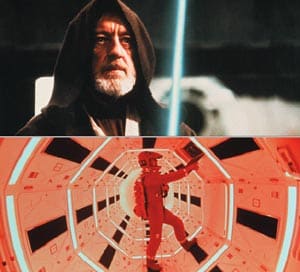
Although my diet of films has involved many mad scientists and much misrepresented science, there are actually quite a few good science-fiction movies out there. These include 2001: A Space Odyssey (1968) and Star Wars (1977), which were among seven science-fiction entries in a list of the 100 best US films compiled by the American Film Institute in 1998. Science also appears in biographical films (or “biopics” in Hollywood jargon) of eminent scientists, as well as in documentary or semi-documentary films; none of these, however, do anywhere near as well at the box office as your average science-fiction blockbuster.

Some academic commentators have examined the cultural meaning of science-fiction films, notably Vivian Sobchack in her classic 1987 work Screening Space: The American Science Fiction Film. But how are scientists portrayed in the movies? And how accurate is the science on the screen?

From zeros to heroes

Scientists first appeared in the movies in George Méliè’s 1902 production Le voyage dans la lune (Voyage to the Moon), where a collection of bearded astronomers cannons off to the Moon à la Jules Verne. Other landmark films to have shown scientists – not always in a favourable light – include Fritz Lang’s seminal Metropolis (1927), which features the wild-eyed, wild-haired C A Rotwang (Rudolf Klein-Rogge). Every bit as mad as the infamous Dr Frankenstein, Rotwang creates life not by stitching corpses together, but as an engineering project. He builds an electrically animated, machine-like, yet sexy female robot to replace the woman he loved and lost, all of which suggests he could do with a good therapist.

It would be nice to think that cinematic portrayals of physical scientists have become less negative since Rotwang’s early appearance. However, the reality is mixed, with ups and downs that reflect ongoing changes to science and its role in society. For instance, when humanity faced global nuclear disaster during the Cold War, physicists were seen by some as evil wizards who brought nuclear weapons into the world. Later, as ideas like clean fusion power began to seep into the popular consciousness, physicists were instead increasingly depicted as saviours.

Since Rotwang’s day, there have been at least 60 feature films featuring physical scientists and their research. Marie Curie and her husband Pierre (Greer Garson and Walter Pidgeon) appeared early on, in Madame Curie (1943). Like other biopics of the era, the film made the protagonists unrealistically good looking and emphasized their heroic qualities, although it did show some insights into scientific life not often found in fictional stories. Indeed, given the need to encourage more women to study science, the issue of how female physicists are portrayed in films remains pertinent even today (see “Women in the movies”).

Physics in film really hit its stride in 1950 with Destination Moon, a movie about the first rocket ship to go to the Moon. Scientifically accurate in its treatment of spaceflight, the film was to initiate a string of movies that constitute a golden age of science-fiction cinema. By then physics had entered the public psyche following the development of atomic bombs, radar and rockets during the Second World War, and – spurred further by a growing interest in spaceflight and technology – physicists appeared in several classic films of the 1950s.

In addition to the rocket scientists in Destination Moon, there is Nobel laureate Arthur Carrington (Robert Cornthwaite), a veteran of the Bikini atomic-bomb tests, who faces an alien invader at an Arctic research station in The Thing From Another World (1951). That year also saw the release of The Day the Earth Stood Still, in which universally respected theoretical physicist and Einstein look-alike Jacob Barnhardt (Sam Jaffe) helps alien visitor Klaatu warn Earth to be careful with its nuclear weapons. Meanwhile, The War of the Worlds from 1953 sees nuclear and astrophysicist Clayton Forrester (Gene Barry) fighting invading Martians.

Not all fictional physicists in that post-Hiroshima era were depicted in a flattering light though. In The Thing From Another World, Carrington is portrayed as an arrogant and obsessive individual who is devoted to searching for scientific knowledge, even at the cost of human life. When he presents nuclear fission as a glory of science, a bystander comments sarcastically, “Yes, and that sure made the world happy, didn’t it?”.

Another physicist to appear in a less than positive light is Julian Osborne (Fred Astaire) in the 1959 movie On the Beach. The film depicts a nuclear war that has wiped out humanity except for a remnant in Australia, which will soon succumb to fallout. Asked who is responsible, Osborne replies “Einstein!” and expresses dismay at having worked on nuclear weapons. Another example is Stanley Kubrick’s subversive comedy Dr. Strangelove (1964), where Peter Sellers plays the chief US weapons scientist. He appears far from upset about the fact that millions of people could die following the launch of a nuclear war by a demented US Air Force general. There have also been several films that have drawn directly on the dramatic story of the Manhattan atomic-bomb project. The documentary The Day After Trinity (1981) featured footage of Robert Oppenheimer, while Fat Man and Little Boy (1989) presented Oppenheimer, Enrico Fermi and other scientists in a fictionalized story about Los Alamos and the atomic bomb.

With new fears awakened in the public’s mind by developments in biology – cloning, pandemic diseases, exotic viruses and biological weapons – the villains have become the bioscientists, in films like The Boys from Brazil (1978), Outbreak (1995) and The Island (2005). Meanwhile, some physicists are now even depicted as helping humanity. For example, in The Manhattan Project (1986), physicist John Mathewson (John Lithgow) abandons his method for making weapons-grade plutonium using laser separation after seeing how badly the government treats teenage scientific genius Paul Stephens (Christopher Collet). And in Chain Reaction (1996) and The Saint (1997), physicists and an electrochemist develop limitless, non-polluting fusion power and give the technology freely to the world.

Physical scientists have also appeared in the many movies about natural calamities, notably asteroid impacts. The first of these was When Worlds Collide (1951), in which astronomer Cole Hendron (Larry Keating) tracks an incoming object that will smash the Earth to bits, and is instrumental in building a spaceship to save part of humanity. The idea was revived in Meteor (1979), which teams a profane ex-NASA space scientist (Sean Connery) with a hard-drinking Soviet weapons physicist (Brian Keith), both of whom remain heroically at their posts to destroy an incoming rock with nuclear-tipped missiles. The scenario popped up yet again in the 1998 movies Deep Impact and Armageddon. In 1997 Starship Troopers came up with a different twist: this time, hostile insect-like aliens called the Arachnids throw a rock from space that kills millions and wipes out the city of Buenos Aires.

Getting the science straight

All these films illustrate a fundamental pattern for movie science. Rarely is the central scientific concept utterly incorrect, but filmmakers are obviously more interested in creating entertaining stories that sell tickets than in presenting a lesson in elementary physics. They also know that scenes of scientists at a lab bench do not generally make for gripping movie moments. Indeed, the need for drama often pushes the basic scientific idea to the limits of possibility and beyond. To fit within the constraints of a two-hour film and maintain narrative drive, events may also be speeded up and supporting details may be omitted or just plain wrong.

Some films, like Dante’s Peak (1997), do rather well. Indeed, a branch of the Association for Women Geoscientists awarded it a B+ to A– rating for the correctness of its science. It features handsome vulcanologist Harry Dalton (Pierce Brosnan) warning a town in the Pacific Northwest that its neighbouring dormant volcano is about to blow. When it does, Harry is on hand to save a family to which he has become attached, even at risk to himself.

The Day After Tomorrow (2004) – one of a number of films to tackle climate change – is not bad either. It features climatologist Jack Hall (Dennis Quaid) who confirms the warming trend and predicts a counterintuitive outcome: as polar ice melts, fresh water will enter the North Atlantic, disrupting the enormous current that carries heat northwards from equatorial regions and so triggering a new ice age. Although this ice age unrealistically descends in a matter of days, the idea that warming can cool parts of our planet is sound science.

Hall’s heroism in sticking to his scientific guns and going on a remarkable cold-weather trek to rescue his teenage son is overdone, but real physicists will understand – though maybe not applaud – Hall’s immersion in his work, which at one point threatens his relationship with his family. That intense commitment to science is one feature of the scientific mindset that is often accurately portrayed in science-fiction movies, which are not known for much depth of characterization.

Other films built around a nub of sound science include Meteor, Deep Impact and Armageddon, which all envisage various objects colliding with the Earth. Such an event is not out of the question: two years ago asteroid 2004 FH came within 40 000 km of the Earth, and large space objects have hit our planet on other occasions. One created the 1.2 km wide Barringer Crater in Arizona. Another, some 10 km across, landed near the Yucatan peninsula 65 million years ago and kicked up enough dust to seriously affect the world’s climate, which is thought to have wiped out the dinosaurs.

Indeed, the size and speed of the colliding objects in Meteor, Deep Impact and Armageddon jibe well with the destruction they cause. But contrary to the films, the chances that a random rock will hit a big city is tiny. These movies also ignore the fact that we currently know of only one object with even a remote possibility of hitting the Earth: asteroid 1950 DA, with a 1 in 300 chance of smashing into us on 16 March 2880.

Another film that fails in the details, despite its use of a physics concept, is Starship Troopers. It has a real-life parallel in a US Air Force programme nicknamed “Rods from God”, in which dense metal rods would be launched from above the Earth to hit targets with a similar impact to that of a tactical nuclear device. Such rods would not have to be big: after all, the rock that created the Barringer Crater was just 50 m wide yet had the impact of a 10-20 megatonne hydrogen bomb.

However, the rock that destroys Buenos Aires in Starship Troopers is launched by aliens from their own distant solar system. As that can be no closer than the nearest star, Alpha Centauri, audiences are asked to believe that the aliens can hit a city-size target at a distance of four light-years or more. Since it would take decades for an object to reach Earth from that distance – even one travelling at a sizeable fraction of the speed of light – the Arachnids would be well advised to find a different weapon.

Volcano (1997) is even further off beam. It features an erupting cone suddenly growing out of the La Brea tar pits in the heart of Los Angeles, a site where fissures in the Earth’s crust allow crude oil to seep to the surface and deposit pools of thick liquid tar. Fortunately, geologist Amy Barnes (Anne Heche) helps find ways to cool and divert the lava flow. The problem is that the film blames the San Andreas fault for causing the brand new volcano, even though this particular type of fault can only produce earthquakes.

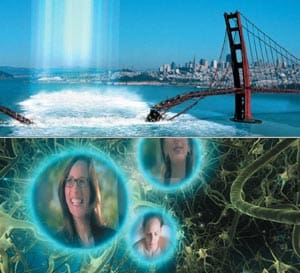
A special place in the annals of bad physics, however, goes to The Core (2003). It features geophysicist Josh Keyes (Aaron Eckhart), who finds that the Earth’s rotating iron core has screeched to a halt, thereby threatening the whole planet. Along with three other physicists – experts in materials, lasers, ultrasound and nuclear weapons – Keyes builds the Virgil, a vehicle that cuts its way down through rock and magma to the Earth’s core. There the scientific team saves the planet by setting off hydrogen bombs that restore the Earth’s spin. After a scene where Josh uses a peach to correctly illustrate the inner structure of the Earth, virtually every other scientific fact and activity in the movie is completely wrong. For example, the scientists in the film tell us that the Virgil is built from a magic material that gets stronger at higher temperatures; they blame the microwave radiation in the universe for melting the Golden Gate bridge; and use non-directional hydrogen-bomb blasts to impart spin to the core.

What the #$*!

But these triumphs of drama over scientific reality are not in the same class as what was done to quantum physics in the movie What the #$*! Do We (K)now!? (2004), or What the Bleep for short – a film not made by a Hollywood studio, but widely distributed in cinemas. The film combines the story of Amanda (Marlee Matlin), a photographer, with documentary-like interviews of a dozen sages. Amanda is unhappy about her recent divorce and about her body shape, which she sees as fat. Meanwhile, the sages talk about shaping their own “reality”, by which they mean a vastly garbled version of quantum theory that somehow transmutes quantum uncertainty into the ability to shape the human-scale world by thought alone. When Amanda grasps this message, she suddenly and happily finds that she can slim her thighs just by wishing it.

As it turns out, What the Bleep was made by adherents of Ramtha’s School of Enlightenment in Yelm, Washington. This fringe group follows the “teachings” of a 35,000-year-old warrior called Ramtha – an ascended “Master” from the lost continent of Lemuria as it happens – whose thoughts are “channelled” by a woman named J Z Knight, one of the film’s gurus. One talking head with believable credentials – Columbia University science philosopher David Albert – later complained that his interview was edited to completely excise his opposition to the ideas in the film. No wonder film critic Philip French in the Observer newspaper called What the Bleep a “near-demented combination of quantum physics [and] New Age mysticism”.

While films like The Core are simply disdainful of science – or do not care enough to get the physics even vaguely right – What the Bleep is positively misleading. It purports to present an accurate, documentary-like view of quantum physics, but in reality aims to persuade the credulous that quantum physics supports the distinctly odd views of a particular faith-based group. Nevertheless, most of the films I have discussed have at least a modicum of real physics. The fact that many are science fiction is a plus: having interviewed numerous scientists for my books and articles, many told me it was science-fiction books and movies that inspired them to go into science. Complete and exact scientific accuracy in films is therefore not as important as you might think; even if the movies do not get every detail right, they may well excite young people to do science as it should be done.

Still, there is no reason why we should not have more films that combine gripping entertainment with valid science, and that present scientists as rounded human beings. It is pleasing to be painted as courageous, generous and extremely good looking, not to mention heroic; but these positive exaggerations are as unrealistic as those that present physicists as despicable villains. I hope that a recent series of workshops held at the University of Southern California in Los Angeles will fulfil its goal of getting scientists to write screenplays that filmmakers will want to use. Meanwhile, next time you see a movie, settle back and enjoy whatever good physics may appear – unless you are watching The Core or What the Bleep, in which case, try not to choke on your popcorn.

Women in the movies

Female physicists are rarely presented well in movies. An early example is When Worlds Collide from 1951, which features Barbara Rush as an astrophysicist. She only appears as a secondary character, whose main functions are to assist her father and to fall in love with a handsome spaceship pilot. Things had not changed much by the 1980s, when Kelly McGillis plays glamorous Charlie Blackwood in the 1986 blockbuster Top Gun. Despite being an astrophysicist, Blackwood is for some strange reason involved in training fighter pilots, notably Tom Cruise, with whom she has an on-screen romance.

Thankfully, the film portrayal of female scientists has improved in recent years. One study by Jocelyn Steinke from Western Michigan University revealed that 31% of all on-screen scientists in films made between 1991 and 2001 are female. This compares with just 17% for all films between 1929 and 2003, according to a separate study carried out by Eva Flicker from the University of Vienna.

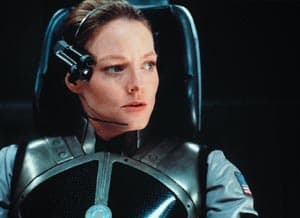
One film with a positive image of a female physical scientist is Contact (1997), which features radio astronomer Eleanor Arroway, played by Jodie Foster. Dedicated to her work, Arroway comes across as a less glamorous but more complex and believable scientist than Blackwood. When her funding is withdrawn, Arroway works hard to find other support, and shows integrity in standing by her beliefs about scientific knowledge versus religious faith, even at personal cost. Offered a chance of romantic involvement, she chooses instead to continue her work, making her more than a typical Hollywood romantic cliché.

Emma Russell (Elisabeth Shue) in The Saint (1997) is also a serious scientist – an electrochemist who can make cold fusion work and is passionate about its possibilities. But The Saint (Val Kilmer) – a professional thief – manipulates her yearning for romance and steals the notes for her process. Eventually all is resolved, however: they fall in love, and Russell convinces The Saint that they should give cold fusion to humanity rather than profit from it. Although Kilmer is top-billed and has all the exciting action scenes, Shue emerges as the film’s scientific centre and as a gutsy, idealistic, and attractive woman. While these women are better examples than Hendron and Blackwood, not all is perfect: Arroway’s entire career is shakily based on finding intelligent aliens, and the cold fusion that Russell pursues has been discredited in the real world.

At a Glance: Hollywood physics

  • Since the 1920s there have been at least 60 feature films featuring physical scientists and their research
  • Not all movie physicists conform to the stereotypical mad scientist, but include heroes and villains too
  • Although the physics in films is rarely completely wrong, some films (like Dante’s Peak) are much more accurate than others (notably The Core)
  • The 2004 film What the #$*! Do We (K)now!? misleadingly purports to present an accurate view of quantum physics but in fact promotes a strange quasi-religious cult

More about: Hollywood physics

Insultingly Stupid Movie Physics: intuitor.com/moviephysics – rates the physics content of films from GP (good physics) to XP (physics from an unknown universe)
Bad Astronomy: www.badastronomy.com/bad/movies – points out ridiculous errors in astronomy in a variety of films “Bleep” of faith by John Gorenfeld: dir.salon.com/story/ent/feature/2004/09/16/bleep/ – excellent article about What the #$*! Do We (K)now!?
Dante’s Peak: volcano.und.nodak.edu/vwdocs/vw_news/dantespeak.html – geoscientists give examples of good and bad science in the film


Life after the lab

A couple of years before he was due to retire from the Institute for Advanced Study in Princeton in 1944, Albert Einstein contemplated the meaning of old age. In a letter to his friend Otto Juliusburger, he wrote: “People like you and I, though mortal of course, like everyone else, do not grow old no matter how long we live. [W]e never cease to stand like curious children before the great Mystery into which we were born.”

That unrelenting quest to understand nature is the main reason why so many physicists – especially those who have spent the bulk of their lives closeted in academia – do not relish the prospect of retiring. Retirement is a bothersome event, disrupting them from getting on with the main love of their lives – physics. Many physicists therefore continue to go to the lab as if nothing has changed, and some, like Einstein, retain an office until the day they die.

As we report (see p11; print version only), Theodor Hänsch, who shared last year’s Nobel Prize for Physics at the age of 63, was equally unhappy at the prospect of having to retire from the University of Munich. According to Bavarian rules, all university staff are obliged to retire at 65. Threatening to leave for a new professorship in the US, where there is no mandatory retirement age, his university backed down and has offered to keep his job open.

But this single-minded obsession to continue with physics is not necessarily a good thing. It means that many physicists do not have a life outside the lab – no other interest can sustain them in old age. Like Einstein, many feel there is another great result just around the corner, even though their most brilliant work was done in their youth. Few ever reach those heights again, which can be hard to bear, particularly for scientists whose physical and mental well-being deteriorates in later life. (We publish an obituary of neutrino pioneer Ray Davis, who died at the end of May due to complications from Alzheimer’s disease. see p12; print version only) On a more practical level, the presence of too many retired staff can be a delicate problem for universities, which need to make space for young blood.

One solution being pioneered in the US is to build special “retirement communities” that allow academics to live alongside one another in old age – a sort of high-brow old-people’s home (see “The retirement problem”). Most have links with local institutions, and one such community – affiliated to Cornell University – has been dubbed “the best physics department in town”, being home as it was to the late Hans Bethe and other luminaries from the world of physics.

Of course, many physicists do find new activities after they retire. Some write books, take up editorial work, become consultants and even set up their own companies. Others get involved with charity work and local clubs and societies. The key thing is for physicists to prepare for retirement otherwise the transition can be traumatic. We cannot be sure, but the shock of retirement may have contributed to the untimely death of Nobel laureate Cecil Powell, who suffered a fatal heart attack just eight days after retiring from Bristol University in 1969.

But others still cling resolutely to their research when they retire. As Einstein said shortly before his death: “I’m like a run-down old car – something is wrong in every corner. But life is still worthwhile as long as I can still work.”

Solar explosions in 3D

In March 1989 residents of the Canadian city of Quebec got a taste of the Sun’s disruptive potential. A magnetic storm in the Earth’s atmosphere produced a small power surge in part of the city’s electrical grid, which flipped a circuit breaker. This, in turn, caused another breaker to flip, and so on until the whole grid went down. As a result, local people went without power and heat for nine hours, the underground railway system and airport shut down, and schools and businesses were forced to close.

The phenomenon that is believed to be responsible for this and other geomagnetic storms is a coronal mass ejection (CME). These enormous explosions on the surface of the Sun can eject billions of tonnes of plasma into space at millions of kilometres per hour and send electrical currents and high-energy particles coursing through the Earth’s protective magnetic field. Existing Sun-monitoring satellites can provide some warning of approaching storms, for example allowing power companies to isolate certain parts of their networks or satellite operators to put their devices into “safe mode”. But these warnings are often too late or inaccurate – shortcomings that can prove extremely costly. Indeed, scientists predict that a particularly powerful geomagnetic storm could cause up to $70bn worth of damage to satellites when the associated loss of service is taken into account.

But help will soon be at hand in the shape of NASA’s Solar Terrestrial Relations Observatory (STEREO). Due to be launched this summer, the $540m mission will consist of two almost identical satellites – one positioned ahead of the Earth in its orbit around the Sun, the other behind. These satellites will provide a 3D view of CMEs, which should not only transform our understanding of these events but also provide much better forecasting of the consequent geomagnetic storms.

Magnetic contortions

The Sun, like the Earth, can be thought of as containing a huge bar magnet, or dipole. The field strength of this magnet is unexceptional – about 50 G (5 × 10-3 T), roughly equal to that of a fridge magnet. But local distortions of the field can be much stronger. These distortions are thought to be caused by the Sun’s differential rotation, whereby regions near the poles take about 33 or 34 days to rotate while the equator zips round in about 25 days. As a result, the magnetic field created in the centre of the Sun becomes twisted and entangled, leading to regions of dense field lines that protrude out from the centre. These regions, which have field strengths of thousands of gauss, are thought to limit the upward convection of heat from the centre and generate the dark patches on the solar surface known as sunspots.

Eventually the fields become so entangled that they reach breaking point and suddenly disentangle, releasing huge amounts of energy as they do so. These energy releases are believed to cause solar flares – the enormous explosions in the Sun’s atmosphere that accelerate charged particles emitted by the Sun to great speeds. They are also believed to cause CMEs.

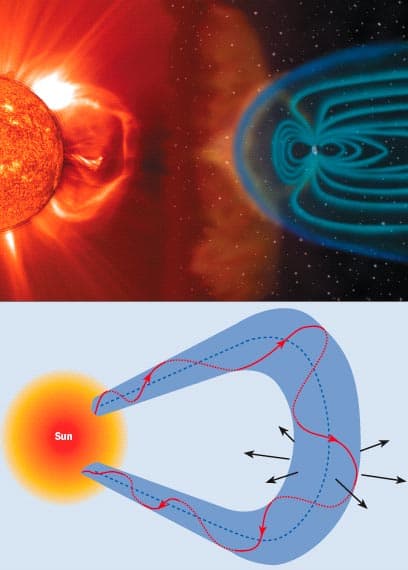
A CME expels huge quantities of plasma in an expanding U-shaped bubble that is threaded by a magnetic field partially rooted at the Sun (see figure 1). A bubble ejected towards the Earth generally takes two or three days to arrive. On its journey it pushes against the slower moving solar wind, a stream of charged particles continuously emitted by the Sun. The bubble acts like a snow plough, piling up the solar wind into a high-density region that has a well-defined leading edge known as a shock wave. This shock wave in turn accelerates a small fraction of solar-wind particles to higher energies.

The arrival of the CME bubble at the Earth has two main effects. First, the shock wave compresses the “nose” of the magnetosphere – the region of space filled by the Earth’s magnetic field. This can be problematic for geosynchronous satellites if the nose, which is normally located at over 60,000 km from the Earth’s surface, is pushed below the orbit of these satellites at about 40,000 km. If this happens, high-energy particles from solar flares or the solar wind can penetrate the casing of these satellites, causing their computer memories to switch from on to off.

Second, the magnetic field lines from within the bubble connect with those in the Earth’s magnetosphere, releasing huge amounts of energy. This energy accelerates particles that already exist within the magnetosphere, and possibly some from the solar wind. It is the interaction of these particles with gas molecules in the upper atmosphere that is responsible for the Northern and Southern lights. However, by setting up strong electric currents within the magnetosphere, these accelerated particles can also play havoc with the microelectronics in satellites, as well as damaging power supplies on the Earth’s surface, which is what caused the problems in Quebec.

Geomagnetic storms also have the potential to harm astronauts. STEREO project scientist Michael Kaiser points out that a big storm in January last year would have delivered very dangerous doses of radiation to any Mars-bound astronauts who happened to be space-walking at the time. There is also a small chance that anyone outside the relatively low-altitude International Space Station would have been affected. “You would want to be inside,” Kaiser says.

The power of two

Existing spacecraft can warn of impending solar storms. For example, NASA’s Advanced Composition Explorer (ACE) can give a fairly accurate warning of a storm about an hour before it strikes by measuring energetic particles from the solar wind just before they reach the Earth. The NASA/European Space Agency Solar and Heliospheric Observatory (SOHO), on the other hand, observes material much nearer the Sun, which means it can provide several days’ notice of a potential storm. But any error in SOHO’s measurements of the direction of the discharge will be magnified as the material travels to Earth, making its predictions far less reliable.

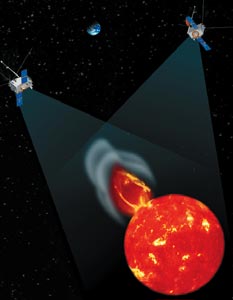
By making measurements in all three dimensions, STEREO will be able to make far more accurate predictions of the evolution of material from a CME. Its two satellites, launched using a single rocket, will work just like a pair of eyes – judging the direction and speed of matter heading towards Earth by virtue of the slight offset between the two observatories (see figure 2). A suite of visible and ultraviolet imagers aboard the spacecraft will track the 3D evolution of CMEs from their origin at the solar surface, through the Sun’s atmosphere (known as the corona) and via the interplanetary medium to their eventual intersection with the Earth. These measurements will include an estimate of the volume of the CME bubble, which provides an indication of the size of the initial explosion and therefore how much energy it will dump in the Earth’s magnetosphere.

In addition, the spacecraft will contain radio receivers to detect emissions given off by the solar-wind particles that are accelerated by the shock wave. These emissions will also generate a 3D picture of the CME bubble, providing an independent and complementary view to that obtained at visible and ultraviolet wavelengths. Another set of instruments on board the satellites will detect the dangerous high-energy particles and measure the orientation of the magnetic field in the CME bubble relative to the direction of the Earth’s magnetic field. These two fields generate far more severe storms when they oppose one another than when they lie in the same direction. “STEREO will combine the capabilities of ACE and SOHO, and do so from two vantage points,” says Kaiser. “We will not really be measuring anything new but we will be making these measurements from a different perspective.”

Storm warning

STEREO will send a stream of data in real time to a group of specialized tracking stations around the world organized by the National Oceanic and Atmospheric Administration – the organization that provides weather forecasts, including space weather, to the US. According to Kaiser, the STEREO data – which will consist of a compressed picture of the Sun and measurements of energetic particles – could improve the storm notice from one hour with ACE to a couple of days.

However, for some purposes a two-day warning is not enough. Airlines, for example, would like a week’s notice in order to reroute aircraft away from the poles – the regions most affected by geomagnetic storms. But since the material ejected by a CME only takes two to three days to reach Earth, this would involve being able to predict the occurrence of a CME and its potential severity by studying conditions on the Sun. STEREO will not be sensitive enough to provide such predictions, but the Japanese Solar-B mission, due to be launched later this year, and NASA’s Solar Dynamics Observatory, which is scheduled to blast off in a couple of years’ time, should take us some of the way there. Both will make very accurate measurements of the changing magnetic fields on the Sun.

Kaiser compares the progress made on understanding space weather in the last 10 years with our much-improved ability to predict weather on the Earth’s surface. “If you look back at the 1950s, predicting hurricanes was really black magic,” he says. “But these days it is possible to predict where they are going to hit within about 10 miles and when they are going to form. We are moving in that same direction.”

• stereo.gsfc.nasa.gov

Shelf life: Janna Levin


What are the three best popular-science books?

I daren’t compile such a list because more than three of my friends have written popular-science books! But I can suggest a few classics. Primo Levi’s The Periodic Table is lovely, original, personal and moving; Oliver Sacks’ The Man Who Mistook His Wife for a Hat is fascinating and so well written; Heinz Pagels’ The Cosmic Code was one of the first and finest cosmology books; and even Desmond Morris’s The Naked Ape deserves mention, although it makes my list longer than three. It is amusing and appropriate to deflate our sense of importance and view ourselves as a zoologist might, even if some of the thinking on the subject has changed in the intervening years.

What science books are you currently reading?

This may seem odd, but I’m not reading any. I’ve been reading lots of fiction, even some fiction based on scientific themes, and I am starting to read a technical science book: A First Course in String Theory by Barton Zwiebach.

What else are you reading?

I’m re-reading Kazuo Ishiguro’s novel Never Let Me Go – a beautiful book.

Which popular-science book have you never read, but feel you ought to have tackled, and why?

I’d like to read Steven Pinker’s The Language Instinct. Books outside my own specialty appeal to me and the subject is remarkable.

What advice can you offer physicists who want to write a popular-science book?

Pretty simple advice: never talk down to your audience, write about what you love and write for yourself.

A case of mistaken identity

It’s 17 June 1945. We are in a sleazy hotel room in the middle of nowhere: Socorro, New Mexico to be precise. One by one, four characters stumble in: Dick or Richard or Ritty – or is it Feynman, Feinstein or Fuchs? – who has not slept for 58 hours; a bouncy 18 year old, Matilda, who knows lots about frogs; a “fat man” straight out of central casting for a 1940s gumshoe; and a “little boy”, name of Billy (or is it Conrad, or maybe Nicky?). The stage is set for a smoke-and-mirrors production about what goes on at that mysterious place the locals call “the hill”.

Clever Dick, written and directed by Crispin Whittell, is an imaginative fictional gathering that pokes fun at the security-crazy world of the Manhattan Project, or perhaps anywhere these days. Terry Johnson’s Insignificance and Michael Frayn’s Copenhagen immediately leap to mind. As in Insignificance, in which Albert Einstein, Marilyn Monroe, Senator Joe McCarthy and Joe DiMaggio end up in a hotel room in Times Square, the looming unseen presence is Einstein’s iconic equation, E = mc2. But whereas the plays of Johnson and Frayn explored serious social and scientific issues, Whittell’s offering is more like a Ben Elton slapstick – involving mistaken identities, a frog that gets shot and a nun on a trampoline.

The sobriquets “fat man” and “little boy” appear only in the cast list, not the play itself. Unless you already know their meaning, you will miss whatever significance the playwright intended. In real life, “Fat Man” was a spherically shaped bomb with an implosion mechanism to compress a sphere of plutonium and blow it up. In the play, Fat Man (Corey Johnson) is a rotund, bumbling counter-intelligence agent zealously trying to ferret out commie spies and help blast “the yella fellas”. “Little Boy” – the sleek, cylindrical bomb containing a uranium gun that was detonated over Hiroshima – is the playboy Nicky Hilton (Jamie King), best known today as the grandfather of It-girl Paris.

Nicky and Dick are the only two non-fictional characters in the play. In real life, Dick (Adrian Rawlins) – the physicist Richard Feynman – was back at Los Alamos (“the hill”) that night, sorely depressed over his wife’s death the day before, while Hilton was in the South Pacific on the battleship USS North Carolina.

Though not portrayed in the play, the nuclear physicist Klaus Fuchs also looms large. Fuchs was a brilliant and popular scientist who liked to joke that if there was a spy at Los Alamos, it was probably Feynman since he was constantly away (in fact he was visiting his dying wife). But it was Fuchs who was revealed as a Soviet spy in 1949. His handler was Harry Gold, an American industrial chemist, and together they delivered a wealth of information to the Russians, including the design of “Fat Man”.

Back in the world of Clever Dick, Fuchs is suspected of spying and the Keystone cop is on the trail of his blue Buick, which Feynman has happened to borrow. In the course of climbing in and out of various hotel rooms, Matilda (Jennifer Higham) tells Feynman that a Mr Gold (“He talks funny too. He talks like you.”) is in the next room. This clinches it for the dick that Dick is Fuchs, setting up a classic case of mistaken identity.

The play is well acted and funny, with an imaginative stage set and nostalgic 1940s swing music. I am happy to report that the physics, though sparse, is interesting. “Everybody’s heard of it, which isn’t the same as knowing what it means,” says Matilda aptly to Feynman about E = mc2. Feynman encourages her inquisitiveness, telling her that he too is in a state of constant confusion. If “a lump of radioactive stuff” gives off a lot of energy, she wonders, and if c is a small number, then a lot of mass is lost too. “But it isn’t, is it? It comes down to the c, doesn’t it,” she concludes correctly.

Then Matilda asks the $64,000 question: “Why did he [Einstein] choose the speed of light?” “Who knows? I don’t know. Albert possibly knows. But it’s also possible that he doesn’t, precisely. I’m guessing it was a guess,” replies Feynman, in Feynmanese, reminding us of the cartoon in which Einstein writes “E = ma2” on a blackboard, crosses it out and writes under it “E = mb2“. The real Feynman would have said to luscious Matilda that “c is in E = mc2 because of Einstein’s method for synchronizing clocks using light signals. And here’s how that goes, babe…”.

My New York Bronx ear detected Feynman speaking Brooklynese, not Long Islandese. But this is just hair-splitting for a UK audience. Could you imagine an American actor doing Wayne Rooney? Feynman is presented undeservedly as a geeky scientist, and the actor playing him is a bit long in the tooth for someone who was at that time a very young-looking 27 year old. All in all, this is a play for which that hackneyed caveat emptor holds: any coincidence with characters living or dead is purely coincidental.

From the present to the past

Most models of the universe are bottom-up, that is, you start from the well-defined initial conditions of the Big Bang and work forward. However, Hawking and Hertog say that this method is flawed because we do not and cannot know the initial conditions present at the beginning of the universe and that we only know the final state — the one we are in now. Their idea is therefore to start with the conditions we observe today — like the universe is 3D, nearly flat and expanding at an accelerating rate — and work backwards in time to determine what the initial conditions might have looked like.

The new theory aims to get round a fundamental problem of string theory — the most popular candidate for a “theory of everything” — which is that it allows the existence of a multitude of different types of universes as well as our own. Each possible universe in this “landscape” has its own fundamental constants and even different numbers of space-time dimensions. Moreover, string theory does not favour any particular universe over another, which is not a good state of affairs as we clearly live in a universe with a particular set of physical properties.

To address this, Hawking and Hertog say that all these alternative universes of string theory may have actually existed together in the first few instants after the Big Bang. At this time, the universe was in a “superposition” of all these possible worlds. However, most of these universes then quickly faded away to leave behind our present-day universe. By tracing our universe back from the present to the past, we can ignore most of other branches that the universe took because they are too different from the current universe.

While this idea sounds fantastic, it is based on Richard Feynman’s “sum over paths” formulation in quantum theory, which says that the probability that a photon, say, arrives at a particular place can be calculated by summing up over all the different possible trajectories of the photon. Although the photon could follow lots of different paths, the straight-line path dominates over all the others so this is the one we see. In the same way, Hawking and Hertog say that the universe did not take just one path through time to arrive in its present state, but took a multitude of paths, or histories. The “sum over all histories” is therefore the universe we observe today.

The new top-down theory could also explain why some constants of nature seem to have finely tuned values that have allowed life to evolve in our universe. For example, the cosmological constant, Λ — the force that appears to be causing the expansion of the universe to accelerate, or the density of dark energy — has a small positive value; if it were any smaller or bigger then life would not exist. According to the new theory, the current universe must have “chosen” those histories that led to the “correct” value of Λ otherwise we would simply not be here to experience it — a theory also known as the “anthropic principle”.

Hawking and Hertog also say their model could be tested by comparing observations of the patterns of minute intensity variations in the cosmic microwave background (CMB) radiation with those calculated by their theory when it is more developed. The CMB is the radiation left over from the Big Bang and should contain “imprints” of some of the very early alternative histories within it.

Holey germanium

Scientists first discovered in the early 1990s that silicon could be made to emit light by etching holes into it. But attempts to make porous germanium — another semiconductor in the same group of the periodic table as silicon — have been less successful, yielding structures with only randomly distributed pores. Now, Sarah Tolbert and colleagues at the University of California at Los Angeles and Gerasimos Armatas and Mercouri Kanatzidis of Michigan State University have used a technique called “surfactant templating” to make germanium containing well-ordered pores for the first time (Nature 441 1126 & 1122).

Tolbert’s team made their porous germanium by taking a compound called K2Ge9, which contains small clusters of nine germanium atoms that link up to form short polymer chains. They then reacted this material with a carbon-containing “surfactant” molecule that, like soap, has a water-loving end and a water-repelling end.

The different electrostatic interactions between the chains of germanium atoms and the two ends of the surfactant molecule cause the germanium atoms to form a hexagonal-shaped honyecomb structure, with the surfactant molecules lying in between as a “scaffold”. The surfactant was then removed by oxidising the sample to leave just the porous, honeycomb germanium (figure 1).

The Michigan team used a similar approach, but with a different germanium compound a different surfactant, to obtain porous germanium with cubic channel structures (figure 2).

Both groups found that the nanoporous germanium absorbs light at shorter “bluer” wavelengths than ordinary crystalline germanium. Moreover, Tolbert’s team found they could “tune” this wavelength by altering the thickness of the walls between pores, converting only some of the germanium to germanium oxide. The researchers also found that this worked for alloys of silicon and germanium – compounds that are routinely used in micro- and optoelectronics.

Copyright © 2026 by IOP Publishing Ltd and individual contributors