Small returns for nanoscience?

What has the $18bn spent worldwide on publicly supported nanotechnology research done for us so far? According to some jaded observers, the main outcomes have been stain-resistant trousers and better sunscreen. The gulf between the promises of those who extol nanotechnology and what has been delivered in the marketplace is indeed large: dangerously large in a world where investment in science is predicated on unrealistic expectations of fast economic returns. The science underlying nanotechnology is fascinating, but much of the writing about its business potential is worryingly reminiscent of the dot-com bubble in its uncritical and self-serving optimism.

Steve Edwards, as a consultant and industry analyst, comes from the business end of the spectrum. The Nanotech Pioneers, though, is refreshingly free of the hype and press-release punditry that plagues too much writing about the potential applications of nanotechnology. Instead, Edwards displays both a real understanding of the science that underlies the hype and an appreciation of the all-important difference between what is possible in principle and what makes economic sense.

But who are the nanotech pioneers? Just as few people can agree on how to define nanotechnology, opinions differ as to who was responsible for starting the field. The iconic Richard Feynman is a popular choice, on the strength of his 1959 lecture “There’s plenty of room at the bottom”, but beyond that there is little consensus. Edwards gives plenty of space to the controversial figures of Eric Drexler, Ralph Merkle and Ray Kurzweil, whose visionary pronouncements have made their brand of nanotechnology a staple for science-fiction writers and futurists – to the dismay of many academic nanoscientists. Mike Roco, the Washington power-broker behind the well-funded National Nanotechnology Initiative, also gets his fair share of attention.

Moving back from politics to science, though, Edwards also credits as founding fathers of nanotechnology both the inventor of the scanning tunnelling microscope, Gerd Binnig, and the electron-microscope pioneer Ernst Ruska. While everyone agrees on the importance of scanning probe microscopes in the emergence of nanotechnology, the re-emphasis Edwards places on electron microscopy is welcome. Electron microscopes have been around for a long time, and this familiarity has perhaps lessened the impact of recent developments, such as aberration correction for sub-Ångstrom resolution.

Edwards identifies three important precursors of nanotechnology – lithography and patterning, biotechnology, and supramolecular chemistry – and three areas in which nanotechnology shows early signs of commercial promise. For fullerenes – the new forms of carbon discovered by Sir Harry Kroto and the late Richard Smalley more than 20 years ago – the road to applications has been slow, but some are now emerging in areas such as unconventional solar cells. There are interesting potential applications in drug delivery for dendrimers, a type of polymer molecule with a branched “star-burst” structure. And quantum dots – tiny semiconductor particles the emission and absorption spectra of which vary with size – can replace fluorescent dyes in applications such as the tagging of biological molecules in cell-biology experiments.

It is clear, however, that most of the potential uses for nanotechnology are still to find their way out of the laboratory. Biology is a potent inspiration, and Edwards cites some fascinating examples of biomimetic nanotechnology, such as synthetic analogues of the marvellously sticky gecko’s foot. The interface between biology and nanotechnology also leads to thoughts of medical applications. Here we can expect improved methods for delivering drugs and diagnosing diseases in the near term, and on a longer timescale perhaps artificial organs and direct interfaces between brain and machine. From nanophysics, Edwards is enthusiastic about the potential of spintronics and plastic electronics.

Looking forward, the author sets three grand challenges for nanotechnology. The importance of finding clean and renewable energy sources is surely uncontroversial, and potential contributions from nanotechnology in the shape of low-cost solar cells, improved fuel cells and economically viable hydrogen storage must be worth pursuing. I am personally less convinced about the importance of the space elevator – a cable linking a geostationary satellite to the Earth’s surface – but it is certainly an ambitious target for researchers to make a material strong, stiff and light enough for this purpose. Finally, Edwards is optimistic about the potential for semiconductor nanotechnology to permit an economically viable implementation of quantum computing.

There has been much discussion of what nanotechnology might mean for society at large, and what its downsides could be. These debates are comprehensively covered by Edwards, from the far-fetched but dramatically compelling eco-disaster of self-replicating nanobots to the much more likely problem that some nanoparticles might, by virtue of their size, prove to be more toxic than the materials from which they are derived. This discussion is coloured by an almost-caricatured North American viewpoint, in which Europeans are seen as technology-averse while Americans are universally visionary and forward-looking. Canada, meanwhile, is written off as “a European country that happens to be located in North America”.

But there is actually a strange passivity and pessimism on display here about the prospects for managing the technology’s inevitable downsides. On the question of potential toxicity and environmental problems from nanomaterials, Edward says, “Unfortunately, we will still most likely deal with nanotech environmental hazards in the way that we always have, by ignoring them until they have become disastrous in an obvious way.” Likewise the author washes his hands of responsibility for any broader societal issues: “Neither nanotechnologists nor the institutions that employ them bear any responsibility for the organisation of society.” I would like to think we can do better than that.

Even if the wilder promises of the economic impact of nanotechnology prove exaggerated, it is clear that the applications will go beyond stain-resistant trousers. I can recommend this book as a well-written and sane introduction to this confusing and contested field.
Waste matters

Nuclear power is “back on the agenda with a vengeance” said UK prime minister Tony Blair in a forthright speech last month. His statements were surprising given that he made them ahead of his own government’s review of energy, which is not due to be announced until the end of this month. That review is expected to recommend the construction of a new generation of nuclear power stations in the UK; Blair’s comments are a strong indication that will indeed be the case.

The energy review comes hot on the heels of a report by the government-appointed Committee on Radioactive Waste Management, which was asked to examine what to do with the country’s current and future nuclear waste. Unfortunately, after three years of deliberation, the committee has concluded what should have been blindingly obvious from the start – namely that nuclear waste should be buried in a deep underground repository (see pp8-9; print version only). It does have sensible things to say about the importance of consulting the public over nuclear waste, but it falls short on technical recommendations.

Having wasted much valuable time debating – and then dismissing – exotic solutions such as firing the waste into space, the committee has given no clear view on what kind of repository should be built or even what kind of geology would be most suitable for such a site. These decisions still need to be made, which will only delay construction of a repository still further. Blair’s apparent enthusiasm for nuclear power is to be welcomed, but a clear long-term plan on what to do with the waste needs to be in place before the construction of any new stations begins.

Words matter

Statements by physicists about controversial political issues have a long and honourable tradition, notably Einstein’s famous letter in 1945 warning US President Roosevelt about nuclear weapons. Jorge Hirsch, a condensed-matter physicist from the University of California, San Diego, is maintaining that tradition (see “Antinuclear call to arms”), having recently written to President Bush urging him not to use nuclear weapons against Iran. Such is Hirsch’s anxiety about the issue that he persuaded a dozen other leading US physicists, including five Nobel laureates, to sign the document too.

But a recent letter in the New York Times sees another group of prominent US scientists commenting on an issue that has nothing to do with physics at all – America’s treatment of prisoners at Guantánamo Bay in Cuba. While Guantánamo Bay is no doubt a serious matter, physicists would be well advised to stick to those issues that are underpinned by science.

Leonard Susskind, Frank Wilczek, Ed Witten and the other signatories are aware that they are going beyond their remit, stating that “although this is not a scientific issue in the usual sense, we feel that to ignore it would be to abdicate our responsibility to the truth”. But by exploiting their authority as eminent scientists to make political statements on non-scientific issues, physicists could be undermining their influence on matters where they deserve to be listened to – like nuclear weapons.

Property market set to slump

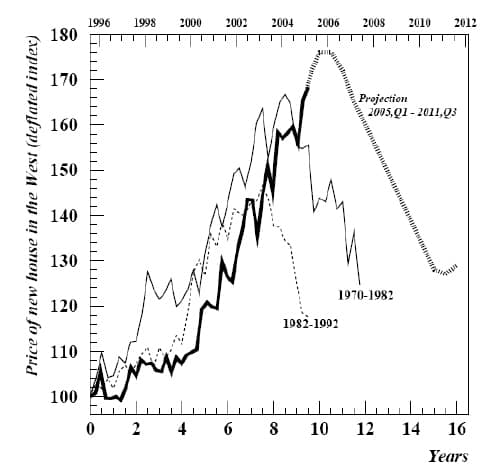
House prices in the big cities of most developed nations, notably with the exception of Japan, have been rising steadily over the last few years. Although the current price increases have the same magnitude as previous rises (typically an increase of between 80 and 100%), the present price peak seems to be lasting for longer than usual. To understand why and to make predictions for the future, Roehner fitted models to quarterly average house prices on the West Coast of the US over the last 40 years.

Roehner identified four rapid surges in house prices during this period, each of which lasted about ten years (figure 1). He then calculated two numbers for each period: the amplitude of a peak (defined by the ratio of highest price to initial price) and the magnitude of the fall in prices (defined by the ratio of the lowest price to the peak price). The results show that the current peak is still in its up-going phase and will have an amplitude larger than 1.7, which is higher than any previous amplitude. This figure is generally less than 3 because house prices are limited by how much people earn.

The model can also predict how house prices might evolve between now and 2011, and shows that the high prices will slowly start to come down at the same rate as they went up (figure 2). This decrease, which will take about six or seven years, is characterized by exponential price falls with rates of about -6% per year, and will start in major cities such as San Francisco and Los Angeles with smaller cities following suit. These predictions might also hold true for other big cities, like London, Madrid, Paris or New York. Indeed, in Melbourne and Sydney the descent has already started.

Roehner says the current period is somewhat different to previous years because there is an inflated demand for property — mainly from investors and high-income buyers — that was not so important before. Moreover, investment funds (including pension and hedge funds) and the stock market are more closely associated with real estate than in previous years. Speculation has also boosted house prices to sometimes unreasonable levels.

However, Roehner also stresses the limits of his and other such models: “Consider the London housing market,” he says. “A year ago everybody (including myself) was convinced that the turning point had been reached and that prices would decline. In fact, over the last 12 months real estate prices in London have increased by 8%. What happened? As explained in a recent article published in the Economist, Gordon Brown [UK Chancellor of the Exchequer] has offered a governmental guarantee to banks and other lending institutions and devoted about $2 billion in subsidies to encourage buyers. Naturally, no model can take such events into account in advance.”

How to make an object invisible

Composed of tiny rods, ensembles of metal rings and the like, metamaterials are artificially structured composite materials that were first made by David Smith, now at Duke University, and colleagues in 2000. What makes them unusual is that they have a negative refractive index – that is, they bend light in the “opposite” direction to ordinary materials. Their electromagnetic properties can also be “tuned” by manipulating their precise structure.

John Pendry of Imperial College London — working with Smith and his Duke colleague David Schurig — has now shown how metamaterials could guide light around a hole within it. Any object placed inside this hole would then be “hidden” because light can not reach it and you would be able to see behind the object as if it was not there. All light rays that come from one direction would propagate around the hole and then be recombined as if nothing were there, a bit like water flowing round a rock. Working independently, Ulf Leonhardt of the University of St Andrews in the UK has also come to the same conclusion.

The new calculations involved placing a hole in a material and then calculating, using Maxwell’s equations, what properties the material would need to have to divert light around it. For this to happen, the material would have to be designed so that the light travels relatively slowly far from the hole and faster as it travels near the hole. (In fact, the light would have to travel infinitely fast when it brushes along the surface of the hole itself, although this would not violate relativity provided the radiation is within a certain frequency band.) Metamaterials would allow this vision to become reality because they can be designed such that the refractive index — and hence the speed of light — varies from point to point.

Although the new results are only calculations, the researchers hope that it will be possible for others to make the metamaterials that can produce the required variations in light speed. This may not be as difficult as it sounds because physicists already know how to design metamaterials that have such properties for radio waves. Indeed, “cloaking” devices for this part of the electromagnetic spectrum could appear in as little as five years, the team says. Such devices could have all sorts of applications in defence and wireless communication.

“This research shows how much electromagnetic or optical instruments can do if there are no limits on the electromagnetic or optical properties of materials,” says Leonhardt. “In practice, there are of course limitations. This research is likely to inspire a new wave of research in metamaterials.”


Interestingly, the new calculations are inspired by the geometry of curved space — a discipline that is normally in the firm hands of researchers in general relativity. “Here we have examples where ideas of general relativity are put to practical use in electrical or optical engineering and nanotechnology,” says Leonhardt. “Isn’t that surprising?”

Schurig is equally excited by the new work. “We have a new paradigm for designing devices that interact with electromagnetic waves,” he says. “It is impossible to imagine all the applications that will stem from this.”

Heavy ions feel the squeeze

Scientists routinely carry out experiments on materials subject to high pressure and high temperature to mimic the conditions inside the Earth. Nuclear physicists, meanwhile, regularly study what happens to materials that are bombarded by fast-moving, highly energetic heavy ions. Now, however, a team of physicists and geoscientists has studied how materials behave when they are exposed to heavy ions and extremely high pressures at the same time.

The experiment involved firing heavy ions of uranium or gold from the GSI’s synchrotron at synthetic crystalline graphite and natural single crystals of zircon. The team chose to study zircon because it is an important component of the Earth’s crust and mantle. Moreover, the effects of radiation damage to graphite and zircon are interesting because graphite is used in nuclear power plants and zircon could be used to store nuclear waste.

Using a common piece of kit from high-pressure physics called a “diamond anvil cell”, the researchers squeezed the graphite and zircon samples to pressures of as high as 14 GPa — or 140, 000 atmospheres(figure 1). They then bombarded the sample in the cell for a few seconds with a beam of uranium or gold ions that had been accelerated to 80% the speed of light (up to 70 GeV energies). The beam did not heat up the sample, which remained at room temperature.

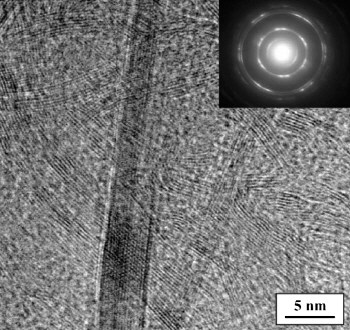
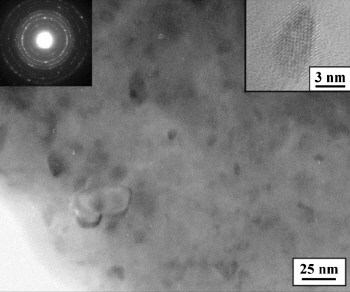
Images taken with an electron microscope of graphite samples that had been irradiated at pressures of 8 and 12 GPa with uranium or gold ions did not reveal any individual ion tracks, but showed that the material had been almost completely transformed into an amorphous solid, interfused by recrystallised graphite bands (figure 2). In contrast, samples that had been exposed to ion beams with no pressure were found to have typical ion tracks embedded in the crystalline matrix.

Raman spectroscopy of the zircon sample irradiated with uranium ions also showed similar novel effects: it decomposed into nanometre-sized crystals and was transformed into its high-pressure phase — known as reidite — at pressures of 14 GPa (figure 3). The finding was unexpected because this transition normally occurs (in the absence of ion beams) at much higher pressures of 20 GPa or above.

The team says the observed formation of reidite may shed new light on the effects of radioactive decay in uranium- and thorium-containing minerals in the high-pressure environment of the Earth’s crust and mantle. Their technique could also be used to make novel metastable phases in solids that are not accessible with existing techniques.

Amateur astronomers prove their mettle

The team, led by Peter McCullough of the Space Telescope Science Institute in Baltimore, included four amateur enthusiasts from Europe and North America. Their home made ‘XO’ telescope trawled the night sky, and every two months obtained sightings of several hundred likely planets. These were then narrowed down by the nine professional astronomers to a few dozen leads, which were then passed on to the amateurs for close observation and analysis.

Dubbed X-O1b, the planet is 300 light years away, and is found to have a mass approximately equal to that of Jupiter- that is roughly 300 times that of Earth. However it is also hotter than Mercury, being substantially closer to its sun than any planet in our solar system.

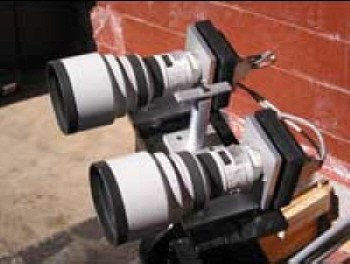
The telescope the astronomers used, which is composed of two 200-mm lenses, resembles a large pair of binoculars. Positioned on the Haleakala volcano, Hawaii, the telescope was made from off-the-shelf components, and cost a “relatively inexpensive” $60,000 dollars to put together. To amateurs who wish to follow in the footsteps of the X0-1b four, however, it is still not cheap.

Funded by a grant from NASA’s ‘Origins’ program, which supports projects to determine whether we are alone in the universe, the discovery sends a mixed message to avid amateur astronomers. Although this project proves that amateurs may well have the skills to make significant astronomical discoveries, the XO telescope was somewhat out of the price range for hobbyists, and the team “spent far more than $60,000 on software” according to McCullough. Luckily for this particular project, NASA have agreed to a further $225,000 grant, which will allow the group to continue for another three years, during which they aim to discover six more new planets.

“It was a wonderful feeling because the team had worked for three years to find this one planet” McCullough explained. “The discovery represents a few bytes out of nearly a terabyte of data; it’s like trying to distil gold out of seawater”.

One of the amateur astronomers was Paul Howell, who was ecstatic to get the chance to take part in the project. “I was just going out to look at some stars. At no time did I think a thing like this was possible,” he said later. “The brilliance of this particular programme is it combines the efforts of the professionals with amateurs who have lots of free time”

The team used the ‘Transit’ method for discovering new extra solar planets, monitoring dips in brightness of various stars. These dips indicated a partial eclipse by a planet, although the planet itself was too far away to see directly. The team discovered a 2% dip in brightness of the star XO-1 every four days, which means that XO-1b has a four-day orbit.

Once the planet had been discovered, astronomers at the McDonald observatory in West Texas were able to confirm its existence. This was accomplished using the radial velocity method, the Harlan J. Smith and Hobby-Eberly telescopes being used to measure the slight wobble induced upon the planet by its parent star. This also allowed them to accurately calculate its mass.

The star itself, XO-1, has characteristics closely mirroring those of our own Sun. This, and the similarities between XO-1b and Jupiter (which is another gas giant), leads to speculation about the possible presence of another planet which, in the words of McCullough, “could be similar to Earth”.

Silver clusters go magnetic

Clusters of atoms and ions form a type of matter that is intermediate between single atoms and bulk matter. Metallic clusters are widely used as catalysts because they have a very high surface to volume ratio, which allows them to speed up chemical reactions. Researchers have, however, recently begun to see if magnetic clusters can be used in biomedicine — for example, to separate labelled biological cells, to improve drug delivery and to enhance contrast in magnetic resonance imaging.

The new study, carried out by Manuel Pereiro and colleagues at the University of Santiago de Compostela, involved performing “density functional” calculations using an off-the-shelf computer package. The calculations involved solving the Schrödinger equation for groups of atoms arranged into a cluster and searching for sliver clusters with the lowest energy and hence the highest stability. To do this, the researchers analysed a huge sample of trial geometries, containing between 2 and 22 silver atoms (figure 1). Of these clusters, they then looked at those structures that had the highest magnetic moment.

Pereiro and co-workers found that the most stable cluster with the highest magnetic moment contained 13 silver atoms (figure 2). According to the team, this is because the cluster has a highly symmetric icosahedral symmetry. Symmetry allows the silver atomic orbitals to become degenerate, or have the same energy, which, in turn, produces magnetism. Clusters bigger than 13 atoms have a lower magnetic moment per atom because they have distorted icosahedral symmetry; smaller clusters have a lower magnetic moment due to their different, unstable, shapes.

According to the researchers, the silver-13 cluster has a high magnetism because atoms at the edge of the cluster transfer electrons to the atom in the middle — to make this inner atom more energetically stable. The charge transfer reduces the inner atom’s magnetism and boosts that of the outside atom. This is because the number of outer atoms with partially filled orbitals (that is, unpaired spins) increases while the number of inner atoms with unpaired spins decreases. (Only atoms with unpaired spins can exhibit magnetism in the absence of an external magnetic field). Overall, this leads to an increase in the average magnetic moment of the Ag13 cluster.

Such clusters could be used in medicine because they are more biocompatible and less toxic than conventional metallic clusters, which make them ideal for therapeutic drug delivery applications. Confirming the magnetic properties of clusters in the lab would also be “a golden opportunity for experimentalists”, says Pereiro.

Change of focus for liquid crystals

Most liquid-crystal lenses exploit the fact that liquid-crystal molecules, which are shaped like tiny rods, can change the way they point in an electric field. In particular, if the field is big enough, they all line up in the direction of the field. This alters the refractive index — and hence the focusing power — of the material.

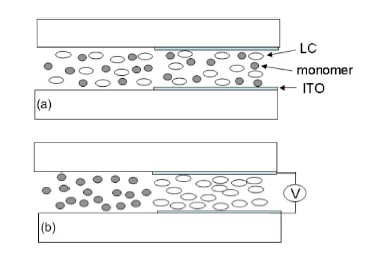
The new lens, which has been built by Shin-Tson Wu and colleagues at the University of Central Florida, allows the focus to be changed in a new way. The device consists of a mixture of liquid-crystal molecules and smaller N-vinylpyrrollidone monomers placed between two glass substrates, each of which is coated with a thin transparent layer of conducting indium tin oxide (figure 1). They then placed a concave glass lens with a flat base on top of one of the substrates.

Without any voltage, the liquid-crystal/monomer mixture was uniformly distributed throughout the gap between the substrates. But when the researchers applied a voltage across the two substrates, the liquid-crystal molecules clumped together at either end of the gap, where the electric field was higher, while the monomers moved towards the middle of the gap, where the field was lower (figure 2).

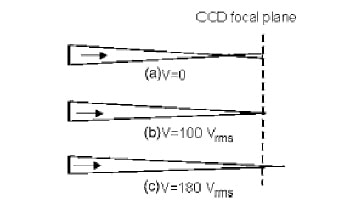
As a result of this concentration gradient, the refractive index varied across the device, being highest at the ends and lowest in the middle. The device therefore functioned as a lens, which the researchers proved by firing a helium-neon laser through it and focusing the light on a CCD camera. The researchers were able to increase the lens’s focal length simply by turning up the voltage across the device (figure 3).

Moreover, since no molecular reorientation is involved, the new lens overcomes some of the problems associated with conventional liquid-crystal lenses, such as strong astigmatism (when the lens cannot focus properly), distortion or light scattering during focus change.

The only snag with the new device is its long focusing time of about three minutes. This is because the lens is relatively large (9 mm), which means that molecular diffusion across it is slow. However, this should not be problem in micro-sized lenses in which the estimated response time is around 1 second at room temperature. The technique could also be used to make other adaptive microdevices such as prism arrays and phase gratings, say the researchers.

Magnetic fields go to the maximum

All compact astronomical objects, such as white dwarfs, neutron stars and black holes, have enormous magnetic fields — as high as 1017 G — associated with them. The Earth’s magnetic field, in contrast, is less than 1 G. However, theorists have also predicted that hypothetical objects called superconductive cosmic strings could have even higher magnetic fields near them of 1047 to 1048 G.

Cosmic strings are believed to be extremely thin 1D topological defects in the fabric of spacetime that stretch across the universe, perhaps making up structures like galaxies as they loop around themselves. They are invoked in grand unified particle physics models and are thought to have been produced just after the Big Bang.

However, the new maximum value for magnetic fields of 1042 G, which has been calculated by Anatoly Shabad of the Lebedev Physics Institute in Moscow and Vladimir Usov at the Weizmann Institute of Science in Rehovot, is lower than that associated with cosmic strings. If correct, it would rule out the existence of extremely strong magnetic fields in the vicinity of these objects.

The value obtained is 109 times lower than the previous upper limit of 1051 G, which had the drawback that it assumed that “Dirac monopoles” exist in Nature. Predicted by some theories that seek to unify the electroweak and strong interactions, these particles have never yet been observed experimentally.

Shabad and Usov obtained their result by considering what the maximum possible value of the magnetic field could be in pure quantum electrodynamics (QED), which describes the fundamental forces between particles as being due to the exchange of “field quanta”. Until now, scientists believed that a magnetic field could take on arbitrarily high values in QED.

The duo employed the so-called “Bethe-Salpeter” equation, which is good for studying relativistically bound states formed from charged particles interacting with each other. The physicists solved the equation in the case of a positronium atom, which contains an electron and a positron.

In their calculation, Shabad and Usov place a positronium in a strong magnetic field and find that, at relativistic energies of the electron and positron inside the positronium, the field enhances the attraction between the particles. This attraction becomes stronger and stronger until the electron and positron “fall” onto one another at a maximum field of 1042 G. The authors call this the “collapse” of the positronium.

At this value of field, the energy gap separating the electron and positron shrinks so that the positronium becomes indistinguishable from the vacuum. According to the researchers, this means that fields higher than 1042 are not possible. “If they were,” explains Shabad, “the vacuum would explode by producing collapsed positronia.” One crucial mechanism in the calculation is that a magnetic field larger than the “maximum value” would be needed to separate the electron from the positron.

Copyright © 2026 by IOP Publishing Ltd and individual contributors