Radioactive fun! This 1955 children’s board game was inspired by the US government’s drive to encourage the domestic discovery and mining of uranium. (Courtesy: Oak Ridge Associated Universities Museum of Radiation and Radioactivity)
The uranium craze that hit America in the 1950s was surely one of history’s strangest fads. Jars of make-up lined with uranium ore were sold as “Revigorette” and advertised as infusing “beautifying radioactivity [into] every face cream”. A cosmetics firm applied radioactive soil to volunteers’ skin and used Geiger counters to check whether its soap could wash it away. Most astonishing of all, a uranium mine in the US state of Montana developed a sideline as a health spa, inviting visitors to inhale “a constant supply of radon gas” for the then-substantial sum of $10.
The story of this craze, and much else besides, is entertainingly told in Lucy Jane Santos’ new book Chain Reactions: a Hopeful History of Uranium. Santos is an expert in the history of 20th-century leisure, health and beauty rather than physics, but she is nevertheless well-acquainted with radioactive materials. Her previous book, Half Lives, focused on radium, which had an equally jaw-dropping consumer heyday earlier in the 20th century.
The shift to uranium gives Santos the license to explore several new topics. For physicists, the most interesting of these is nuclear power. Before we get there, though, we must first pass through uranium’s story from prehistoric times up to the end of the Second World War. From the uranium-bearing silver mines of medieval Jachymóv, Czechia, to the uranium enrichment facilities founded in Oak Ridge, Tennessee as part of the Manhattan Project, Santos tells this story in a breezy, anecdote-driven style. The fact that many of her chosen anecdotes also appear in other books on the histories of quantum mechanics, nuclear power or atomic weapons is hardly her fault. This is well-trodden territory for historians and publishers alike, and there are only so many quirky stories to go around.
The most novel factor that Santos brings to this crowded party is her regular references to people whose role in uranium’s history is often neglected. This includes not only female scientists like Lise Meitner (co-discoverer of nuclear fission) and Leona Woods (maker of the boron trifluoride counter used in the first nuclear-reactor experiment), but also the “Calutron Girls”, who put in 10-hour shifts six days a week at the Oak Ridge plant and were not allowed to know that they were enriching uranium for the first atomic bomb. Other “hidden figures” include the Allied prisoners who worked the Jachymóv mines for the Nazis; the political “undesirables” who replaced them after the Soviets took over; and the African labourers who, though legally free, experienced harsh conditions while mining uranium ore at Shinkolobwe (now in the Democratic Republic of the Congo) for the Belgians and, later, the Americans.
Most welcome of all, though, are the book’s references to the roles of Indigenous peoples. When Robert Oppenheimer’s Manhattan Project needed a facility for transmuting uranium into plutonium, Santos notes that members of the Wanapum Nation in eastern Washington state were given “a mere 90 days to pack up and abandon their homes…mostly with little compensation”. The 167 residents of Bikini island in the Pacific were even less fortunate, being “temporarily” relocated before the US Army tested an atomic bomb on their piece of paradise. Santos quotes the American comedian Bob Hope – nobody’s idea of a woke radical – in summing up the result of this callous act: “As soon as the war ended, we located the one spot on Earth that hadn’t been touched by war and blew it to hell.”
The most novel factor that Santos brings to this crowded party is her regular references to people whose role in uranium’s history is often neglected
These injustices, together with the radiation-linked illnesses experienced by the (chiefly Native American) residents of the Trinity and Nevada test sites, are not the focus of Chain Reactions. It could hardly be “a hopeful history” if they were. But while mentioning them is a low bar, it’s a low bar that the three-hour-long Oscar-winning biopic Oppenheimer didn’t manage to clear. If Santos can do it in a book not even 300 pages long, no-one else has any excuse.
Chain Reactions is not a science-focused book, and in places it feels a little thin. For example, while Santos correctly notes that the “gun” design of the first uranium bomb wouldn’t work for a plutonium weapon, she doesn’t say why. Later, she states that “making a nuclear reactor safe enough and small enough for use in a car proved impossible”, but she leaves out the scientific and engineering reasons for this. The book’s most eyebrow-raising scientific statement, though, is that “nuclear is one of the safest forms of electricity produced – only beaten by solar”. This claim is neither explained nor footnoted, and it left me wondering, first, what “safest” means in this context, and second what makes wind, geothermal and tidal electricity less “safe” than nuclear or solar?
Despite this, there is much to enjoy in Santos’ breezy and – yes – hopeful history. Although she is blunt when discussing the risks of nuclear energy, she also points out that when countries stop using it, they mostly replace nuclear power plants with fossil-fuel ones. This, she argues, is little short of disastrous. Quite apart from the climate impact, ash from coal-fired power plants carries radiation from uranium and thorium into the environment “at a much larger rate than any from a nuclear power plant”. Thus, while the 2011 meltdown of Japan’s Fukushima reactors killed no-one directly, Japan and Germany’s subsequent phase-out of nuclear power contributed to an estimated 28,000 deaths from air pollution. Might a revival of nuclear power be better? Santos certainly thinks so, and she concludes her book with a slogan that will have many physicists nodding along: “Nuclear power? Yes please.”
If the Earth was a perfect sphere or ellipsoid, modelling its gravitational field would be easy. But it isn’t, so geoscientists instead use an approximate model based on a so-called Brillouin sphere. This is the smallest geocentric sphere that the entire planet fits inside, and it touches the Earth at a single point: the summit of Mount Chimborazo in Ecuador, near the crest of the planet’s equatorial bulge.
For points outside this Brillouin sphere, traditional methods based on spherical harmonic (SH) expansions produce a good approximation of the real Earth’s gravitational field. But for points inside it – that is, for everywhere on or near the Earth’s surface below the peak of Mount Chimborazo – these same SH expansions generate erroneous predictions.
A team of physicists and mathematicians from the universities of Ohio State and Connecticut in the US has now probed the difference between the model’s predictions and the actual field. Led by Ohio State geophysicist Michael Bevis, the team showed that the SH expansion equations diverge below the Brillouin sphere, leading to errors. They also quantified the scale of these errors.
Divergence is a genuine problem
Bevis explains that the initial motivation for the study was to demonstrate through explicit examples that a mathematical theory proposed by Ohio State’s Ovidiu Costin and colleagues in 2022 was correct. This landmark paper was the first to show that SH expansions of the gravitational potential always diverge below the Brillouin sphere, but “at the time, many geodesists and geophysicists found the paper somewhat abstract”, Bevis observes. “We wanted to convince the physics community that divergence is a genuine problem, not just a formal mathematical result. We also wanted to show how this intrinsic divergence produces model prediction errors.”
In the new study, the researchers demonstrated that divergence-driven prediction error increases exponentially with depth beneath the Brillouin sphere. “Furthermore, at a given point in free space beneath the sphere, we found that prediction error decreases as truncation degree N increases towards its optimal value, Nopt,” explains Bevis. Beyond this point, however, “further increasing N will cause the predictions of the model to degrade [and] when N >> Nopt, prediction error will grow exponentially with increasing N.”
The most important practical consequence of the analysis, he tells Physics World, was that it meant they could quantify the effect of this mathematical result on the prediction accuracy of any gravitational model formed from a so-called truncated SH expansion – or SH polynomial – anywhere on or near the surface of the Earth.
Synthetic planetary models
The researchers obtained this result by taking a classic theory developed by Robert Werner of the University of Texas at Austin in 1994 and using it to write code that simulates the gravitational field created by a polyhedron of constant density. “This code uses arbitrary precision arithmetic,” explains Bevis, “so it can compute the gravitational potential V and gravitational acceleration g anywhere exterior to a synthetic planet composed of hundreds or thousands of faces with a triangular shape.
“The analysis is precise to many hundreds of significant digits, both above and below the Brillouin sphere, which allowed us to test and validate the asymptotic expression derived by Costin et al. for the upper limit on SH model prediction error beneath the Brillouin sphere.”
The new work, which is described in Reports on Progress in Physics, shows that traditional SH models of the gravitational field are fundamentally flawed when they are applied anywhere near the surface of the planet. This is because they are attempting to represent a definite physical quantity with a series that is actually locally diverging. “Our calculations emphasize the importance of finding a new approach to representing the external gravitational field beneath the Brillouin sphere,” says Bevis. “Such an approach will have to avoid directly evaluating SH polynomials.”
Ultimately, generalizations of the new g simulator will help researchers formulate and validate the next generation of global gravity models, he adds. This has important implications for inertial navigation and perhaps even the astrophysics of exoplanets.
The team is now working to improve the accuracy of its gravity simulator so that it can better model planets with variable internal density and more complex topography. They are also examining analytical alternatives to using SH polynomials to model the gravitational field beneath the Brillouin sphere.
The paper appears in IOP Publishing’s flagship journal, Reports on Progress in Physics, which now publishes original research.
The nuclear physicist Martin Freer is to be the next chief executive of the Faraday Institution – the UK’s independent institute for electrochemical energy-storage research. Freer, who is currently based at the University of Birmingham, will take up the role on 2 September. He replaces the condensed-matter physicist Pam Thomas, who stepped down in April after almost four years as boss.
The Faraday Institution was set up in 2017 to help research scientists and industry experts to reduce the cost and weight of batteries and improve their performance and reliability. From its base at the Harwell Science and Innovation Campus in Oxfordshire, it carries out research, training, market analysis and early-stage commercialization, with the research programme currently involving 27 UK universities and 50 businesses.
With a PhD in nuclear physics from Birmingham, Freer has held a number of high-profile roles in the energy sector, including director of the Birmingham Centre for Nuclear Education and Research, which he established in 2010. Five years later he became director of the university’s Birmingham Energy Institute.
Freer told Physics World that joining the Faraday Institution is a “tremendous opportunity”, especially when it comes to the transition to electric vehicles and ensuring that UK battery innovation plays an integral part.
“Energy storage is going to be needed to manage our future energy system from domestic to grid scale and there is a crucial role for the Faraday Institution to play,” says Freer. “This is a globally competitive sector, and the UK needs to ensure it does not lose the advantage it has created for itself through the Faraday Battery Challenge.”
Theoretical physicist Steven Cowley, who is chair elect of the Faraday Institution, notes that Freer is a “proven leader” and is a “terrific fit” for the institution.
“[Freer] knows first-hand what it takes to work with industry and policy makers to translate research into future energy technologies on the ground,” notes Cowley, who is director of the Princeton Plasma Physics Laboratory in the US. “[He] will help to accelerate its mission as it further establishes itself in the UK’s research ecosystem.”
A former South Dakota gold mine is the last place you might think to look to solve one of the universe’s biggest mysteries. Yet what lies buried in the Sanford Underground Research Facility, 1.47 km beneath the surface, could be our best chance of detecting the ghost of the galaxy: dark matter.
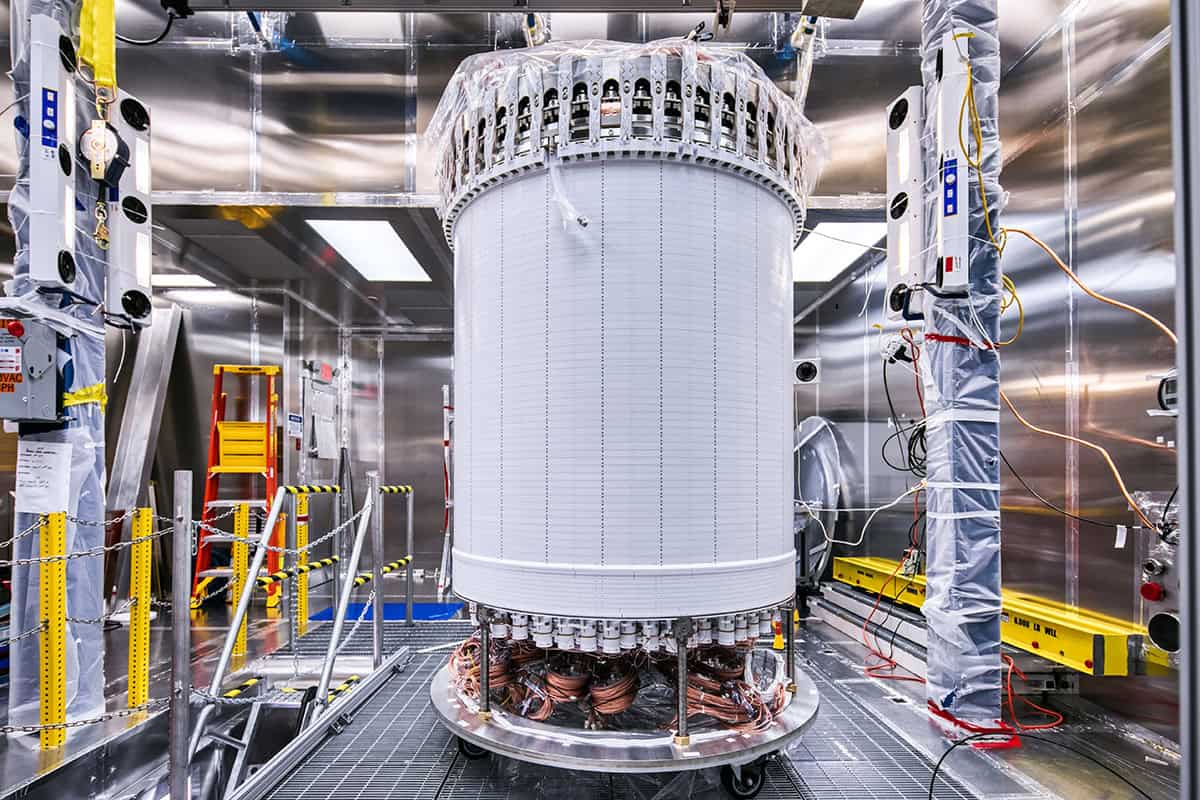
Deep within those old mine tunnels, accessible only by a shaft from the surface, is seven tonnes of liquid xenon, sitting perfectly still (figure 1).
This is the LUX-ZEPELIN (LZ) experiment. It’s looking for the tiny signatures that dark matter is predicted to leave in its wake as it passes through the Earth. To have any chance of success, LZ needs to be one of the most sensitive experiments on the planet.
“The centre of LZ, in terms of things happening, is the quietest place on Earth,” says Chamkaur Ghag, a physicist from University College London in the UK, and spokesperson for the LZ collaboration. “It is the environment in which to look for the rarest of interactions.”
For more than 50 years astronomers have puzzled over the nature of the extra gravitation first observed in galaxies by Vera Rubin, assisted by Kent Ford, who noticed stars orbiting galaxies under the influence of more gravity than could be accounted for by visible matter. (In the 1930s Fritz Zwicky had noticed a similar phenomenon in the movement of galaxies in the Coma Cluster.)
The standard model of cosmology tells us that about 27% of all the matter and energy in the universe is dark matter, but no-one knows what it actually is. One possibility is a hypothetical breed of particle called a weakly interacting massive particle (WIMP), and it is these particles that LZ is hoping to find. WIMPs are massive enough to produce a substantial gravitational field, but they otherwise only gently interact with normal matter via the weak force.
With more questions than answers, the search for dark matter is heading for a showdown
“The easiest explanation to solve dark matter would be a fundamental particle that interacts like a WIMP,” says Ghag. Should LZ fail in its mission, however, there are other competing hypotheses. One in particular that is lurking in the wings is a lightweight competitor called the axion.
Experiments are under way to pin down this vast, elusive portion of the cosmos. With more questions than answers, the search for dark matter is heading for a showdown.
Going deep underground
According to theory, as our solar system cruises through space we’re moving through a thin fog of dark matter. Most of the dark-matter particles, being weakly interacting, would pass through Earth, but now and then a WIMP might interact with a regular atom.
This is what LZ is hoping to detect, and the seven tonnes of liquid xenon are designed to be a perfect WIMP trap. The challenge the experiment faces is that even if a WIMP were to interact with a xenon atom, it has to be differentiated from the other particles and radiation, such as gamma rays, that could enter the liquid.
1 Buried treasure
(Courtesy: Matthew Kapust, Sanford Underground Research Facility)
The seven-tonne tank of liquid xenon that comprises the LZ detector. The experiment is located almost a mile beneath the Earth to reduce background effects, which astronomers hope will enable them to identify weakly interacting massive particles (WIMPs).
Both a gamma ray and a WIMP can create a cloud of ionized free electrons inside the detector, and in both cases, when the ionized electrons recombine with the xenon atoms, they emit flashes of light. But both mechanisms are slightly different, and LZ is designed to detect the unique signature of a WIMP interaction.
When a gamma ray enters the detector it can interact with an electron in the xenon, which flies off and causes a chain of ionizations by interacting with other neighbouring electrons. The heavy WIMP, however, collides with the xenon nucleus, sending it spinning through the liquid, bumping into other nuclei, and indirectly ionizing a few atoms along the way.
To differentiate these two events, an electric field of a few tens of kilovolts is cast across the xenon tank, drawing some of the ionized electrons toward the top of the tank before they can recombine. When these electrons reach the top, they enter a thin layer of gas and produce another, second, burst of light.
When a gamma ray enters the tank, the second flash is brighter than the first – the recoil electron flies off like a bullet, and most of the electrons it liberates are pulled up by the detector before they recombine.
A nucleus is much heavier than an electron, so when a WIMP interacts with the xenon, the path of the recoil is shorter. The cloud of electrons generated by the interaction is therefore localized to a smaller area and more of the electrons find a “partner” ion to recombine with before the electric field can pull them away. This means that for a WIMP, the first flash is brighter than the second.
In practice, there is a range of brightnesses depending upon the energies of the particles, but statistically an excess of brighter first flashes above a certain background level would be a strong signature of WIMPs.
“Looking for dark matter experimentally is about understanding your backgrounds perfectly,” explains Ghag. “Any excess or hint of a signal above our expected background model – that’s what we’re going to use to ascribe statistical significance.”
LZ is now up and running, as of late 2021, and has completed about 5% of its search. Before it could begin its hunt, the project had to endure a five-year process to screen every component of the detector, to make sure that the background effects of every nut, bolt and washer have been accounted for.
WIMPs in crisis?
How many, if any, WIMPs are detected will inform physicists about the interaction cross-section of the dark-matter particle – meaning how likely it is to interact with normal matter it comes into proximity with.
The timing couldn’t be more crucial. Some of the more popular WIMP candidates are predicted by a theory called “supersymmetry”, which posits that every particle in the Standard Model has a more massive “superpartner” with a different quantum spin. Some of these superpartners were candidates for WIMPs but the Large Hadron Collider (LHC) has failed to detect them, throwing the field – and the hypothetical WIMPs associated with them – into crisis.
Francesca Chadha-Day, a physicist who works at Durham University and who studies dark-matter candidates based on astrophysical observations, thinks time may be up for supersymmetry. “The standard supersymmetric paradigm hasn’t materialized, and I think it might be in trouble,” she says.
Ruling out WIMPs now would be like building the LHC but stopping before turning it on
Chamkaur Ghag
She does, however, stress that supersymmetry is “only one source of WIMPs”. Supersymmetry was proposed to explain certain problems in physics, such as why gravity is more feeble than the weak force. Even if supersymmetry is a dead end, there are alternative theories to solve these problems that also predict the existence of particles that could be WIMPs.
“It’s way too early to give up on WIMPs,” adds Ghag. LZ needs to run for at least 1000 days to reach its full sensitivity and he says that ruling out WIMPs now would be “like building the LHC but stopping before turning it on”.
The axion universe
With question marks nevertheless hanging over WIMPs, an alternative type of dark-matter particle has been making waves.
Dubbed axions, Chadha-Day describes them as “dark matter for free”, because they were developed to solve an entirely different problem.
“There’s this big mystery in particle physics that we call the Strong CP Problem,” says Chadha-Day. C refers to charge and P, parity. The CP problem describes how, if you switch a particle for its oppositely charged antiparticle and swap it for a spatial mirror image, the laws of physics would still function the same for it.
The Standard Model predicts that the strong force, which glues quarks together inside protons and neutrons, should actually violate CP symmetry. Yet in practice, it plays ball with the conservation of charge and parity. Something is intervening and interacting with the strong force to maintain symmetry. This something is proposed to be the axion.
“The axion is by far the most popular way of solving the Strong CP Problem because it is the simplest,” says Chadha-Day. “And then when you look at the properties of the axion you also find that it can act as dark matter.”
Supersymmetry’s difficulties have seen a recent boom in support for axions as dark matter
These properties include rarely interacting with other particles and sometimes being non-relativistic, meaning that some axions would move slowly enough to clump into haloes around galaxies and galaxy clusters, which would account for their additional mass. Like WIMPs, however, axions have yet to be detected.
Supersymmetry’s difficulties have seen a recent boom in support for axions as dark matter. “There are strong motivations for axions,” says Ghag, “Because they could exist even if they are not dark matter.”
Lensing patterns
Axions are predicted to be lighter than WIMPs and to interact with matter via the electromagnetic force (and gravity) rather than the weak force. Experiments to directly detect axions use magnetic fields, because in their presence an axion can transform into a photon. However, because axions might exist even if they aren’t dark matter, to test them against WIMPs, physicists have to take a different approach.
The extra mass from dark matter around galaxies and galaxy clusters can bend the path of light coming from more distant objects, magnifying them and warping their appearance, sometimes even producing multiple images (figure 2). The shape and degree of this effect, called “gravitational lensing”, is impacted by the distribution of dark matter in the lensing galaxies. WIMPs and axions are predicted to distribute themselves slightly differently, so gravitational lensing can put the competing theories to the test.
2 Seeing quadruple
(Courtesy: NASA, ESA, A Nierenberg (JPL) and T Treu (UCLA))
Galaxies and galaxy clusters can bend the light coming from bright background objects such as quasars, creating magnified images. If the lensing effect is strong, as in these images, we may even observe multiple images of a single quasar. The top right image shows quasar HS 0810+2554 (see figure 4).
If dark matter is WIMPs, then they will form a dense clump at the centre of a galaxy, smoothly dispersing with increasing distance. Axions, however, operate differently. “Because axions are so light, quantum effects become more important,” says Chadha-Day.
These effects should show up on large scales – the axion halo around a galaxy is predicted to exhibit long-range quantum interference patterns, with the density fluctuating in peaks and troughs thousands of light-years across.
Gravitational lensing could potentially be used to reveal these patterns, using something called the “critical curve”. Think of a gravitational lens as a series of lines where space has been warped by matter, like on a map where the contour lines indicate height. The critical curve is where the contours bunch up the most (figure 3).
Gravitational lensing around the Abell 1689 galaxy cluster. Red lines indicate the critical curve where magnification is infinite and yellow contours indicate the regions of the sky where objects are magnified by more than a factor of 10.
Critical curves “are lines of sight in the universe where you get enormous magnification in gravitational lensing, and they have different patterns depending on whether dark matter is WIMPs or axions”, says Massey. With axions, the quantum interference pattern can render the critical curve wavy.
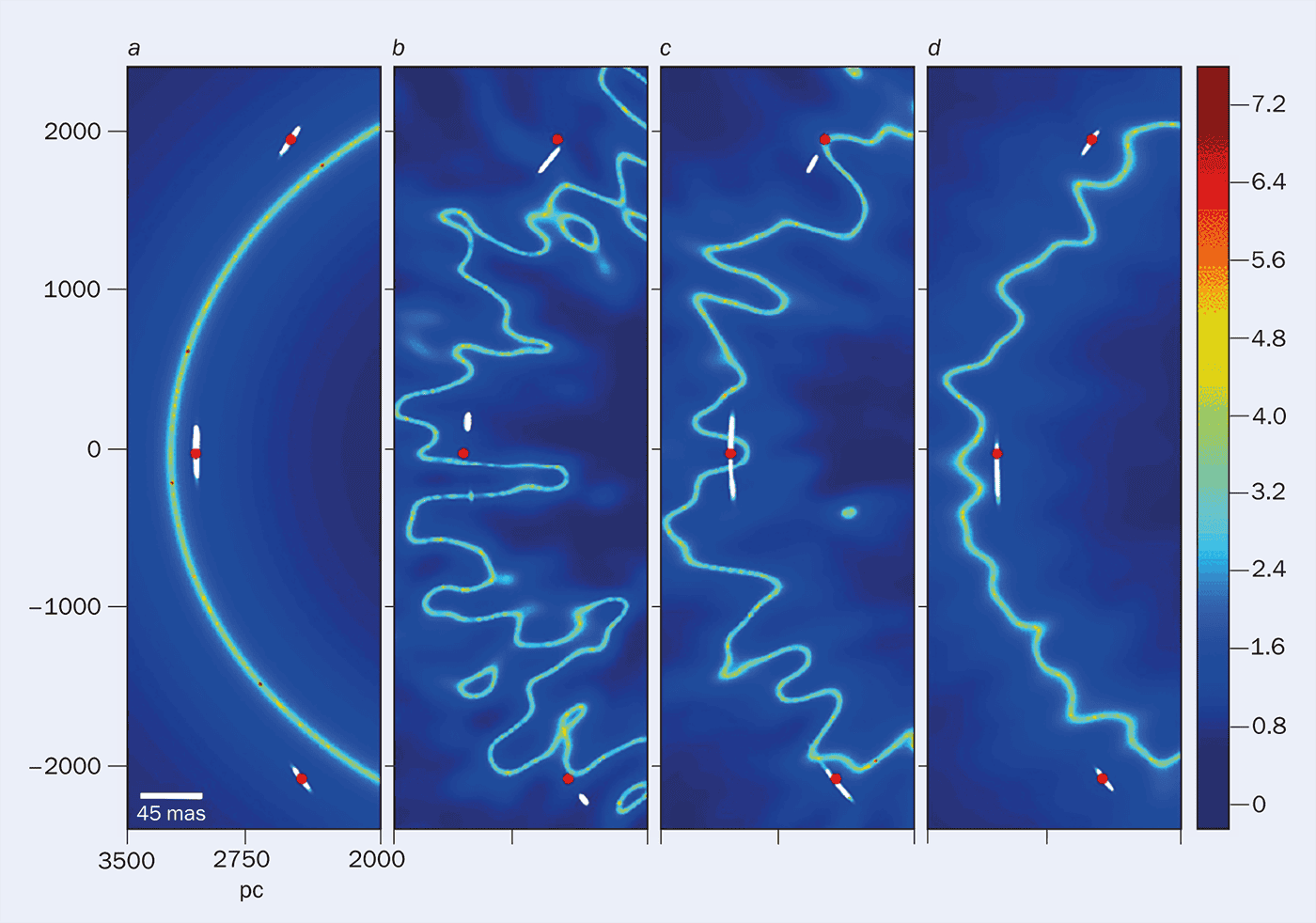
In 2023 a team led by Alfred Amruth of the University of Hong Kong found some evidence of wavy effects in the critical curve. They studied the quasar HS 0810+2554 – the incredibly luminous core of a distant galaxy that is being gravitationally lensed (we can see four images of it from Earth) by a foreground object. They found that the lensing pattern could be better explained by axions than WIMPs (figure 4), though because they only studied one system, this is far from a slam dunk for axions.
Dark-matter interactions
Massey prefers not to tie himself to any one particular model of dark matter, instead opting to take a phenomenological approach. “I look to test whether dark-matter particles can interact with other dark-matter particles,” he says. Measuring how much dark matter interacts with itself (another kind of cross section) can be used to narrow down its properties.
The shape of a gravitational lens would change depending on whether dark matter is WIMPs or axions. Alfred Amruth and colleagues developed a model of the gravitational lensing of quasar HS 0810+2554 (see figure 2). Light from the quasar is bent around a foreground galaxy, and the shape of the gravitational lensing depends on the properties of the dark matter in the galaxy. The researchers tested models of both WIMP-like and axion-like dark matter.
The colours indicate the amount of magnification, with the light blue lines representing the critical curves of high magnification. Part a shows a model of WIMP-like dark matter, whereas b, c and d show different models of axionic dark matter. Whereas the WIMP-like critical curve is smooth, the interference between the wavelike axion particles makes the critical curve wavy.
The best natural laboratories in which to study dark matter interacting with itself are galaxy cluster collisions, where vast quantities of matter and, theoretically, dark matter collide. If dark-matter halos are interacting with each other in cluster collisions, then they will slow down, but how do you measure this when the objects in question are invisible?
“This is where the bits of ordinary matter are actually useful,” says Massey. Cluster collisions contain both galaxies and clouds of intra-cluster hydrogen. Using gravitational lensing, scientists can work out where the dark matter is in relation to these other cosmic objects, which can be used to work out how much it is interacting.
The galaxies in clusters are so widely spaced that they sail past each other during the collision. By contrast, intra-cluster hydrogen gas clouds are so vast that they can’t avoid each other, and so they don’t move very far. If the dark matter doesn’t interact with itself, it should be found out with the galaxies. If the interaction is strong, however, it will be located with the hydrogen clouds. If it interacts just a bit, then the dark matter will be somewhere in-between. Its location can therefore be used to estimate the interaction cross-section, and this value can be handed to theorists to test which dark-matter model best fits the bill.
High-altitude astronomy
The problem is that cluster collisions can take a hundred million years to run their course. What’s needed is to see galaxy cluster collisions at all stages, with different velocities, from different angles.
Enter SuperBIT – the Super Balloon-borne Imaging Telescope, on which Massey is the UK principal investigator. Reaching 40 km into the atmosphere while swinging beneath a super-pressure balloon provided by NASA, SuperBIT was a half-metre aperture telescope designed to map dark matter in as many galaxy-cluster collisions as possible to piece together the stages of such a collision.
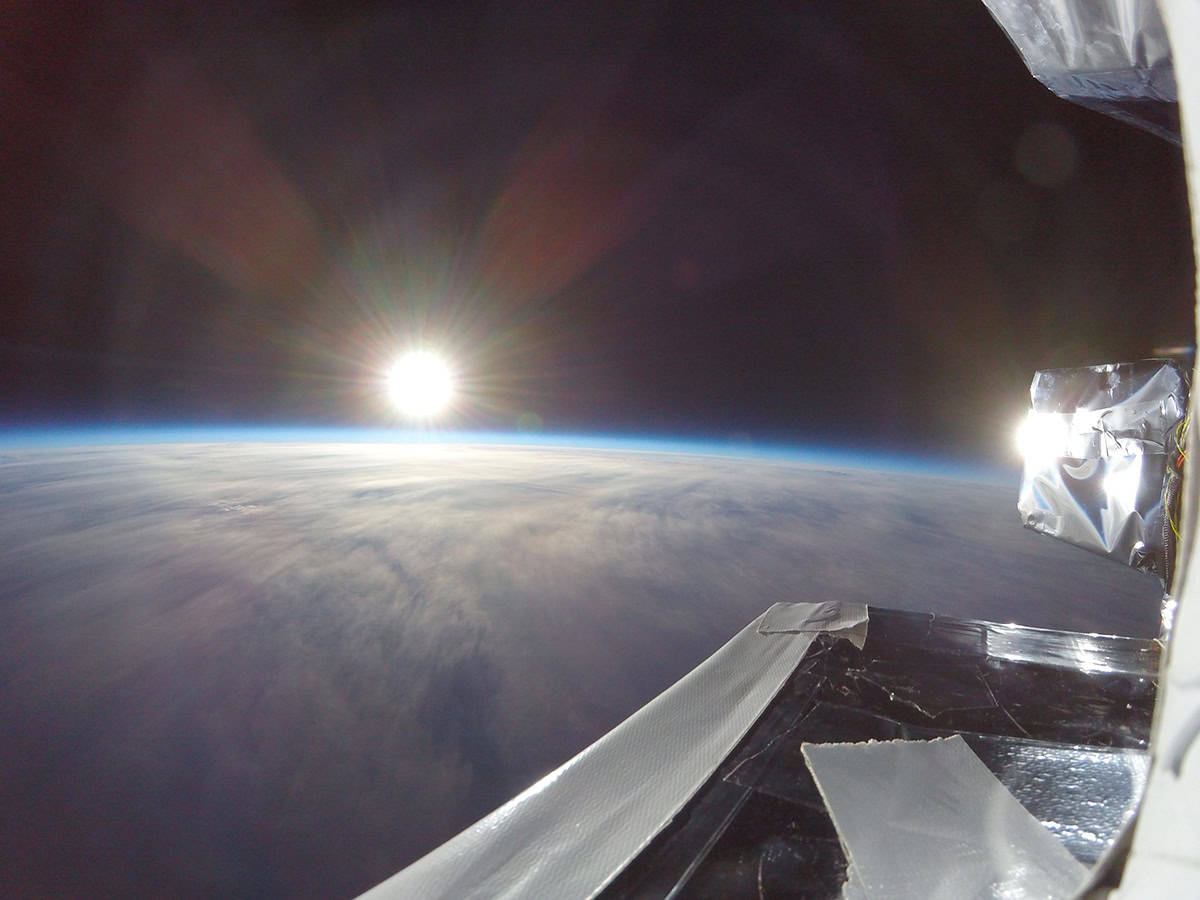
SuperBIT flew five times, embarking on its first test flight in September 2015 (figure 5). “We would bring it back down, tinker with it, improve it and send it back up again, and by the time of the final flight it was working really well,” says Massey.
5 Far from home
(CC BY-SA Javier Romualdez/SuperBIT)
The SuperBIT telescope took gravitational lensing measurements of cluster collisions to narrow down the properties of dark matter. This photo of the Earth was taken from SuperBIT during one of its five flights.
That final flight took place during April and May 2023, launching from New Zealand and journeying around the Earth five and a half times. The telescope parachuted to its landing site in Argentina, but while it touched down well enough, the release mechanism had frozen in the stratosphere and the parachute did not detach. Instead, the wind caught it and dragged SuperBIT across the landscape.
“It went from being aligned to within microns to being aligned within kilometres! The whole thing was just a big pile of mirrors and metal, gyroscopes and hard drives strewn across Argentina, and it was heart-breaking,” says Massey, who laughs about it now. Fortunately, the telescope had worked brilliantly and all the data had been downloaded to a remote drive before catastrophe struck.
As long as a detection remains elusive, the identity of dark matter will continue to be a sore point for astronomers and physicists
The SuperBIT team is working through that data now. If there is any evidence that dark-matter particles have collided, the resulting estimate of the interaction cross-section will point to specific theoretical models and rule out others.
Astronomical observations can guide us, but only a positive detection of a dark-matter particle in an experiment such as LZ will settle the matter. As long as a detection remains elusive, the identity of dark matter will continue to be a sore point for astronomers and physicists. It also keeps the door ajar for alternative theories, and proponents of modified Newtonian dynamics (MOND) are already trying to exploit those cracks, as we shall see in the third and final part of this series.
In the first instalment of this three-part series, Keith Cooper explored the struggles and successes of modified gravity in explaining phenomena at varying galactic scales
Water is a vital resource to society and is one of the main focus areas for the United Nations Sustainable Development Goals. However, around two thirds of the world still doesn’t have regular access to freshwater – with people in this category facing water scarcity for at least a month each year.
Alongside, every two minutes a child dies from water-, sanitation- and hygiene-related diseases; and freshwater sources are becoming ever more polluted, causing further stress on water supplies. With many water-related challenges around the world, new ways of producing freshwater are being sought. In particular, solar steam-based desalination methods are seen as a green way of producing potable water from seawater.
Solar steam generation a promising approach
There are various water treatment technologies available today, but one that has gathered a lot of attention lately is solar steam generation. Interfacial solar absorbers convert solar energy into heat to remove the salt from seawater and produce freshwater. By localizing the absorbed energy at the surface, interfacial solar absorbers reduce heat loss to bulk water.
Importantly, solar absorbers can be used off-grid and in remote regions, where potable water access is the most unreliable. However, many of these technologies cannot yet be made at scale because of salt crystallization on the solar absorber, which reduces both the light absorption and the surface area of the interface. Over time, the solar absorption capabilities become reduced and the supply of water becomes obstructed.
Quasi-waffle design could prevent crystallization
To combat the salt crystallization challenge, researchers in China have developed a waffle-shaped solar evaporator (WSE). The WSE is made of a graphene-like porous monolith, fabricated via a zinc-assisted pyrolysis route using biomass and recyclable zinc as the precursor materials.
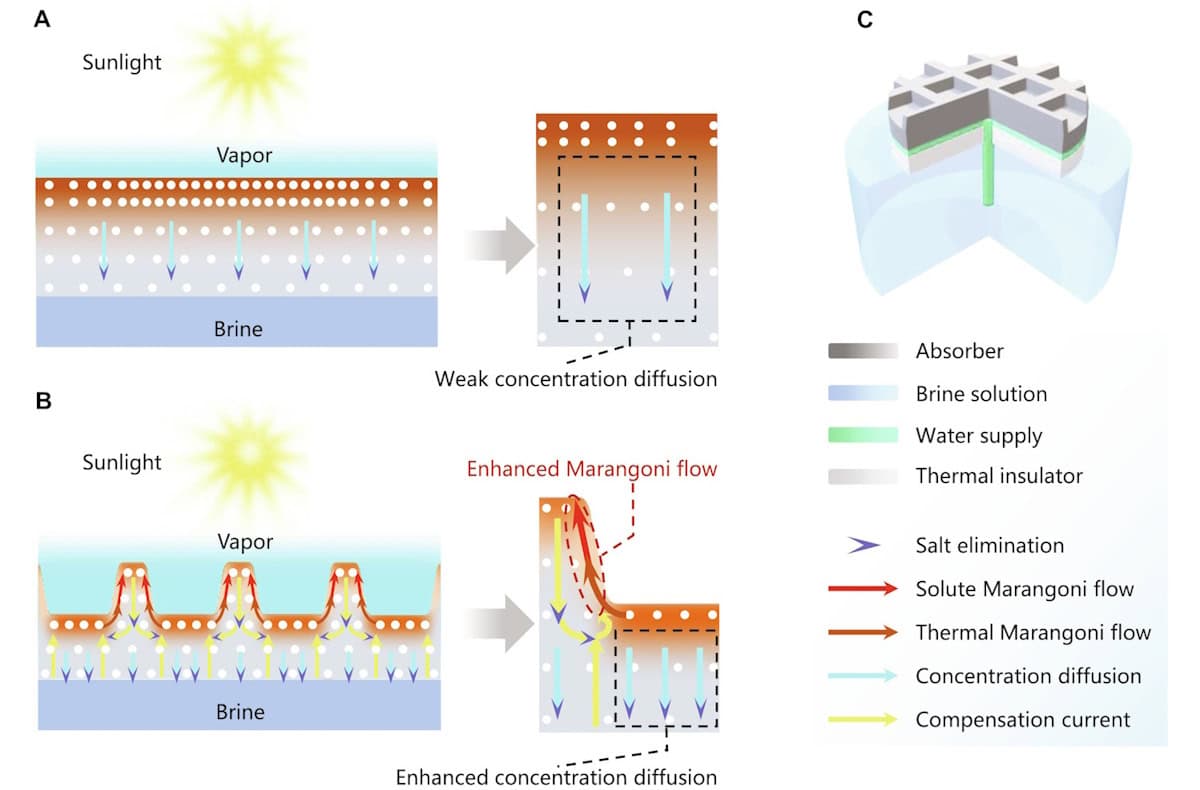
First authors Yanjun Wang and Tianqi Wei from Nanjing University and their colleagues designed the WSE with a basin and ribs, plus extra sidewalls (that conventional plane-shaped solar evaporators don’t have) to drive the Marangoni effect in the device. The Marangoni effect is the flow of fluid from regions with low surface tension to those of high surface tension. Marangoni effects can be induced by both gradients in solute concentration or in temperature – and the WSE’s extra sidewalls trigger both effects.
WSE schematic Brine evaporation in a conventional plane evaporator (A) and a WSE (B); white spots denote salt concentration; blue arrows indicate salt transport. The extra sidewalls in the WSE induce Marangoni flows (red and brown arrows). C) The interfacial solar steam generation device. (Courtesy: Y Wang et al Sci. Adv. 10.1126/sciadv.adk1113)
When the saltwater evaporates, the faster evaporation and more efficient heat consumption on the plateaus than in the basins creates gradients in solute concentration and temperature. Based on these gradients, the sidewalls then generate a surface-tension gradient, which induces solute- and temperature-driven Marangoni flows in the same direction.
The two Marangoni effects increase the convection of fluid in the device, accelerating the transport of salt ions and diluting the maximum salinity of the system below the critical saturation value – therefore preventing salt crystallization from occurring. This leads to continuous salt rejection with reduced fouling at the interface.
The WSE delivers a solar absorption of 98.5% and high evaporation rates of 1.43 kg/m2/h in pure water and 1.40 kg/m2/h in seawater. In an outdoor experiment using a prototype WSE to treat a brine solution, the device produced freshwater at up to 2.81 l/m2 per day and exhibited continuous operation for 60 days without requiring cleaning.
The WSE’s ability to alleviate the salt crystallization issues, combined with its cost-efficiency, means that the device could theoretically be commercially scalable in the future.
Overall, the WSE overcomes the three main obstacles faced when designing solar desalination devices: efficient water evaporation and condensation, and preventing salt fouling. While the device achieved a high desalination stability (evident from the long cleaning cycles), the evaporation rate is currently restricted by the upper limits of a single-stage evaporator. The researchers point out that introducing a multistage evaporator to the system could help improve the solar-to-water efficiency and the freshwater yield of the device. They are now designing such a multistage evaporator to further their current research.
Over the last century, optics and photonics have transformed the world. A staggering 97% of all intercontinental communications traffic travels down optical fibres, enabling around $10 trillion of business transactions daily across the globe. Young people especially are at the heart of some of the most dramatic changes in optical technologies the world has ever witnessed.
Whether it’s a growing demand for higher data rates, larger cloud storage and cleaner energy supplies – or simply questions around content and self-censorship – communications networks, based on optics and photonics, are a crucial aspect of modern life. Even our knowledge of the impact of climate change comes mostly from complex optical instruments that are carried by satellites including spectrometers, narrow linewidth lasers and sophisticated detectors. They provide information that can be used to model key aspects of the Earth’s atmosphere, landforms and oceans.
Optics and photonics can also help us to monitor the behaviour of earthquakes and volcanoes – both terrestrial and underwater – and the risk and impact of tsunamis on coastal populations. The latter requires effective modelling together with satellite and ground-based observations.
Recent developments in optical quantum technologies are also beginning to bear fruit in areas such as high-resolution gravimetry. It allows tiny changes in subsurface mass distributions to be detected by measuring the spatial variations in gravity, and with it the movement of magma and the prediction of volcanic activity.
The challenge ahead
The UK-based Photonics Leadership Group (PLG) estimates that by 2035 more than 60% of the UK economy will directly depend on photonics to keep it competitive, becoming one of the top three UK economic sectors. PLG projects that the UK photonics industry will increase from £14.5bn today to £50bn over that period. The next 25 years are likely to see further significant advances in photonics, integrated circuits, far-infrared detector breakthroughs, free-space optical communication and quantum optical technologies.
There are likely to be breakthroughs in bandgap engineering in compound-semiconductor alloy technologies that will let us easily make and operate room-temperature very-long-wavelength infrared detectors and imaging devices. This could boost diagnostic medical imaging for management of pain, cancer detection and neurodiagnostics.
The joint effort between photonics and compound semiconductor materials science will become a significant capability in a sustainable 21st century and beyond. Defence and security are also likely to benefit from long-range spectroscopic identification of trace molecules. Optics and photonics will dominate space, with quantum technologies coming into service for communications and environmental monitoring, even if the proliferation of low-Earth-orbiting space objects are likely to cause congestion and hamper direct line-of-sight communications and monitoring.
Such developments, however, don’t come without their challenges, especially when adapting to the pace of change. Optics has a long history in the UK and the evolving nature of the subject is similar to that faced over a century ago by the Optical Society, Physical Society and the Institute of Physics (see box below).
Education will be key and making undergraduate courses attractive as will having a good balance of optics, photonics and fundamental physics in the curriculum. Making sure that students get experience in photonics engineering labs that reflect practical on-the-job tasks will be crucial as will close partnerships with the photonics industry and professional societies when aligning course content with the needs of the photonics industry.
Postgraduate photonics research in the UK remains strong, but we cannot rest on our laurels and it must be improved further, if not expanded.
Another challenge will be tackling the gap in optics and photonics advances between low-income nations and those that are high-income. These include access to optics and photonics education, research collaborations and mentoring as well as the need to equip developing nations with optics and photonics expertise to tackle global issues like desertification, climate change and the supply of potable water.
Desertification exacerbates economic, environmental and social issues and is entwined with poverty. According to the United Nations Convention to Combat Desertification, 3.2 billion people worldwide are negatively affected by spreading deserts. The International Commission for Optics is working with the International Science Council to tackle this by offering educational development, improving access to optical technologies and international collaborations with an emphasis on low-income countries.
If I had a crystal ball, I would say that over the next 25 years global economies will depend even more on optics and photonics for their survival, underpinning tighter social, economic and physical networks driven by artificial intelligence and quantum-communication technologies. Optical societies as professional bodies must play a leading role in addressing and communicating these issues head on. After all, only they can pull together like-minded professionals and speak with one voice to the needs and challenges of society.
Why the Optical Group of the Institute of Physics is the UK’s optical society
The Optical Group of the Institute of Physics, which is celebrating its 125th anniversary this year, can trace its roots back to 1899 when the Optical Society of London was formed by a group of enthusiastic optical physicists, led by Charles Parsons and Frank Twyman. Until 1931 it published a journal – Transactions of the Optical Society – which attracted several high-profile physicists including George Paget Thomson and Chandrasekhara Raman.
Many activities of the Optical Society overlapped with those of the Physical Society of London and they held several joint annual exhibitions at Imperial College London. When the two organizations formally merged in 1932, the Optical Group of the Physical Society became the de facto national optical society of the UK and Ireland.
In 1947 the Physical Society – via the Optical Group – became a signatory to the formation of the International Commission for Optics, which is now made up of more than 60 countries and provides policy recommendations and co-ordinates international activities in optics. The Optical Group is also a member of the European Optical Society.
In 1960 the Physical Society merged with the Institute of Physics (IOP), and today, the Optical Group of the IOP, of which I am currently chair, has a membership above 2100. The group represents UK and Irish optics, organizes conferences, funds public engagement projects and supports early-career researchers.
Highly adaptable entanglement: The new technique makes it possible to alter both the flux and the polarization state of the photon pairs simply by changing the orientation of the molecules in the liquid crystal. This can be done either by engineering the sample geometry or applying an electric field. (Courtesy: Adapted from Sultanov, V., Kavčič, A., Kokkinakis, E. et al. Tunable entangled photon-pair generation in a liquid crystal. Nature (2024). https://doi.org/10.1038/s41586-024-07543-5)
Researchers in Germany and Slovenia have found a new, more adaptable way of generating entangled photons for quantum physics applications. The technique, which relies on liquid crystals rather than solid ones, is much more tunable and reconfigurable than today’s methods, and could prove useful in applications such as quantum sensing.
The usual way of generating entangled photon pairs is in a crystal such as lithium niobate that exhibits a nonlinear polarization response to an applied electric field. When a laser beam enters such a crystal, most of the photons pass straight through. A small fraction, however, are converted into pairs of entangled photons via a process known as spontaneous parametric down-conversion (SPDC). Because energy is conserved, the combined energy and momenta of the entangled photons must equal those of the original photons.
This method is both cumbersome and inflexible, explains team leader Maria Chekhova. “First they grow a crystal, then they cut it in a certain way, and after it’s cut it can only be used in one way,” says Chekhova, an optical physicist at the Friedrich-Alexander Universität Erlangen-Nürnberg and the Max-Planck Institute for the Science of Light, both in Germany. “You cannot generate pairs at one wavelength with one sort of entanglement and then use it in a different way to generate pairs at a different wavelength with a different polarization entanglement. It’s just one rigid source.”
In the new work, Chekhova, Matjaž Humar of the Jožef Stefan Institute in Slovenia and colleagues developed an SPDC technique that instead uses liquid crystals. These self-assembling, elongated molecules are easy to reconfigure with electric fields (as evidenced by their widespread use in optical displays) and some types exhibit highly nonlinear optical effects. For this reason, Noel Clark of the University of Colorado at Boulder, US, observes that “liquid crystals have been in the nonlinear optics business for quite a long time, mostly doing things like second harmonic generation and four-wave mixing”.
Generating and modifying entanglement
Nobody, however, had used them to generate entanglement before. For this, Chekhova, Humar and colleagues turned to the recently developed ferroelectric nematic type of liquid crystals. After preparing multiple 7-8 μm-thick layers of these crystals, they placed them between two electrodes with a predefined twist of either zero, 90° or 180° between the molecules at either end.
When they irradiated these layers with laser light at 685 nm, the photons underwent SPDC with an efficiency almost as high as that of the most commonly used solid crystals of the same thickness. What is more, although individual photons in a pair are always entangled in the time/frequency domain – meaning that their frequencies must be anti-correlated to ensure conservation of energy – the technique produces photons with a broad range of frequencies overall. The team believes this widens its applications: “There are ways to concentrate the emission around a narrow bandwidth,” Chekhova says. “It’s more difficult to create a broadband source.”
The researchers also demonstrated that they could modify the nature of the entanglement between the photons. Although the photons’ polarizations are not normally entangled, applying a voltage across the liquid crystal is enough to make them so. By varying the voltage on the electrodes and the twist on the molecules’ orientations, the researchers could even control the extent of this entanglement — something they confirmed by measuring the degree of entanglement at one voltage and twist setting and noting that it was in line with theoretical predictions.
Potential extensions
The researchers are now exploring several extensions to the work. According to their calculations, it should be possible to use liquid crystals to produce non-classical “squeezed” states of light, in which the uncertainty in one variable drops below the standard quantum limit at the expense of the other. “We just need higher efficiency,” Chekhova says.
Another possibility would be to manipulate the chirality within the crystal layers with an applied voltage. The team also seeks to develop practical devices: “Pixellated devices could produce photon pairs in which each part of the beam had its own polarization,” Chekhova says. “You could then produce structured light and encode quantum information into the structure of the beam.” This could be useful in sensing, she adds.
“This liquid crystal device has a lot of potential flexibility that would never have been available in crystalline materials,” says Clark, who was not involved in the research. “If you want to change something in a [solid] crystal, then you tweak something, you have to re-grow the crystal and evaluate what you have. But in this liquid crystal, you can mix things in, you can put electric field on and change the orientation.”
When Ukraine was invaded by Russia in February 2022, life for the country’s citizens was turned upside down, with scientists no exception. Efforts to help have come from many quarters both within Ukraine and the wider international community. Michael Banks caught up with Holly Tann, who has a PhD in nuclear physics from the University of Liverpool and the University of Jyväskylä, Finland, and Adam McQuire, who is completing a PhD in archaeology, focusing on contemporary conflict analysis, also at Liverpool.
Why did you set up Casus Pax?
Casus Pax, which is a registered and regulated non-profit organization, was formed in the first week of the Russian invasion in February 2022. Adam went to the Polish–Ukrainian Border a few days later, initially on a fact-finding mission to find a way to help civilians escaping the war. He soon began assisting with the construction of an impromptu field hospital, inside a truck stop, to help refugees approaching the border. This field hospital treated more than 300,000 patients in the first month of the war and required a constant supply of equipment and consumables.
Did you have any links with Ukraine?
We have always had a connection with Eastern Europe. Holly has her family roots in western Ukraine while Adam has family who live close to the Ukrainian border in Poland. When the Russian invasion began, it didn’t feel like a distant conflict in some faraway land because Holly was working in Finland at the time.
What kind of support did you have to set up Casus Pax?
At the beginning it was simply the two of us and our van, but friends and family helped us to raise funds to buy aid and transport it over. Slowly we were able to gather a group of motivated, highly skilled volunteers who have been instrumental in developing Casus Pax into what it is today.
Are you now full time?
We work very long hours running Casus Pax, alongside which Adam is still finishing his PhD. Holly left academic research last year after finishing her doctorate.
How many people are involved with the organization?
Casus Pax is run by us on a day-to-day basis. We also have volunteers doing outreach, procurement and fundraising and who travel to Ukraine with us. Daniel Bromley, for example, is a physics postdoc at Imperial College London who volunteers when he can. Jessica Wade – another Imperial physicist – recently became a patron. In Ukraine we have Yuriy Polyezhayev of University of Zaporizhzhia Polytechnic as an education co-ordinator.
Your focus initially was on medical supplies – what has that involved?
Since our operations began we have delivered over a million pieces of lifesaving equipment directly to civilian practitioners across every frontline region. We tend to operate between 1 and 50 km from the front lines. These locations feature the most unstable conditions and therefore need medical resources designed to deal with severe wounds and catastrophic injuries. This equipment, sadly, is often used soon after delivery and it is unlikely that we will run out of places to deliver for quite some time.
The Casus Pax team delivering medical equipment to Kherson in October 2023 (courtesy: Adam McQuire)
Where do you get the supplies?
We buy the majority of the supplies we provide and most is sourced as surplus from the UK National Health Service, UK Ministry of Defence and private hospitals. The rest we receive as donations from the private sector.
Are you solely focused on consumables?
No. We have also provided a fleet of eight ambulances and rescue vehicles to the Ukrainian emergency services. Again, these vehicles are unlikely to survive long enough to be discarded due to age-related wear and will invariably need to be replaced fairly quickly.
What were some of the challenges in the early months of the war?
The first challenge was the language barrier. We are by no means fluent, but knowing some gives you a better understanding of Ukrainian administration and bureaucracy. The second was developing a reputation for efficiency and honesty, which took some time. The longest challenge, however, is the constant process of staying safe. Learning how to use different intelligence options and security protocols and ensuring that we are suitably trained and equipped for emergencies.
How often do you return to Ukraine?
We go back every 6–8 weeks. Sometimes we meet people who are truly desperate with nothing left – a family killed and a house destroyed, clinging to the land they grew up on accompanied only by a pet or two. Ukrainians are tough, resilient and stoic but they are not bulletproof nor are they free from the effects of prolonged psychological duress. On one visit to the front-line town of Berylsav in Kherson Oblast in 2023, which was left without reliable clean water after the Kakhovka Dam had failed, we brought medical supplies, water and water filtration equipment and a couple of tonnes of food. Despite the situation, we were greeted warmly and given boiled potatoes and kompot. One elderly woman said to Holly in Ukrainian: “I don’t know who you are and I don’t care that you can’t understand me, I love you.”
You were also asked by the Ukrainian police to help preparations for a nuclear event; what did that entail?
In July 2023 we met leaders of the Zaporzhzhia Regional Administration to discuss the risk posed by the ongoing Russian occupation of the Zaporizhzhia Nuclear Power Plant (ZNPP). The local authorities were deeply troubled and were struggling to generate international co-operation to prepare for the worst. We then received a letter from the Office of the President, recognizing the risk of an accident at the ZNPP and endorsing Casus Pax as an organization positioned to assist.
From the president’s office itself?
Yes. Two weeks later we received a call from the National Police of Ukraine HQ in Kyiv while we were in Scotland picking up an aid vehicle to take to Ukraine. They requested that we help them prepare for a major chemical, biological, radiological and nuclear incident. Three weeks later we made our first delivery of hundreds of thousands of pieces of equipment to the national police based in Zaporizhzhia.
Did your technical backgrounds help with this request?
With the rise in concern over the occupation of the nuclear power plant, it became clear that we were in a niche position to relay information from technical sources to humanitarian organizations. Through Zaporizhzhia we also developed a number of relationships with academic and educational leaders in the city and were asked to work with universities and schools during our deployments.
Can you say more about these educational initiatives?
It was a natural progression for us to move towards supporting schools and universities, after using our academic networks to good effect in Zaporizhzhia. We met Yuriy, now our education co-ordinator, through his translation work with the National Police. Yuriy works in several institutions, having taken on extra teaching roles to compensate for those that have left or been called up to serve. We discussed the challenges faced by the universities and schools in the frontline regions and we visited some institutions to see how learning was continuing.
The Casus Pax team at the Zaporizhzhia Polytechnic National University in April 2024 (Courtesy: Zaporizhzhia Polytechnic National University)
What were some of the challenges?
Many school classes had moved into universities without an opportunity to bring their classroom equipment, while older school children and university students were using apparatus in buildings regularly hit by airstrikes. After discussions with officials at the University of Zaporizhzhia Polytechnic, we developed a long-term plan for how Casus Pax might assist. They were keen on developing connections with researchers and institutions to facilitate outreach and cultural exchange. International collaboration collapsed post invasion and without it, academic aspiration has weakened.
What did this involve?
Our first delivery of aid to the university included medical equipment to bolster the university’s bomb shelter reserves and response capacity. But we also supplied 20 Micro:bit kits, which were donated to us by BBC Micro:bit. The University of Zaporizhzhia Polytechnic had previously been using Micro:bits in limited numbers to develop robotics and computing skills. But the university did not have enough to efficiently roll out courses. Now they do and we want to connect schools in the UK with those in Ukraine so that they can run Micro:bit classes in tandem. This has educational benefits but is also morale boosting.
How challenging is it for students?
It’s very hard for a young person to try and compartmentalize war and focus on studies and career ambitions. But the students are remarkable. Thousands of schools have suffered significant damage during the war and have had to close. Tens of thousands of internally displaced students also attend schools in safer areas often under the auspices of universities. This is not unusual, it is the norm. Education is continuing because of the commitment that a reduced number of staff have to the future of their students.
What future plans do you have for education?
In the coming months we will be hosting a platform where researchers can guest lecture remotely about their work or interests at the University of Zaporizhzhia Polytechnic. We want to expand this model to cover the whole of Ukraine, and in time take it international. We hope to have thousands of online resources available by 2025 that can be used anywhere.
Above all else we need donations and sponsorship. The equipment we supply saves lives and we need to continue with this work
What do you also hope for Casus Pax in the future?
We would like to keep our team relatively small, which means it is easier to ensure that every penny is accounted for. At the same time, we need to expand the reach of our operations. Every day we have desperate requests for urgent and often complex medical support – not only from Ukraine but elsewhere too – and sadly the only limiting factor is funding.
What kind of support do you need to achieve this?
Above all else we need donations and sponsorship. The equipment we supply saves lives and we need to continue with this work alongside the new education initiatives. Without financial support the whole operation will stop. We are also asking anyone who is interested to come forward and help, especially those keen to do outreach work.
A series of eruptions at the Hawaiian volcano Kilauea in 2018 may have been driven by a hitherto undescribed mechanism that resembles the “stomp-rocket” toys popular in science demonstrations. While these eruptions are the first in which scientists have identified such a mechanism, researchers at the University of Oregon, US, and the US Geological Survey say it may also occur in other so-called caldera collapse eruptions.
Volcanic eruptions usually fall into one of two main categories. The first is magmatic eruptions, which (as their name implies) are driven by rising magma. The second is phreatic eruptions, which are prompted by ground water flash-evaporating into steam. But the sequence of 12 closely-timed Kilauea eruptions didn’t match either of these categories. According to geophysicist Joshua Crozier, who led a recent study of the eruptions, these eruptions instead appear to have been triggered by a collapse of Kilauea’s subsurface magma reservoir, which contained a pocket of gas and debris as well as molten rock.
When this kilometre-thick chunk of rock dropped, Crozier explains that the pressure of the gas in the pocket suddenly increased. And just like stamping on the gas-filled cavity in a stomp rocket causes a little plastic rocket to shoot upwards, the increase in gas pressure within Kilauea blasted plumes of rock fragments and hot gas eight metres into the air, leaving behind a collapsed region of crustal rock known as a caldera.
A common occurrence?
Caldera collapses are fairly common, with multiple occurrences around the world in the past few decades, Crozier says. This means the stomp-rocket mechanism might be behind other volcanic eruptions, too. Indeed, previous studies had hinted at this possibility. “Several key factors led us to speculate along the line of the stomp-rocket, one being that the material erupted during the Kilauea events was largely lithic clasts [broken bits of crustal rock or cooled lava] rather than ‘fresh’ molten magma as occurs in typical magmatic eruptions,” Crozier tells Physics World.
This lack of fresh magma might imply phreatic activity, as was invoked for previous explosive eruptions at Kilauea in 1924. However, in 2018, USGS scientists Paul Hsieh and Steve Ingebritsen used groundwater simulations to show that the rocks around Kilauea’s summit vent should have been too hot for liquid groundwater to flow in at the time the explosions occurred. Seismic, geodetic, and infrasound data also all suggested that the summit region was experiencing early stages of caldera collapse during this time.
First test of the stomp-rocket idea
The new work is based on three-dimensional simulations of how plumes containing different types of matter rise through a conduit and enter the atmosphere. Crozier and colleagues compared these simulations with seismic and infrasound data from previously-published papers, and with plume heights measured by radar. They then connected the plume simulations with seismic inversions they conducted themselves.
The resulting model shows Kilauea’s magma reservoir overlain by a pocket of accumulated high-temperature magmatic gas and lithic clasts. When the reservoir collapsed, the gas and the lithic clasts were driven up through a conduit around 600-m long to erupt particles at a rate of roughly 3000 m3/s.
As well as outlining a new mechanism that could contribute to hazards during caldera collapse eruptions, Crozier and colleagues used subsurface and atmospheric data to constrain Kilauea’s eruption mechanics in more detail than is typically possible. They were able to do this, Crozier says, because Kilauea is unusually well-monitored, being covered with instruments such as ground sensors to detect seismic activity and spectrometers to analyze the gases released.
“Our work provides a valuable opportunity to validate next-generation transient eruptive plume simulations, which could ultimately help improve both ash hazard forecasts and interpretations of the existing geologic eruption record,” says Crozier, who is now a postdoctoral researcher at Stanford University in the US. “For example, I am currently looking into the fault mechanics involved in the sequence of caldera collapse earthquakes that produced these explosions. In most tectonic settings we haven’t been able to observe complete earthquake cycles since they occur over long timescales, so caldera collapses provide valuable opportunities to understand fault mechanics.”
Today’s noisy quantum processors are prone to errors that can quickly knock a quantum calculation off course. As a result, quantum error correction schemes are used to make some nascent quantum computers more tolerant to such faults.
This involves using a large number of qubits – called “physical” qubits – to create one fault-tolerant “logical” qubit. A useful fault-tolerant quantum computer would have thousands of logical qubits and this would require the integration of millions of physical qubits, which remains a formidable challenge.
In this episode of the Physics World Weekly podcast, I am in conversation with Stephanie Simmons, who is founder and chief quantum officer at Photonic Inc. The Vancouver-based company is developing optically-linked silicon spin qubits – and it has recently announced that it has distributed quantum entanglement between two of its modules.
I spoke with Simmons earlier this month in London at Commercialising Quantum Global 2024, which was organized by Economist Impact. She explains how the company’s qubits – based on T-centre spins in silicon – are connected using telecoms-band photons. Simmons makes the case that the technology can be integrated and scaled to create fault-tolerant computers. We also chat about the company’s manufacturing programme and career opportunities for physicists at the firm.