US told to invest in particle physics

The Committee on Elementary Particle Physics in the 21st Century says that America’s top priority in particle physics should be to continue its active participation in the Large Hadron Collider, which is currently being built at CERN in Switzerland. As its next priority, the US should aim to become the world’s leading centre for the development of the next huge particle machine, the International Linear Collider (ILC), which is due to come online in around 2015.

According to the committee, which was chaired by economist and former Princeton University president Harold Shapiro, the US should significantly expand its investment on R&D in the collider, to between $300m and $500m over the next five years. The panel also asserts that the US should put forward an aggressive bid to host the ILC, and strongly implies that Fermilab should be the host. Shapiro notes that Fermilab has the infrastructure needed to host the ILC and that it will shortly become the only large laboratory left in the country that is devoted exclusively to particle physics.

“The science on the horizon is very exciting,” say Shapiro. “But the US programme in particle physics, unlike those in Europe or Japan, is at a moment when decisions must be made about its strategic direction. It requires those in charge to take some thoughtful risks and make some thoughtful investments if they are to sustain the programme.”

Unusually, the panel consisted not only of particle and accelerator physicists but also other types of physicists, biologists, industrialists and policy experts. Many of the members of the committee were previously unaware of what the committee calls the “challenge” facing the US in the field.

Since the huge Superconducting Super Collider was axed in the early 1990s, the US programme has lacked focus, says the committee in its report, which was released late last month. Europe currently invests about twice as much in the subject as the US.

The committee also says that an increased share of the US particle-physics budget should be spent on science at the interface with astrophysics and cosmology, in particular the direct detection of dark matter in terrestrial laboratories, precision measurements of the polarization of the cosmic microwave background, and measurement of dark energy’s key properties.

In addition, Shapiro’s panel recommends a coordinated international programme of experiments to determine the properties of neutrinos, and also suggests participation in “inexpensive, small-scale, high-precision” experiments to study physics beyond the Standard Model.

Given the current US budget deficit, it remains to be seen whether America can afford to carry out the committee’s recommendations. Shapiro, however, is in no doubt of the importance of doing so. “For a nation the size and wealth of ours, it is important to take leadership,” he says.
No WIMPS — only superWIMPS

Dark matter was originally proposed by astronomers to explain why galaxies rotate much faster than can be explained by the amount of visible matter they contain. This mysterious form of matter does not emit or absorb electromagnetic radiation — hence the name “dark” — and can only be detected by its gravitational influence on ordinary matter. Although dark matter is thought to make up 25% of the matter in the universe, no one knows what it is.

Black holes and other objects are known to make up some of the dark matter in our galaxy. However, many cosmologists believe that galaxies also contain exotic particles left over from the big bang. These include WIMPS (Weakly Interacting Massive particles) and other particles not included in the Standard Model of particle physics.

As their name suggests, WIMPS interact with other particles via the weak force (one of the four fundamental forces in Nature). Yet, despite numerous searches by particle physicists around the world, no WIMPS have ever been detected. Many theorists assume that WIMPS are the lightest of all particles and are therefore the most stable. However, in 2003, Jonathan Feng of the University of California at Irvine and colleagues found that WIMPS are often not stable at all because they can decay into lighter particles, which they called SuperWIMPS.

Like WIMPS, SuperWIMPS emit no light and have mass and exert a gravitational force. However, they do not have the type of weak-force interactions that WIMPS have and can only interact via gravity. Since the gravitational force is not as strong as the weak force, these interactions are called “superweak”. This means that SuperWIMPS will rarely collide with other particles and are incapable of decaying into other particles. They are thus viable alternatives for dark matter says Feng.

“SuperWIMPS are similar to neutrinos, but even more weakly interacting,” explains Feng. “Perhaps the best candidate is the ‘gravitino’, which is the supersymmetric partner of the graviton, the particle that carries the force of gravity.”

Feng and co-workers have now calculated that such SuperWIMPS could be created and detected at the Large Hadron Collider (LHC). This 14 TeV proton-proton collider in Geneva was built to search for the Higgs particle (or particles), which are thought to explain the origins of mass. It will also search for “supersymmetric” particles and to explore why the universe is made entirely of matter, even though it is thought that the big bang created equal amounts of matter and antimatter.

The researchers have derived lower limits on the production rate of dark matter at LHC and other colliders by calculating its interaction strength with ordinary matter. In theory, WIMPS or SuperWIMPS could be detected at the LHC because they require new particles with masses near 100 GeV, which is the scale to be probed by the collider. However, the US team says that the signal from any WIMPS produced with this lower limit rate would be indistinguishable from the background. In contrast, the signal from SuperWIMPS would be “spectacular” and easily detectable.

“If dark matter is produced at the LHC, we will be able to study its properties in detail for the first time,” says Feng. Although the LHC was not designed to look for dark matter, he says this has become “more and more promising…and one of the LHC’s most tantalizing possibilities”.

Google unearths physics gems

Scientists usually measure the importance of a paper by counting the number of times it is cited by other papers. However, the technique is not always reliable. It can, for example, overlook papers with relatively few citations that have nonetheless had a great influence on physics. One example is Richard Feynman and Murray Gell-Mann’s 1958 publication “Theory of the Fermi Interaction”, which introduced a new theory that subsequently became the “standard model” of weak interactions. This was one of the papers discovered with the new technique.

Sidney Redner and Pu Chen of Boston University and Huafeng Xie and Sergei Maslov at the Brookhaven National Laboratory now propose a new technique to unearth such papers using the Google PageRank algorithm. In their study, the researchers simply applied this algorithm to the entire network of citations for all articles in the Physical Review family of journals published between 1893 to June 2003. The network in the experiment consists of 353,268 “nodes”, which represent all articles published during this time, and 3,110,839 “links” that represent all citations to Phys. Rev. articles from other Phys. Rev. articles.

The algorithm involves launching many random “walkers” on the network of citations. Half the time, each walker jumps from a paper to one of its references (each with equal probability) and the rest of the time the walker jumps to random papers in the entire network. This hopping process is repeated until the populations of random walkers at each node becomes statistically constant. The average number of walkers at a given node in the network is the Google number.

The team found that the results from the PageRank technique are linearly correlated with those obtained from citation indices. In other words, highly cited papers also have high Google rank numbers. However, the team was surprised to find a few “outliers” — exceptional papers that have anomalously high Google rank numbers compared with their citation rank.

Examples of such “classic” papers are:
*1933 Phys. Rev. paper by Wigner and Seitz, “On the Constitution of Metallic Sodium” – the Wigner-Seitz construction appears in most solid-state textbooks;
*1957 Phys. Rev. publication by Gell-Mann and Brueckner, “Correlation Energy of an Electron Gas at High Density”, which is important for many-body theory;
*1963 Phys. Rev. Lett. paper by Glauber, “Photon Correlations”, recognized in last year’s Nobel Prize for physics.

“I imagine using Google PageRank to help organize scientific literature searches,” says Redner. “The technique might also emerge as a more useful measure of scientific impact than merely the number of citations alone,” he adds. The method will also help unearth recent important papers — not just older gems.

However, Maslov warns that the technique should not become the only way to do literature searches and that scientists should continue to randomly browse papers the “old-fashioned” way. As he points out, a mediocre paper that temporarily appears near the top of a Google ranking list could attract a disproportionately large number of citations. “The high status of this paper would then become a self-fulfilling prophecy,” he says. “Another danger is that a preferential placement could be either bought (think of ‘sponsored links’ on Google) or spontaneously generated because of inherent fluctuations in the algorithm itself.”

Metals protect Milky Way from gamma-ray bursts

Gamma-ray bursts (GRBs) are powerful explosions that release high-energy beams of radiation that shoot out across space. They occur quite rarely — about once every few years — and last for anything from one hundred seconds to just a few milliseconds. Astronomers now believe that “long” gamma-ray bursts — bursts that last more than two seconds — happen when a massive star undergoes a supernova explosion at the end of its life and collapses to form a black hole.

Scientists say that if a long GRB were to occur near our solar system, it would wipe out life on Earth. Some even believe that such a burst might have caused a mass extinction event on Earth some 450 million years ago. Now, Stanek and co-workers have found that GRBs only tend to occur in small, misshapen galaxies that lack “heavier” elements beyond hydrogen, helium and lithium (known collectively in astrophysics as “metals”).

The Ohio astronomers came to this conclusion by statistically analysing four GRBs that occurred in nearby galaxies. The team compared the mass of the four galaxies, the rate at which new stars were forming in them, and how much metal they have compared to other galaxies catalogued in the “Sloan Digital Sky Survey”. All four galaxies, they found, were small with high rates of star formation and low metal content.

Stanek and colleagues discovered that the galaxy with the most metals — and therefore the one most similar to our own Milky Way — hosted the weakest GRBs. They calculated that the probability of a GRB occurring in this galaxy was just 0.15%. And since our galaxy contains twice as much metal as this galaxy, the odds of a GRB happening here are even lower. According to the team, the Milky Way has been too metal-rich to host GRBs for at least the last several billion years, which means that these bursts could not have been responsible for mass extinctions on Earth.

The result also shows that GRBs do not pose a threat to anywhere in the universe where life might exist. This is because planets need metals to form and so would only be found in low-risk metal-rich galaxies like ours.

General relativity reveals its secrets

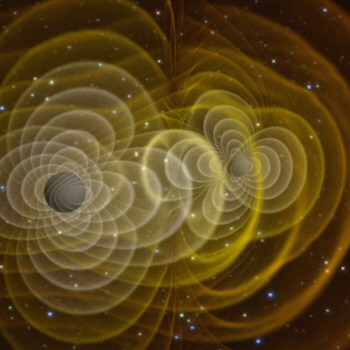
Now, Joan Centrella and co-workers at NASA’s Goddard Space Flight Center have made an important breakthrough in numerical relativity by simulating what happens when two black holes merge. These extraordinarily powerful events, which occur in the final stages of a galactic collision, produce copious gravitational waves or “ripples” in space–time.

A central prediction of general relativity, gravitational waves are yet to be detected directly. But the new NASA simulation reveals precisely what the gravitational wave signature will look like for a specific astrophysical process (figure 2). Performed on the Columbia supercomputer at NASA’s Ames Research Center in California, the simulation was the result of translating complex mathematical expansions of Einstein’s field equations into many thousands of lines of computer code.

Combined with observations from gravitational waves detectors such as the Laser Interferometer Gravitational Wave Observatory (LIGO) in the US or the future space-based detector LISA, the work will enable physicists to test general relativity even more precisely.

“Black hole mergers are by far the most powerful events occurring in the universe, with each one generating more energy than all of the stars in the universe combined,” says Centrella. “Now we have realistic simulations to guide gravitational wave detectors coming online.” The researchers are now extending their simulation to model mergers between black holes with different masses.

Putting equilibrium on hold

If you put two gases in a box, they will eventually become perfectly mixed as a result of the atoms colliding with each other. The system soon reaches its most probable state, which is called thermodynamic equilibrium. However, Weiss and co-workers have found that a gas in one dimension behaves differently and never reaches equilibrium.

Weiss’ team began by constructing a one-dimensional optical trap using interfering beams of laser light that form an array of thousands of parallel tube-shaped traps. Next, the physicists introduced an ultracold gas containing tens of thousands of rubidium atoms cooled to almost absolute zero into the trap. This ultracold is known as a Bose–Einstein condensate, in which all atoms enter the same quantum state.

Each tube contains about 150 atoms, which are forced to stay in one dimension because of the shape of the tube. The researchers then used other lasers to set the trapped atoms in motion so that they all oscillated with about the same amplitude. Although the atoms collided with each other, as happens in a normal gas, their distribution of momentum did not change. Instead, each atom continued oscillating with the same amplitude as at the start of the experiment — even after thousands of collisions.

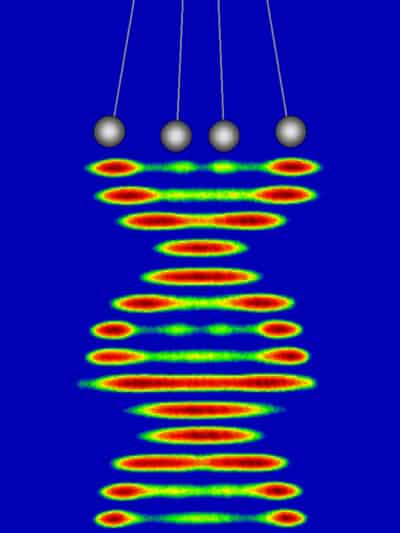
According to the team, the system behaves like a quantum Newton’s cradle. In the classical version of this toy, a ball at one end can be made to hit the next ball in line, but only the last ball at the other end of the line moves; all the others stay still (figure 1). The quantum Newton’s cradle contains hundreds of atoms, not just five balls, and instead of always bouncing off each other, they often go right through each other, but the essential physics is the same. Another difference is that almost all of the atoms are oscillating at the beginning — something that can be done with a classical Newton’s cradle too (figure 2).

“Such striking behaviour, where the momentum values do not change even though momentum is exchanged among the balls, only occurs in one dimension,” explains Weiss. “Collisions between particles in two or three dimensions quickly result in the familiar homogenized state of thermal equilibrium.”

The study could shed more light on how thermodynamic equilibrium is reached in many-particle systems says Weiss. The one-dimensional trapped atoms could also be used a precise force sensors because they would not be limited in their sensitivity by collisions.

Weiss adds that that the new system is “integrable”, meaning that it can be described by equations of motion that predict its future when the equations are solved in one direction, and its past when they are solved in the opposite direction. “Only a handful of integrable many-body systems are known, and this is the first time that any of them has been observed experimentally,” he says.

Fermilab probes matter-antimatter transitions

Cosmologists believe that equal amounts of matter and antimatter were created in the big bang. But if matter and antimatter particles were exact opposites of each other, they should have annihilated to leave only photons. This did not happen, which is why there is so much more matter than antimatter in the universe.

The existence of our matter-dominated universe suggests that matter and antimatter underwent different processes after the big bang. In the Standard Model of particle physics, a process called charge-parity (CP) violation is responsible for the difference between matter and antimatter. CP violation means that the laws of physics change slightly when a particle is replaced by its antiparticle and when all three directions in space are reversed.

CP violation can manifest itself in different ways. In the “indirect” process, first observed in neutral kaon particles in 1964, quantum mechanics allows particles to change into their antiparticles and back again in a process known as “mixing”. In 2001, The BaBar team, working at the Stanford Linear Accelerator (SLAC) — and independently the Belle collaboration at the KEK laboratory in Japan — were the first experiments to detect this in a B meson. BaBar observed “direct” CP violation in 2004 by showing that the number of decays observed for B mesons was higher than for their antiparticle equivalents.

A B meson is a short-lived particle made up of both matter and antimatter — one quark and one antiquark. The CDF physicists measured the rate of matter-antimatter transitions for the neutral Bs meson, a particle composed of a “bottom” quark and a “strange” antiquark. They did this at the Tevatron proton-antiproton collider at Fermilab by analysing data from over a billion collisions in an experiment called “Tevatron Run II”, which began in 2001. Although the Tevatron produces many orders of magnitude more hadrons than do the machines at KEK and SLAC, it is nevertheless much harder to study the decay of B mesons in proton-antiproton collisions.

The experiment found that the transition rate is three trillion (3 x 10¹²) times per second, measured to a precision of 2%. This is the most precise measurement of this rate ever made and agrees very well with predictions in the Standard Model. A separate analysis by the D0 collaboration at Fermilab was only able to give a range for the transition rate of between 2.7 and 3.3 trillion times per second.

The new result also places stringent constraints on other more exotic models, such as supersymmetry theories, that require oscillation rates that are much higher still. In other words, establishing the oscillation frequency makes it possible to begin to study CP violation in Bs mesons, which could in turn lead to signs of physics outside the Standard Model.

“Although the new measurement confirms the Standard Model with precision, it cannot — by itself — fully explain the observed imbalance between matter and antimatter in the universe,” says CDF team member Aurore Savoy-Navarro of the University of Paris VI in France. “In this sense, the result adds to this mystery!”

Physics goes to the movies

Hidalgo and co-workers have developed a model that can explain the different types of behaviour observed in filmgoers. The model takes into account how many people go to the opening of a movie and whether they go to see a film alone or in a group. It also describes the rate at which individuals lose interest in a film once it has opened, which means the probability of them going to see it decreases.

Using these parameters, the researchers came up with a quantitative indicator that provides a good estimate of a film’s commercial value. This indicator does not consider polls and surveys about the film, such as top-ten lists, and is based on how many people go to see a particular film during the time it is showing in cinemas.

The Chile-US scientists say their quantitative indicator could be used by film producers and studios when deciding to produce a sequel, for example, or when investing in a film of a certain genre. “At the moment, the film industry bases such decisions solely on revenues but I believe an indicator such as ours would allow the industry to discover hidden markets that could be exploited,” says Hidalgo.

The team constructed two main equations in its model by considering two points. The first is that individuals are not likely to go and see the same film twice. The second is that the probability of someone going to see a particular film depends on his or her interactions with a person who has already seen the film. In other words, if this person liked the film, others in his entourage are more likely to go and see it. The reverse applies if the person didn’t like it.

The model, which the researchers validated by comparing it with box-office data for the 44 movies with the biggest budgets in 2003 (see figure), could also be extended to other form of entertainment. These include going to concerts, plays, museum exhibitions and buying a particular CD or best-selling book. “Our paper belongs to a larger class of papers that are starting to show that human behaviour is not as random and unpredictable as some people think,” says Hidalgo.

Water drops bounce into action

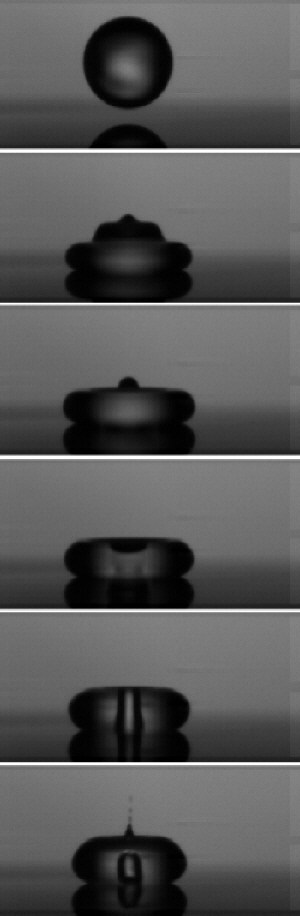
The experiment was carried out by Denis Bartolo of the Ecole Normale Supérieure (ENS) in Paris and colleagues, who used a high-speed video camera to film what happens when water drops with a diameter of 1 mm fall onto a hydrophobic surface. Although the initial velocity of a drop was only about 0.5 metres per second, the researchers found that an ultrafine, high-speed jet emerged from the drop with a speed that was around 20 metres per second or higher (figure 1).

According to the team, the jets are created by the collapse of air bubbles inside the water droplets as they hit the surface (figure 2). The phenomenon does not occur for water droplets with a higher initial impact velocity (greater than around 0.7 metres per second) because air bubbles are not trapped in the liquid anymore. The team also found that very large air bubbles can remain trapped on the drops in certain circumstances.

“Our results will be important to fully understand drop impact, which is crucial for virtually all coating applications such as spray painting, ink-jet printing and pesticide deposition on plant leaves,” Bartolo told PhysicsWeb. “Both bubble trapping and jet formation would be harmful for these applications: the jets would limit the resolution on printing and bubbles could favour paint peeling.”

Spray-on silicon makes its debut

Silicon microelectronic devices are currently made by heating highly purified silicon in a vacuum and allowing the resulting “mist” of free silicon atoms to coat a surface such as a plastic. Once deposited, the solid film is etched and patterned using photolithography techniques to produce circuit elements. However, this method is expensive and complicated because it has to be carried out in an ultra-clean environment to ensure that impurities do not contaminate the silicon and ruin its electronic properties.

The new technique, developed by a team led by Masahiro Furusawa of the Seiko Epson Corporation in Nagano-ken, avoids these complications. It uses a liquid form of silicon that can be made at room temperature and pressure and can then be sprayed onto a surface using an ink-jet printer.

Furusawa and co-workers start with a molecule called cyclopentasilane, which contains five silicon atoms joined in a ring. When this liquid is exposed to ultraviolet light, some of the rings break open to form linear chains. These link up end-to-end to form even longer chains, producing a highly viscous fluid.

The team dilute the liquid with an organic solvent, which they then deposit on a surface either by spin-coating or ink-jet printing. The resulting liquid film is finally heated at around 500°C, which converts it into hard, polycrystalline silicon. The team claims to have been able to make transistors from the films.

According to the scientists, the electronic properties of their films are as good as those of ultra-pure films made by conventional processing techniques. Although the properties of the ink-jetted films were not quite as good as those that were spray-coated, the former were still much better than solution-processed films of organic carbon-containing materials.

The new process is not perfect, however, as air and water have to be carefully excluded. Furthermore, the current ink-jetting method does not have the resolution necessary to pattern high-density integrated circuits needed to make computer chips. Nevertheless, the technique could be a novel, inexpensive and easy way of making devices for a range of everyday electronic equipment, including circuits for large-area displays, solar cells and sensors.

Copyright © 2026 by IOP Publishing Ltd and individual contributors