Nanoparticles join a new league

Since nanoparticles do not have long-range crystalline order, it is difficult to use conventional crystallographic methods to look at their structure. But the new algorithm allows researchers to determine the 3D structure of a nanoparticle from 1D X-ray or neutron diffraction data, which is the type of data normally obtained from standard X-ray and neutron diffraction techniques for a powder ensemble of nanoparticles.

There were challenges to overcome along the way though because recreating a 3D nanoparticle – containing around 100 atoms — from a 1D dataset is a computationally difficult problem. This is because traditional algorithms used to build up a 3D picture of a particle, such as the Monte Carlo approach, fail for very small clusters of atoms. The Michigan team therefore decided to try a “cluster build-up” approach instead. This involves proposing “trial structures” and simulating the data for these structures: “how ‘good’ a proposed nanocluster structure is depends on how much its 1D X-ray and neutron diffraction characteristics agree with the simulated data,” says Billinge.
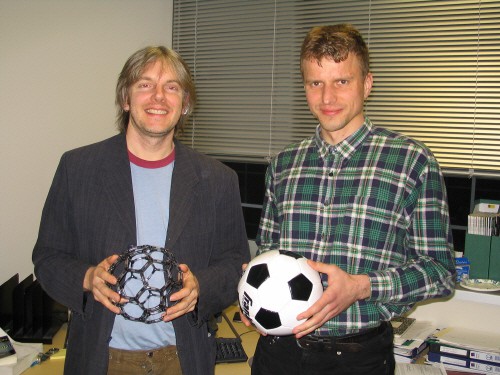
The researchers used their algorithm to solve the structure of a C60 molecule from its “atomic pair distribution function” (PDF), measured using neutron diffraction. PDF data from nanoclusters made up of single elements contains a simple list of the distances between pairs of atoms in the cluster but it does not provide information directly on how those atoms are arranged. The Liga algorithm uses a trial and error approach to recreate the structure using just the distance list as input.

“Our algorithm uses a competition between the clusters like a soccer league,” explains Billinge. “Good clusters get promoted and grow by buying players (atoms); poor clusters are relegated and sell their worst player before competing again at the lower level. The cluster that ultimately wins the top division, the league champion, is the correct cluster. We call it the ‘Liga’ algorithm – well, it sounds better than league.”

Initial applications for the technique will be for inorganic nanomaterials. “It could also be used for studying molecules and clusters in solution,” says Billinge. “By incorporating chemical information and other a priori constraints it may be possible to study quite complex systems, but we don’t yet know how far it will go.”

The team is now extending the Liga algorithm to handle systems containing more than one element, and larger clusters, with a view to applying it to “real systems of physical and chemical interest”.

Optical rotation sheds light on vacuum

Classical physics tells us that space is empty, but the uncertainty principle allows particles and antiparticles to spontaneously appear and disappear, changing the structure of the vacuum in the process. In particular, a large magnetic field can cause the refractive index of space to vary with the polarization of light passing through it.

In the PVLAS experiment a linearly polarized laser beam is sent through 5 Tesla magnetic field in a vacuum, and any changes in the polarization of the beam over a distance of 1m are measured. Based on 44,000 such measurements Zavattini and co-workers found that the beam emerges with a slight elliptical polarization, and that its polarization vector is rotated by 3.9±0.5×10⁻¹² radians (less than half a billionth of a degree).

These two results can be explained by supposing that photons interact with an as yet unobserved particle when they pass through the vacuum. For example, a laser photon may interact with a virtual photon to produce an intermediate particle that quickly decays back into two photons. This intermediate particle delays the propagation of photons that are polarized parallel to the external field, causing the beam to become elliptically polarized. The rotation in the plane of polarization, meanwhile, could be caused by a photon interacting with a virtual photon to produce a real particle that propagates away — carrying angular momentum with it.

If the PVLAS results are indeed due to the existence of an axion-like particle, the experiment could place tighter restrictions on its mass and coupling strength. Furthermore, the result could lead to observable astrophysical effects in the vicinity of compact objects such as neutron stars. Indeed, Giovanni Bignami of Pavia University and co-workers recently proposed that the magnetic fields around neutron stars, which can be as high as 1011 Tesla, could bend light such that we would see multiple images of distant objects.

According to Bignami, such quantum vacuum lensing should be particularly visible during an eclipse of the double pulsar system J037-3039, although the next such eclipse is not expected until about 2020. In the mean time, the PVLAS team is continuing to scrutinize its lab-based version by repeating the experiment with a shorter-wavelength laser.

New look for comets

Comets are “undercooked leftovers” that remained after clouds of dust and gas condensed to form the Sun and planets some 4.5 billion years ago. Composed of ice, dust and gas, they are often known as “dirty snowballs”. As their orbits pass close to the Sun, the ice they contain sublimates, producing a characteristic tail of gas and dust. Previously, it was thought that comets were only formed in the cold outer reaches of the solar system — beyond Neptune in the Kuiper belt and Oort cloud — periodically approaching close to the Sun thanks to their elongated orbits.

Asteroids, on the other hand, have near-circular orbits and spend much more time close to the Sun and any ice once contained within them is thought to have evaporated long ago. However, a puzzling object called “133P/Elst-Pizarro” shows characteristics of both asteroids and comets. It was first classified as an asteroid because of its orbit, but in 1996, astronomers observed a dusty tail behind it — implying that the object was an ice-containing comet.

Over the last three years Hsieh and Jewitt have conducted a survey of the asteroid belt searching for similar objects. In November last year they observed a very faint dust tail from Asteroid 118401 using the 8m Gemini North telescope on Mauna Kea in Hawaii. Together with a third such object called P/2005 U1, observed independently in October 2005, this suggests the existence of a whole new class of comets orbiting entirely within the asteroid belt, which the two researchers have dubbed “Main-belt Comets”.

The Earth is thought to have formed as a hot, dry planet, with water delivered from elsewhere after it cooled. Possible candidates for this water are comets or asteroids but recent analyses have shown that the isotopic composition of comet water is significantly different from the ocean water found on Earth today. “Main-belt comets are a potential source of the Earth’s water,” says Hsieh. “However, more detailed study is needed before we can say anything definitive.”

The team now plans to characterize the new comets more fully and search for additional main-belt comets. Further in the future, spacecraft could even visit the comets and analyse the ice to determine whether these objects really did bring water to Earth.

Surface plasmons squeeze light

Physicists in Denmark and France led by Sergey Bozhevolnyi of the University of Aalborg have developed a new class of waveguide that could get round one of the biggest obstacles to photonic circuits. The devices allow light at telecommunications wavelengths to be “squeezed” to below the diffraction limit, allowing it to pass though small regions such as channels on a chip without being significantly lost (Nature 440 508).

Diffraction means that only a tiny amount of light can pass through a hole that is narrower than the wavelength of the light, and the light that is transmitted emerges in all directions. This can be problematic, for example, in optical lithography where diffraction prevents the fabrication of semiconductor features below a certain size. In telecommunications, where the light typically has a wavelength of 1.5 microns, light cannot pass though the channels used to guide electrons in today’s silicon chips because they are too small.

One way to overcome this problem is to use light waves to excite the collective wavelike motions of billions of electrons on the surface of metals. Unlike the light waves themselves, these “surface plasmons” are not restricted by the diffraction limit of light. Indeed, Bozhevolnyi and co-workers previously showed that the plasmons can be used to guide light through grooves in gold that are much narrower than the wavelength of the light used.

Now, the Denmark-France team has taken this work a step further by using a new class of surface plasmons called channel plasmon-polaritons — electromagnetic waves that originate at the interface of a metal and an insulating dielectric such as air. The researchers have shown that these plasmons can guide and manipulate light along the bottom of sub-wavelength V-shaped grooves in a gold film without significant propagation losses (see figure). This is because the surface plasmons remain tightly bound to the interface and thus concentrate the light into a volume that is less than one wavelength across.

Channel plasmon-polaritons can be used to transmit light signals for wavelengths of around 1.5 microns — just right for telecommunications applications. Furthermore, the propagation length of a plasmon at a planar gold-air interface is around 1mm, which is long enough to optically connect two devices on a chip.

“Our technique is so good that it can already be used for many practical applications, such as ultracompact optical interconnects, interferometers and waveguide-ring resonators,” explains Bozhevolnyi. “It should also be borne in mind that the channel plasmon-polaritons are bound to and propagate along the metal surface, thereby allowing for natural integration with electrical circuits.”

Incoherent boost for light surgery

Laser light can be used to perform a number of medical procedures, such as removing cancerous tissue. The beam is fed into an optical fibre and through a catheter, heating the millimetre- or centimetre-sized growths to death. However, the technique is expensive and therefore not that widely used.

In 2002, Jeffrey Gordon and colleagues at the Ben-Gurion University of the Negev in Israel developed an alternative to laser surgery that focused ordinary sunlight into a narrow optical fibre using a parabolic mirror. The device can provide the same power and flux levels as lasers but solar surgery is of limited practical value because some countries are sunnier than others.

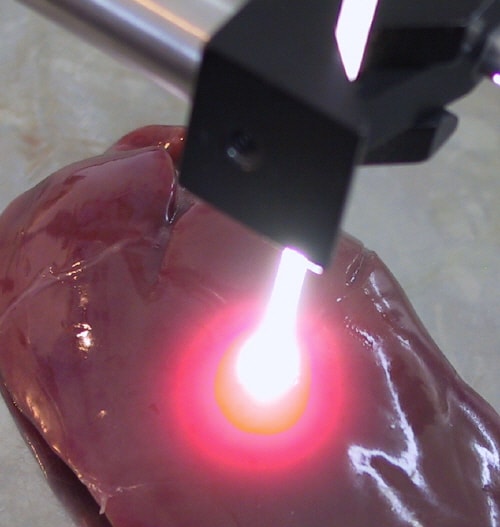
The team has now achieved similar results using light from commercially available short-arc discharge lamps — a system that does not rely on the presence of sunlight. The set-up uses two mirrors to concentrate the light and a third to “recycle” light emissions. This is because half the light emissions go into the hemisphere away from the concentrator. The hemispherical recycling mirror captures 50% of otherwise lost lamp emission and focuses it so that light throughput can be enhanced for an optical fibre of the same diameter (figure 1).

The device has a number of advantages over lasers — one is that its output contains visible wavelengths, which can penetrate more deeply into tissue than the infrared or ultraviolet radiation from lasers. Another bonus is cost: Gordon says that the system can destroy as much tissue per unit of energy as a laser, but is at least ten times cheaper. The device is also safer than conventional laser systems because the light can be seen, in contrast to lasers that operate outside visible wavelengths.

The team has used its new device to carry out surgery on ex-vivo chicken livers and kidneys (figures 2 & 3) and has also begun clinical trials on live animals. “The trials have so far yielded excellent preliminary indications and will be followed by trials on animals with cancer,” says Gordon.

Geomagnetic flip may not be random after all

Although a full geomagnetic polarity reversal can take thousands of years to complete, it does have implications. As well as affecting the migration trajectories of birds and other animals, the disruption to the Earth’s magnetic field could expose the Earth to hazardous cosmic rays. Geoscientists believe that our planet’s internal magnetic dynamo is responsible for pole reversals, but the actual mechanism is not well understood.

Previous analyses assumed that the number of times the poles have reversed over last 160 million years follows a Poisson distribution, implying that the events are random. The Poisson distribution tells you the probability of a number of events occurring in a fixed time if the events are independent and the average rate is known. A good example of the Poisson distribution in physics is the likelihood of unstable radioactive nuclei decaying in a certain period.

Now, a team of physicists led by Vincenzo Carbone of the University of Calabria have discovered that the sequence of polarity reversals can be well described by a Lévy distribution instead. In contrast to Poisson statistics, the Lévy distribution describes stochastic processes that are characterised by the presence of “memory” effects — or long-range correlations between the events in time. Lévy distributions are widely used to study many critical phenomena, such as earthquakes, and also when analysing financial data. The researchers obtained their results by careful statistical analysis of different sets of paleomagnetic data containing estimates of when the Earth’s poles reversed.

“The result means that polarity reversals are not random events that are independent of each other,” explains team member Fabio Lepreti. “Instead, there is some degree of memory in the magnetic dynamo processes giving rise to the reversals,” he says. “We hope that our work will serve as a useful reference point for models that aim to describe the phenomenon of pole reversal.” The Italy team now plans to build new dynamic models to describe the field reversal sequences in a simple way, so that the physical mechanisms that trigger pole reversals can be more easily explained.

New direction for cosmic radiation

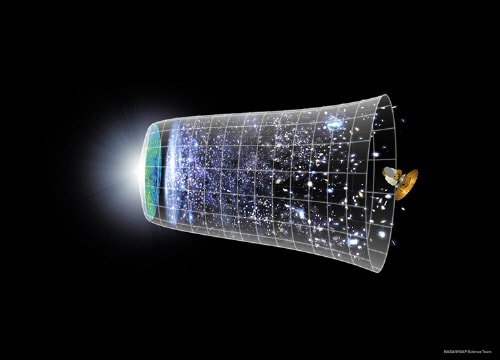
The cosmic microwave background was born about 380,000 years after the Big Bang, when the universe cooled enough to allow the first atoms to form. Photons could suddenly travel unhindered through space, their wavelengths being stretched by the expansion of the universe to leave a haze of microwave radiation in every direction we look.

The first year of WMAP data, released in February 2003, revealed the temperature of this background radiation in exquisite detail. Crucially, it enabled researchers to measure tiny temperature fluctuations thought to have been produced by the same irregularities in space that led to the formation of galaxies.

Now, with three times more data, the WMAP team has measured the incredibly weak polarization signal of the photons, allowing cosmologists to infer how much the fluctuations are due to the distorting effects of matter and how much they are due to gravity waves in the infant universe. These measurements place strong constraints on models of inflation, a period that began 10-35 seconds after the Big Bang during which the universe is thought to have undergone an enormous expansion. Furthermore, since the polarization of the photons would have been affected by the presence of ionizing material, the latest data show that the first stars formed when the universe was 400 million years old — and not 200 million years as was previously thought.

The keenly awaited results, which were announced at a press conference at Princeton University yesterday, also confirm that we live in a flat universe comprising just 4% ordinary matter, 22% dark matter and 74% dark energy — in agreement with the standard model of cosmology.

“This is brand new territory,” says WMAP team member Lyman Page. “We are quantifying the cosmos in a different way to open up a new window for understanding the universe in its earliest times.”

Hurricane intensity linked to warmer oceans

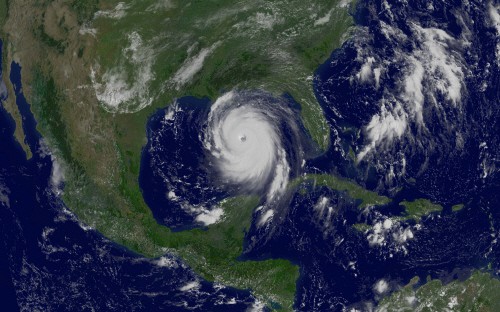
A number of studies have shown that hurricanes have steadily become stronger over the last 25 years, particularly in recent years (figure 1). Indeed, 2005 was a record year in terms of the number of severe hurricanes, with hurricane Katrina alone claiming 1300 lives and causing over 100 billion dollar’s worth of damage.

Some researchers think that this rise is due to higher sea surface temperatures providing “fuel” for the hurricanes (generally, the sea surface temperature must be above about 26°C for hurricanes to form and intensify). Others, however, believe that higher surface temperatures do not necessarily mean stronger hurricanes, and that additional variables — such as wind shear and humidity — could also be responsible.

The new Georgia Tech study has now clarified this issue, showing that while hurricane intensity may be substantially influenced by these other factors for an individual storm or storm season, only an increase in sea surface temperatures can account for the long term increase in hurricane strength.

Hoyos and co-workers analysed how four different climatic factors — sea surface temperatures, humidity in the lower troposphere, vertical wind shear and the changes in “zonal” winds with longitude — varied between 1970 and 2004, based on satellite data for the North Atlantic, West Pacific, East Pacific, South Pacific, South Indian and North Indian oceans. The team used information theory to analyse the relationship between the variables and the number of Category 4 and 5 hurricanes observed, and employed time series analysis to distinguish long-term trends from shorter-term variations. The results showed a clear, positive increase in global sea surface temperatures since 1970, and no sign of any global trends in humidity, wind shear or zonal wind change.

“This research supports the hypothesis that the worldwide increase in sea surface temperatures since 1970 is contributing to increase in global hurricane intensity,” team member Judith Curry told PhysicsWeb. “The current consensus is that the increase in tropical sea surface temperatures during the last 35 years is attributed to anthropogenic greenhouse warming.”

Bosons form quantum threesome

Predicted 30 years ago by Russian physicist Vitali Efimov, these quantum states consist of three atoms that are loosely bound together despite the absence of bound states of any two pairs of atoms in the system. This counterintuitive situation, Efimov argued, could occur for both bosons, that is, atoms that have integer values of intrinsic angular momentum or spin, or fermions — atoms that have half-integer spin. (However, the Efimov effect would be absent for a system of three identical fermions if they were all in the same internal spin state). Despite numerous searches, no such states had been seen until now.

Hanns-Christoph Nägerl of Innsbruck University and colleagues first cooled a gas of caesium atoms to just 10 nK (Nature 440 315). They then used a magnetic field to carefully tune the “scattering length” — a measure of the interaction strength — between the atoms. Controlling the scattering length is crucial because Efimov states are only expected to form at lengths greater than the range of the interaction between just two atoms. The team observed an Efimov-like state resonance at a scattering length of about -850a0, where a0 is the Bohr radius (a standard unit of distance in atomic physics that measures 0.53 Angstroms).

“Efimov states present a particularly simple solution to the notoriously difficult three-body problem,” explains Nägerl. “We hope that our measurements will trigger more refined theoretical and experimental work that will lead to a deeper understanding of this problem.” The researchers now hope to confirm their results by measuring more than one Efimov resonance in their experiment, and also plan to study the properties of the three-body states in more detail.

Barrow lifts religion prize

Barrow first came to attention in 1986 when he and Frank Tipler wrote The Anthropic Cosmological Principle. The book looks at the impact on science, history, philosophy, and religion of the anthropic principle, which states that the observable universe has to be as it is otherwise we would not be able to observe it. The foundation said that the book has become “an essential work for those who explore the deep questions at the interface of science and religion”.

It also praised Barrow for “having used insights from mathematics, physics, and astronomy to set out wide-ranging views that challenge scientists and theologians to cross the boundaries of their disciplines if they are to fully realize what they may or may not understand about how time, space, and matter began, the behaviour of the universe (or, perhaps, “multiverses”), and where it is all headed, if anywhere.”

A hugely prolific author, Barrow has so far written over 400 scientific papers and some 17 popular-science books that have been translated into 27 languages. His other books cover topics as wide-ranging as the nature of mathematics (Pi in the Sky, 1992), the links between the universe and human aesthetic appreciation (The Artful Universe, 1995) and how the universe is characterized by what cannot be known about it (Impossibility, 1998). Barrow also wrote an award-winning play Infinites that was performed in Milan in 2002.

“Many of the deepest and most engaging questions about the nature of the universe have their origins in our purely religious quest for meaning”, Barrow said in remarks prepared for a news conference in New York yesterday. “The concept of a lawful universe with order that can be understood and relied upon emerged largely out of religious beliefs about the nature of God.”

He added that astronomy had “breathed new life” into religious questions. “Our scientific picture of the universe has revealed time and again how blinkered and conservative our outlook has often been, how self-serving our interim picture of the universe, how mundane our expectations, and how parochial our attempts to find or deny the links between scientific and religious approaches to the nature of the universe,” he said.

Born in London in 1952, Barrow studied mathematics at the University of Durham and then did a DPhil in cosmology at Oxford University under the late Denis Sciama. Following spells at Berkeley and back at Oxford, he moved to the University of Sussex in 1989, serving as director of its Astronomy Centre from 1995. Four years later he moved to the Department of Applied Mathematics and Theoretical Physics at Cambridge University, where he has also been director of the Millennium Mathematics Projects, which seeks to get young people interested in maths.

Other physists to have won the Templeton Prize include Charles Townes (2005), George Ellis (2004), John Polkinghorne (2002), Freeman Dyson (2000), Ian Barbour (1999) and Paul Davies (1995).

Copyright © 2026 by IOP Publishing Ltd and individual contributors