At a Glance: Fusion power
- Fusion is the process whereby two light nuclei bind to form a heavier nucleus with the release of energy
- Harnessing fusion on Earth via deuterium and tritium reactions would lead to an environmentally friendly and almost limitless energy source
- One promising route to fusion power is to magnetically confine a hot, dense plasma inside a doughnut-shaped device called a tokamak
- The JET tokamak provides a vital testing ground for understanding the physics and technologies necessary for an eventual fusion reactor
- ITER is due to power up in 2016 and will be the next step towards a demonstration fusion power plant, which could be operational by 2035
By 2025 the Earth’s population is predicted to reach eight billion. By the turn of the next century it could be as many as 12 billion. Even if the industrialized nations find a way to reduce their energy consumption, this unprecedented increase in population – coupled with rising prosperity in the developing world – will place huge demands on global energy supplies.
As our primary sources of energy – fossil fuels – begin to run out, and burning them causes increasing environmental concerns, the human race faces the challenge of finding new energy sources. Conventional nuclear power produces long-lived radioactive waste, while renewable energy sources such as wind, wave or solar power provide variable output and are unlikely ever to be able to satisfy total demand.
Nuclear fusion offers a potentially safe, environmentally friendly and economically competitive energy source. To operate for a whole year generating about seven billion kilowatt hours of electricity, a fusion plant would use just 100 kg of deuterium and three tonnes of lithium – releasing no greenhouse gases in the process. A typical coal-fired power station, in contrast, devours three million tonnes of fuel and produces some 11 million tonnes of carbon dioxide to yield the same annual output.
Last year researchers took a major step towards the goal of fusion power, when the partners in the International Thermonuclear Experimental Reactor (ITER) project finally decided that the facility will be built at Cadarache in France. Negotiations between ITER’s members – China, the European Union, Japan, Russia, South Korea and the US – over which would host the €5bn machine had been deadlocked since 2003. After much hard bargaining, it was agreed that France would be the favoured site, with Kaname Ikeda from Japan taking over as director general (see page 12; print version only). Since then, India has also joined the project, so that half of the world’s population is now represented in this scientific endeavour.
ITER – which means “the way” in Latin – is scheduled to power up in 2016 and will be the penultimate step towards commercial fusion power. But although the 20,000 tonne facility is now ready for construction, there is still plenty of work to be done at existing fusion experiments. The Joint European Torus (JET) in the UK is playing a vital role in this effort, being the only device capable of operating with the same fuel and materials planned for ITER. Moreover, JET is the only fusion experiment that is currently big enough to approach the enormous power loads expected in an eventual commercial fusion reactor.
From moonshine to sunshine
Ernest Rutherford once famously declared that “anyone who expects a source of power from the transformation of the atom is talking moonshine”. But science fiction has a habit of becoming science fact, and Rutherford’s sentiments were disproved less than 10 years later with the demonstration of controlled nuclear fission by Enrico Fermi in 1942. Fusion, on the other hand, has proved much more difficult to achieve.
Nuclear fusion is the powerhouse of the stars, and is therefore the mechanism by which all the chemical elements around us were created. It is the process whereby two light nuclei bind together to form a third, heavier nucleus: because the mass of the final nucleus is slightly less than the total mass of the initial nuclei, energy is released via Einstein’s famous equivalence of mass and energy (E = mc2).
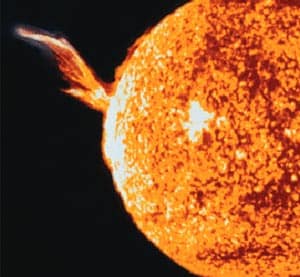
In the Sun, for example, energy is released through a chain of reactions that begins with the fusion of two protons into a deuteron – a deuterium nucleus containing one proton and one neutron. The deuteron then combines with another proton to produce a nucleus of helium-3, which, in turn, fuses with another helium-3 nucleus to form a nucleus of helium-4 (an alpha particle). This process takes hundreds of millions of years, which is rather fortuitous since if it occurred too rapidly, the solar furnace would have burned out long before life on Earth had a chance to evolve! The downside, of course, is that protonic fusion cannot be used as a viable source of terrestrial fusion energy.
But there is a quicker route to fusion involving the nuclei of deuterium and tritium – an isotope of hydrogen containing one proton and two neutrons. When these two nuclei fuse, they produce a helium-4 nucleus plus a neutron. Because this reaction involves only the rearrangement of protons and neutrons, rather than the transformation of a proton into a neutron, it proceeds much more rapidly than protonic fusion. However, the final mass defect in this reaction is lower, which means that less energy is released. Still, provided the deuterium and tritium nuclei can be made to collide with one another indefinitely at energies of between 10 and 100 keV, the reactions proceed at a useful rate for power production.
One way to achieve this situation is to heat the reactants so that a neutral gas of ions and electrons (a plasma) is produced, and to confine this hot plasma for long enough for significant fusion to occur. In the Sun, this confinement is supplied by the star’s enormous gravitational field. On Earth, confinement alone is insufficient: the plasma must also be isolated from the confining medium to prevent impurities from contaminating the plasma and reducing the fusion efficiency.
There are two ways to create such conditions. The first is magnetic confinement, in which magnetic fields hold the charged plasma particles inside a containment vessel. The other is inertial confinement, whereby fuel is compressed at such high speeds that fusion occurs before the fuel has time to expand and touch the container walls. This latter technique is the principle behind the hydrogen bomb, and it is currently being studied at several research laboratories using high-power lasers. Researchers have been pursuing magnetically confined fusion since 1958, when much of fusion research was declassified at the “Geneva Atoms for Peace” conference. By far the most promising way to do this in terms of an eventual power plant is to use a “tokamak” – a concept pioneered by Soviet physicists Andrei Sakharov and Igor Tamm in the 1950s. ITER, like JET, will be a tokamak.

A tokamak is a doughnut-shaped vessel or torus, in which a helical magnetic field insulates charged particles in the plasma from the surrounding walls. The helical field is produced by combining a toroidal field, which guides particles “the long way round” the torus, and another “poloidal” field, which guides them the short way round (figure 1). The former is provided by large external coils, while the latter is generated by a current flowing through the plasma in the toroidal direction. This plasma current arises from a toroidal electric field that is produced inductively by a coil passing through the centre of the torus, which acts as the primary winding of a transformer (the second winding is provided by the plasma ring).
For fusion to occur, nuclei must be slammed together fast enough and often enough to overcome their Coulomb repulsion and make the process self-sustaining. A tokamak therefore needs to maintain high densities of fuel ions at enormous temperatures – about 100 million degrees – for a sufficiently long time. Achieving this in the face of a multitude of plasma instabilities has been a significant challenge for fusion researchers.
However, it is precisely the lack of “runaway” possibility in a fusion reactor that makes fusion so much more attractive than fission, where the challenge is to get the fuel to react slowly over a period of years. Furthermore, fusion produces no highly radioactive or fissile products and its fuel exists naturally in abundance (deuterium exists in water at concentrations of about 1 part in 6700, and can be extracted easily using electrolysis; tritium can be bred within the fusion reactor itself).
Of all the possible combinations of light elements that could be used for terrestrial fusion, the deuterium-tritium reaction proceeds at the highest rate for the lowest temperature and is therefore the best candidate for a fusion power plant. Each reaction yields an energy of 17.6 MeV, which is shared by an alpha particle and a neutron. The neutrons, carrying most of this energy, escape the confining fields and are captured in the walls of the tokamak where they generate heat. As a result, coolant circulating through the walls can be passed through a heat exchanger to produce steam in order to drive turbines, as in a conventional power station. The walls also double as a “breeding blanket” in which neutrons react with lithium to produce further tritium.
The alpha particles, in contrast, are confined by the magnetic field and transfer their energy to the deuterium and tritium fuel ions via Coulomb collisions. When this alpha heating is sufficient by itself to maintain the density and temperature of the plasma at the required levels, the process becomes self-sustaining and the plasma is said to have ignited. Through this process, ITER aims to produce about 400 MW of fusion power for several minutes. This equates to a “fusion gain” (the ratio of fusion power to the input power required to raise the plasma temperature) of about QDT = 10. When QDT = 1 we say that breakeven is achieved, and QDT = ∞ for an ignited plasma.
The idea of fusion gain was first introduced just over 50 years ago by a young engineer called John Lawson, who was working on the then-secret ZETA fusion experiment at AERE Harwell in the UK. Motivated by “the unrealistic expectations of his enthusiastic physics fellows”, Lawson deduced a condition based on the plasma density and confinement time that would have to be satisfied for a useful reactor. The value of the so-called triple product derived from the Lawson criterion has increased by more than five orders of magnitude since the early tokamak experiments, leaving Rutherford’s pessimistic outlook for nuclear fission sorely misplaced for fusion too (figure 2).

The fusion challenge
One of the reasons why achieving fusion power is so demanding is the vast range of time- and space-scales associated with the underlying physics. For example, understanding how the helium produced in deuterium-tritium reactions affects the stability of the plasma requires tests to be carried out in large devices for long times. To complicate things further, the different timescales are linked: the structure of the plasma on the macro scale, for instance, depends on turbulent processes at the electron Larmor radius scale (about 0.1 mm), while plasma instabilities over periods of hundreds of microseconds can affect the erosion of materials over the course of years.
Only with ITER can these critical aspects of fusion be addressed simultaneously. The challenge facing the fusion community now is to provide as much information as possible to assist ITER’s research programme. This is where JET comes to the fore. As well as being the largest fusion device currently in operation, JET can access many of the key physics regimes of ITER. It also has similar technical capabilities, such as operating with tritium fuel, using beryllium on its plasma-facing surfaces and having similar heating systems as ITER.
JET has recently been upgraded, with various sensors now in place to improve our knowledge of properties such as the temperature, density and shape of the plasma. Further increases in the heating power are also planned in 2008, placing JET in a much stronger position to address the plasma-physics and technological challenges of burning-plasma regimes. In addition to understanding the physics of fusion plasmas, the performance of a tokamak is ultimately determined by boundary conditions imposed at its surfaces. This means dealing with the perennial thorn in fusion’s side: the choice of which material to use for the surfaces that directly face the plasma.
Early tokamaks were simple devices in which the plasma had a circular cross-section and was faced only by the steel walls of the vacuum vessel. To reduce direct plasma-wall interactions, small objects called limiters were strategically placed on the walls to define a “last closed” magnetic surface. Beyond this point, magnetic field lines carrying particles and heat terminate on the limiters, localizing most of the plasma-surface interaction a few centimetres from the wall.
Managing this interaction or “particle exhaust” is not an issue in small tokamaks, but it becomes critical when building a large device such as ITER. Sustained, high-power operation produces considerable particle and heat loads, leading to the release of surface material. Such impurities can make their way into the plasma, polluting it and severely reducing the fusion gain. Furthermore, the alpha particles that sustain the temperature in a fusion plasma must also be removed before they themselves become a source of pollution.
Some modern experimental tokamaks still use limiters to deal with particle exhaust. However, most – including JET and ITER – favour the use of magnetic coils to generate an “X-point” where the poloidal magnetic field is zero (figure 3). The advantage with the magnetic-coil approach is that field lines diverging away from the X-point can be diverted onto a remote target where the plasma-surface interaction and particle exhaust can be localized.
The X-point configuration also brings other important benefits: the weak poloidal field near the zero-field point means that magnetic field lines make many transits around the torus before terminating on the divertor targets. As a result, the plasma at the targets is cool enough to allow electrons and ions to recombine and locally extinguish the plasma “flame”. The low temperatures also allow a region of high neutral pressure to develop, enabling the helium ash produced by the fusion reactions to be efficiently pumped out of the system. This, along with the reduction of heat loads on the targets, will be critical to the success of ITER and future power plants.
Today’s divertor targets and other protection armour inside tokamaks are almost exclusively made from graphite or carbon-fibre composites. Carbon has a low atomic mass, which means that any carbon atoms released into the core of the plasma are stripped of their electrons at temperatures above about 500 eV. As a result, the plasma loses less energy via photon emission due to electronic transitions. In the lower temperatures at the edge and divertor regions, however, carbon radiates extremely efficiently and therefore dissipates energy that would otherwise be channelled into plasma-surface interactions. Carbon is also strong and able to withstand high temperatures. So far so good, but carbon also has two major drawbacks: it reacts chemically with the plasma fuel, and it traps the fuel like a sponge. This can lead to enhanced material erosion and unacceptable levels of tritium retention.
So what material should we use for ITER? For the moment, the machine designers are playing it safe, using carbon in the high-heat-flux divertor areas to cope with the highest temperatures, and using beryllium and tungsten elsewhere to minimize tritium retention. However, even this low ratio of carbon to metal in the plasma-facing surface (about 1%) is probably unacceptable in terms of tritium retention in an eventual fusion reactor. Part of JET and ITER’s remit is therefore to strive for an all-metal solution.
In fact, some tokamaks already use all-metal surfaces. The Alcator C-Mod device at the Massachusetts Institute of Technology and the Italian FTU machine in Frascati have for many years been running with walls made entirely of molybdenum. And graphite plasma-facing components in the ASDEX-Upgrade tokamak at the Max Planck Institute for Plasma Physics in Garching, Germany, are being systematically replaced with tungsten versions to study high-power plasmas with a metal wall (see “When the choice is not immaterial”).
But as the single existing tokamak capable of handling beryllium, it is only at JET that the material mix planned for ITER can be tested. Preparations are therefore under way to install beryllium in the appropriate locations to gain time in the first few years of ITER exploitation. Combined with the heating upgrade scheduled for the same period, JET will allow us to produce “first-wall” power loadings approaching those expected in ITER.
The price of high performance
Even with the right materials, the walls of a tokamak may still not be resilient enough to withstand the most violent energy emissions from the plasma. These emissions, which can heat the surface to several thousand degrees in a fraction of a second, are a side effect of operating the tokamak in the magnetic X-point configuration.
In addition to providing a convenient mechanism for power exhaust, the X-point configuration naturally produces a transport barrier (a region of very high pressure gradient) near the edge of the plasma. This leads to a regime of high-energy confinement, referred to as the “baseline scenario” for ITER operation. Crucially, the baseline scenario will allow sufficient fusion gain for researchers to study the materials, technologies and plasma control that will be important for an eventual fusion reactor. But the improved confinement comes at a price: the strong pressure gradients across the transport barrier can effectively strip off the outer layer of the plasma and throw out violent bursts of particles and energy. These “edge localized modes” (ELMs) are a double-edged sword. They can actually help particles to escape the plasma, and would prevent helium ash from building up in a working reactor. Left unchecked, however, the bursts would erode the plasma-facing surfaces too rapidly for a power plant to be viable.
The key to dealing with ELMs is to get the heat out of the plasma edge more frequently or more smoothly, preventing the build up of pressure so that the modes do not get too large. For the first time in any tokamak, researchers at JET have recently demonstrated an operating regime with tolerable ELMs that should also work in ITER. To do this, they deliberately introduced impurities such as nitrogen in the edge regions, which radiate energy and reduce the efficiency of the transport barrier, leading to a milder type of ELM. The problem is that disturbing the transport barrier also degrades the overall energy confinement, which would reduce the performance of a fusion reactor.
One way to compensate for this loss in confinement is to operate at higher plasma currents. The 2.5 MA current used at JET extrapolates to 17 MA in ITER (its highest design current), which leaves little room for improvement in performance and leads to increased operational risks. Researchers are therefore seeking other ways to improve performance at lower plasma currents. The JET team, for example, is currently exploring whether changes to the shape of the plasma can increase heat losses between each ELM without reducing energy confinement too much. Elsewhere, researchers at the ASDEX-Upgrade tokamak have injected frozen deuterium pellets into the edge of the plasma at high frequencies in order to “pace” the ELMs. And the DIII-D device at the General Atomics Laboratories in San Diego employs external coils to “churn up” the magnetic surfaces in order to increase particle transport and mitigate the ELMs.
Keeping the plasma burning
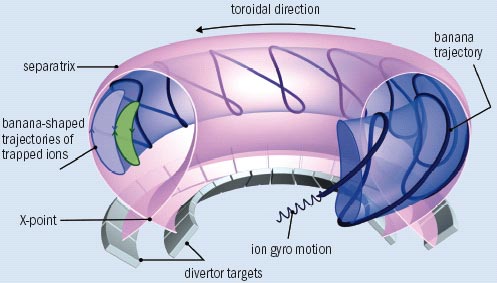
The key problem with the baseline scenario is that the plasma current is driven by a transformer, making tokamaks inherently pulsed devices. Any power plant using a tokamak in this regime would be inefficient and expensive since the device would cool down between pulses, experiencing large thermal stresses. Fortunately, there is another way to drive the plasma current called the bootstrap effect, with reference to the infamous Baron Münchhausen, a German serving as an officer in the Russian cavalry who claimed he could lift himself up by his own bootstraps! In short, the banana-shaped cross-sections of particle orbits in the plasma lead to a net current in the presence of strong density or temperature gradients (figure 3).
In order for a tokamak reactor to be economically viable, this “bootstrap current” has to dominate over the current driven by the solenoid or external heating systems. The trick to achieving this so-called advanced scenario (as opposed to the baseline scenario) is to reduce the size of the turbulent eddies inside the plasma, in order to trigger “internal transport barriers”. These eddies normally transport particles and heat outwards across magnetic surfaces. But they can be broken up by introducing a sheared rotation to the plasma (see figure 4), or by modifying the distribution of plasma current to reduce the natural outward “precessional drifts” of the electron orbits that drive them.
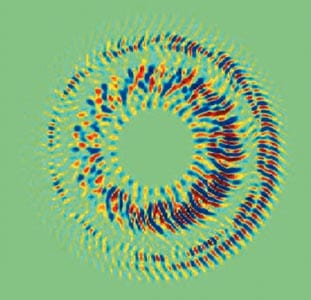
To gain control of advanced scenarios the current distribution required to maintain the transport has to be similar to the naturally generated bootstrap currents. At JET, such conditions have already been found; but on the long timescales required in a fusion power plant, we will need to provide some externally driven current and heat to prevent the plasma from evolving to a lower-performing state.
JET has several key capabilities here, the most immediate being its ability to drive the current in various ways thanks to three different types of heating system. This makes JET the only device in which both the pressure and current distributions can be controlled independently. JET’s size also means that the plasma current diffuses over long timescales, allowing the desired current distribution to be “frozen in” by heating shortly after the initial plasma forms. Finally, the long pulse length (tens of seconds) of JET compared with the timescales over which the plasma evolves enables us to control these advanced scenarios in the presence of transport barriers.
These capabilities will be dramatically improved with further heating upgrades at JET, and efforts are now under way to improve the control over barriers that encompass larger volumes of plasma. This is being complemented by studies at other fusion experiments. In 2003, for example, researchers working on the TCV tokamak in Lausanne, Switzerland, achieved almost 100% bootstrap operation, while the use of current drive for very long pulses is being explored at the Tore Supra device in Cadarache.
Given the challenges posed by these advanced scenarios, there is increasing interest in finding a compromise “hybrid” scenario. Like advanced scenarios, the hybrid uses a strong bootstrap-driven current, but it does this without relying on internal transport barriers. The bootstrap current gives a broader and more stable current distribution than the baseline scenario, allowing operation at higher plasma pressures. This, in turn, maintains the strong bootstrap – a virtuous circle. Nevertheless, the bootstrap current is not strong enough to completely replace the inductive drive, so the tokamak remains pulsed. But since the pulses are much longer than in the baseline scenario, the hybrid could allow a power plant to be operated continuously for many hours.
Burn physics
One massive difference between today’s fusion devices and a real working reactor is the way the plasma is heated. In research tokamaks, external heating systems are required, while a reactor plasma (by definition) will burn in a self-sustaining way thanks to the energetic alpha particles produced in the deuterium-tritium reactions. Since these particles originate within the plasma itself, we need to be able to manage this alpha heating without the luxury of external controls. Only high-current tokamaks such as JET allow us to confine and study these fusion-born alpha particles (see “Burning Issue).
Though indispensable to a fusion reactor, alpha particles have a darker side too: they can drive a type of plasma instability known as shear Alfvén waves, in which charged particles travelling along magnetic field lines cause the lines to vibrate in analogy to a guitar string. Alfvén waves can reach speeds as high as 5% of the speed of light, but fusion-born alpha particles can travel even faster and therefore resonate with them. These instabilities can redistribute the alpha particles and change the heating profile, or even cause a loss of alpha confinement altogether, posing a problem for the integrity of the first wall.
Alpha particles can, however, also affect other plasma instabilities. A good example is the “sawtooth” instability, whereby the rising temperature in the core of the plasma suddenly crashes and releases a burst of heat. The alpha particles can help hold off the sawtooth until a higher temperature is reached. The downside is that the final crash is larger, and it can trigger other performance-degrading instabilities. However, JET is pioneering the use of localized current drive to help destabilize sawtooth instabilities thereby making them smaller – a technique also foreseen for ITER.
Towards the final goal
When he was asked how long it would take to build the first fusion power plant, the Soviet physicist Lev Artsimovich – one of the pioneers of tokamak research – replied that “fusion will be there when society needs it”. That time is fast approaching, and with the construction of ITER finally about to start, efforts are now gearing up for the longer-term prospect of fusion energy.
ITER is intended to be the single experimental link required between existing devices and a demonstration power plant, loosely referred to as “DEMO”. However, several issues of importance for DEMO cannot be addressed with ITER. Perhaps the most important is the need to develop radiation-resilient materials, particularly for DEMO’s steel vacuum vessel. ITER’s short operational cycle means that neutron-induced damage will not be an issue, preventing useful tests of materials at high neutron flux.
One way to address this is to use a continuous neutron source that generates fluxes comparable to those expected in a reactor but in a smaller test volume. Such a device, called the international fusion materials irradiation facility (IFMIF) to be sited in Japan, will operate in parallel with ITER.
The IFMIF is part of a package of facilities being planned to speed the development of fusion power. The package also includes a superconducting upgrade to the world’s second largest operating tokamak – JT-60U in Japan – and the founding of a new fusion research centre, also in Japan, dedicated to modelling scenarios for ITER and for performing DEMO studies. Later, such a facility might also become a remote experimental control centre for ITER, reducing the need to relocate people to Europe and allowing round the clock operations by exploiting the time difference between Japan and Europe.
DEMO construction would probably start some time in 2025, with operation perhaps 10 years later. Commercial power plants could then be up and running by around the middle of the century. In the shorter term, it is hoped that the first plasmas in ITER will be achieved by 2016, with full-power deuterium-tritium operation by about 2021. Almost 50 years have passed since fusion research was declassified; but in less than 50 years from now, man-made Suns on Earth could finally become a reality.
When the choice is not immaterial
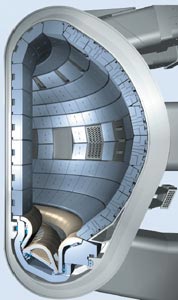
One of the most crucial aspects of a fusion reactor is what materials to use for the “first wall” surfaces that directly encounter the plasma. Some of these surfaces will have to withstand temperatures of more than 1000 degrees for sustained periods over many years, and will also face enormous neutron fluxes. First-wall surfaces must be chosen such that erosion rates and the subsequent contamination of the plasma are below acceptable limits.
The current choice of material for ITER’s main wall is beryllium, because it has a low atomic number, low tritium retention and efficiently removes any oxygen present in the tokamak. The divertor, which will experience the highest temperatures (V-shaped notches visible in the bottom of the chamber), will be built from carbon on the target plates and tungsten elsewhere.
At JET, an ambitious upgrade is being prepared to mimic this first-wall mix and thus provide ITER with some early indications of the operational consequences. However, without a machine the size of ITER, we will never be confident that a particular material choice will make fusion power feasible. In a single discharge lasting seven minutes, for example, ITER will deposit about three times the number of particles in the divertor as JET manages in three years of operation! Furthermore, compared with only about 0.2 g at JET, ITER will devour a massive 50 g of fuel per discharge. Therefore, if carbon is used in ITER – as it is prolifically at JET and other tokamaks – the amount of tritium retained could very quickly exceed the 350 g limit imposed by nuclear licensing restrictions. On the other hand, it is not yet certain whether metals that trap tritium less efficiently will be able to handle the high transient divertor heat loads expected in ITER without melting. ITER’s task is therefore to apply the knowledge gained from decades of fusion research to solve issues that cannot be addressed without long-pulse, high-power operation in a burning-plasma environment.
Burning issue
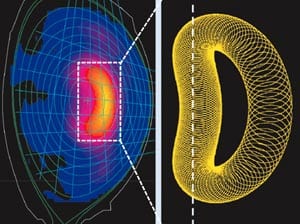
A central issue for ITER will be to improve our control over the fusion-burn process. This means finding ways to accurately determine the location and energies of the fast particles produced in the fusion reactions. JET is playing an important role in this effort, with the recent addition of neutron emission spectroscopy and scintillation-detection techniques. For the last few years JET has also been able to perform gamma-ray imaging, which relies on trace impurities such as beryllium in the main plasma to provide information about alpha particles. Here, a beryllium ion struck by a high-energy alpha particle creates a carbon ion, a neutron and a characteristic gamma ray that allows us to visualize the spatial distribution and temperature of alpha particles (image on left). The localization of the alpha particles to the right-hand side of the plasma is a result of the heating system and the lower magnetic field strength in this region. This is consistent with the full orbit trajectory calculation of a trapped “banana” alpha particle on the right, confirming our predictions and validating this approach for “visualizing” the alpha particles in a burning plasma.
JET in context
- 1973
- JET design commences
- 1979
- Laboratory foundation stone laid
- 1983
- Construction completed and JET operated by 16 European states under the auspices of “EURATOM”
- 1984
- Official opening ceremony
- 1985
- ITER project launched
- 1991
- JET provides world’s first deuterium-tritium tokamak experiment, producing 1.7 MW of fusion power for about 0.5 s
- 1997
- JET produces 16 MW of fusion power for 2 s – a world record
- 2000
- JET’s scientific program controlled by European Fusion Development Agreement (EFDA)
- 2003
- Experiments with trace quantities of tritium 2005 ITER site chosen as Cadarache in the south of France
More about: Fusion power
C M Braams and P E Stott 2002 Nuclear Fusion: half a Century of Magnetic Confinement Fusion Research Plasma Phys. Control. Fusion 44 1767
J D Lawson 1957 Some criteria for a power producing thermonuclear reactor Proc. Phys. Soc. B 70 6-10
J B Lister and H Weisen 2005 What will we learn from ITER? Europhys. News 36 47-51
G McCracken and P Stott 2005 Fusion: the Energy of the Universe (Oxford, Elsevier)
J Pamela et al. 2003 Overview of JET results Nuclear Fusion 45 63-85
P-H Rebut et al. 1992 Fusion energy production from a deuterium-tritium plasma in the JET tokamak Nuclear Fusion 32 187-203
J Wesson 2004 Tokamaks (Oxford University Press)
JET public website: www.jet.efda.org