Lab boss makes surprise exit

Life has not been easy for Brookhaven scientists since Chaudhari came to office in April 2003, having struggled in the face of continued funding cuts. A severe squeeze on the Department of Energy’s Office of Science budget for nuclear physics in 2006 meant that Brookhaven’s Relativistic Heavy Ion Collider (RHIC) faced a reduction in its run time by about 60%. RHIC will only be able to operate at almost full capacity this year thanks to a last-minute gift from private industry, announced in January. This good news came shortly before the Bush Administration released its 2007 budget proposal, which contained a 24% rise in funding for nuclear physics. However, that budget must still be scrutinized by Congress, a process that takes many months.

The Indian-born Chaudhari received a PhD in physical metallurgy from the Massachusetts Institute of Technology in 1966. He then spent 36 years at IBM, rising to the position of vice-president of science in 1982, before taking up his post at Brookhaven. He will stay on at Brookhaven to carry out research, stating in a press release issued by the laboratory that it is time “to spend more time at home and to take advantage of the wonderful opportunities to do science at Brookhaven.”

Astronomers find a mixed-up solar system

Many scientists believe that stars and planets are created when giant clouds of gas and dust collapse. As the cloud collapses, a flat, rotating disk of material forms around the young protostar. This protoplanetary disk is the seed material from which planets then form. The resulting planets all rotate in the same direction as the original cloud. This is what happened in our own solar system: all the planets orbit the Sun in the same direction as the Sun itself rotates.

Now, Anthony Remijan of the National Radio Astronomy and Jan Hollis at the NASA Goddard Space Flight Center have found something completely different. Using the Very Large Array radio telescope in New Mexico, the astronomers have observed that the inner and outer parts of a disk around a young star in the constellation Ophiuchus, some 500 light years away, are rotating in opposite directions. According to the researchers, this star may have received its protoplanetary disk from two clouds — not just one — with both clouds rotating in opposite directions to each other.

“This is the first time that anyone has seen anything like this, and it means that the process of forming planets from such disks is more complex than we previously expected,” says Remijan. “In the solar system that will probably form around this young star, the innermost planets will orbit in one direction and the outer planets will orbit in the opposite direction.”

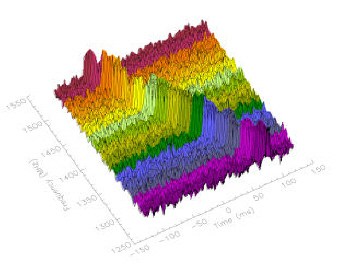
Remijan and co-workers obtained their results by analysing the shifts in frequencies of radio waves emitted by molecules like silicon monoxide within different parts of the cloud as they moved. This Doppler shift reveals the direction in which the gas cloud is moving relative to Earth.

Physicists look at birdsong

A bird’s vocal organ — or syrinx — is similar to the human larynx and consists of folds of tissue in the passage connecting the lungs to the vocal tract. When a bird exhales, the folds oscillate to produce notes with frequencies between 1 and 2 kilohertz. Individual “syllables” in the birdsong last between 10 and 300 milliseconds.

Two factors control how sounds are produced: the pressure of the air entering the syrinx from the lungs, and the elasticity of the oscillating folds. It turns out that the folds only oscillate above a certain air pressure. Previous research by physicists revealed that this motion is analogous to that of a simple nonlinear oscillator, such as a mass on a spring.

Gabriel Mindlin and Marcos Trevisan of the University of Buenos Aries in Argentina and Franz Goller at the University of Utah in the US have now taken this work one step further by considering that the two types of neural nuclei in the brain that control a bird’s breathing could also be modelled as nonlinear systems. Scientists now know that when a bird sings, an area of the its brain called the HVc is activated. This excites neurons in another area known as the RA region. Some neurons in this structure then excite motor neurons that control muscles in the vocal cords or lungs.

Coupled with experimental observations of how the pressure in the bird’s air-sac — a sac that controls the flow of air through the lungs — oscillates, the new model shows that birdsong is simply produced from the interplay between a physical substrate (the air-sac) and a neural system. “This is different to the long-held view in which a nervous system sends instructions to a ‘passive’ body,” explains Mindlin. “The result is surprising because one would think that complex behaviour, like birdsong, with its wide variety of different patterns would require a complex neural architecture,” he adds.

Mindlin believes the work could have wide-reaching implications for the animal world. “If diversity of behaviour can be understood in terms of subharmonics of nonlinear systems, many motor patterns could eventually be the result of neural architectures simpler than we think,” he states.

To confirm its model, the group is now looking for the effect in suboscines — a species of bird that has some of the same neural nuclei as canaries but lacks certain others (called telencephalics). “In this way, we would prove that the complexity does not originate at these telencephalics,” says Mindlin.


New type of star discovered

Pulsars are rapidly spinning neutron stars that are created when a giant star explodes at the end of its life. During this supernova explosion, the outer layer of the star is ejected into space and the inner core collapses into a super-dense, rotating neutron star. Intense magnetic and electric fields make the neutron star emit beams of radiation that sweep across space at regular intervals — often hundreds of times a second — as the star rotates. Magnetars form another class of spinning neutron star, giving off powerful X-ray and gamma-ray bursts.

The new type of neutron star was discovered by McLaughlin’s team using the Parkes radio telescope in Australia while they were looking for normal radio pulsars in the Galactic plane. “The RRATs were discovered in a reanalysis of the Parkes Multibeam Pulsar Survey data that was designed to detect short bursts of radio emission,” explains McLaughlin. “This is different to normal pulsar searches, which look for constant periodic emission.”

The team found 11 RRATs, ten of which have periods of between 0.4 and 7 seconds. The objects send out isolated radio flashes lasting just milliseconds and can then remain “invisible” for up to three hours. According to McLaughlin and co-workers, RRATs probably outnumber conventional radio pulsars by about four times. They are just very difficult to detect because they can only be seen for about 0.1 seconds per day and because the bursts look very similar to man-made radio frequency interference. McLaughlin adds that RRATS could also help to account for the relative proportion of neutrons stars that are radio-quiet, such as magnetars and X-ray dim isolated neutron stars.

The astronomers will now continue to time and monitor the RRATs with larger, more sensitive telescopes, such as the Green Bank and Arecibo telescopes, while also searching for more RRATs. “We are also planning further studies to better estimate the population of these objects and whether their existence challenges current supernova rate estimates,” adds McLaughlin.

Nanotubes break superconducting record

Superconductivity is the complete absence of electrical resistance and is observed in certain materials when they are cooled below a superconducting transition temperature (Tc). Physicists agree that superconductivity relies on getting electrons to overcome their mutual Coulomb repulsion and form “Cooper pairs”. In the Bardeen-Cooper-Schrieffer (BCS) theory of low-temperature superconductivity, the electrons are held together because of their interactions with phonons — lattice vibrations in the material.

However, 1D conductors like carbon nanotubes — rolled up sheets of graphite just nanometres in diameter — are not naturally superconducting. One reason for this is the presence of so-called Tomonaga-Luttinger liquid (TLL) states in the material, which cause the electrons to repulse each other and so destroy Cooper pairs.

Now, however, Haruyama and colleagues have designed a system in which there is a superconducting phase that can compete with the TLL phase and even overcome it — a feat hitherto believed impossible. The system consists of an array of multi-walled carbon nanotubes, each of which consists of a series of concentric nanotube shells. Electrical contacts made of metal are bonded to the tubes so they touch the top of all the shells. Conventional “bulk junction” contacts, in contrast, touch only the outermost shell of a tube and along its length.

Haruyama and co-workers grew their multiwalled nanotubes from a template of porous alumina. Next, they cut the tops off the nanotubes using ultrasound or etching techniques and then evaporated a gold electrode onto the exposed ends of the tubes. In this way, nearly all of the nanotube shells were made electrically active.

The Japan team find that the end-bonded nanotubes lose all resistivity at temperatures below 12 K. According to the researchers, this is because the TLL states are suppressed so that superconductivity can appear. Moreover, the Tc depends on the numbers of electrically activated shells and the physicists will now try to increase this figure by making more or all of the shells active.

The importance of staying clean

SOI technology is interesting because it could be used to build new types of high-speed electronic circuits and sensors. But many of the foreseen advances depend on making the silicon layer as thin as possible. The danger is that if the silicon gets too thin, it no longer behaves like bulk silicon. Researchers have thought that charge traps at the interface with the silicon dioxide could deplete the silicon layer of free carriers and make the resistivity far too high.

One way of telling if the resistivity is too high is if measurements that depend on the flow of current, such as tunnelling microscopy, are impossible with silicon-on-insulator structures. Now, however, Paul Evans and colleagues of the University of Wisconsin-Madison and Soitec in the US have been able to use this technique to image a 10 nm-thick boron-doped silicon layer supported on a silicon dioxide substrate. The only proviso for conduction is that the different layers have to be clean.

“This tells us that if you’re building nanostructures, the surface is really important,” says Evans. “If you make silicon half as thick, you would expect it to conduct half as well. But it turns out that silicon conducts much worse than that if the surface is poorly prepared and much better than that if the surface is well prepared.”

The team believes that the cleaning process creates new electronic states on the silicon surface. These surface states interact with the “bulk” band structure of the silicon, enabling high-mobility carrier conduction and boosting conductivity.

Great balls of lightning

Ball lightning is thought to be a ball of plasma that is formed when a bolt of lightning hits the ground and creates a molten “hot spot”. The ball can typically measure 30 centimetres across and can last for a few seconds. Although they are generally created during thunderstorms, Eli Jerby and Vladimir Dikhtyar from Tel Aviv University in Israel have now been able to make lightning balls in the lab using a “microwave drill”.

The device consists of the magnetron from a 600-watt domestic microwave oven and concentrates its power into a volume of just one cubic centimetre. The researchers inject the microwaves though a pointed rod into a solid substrate made from glass, silicon, germanium, alumina or other ceramics. The energy from the microwaves then produces a molten hot spot in the substrate.

What the scientists then do is pull the microwave drill out of the solid, which drags the molten hot spot and creates a hot drop. The drop then becomes a floating fireball that measures about 3 centimetres across and lasts for some tens of milliseconds (see figure). “The fireball looks like a hot jellyfish, quivering and buoyant in the air,” says Jerby.

Although the composition of the laboratory fireballs still need to be verified, they seem to contain components of the substrate material in various phases, such as ions, neutral atoms and larger macroscopic particles. This is similar to natural lightning balls, which are thought to contain vaporized mineral grains from the soil that have been kicked into the atmosphere by a lightning strike. Moreover, the lab-produced fireballs appear to combine plasma and chemical oxidation and burning processes. Again, this is similar to naturally produced balls in which the vaporised sand grains are thought to react with oxygen in the air and burn to release light.

“Our ability to generate such fireballs in a simple systematic manner may lead to techniques for synthesizing fireballs from solid materials,” explains Jerby. He even hopes that the lab-generated fireballs could be used in practical applications such as coating, deposition, combustion and energy production.

Calculating with Bose condensates

Polynomials are mathematical expressions involving a sum of powers in one or more variables multiplied by coefficients. Random polynomials are simply polynomials with random coefficients that have a Gaussian or bell-shaped probability distribution. Solving the roots of random polynomials is an important field in theoretical physics and although such polynomials have been extensively studied, no one has ever seen what these expressions might actually look like. Now, Castin and colleagues have shown that the location of “vortices” in a rotating 2D Bose-Einstein gas could be used to physically represent the roots of a polynomial.

A Bose-Einstein condensate (BEC) is an ultra-cold cloud of gas atoms that are all in the same quantum state, and can therefore be described by the same wavefunction. Quantum vortices can form in these condensates if they are rapidly rotated. According to Castin and co-workers, the wavefunction of a rotating condensate formed with non-interacting atoms can be described by a random polynomial.

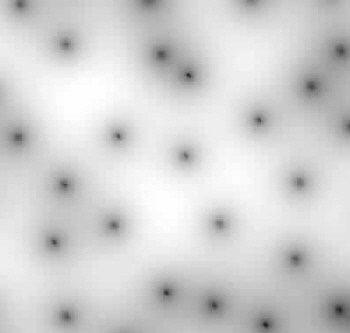
A vortex “sits” at each location where the wavefunction “vanishes”, and it can be associated with a root of the polynomial. Each root is a complex number with a real and imaginary part, which can be viewed as the two spatial coordinates of the vortex. The roots interact with each other and this is represented by the vortices repelling each other.

The team says that the fictitious BEC formed by the roots is interesting in this context because it is a very rare example of an exactly solvable many-body problem in physics. “The mathematical theory of random polynomials and random matrices has already found many applications in physics,” says team member Jean Dalibard. “Indeed the Hamiltonian of a complex or chaotic system can often be viewed as such a matrix.”

So how did the France-Italy team find the unlikely connection between random polynomial theory and BECs? “We were interested in the case of interacting atoms in which the roots of the polynomials — that is the location of the quantized vortices — form a regular array,” explains Dalibard. “To our surprise we noticed that even for strictly non-interacting atoms, a local order of the vortex distribution remained.” This is exactly what happens in mathematical random polynomials — although the coefficients of the polynomial are independent, the root distribution still exhibits some correlations.

The team says there is no fundamental barrier to why the experiment could not be performed in the near future. “Indeed, current experimental conditions are already less than an order of magnitude away from required conditions,” says Dalibard.

Theorists claim dark energy does not exist

The acceleration of the universe is driven by something that has repulsive rather than attractive gravitational interactions. Although this so-called “dark energy” is thought to account for around two-thirds of the universe, no one knows what it is made of. Possible explanations for dark energy include a “cosmological constant” — first introduced by Einstein — or something known as quintessence. However, such explanations are plagued with theoretical and phenomenological problems and scientists would like to find an alternative to dark energy as the source of the universe’s acceleration.

Olga Mena and José Santiago at Fermilab and Jochen Weller of University College London have now calculated that the acceleration of the universe can be explained without the need for dark energy. What they have done is to modify the laws of gravity in such a way that they look relatively unchanged at short distances but get modified only at distances on the order of the current size of the observable universe — the only place where the effects of the acceleration are apparent. At these distances the curvature of space is so small that the universe appears flat.

Although the equations that describe the evolution of the universe in the new model are difficult to solve, Mena and co-workers were still able to do so using approximate analytical methods. This approach allowed the researchers to compare the theoretical predictions of the rate of expansion of the universe to expansion rates obtained using experimental data from type Ia Supernovae. “The agreement is extremely good,” says Santiago. However, the model still requires a “dark matter” component. Dark or “invisible” matter is thought to make up 25% of the universe — even in the model.

The good news is that Einstein’s theory of general relativity remains intact: “All the tests that Einstein’s theory has passed to date are still valid because they were performed at shorter distances,” adds Santiago.

Robert Caldwell, a cosmologist at Dartmouth College in New Hampshire, thinks the results are interesting and will sustain further investigations of the model. “I’m sure the next target will be to study structure formation and the anisotropies in the cosmic microwave background in their model and check that the model predictions are consistent with observation,” he says. “I look forward to their results.”

Fluid lenses feel the pressure

The new lens has been designed by Saman Dharmatilleke and colleagues at the Institute of Materials Research and Engineering (IMRE) in Singapore. It was made by housing a tiny drop of water — or any other liquid with a high surface tension — in the small aperture of a well. Applying pressure to the drop via an actuator changes the radius of curvature — and hence the focal length — of the drop. The focal length can therefore be tuned simply by varying the amount of pressure applied. The lenses can be made either from a liquid-air or a liquid-liquid interface.

Dharmatilleke and co-workers have been able to make two types of lenses with their technique: “bi-convex” lenses, in which both sides of the drop change shape, and “plano-convex” lenses, in which one side of the drop is planar and the other is convex. The latter are made by using one end of the aperture and sealing off the other with a thin transparent substrate. The new lenses can be made as small as 10 microns, making them the smallest lenses available today. They also consume very little power and are cheap to produce.

According to the team, the lenses would be ideal for devices that need to focus and zoom in on an object with precision, such as web cams, mobile phone cameras, bar-code scanners, and portable medical devices such as microscopes and endoscopes. The researchers have already licensed their technology to a Singapore engineering company PGS Precision Pte Ltd.

Although researchers at the electronics giant Philips developed a variable-focus fluid lens in 2004, it worked on different principles. It consisted of a drop of an electrically conducting aqueous solution surrounded by oil, the shape of which was changed by applying a voltage, rather than pressure. The voltage changed the extent to which the oil repelled the water.

Copyright © 2026 by IOP Publishing Ltd and individual contributors