Blogs add a new dimension to physics

In July 2004 security and safety fears led to the temporary closure of the Los Alamos National Laboratory (LANL), the original home of the atomic bomb. Months passed and parts of the lab remained shut. Some staff members opted to leave, while others grumbled to friends and family but essentially endured the situation. Concerned at the lack of public debate, Doug Roberts – a computer scientist at the lab – decided to start an online discussion forum to allow staff to air their views.

But Roberts’ Web log (or “blog”), LANL: The Real Story (lanl-the-real-story.blogspot.com), has been more than just a place for people to moan. It has also been credited with contributing to the resignation, in May 2005, of Peter Nanos, the director of the Los Alamos lab. Indeed, the blog spawned numerous reports in the national and international press, and has so far been visited by about half a million people.

Running the blog is no easy feat for Roberts. At the height of its popularity, maintaining the site took about five or six hours a day. Even though he no longer works at Los Alamos, Roberts still spends two or three hours every day reviewing and posting contributions to the site. “This isn’t for the weak of heart,” he says. “If you create a forum where issues that are not complimentary to your place of work are discussed, you are not going to be very popular with the management.”

Chatting in cyberspace

Creating a blog need not exact such a heavy toll, however. Blogs generally involve one or more regular contributors posting their thoughts about a chosen topic on a website. Anyone reading the blog can then upload their responses to these comments. For physicists, these forums provide a space for intellectual debate as well as social chitchat.

Quantum Diaries (interactions.org/quantumdiaries), for example, is a kind of public-relations exercise for particle physics. Set up as part of the 2005 International Year of Physics, the blog gives a flavour of what working for a large-scale collaboration is like. One contributor – or “blogger” – to Quantum Diaries is Nick Brook, who describes his life as an experimental particle physicist at the CERN laboratory in Geneva. His account may not have made front-page news, but it has led to Brook receiving several e-mails from would-be physicists wanting to enter the field.

Brook has deliberately avoided controversy with his postings, and shied away from commenting on political topics. “I have had to bite my tongue at times,” he says. “If I came back from a particular meeting where something had wound me up, I deliberately didn’t put it on the Web.”

Sean Carroll, a physicist at the University of Chicago and an avid blogger, admits to exercising a degree of self-censorship in his postings too. As one of five contributors to Cosmic Variance (cosmicvariance.com), he is more than happy to share his views on politics, arts and current physics theories, but he has chosen not to comment on his search for a permanent faculty position.

Carroll’s decision to start blogging came shortly after discovering – and enjoying – Web logs from other academics whose work he respected. “Then I realized that the software to do this was free, and if it didn’t work, I could simply stop doing it. So why not?” says Carroll.

Cosmic Variance has a daily readership of about 2000 and growing. Keeping such a large audience interested is far easier with a collective of regular bloggers, he says. The blog’s authority may also be raised if it is more than a sounding box for just one person.

Carroll believes that the informality and immediacy of blogs provide a valuable means of communication, either between experts and non-experts, or among geographically disparate researchers. For instance, when a Cosmic Variance posting triggered interest in an experiment that had allegedly violated Einstein’s theory of relativity, Carroll e-mailed the lead researcher and asked him to comment. The resulting guest blog quickly clarified the situation and prevented rumour from escalating into speculation.

Good for science

Blogging actually fulfils the utopian ideal of shared problem solving that can be absent from real-life scientific research, says Paul Cook, owner of PP Cook’s Tangent Space (ppcook.blogspot.com). When Cook started a PhD in theoretical physics at King’s College London, he was disappointed to find little opportunity for informal discussion about other students’ projects, or wider fields of study. “In reality it turned out that everyone was focused on their area of expertise and not too interested in learning about others,” he says.

Keeping a blog can also provide a sense of community for scientists working alone or with a small team in their particular institution, says Dave Bacon, originator of The Quantum Pontiff (dabacon.org/pontiff). In addition, a blog that is focused on an emerging research field may help attract more interest from the broader physics community, he says.

In The Quantum Pontiff, Bacon writes about his own field of quantum computing and other loosely related areas of physics. Although he describes his blog as nothing more than a “recreational endeavour”, he now receives 400 to 500 visits each day. He acknowledges that blogging may be regarded as self-publicity, but says that writing a popular-science book or submitting a paper to a peer-reviewed journal could also fall into this category.

“It often becomes necessary, in a world where there is so much garbage floating around, to advertise your work,” says Bacon. “Blogging, to me, is no worse than giving a talk at a conference.”

A selection of physics blogs

LANL: The Real Story (lanl-the-real-story.blogspot.com)
Quantum Diaries (interactions.org/quantumdiaries)
Cosmic Variance (cosmicvariance.com)
The Quantum Pontiff (http://dabacon.org/pontiff)
PP Cook’s Tangent Space (ppcook.blogspot.com)
The String Coffee Table (golem.ph.utexas.edu/string/index.shtml)
Lubo_ Motl’s Reference Frame (motls.blogspot.com)
Not Even Wrong (www.math.columbia.edu/~woit/blog)
Leaves on the Line (astro.imperial.ac.uk/~jaffe/blog)
atdotde (atdotde.blogspot.com)
Uncertain Principles (www.steelypips.org/principles)
Three-Toed Sloth (www.cscs.umich.edu/~crshalizi/weblog)
Light and atoms get entangled

Entanglement allows particles to have a much closer relationship than is possible in classical physics: if two particles are entangled, we can know the state of one particle by measuring the state of the other. For example, two particles can be entangled such that the polarization of one particle is always “horizontal” when the spin of the other is “vertical”, and vice versa; or that the spin of one particle is “up” when the other is “down”, and vice versa. An additional feature of quantum mechanics is that the particle can exist in a superposition of both these states at the same time. By taking advantage of such quantum phenomena, a quantum computer could, in principle, outperform a classical computer for certain tasks.

Although physicists can now routinely entangle photons and send them over long distances down optical fibres, these particles are difficult to store for long periods and so are not ideal as qubits for real quantum information systems. In contrast, qubits based on ground-state atoms have long lifetimes and so can be stored. Kuzmich and colleagues have now succeeded in remotely entangling two such atomic qubits using a photon (Phys. Rev. Lett. 96 030405).

The Georgia Tech team made each long-lived qubit using “collective” spin states of a cold cloud of about 100,000 rubidium-85 atoms. Only a single spin is “flipped” in these collective states but the flip is distributed over all of the atoms involved in the qubit. The physicists began by preparing an entangled state of one of these atomic qubits and a single photon in a magneto-optical trap in their laboratory.

Next, the scientists transmitted the photon down an optical fibre to a magneto-optical trap in another lab located 5.5 metres away. Finally, they converted the photon into another atomic qubit, also consisting of rubidium-85 atoms. The team then measured the resulting entanglement of the two atomic qubits by “transferring” their quantum states onto photons and then measuring the polarization correlations of the photons.

“It should now be possible to teleport quantum states of matter over long distances,” says Kuzmich. “The breakthrough also indicates that atoms and photons can be used for larger quantum networks — though further work on practical issues is still necessary.”

Meanwhile, in a separate experiment, Weinfurter and colleagues have entangled a single trapped atom with a single photon at a wavelength of 0.78 microns, which is suitable for low-loss communication over long distances, using similar experimental techniques to the Georgia Tech group (Phys. Rev. Lett. 96 030404). The entanglement is between the polarization of the photon and the internal site of a rubidium-87 atom stored in an optical trap. Kuzmich and colleagues have also demonstrated atom-photon entanglement at “telecommunications” wavelengths of 1.5 microns (quantum-physics/0601055).

Ceramics come out of the cold

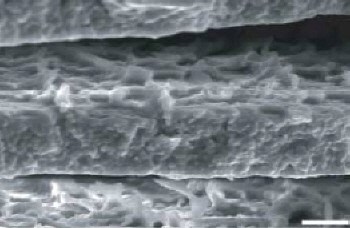
Although modern ceramics are strong, they are brittle and unsuitable for many applications. Researchers have therefore long envied natural materials like “nacre”, a component of mollusc shells. Nacre has a very intricate layered structure that makes the shells incredibly strong and tough (figure 1). A shell can absorb energy when hit, which makes it less likely to fracture.

However, previous techniques for mimicking the way seashells grow have been largely unsuccessful because their intricate structures need to be replicated at different length scales. Tomsia and colleagues have overcome this problem with their new technique, which copies the way that water freezes when impurities are present. Seawater, for example, contains dissolved salt and microorganisms that are expelled into channels between frozen ice crystals.

The team began by suspending a ceramic powder in water. They then froze the water, which causes the ice to grow in a fixed direction at a controlled velocity, trapping the ceramic particles between the growing ice crystals. Evaporating the ice leaves a porous structure — the scaffold — that has the same structure as the ice crystal layers. Finally, they filled the pores of the scaffold with an organic polymer or metal (figure 2).

The result is a tough, strong, dense ceramic composite in which the thickness and the number of layers can be controlled. According to the team, the materials could be used for artificial bone, heat exchangers for electronics, lightweight materials for cars or body armour, and high resistance machining tools.

“Concerning the biomedical field, we have been able to fabricate hydroxyapatite scaffolds strong enough to be considered for load-bearing applications for the first time — for example, prostheses and teeth implants,” explains Tomsia. “Hydroxyapatite is a calcium phosphate closely related to the mineral content of bone and is the best candidate for fabricating scaffolds for osseous tissue regeneration.”

The team is now trying to improve its technique and scale it up for industrial applications.

Volcanoes reveal a new side

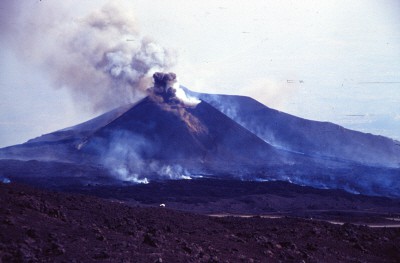
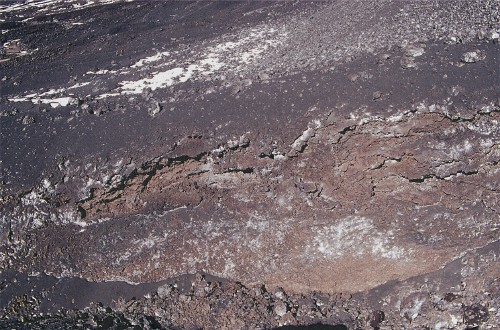
Most scientists believe that lava channels in volcanoes are created when hot flowing lava transfers heat to the cold surrounding rock, thus melting and eroding it. However, other researchers have recently found evidence for purely mechanical or frictional effects, in which the lava “cuts” the rock, rather than melting it. Ferlito and Siewert say that the Laghetto channel on Mount Etna, created during the volcano’s eruption in 2001, might have formed by this sort of mechanical process.

The eruption started on 19 July and formed a crater in the Piano del Lago area of the volcano (figure 1). Ferlito and Siewert observed this event from a safe distance and then studied how it evolved over the following weeks. Ferlito discovered the unusual channel when the eruption finished 13 days later and noticed right away that it was not a “classical” channel “built” by the lava, but that it was somehow incised into it. Ferlito took photographs and measurements of the channel banks, which contained clearly visible strata (figure 2).

The two scientists have now put forward a mathematical model to explain the patterns they observed. They believe that the channel was created from a 20-metre thick lava layer containing a dense mixture of crystals and pieces of already solidified lava (or “clasts”) suspended in a melt matrix. The mesh of clasts got dragged along the rock bed so that the irregular clast surfaces ploughed out grooves in it. According to the team, these grooves are characteristic of abrasive and erosion wear processes and are inherently different from what happens in thermal erosion.

Ferlito and Siewert now hope to strengthen their hypothesis by finding and studying other examples of mechanical erosion and will look at older lava flow channels on Mount Etna to do this. Their results could also help shed more light on how lava channels on the Moon and Venus formed. “Until now, erosional features like channels on other planets have been discussed mainly in terms of thermal erosion,” explains Siewert. “Our work adds the idea of other possible processes that may have contributed.”

How physics can improve your football

Throw-ins are awarded in football when the ball goes out of play, and involves the thrower holding the ball with both hands behind his or her head and launching it forward back onto the field of play. Some footballers, such as Dave Challinor of Stockport County in England, are able to throw the ball far enough into the goal area so that their team mates have a significant chance of scoring. The trick is to be able to throw the ball fast enough and at the right angle.

To work out the optimum angle between the initial direction of the ball and the horizontal, Nicholas Linthorne and David Everett first used a video camera to film a player throwing a football at angles between 10 and 60 degrees. They then used biomechanical software to measure the launch velocity and launch angle of the ball as recorded on the video. Combining this information with the equation of flight of a spherical projectile, they calculated the optimum launch angle to be 30 degrees. Most physics textbooks, on the other hand, quote an angle of 45 degrees. Moreover, the researchers found that the ball could travel a few metres further if it was thrown with a “backspin” at slightly lower angles.

The researchers say that that the techniques used in this study could be applied to any sport that involves projecting a ball or launching the human body. Linthorne is now working out the optimum angle at which football goal kicks should be taken.

Cruise control avoids jams

Traffic congestion is a severe problem on motorways in many European countries. Since it is not always cheap or easy to build extra motorways to solve this problem, researchers are looking for alternative ways to ease congestion. Examples include variable speed limits that depend on the volume of traffic and “ramp metering”, which restricts the number of cars entering the motorway from a slip road. Such methods are based on so-called centralized traffic management, which responds to a given traffic situation. Now, Kesting and colleagues think that traffic flow could be improved by fitting more cars with automatic cruise control.

ACC is a modified version of traditional cruise control. ACC automatically accelerates or decelerates a vehicle to maintain a fixed distance between it and the car in front and works by using radar sensors to measure the actual distance and speed difference between the two vehicles. Although only a few cars are fitted with ACC today, the proportion is likely to increase in the future as the technology improves and penetrates the car market more fully.

The German researchers carried out computer simulations of traffic — in which each vehicle is represented by a small particle — to describe the dynamics of traffic on motorways. Their approach allows them to vary the number of different types of vehicle and driving styles — such as cars and trucks, and fast and slow drivers. The simulations consider traffic flows that consist mostly of “human” drivers and a small number of “partly automated” ACC cars.

The team found that even if just 10% of all cars use ACC then congestion is dramatically eased because “traffic breakdown” — where cars come to a complete halt as in a traffic jam — is delayed (see figure). “This is a benefit to drivers because fewer people are affected and the waiting time is smaller thanks to reduced queue lengths,” explains Kesting. Moreover, the effect is scaleable so if, say, 20% of cars had ACC, then congestion would be reduced even further.

The researchers believe that it is now up to engineers to construct more efficient ACC systems because today’s designs are not yet advanced enough to behave like the ACCs described in the simulations. “That will be the starting point to realize the potential of ACC as a promising strategy for the better traffic performance outlined in our work,” says Kesting.

Matter bound by light

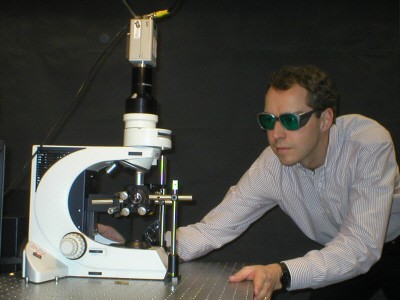
Bain and Mellor began by overlapping two laser beams on the surface of a silica prism. The beams were made to strike the surface above the critical angle, so that only the evanescent — or surface — fields penetrate out into the space beyond the prism. Next, the researchers placed a drop of water containing a dilute solution of polystyrene beads about 300 to 600 nm in diameter on the surface of the prism. The spheres are attracted by the evanescent field and spontaneously assemble into 2D arrays (see figure 1).

“For most physicists, the idea of materials held together by light is still foreign,” says Bain. “The most surprising result in this new work is the formation of a square array of 390 nm particles with orthogonally polarized laser beams. Although the electric field is quite uniform in the plane of the surface, a large regular array is observed.”

The new optical matter arrays are distinct from optical tweezers, in which spatially varying electric fields are used to control the positions of particles. According to Bain and Mellor, the 2D ordering in optical arrays comes from the scattering of the evanescent light field by the particles themselves and not from an imposed field gradient.

“The arrays show many of the dynamical features of molecular crystals, such as surface diffusion, migration of defects, nucleation of phase transformations and ‘Ostwald ripening’ – where two arrays coalesce into one,” says Bain. “As well as being a new way to assemble matter on the nanoscale, such arrays may also provide a way of visually studying, in real time, the processes that occur invisibly in crystals on sub-nanoscales.”

Bain now plans to develop a quantitative model to explain the optical binding in these arrays, and to study how particles with different shapes and sizes assemble. He also hopes to extend the optical matter arrays into 3D.

Comet samples return to Earth

Stardust is the first mission since Apollo to return extraterrestrial material to Earth. Launched in February 1999, it captured tiny fragments from the dust cloud and tail of comet Wild 2 in January 2004 as it approached to within 250 km of the comet. The particles were collected by trapping them in a “butterfly net” collector smeared with an aerogel – a light, foamy glass consisting of 99.9% air that is the least dense solid known.

After being captured, the sample was locked in a capsule that was only released by the Stardust craft when it flew past the Earth. Although the sample is small – a few thousand particles weighing about 1 milligram in all – it represents the only sample of extraterrestrial material for which astronomers know the source. The craft also collected samples of inter-planetary dust at various points on its seven-year journey.

“Comets originate from the outer solar system and therefore the Stardust samples are unique,” says Ian Franchi, a planetary scientist at the Open University (OU) in the UK. “They formed early and have remained largely unchanged since, offering a unique insight into the materials that formed the solar system, including the complex organic molecules that may have had a role in the development of life on this planet and elsewhere.” Franchi’s team is expected to be one of the first to analyze the samples.

The samples will now be examined by groups worldwide using a range of instruments, such as electron microscopes, ion microprobes, and laser-probe mass spectrometers that will analyze the particles down to the atomic scale. “This will provide a depth and detail of knowledge that cannot be obtained from remote observation and analysis,” says Simon Green, another planetary scientist at the OU.

There are even plans to set up an online virtual microscope, pioneered by the University of California at Berkeley to help with the research. Dubbed Stardust@home, it will allow anyone with an Internet connection to sift through the anticipated 1.5 million aerogel images to look for dust tracks — trails left by particles when the burrow through the aerogel. Once the tracks are found, researchers will then be able to find the particles that lie at the end of the track.

However, the detailed analysis is likely to last many years and will involve combining data from many different investigators. According to Green, the main difficulties will be in extracting and manipulating the tiny particles from the aerogel, particularly if the captured dust is fluffy and has a low density.

Crystals light up

Coherent light has a very narrow bandwidth and consists of photons that are all in phase with one another. Until now, however, all practical coherent light sources have been either lasers (which were invented in 1958) or free-electron lasers, which harness the radiation emitted by relativistic electrons. The new light source, proposed by Evan Reed and colleagues at the Massachusetts Institute of Technology and the Lawrence Livermore National Laboratory, is fundamentally distinct from these sources.

Using the Thunder parallel computer at the Lawrence Livermore Lab, the researchers performed a series of theoretical calculations and experimental simulations to observe what happens when a mechanical shock wave is generated inside a dielectric crystalline material, such as sodium chloride. They expected to observe only incoherent photons and “sparks” to be produced from the crystal, but to their surprise the researchers found weak yet measurable coherent light emerging from it with a frequency between one and 100 THz

According to the team, the shock wave makes large numbers of atoms in the crystal move in a synchronized way as it propagates through the lattice. This induces an oscillating dipole-like polarization in the material that produces the coherent radiation observed. The frequency of the emitted light is determined by the speed of the shock wave and the periodic lattice structure of the crystal, and not by the coherence of the source that generates the shock wave.

“To our knowledge, coherent light never has been seen before from shock waves propagating through crystals because a shocked crystal is not an obvious source to look for coherent radiation,” explains Reed. “The light and radiation was in a portion of the electromagnetic spectrum that is not usually observed in these types of experiments.”

The researchers say that the effect should be observed in a wide variety of crystalline materials, and plan to perform experiments to observe coherent radiation in the laboratory. Among a diverse range of potential applications, coherent light from a shocked crystal could be used as a diagnostic tool to determine atomic-scale properties of the shocked material.

Pulsar breaks speed record

Most neutron stars — extremely dense stars that are heavier than the Sun, even though they measure just tens of kilometres across — rotate slower than a few times a second. However, neutron stars in binary systems can spin several hundreds of times a second because their companion stars transfer angular momentum to them. Some of these neutron stars, called millisecond pulsars, emit radio waves at periods modulated by the star’s rotation speed.

The fastest pulsar known until now was the 642-Hz pulsar B1937+21, discovered in 1982. Coincidentally, this was the also the first millisecond pulsar ever to be found. Because no other fast pulsars have been detected since, many astronomers believe that such rapidly rotating pulsars must be rare.

Hessels and colleagues decided to look for such pulsars in the globular cluster Terzan 5 using the National Astronomy Observatory’s 100-m Green Bank Telescope — the world’s largest fully steerable radio telescope. Globular clusters contain many more millisecond pulsars than our galaxy does because they contain a high density of stars in their cores, which promotes the creation of binary systems. The Canada-US team have uncovered 30 millisecond pulsars in Terzan 5 so far — including Ter5ad — in addition to the three previously known pulsars in this cluster.

Finding Ter5ad was not an easy task because the pulsar is eclipsed by its companion star for over 40% of the time. It is also a weak radio source. According to the researchers, such rapidly rotating pulsars might not be so rare after all — they are just very difficult to detect.

The size of neutron stars is also notoriously hard to measure but the team used the fast spin rate of Ter5ad to calculate its radius. “If we assume that it weighs less than two solar masses, then its radius must be less than 16 km,” Hessels told PhysicsWeb. “This helps constrain the equation of state of matter at supranuclear densities and so helps us understand the behaviour of matter at these extreme conditions.”

The astronomers now hope to discover even faster-spinning pulsars in Terzan 5. “We have found a number of new pulsars since Ter5ad, but none are spinning as fast,” says Hessels.

Copyright © 2026 by IOP Publishing Ltd and individual contributors