Ministers support Europe in space

Ministers agreed that ESA’s science programme will receive €2.1bn over the next five years, which is what the agency had asked for. This means that funding for science will rise by 2.5% per year, keeping it in line with inflation. Previously the science budget had remained flat and there was therefore “an erosion of buying power” in ESA speak. ESA spokesman Franco Bonacina says that the Bepi-Colombo mission to Mercury, due to take off in 2012 but which some had feared may be axed, should now be safe.

Most other parts of the ESA programme received all or nearly all the money that had been requested by the agency. But a new project being organized jointly with the European Union called Global Monitoring for Environment and Security (GMES), receives some €250m, €50m more than was asked for. This project will integrate all available Earth monitoring data, whether obtained in space or on the ground, and launch a new set of Earth-observation satellites. This will allow scientists to improve their understanding of the climate and to monitor natural disasters such as earthquakes and floods, and also allow the EU and its member states to monitor fishing quotas and carry out other surveillance tasks.

Another project to get more than was asked for was the Exomars mission. Due to take off in 2011, this will involve sending a rover to search for signs of life on Mars. It will receive some €550m over the next six years. This will be complemented by a further €150m to start the development of future robotic and human exploration missions to the Moon and Mars. However, some €50m requested to begin developing a replacement to the Soyuz manned spacecraft, known as Clipper, with Russia over the next two years was not forthcoming. Ministers felt that the Clipper programme was “not yet mature enough”, according to Bonacina.

There was also no explicit money for a replacement to the CryoSat satellite, which was supposed to study the effect of climate change on the Earth’s polar ice caps but which was lost shortly after take off last October. But, says Bonacina, with the Earth observation programme receiving nearly full funding, there is a good chance that a successor to Cryosat will be built.

In addition to thrashing out ESA’s budget, ministers at the Berlin meeting also decided that all missions developed by ESA and its member states must use European launchers. Bonacina says that it may be more expensive to use the Ariane, Soyez or forthcoming Vega launchers than those from overseas but that doing so ensures European taxpayers’ money is well spent.

Photons create primitive quantum network

Conventional computers store and send information as “bits”, which can have a value of either 1 or 0. As electronic components become smaller, physicists have suggested that information could be stored and sent in certain two-level quantum systems. These include the horizontal and vertical polarization states of photons, or the “spin up” and “spin down” states of electrons.

The crucial difference is that these quantum bits — or “qubits” — can exist in both possible states at the same time, a phenomenon known as superposition, which means that a quantum computer could, in principle, outperform a classical computer for certain tasks. Another feature of quantum mechanics is entanglement. This allows particles to have a much closer relationship than is possible in classical physics: if two particles are entangled, we can know the state of one particle by measuring the state of the other.

Photons are good candidates for making qubits because they can travel long distances with little decoherence – the transition from quantum to classical behaviour that occurs when the particles interact with their environment. Moreover, they can be stored for long periods. However, for this technology to work, scientists need to be able to manipulate single photons — a feat that has not been achieved until now.

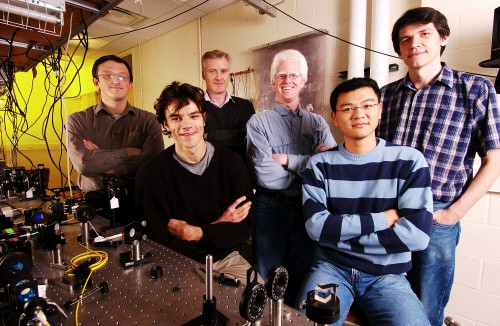
Using lasers and electromagnetic traps, Matthew Eisaman of Harvard University and colleagues, and independently, Alex Kuzmich and co-workers at Georgia Institute of Technology, created a single photon in one atomic ensemble and then sent this photon to another ensemble, where they were able to store and retrieve it. The main difference between the two experiments was that the first employed rubidium-87 atoms at room temperature while the second used atoms of rubidium-85 at ultracold temperatures (Nature 438 837 & 833). The researchers confirmed that the quantum characteristics of the created and the retrieved photon were preserved even after the storage process.

“We have essentially created a very primitive quantum network,” Eisaman told PhysicsWeb. “Quantum networks are the quantum analogue of classical computing networks and will be an integral part of any future realisations of quantum computing or quantum communication.” Other potential applications include quantum cryptography, which allows data to be transmitted with complete security.

Finally, Jeff Kimble and colleagues at the California Institute of Technology and Bell Labs demonstrated that a stored atomic state of matter can be transferred to an entangled state of light for the first time (Nature 438 828). These experiments will be important for making scalable quantum communication networks with atomic assemblies.

Exploding dark-matter balls predicted

Dark matter was originally proposed to explain why galaxies rotate much faster than can be explained by the amount of visible matter they contain. This mysterious form of matter does not emit or absorb electromagnetic radiation — hence the name “dark” — and can only be detected by its gravitational influence on ordinary matter. According to the standard model of cosmology, the universe is thought to contain about 5% of ordinary matter, 25% of dark matter and 70% of dark energy. The nature of this dark matter and energy is the biggest mystery in cosmology today.

Unlike some other recent theories, the new model for dark matter, which has been proposed by Colin Froggatt of Glasgow University and Holger Nielsen of the the Niels Bohr Institute in Copenhagen, does not require any new fundamental particles or interactions beyond the Standard Model of particle physics. The model also predicts a ratio of dark matter to ordinary matter that agrees with the value obtained by NASA’s WMAP satellite in 2003. It does, however, assume the existence of an “alternative vacuum” that has the same energy density — or “cosmological constant” — as our own ordinary vacuum.

Froggatt and Nielsen calculate that the two different types of vacuum separated out into different regions of space quite early in the history of the universe by “domain walls” that formed at the high temperatures present at this time. Roughly one second after the Big Bang, the researchers say, these walls formed balls that encapsulated matter inside pieces of the alternative vacuum. All nucleons might have been captured this way, leading to the formation of the first light nuclei, such as helium, as the balls rapidly contracted.

This contraction continued until the helium nuclei fused together to form heavier nuclei and the energy released in the subsequent chain reactions expelled the nucleons from the balls say the researchers. According to the new model, one sixth of the nucleons were freed this way, entering the ordinary vacuum and becoming normal matter. The rest of the nucleons remained trapped as dark matter inside the balls of the alternative vacuum.

The team believes that some of the balls might have collected inside heavy stars. At sufficiently high temperatures and densities, they could have started consuming the star, so releasing enough energy to make it explode in a supernova. The balls themselves could even implode and therefore provide a way to produce ultra-high energy cosmic rays from seemingly empty places in the universe. The researchers also say that their theory might explain why the amount of lithium in the universe is 2 to 3 times less than is predicted by the standard Big Bang nucleosynthesis model.

Exotic materials and pulsars win European prize

The EXEL collaboration wins its €200,000 for demonstrating the physical reality of left-handed materials, which can refract light rays “negatively”. Thirty years after Russian scientist Victor Veselago postulated the existence of left-handed materials in the 1960s, John Pendry of Imperial College in London proposed that such materials could be made from either arrays of non-magnetic metallic wires or from split-ring resonators. The realization of these materials by Pendry and colleagues in the EXEL collaboration suggests a number of exciting technologies, such as improved magnetic resonance imaging devices, better mobile phone antennas and “perfect” lenses that would focus an image with a resolution not restricted by the wavelength of light.

The PULSE collaboration wins its share of the prize for the study of pulsars, rapidly rotating neutron stars formed by the collapse of a massive star in a supernova explosion. By studying apparent variations in pulse rates, researchers can test general relativity and explore the solid-state physics of super dense matter, as well as learning more about the behaviour of pulsars themselves. PULSE, led by Andrew Lyne of the University of Manchester and in collaboration with astronomers in Australia, has located over 850 pulsars, exceeding the number located by all astronomers over the previous 30 years. The highlight of this research was the first ever discovery in 2003 of a double pulsar, which has provided a very stern test of general relativity.

The other three fifths of the Descartes Research Prize are awarded to the CECA team for its work on climate and environmental change in the Arctic; to ESS for comparing social values across Europe; and to EURO-PID for research on rare genetic diseases. The Descartes Science Communication Prize is awarded to Carl Sundberg from Sweden; the Copenhagen University astrophysicist Anja Andersen; Jos Van Hemelrijck of VRT Television in Belgium; the author Bill Bryson; and Michael Seifert of Tübingen University. There are also five runners-up for the research prize, each of which receives €30,000, and five runners-up for the science communication prize, each of whom receive €5000. The awards were made on December 2 at the Royal Society in London.

Optical devices get fishy

DNA has unique electronic and optical properties. It has low optical loss over a broad range of wavelengths and its electrical resistivity is three to five orders of magnitude lower than other polymers. Moreover, the resisitivty of the DNA can be tweaked by changing the molecule’s molecular weight.

According to Grote’s team, which includes researchers from the universities of Dayton and Cincinatti, the material could be used to make a waveguide device that could have lower optical losses than other polymers. “There is also promise for both passive and active all DNA devices such as electro-optic modulators,” adds Grote.

The team obtained the DNA by treating a mix of salmon milt and roe sacs with enzymes to remove unwanted proteins. They then purified the material by dissolving it in an organic solvent and filtering it through a membrane. Finally, they used the technique of “spin deposition” to create thin DNA films on a substrate that are stable up to 200°C. By cross-linking DNA — joining neighbouring molecules through chemical bonds — the team was able to toughen the material and create multi-layer structures.

Entanglement reaches new levels

Entanglement allows particles to have a much closer relationship than is possible in classical physics: if two particles are entangled, we can know the state of one particle by measuring the state of the other. For example, two particles can be entangled such that the spin of one particle is always “up” when the spin of the other is “down”, and vice versa. An additional feature of quantum mechanics is that the particle can exist in a superposition of both these states at the same time. By taking advantage of such quantum phenomena, a quantum computer could, in principle, outperform a classical computer for certain tasks.

Using lasers and ultra-cold electromagnetic traps, the NIST scientists entangled six beryllium ions so that all their nuclei were collectively spinning in both clockwise and anticlockwise directions at the same time (Nature 438 639). These states are also known as “cat” states after Erwin Schrödinger’s famous thought experiment in which a cat was somehow both alive and dead at the same time. Using similar techniques, the Austrian scientists entangled eight calcium ions that were more robust because they were stable even if some particles were removed (Nature 438 643).

The new results break the previous record of five entangled photons achieved last year. Moreover, the entangled states can be produced “on demand” and made available for further tasks without being destroyed — something that has never been done before. The number of particles entangled could be increased even further, leading the way to large-scale quantum computers.

Cat states could be used to correct errors in quantum computation and so make fault-tolerant quantum computers. These entangled states are also more sensitive to decoherence — the transition from quantum to classical behaviour that occurs when the particles interact with their environment — than other types of superpositions. They could therefore be useful in applications such as precision spectroscopy and quantum cryptography, which allows data to be transmitted with complete security.

Beyond belief

In the October issue of Physics World Robert Crease asked how scientists should respond to “intelligent design”. Supporters of intelligent design (ID) argue that evolution is not the random process proposed by Darwin. Rather, they believe that living creatures have evolved in accordance to a design drawn up, presumably, by a supernatural creator or God.

Why should physicists be interested in this debate? First, supporters of ID are campaigning to force schools in the US to read out statements in science lessons that could lead students to believe that the scientific evidence for evolution and ID is comparable. The Big Bang model of cosmology has been challenged in a similar way in the past.

Second, Crease’s article prompted more letters to Physics World than any article in the past 10 years, revealing that many physicists are interested in the interface between science and religion (see pp18-19; print version only). Recent developments in cosmology and genetics mean that the traditional divide between science and religion – science can tell us nothing about how to lead our lives, religion can tell us nothing about how the world works – is becoming blurred. Indeed, when professors of theology start to deliver lectures on “Religion and the quantum world”, as happened recently at Gresham College in London, it suggests that stimulating interactions between the two sides are possible.

It is impossible, however, to see how ID can be considered as science (although what religious-education teachers choose to do is their concern). Science is all about finding out how the world works through observation and hypothesis. Scientific theories should be able to explain all the experimental data available and, ideally, make new predictions that can be tested. However, no theory can ever be proved to be correct because there is always the possibility that some piece of evidence will turn up to the contrary. For instance, we will never be able to say that the general theory of relativity is true, but that does not mean that we can deny the existence of gravity. The same is true of the theory of evolution by natural selection.

There are still gaps in the theory of evolution and disagreements between biologists about the details, but this is the case for most scientific theories. The bottom line is that evolution makes predictions and ID does not, and that means that ID has no place in science lessons.

Physics after the year of physics

There is still work to do

We can say with confidence that Einstein has received good press in the International Year of Physics, which ends this month, but it will take some time to determine if the main goal of the year – to raise public awareness of physics and the physical sciences – has been achieved (see p13; print version only). The shortage of students studying physics at schools and universities, and a lack of people qualified to teach the subject in schools, will not be solved in a year, so it is essential that all efforts to address these problems are maintained and, if possible, increased. If the year of physics helps to reverse these trends, then 2005 will truly have been another annus mirabilis.

Does God play dice?

Gerard ‘t Hooft argues that the problems we face in reconciling quantum mechanics with general relativity could force us to reconsider the basic principles of both theories.

If there is any preconceived notion concerning the laws of nature – one that we can rely on without any further questioning – it is the assumption that they are controlled by strict logic. Under all conceivable circumstances, the laws of nature should dictate how the universe evolves. Curiously, however, quantum mechanics has given a new twist to this adage. It does not allow a precise sequence of events to be predicted, only statistical averages. All statistical averages can be predicted – in principle with infinite accuracy – but nothing more than that.

Einstein was one of the first people to protest against this impoverishment of the concept of logic. It has turned out, however, to be a fact of life. Quantum mechanics is the only known realistic description of the microscopic parts of our universe like atoms and molecules, and it works just fine. Logically impoverished or not, quantum mechanics appears to be completely self-consistent.

But how does quantum mechanics tie in with particles that are much smaller than atoms? The Standard Model is the beautiful solution to two fundamental problems: one, how to combine quantum mechanics with Einstein’s theory of special relativity; and two, how to explain numerous experimental observations concerning the behaviour of sub-atomic particles in terms of a concise theory. This model tells us how far we can go with quantum mechanics. Provided that we adhere strictly to the principles of quantum field theory, nature obeys both quantum mechanics and special relativity up to arbitrarily small distance and time scales.

Just like all other successful theories of nature, the Standard Model obeys the notions of locality and causality, which makes this theory completely comprehensible. In other words, the physical laws of this theory describe in a meaningful way what happens under all conceivable circumstances. The standard theory of general relativity, which describes the gravitational forces in the macroscopic world, approaches a similar degree of perfection. Einstein’s field equations are local, and here, cause also precedes effect in a local fashion. These laws, too, are completely unambiguous.

But how can we combine the Standard Model with general relativity? Many theorists appear to think that this is just a technical problem. But if I say something like “quantum general relativity is not renormalizable”, this is much more than just a technicality. Renormalizability has made the Standard Model possible, because it lets us answer the question of what happens at extremely tiny distance scales. Or, more precisely, how can we see that cause precedes effect there? If cause did not precede effect, we would have no causality or locality – and no theory at all.

Asking both questions in quantum gravity does not appear to make sense. At distance scales small compared with the Planck scale, some 10-33 cm, there seems to be no such thing as a space-time continuum. That is because gravity causes space-time to be highly curved at very small distances. And at small distance scales, this curvature exceeds all bounds. But what exactly does this mean? Are space and time discrete? What then do concepts such as causality and locality mean? Without proper answers to such questions, there is no logically consistent formalism, not even a quantum-mechanical one.

One ambitious attempt to combine quantum mechanics with general relativity is superstring theory. However, I am unhappy with the answers that this theory seems to suggest to us. String theory seems to be telling us to believe in “magic”: it is claimed that “duality theorems”, which are not properly understood, will allow us to predict features without reference to locality or causality. To me such magic is synonymous with “deceit”. People only rely on magic if they do not understand what is really going on. This is not acceptable in physics.

In thinking about these matters, I have reached a conclusion that few other researchers have adopted: the problem lies with quantum mechanics, possibly with general relativity, or conceivably with both.

Quantum mechanics could well relate to micro-physics the same way that thermodynamics relates to molecular physics: it is formally correct, but it may well be possible to devise deterministic laws at the micro scale. However, many researchers say that the mathematical nature of quantum mechanics does not allow this – a claim deduced from what are known as “Bell inequalities”. In 1964 John Bell showed that a deterministic theory should, under all circumstances, obey mathematical inequalities that are actually violated by the quantum laws.

This contradiction, however, arises if one assumes that the particles we talk about, and their properties, are real, existing entities. But if we assume that objects are only real if they have been precisely defined, including all oscillations as small as the Planck scale – and that only our measurements of the properties of particles are real – then there is no blatant contradiction. One might assume that all macroscopic phenomena, such as particle positions, momenta, spins and energies, relate to microscopic variables in the same way thermodynamic concepts such as entropy and temperature relate to local, mechanical variables. Particles, and their properties, are not (or not entirely) real in the ontological sense. The only realities in this theory are the things that happen at the Planck scale. The things we call particles are chaotic oscillations of these Planckian quantities. What exactly these Planckian degrees of freedom are, however, remains a mystery.

This leads me to an even more daring proposition. Perhaps general relativity does not appear in the formalism of the ultimate equations of nature. In making the transition from a deterministic theory to a statistical – i.e. quantum mechanical – treatment, one may find that the quantum description develops many more symmetries than the deeper deterministic description.

Let me try to clarify what I mean. If, according to the deterministic theory, two different states evolve into the same final state, then quantum mechanically these states will be indistinguishable. We call such a feature “information loss”. In quantum field theories such as the Standard Model, we often work with fields that are not directly observable, because of “gauge invariance”, which is a symmetry. Now, I propose to turn this around. In a deterministic theory with information loss, certain states are unobservable (because information about them has disappeared). When one uses a quantum-mechanical language to describe such a situation, gauge symmetries naturally arise. These symmetries are not present in the initial laws. The “general co-ordinate covariance” of general relativity could be just such a symmetry. This is indeed an unusual view on the concept of symmetries in nature.

Nature provides us with one indication that perhaps points in this direction: the unnatural, tiny value of the cosmological constant Λ. It indicates that the universe has a propensity to stay flat. Why this happens is a mystery that cannot be explained in any theory in which gravitation is subject to quantum mechanics. If, however, an underlying, deterministic description naturally features some preferred flat co-ordinate frame, the puzzle will cease to perplex us. There might be another example, which is the preservation of the symmetry between the quarks in the subatomic world, called charge-parity (CP) symmetry – a symmetry that one would have expected to be destroyed by their strong interactions.

The problem of the cosmological constant has always been a problem of quantum gravity. I am convinced that the small value of Λ cannot be reconciled with the standard paradigms of quantized fields and general relativity. It is obvious that drastic modifications in our way of thinking, such as the ones hinted at in this text, are required to solve the problems addressed here.

Edward Witten thinks that one of the most perplexing aspects of quantum mechanics is how to apply it to the whole universe

Quantum mechanics is perplexing, and likely to remain so. The departure from ordinary classical intuition that came with the emergence of quantum mechanics is almost surely irrevocable. An improved future theory, if there is one, will probably only lead us farther afield.

Is there any hint of a clue that might lead to a more complete theory? Experimental physicists are increasingly able to perform experiments that used to be called thought experiments in textbooks. Quantum mechanics has held up brilliantly. If there is a cloud on the horizon, it is that it is hard to see what it means to apply quantum mechanics to the whole universe. I suppose that there are two aspects to this. Quantum-mechanical probabilities do not seem to make much sense when applied to the whole universe, which appears to happen only once. And we all find it confusing to include ourselves in a quantum description of the whole universe.

Yet applying quantum mechanics to something less than the whole universe – to an experimental system that is observed by a classical human observer – is precisely what forces us to interpret quantum mechanics in terms of probabilities. If we had a good understanding of what quantum mechanics means when applied to the whole universe, we might ultimately say that the notion that “God plays dice” results from trying to describe a quantum reality in classical terms.

Fay Dowker thinks that the puzzles of quantum mechanics could be solved by considering what are known as the “histories” of a system, as introduced by Richard Feynman

The development of quantum mechanics was a major advance in our understanding of the physical world. However, quantum mechanics has not yet come fully to fruition because it has not replaced classical mechanics in the way that general relativity has replaced Newtonian gravity. In the latter case, we can start from general relativity and derive the laws of Newtonian gravity as an approximation; we can also predict when – and quantitatively to what extent – that approximation is valid.

But we cannot yet derive classical mechanics from quantum mechanics in the same way. The reason is that, in its standard textbook formulation, quantum mechanics requires us to assume we have classical measuring equipment. Predictions about the measurements that are recorded, or observed, by this equipment form the scientific output of the theory. But without a classical observer, we cannot make any predictions. While many physicists have been content with quantum mechanics in its textbook form, others – beginning with Einstein – have sought to complete the quantum revolution and make it a truly universal theory, independent of any classical crutch.

One attempt to sort out quantum mechanics is to view it as a generalization of classical “stochastic” theories, such as Brownian motion. In Brownian motion, a particle moves along one of a number of possible trajectories, or “histories”. The notion of a history is crucial here: it is a complete description of the system at each time between some initial and final times. A history is an a priori possibility for the complete evolution of the system, and the collection of all the histories is called the “sample space”.

The system will have only one actual history from the sample space but any one is an a priori possibility. The actual history is chosen from the sample space at random according to the “law of motion” for a Brownian particle. This law is a probability distribution, or “measure”, on the sample space that outlines, roughly, how likely each history is for the actual evolution.

Quantum mechanics also has a sample space of possible histories – trajectories of a particle, say – but on this occasion the sample space has a “quantal measure” associated with it. As with Brownian motion, the quantal measure gives a non-negative number for each subset of the sample space. However, this quantal measure cannot now be interpreted as a probability because of the phenomenon of quantum interference, which means that the numbers cannot be added together like probabilities.

For example, when electrons pass through a Young’s double-slit set-up, the quantal measure of the set of all histories for the electron that ends up at a particular region on the screen is not just the quantal measure of the set of histories that goes through one slit added to the quantal measure of the set of histories that goes through the other. Essentially, this is due to the phenomenon we call quantum interference between histories, which is due, in turn, to the way we calculate the quantum measure of a bunch of histories as the square of the sum of the amplitudes of the histories in the bunch. When you add some numbers and then square the result, you do not get the sum of the squares – there are also cross terms, which are the expression of the interference that spoils the interpretation as probabilities.

The challenge is to find the right interpretation of this quantal measure, one that explains the textbook rules by predicting objectively when classical “measurement” situations arise. This includes the struggle to understand quantum mechanics as a theory that respects relativistic causality in the face of experimental evidence that widely separated particles can be correlated in ways that seem incompatible with special relativity.

It is no coincidence that those physicists who are at the forefront of developing this histories approach to quantum mechanics – people like James Hartle from the University of California at Santa Barbara, Chris Isham at Imperial College, London and Rafael Sorkin at Syracuse University – all work on the problem of quantum gravity, which is the attempt to bring gravity within the framework of a universal quantum theory. In histories quantum gravity, each history in the sample space of possibilities is not in space-time; rather, each history is a space-time. If a theory of quantum gravity of this sort can be achieved, it would embody Einstein’s hopes for a unification in which matter and space-time, observer and observed, are all treated on an equal footing.

Paul Davies believes that the complexity of a system could define the boundary between the quantum and classical worlds

Despite its stunning success in describing a wide range of phenomena in the micro-world, quantum mechanics remains a source of puzzlement. The trouble stems from meshing the quantum to the classical world of familiar experience. A quantum particle can be in a superposition of states – for example it may be in many places at once – whereas the “classical” world of observation reveals a single reality. This conundrum is famously captured by the paradox of Schrödinger’s cat, in which a quantum superposition is amplified in order to put an animal into an apparently live-dead hybrid state.

Physicists divide into those who believe quantum mechanics is a complete theory that applies to the universe as a whole, regardless of scale, and those who think it must break down at some level between atom and observer. The former group subscribe to the “many universes” interpretation, according to which all branches of a quantum superposition are equally valid and describe parallel realities. Though many physicists reject this interpretation as unacceptably bizarre, there is no consensus on the alternative. Quantum mechanics does not seem to fail at any obvious scale of size or mass, as the phenomenon of superconductivity attests. So perhaps some other property of a physical system signals the emergence of classicality from the quantum realm? I want to suggest that complexity may be the appropriate quantity.

Just how complex must a system be to qualify for the designation “classical”? A cat is, I submit, a classical object because it is complex enough to be either alive or dead, and not both at the same time. But specifying a precise measure of complexity is difficult. Many definitions on offer are based on information theory or computing. There is, however, a natural measure of complexity that derives from the very nature of the universe.

This is defined by the maximum amount of information that the universe can possibly have processed since its origin in a Big Bang. Seth Lloyd of the Massachusetts Institute of Technology has computed this to be about 10120 bits (2000 Nature 406 1047 and 2002 Phys. Rev. Lett. 99 237901). A system that requires more than this quantity of information to describe it in detail is so complex that the normal mathematical laws of physics cannot be applied to arbitrary precision without exceeding the information capacity of the universe. Cosmology thus imposes a small but irreducible uncertainty, or fuzziness, in the operation of physical laws.

For most systems the Lloyd limit is irrelevantly large. But quantum systems are described by vectors in a so-called Hilbert space, which may have a great – indeed infinite – number of dimensions. According to my maximum-complexity criterion, quantum mechanics will break down when the dimensionality of the Hilbert space exceeds about 10120.

A simple example is an entangled state of many electrons. This is a special form of superposition in which up and down spin orientations co-exist in all possible combinations. Once there are about 400 electrons in such a state, the Lloyd limit is exceeded, suggesting that it is at this level of complexity that classicality emerges. Although such a state is hard to engineer, it lies firmly within the design specifications of the hoped-for quantum computer. This is a machine that would harness quantum systems to achieve an exponentially greater level of computing power than a conventional computer. If my ideas are right, then this eagerly awaited technology will never achieve its full promise.


Life in a landscape of possibilities

Theoretical physicists are as big a bunch of atheists as you would care to meet. So why are they always going on about God?

“God does not play dice,’’ declared Albert Einstein.

“We should know the mind of God,’’ wrote Stephen Hawking.

Not even the experimentalists are immune: the Nobel laureate Leon Lederman wrote a book called The God Particle.

The answer, it seems, is that their God is not a personal deity in the usual religious sense, but rather some cosmic intelligence responsible for creating the universe and designing the laws of nature. As Hawking put it, “You still have the question: why does the universe bother to exist? If you like, you can define God to be the answer to that question.”

Nevertheless, they are treading on dangerous ground. Nowadays, the words “intelligent” and “design” have acquired a more sinister meaning in the US when combined into the “intelligent design” movement. Its supporters seek to undermine Darwin’s theory of natural selection by claiming that the world is just too complex to have evolved naturally and must therefore be the work of an intelligent being. Intelligent design is creationism through the back door.

With his new book, Leonard Susskind – Felix Bloch professor of theoretical physics at Stanford University – has now decided to step into these waters. Susskind is one of the pioneers of string theory and a leading light in our attempts to understand the origin of the universe and the laws of nature. Like most of his fellow theorists, he is a card-carrying atheist. Nevertheless, in The Cosmic Landscape he expresses sympathy for the intelligent-design view when applied to physics and cosmology rather than biology.

Susskind believes that it is more than dumb luck that the universe is so accommodating to human beings. “Can science explain the extraordinary fact that the universe appears to be uncannily, nay, spectacularly, well designed for our own existence?” he asks.

But does this mean that the religious fundamentalists have won? Must we invoke the existence of a god to account for the gaps in our knowledge? Susskind’s answer is “no” on both counts. As you might have guessed from the book’s subtitle, he argues that while “the appearance of intelligent design is undeniable”, science can nevertheless explain it all. Phew! Thank God for that.

The key ingredient in Susskind’s thesis is the “landscape” – a term that he coined in 2003. To understand what the landscape is, we need to recall some things about superstring theory. This theory says that the fundamental building blocks of nature are not point-like elementary particles but tiny 1D strings that live in a universe with one time and nine space dimensions. Just like violin strings, these relativistic strings can vibrate, and each mode of vibration represents a different elementary particle.Most importantly, these stringy particles include gravitons, the hypothetical carriers of the gravitational force.

Indeed, superstrings satisfy one of the main requirements of a consistent theory of quantum gravity. They allow us to calculate the probability of transitions from one quantum state to another involving gravitons without encountering the infinities and anomalies that have plagued all previous attempts based on applying ordinary quantum field theory to Einstein’s general relativity.

Superstrings nevertheless subsume Einstein’s theory, which is recovered in the limit where the energy of the gravitons is sufficiently small. Moreover, the superstring equations allow solutions for which six of the nine dimensions are curled up to an unobservably small size. The theory is, in other words, compatible with our experience of a world with only three space dimensions (see “Superstrings” by Leonard Susskind Physics World November 2003 pp29-35).

Unfortunately, there are not one but five mathematically consistent superstring theories, each competing for the title of the theory of everything; clearly an embarrassment of riches. This problem is cured by M-theory, a unique, all-embracing theory that subsumes the five superstring theories by requiring 11 space-time dimensions and incorporating higher-dimensional extended objects called branes. Among the achievements of M-theory is the first microscopic explanation for the entropy of a black hole, first predicted in the 1970s by Hawking using macroscopic arguments.

The problem with M-theory is that although its equations may be unique, it has billions and billions of different solutions. (Susskind claims about 10500, but I would take issue with this: in 11D supergravity – the low-energy approximation to M-theory – the number of ways of curling up its extra dimensions is actually infinite.) Susskind’s landscape is just this space of possibilities – a schematic representation of all the possible environments permitted by theory.

Each possible environment has its own laws of physics, its own elementary particles and its own constants of nature. Even the number of space-time dimensions might be different. So what singles out our particular universe? For many years, physicists hoped that some selection principle would be discovered that would pick one valley in the landscape – and that that valley would be our universe. But as Susskind notes, this selection principle has proved to be a lot like the Loch Ness monster: it is often claimed to exist but no-one has ever seen it.

An alternative answer to what makes our universe so special might be the anthropic principle. As its supporters note, all it takes is a small change in Newton’s laws, or to the rules of atomic physics, and life would either be instantly extinguished or would never have formed. In other words, the anthropic principle says that the world is fine-tuned so that we can be here to observe it. Unfortunately, many physicists think the anthropic principle is uncomfortably close to intelligent design.

Nevertheless, no less a person than Nobel laureate and arch-atheist Steven Weinberg believes that one particular constant of nature – Einstein’s cosmological constant Λ – may be anthropically determined. The size of L has long been an enigma. Theoretically its most natural value would be unity in natural units, but anything bigger than 10-120 would be inconsistent with astronomical data – and a world record for the worst agreement between theory and experiment!

So Weinberg set out to see if any bigger value would prevent life. The answer, it turned out, did not have anything to do with molecular chemistry or the stability of the solar system. Weinberg found that if L were just an order of magnitude bigger than 10-120, no galaxies, stars or planets would have formed. His anthropic arguments not only provided a limit on L, they also give some idea of its expected value. In 1992 he wrote, “Thus if such a cosmological constant is confirmed by observation, it will be reasonable to infer that our own existence plays an important role in explaining why the universe is the way it is.” Even sceptics had to take notice, therefore, when recent astrophysical observations indicated that L is, in fact, non-zero and has just about the value Weinberg predicted.

To avoid any intelligent-design connotations, however, there is still one missing ingredient: the “multiverse” or, as Susskind likes to call it, the “megaverse”. According to a popular but still controversial version of “cosmic inflation”, due to Andre Linde and others, there is not just one Big Bang but a whole series of bubble universes that are continuously being created. If we combine this with M-theory, every kind of universe permitted by the landscape will eventually come into existence. This is called the “populated landscape”.

To avoid confusion, Susskind reminds us that the landscape is not a real place, just a list of possibilities. The pocket universes of the megaverse, on the other hand, are real places. Hence his slogan: “A landscape of possibilities populated by a megaverse of actualities.”

Susskind concludes that questions such as “why is a certain constant of nature one number rather than another?” may well be answered by “somewhere in the megaverse the constant equals this number: somewhere else it is that number. We live in one tiny pocket where the value of the constant is consistent with our kind of life. That’s it! That’s all. There is no other answer to the question”.

The anthropic principle is thus rendered respectable and intelligent design is just an illusion. The author’s stance is the same as that of Laplace when asked by Napoleon why his celestial mechanics had no mention of a creator: “Your highness, I have no need of this hypothesis.”

By the way, Susskind expresses the hope that the sentence “the appearance of intelligent design is undeniable’’ will not appear out of context on a religious Internet site. Fat chance!

Loners, renegades and evil geniuses

Cinema is arguably the first art form created by modern science. One might therefore expect that scientists would be accorded a certain degree of respect by such a highly technical medium. But as Christopher Frayling’s fascinating new book Mad, Bad and Dangerous? illustrates, this has rarely been the case.

Frayling, who is a historian, critic and broadcaster, surveys nearly 100 years of cinema history to arrive at the disappointing – though hardly surprising – conclusion that portrayals of scientists in the movies typically mimic and perpetuate cultural stereotypes. Citing exhaustive (sometimes bordering on tiresome) recitations of plot and character summaries from hundreds of films, we learn that most celluloid scientists are aloof, socially inept, amoral creatures driven by pathological obsessions with the secrets of the universe and the power that understanding these secrets might bestow.

In the early decades of the 20th century, scientists were commonly portrayed as modern alchemists. Press accounts of the work of real scientists echoed and reinforced these sentiments. Thomas Edison was the “wizard” of Menlo Park, while Guglielmo Marconi was a “magician” summoning voices out of the ether. The laboratories of fictional scientists from Dr Frankenstein to Dr Rotwang (the evil genius in Fritz Lang’s 1926 film Metropolis) were filled with boiling potions and Tesla coils. Film directors clearly gave little regard to what a real laboratory looked like.

Not every scientist in this era was cast as an evil genius, but even the sympathetic ones came off as less than fully human. During the 1930s and 1940s, “bio-pics” based on the lives of real scientists enjoyed a certain popularity. Edward G Robinson won critical praise for his portrayal of Paul Ehrlich, the German bacteriologist who devised the first effective treatment for syphilis. Louis Pasteur, Marie Curie, Edison and other giants of the 20th century received film treatments as well.

But because their scientific achievements were not considered particularly dramatic or marketable, the studio bosses looked for emotional hooks in these films – a love story if possible. The films would be built around the formula of a lone, renegade visionary fighting against doubting and reactionary peers to achieve a scientific breakthrough. But even in these well-intentioned works, the personality quirks and “egghead” intellectualism of the scientist/hero tended toward caricature, reinforcing the view that scientists are fundamentally unlike other people. These films often misrepresented the work of their protagonists as well, either out of ignorance or careless dramatic licence.

For me, the most absorbing section of Frayling’s book charts the involvement of scientists in movie making. Before filming Frau im Mond (Woman in the Moon) in 1929, Lang enlisted the help of the dean of German rocket scientists Hermann Oberth as a technical advisor. Oberth helped Lang envision a rocket trip to the Moon as realistically as possible. The scientist/hero of the film was a hapless, almost comic figure, but the launch sequence that rockets him into space was technically credible, as well as visually stunning and dramatic. (Oberth’s advice does not appear to have included any basic astronomy; in the film, the Moon harbours a breathable atmosphere.)

In the early 1950s Oberth’s most celebrated student – the rocket scientist Wernher von Braun – wrote a series of articles promoting the idea of human space travel for Collier’s magazine. Hollywood set artist Chesley Bonestell illustrated von Braun’s vision with stunning paintings of giant, spinning space stations and nuclear-powered vessels bound for Mars. The articles were hugely popular, and the showmanship that von Braun demonstrated in selling his rocket dreams to the American public attracted the attention of an even more successful showman – Walt Disney.

Disney was producing a TV series called The Wonderful World of Disney to promote his new theme park, Disneyland, which included a province called Tomorrowland. In 1955 von Braun was featured in three episodes of the series touting the wonders of Tomorrowland, and helped design the “trip to the Moon” ride located there. As we all know, the Soviet Union caught up with science fiction in 1957 with the launch of Sputnik. Frayling suggests that if it had not been for the Cold War and Hollywood, humans would not as yet have walked on the Moon. I suspect he is right.

Von Braun’s participation in the German war machine was never mentioned during his work for Disney, but it was addressed directly in I Aim for the Stars, a bio-pic produced in 1960. A fictional US Army officer appears in some of the post-war scenes to make pointed comments about von Braun’s involvement with his previous employer, but by the end of the film the charming German rocketeer (played by Curt Jurgens) has all but won him over. Clearly von Braun’s influence on this film was not limited to technical advice, a fact not lost on his critics. (One reviewer of the time suggested the subtitle of I Aim for the Stars should have been “But Sometimes I Hit London”.)

The atomic bomb and the fear of the Soviet Union conjured a darker tone in science-fiction films during much of the 1950s and 1960s. Radiation – heralded for its potential to heal in Madame Curie – produced all manner of rampaging mutant monsters in films such as Them!. But nuclear nightmares had their lighter moments too. The ultimate Cold War satire premiered in 1964 – Doctor Strangelove: Or How I Learned to Stop Worrying and Love the Bomb. The title character, brilliantly portrayed by Peter Sellers, was allegedly inspired by von Braun.

Frayling’s interest in scientists on the big screen was piqued by a survey that the anthropologist Margaret Mead conducted in 1957 to gauge the attitudes of US high-school students toward scientists in the real world. The common denominators – a “brainiac” in a white lab coat and horn-rimmed glasses, surrounded by test tubes and Bunsen burners – confirmed the pervasiveness of the familiar stereotypes. Later studies, including one conducted in 2003 by Frayling himself, asked somewhat younger children to draw a scientist. Suffice to say that little has changed in nearly 50 years.

But Frayling believes that the failure of scientists to communicate clearly with the public has strongly contributed to their unflattering representations in film. He takes the scientific community to task for its alleged ivory-tower condescension and a general lack of enthusiasm for justifying its work in lay terms. This smacks a bit of blaming the victim. Recent science popularizers like Carl Sagan and Stephen Hawking have certainly made a positive impact on public attitudes toward scientists (as Frayling acknowledges) but the scientist-as-nerd image remains deeply ingrained in the popular culture. I suspect it would take a protracted and costly public-education campaign to rectify this.

Frayling concludes that if film-makers had embraced a more enlightened view of science and the people who practise it, some extremely entertaining movies might never have been made. Possibly, if films like Mars Needs Women and Doctor Cyclops are your cup of tea. But is it really so hard to imagine a great movie that features scientists who do not focus their research on building monsters out of spare body parts? One would hope the next century of cinema provides a positive answer.

Copyright © 2026 by IOP Publishing Ltd and individual contributors