

How do stars form?

There are two main models of star formation. Gravitational collapse is a top-down process in which molecular clumps that are hundreds of times heavier than the Sun fragment into gaseous cores, which then collapse to make individual stars. Competitive accretion, on the other hand, is bottom-up process: stars are born as small seeds that grow by accreting material from nearby clouds of gas and, sometimes, colliding with one another.

Based on computer simulations Mark Krumholz from Princeton University, Christopher McKee from the University of California at Berkeley, and Richard Klein from Berkeley and Lawrence Livermore National Laboratory now claim that the bottom-up theory is incorrect because the seeds cannot grow fast enough during the lifetimes of the clouds to reach typical star sizes. Krumholz and co-workers simulated the accretion process for different types of molecular clumps and identified those in which the accretion rate is high enough for stars to form. However, the types of clumps in which this happens do not correspond to any that have been seen in observations.

“Our result is that the bottom-up idea doesn’t work,” Krumholz told PhysicsWeb, “because seeds can’t accrete quickly enough to grow to stellar masses within the lifetimes of the clouds out of which they are born. Instead, stars form by fragmentation, and the fragmentation process determines their masses.”

The results also explain, the team says, why observations suggest that objects as different as small brown dwarfs and massive stars have a common formation mechanism. In contrast, the accretion model involves different mechanisms for making objects with different masses. A universal formation process might also explain why the mass distribution of newly formed stars – the initial mass function – seems to be constant throughout our galaxy and other galaxies.

“Many earlier simulations of star formation processes made a significant error because they modelled environments with properties that are very different from those observed,” says Krumholz. “A lot of these simulations are now going to have to be reconsidered and probably re-done.”
New look for optical microscopy

Scientists have known for many years that the electronic structure of an atom can be modified by placing it close to a boundary. Now, Vahid Sandoghdar and colleagues at the Swiss Federal Institute of Technology (ETH) in Zurich, the Zuse Institute in Berlin, and the University of Potsdam, also in Germany, have exploited this phenomenon to perform high-resolution microscopy.

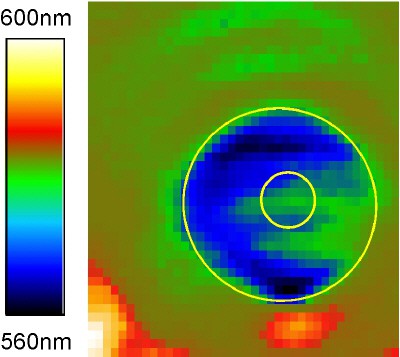
The new technique is very different from other forms of optical microscopy because it does not involve the detection of photons from the object being imaged. Instead, it relies on measuring how the intrinsic properties of the gold nanoantenna — such as its resonance frequency and line width — change when it is placed close to a sample.

Sandoghdar and co-workers began by mounting a single gold nanoparticle on the end of a glass fibre tip. Next, they focussed white light from a Xenon lamp onto the end of the tip, which excited a resonance frequency in the nanoantenna. Finally, they measured the resonance wavelength and line width of the antenna while scanning it across the surface of a sample (figure 1). By plotting these quantities for different positions of the tip with respect to the sample, they were able to obtain an image (figure 2).

Although Sandoghdar and co-workers used photons to read the spectrum of the nanoantenna, they say that electric current could easily be used to excite a resonance frequency in the gold instead. Moreover, the method is capable of sub-wavelength resolution because imaging takes place very close to the sample in its “near field”.

“I am not sure how far this method will go into applications as a real microscopy method – that is, you give me an unknown sample and I will tell you what it is made of – but one promising application is in sensing,” says Sandoghdar. “We have shown that we can have a controlled nanoscopic probe that is very sensitive to slight changes of the dielectric constant in its surroundings.”

Sound waves target new applications

When the surface of a solid object is tapped, sound waves reverberate through it. Different points on the surface produce slightly different sounds because the acoustic waves travel along different paths. Each point on the surface therefore has a unique acoustic “signature”. Now, Ros Kiri Ing and Nicolas Quieffin of Sensitive Object, a new company based near Paris, together with Stefan Catheline and Mathias Fink of the University of Paris VII, have shown that this signature could be exploited in a new variation on traditional touch screens.

The French physicists demonstrated their technique in a glass plate with an area of 40 cm by 30 cm and a thickness of 5 mm. They tapped the plate at various positions and detected the resulting sound waves with a simple sensor connected to a personal computer. The new technique relies on a process called acoustic time-reversal that allows sounds waves to be reversed and sent back to their origin.

However, rather than reversing the sound waves, the new technique relies on using similar ideas to calculate where the sound came from in the first place. In this way different positions on the surface can be related to different actions: for instance, a tap at one position might switch on a light, while a tap at a different position could turn on a CD player.

The new technology is better than existing touch screens in several ways says Catheline. First, there is no need to build complicated sensor devices into the object. Moreover, the approach also works for objects that are not flat. “One of our experiments is on a globe,” he says. “When a country is touched, information related to that country is displayed on a computer screen.”

The team now plans to make the technology more robust so that it works in noisy environments and at different temperatures, and is also exploring the possibility of more than one person using it at the same time.

Search engines are not unfair

Many search engines take account of the number of links to a web page when they return the results of a search. “There is a widespread belief that search engines create a vicious cycle by making well known pages more and more popular at the expense of new ones,” says Fortunato. “This presumed phenomenon, which is sometimes called ‘googlearchy’, has been widely discussed in the computer, social and political science communities. Our findings contradict this picture.”

The Indiana-Bielefeld scientists measured the traffic and incoming links for 28,164 web sites using the Alexa, Google and Yahoo search engines, and then developed a new theoretical model that combines the various factors at play in web searching. These factors include: the queries users submit; the way that search engines retrieve and rank results; and the way that people use the results obtained.

To derive a scaling relation between the two quantities, Fortunato and co-workers plotted the traffic to a web page – measured as the fraction of all user clicks in a three-month period – against the number of incoming hyperlinks for that page. Each web page in their sample was represented by a point on this graph. They found that existing models failed to match their data. Whereas previous models had predicted that the traffic and the number of incoming links are related by a power law, Fortunato and co-workers discovered that there was a simple linear relationship between the two quantities instead (figure 2).

“Search engines are the interface between society and the main commodity of the 21st century – information,” says Fortunato. “Our findings are broadly relevant to scientists who model the structure of the web, search engine designers, computer scientists who forecast traffic patterns, marketing experts who try to predict the effect of Web advertising campaigns and, finally, social scientists who are interested in the impact of the Web on knowledge discovery and propagation in the information society.”

Electrons lose their mass in carbon sheets

Last year Andre Geim and co-workers at Manchester University in the UK and the Institute for Microelectronics Technology in Chernogolovka in Russia showed how to make graphene – two-dimensional sheets of carbon that are just one atom thick – from graphite, the form of carbon that is found in pencils. Now Geim and co-workers at Manchester, Chernogolovka and the Radboud University of Nijmegen in the Netherlands and, independently, Philip Kim and co-workers at Columbia University in New York, have explored the electronic properties of this novel form of carbon and have discovered that it is an excellent conductor.

In particular they discovered that the electrons in graphene behave like relativistic particles that have no rest mass and travel at about 106 metres per second. Although this is a factor of 300 slower than the speed of light in vacuum, it is still much faster than the speed of electrons in an ordinary conductor. Moreover, the electrons in most conductors can be described by non-relativistic quantum mechanics, whereas the electrons in graphene need to be treated as relativistic particles called massless Dirac fermions.

Both teams also observe a new “half-integer” quantum Hall effect, which is the relativistic analogue to the conventional integer quantum Hall effect that is seen for free electrons in semiconducting systems (and which is distinct from the fractional quantum Hall effect that has been observed in many-body systems, such as strongly interacting electrons in semiconductors). The quantum Hall effect is itself a variation on the classic Hall effect that is seen when a current flows through a material in the presence of an applied magnetic field. In this classic version of the effect a voltage builds up in the direction at right angles to both the current and the magnetic field.

Finally, both teams found that the electrical conductivity of graphene does not fall below a certain minimum value, even when there are no mobile electrons in the graphene sheet. “This is completely counterintuitive because in all other systems the conductivity disappears if no charge carriers are present,” says Geim.

Kim and colleagues also observed that the topology of the graphene gives rise to a Berry phase – a subtle quantum effect that has also been observed in a number of other quantum systems.

“These experiments demonstrate that graphene is not just another ‘smart material’,” says Geim. “It is full of surprises and shows far greater promise than one could reasonably hope for in a new experimental system. Indeed, studies of electron transport in graphene give us access to the rich and subtle physics of quantum electrodynamics (QED) in a bench-top condensed matter experiment.”

Doing physics with bacteria

Molecules that have chiral symmetry or handedness cannot be superimposed onto their mirror image, and this has far reaching effects in many areas of science. For example, rod-like, non-chiral molecules can form a “nematic” liquid-crystal phase that has long-range order. However, if a few atoms in the molecule are rearranged to make it chiral, this nematic phase can transform into a “cholesteric” phase that has very different physical properties.

Dogic and co-workers began by isolating flagellar filaments from Salmonella typhimurium, which they then labelled using a fluorescent dye. Bacteria use flagellar filaments – macromolecular structures that are made up of a single protein called flagellin – to “swim” and find food. The US team then suspended the filaments in aqueous solution.

The shape of the filament can be precisely controlled because it depends on the amino acid sequence in the flagellin, as well as the temperature and pH of the solution. For instance, the filaments can be changed from achiral rods to highly twisted helices that look like springs. Using a polarisation microscope, Dogic and colleagues found that helical filaments undergo a phase transition to a novel liquid crystalline state in which the flagella become cone-shaped for concentrations above a certain level. In contrast, this phase transition is not seen in experiments with rod-shaped filaments.

The results could also be used to model polymers: “Nature is very good at making structures with well-defined symmetry,” says Dogic. “We realised that we could use our purified flagella as ‘ideal polymers’ to test long-standing predictions of how the packing of chiral helices is different from that of achiral rods. There are no synthetic polymers that would permit us to do such experiments.”

Einstein paper turns up on arXiv

Schmekel was asked to translate the paper by Neil Ashcroft, the distinguished theoretical condensed matter physicist at Cornell University. “I was giving a colloquium on superconductivity in the Spring of this year,” says Ashcroft, “and since we are celebrating the centenary of Einstein’s work in 1905, I thought it could be historically informative, and also interesting, to dig through the older literature to see if Einstein had contributed to the theory of superconductivity.”

“After quite some effort, I finally located a reference to the 1922 paper by Einstein and thought it surely must have been translated,” he recalls. However, Ashcroft could not find any translations of the article, which was based on a talk that Einstein had given at Leiden University in the Netherlands. Superconductivity was discovered by Heike Kamerlingh Onnes at Leiden in 1911.

Pat Viele, a librarian at Cornell, suggested that Ashcroft approach Schmekel, who was a graduate student in theoretical astrophysics at Cornell at the time, and he duly agreed to translate it. “When I read it I was struck by the extreme clarity of thought,” says Schmekel. “The translation took only one afternoon.”

So did the paper have any influence on our understanding of superconductivity? “I suspect that the general answer to this question must be a guarded ‘No’,” says Ashcroft, “otherwise the paper would surely have been referenced, and I could not find any references to it.” However, Ashcroft points out that it is essential to appreciate that superconductivity was discovered in 1911, and that the first accepted theory — the Bardeen-Cooper-Schrieffer (BCS) theory — did not appear until 1957.

“In the period between 1911 and 1957 the theoretical machinery needed to describe many-particle physics — as opposed to thinking of electrons in metals as largely independent particles in a static lattice — was under vigorous development,” says Ashcroft. “Much of this was essential to the eventual theory and it simply post-dates Einstein’s paper.” However, Schmekel adds that Einstein raises some interesting points that were later found to be correct.

“I find it inconceivable that this paper is not well known,” adds Ashcroft, who now includes a transparency of highlights from it when he gives talks on superconductivity. “Einstein was too important a figure, and superconductivity too important a phenomenon, for this to have been overlooked.”

Silicon chip puts the brakes on light

Over the past decade, physicists have used exotic media such as ultracold atomic gases and various crystals to make “slow” or “fast” light. Some groups have managed to stop and store light, while others have demonstrated group velocities greater than the speed of light in vacuum. However, if the speed of light could be controlled with a silicon chip, it might be possible to include such devices in conventional microelectronic circuits.

Yurii Vlasov and colleagues at the IBM T J Watson Research Center in New York have now taken a step in this direction by using a photonic crystal waveguide made of silicon to produce slow light. The waveguide, which is 250 microns long, is etched with a pattern of tiny holes, each 109 nanometres wide, that give the silicon a very high refractive index. An electrical contact acts as a miniature heater.

When a current flows through the heater, it heats up the waveguide, which changes the refractive index and therefore the speed of light in the structure. Applying just 2 milliwatts of electrical power can change the group velocity by a factor of three within 100 nanoseconds.

The IBM work follows a spate of recent work on manipulating the speed of light with optical fibres and various semiconductor structures.

Tracking down the first stars

Population III stars are thought to have formed in the first 200 million years after the Big Bang. Simulations predict that they were over 100 times more massive than the Sun and that they existed in clusters.

Although light from Population III stars is too weak to be detected with existing telescopes, Kashlinsky and colleagues and, independently, Asantha Cooray of the California Institute of Technology and co-workers, recently calculated that these early stars should have a left significant and measurable signal in the cosmic infrared background (CIB). However, separating out the signal from the Population III stars from all the other infrared radiation emitted by other stars and galaxies in the universe is very difficult.

Kashlinsky and colleagues used the Infrared Array Camera (IRAC) on Spitzer, which can detect wavelengths between 3.6 and 8 microns. Light from the earliest stars would have been red-shifted into this region by the expansion of the universe. When they removed infrared signals from all the other stars and galaxies in the universe, the NASA team found significant large-scale fluctuations in the infrared background.

The fluctuations were seen at four different wavelengths and at several points across the sky, which suggest that the signal is a real astrophysical effect. Moreover, the signal had not changed significantly after six months, which ruled out “zodiacal light” reflected by local interplanetary dust in our Solar System as a possible source.

“The easiest explanation of the signal is that it originates from very massive and highly clustered Population III stars,” Kashlinsky told PhysicsWeb. “This identifies for the first time the cumulative emissions produced by these, so-far hypothetical, objects.”

The team is now analysing data from observations that looked even deeper into space, and also data at larger angular scales.

Shelf life: Sidney Perkowitz

What are the three best popular-science books?

I will name three books that are excellent in terms of writing or content or both, and that have a special meaning to me because they helped me to develop as a science writer.

Taming the Atom: The Emergence of the Visible Microworld by Hans Christian Von Baeyer. This book showed me that it is possible to write about difficult scientific topics with complete accuracy, yet in beautiful well-crafted prose that has unquestionable literary merit. Von Baeyer’s regular pieces in The Sciences magazine (now sadly defunct) always displayed this same enchanting mix of content and style. To see it sustained in a whole book was a revelation.

Hubble Wars: Astrophysics Meets Astropolitics in the Two-Billion-Dollar Struggle Over the Hubble Space Telescope by Eric Chaisson. This book was a pioneer in presenting the mix of science, technology, economics, politics and sheer brute human ego that is the reality of big science projects. Non-scientific reviewers were astonished at the degree of realpolitik involved in the Hubble project.I think it is valuable for the public to see science removed from an imaginary remote realm of inhuman objectivity and cast as it really is: an essential, human activity that strives for objective perfection but that is subjected to the stresses and strains of human nature and the real world. The book also helps scientists to understand more clearly how science and the rest of the world influence each other outside the laboratory.

Alexander A Friedmann: The Man Who Made the Universe Expand by E A Tropp, V Ya. Frenkel and A D Chernin. This book is not especially well written, although that may be the fault of the translation from Russian into English. Its authors have also been accused of whitewashing some of the political implications of this story of Soviet scientists who persuaded Einstein to trade his static universe for an expanding one. But Friedmann’s life is fascinating, mixing his military science with highly abstract nonlinear mathematical physics against the backdrop of the First World War and the early days of the Soviet Union. There is also drama and a message about scientific recognition. The story impressed me so much that I wrote a play called Friedmann’s Balloon that was produced in 2001.

What science books are you currently reading?

When I’m working on a book, as I am right now, my general reading time is cut down because I focus on research for the book. My current book project is about how science and scientists are treated in film, so I am watching a lot of movies and reading relevant books. For my chapter on nuclear science and scientists in the movies, I am reading Richard Rhodes’ The Making of the Atomic Bomb and Robert Jungk’s Brighter Than A Thousand Suns.

What else are you reading?

I have just finished Charles Chadwick’s It’s All Right Now (a novel about character and human interaction); Jeffrey Shaara’s semi-non-fiction novel To the Last Man (about the First World War); and Cormac McCarthy’s No Country for Old Men (about drugs, violence and the old traditions of the American West). Next on the list is My Life in the Middle Ages – a memoir by the writer James Atlas.

Which popular-science book have you never read, but feel you ought to have tackled, and why?

It is not exactly a popular-science book, but I have never read more than a few snippets from Charles Darwin’s On the Origin of Species. This seems to me to be required reading for any scientist or science writer for many reasons: the importance of the theory per se; its wide relevance to other areas of science and other human endeavours; and the insight that it gives into a certain kind of scientific mind.

I imagine that the book would also help one to understand what evolution really means, especially in light of current attempts to conflate and confuse scientific and religious views of how we came to be.

Copyright © 2026 by IOP Publishing Ltd and individual contributors