New look for Hall effect

The classic Hall effect occurs when an electric current flows through a conductor in a magnetic field. If the current and magnetic field are at right angles to each other, the Lorentz force deflects the electrons to one side and a Hall voltage builds up in the direction that is at right angles to both the current and the magnetic field. It has been assumed that the Hall effect could not exist for phonons because they are not charged.

In 1996, however, Geert Rikken of the Grenoble High Magnetic Field Laboratory (GHMFL) and Bart van Tiggelen of the Université Joseph Fourier, also in Grenoble, observed a Hall effect with photons. Now, Rikken, Cornelius Strohm and Peter Wyder, who are both based at the GHFML, have seen the effect with phonons. Inspired by the photon Hall effect, they argued that the way certain phonon modes coupled to an external magnetic field should mean that phonon scattering depended on the direction the phonons were moving in. This, in turn, should lead to heat flow in a direction at right angles to the magnetic field and an applied heat flow.

To look for this effect, they passed a heat current through a crystal of terbium gallium garnet – a paramagnetic material that is often used in magneto-optical devices – and applied a magnetic field at right angles to this current. When they measured the temperature in a third direction they found differences of up to 200 microkelvin. Moreover, this temperature difference vanished when the heat current and the magnetic field were parallel (see figure).

“We have observed a phenomenon that was believed to be non-existent,” says Rikken, who is based at the LNCMP magnetic field lab in Toulouse, “and we have shown that phonons in a magnetic field behave like photons.”

Working with water waves

Water waves can usually only be refracted in shallow water. However, Hu and Chan found that an array of cylinders fixed to the sea bed and extending above the surface of the water changed both the “effective” depth and gravitational constant of the water, and that this resulted in the waves being refracted. They showed, for instance, that the effective gravitational constant could be increased from its regular value of 9.8 metres per second per second to 16 metres per second per second.

The Hong Kong team also found that wave propagation was forbidden in some frequency ranges, which leads to water-wave band gaps that are analogous to those that exist for electrons in semiconductors, photons in photonic crystals, and phonons (or sound waves) in phononic crystals. Hu, who is now at Iowa State University in the US, and Chan showed that the refracted water waves obey Snell’s law, which means that many concepts from optics could be adapted for use with water waves.

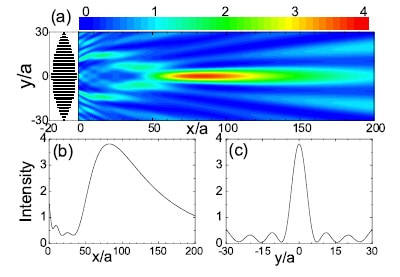
“The phenomenon can be viewed as a mechanism to control and manipulate water waves,” says Chan. “For example, we can use the concept to design a ‘lens’ that focuses water energy to one point (figure 2). This is good for converting wave energy into other forms of energy, like electricity.”

Vacuum challenges and solutions

Reliability and innovation are touchstones for the vacuum industry in the 21st century. Reliability is needed to get the most out of expensive manufacturing equipment, while innovation is essential to cope with the increasingly complex demands being placed on the suppliers of vacuum equipment by a wide range of customers. This special Physics World supplement starts with a general introduction to vacuum science and technology by Ugo Valbusa, president of the International Union for Vacuum Science, Technique and Applications (see p5). This is complemented by a summary of the broad field of vacuum coating, including the crucial process that goes by the name of “sputtering” (p11), advice about how a Master’s degree can improve your career prospects in the vacuum industry (p9), and a trio of case-studies from different vacuum companies (pp7, 15 and 17). This is the fourth year in a row that Physics World has published a vacuum supplement. We hope you enjoy it as much as you did the previous three.

Vacuum around the world
The International Union for Vacuum Science, Technique and Applications (IUVSTA) represents all sections of the international vacuum community, as its president, Ugo Valbusa, explains

Rising to the uniformity challenge
Building a “showerhead” for a gas reactor presented a number of challenges, as Paul Brooker of Creative Group describes

Mastering the vacuum
An MSc in vacuum technology is a passport to a career in many different industries. Philip Parsons recounts how he landed a job at GV Instruments

The secret world of vacuum coating
What do drill bits, food packing and architectural glass have in common? They all rely on vacuum coatings, as David J Christie of Advanced Energy Industries reports

Innovative approaches to pumping
Architectural glass production places big demands on pumping systems. Willijan Vissers of Varian Incorporated describes what is involved

Model shows how to turn one pump into two
How do you convert an ordinary turbo pump into a split-flow version? Andy Pearce of Oxford Vacuum Science explains all

Diary

It takes two

Although gamma-ray bursts were first observed more than 30 years ago, they are still not fully understood. Often described as the most powerful explosions in the universe, they have durations that range from about one hundred seconds to just a few milliseconds. The initial burst of gamma rays is followed by an “afterglow” of longer wavelength radiation that can last for weeks or even years.

Astronomers now believe that “long” gamma-ray bursts – bursts that last more than two seconds – happen when a massive star undergoes a supernova explosion at the end of its life and collapses to form a black hole. However, the afterglow of a short gamma-ray burst had not been seen at optical or X-ray wavelengths until earlier this year.

George Ricker of the Massachusetts Institute of Technology and colleagues detected a gamma-ray burst lasting just 70 milliseconds on 9 July this year with the HETE-II satellite (Nature 437 855). The burst, known as GRB 050709, was followed by a fainter X-ray afterglow that Derek Fox of the California Institute of Technology and co-workers captured with the Chandra space telescope (Nature 437 845). The Chandra data allowed the position of the burst to be located which, in turn, enabled Jens Hjorth of the University of Copenhagen and co-workers to see it at visible wavelengths. Hjorth and colleagues used the Danish 1.54-m telescope at the European Southern Observatory in Chile for these observations (Nature 437 859).

GRB 050709 lies some 2400 million light years from Earth at the edge of a young star-forming dwarf galaxy. All three teams believe that the gamma-ray burst may be a result of the merger of two neutron stars – extremely dense stars that are heavier than the Sun, even though they measure just tens of kilometres across – or a neutron star and a black hole. The astronomers have also ruled out alternative sources such as flares from highly magnetized neutron stars or the collapse of a massive star.

Meanwhile, Neil Gehrels of the NASA Goddard Spaceflight Center and co-workers detected the X-ray afterglow from another short burst, GRB 050509B, with the SWIFT satellite on 9 May (Nature 437 851). These observations pinpointed the origin of the burst as an elliptical galaxy about 2700 million light years away. Since elliptical galaxies are usually rich in binary systems of stars, this adds weight to the theory that collisions involving neutron stars are responsible for short gamma-ray bursts.

The astronomers have shown that these short bursts are about a thousand times fainter than long gamma-ray bursts, even though they are ten times closer to the Earth.

Did warm waters fuel Hurricane Katrina?

In papers written before Hurricane Katrina various researchers – including Kerry Emanuel of the Massachusetts Institute of Technology (Nature 436 686) and Peter Webster of Georgia Tech and co-workers (Science 309 1844) – reported that hurricanes have steadily become stronger over the last 25 years, and particularly in the last few years. This could be due to higher sea surface temperatures providing “fuel” for the hurricanes. Generally, the sea surface temperature must be above about 26°C for hurricanes to form and intensify.

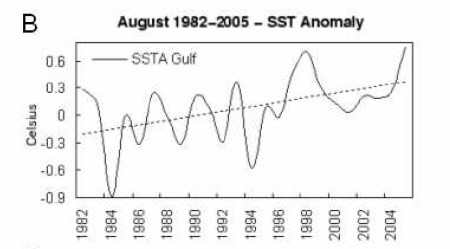
Using satellite data from the Tropical Rainfall Measuring Mission Instrument, Kafatos and co-workers analysed how sea surface temperatures in the Gulf of Mexico have varied over the last 30 years. They found that mean sea surface temperatures were over 30°C throughout August this year, with a patch of 33°C next to the state of Louisiana (figure A). Furthermore, sea surface temperatures in the Gulf reached a record 0.8°C above normal compared to previous years (figure B). Hurricane Katrina caused devastation in New Orleans and the surrounding area when it reached the Louisiana coast on 29 August.

In addition to sea temperatures, hurricane behaviour is dictated by two other phenomena: surface latent heat flux, which is related to water evaporating and condensing; and sensible heat flux, which leads to changes in the temperature of the atmosphere. Inside a hurricane, latent heat can be converted into kinetic energy to produce secondary circulation which, in turn, can intensify the hurricane. Kafatos and co-workers found that daily variations of surface latent heat and sensible heat fluxes increased significantly during the intensification period of hurricane Katrina, so further adding to its strength (figure C).

“The Gulf waters should be continuously monitored using satellites to discern whether the increase continues in the following years,” says Kafatos. “If this turns out to be the case, it will mean similar catastrophic events in the future.”

However, further evidence is needed before climate scientists can be sure that there is a direct connection between global warming and the recent increases in hurricane intensity. For instance, the increase in the temperature of the sea needs to extend deep below the surface, whereas most satellites can only measure the temperature of a thin layer of water at the surface.

Probing the antiworld

One of the most staggering achievements in quantum physics was Paul Dirac’s prediction of the anti-electron in 1930. By tirelessly modifying Schrödinger’s description of the electron until it was consistent with special relativity, Dirac derived a beautiful equation that had additional “negative energy” solutions. He proposed that these solutions corresponded to a particle that has the same mass as the electron but the opposite electrical charge. Three years later the world’s first antiparticle – called the positron – was discovered by Carl Anderson at the California Institute of Technology.

But Dirac’s vision for antimatter did not stop there. By 1931 he had realized that the only other elementary particle known at that time – the proton – should also have a corresponding antiparticle: the antiproton. This particle was discovered at Berkeley in October 1955 (see “Antiprotonic helium”), setting the stage for the creation of atoms made entirely from antimatter.

A positron and an antiproton form the simplest type of anti-atom – antihydrogen. However, getting these two antiparticles to come together and form a single atomic system is no mean feat, not least because antimatter immediately annihilates when it comes into contact with ordinary matter. So why have physicists even bothered trying for the past 50 years?

Asymmetric world

When we look out at the universe from our vantage point here on Earth, one thing is clear: it is dominated by matter. Irrespective of how or where we look, antimatter simply does not exist in the quantities we would expect if matter and antimatter had been created in equal amounts in the Big Bang, as is generally assumed to have happened. Understanding this asymmetry between matter and antimatter is of enormous importance in physics and astronomy. After all, if every particle and antiparticle created in the Big Bang had annihilated with each other, there would be nothing out there to look at, and nobody down here to look at it.

One way to test the equivalence of matter and antimatter is to consider a fundamental quantum transformation known as the charge-parity-time (CPT) operation. When the CPT transformation is applied to a physical system, three things happen: every particle is converted to its antiparticle; each spatial co-ordinate is reflected so that left becomes right, up becomes down and forward becomes backward; and time is reversed. According to the CPT theorem, which lies at the heart of the Standard Model of particle physics, the universe is perfectly symmetric under this combined transformation, although certain combinations of C, P and T can be violated individually (see The CPT Theorem).

There is currently no experimental evidence or even a compelling theoretical reason to doubt the validity of the CPT theorem. However, precision measurements of the properties of anti-atoms provide a unique way to test this once and for all. If CPT symmetry is violated, it could show up as a slight difference in the frequency of certain electronic or “positronic” transitions in hydrogen and antihydrogen atoms.

Synthetic antihydrogen

The prospect of creating antihydrogen in the laboratory was transformed from a distant dream into reality about 20 years ago. The catalyst was an improved way to generate dense, mono-energetic beams of antiparticles – a process known as “cooling”. In particular, Simon van der Meer of CERN had invented a technique called stochastic cooling that enabled antiproton beams of very high quality to be produced and controlled. Indeed, it was this technique that led to the discovery of the W and Z particles in collisions between protons and antiprotons by Carlo Rubbia and the UA1 collaboration at CERN in 1983. Van der Meer and Rubbia shared the Nobel Prize for Physics the following year.

In the early 1990s, while most of us were busy figuring out how to get our positrons and antiprotons together, Charles Munger of the Stanford Linear Accelerator Center and co-workers at Fermilab, both in the US, hit upon a new approach to making antihydrogen. They realized that an antiproton travelling at relativistic speeds can create an electron-positron pair if it passes close to an atomic nucleus. And in a tiny fraction of these cases, the antiproton can bind with the positron and emerge as an antihydrogen atom. All that had to be done to observe these rare events was to circulate antiprotons as many times as possible in a storage ring.

This idea sparked a race between the two antiproton storage rings operating at the time: the “accumulator” at Fermilab and the Low-Energy Antiproton Ring (LEAR) at CERN. The race was won by the PS210 experiment at CERN, led by Walter Oelert and Mario Macri, which announced in 1995 that it had created 10 or so antihydrogen atoms. This result provided a media feast for CERN, but nonetheless proved to be the swan-song for LEAR. This unique facility finally closed at the end of 1996, by which time Munger and co-workers had produced about 100 antihydrogen atoms in the E862 experiment at Fermilab.

The news that LEAR was being closed down created a planning hiatus in the field, and the announcement was widely condemned (see Physics World December 1994 p3; print version only). But CERN’s decision did have at least one positive outcome for those working on ultra-low-energy physics: it led to the formation of what were to become the two antihydrogen collaborations, ATHENA and ATRAP. A third collaboration called ASACUSA was also formed to study exotic hybrid atoms, such as antiprotonic helium, that contain both matter and antimatter (see “Antiprotonic helium”).

A number of individuals deserve credit for keeping this community together in a difficult period, and also for securing resources to develop a slimmed-down facility dedicated to physics with very low-energy antiprotons. In particular, the Japanese government provided important financial backing for a completely new, self-contained antiproton factory at CERN called the Antiproton Decelerator (AD). This machine, which was built from some of the leftovers from LEAR and the CERN antiproton source, produced its first beams of antiprotons in 1999.

Once news had filtered through that the AD was on the way, ATHENA and ATRAP researchers – including the present authors – began to gear up for the production of “cold” antihydrogen. The original antihydrogen atoms produced at CERN and Fermilab in the mid-1990s were very energetic or “hot”, which meant they were poorly suited for precision tests of CPT.

The ultimate prize for the ATHENA team came in September 2002, when it reported that it had created the first cold antihydrogen atoms and directly observed their annihilation. ATRAP quickly followed with separate and quite distinct observations, and a new era in atomic physics was born.

Experimental basics

The Antiproton Decelerator at CERN is tailor-made for producing antihydrogen. It consists of a storage ring with a circumference of 188 m into which the antiprotons – which have been generated elsewhere by firing high-energy protons into a stationary target – are injected. Once inside the ring, the antiprotons are decelerated in stages from an energy of 3 GeV to about 5.3 MeV using radio-frequency electric fields. The antiprotons also undergo stochastic and electron cooling to maintain the quality of the circulating beam. In total, this cycle of events takes about 100 s, after which the AD ejects a focused burst of about 20-30 million antiprotons and prepares for the next injection.

Although distinctly cool by CERN’s standards, 5.3 MeV corresponds to a temperature of about 60 billion kelvin, which is still way too high to produce cold antihydrogen. Fortunately, in 1986 Gerald Gabrielse of Harvard University and co-workers had developed a straightforward, if somewhat inefficient, technique for cooling antiprotons down to much lower temperatures.

First, the antiprotons are passed through a thin metal foil, where they are slowed via Coulomb interactions. Next, a fraction of the particles are captured in an electromagnetic “bottle” called a Penning trap, which confines them in the transverse direction using a strong solenoidal magnetic field and in the longitudinal direction using an electric field created by hollow cylindrical electrodes. Finally, the antiprotons undergo Coulomb interactions with electrons in the trap, which themselves are cooled by the emission of cyclotron radiation as they rotate in the magnetic field. This chain of events typically leaves about 10,000 usable antiprotons in the trap at a temperature of about 4 K.

Getting hold of the other component of antihydrogen – positrons – is somewhat easier, partly because they can be continuously produced by the million from radioactive sources. The ATHENA experiment accumulates positrons using a technique pioneered by Cliff Surko and colleagues at the University of California in San Diego. Here, positrons are slowed via collisions with nitrogen gas, accumulated for about 200 s in a Penning trap, and finally transferred to a second Penning trap in the same magnet used to trap the antiprotons. All one has to do to produce antihydrogen is release the antiprotons into this positron plasma, where roughly 15% of the trapped antiprotons end up as the nuclei of antihydrogen atoms.

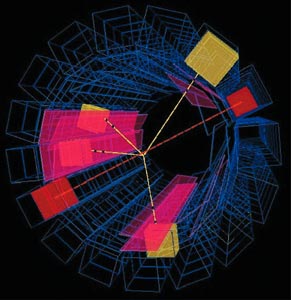
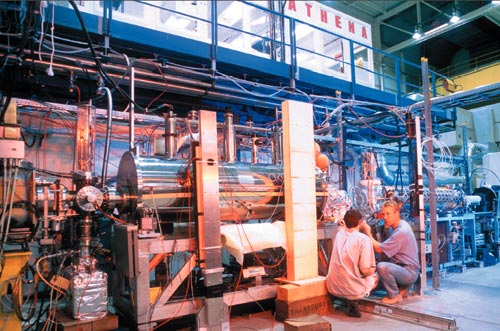
When an antihydrogen atom forms, it has no net charge and is therefore not confined by the electromagnetic fields in the Penning trap. Once it escapes from the apparatus, the anti-atom can be detected in two ways. The method favoured by ATHENA is to record the annihilation of anti-atoms when they come into contact with the trap electrodes, which produces a “flash” of pions and gamma rays that can be detected with a sophisticated imaging detector (figures 1 and 2). ATRAP, on the other hand, uses electric fields to pull weakly bound anti-atoms apart, and then traps and records the antiprotons as they annihilate. In both cases the antimatter signals are unambiguous, allowing researchers to study the way anti-atoms form and to begin exploring their properties.

Cryogenic gymnastics

Since hydrogen is the most abundant element in the universe, you might think that the process by which a proton and electron combine to make an atom – or the equivalent “antiprocess” – is fairly straightforward. If that was the case, however, many of us could have packed up and moved on to other experiments some time ago! The difficulty arises because antihydrogen atoms need to be produced at liquid-helium temperatures before we can study them in any detail.

At these cryogenic temperatures antihydrogen can form via two different reactions: “radiative capture”, whereby an antiproton captures a passing positron and releases the excess energy as a photon; or the “three-body” process whereby an antiproton interacts with two positrons, one of which acts as a spectator that removes the excess energy and leaves an antihydrogen atom behind.

Provided that the antiprotons and positrons are in thermal equilibrium, the rate of these reactions depends on the temperature of the positron plasma: the rate of radiative capture is inversely proportional to the square root of the positron temperature, T, while the rate of the three-body process scales as T-9/2. This makes the three-body reaction the dominant mechanism for antihydrogen production at liquid-helium temperatures.

Each reaction also tends to produce antihydrogen atoms with different binding energies and hence different principal quantum numbers, n. These quantum numbers are the same as those that apply to ordinary hydrogen, only here they describe the energy level occupied by a positron rather than an electron. The radiative reaction favours tightly bound anti-atoms with n ∼ 1 – 10, while the three-body process produces highly excited antihydrogen with n > 40.

In practice, both reactions produce a distribution of atomic states rather than atoms with a single, well-defined principal quantum number. Furthermore, the internal structures of these states can be greatly affected by the strong magnetic field in the Penning trap and by collisions in the positron plasma. Producing useful antihydrogen is therefore a considerable experimental challenge – especially if the antihydrogen detector has to be in close proximity to the cryogenic traps, as it was in ATHENA.

Trapping antimatter

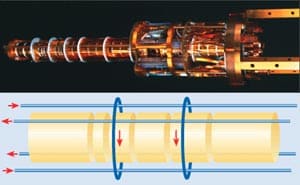
In the last few years the ATHENA and ATRAP experiments have produced many millions of cold antihydrogen atoms. But in order to make precision tests of CPT and, perhaps, to measure how antimatter behaves under gravity, we need to somehow confine these atoms in a purely magnetic trap (figure 3). Such traps are shallow – they are typically only able to trap atoms that have temperatures less than 1 K – so if antihydrogen is to be trapped at all, it should be produced at a similar temperature. Furthermore, it should preferably be in its ground state, which means we need to know the kinetic energies and the principal quantum numbers of the antihydrogen atoms.

The different antihydrogen detection schemes adopted by ATHENA and ATRAP provide complementary information. ATHENA’s annihilation method, for instance, allows us to detect all the antihydrogen atoms that survive the harsh environment of the positron plasma, independent of their binding energies or velocities. The field-ionization technique adopted by ATRAP, however, is restricted to high-n states due to limitations on the voltages that can be applied to the electrodes in the Penning trap. Moreover, this method is only sensitive to antihydrogen atoms emitted along the axis of the trap (coincidentally, this is precisely the region of solid angle not covered by the ATHENA detector).

Towards the end of 2003 the ATHENA collaboration figured out that most of the antiproton annihilations it observed were caused by antihydrogen, as opposed to losses of antiprotons from the trap. Once we applied a simple method to remove events that we knew did not result from antihydrogen, we suddenly realized that millions more anti-atoms had actually been synthesized! Indeed, when the experiment was running smoothly, some 400-500 antihydrogen atoms were being produced each second.

One of the most distinctive aspects of antihydrogen production is its predicted temperature dependence due to the radiative-capture and three-body reactions. However, when ATHENA researchers decided to investigate this in 2003, by varying the temperature of the positron plasma between 15 and 3500 K using a radio-frequency signal, they were faced with several surprises. At cryogenic temperatures, for instance, they did not see the expected increase in antihydrogen production when the three-body process was supposed to have kicked in. At room temperatures and above, on the other hand, the observed temperature dependence was more consistent with the radiative reaction. However, the measured rate was at least an order of magnitude too high to be explained by this process.

These results are still not fully understood, but Francis Robicheaux of the University of Auburn has recently pointed out that the three-body process really involves a complex sequence of capture and release. Since the antiprotons in both ATHENA and ATRAP move rapidly in and out of the positron plasma, the reaction could therefore be arrested. Another possibility, which resulted from a careful analysis of the directions in which the antihydrogen atoms were emitted from the ATHENA apparatus, is that the antihydrogen atoms are produced before the antiprotons can come into equilibrium with the cold positrons. In this case, the temperature dependencies described earlier do not apply. Furthermore, the ATRAP collaboration had also measured antihydrogen temperatures well above the 4 K environment of its apparatus.

In 2002 the ATRAP collaboration used its field-ionization technique to determine the binding energies of antihydrogen states. The Coulomb field between the positron and antiproton in a ground-state antihydrogen atom is a colossal 5 × 109 V cm-1, which means that we would need an electric field of at least this strength in order to separate the pair.

However, it is easy to show, using the Bohr model, that the Coulomb force diminishes rapidly as the fourth power of the principal quantum number, n. This means that antihydrogen atoms with n greater than about 40 can be separated into their constituents by letting them drift across a weaker electric field. Using this technique, the ATRAP team found that its antihydrogen states correspond to principal quantum numbers in the range n = 40-70, which means the antihydrogen is likely to have been formed via the three-body process.

At a Glance: Antihydrogen

  • Antihydrogen consists of a positron in orbit around an antiproton and was first produced at CERN towards the end of 1995
  • According to the CPT theorem, antihydrogen should have the same atomic spectrum as hydrogen
  • The challenge now is to trap antihydrogen atoms at cryogenic temperatures for long enough to allow precision tests of the CPT theorem
  • Antimatter and matter annihilate instantly when they encounter one another
  • It takes more energy to produce antimatter than is released when it annihilates, so, contrary to many science-fiction novels, antimatter will never be a viable energy source

Antimatter to order

The basic ATHENA and ATRAP formation schemes produce antihydrogen atoms with a range of different quantum states, but ideally we would like to have more control over this outcome. One way to do this is to use lasers, which should enable us to produce antihydrogen atoms with a particular principal quantum number or binding energy.

In 2004 the ATHENA collaboration attempted to stimulate the radiative process by which an antiproton and a positron combine. Using an intense carbon-dioxide laser with a carefully tuned wavelength to cross the Penning trap with infrared radiation during the positron-antiproton mixing stage, we hoped that we could produce antihydrogen states with a principal quantum number of n = 11. Unfortunately, we did not see any enhancement in the rate of antihydrogen production, and further study is needed to determine whether or not this method is feasible.

Another way to produce antihydrogen atoms with particular quantum numbers is to force antiprotons to interact with “positronium” atoms – bound states of an electron and a positron. This approach was first suggested by Bernie Deutch of the University of Aarhus in 1986, but soon afterwards one of us (MC) realized that the reaction rate would be enhanced dramatically if highly excited states of positronium could be used. Moreover, by selecting the quantum state of the positronium we would be able to tell in advance which state the resulting antihydrogen atom would be in.

In 1998 Eric Hessels and colleagues at the University of Toronto came up with an ingenious way to implement this scheme called double charge exchange. First, caesium atoms, which have been prepared in n ∼ 50 states with a laser, are allowed to interact with a cloud of cold positrons. A positron then captures the excited electron from a caesium atom via charge exchange to form positronium. Finally, a second charge-exchange reaction between positronium and nearby antiprotons leads to the formation of an antihydrogen atom with n ∼ 45.

Earlier this year the ATRAP collaboration observed this sequence of reactions. In a proof-of-principle experiment, the team detected about 14 antihydrogen atoms when lasers were tuned to produce caesium atoms in the n = 37 state (see “Antimatter performs optical gymnastics”). Crucially, the team did not observe any events when the lasers were detuned or when positrons were absent. However, the next challenge is to determine the kinetic energies of the anti-atoms produced in order to determine whether this approach can produce very cold antihydrogen.

The CPT theorem

What would happen to the universe if we could change each and every particle into its associated antiparticle, reverse all three directions in space, and force time to run backwards? The answer, according to the CPT theorem, is nothing – we would find ourselves in a universe that behaves exactly as the original one. But how can we be sure?

At various times in the past 100 years physicists have thought that each of the three discrete symmetries – charge conjugation, denoted by C; parity reversal or P; and time reversal or T – is respected by nature. In 1956, however, Chen Ning Yang and Tsung-Dao Lee realized that the weak interaction (which is responsible for radioactive decay) does not conserve parity – a prediction that was soon confirmed in experiments led by Chien-Shiung Wu and co-workers. Then, in 1964, James Christenson, James Cronin, Val Fitch and Rene Turlay discovered that CP symmetry was violated in the decay of neutral K-mesons. Indeed, it is now thought that the breaking of CP symmetry may help to explain why the universe is dominated by matter (see “Nature’s flawed mirror” Physics World July 2003 pp27-31). It is therefore natural to turn our attention to CPT: could this bedrock of modern quantum field theory, which underpins the Standard Model of particle physics, also be violated?

Now, apart from marvelling that physicists actually get paid to ask such a question, you are probably wondering what all of this has to do with antihydrogen. The point is that the CPT theorem is just that – a theorem that needs to be put to the test. And when it comes to precise experimental tests, the hydrogen atom is something we understand very, very well. The CPT theorem demands that hydrogen and antihydrogen have the same spectrum. And since the frequency of a particular transition in the hydrogen atom called the 1s-2s line has been measured absolutely to a precision of about one part in 1015, the holy grail of anti-atom research is to make a similarly precise measurement with antihydrogen atoms.

The current best test of CPT violation involves measuring the mass difference between neutral kaons and their antiparticles in experiments, which have shown that any difference must be less than 10-18 times the kaon mass. Fractional quantities like these should, however, be taken with a pinch of salt because we do not have a strong candidate mechanism for CPT violation. In other words, we do not know if the degree of CPT violation – if CPT is indeed violated – is proportional to mass or frequency or to some other quantity.

Antihydrogen provides a unique opportunity to accurately compare baryonic matter – i.e. matter made of particles such as protons and neutrons – with its antimatter counterpart in a very straightforward experiment. Our best measurement of this, performed by Gabrielse and co-workers, involves the charge-to-mass ratio of protons and antiprotons, which agree to one part in 1010.

The antimatter spectrum

We have only just crossed the threshold into the domain of cold antimatter research and caught our first glimpses of the science within. But already we are confronted by puzzles and promise in equal amounts.

As described earlier, both the ATRAP and ATHENA experiments indicate that the antihydrogen produced by simply mixing antiprotons and positrons is warmer than the ambient temperature of a few degrees above zero. It thus remains to be seen if these relatively simple and highly efficient production techniques are compatible with state-of-the-art magnetic traps, which would allow us to study the properties of anti-atoms. New processes and techniques, such as the Deutch positronium method, may be needed, but it is our belief that the first experiments on the spectrum of antihydrogen will be possible in the next few years.

ATHENA’s work is now complete, but a new collaboration led by one of us (JSH) called ALPHA (Antihydrogen Laser PHysics Apparatus) will now concentrate on trapping antihydrogen atoms. In ATHENA the antihydrogen atoms annihilated a few microseconds after they were formed, but the ALPHA team hopes to trap them for many seconds or longer. Only then will it be possible to perform precision spectroscopic tests of CPT invariance.

Finally, it should be noted that none of this effort to probe the structure of anti-atoms will be possible without CERN’s AD. In an ominous recent shift in mood, reminiscent of that surrounding the ill-fated LEAR in the 1990s, CERN management is once again looking at its low-energy antiproton research from a financial point of view. Indeed, the AD will not operate at all this year, and the amount of beam-time allocated to the machine in 2006 has been slashed because the Large Hadron Collider is over budget.

Let us hope that this time, good sense will prevail and low-energy antimatter research will continue to flourish. After all, this field has done so much recently to keep CERN and particle physics in the public eye.


More about: Antihydrogen

M Amoretti et al. (ATHENA collaboration) 2002 Production and detection of cold antihydrogen atoms Nature 419 456-459
G Baur et al. (PS210 collaboration) 1996 Production of antihydrogen Phys. Lett. B 368 251-258
G Blanford et al. (E862 collaboration) 1998 Observation of atomic antihydrogen Phys. Rev. Lett. 80 3037-3040
G Gabrielse et al. (ATRAP collaboration) 2002 Driven production of cold antihydrogen and the first measured distribution of antihydrogen states Phys. Rev. Lett. 89 233401 ALPHA experiment: alpha.web.cern.ch/alpha
ATHENA experiment: athena.web.cern.ch/athena
ATRAP experiment: hussle.harvard.edu/~atrap

A global role for physics


At a Glance: Physics and the developing world

  • The World Year of Physics culminates this month with a major meeting in South Africa on physics and sustainable development
  • The problems of the developing world concern us all because the world is an increasingly connected place
  • Investment in science is vital for developing nations, but they often fail to see the benefits it brings
  • Physics can play a key role in creating new technologies for, say, clean drinking water New world-class centres of excellence will also be vital for boosting science in the developing world

When the leaders of the world’s main industrialized nations met at the G8 summit in Scotland in July, the issues of Africa and climate change were at the top of the agenda. Certainly it was good to see that aid to developing nations will be boosted by $50bn and that the debts of the 18 poorest nations will be cancelled. However, it was disappointing that science did not figure as prominently in the leaders’ final communiqué as one might have hoped.

Nevertheless, there was a clear recognition that science makes important contributions to society. In particular, the G8 leaders made a firm commitment to support centres of excellence in the developing world, which are vital for producing the skilled scientific professionals of the future. My hope is that many African nations – with their debt burdens now reduced or removed – will invest more in science and set up world-class centres that will, over time, transform the scientific scene. Creating scientifically educated people is the best investment that a country can make.

The importance of science in the developing world is also the theme of a major international conference taking place in Durban, South Africa, from 31 October to 2 November this year. Entitled “Physics and sustainable development”, it is the formal culmination of the World Year of Physics, during which physicists have been celebrating the three groundbreaking achievements made by Einstein in 1905. Over 500 delegates from around the world are expected to attend, including representatives from business and the private sector. Potential donors such as the World Bank, the European Commission and the African Development Bank have been invited to support specific projects that will be discussed at meeting.

The conference will focus on four main themes: physics and health; physics and economic development; physics education; and energy and the environment. It will thereby give the international physics community the chance to show some of the benefits of physics to the wider world. Delegates will also discuss why science is not more central to the political and social fabric of developing nations, and what can be done to change that situation. If politicians can be persuaded to improve science in the developing world, the conference – and the World Year of Physics – will have been a success.

Living in an interconnected world

It requires no great insight to observe that we now live in a world of increased connectivity, in which we travel far, communicate quickly and easily, and conduct business with distant customers. It is also a world in which we share the tragedies of disasters. Consider the catastrophic tsunami last December, which began 350 km off the north-western tip of Sumatra in Indonesia and barrelled quickly across the Indian Ocean killing some 300 000 people in Southeast Asia. In total, citizens from more than 30 countries were affected, with Sweden – a country far from the Indian Ocean – alone losing more than 550 lives.

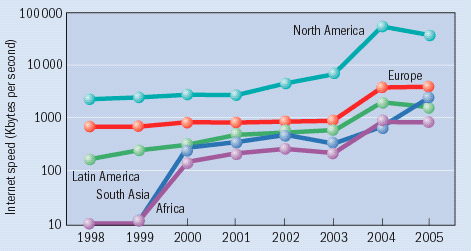
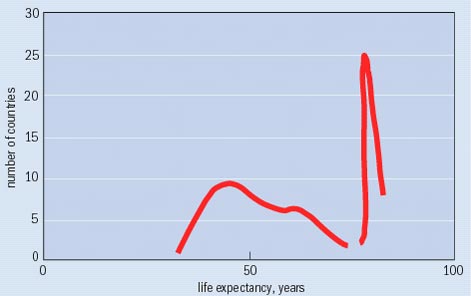
Despite the world becoming more interconnected, it is also clear that we live in a divided world. The average per-capita income in industrialized nations is $27 000 per year, compared with barely $2000 or so in the developing world. Literacy rates approach 100% of the adult population in developed countries, but the figure falls to below 50% in developing nations. While the Internet has helped global communication and its use is rising everywhere, the proportion of people with access to it is far higher in rich nations than it is in poor nations . And as life expectancy in the developed world approaches 80 years of age, it is slipping towards 40 in the world’s poorest countries.

The economist Jeffrey Sachs, who is a special advisor to the UN secretary-general Kofi Annan, has described the endless tragedies that afflict the developing world due to poverty, disease and environmental degradation as “silent tsunamis”. He also suggests that such events are aggravated by a lack of access to science and technology. Indeed, Abdus Salam – the Nobel-prize-winning Pakistani physicist who founded the International Centre for Theoretical Physics (ICTP) in Trieste, Italy – often argued that scientists in rich nations must work towards reducing the imbalance between the rich and the poor.

Unfortunately, the disparities are widening. Mitigating them is not just a moral imperative, but is also in the self-interest of developed nations because the consequences of neglecting today’s problems are too vast to contemplate. After all, most of the Earth’s population lives in developing nations, which means that we are all in it together, if only because we share both the fruits and perils of the future.

The importance of scientific investment

Science – and physics in particular – can play a major role in solving the problems facing humanity. Of course, science does not have all the answers and not all scientific advances have benefited society. One need look no further than nuclear weapons, which remain a major international concern. Yet, on balance, the contributions of science have been positive and significant. Being largely devoid of political, economic and religious influences, science has the power to form consensus between people.

Moreover, only scientific knowledge can help governments decide which technologies are needed to solve problems in a particular country. Although economics, politics, public acceptability, technological simplicity and other socio-economic factors play a role, science and good engineering are what ultimately count. From electricity and transport to computers and the Internet, physics has laid the foundation for numerous transforming technologies over the past 200 years. And with the need to develop cleaner energy and mitigate the adverse effects of climate change, for example, society will increasingly depend on physics to understand and solve its problems.

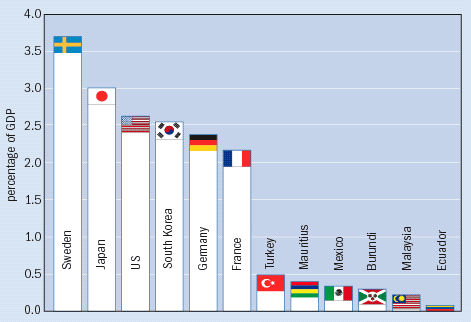
Yet scientific investment in developing countries is woefully inadequate. In the West, the proportion of gross domestic product (GDP) devoted to research and development averages between 2.5% and 4%, with Sweden (3.7%), Japan (3.0%) and the US (2.6%) leading the way. However, the equivalent figures in the developing world are often substantially less than 0.5%, with Ecuador, for example, spending just 0.08% of its GDP on research. Only a handful of developing countries – notably Brazil, China and India – have managed to boost their spending to above 1%.

Unfortunately, many nations fail to appreciate the benefits of science. Instead, they associate it with some of the more negative effects of modern life, such as fumes from incessant traffic, the pollution of land by oil refineries, and the use of increasingly deadly weapons. They shy away from science because of such dark images.

Too many developing countries also fail to see that science enables technological innovation, which is vital for economic development and wealth creation. Estimates from a number of sources, such as the UK’s Office of Science and Technology, have shown that sustained public investments in science generate returns of between 20% and 65% a year. The immense economic gains made by Japan since the Second World War – and more recently by South Korea – are almost entirely due to science and technology.

The lack of investment in turn means that many scientists in developing nations feel alienated from their own societies, which tend to view science as a product of the industrialized world. These scientists often migrate to lucrative jobs in the US, Europe and Japan, making it even harder to create an educated workforce in their home countries. The result is that barely one in every million people in sub-Saharan Africa (excluding South Africa) is estimated to have a PhD degree; in the US, the proportion is about a thousand times greater.

Perhaps equally importantly, investment in science and help for entrepreneurs in developing nations are held back by monetary policies that are driven by regressive forms of taxation and a dependence on hand-outs. The tremendous financial contributions made by private organizations such as the Bill and Melinda Gates Foundation are partly spurred by the favourable tax incentives in the US. Other factors holding back scientific investment include unstable political environments that cultivate corruption and instability, as well as exploitation by rich countries.

Opportunities for physics

The huge technological developments of the last century have, of course, come with a price tag. In particular, our use of the Earth’s finite resources – triggered by the insatiable demands of the world’s increasing population – has escalated. Managing these resources without depleting them for good – a concept known as “sustainable development” – is one of the most urgent challenges we face today.

The Millennium Development Goals – a series of ambitious targets that UN members agreed to reach by 2015 – provide a clear vision for sustainable development. They include, for example, a 50% cut in the number of people who do not have sustainable access to safe drinking water, as well as targets for reducing poverty and improving public healthcare.

Physics will play a critical role in attaining these goals. Taking clean water as an example, membranes that are made from carbon nanotubes – rolled-up 2D sheets of graphite – can be used to block the passage of bacteria, viruses, heavy metals and other pollutants. They can therefore be used as effective filters for purifying water. Indeed, laboratory experiments at the Rensselaer Institute in Troy, New York, and the Banaras Hindu University in Varanasi, India, have demonstrated that carbon-nanotube filters can remove polio viruses 25 nm in size from water, as well as larger pathogens such as E. coli and Staphilococcus aureus bacteria. Carbon nanotubes can also withstand relatively high temperatures, which means the filter could be unclogged periodically by heating it; conventional polymer-based water filters, in contrast, are destroyed if heated.

Meanwhile, natural tracers such as tritium, helium-3 and carbon-14 – in conjunction with chemical and hydrological measurements – can be used to determine where ground water has come from and whether it has been contaminated with pollutants. Such information is critical for determining if the water is safe to drink. Other applications of physics include the development of recyclable polymeric nanocomposites that may replace metals and other materials that are currently used in industrial manufacturing. Telemedicine links, using broadband communication, could bring healthcare services to remote areas of the developing world. Novel recyclable materials could be produced by nanotechnology and self assembly of molecules, while genetic engineering could help to develop foods and plants such as cotton that are resistant to harmful insects.

Indeed, we could be on the cusp of a new “golden age” of physics, inspired by the ideas of sustainable development. The previous golden age, which lasted from the 1940s to the 1980s, was driven largely by the national-security concerns that preoccupied the world’s two superpowers, the US and the Soviet Union. The new golden age will be different. It will have clear economic and social consequences, it will be interdisciplinary in nature, and will take place across the globe, rather than in just a handful of nations.

So if we are to be serious about encouraging sustainable development, we will have to boost scientific capacity throughout the developing world. The focus should not be on technology transfer, but on nurturing scientific talent. One way of doing this is through institutions like the ICTP, which has brought some 100,000 scientists from developing and developed worlds together in roughly equal numbers over the last 40 years. Ultimately, however, each nation has to develop its own base of scientific knowledge.

The way ahead

While several Asian and Latin American countries have recently begun to rectify their lack of investment in science, developing countries must invest in talented young scientists to ensure that they fulfil their potential. As the recent economic boom in China makes clear, it is reaping the rewards of a massive effort in the 1980s and 1990s to educate young Chinese students at overseas universities.

Developing countries must also create research institutions that reward excellence, so that young scientists can see a future in their own nations. While this effort must encompass universities, research institutes and scientific academies, it will be particularly important to create a few world-class centres of excellence in different regions of the world. Scientific talent and know-how can then be maximized by forming a network of such centres. This will also help foster collaboration between physicists, biologists, medical professionals and engineers, which is essential to effectively tackle the environmental, healthcare, communications and materials-science issues facing developing nations.

Balancing development and sustainability will not be easy in developing nations, particularly given their growing populations and their fast-increasing energy needs. But two things are clear. First, there are not enough resources on the planet for the developing world to follow the same path to economic growth that the industrialized countries followed themselves. The developing world has to show greater ingenuity and generate alternative solutions, which calls for even greater investment in science. Second, the rest of the world has to become an engaged and benign partner in the fate of the developing nations. The consequences of unsustainable development in one part of the world will irretrievably damage us all.

More about: Physics and the developing world

Abdus Salam International Centre for Theoretical Physics: www.ictp.it

International Atomic Energy Agency: www.iaea.org

The Academy of Sciences for the Developing World: www.twas.org

UN Educational, Scientific and Cultural Organization: www.unesco.org

World Conference on Physics and Sustainable Development: www.wcpsd.org

Do names matter?

A working group set up by the International Astronomical Union (IAU) is expected to announce shortly that the word "planet" should not be used without an adjective like terrestrial or trans-Neptunian in front of it. The definition of a planet has become a hot topic following the discovery of several objects that are comparable in size to Pluto. Are they planets or not? Indeed, is Pluto a planet? If the proposal is accepted by the IAU, the word planet, like quite a few other, everyday words (weight, work and so on) will mean one thing to scientists and another to the general public. Some scientists get needlessly worked up about these words, but there are few things more pointless in life – or physics – than criticizing people who confuse mass and weight. It would be a great shame if we could no longer use the word planet on its own without fear of condemnation.

Global challenges

Later this month 500 or so delegates will gather in Durban, South Africa, for the first World Conference on Physics and Sustainable Development (www.wcpsd.org). As the conference organizers point out, physics has already made tremendous contributions to the health and welfare of people and nations, but many of these contributions have benefited people in the developed world more than those in the developing world. The aim of the Durban conference is to “give the physics community the chance to begin to focus on how we can work with colleagues in the developing world to bring more benefits to their world” (see A global role for physics).

One of the biggest challenges is education. About 20% of the 100 million children of primary-school age in the developing world do not attend school, and this figure rises to about 40% in sub-Saharan Africa. It comes as little surprise that these countries do not have strong track records in either higher education or science and technology (see “The challenges for Africa” Physics World October p12; print version only).

However, a number of agencies have started to address these problems. A report prepared for the United Nations by a task-force on science, technology and innovation calls on developing nations to concentrate on generic or “platform” technologies that are relevant to their local needs, to build their infrastructure, and to rethink the role of universities to ensure that there are stronger links between R&D and local companies and needs (see “Innovations for all nations” Physics World October p16; print version only). Platform technologies identified by the task-force include information and communications technology, biotechnology, nanotechnology and new materials.

Of course, progress in the developing world will not happen without support from the developed world, and it is a disgrace that some western governments have already started to back away from previous commitments. Moreover, the challenges are not confined to the developing world. The Earth has only limited natural resources – notably of energy and safe drinking water – and it is essential that everyone on the planet co-operates to make the most of these, and to develop new sustainable resources, otherwise we all lose out.

Nobel prize recognizes optics researchers

Glauber is credited with establishing the basis of quantum optics by showing how quantum theory has to be formulated to describe the detection of photons. To do this he used quantum electrodynamics, which describes how photons absorbed by a detecting medium cause electrons to be emitted from that medium. Since it is these electrons — not the photons — that are counted in the detector, information about the behaviour of these photons is always indirect. Glauber’s work clarified the fundamental differences between thermal light sources such as light bulbs, which have a mixture of frequencies and phases, and coherent sources of light such as lasers and quantum amplifiers.

Hall and Hänsch, meanwhile, have been recognized for their work on using lasers to carry out extremely precise spectroscopic measurements. In particular, they have developed a technique known as the optical frequency comb, which uses interference effects to generate a series of femtosecond-length pulses. These methods have been used to probe the fine structure of atoms and the properties of atomic nuclei, as well as develop a number of applications including extremely accurate atomic clocks and improved GPS technology.

Glauber was born in 1925 in New York and received a PhD in physics in 1949 from Harvard. John Hall was born in 1934 in Denver, US, gaining his physics PhD in 1961 from the Carnegie Institute of Technology in Pittsburgh, while Theodor Hänsch was born in 1941 in Heidelberg, Germany, and received his PhD in physics in 1969 from the University of Heidelberg.

Copyright © 2026 by IOP Publishing Ltd and individual contributors