Monitoring the Moon

Moon Watch is being launched to coincide with Ramadan, the Muslim month of fasting, which is expected to start on 4 or 5 October. The Council for the Central Laboratory of the Research Councils (CCLRC) is asking people to look for the new crescent moon immediately after sunset in the western sky on the first three days after the new moon. This will fall between 4 to 6 October, 3 to 5 November and 2 to 4 December.

Participants can look at the moon using the naked eye, binoculars or a telescope and can then submit their results to a special website (see “Crescent Moon Watch” in related links). These data will be analysed by staff at the HM Nautical Almanac Office (HMNAO), who will use the results to refine existing astronomical models. The project is planned to run for several years, with the first results being released in December 2005.

“This is a great opportunity to get the public to help us answer the age-old question of when the new crescent moon can be seen,” says Steven Bell, who is scientific editor for the HMNAO at the CCLRC’s Rutherford Appleton Laboratory near Oxford. “Current methods for predicting the new crescent moon are based on data in an American study. We want to gather observations worldwide and particularly from Northern Europe to test the validity of our predictions and improve our global models.”

In addition to helping Muslims set the date for Ramadan each year, the project will also help other religions – including the Christian, Jewish and Hindu faiths – that base important festivals on the lunar calendar.

Metallic superfluid seen in computer

At ultra-low temperatures the de Broglie wavelength of particles becomes comparable to the distance between them and this results in new states of matter with exotic and counterintuitive properties. In superconductors, for instance, electrons move without electrical resistance, while superfluids can flow without any internal friction.

Last year, Egor Babaev and Asle Sudbo of the Norwegian University of Science and Technology in Trondheim and Neil Ashcroft of Cornell University predicted that liquid metallic hydrogen – essentially a liquid of protons and electrons that is formed under extreme pressure – might form two superstates. One of these states was a superconducting superfluid that had no viscosity or electrical resistance, while the other was a metallic superfluid that displayed electrical resistance but not viscosity (Nature 431 666).

Now Babeav, Sudbo, Eivind Smorgrav and Jo Smiseth have found evidence for the metallic superfluid state in numerical calculations performed at the Norwegian High-Performance Computing Center in Trondheim (see figure). The new state consists of electronic and protonic vortices — which Sudbo refers to as “quantum tornadoes”. When the electrons and protons flow in the same direction, they do not experience any electrical resistance. However, when they move in opposite directions, they encounter resistance.

“At present it is not possible to reach the pressures of about 4 million atmospheres that are needed to see the metallic superfluid state,” says Sudbo, “but recent breakthroughs in the synthesis of ultrahard artificial diamonds at the Carnegie Institution in Washington means that pressures of ten million atmospheres are envisaged within the next few years, so hopefully the metallic superfluid will be seen in experiments within the next five to ten years.”

The new superfluid state is thought to contain Cooper pairs of both protons and electrons at low temperatures, which means that it would be radically different from other quantum fluids. However, the theoretical work done so far has been based on fundamental symmetry principles and a more detailed theory needs to be developed.

New pill gets a grip

Now Andrea Moglia of the CRIM Lab in Pontedera, near Pisa, and colleagues have developed a clamping system or “gripper” that could be used to stop such capsules at specific locations of medical interest. The gripper is made of a biocompatible nickel-titanium alloy that can be made to change its shape. The work could lead to the development of a pill that can perform biopsies in a non-invasive way (J. Micromech. Microeng. 15 2045).

The gripper is able to gently grip the walls of the intestine and it can move forwards and backwards with respect to the capsule thanks to two springs. The next stage is to attach a tiny video camera and battery to the capsule, which is just 26 mm long and 12 mm across.

The gripper relies on “shape memory alloys” – materials that respond to changes in the environment. In particular, these alloys are able to recover their initial shape when the temperature changes or when a mechanical stress is removed.

The new device is activated by a dedicated electrical interface. When current flows through a nickel-titanium wire, electrical energy is converted into mechanical energy and the gripper opens. When the current is switched off, the gripper closes automatically.

The scientists tested their prototype device in pig tissue and found that the gripper could exert a force of up to 0.6 Newtons on intestinal tissue. This is strong enough to overcome the peristalsis forces in the gut. The team now plans to increase the speed of the device and reduce its power consumption.

New look for laser accelerators

Conventional accelerators have to be hundreds of metres in length, or longer, to accelerate particles to energies of interest to particle physicists. In recent years, scientists have developed a variety of techniques, mostly based on laser-produced plasmas, that are able to achieve much higher acceleration gradients than conventional accelerators. This opens the possibility of significantly reducing the length of these machines. However, some of these techniques suffer from synchrotron radiation losses or poor beam quality, which will limit their appeal to particle physicists.

The new method demonstrated by the Stanford team involves using a laser beam with a longitudinal electric field component — that is, an electric field component in the direction that the laser beam is travelling — to accelerate electrons that are travelling in the same direction. The energy gained by the electron corresponds to the integral of the longitudinal electric field component over the distance along which the electron beam and the laser beam interact with each other. The device relies on accelerating the electrons in a vacuum rather than in the much more complicated environment of a plasma.

In free space, the phase velocity of the laser — the speed at which light of a single wavelength would move — does not match the velocity of the electrons, so there is no acceleration. However, Plettner and co-workers have now overcome this problem by placing a “boundary”, made of gold-coated polymer tape, at the point where the beams interact (see figure). This limits the interaction between the beams and allows for a non-zero energy exchange between the two, which leads to electron acceleration.

“The initial and main motivation for this work is the possibility for developing particle accelerator technology that could reduce the length of existing linear accelerators by an order of magnitude,” says Plettner. “This will lead to a compact high-luminosity lepton collider with the potential for collision energies of 1 TeV (1012 electron volts) and beyond.” The new approach could also lead to the development of very compact coherent X-ray sources.

Shelf life: Giorgio Margaritondo

What are the three best popular-science books?

My favourite is From X-rays to Quarks by Emilio Segrè, in which the author not only describes the work of a number of leading scientists but also illustrates their human dimensions. His portraits of the likes of Niels Bohr, Ernest Rutherford and Marie Curie – weaknesses and all – are far more realistic than the usual, stereotypical descriptions. My second choice is Richard Feynman’s Surely You’re Joking, Mr Feynman! because the author does for himself what Segrè did for other physicists. For sentimental reasons, my third choice is Laura Fermi’s Atoms in the Family, because she talks about the school of physics at Rome, where I also studied. The book played an important role in turning me on to physics.

What science books are you currently reading?

The most recent was L’irresistibile fascino del tempo by Antonino Zichichi. I found it very stimulating and good for a broad readership, in particular because the author is not afraid of repeating the important concepts over and over again as all good teachers do. I do not know if it has ever been translated into English, but I think it should be.

What else are you reading?

Tales of the South Pacific by James A Michener. It is a wonderful book that renews the feeling of my visits to that marvellous region in a non-touristy way.

Which popular-science book have you never read, but feel you ought to have tackled, and why?

Abraham Pais’s biography of Einstein Subtle is the Lord. However, I should qualify my answer: I did once read this book, but only in a rather superficial way. I believe it is a wonderful book. It is slightly above the level of most popular-science books and deserves to be read more thoroughly. I hope to find time to do so one of these days.

The future of nuclear power

When it was announced in June that France had beaten Japan in the race to host the world’s next big fusion lab, the news made headlines around the world. The media reported in generally positive tones how the €10bn International Thermonuclear Experimental Reactor (ITER) will be the next step on the path to a commercially viable nuclear fusion reactor (Physics World August p5). The coverage was a clear sign of the growing debate surrounding the future of nuclear power.

Nuclear Renaissance is a welcome contribution to that debate. The book bills itself as a “semi-technical overview of modern technologies”, which perhaps underplays what the author has achieved. It reviews past, current and prospective nuclear technologies, but links them clearly to the wider topics of energy policy, climate change and energy supply.

Apart from being “semi-technical”, the book is also “semi-British”. Although those sections on technology have a global scope, the lengthy first part – devoted to the “policy landscape” – is firmly UK in its perspective. It provides a basic description of nuclear power, the economics of nuclear generation, and how nuclear energy could combat climate change. The contribution of nuclear power to a balanced energy supply and its links with weapons proliferation are also discussed. This opening part ends with a chapter on waste management.

While the first part of the book could be a stand-alone introduction to nuclear power for layreaders, the second and third parts – on nuclear fission and nuclear fusion – seem to be aimed at a different readership altogether. In particular, they will help students who have some scientific training to understand in more detail how specific types of nuclear technology work. If you want to know how a Westinghouse Advanced Passive Reactor differs from a European Pressurised Water Reactor – or learn the specifics of the Canadian CANDU reactor or the South African pebble-bed modular reactor – then this is for you. Nuttall helpfully highlights the advantages and disadvantages of each reactor type in terms of safety, economics, flexibility of operation, proliferation risk and so on.

The author also discusses so-called Generation IV technologies – advanced reactor designs that, the author believes, might be deployed from 2030 onwards. The term derives from a US-led international initiative to develop road-maps and strategies for the long-term technological development of nuclear power. Nuttall outlines how the initiative operates and briefly examines advanced reactor designs, including those that might be used for the production of hydrogen rather than electricity.

Although commercial power plants driven by nuclear fusion are certainly a long way off, the final part of the book covers the science of this form of energy. It describes how reactors like ITER will use magnetic fields to initiate fusion and how the National Ignition Facility in the US will use lasers to carry out that task instead. Although conventional wisdom has it that “fusion power is 50 years away, has always been 50 years away and will always be 50 years away”, Nuttall describes a “fast track” that would make fusion a commercially viable proposition within 30 years. Indeed, he believes that following such a path is a political imperative.

Given that the book has a strong policy component, where does the author stand on nuclear power? The impression is that he is a supporter of this form of energy who is struggling at all times to remain even-handed. In a curious afterword, Nuttall concludes that nuclear power is a “beneficial but not an essential technology”. He discusses at some length the proposition that, in retrospect, nuclear power has been a Pandora’s box for humanity, before finally concluding that it would “seem prudent for the developed world to maintain a civil nuclear power industry on at least its current scale”. This “yes, on balance” attitude reflects the tone of much of the policy discussion.

Is there anything in the book I would take issue with? One quibble is that by dividing the material into three almost independent parts – without any substantial linking passages – the book is less well joined up than it might have been. I would also have welcomed a simple summary and/or a diagram sketching out the basic families of nuclear technology. As it stands, the section on fission dives straight into a description of specific reactor types – so if you do not know your PWRs and BWRs from your LWRs and pebble-bed HTGRs, the book is not easy to dip into. I would also have liked some basic statistics about the deployment of different types of nuclear plant worldwide.

Overall, Nuclear Renaissance is a useful book that will help the reader get up to speed on nuclear technology. Although the more technical sections will be better suited to those with some scientific training, the first part should be widely accessible.

A cosmic hall of mirrors


At a Glance: Cosmic topology

• There are three possibilities for the curvature of the universe: space can be flat, spherical or hyperbolic
• The geometry of the universe depends on its curvature and also on its topology, which governs the way space is connected and so determines if it is finite or infinite
• Measurements of the cosmic microwave background constrain the curvature of the universe and provide hints about its topology
• Recent data suggest that the universe might be multiply connected, like the left- and right-hand sides of the screen in a computer game
• Since the early 1990s the number of cosmo-topologists around the world has grown to more than 50

For centuries the size and shape of space has intrigued the human race. The Greek philosophers Plato and Aristotle claimed that the universe was finite with a clear boundary. Democritus and Epicurus, on the other hand, thought that we lived in an infinite universe filled with atoms and vacuum. Today, 2500 years later, cosmologists and particle physicists can finally address these fundamental issues with some certainty.

Surprisingly, the latest astronomical data suggest that the correct answer could be a compromise between these two ancient viewpoints: the universe is finite and expanding but it does not have an edge or boundary. In particular, accurate maps of the cosmic microwave background – the radiation left over from the Big Bang – suggest that we live in a finite universe that is shaped like a football or dodecahedron, and which resembles a video game in certain respects.

In such a scenario, an object that travels away from the Earth in a straight line will eventually return from the other side of the universe, having been rotated by 36° in the process. Space might therefore act like a cosmic hall of mirrors by creating multiple images of faraway light sources, which raises new questions about the physics of the early universe. However, this is just one possibility and other proposals made by researchers in the expanding field of cosmic topology include tetrahedral and octahedral spaces, flat doughnuts and an infinite “horn-shaped” universe.

The curvature of space

The first testable predictions about the size and shape of the universe were made by Einstein in 1916 as part of his general theory of relativity. In general relativity massive bodies such as stars change the shape of space-time around them, much as a bowling ball would change the shape of a trampoline. Indeed, it is this local deformation of space-time that is responsible for gravity in Einstein’s theory.

The average curvature of space therefore depends on the overall density of matter and energy in the universe. This density is usually expressed in terms of the ratio Ω, which is defined as the actual density of the universe divided by the critical density required for space to be flat or Euclidean. Space can therefore have three possible curvatures: zero curvature (Ω = 1), which means that two parallel lines remain a constant distance apart as they do in the familiar Euclidean space; negative curvature (Ω < 1), with parallel lines diverging as they do on the hyperbolic surface of a saddle; or positive curvature (Ω > 1), which means that parallel lines eventually cross one another as they do on the surface of a sphere.

In the standard model of cosmology, space has been flat and infinite ever since the universe underwent a short period of extremely rapid expansion called inflation shortly after the Big Bang. Moreover, we now know that the expansion of the universe is actually accelerating due to a mysterious repulsive force caused by “dark” energy (see “Dark energy” Physics World May 2004 pp37-42).

In 2003 the Wilkinson Microwave Anisotropy Probe (WMAP) produced a high-resolution map of the cosmic microwave background that provided clues about the expansion rate of the universe and its curvature. Combined with other astronomical observations, the WMAP data suggest that Ω = 1.02 ± 0.02, which favours a spherical universe with positive curvature. The simplest such space is a “hypersphere”, which can be thought of as the 3D surface of a 4D ball, just as an ordinary sphere is the 2D surface of a 3D ball. Hyperspherical space is therefore finite but it does not have a problematic boundary (figure 1). However, as we will see, many other spherical spaces can fit the data better than a hypersphere.

The topology of space

Curvature is clearly central to the large-scale shape of space, but it is not the only factor. The global topological properties of space are also important because they determine whether the universe is finite or infinite. All spherical spaces are finite, for instance, but not all finite spaces are spherical. Indeed, flat and hyperbolic spaces can have finite or infinite volumes depending on their topologies.

To illustrate this in two dimensions, think of a square and identify opposite sides as being the same, as happens in video games where a spaceship disappearing to the right of the screen reappears on the left. In three dimensions, a spaceship or anything else (such as a particle or a photon) that leaves the “fundamental” cube through one face re-enters it from the opposite face. In this case one can imagine a cubic block of space whose opposite faces have been “glued” together to produce what is effectively a 3D torus.

At first glance all the familiar rules of Euclidean geometry hold in both of these examples, and the spaces look infinite to those who live in them. However, unless the spaceship keeps encountering the same objects on its travels, there is no way that its crew could tell if it is moving through an infinite space or through the same finite space again and again.

Furthermore, general relativity does not distinguish between these possibilities because each of the three plausible cosmic geometries – flat, hyperbolic and spherical – is consistent with many different topologies. For example, a 3D torus and ordinary flat Euclidean space are described by the same equations in general relativity, even though the former is finite and the latter infinite. Determining the topology of the cosmos therefore requires some physical understanding beyond relativity, in particular concerning the way different regions of space-time are connected.

Cosmologists usually assume that the universe is simply connected like a plane, which means there is only one direct path for light to travel from a source to an observer. A simply connected Euclidean or hyperbolic universe would indeed be infinite, but if the universe is multiply connected, like a torus, there would be many different possible paths. This means that an observer would see multiple images of each galaxy and could easily misinterpret them as distinct galaxies in an endless space, much as a visitor to a mirrored room has the illusion of seeing a crowd. Could we, in fact, be living in such a cosmic hall of mirrors?

Topologists have proved that in addition to the ordinary, simply connected Euclidean, spherical and hyperbolic spaces, there are 17 other Euclidean spaces and an infinite number of spherical and hyperbolic spaces – all of which are multiply connected. These spaces differ in the shape of their fundamental blocks, which can take the form of a parallelepiped or a hexagonal prism for a Euclidean space or more complicated polyhedrons for spherical and hyperbolic spaces. The way the faces of these blocks are glued together also differs between each space. The surprise from the WMAP data is that the topology of space seems indeed to be multiply connected and described by a special class of shapes that are called “well proportioned”.

Cosmic harmonics

The best way to determine the shape of our universe is to go back to its beginning, just after the Big Bang. The infant universe is thought to have been crossed by acoustic waves that would have caused tiny density fluctuations in the primordial plasma. After about 380,000 years, however, the universe had expanded and cooled enough to allow matter and antimatter to decouple. This meant that photons could travel unhindered through space, carrying with them vital information about the primordial density fluctuations (which are now thought to have been the seeds for galaxies and clusters of galaxies to form). Today, 13.7 billion years after the Big Bang, this radiation has cooled to a temperature of about 2.7 K, which is in the microwave region. And the fluctuations are imprinted as hot and cold spots in this cosmic microwave background.

A good way to understand the connection between acoustics and topology is to sprinkle fine sand uniformly over a drumhead and then make it vibrate. The grains of sand will collect in characteristic areas and patterns that reveal information about the local geometry of the drum and about the elasticity of its membrane. But the distribution of these spots also depends on the global shape – i.e. the topology – of the drum. For example, the waves will be reflected differently according to whether the drumhead is infinite or finite, and whether it is shaped like a circle, an ellipse or some other shape.

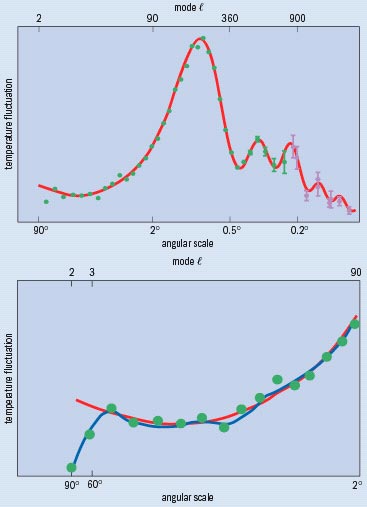
Just as the vibration of a drumhead may be expressed as a combination of its harmonics, fluctuations in the temperature of the cosmic background radiation may be expressed as combinations of the vibrational modes of space itself. When the level of fluctuations is plotted as a function of angle, we therefore find a series of peaks that provides a signature of the geometry of space 13.7 billion years ago (figure 2). For example, the position and amplitude of the first peak – i.e. the peak at the largest angle – in this “angular power spectrum” gives the radius of curvature of space.

Different cosmological models predict different power spectra, and high-resolution measurements of the cosmic microwave background from instruments such as WMAP now allow us to compare different theories against real data. However, when WMAP released its first data in 2003, advocates of the standard cosmological model were faced with several surprises.

The position of peaks in the angular spectrum is usually described by their wavenumber or mode L = 180°/θ, where θ is the angular distance in the sky. In fact, the lowest mode – the dipole or L = 1 mode – is swamped by the far stronger dipole induced by the motion of the solar system relative to the cosmic background, which means that it cannot be measured. But when researchers determined the first observable mode – the L = 2 or quadrupole mode – they found that it was seven times weaker than the predictions for a flat, infinite universe. Furthermore, the octopole or L = 3 mode was also less than the expected value by a factor of about two-thirds.

For higher modes up to L = 900, which correspond to angular scales of just 0.2°, the WMAP data were fairly consistent with the standard model. But a more careful analysis of the power spectrum also reveals that the distribution of temperature fluctuations is not fully isotropic and that the fluctuations are distributed differently on different angular scales.

All these anomalies contradict the standard picture of the universe, which has led some more conservative cosmologists to claim that they are due to errors in the data analysis. Furthermore, the second round of WMAP data – originally expected in February 2004 – has been delayed for more than a year, which may hint at additional trouble to come! Meanwhile, other cosmologists have taken the problem seriously and proposed new laws to explain the early universe, some of which have exotic names such as “vanilla” and “racetrack” inflation.

Cosmo-topologists, on the other hand, have tried to find a more natural, geometrical explanation for the observed power spectrum. Put simply, the unusually low amplitudes of the quadrupole and octopole modes means that long wavelengths (i.e. temperature fluctuations over large angular scales) are missing, possibly because space is not big enough to sustain them. This can be likened to oscillation of a string fixed at both ends, where the maximum wavelength of an oscillation is twice the string length. The geometrical explanation of the power spectrum thus implies that we live in a finite, multiply connected space that is smaller than the observable universe.

Dodecahedral space

Surprisingly, not all small-volume universes suppress the large-scale fluctuations. In 2003 the present author, Jeff Weeks and co-workers proved that the long-wavelength modes tend to be relatively lowered only in a special family of finite, multiconnected spaces that are called “well-proportioned spaces” because they have a similar extent in all three dimensions. More specifically, we discovered that the best candidate to fit the observed power spectrum is a well-proportioned space called the Poincaré dodecahedral space.

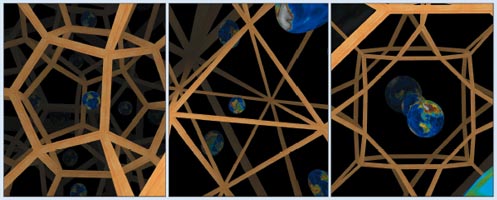
This space may be represented by a polyhedron with 12 pentagonal faces, with opposite faces being “glued” together after a twist of 36° (figure 3). This is the only consistent way to obtain a spherical (i.e. positively curved) space from a dodecahedron: if the twist was 108°, for example, we would end up with a radically different hyperbolic space. The Poincaré dodecahedral space is essentially a multiply connected variant of a simply connected hypersphere, although its volume is 120 times smaller.

A rocket leaving the dodecahedron through a given face immediately re-enters through the opposite face, and light propagates such that any observer whose line-of-sight intercepts one face has the illusion of seeing a slightly rotated copy of their own dodecahedron. This means that some photons from the cosmic microwave background, for example, would appear twice in the sky.

The power spectrum associated with the Poincaré dodecahedral space is different from that of a flat space because the fluctuations in the cosmic microwave background will change as a function of their wavelengths. In other words, due to a cut-off in space corresponding to the size of the dodecahedron, one expects fewer fluctuations at large angular scales than in an infinite flat space, but at small angular scales one must recover the same pattern as in the flat infinite space.

In order to calculate the power spectrum we varied the mass-energy density of the dodecahedral universe and computed the quadrupole and the octopole modes relative to the WMAP data. To our delight, we found a small interval of values over which both these modes matched the observations perfectly. Moreover, the best fit occurred in the range 1.01 < Ω < 1.02, which sits comfortably with the observed value.

The Poincaré dodecahedral space therefore accounts for the lack of large-scale fluctuations in the microwave background and also for the slight positive curvature of space inferred from WMAP and other observations. Moreover, given the observed values of the mass-energy densities and of the expansion rate of the universe, the size of the dodecahedral universe can be calculated. We found that the smallest dimension of the Poincaré dodecahedron space is 43 billion light-years, compared with 53 billion light-years for the “horizon radius” of the observable universe. Moreover, the volume of this universe is about 20% smaller than the volume of the observable universe. (There is a common misconception that the horizon radius of a flat universe is 13.7 billion light-years, since that is the age of the universe multiplied by the speed of light. However, the horizon radius is actually much larger because photons from the horizon that are reaching us now have had to cross a much larger distance due to the expansion of the universe.)

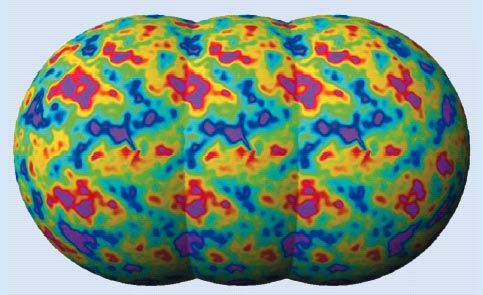
If physical space is indeed smaller than the observable universe, some points on the map of the cosmic microwave background will have several copies. As first shown by Neil Cornish of Montana State University and co-workers in 1998, these ghost images would appear as pairs of so-called matched circles in the cosmic microwave background where the temperature fluctuations should be the same (figure 4). This “lensing” effect, which can be precisely calculated, is thus purely attributable to the topology of the universe.

Due to its 12-sided regular shape, the Poincaré dodecahedral model actually predicts six pairs of diametrically opposite matched circles with an angular radius of 10-50°, depending on the precise values of cosmological parameters such as the mass-energy density.

Circles in the sky

When news of our dodecahedral model appeared in Nature in October 2003, it was not long before the press started running headlines based on what was being hailed the new “football-shaped” model of the universe. However, since cosmo-topology is a very competitive field, the initial response from other groups was not always favourable.

For instance, the New York Times ran the headline “Cosmic soccer ball? Theory already takes sharp kicks”, based on an apparently negative search for matched circles in the WMAP data performed by Cornish and co-workers. Using massive computer simulations, they claimed to have found no evidence of matching on angular sizes greater than 25° and thus rejected the Poincaré hypothesis the same day it appeared.

In fact, their rejection was rather premature because they had only looked for non-rotated matched circles that were diametrically opposite one another – a case that did not test the dodecahedron model at all.

After the initial excitement, Cornish and co-workers went back and reassessed the data. Taking account of the additional 36° twist took a few additional months of computer time, but the matched circles remained elusive. This led them to conclude that there was no reasonable topology for the universe that had a characteristic length smaller than the observable horizon.

However, it turned out that the researchers had taken a short cut to save computer time. While they correctly took into account the possible rotations between matched circles that are implied by most multiconnected topologies, they only searched for matched circles that were back-to-back or very nearly back-to-back. This led them to exclude all likely multiply connected spaces. In the mean time, however, we had proved that in most multiply connected, well-proportioned topologies space is not homogeneous. This means that the position of matched circles in the sky depends on the location of the observer, and they are not, therefore, back-to-back. Only in the simplest of topologies, such as the hypertorus in flat space and the Poincaré dodecahedron in a spherical space, is space homogeneous and the circles back-to-back.

This violates one of the most basic principles of cosmology, that there is no privileged position in the universe. But this principle could be illusory, like the ant in the desert that is convinced the whole world is filled with sand and dunes. For instance, in a flat-torus universe, any gluing together of the opposite faces combined with a screw motion produces pair of circles that are far from being back-to-back. Unfortunately, the increase in the number of degrees of freedom that results from such a scenario means that a full-circle search in the WMAP data is beyond current computing capabilities.

Cosmic horn

In June 2004, however, Boud Roukema and colleagues at the Torun Centre for Astronomy in Poland independently searched for circles in the WMAP data. By only looking for back-to-back circles within a limited range of angular sizes and neglecting all other possible matches, the computer time was reduced drastically. Remarkably, the Polish team found six pairs of matched circles distributed in a dodecahedral pattern and twisted by 36°, each with an angular size of about 11°. This implied that Ω = 1.010 ± 0.001, which is perfectly consistent with our dodecahedral model, although the result was much less publicized than the earlier negative results.

In fact, the statistical significance of the match still needs to be improved, which means that the validity of the Poincaré dodecahedron model is still open to debate. In the last few months, however, there has been much theoretical progress on well-proportioned spaces in general. Early this year, for example, Frank Steiner and co-workers at the University of Ulm in Germany proposed a multiply connected hyperbolic topology called the Picard hyperbolic space. Like the Poincaré dodecahedron, this horn-shaped space belongs to the family of well-proportioned spaces and it also correctly fits the low vibrational modes of the WMAP data. However, since the topology requires the density parameter to have a value of Ω = 0.95, and thus a negatively curved space, it does not fit the experimental constraints we already have on the curvature of space.

After studying the horn-shaped topology further, Steiner and co-workers realized that well-proportioned spherical spaces were, in fact, more promising. They went on to prove that the fit between the power spectrum predicted by the Poincaré dodecahedron model and that observed by WMAP was even better than we had previously thought. But the German team also extended its calculations to well-proportioned tetrahedral and octahedral spherical spaces in which Ω < 1 (see figure 3).

These spaces are somewhat easier to understand than a dodecahedral space, but they require higher values of the density: Ω < 1.015 for octahedral spaces and Ω < 1.025 for tetrahedral spaces, compared with Ω < 1.009 for dodecahedral spaces. However, these values are still compatible with the WMAP data. Furthermore, Steiner and co-workers found that the signal for pairs of matched circles could have be missed by current analyses of the cosmic microwave background due to various measurement effects that damage or even destroy the temperature matching.

Another active area of cosmic topology is “cosmic crystallography”, which was initially devised by the present author and co-workers in 1996 and is now being pursued by, among others, Germán Gomero of the Universidade Estadual Paulista in Brazil and Marcelo Reboucas of the Brazilian Center for Research in Physics. In cosmic crystallography researchers look for repeating patterns in the 3D distribution of high-redshift sources, such as galaxy clusters and quasars, much like the repeating patterns of atoms observed in crystals. By building so-called pair-separation histograms, cosmologists are in most cases able to detect a multiconnected topology of space in the form of spikes that clearly stand out above the distribution expected for the simply connected case.

A Pandora’s box for physics

Finite well-proportioned spaces, especially the Poincaré dodecahedron, open something of a Pandora’s box for the physics of the early universe. The standard model of cosmology relies in the main on the hypothesis that the early universe underwent a phase of exponential expansion called inflation, which produced density fluctuations on all scales. In the simplest inflationary models, space is supposed to have become immensely larger than the observable universe. Therefore, a positive curvature (i.e. Ω > 1), even if weak, implies a finite space and sets strong constraints on inflationary models.

It is possible to build “low scale” inflationary universes in which the inflation phase ends more quickly than it does in general inflationary modes, leading to a detectable space curvature. In other words, even if space is not flat, a multiconnected topology does not contradict the general idea of inflation. However, no convincing physical scenario for this has yet been proposed.

Perhaps the most fundamental challenge is to link the present-day topology of space to a quantum origin, since general relativity does not allow for topological changes during the course of cosmic evolution. A quantum theory of gravity could allow us to address this problem, but there is currently no indication about how such a unified theory might actually describe the emergence of multiply connected spaces.

Data from the European Planck Surveyor, which is scheduled for launch in 2007, will be able to determine Ω with a precision of 1%. A value lower than 1.01 will rule out the Poincaré dodecahedron model, since the size of the corresponding dodecahedron would become greater than the observable universe and would not leave any observable imprint on the microwave background. A value greater than 1.01, on the other hand, would strengthen the models’ cosmological pertinence.

Whether or not some multiply connected model of space such as the Poincaré dodecahedron is refuted by future astronomical data, cosmic topology will continue to remain at the heart of our understanding about the ultimate structure of our universe.

More about: Cosmic topology

W Aurich et al. 2005 CMB anisotropy of the Poincaré dodecahedron arXiv.org/abs/astro-ph/0412569
N Cornish et al. 2004 Constraining the topology of the universe Phys. Rev. Lett. 92 201302
J P Luminet et al. 2002 Is space finite? The Once and Future Cosmos, Scientific American (special edition) pp58-65
J P Luminet et al. 2003 Dodecahedral space topology as an explanation for weak wide-angle temperature correlations in the cosmic microwave background Nature 425 593
A Riazuelo et al. 2004 Cosmic microwave background in multiconnected flat spaces Phys. Rev. D 69 103518
B Roukema et al. 2004 A hint of Poincaré dodecahedral topology in the WMAP first year sky map Astron. Astrophy. 423 821
J Weeks 2001 The Shape of Space (New York, Dekker)
WMAP results: map.gsfc.nasa.gov


Subtle are Einstein’s thoughts

“Stop telling God what to do!” When Niels Bohr said these words to Albert Einstein – if indeed he ever did – it was probably in exasperation with Einstein’s frequent repetition of the phrase “He does not play dice with the universe”. The latter is perhaps the most famous of Einstein’s many references to religion, although “The Lord God is subtle, but malicious he is not” comes a close second. There are many others too (see box below).

Scientific materialists, who regard all forms of religious belief as superstition, are often puzzled and even embarrassed by Einstein’s frequent remarks about God. But conventional religious believers – knowing that Einstein was a Jew – often jump to the conclusion that he was referring to the traditional Judaeo-Christian God, and invoke his authority in support of their own beliefs.

I suspect that both groups have misunderstood Einstein and that we should all read more carefully what he wrote about science and religion. In 1940, for example, he submitted a paper to a conference on this subject in which he clearly stated that, in his view, there could be no “legitimate conflict between science and religion”. The main source of conflict between the two, he argued, lay in the concept of “a personal God”.

As the physicist Max Jammer describes in his 1999 book Einstein and Religion, that remark created a furore at the time. Many people in the US assumed that by denying the existence of a personal God, Einstein was denying any kind of God. What we now call the “religious right” was then vocal in its criticisms (and probably would be today).

However, Einstein’s use of the word “God” was idiosyncratic. Indeed, Banesh Hoffmann – his biographer and former colleague – wrote that we do not know precisely what Einstein meant by the word. Perhaps, however, we can explore some of the things he did not mean.

Religious experience

As has been well documented, Einstein was born into a secularized Jewish family that did not observe any traditional rites. Nevertheless, stimulated by religious instruction from other relatives and at school, the young Einstein had an intensely religious phase that lasted for about a year. It came to what he later called an “abrupt end” at the age of 12, when he concluded that many Bible stories were incredible. At the same time, he discovered Euclidean geometry, which he then thought offered a level of certainty that no religion could.

After that early experience, Einstein never again took part in any formal religious observances – Jewish or Christian – except, perhaps, to attend the weddings or funerals of friends and relatives as a matter of courtesy. Looking back on his brief religious foray, Einstein wrote in his 1949 Autobiographical Notes that it was quite clear “that the religious paradise of youth…was a first attempt to free myself from the chains of the ‘merely personal’, from an existence dominated by wishes, hopes, and primitive feelings”.

Einstein felt that the insights into the universe given by science and mathematics were a greater and surer release from the “merely personal” than religion. He was awestruck by our ability to comprehend the universe, at least in part, and in later life remarked several times that the most incomprehensible thing about the universe is that it is comprehensible. This kind of awe, he believed, was essential for scientists and, indeed, for human beings.

“The most beautiful experience we can have is the mysterious,” he wrote in a 1931 essay. “A knowledge of the existence of something we cannot penetrate, our perceptions of the profoundest reason and the most radiant beauty, which only in their most primitive forms are accessible to our minds – it is this knowledge and this emotion that constitute true religiosity; in this sense, and in this alone, I am a deeply religious man.” This remark shows that Einstein defined religiosity in his own terms. Indeed, in the essay he goes on to distance himself from orthodox Jewish and Christian religion, expressing his disbelief in the idea that an individual can survive after their body dies or in any kind of final judgement. He was instead satisfied with the “devoted striving to comprehend a portion, be it ever so tiny, of the Reason that manifests itself in nature”.

Pantheism and the personal God

Einstein’s conviction that nature is rational is closely linked to his conception of God: he could not believe that God played dice with the universe, because that would be irrational. He accepted what he believed to be the corollary, namely that human beings have no free will. Einstein’s other favourite saying – that the Lord is subtle but not malicious – is related to the same conviction of rationality. “Nature”, he concluded, “hides her secret because of her essential loftiness, but not by means of ruse.”

For those who regard all forms of religious belief as superstition, it would be attractive to conclude that Einstein simply meant “nature” whenever he used the word “God”. Indeed, identifying God with nature is known as pantheism, a belief that is generally attributed to the unorthodox Jewish philosopher Baruch Spinoza (1632-1677). We know that Einstein admired Spinoza greatly and, although he did not share all of his religious views, it would seem plausible to label Einstein a pantheist.

However, in 1929 – during a rare interview with a journalist – Einstein was directly asked if he believed in the God of Spinoza. “I can’t answer with a simple yes or no,” he replied. “I am not an atheist [and] I do not know if I can define myself as a pantheist.” Indeed, pantheists view God and the universe as co-eternal and believe that there was no act of creation, whereas Einstein does seem to have regarded the universe as a creation.

But why did Einstein not believe in a personal God? To answer that question, we have to understand what he meant by the term. I would define a personal God as a God with whom human beings can have a relationship, analogous to those they have with one another. Although this idea might seem to indicate that God has a human form, I think it is perfectly possible to believe in a personal God who is not anthropomorphic. I suspect – but cannot clearly demonstrate – that Einstein sometimes confused the two ideas.

For example, while Einstein certainly did not like anthropomorphism, he still used personal terms, such as subtlety and malice, when speaking about God. Indeed, in his 1929 interview, the best simile he could think of for God was as the author of a whole library of books! Einstein would probably have defended himself by pointing to the limitations of human language, which make it almost impossible to avoid personal terminology completely.

But it is surprising that Einstein used such personal terms when talking about God, given that he saw his lifelong devotion to science as an attempt to transcend the “merely personal” in his own life; this suggests that he thought a personal God would be a limited God. Whatever he meant by “personal God”, Einstein remained consistent in his opposition to the idea until the very end of his life.

Cosmic religion

Although Einstein was not always consistent in what he said about God, there is a consistent theme running through his thoughts on religion – a theme that he called “cosmic religion”. He used this term to reflect the awe he felt when confronted with the universe and our ability to begin, at least, to comprehend it. Writing in 1930, he saw hints of this cosmic religion in the Psalms and the Hebrew prophets, and more clearly in Buddhism. This cosmic religion, he wrote, “knows no dogma and no God conceived in man’s image; so that there can be no church whose central teachings are based on it”.

Einstein’s dislike of organized religion is clear. Many people today, according to opinion polls, have similar ideas. They profess to believe in the spiritual – or even in God – yet rarely or never enter a church, mosque or synagogue. However, Einstein should not be regarded as their precursor. Their “new-age spirituality” is often anti-scientific, whereas Einstein’s cosmic religion was based firmly on a profound understanding of the physical universe, and of its underlying mathematical structure.

Einstein also often referred to his feelings of mystery and awe. The mystery, it seems to me, had three elements. Why is there anything at all? Why is the universe rational and ordered? And how can we, with our limited human minds, understand and appreciate at least something of that ordered rationality? I believe he used the word “God” as a shorthand for all this because he could think of none better.

Einstein’s condemnation of anthropomorphic images of God is at one with the most profound insights of all religions. He knew very well that the second commandment (which Jews and Muslims have kept more strictly than Christians) says we should not make any graven image and bow down and worship it. On that theme, Einstein agrees with the Hebrew prophets, whom he saw as forerunners of his cosmic religion.

Whether or not he meant more than their denunciations of idols when he denied belief in a personal God, I do not know. However, Einstein’s cosmic religion differs both from orthodox monotheism and from scientific materialism because of his conviction that science and religion must work together to explore the mysteries that fascinated him. That, surely, is the meaning of another of his famous sayings: “Science without religion is lame, religion without science is blind.”

Box: Einstein on God and religion

  • [Quantum] theory yields much, but it hardly brings us close to the Old One’s secrets. I, in any case, am convinced He does not play dice. (1926, in a letter to Max Born)
  • I cannot conceive of a God who rewards and punishes his creatures, or has a will of the kind we experience in ourselves. Neither can I nor would I want to conceive of an individual who survives his physical death…. (1930, from an essay)
  • We see a universe marvellously arranged and obeying certain laws, but only dimly understand those laws. Our limited minds cannot grasp the mysterious force that moves the constellations. (1929, part of his reply to the question: “Do you believe in the God of Spinoza?”)
  • What I am really interested in is whether God could have created the world in a different way; in other words, whether the requirement of logical simplicity admits a margin of freedom. (Mid-1940s, remark reported by Ernst Gabor Straus, then Einstein’s assistant)
  • Then I would feel sorry for the good Lord. The theory is correct anyway. (1919, reply to his assistant, Ilse Rosenthal-Schneider, who asked what he would have done had Eddington’s eclipse measurements not supported general relativity)
  • Science without religion is lame, religion without science is blind. (1941, from an essay)

Can proteins perform logic?

The main role of many proteins is to transmit and process information in living cells. These processes involve other molecules called regulatory ligands that bind to specific sites on the surface of the protein. It has been known for almost 50 years that a typical protein can switch between an inactive and an active state as the concentration of the ligand varies. These states could be used to represent the “0”s and “1”s of binary logic, but proteins are not true logic gates because a large change in concentration is needed to switch them from one state to another.

Now, Ian Graham and Thomas Duke of Cambridge University have shown how, in theory, certain proteins can bind two different ligands at the same time to perform all the elementary logic functions, including AND, OR, XOR and NOT XOR. These proteins can act as individual logical elements because their output depends on two inputs – the concentrations of the ligands. Moreover, when the proteins cluster together, the response is further enhanced. The clusters can thus act as logic gates whose activity can be abruptly switched from fully active to fully inactive as the concentrations of the ligands pass certain thresholds.

Graham and Duke cite the bacteria E. Coli as an example – different types of receptor proteins bind various ligands, such as glucose and lactose, to produce a well-defined response. The switching can be observed by watching the bacteria “light up” as the concentration of ligands increase because they contain genetically modified fluorescent proteins.

“The interesting bit is the switch-like property of the receptor cluster,” says Graham. “Before, all experiments were done on cell populations, so the error bars in the experiments obscured this exciting fact: that the receptor proteins act as an ultra-sensitive three-state switch that is ‘null’ in the absence of a stimulus, ‘on’ if the ligand concentration increases and ‘off’ if it decreases.”

A giant leap for nanodroplets

When small droplets hit a solid surface they can either stick to it or bounce off it. In some applications, such as ink-jet printing and crop spraying, it is important that the droplets stick to the surface, whereas in others, such as the development of self-cleaning and water-repellent surfaces, the droplets should bounce away.

Johannes Boneberg of the University of Konstanz and colleagues in Konstanz, Munich and Freiburg used colloidal lithography to make triangular gold structures about 100 nanometres across on a graphite surface. The German team then illuminated the nanostructures with a laser pulse with a duration of a few nanoseconds.

The laser melts the gold to form a triangular droplet of molten gold. However, since gold does not naturally wet a graphite surface, the molten gold changes from a triangular shape into a sphere (see figure). This process starts at the corners of the triangles, where the radius of curvature is small and the force due to surface tension is high. In this way, the surface energy transforms into kinetic energy and the droplet detaches itself from the surface in a process called “dewetting”. The entire sequence of events takes only nanoseconds, after which the gold solidifies again. However, the nanodroplets can jump into the air at velocities of around 10 metres per second.

Previous experiments with droplets were restricted to micron-sized droplets and time scales of microseconds. The German work will allow this research to be extended to much smaller droplets and much faster time scales. Boneberg and co-workers also plan to perform the experiment under zero-gravity conditions and to investigate how droplets made from different materials behave.

Copyright © 2026 by IOP Publishing Ltd and individual contributors