Thyristors go organic

Thyristors are devices that can switch between two different conductance states and they are widely employed to control electric currents in applications such as motors and refrigerators. A conventional thyristor consists of a series of diodes. Ichiro Terasaki of Waseda University and colleagues have now discovered an organic material that exhibits similar behaviour in its bulk state.

The Japanese team made its device from an organic conducting salt known as θ-(BEDT-TTF)2CsCo(SCN)4, which consists of alternate layers of BEDT-TTF, which is a conductor, and CsCo(SCN)4, which is an insulator. At low temperatures, the conduction electrons in the crystals exhibit a high resistance as a result of “charge ordering”.

When a current is applied to the crystal, the charge order immediately “melts”, causing the resistance to decrease rapidly as the current increases. This means that that the crystal has essentially the same characteristics as a conventional thyristor, although the mechanism is different. The Japanese team showed that the device can convert a small applied direct current into an alternating current with a frequency of 40 Hz.

“The charge-ordered state is a kind of ‘ice’ of conduction electrons and thus we may say that current melts the ice,” explains Terasaki. “On a cold day, water on a pond is frozen but water in a river still flows – our finding is a similar phenomenon in solids.”

The team plans to use the material to explore non-equilibrium phenomena in general. The experiments were all carried out at low temperatures, so Terasaki and co-workers hope to find organic materials that exhibit thyristor-like behaviour at room temperature. They also plan to search for inorganic single crystals with similar properties.

Cold plasmas move on

At atmospheric pressure, most plasmas are so hot (thousands of degrees centigrade) that they would immediately kill any living cells they come into contact with. Moreover, these high-temperature plasmas are also very difficult to control. In recent years, however, researchers have developed techniques for producing low-temperature plasmas and some of these have been used in biomedical applications. However, sources that are more reliable and user-friendly are still needed.

A good low-temperature plasma source must be able to work at room temperature and atmospheric pressure. Moreover, it should be hand-held and must not “arc” and heat up while operating. The new device developed by Laroussi and Lu consists of two electrodes, each made of a thin copper ring attached to the surface of a glass disk: the disk is about 2.5 centimetres across and has a small hole at its centre. These electrodes are then inserted into a dielectric tube and are separated by a gap that can be varied between 0.5 and 1 centimetre (figure 1).

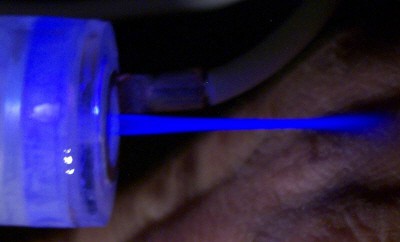
When helium gas is injected into the tube and short (less than one microsecond) high-voltage pulses are applied to the electrodes, a discharge is ignited in the gap between the electrodes. This produces a plasma plume that is ejected through the hole in the outer electrode. The plume can be up to 5 centimetres long, with the length depending on the flow rate of the helium and the size of the voltage pulses. The plume remains at room temperature and can be touched by bare hands (figure 2).

The device is an improvement on previous plasma “jet” devices that only generate short plumes that have lengths in the millimetre range and can reach temperatures several tens of degrees above room temperature. And unlike other devices, such as the “plasma needle”, the new apparatus contains no sharp metal objects. And since very short voltage pulses are used, there is no risk of arcing and heating if the device is deployed for long periods.

A cold twist on the Hanbury Brown Twiss effect

The first observation of the Hanbury Brown Twiss effect in an ultracold gas was made by researchers from the University of Tokyo in 1996 with neon atoms, but the team was unable to study the effect in any detail. Now, Chris Westbrook and colleagues of the University Paris-Sud and co-workers at the University of Minho have developed a detector that can identify the arrival of single atoms of ultracold helium on a time scale of nanoseconds and distances less than 200 microns. This allows the team to detect any small atomic correlations between atoms that might be present.

Although such detectors are routinely used to study atomic and ionic collisions, they have never been used for Bose-Einstein condensates. First produced in 1995, a Bose-Einstein condensate (BEC) is a collection of atoms that has been cooled to such low temperatures that all the atoms collapse into the same quantum state. Most BECs have been formed from alkali atoms such as sodium and rubidium, but detecting individual atoms is easier when metastable helium atoms — from which Westbrook’s team and other groups in France first produced BECs in 2001 — are used.

Westbrook and co-workers found strong correlations in the ultracold helium gas when it was above the transition temperature for a BEC to form, but the correlations disappeared when the gas was cooled below the transition temperature. According to Westbrook, this is because the quantum interference effect that normally increases the probability of finding two events close together is not present in a BEC.

“Our technique will be a great tool for studying BECs and other quantum gas systems, especially near a phase transition,” says Westbrook. The team now plans to investigate phase transitions to Mott insulators and atom correlations due to Feshbach resonances, which have been central in allowing researchers to produce molecular and fermionic condensates in recent months.

What music do you like?

The study by Lambiotte and Ausloos was based on data from audioscrobbler.com — a website where users upload their favourite musical recordings to a personal “library” on a central server. The website is designed to encourage users to discover new music by proposing recordings in other people’s libraries that it thinks meet their taste. Using data from the site in January 2005, the two physicists were able to examine the music listened to by a total of 35916 people, who together owned 617 900 different “music groups” in their libraries. Each music group refers to a particular artist, the top five of which were Radiohead, Nirvana, ColdPlay, Metallica and the Beatles.

Lambiotte and Ausloos realised that the list of users and the music they listen to can be analyzed using methods from “complex-network theory”, in which the people and the music form two different types of “nodes” in a network. The physicists started with a “fully connected” network, in which any two people are connected if they share at least one song by the same artist. They then applied a “filter” to their network, which takes into account correlations between peoples’ entire music collections rather than just between the individual music groups they like.

As the value of the filter increased, the Belgian duo found that disconnected structures or “branches” formed along the original network structure, thus revealing collective trends and cliques in the form of a “map” of different musical genres (see figure). Moreover, the study revealed that each listener is characterized by a very diverse mixture of music groups, which Lambiotte and Ausloos call the “individual musical signature”. The fact that our musical tastes are becoming more varied and unconventional may be because people can easily download music from the Internet to form personalized databases of favourite recordings on iPods and other devices.

The physicists found listeners who liked such diverse groups as The Jon Spencer Blues Explosion, Galaxie 500, Prince and the Revolution, Uriah Heep and Laurent Garnier — an unexpected mixture of indie rock, funk, hard rock and dance. “These structures do not fit the neat usual genres defined by the music industry and represent the non-conventional taste of listeners,” explains Lambiotte. “Our method accounts for the fact that music perception is driven both by the people who make music and also the people who listen to it.”

The results could also provide a new way to redefine these genres based on the choices of the listeners themselves. Lambiotte and Ausloos also present a simple “agent-based voter growth model” that highlights how listeners form opinions about different types of music, which could help to explain how particular artists becomes trendy. “Our method allows us to quantify the music signatures of a large sample of individuals and visualize their collective behaviour, that is the emergence of sociological communities,” says Lambiotte.

Nanomagnets come together

Shehzaad Kaka and colleagues at the National Institute of Standards and Technology (NIST) in Boulder and Fred Mancoff and co-workers of Freescale Semiconductor Inc. in Arizona built their nanomagnets from two magnetic films of different thicknesses separated by a non-magnetic layer. The layers were patterned using standard semiconductor processing technology, allowing the teams to produce magnets less than 100-nm across. The NIST device, for example, consists of circular devices with a diameter of 50 nanometers (see figure).

When a DC current is applied to such a device, the magnetic nature of the layers causes the intrinsic angular momentum or spin of electrons in the current to point in the same direction. In the NIST device this spin-polarized current induces a “spin torque”, which causes the direction of magnetization in the device to switch back and forth. In the Freescale device, the spin of the electrons in the current is transferred from the first film to the second, again causing its magnetization to oscillate.

These oscillations generate microwaves that can be tuned from a few gigahertz to several tens of gigahertz by simply varying the current or by applying an external magnetic field. Moreover, when two nanomagnets are placed close together (about 500-nm in the case of the NIST and 200-nm for the Freescale device) and certain combinations of currents are applied, they oscillate in harmony. This phase-locked system produces a microwave signal twice as intense as that generated by a single magnet, which was a key experimental signature of the effect.

Both teams say that phase-locking should occur in arrays containing more than two oscillating nanomagnets. An individual oscillator produces a 10 nanowatt signal, but small arrays of 10 nano-oscillators could produce more than 1 microwatt. Furthermore, the radiation produced is highly directional, making such arrays potentially useful in wireless transmitters and receivers. The researchers now plan to determine the mechanism behind the oscillations in more detail.

Sir Hermann Bondi: 1919 – 2005

Bondi was born in Vienna, Austria, on 1 November 1919 into a Jewish family. Alarmed by the rise of the Nazis in neighbouring Germany and encouraged by the cosmologist Sir Arthur Eddington, he moved to Trinity College, Cambridge, in 1937, where he completed a mathematics degree in 1940. Bondi was, however, interned as an “enemy alien” by the British government in March 1940, spending over a year at camps on the Isle of Man and in Canada, where he first encountered Gold.

Upon his release in autumn 1941, Bondi went back to the UK where he and Gold worked on radar research for the Admiralty under the supervision of Hoyle. Once the Second World War was over, Bondi returned to Cambridge, where he, Gold and Hoyle developed their steady-state theory in 1948. It saw no need for an initial singularity (the big bang) and proposed instead that the universe has no beginning or end. To account for the continual expansion of the universe, the theory requires that matter is being continuously created so that the average density of the universe is constant.

In 1954 Bondi took up a professorship at King’s College London, where he carried out pioneering theoretical work on how a black hole or star can accrete matter from surrounding gas. Following the discovery of the cosmic microwave background in 1965, Bondi — unlike Gold and Hoyle — was not afraid to admit that the steady-state theory was probably wrong. Having already advised the government on construction of the Thames Barrier, Bondi became increasingly attracted to public service and in 1967 was appointed director general of the European Space Research Organisation in Paris, which was the forerunner of the European Space Agency.

In 1971 Bondi was appointed chief scientist at the UK Ministry of Defence — where he backed Britain’s independent nuclear deterrent. Six years later he took up the same role at the Department of Energy under Tony Benn. In 1980 Bondi began a four-year spell as head of the Natural Environment Research Council and in 1983 was appointed master of Churchill College Cambridge, where he remained until 1990. His books include Cosmology (1952) and his autobiography Science, Churchill and Me (1990).

Living in a dodecahedral universe

It is not just Physics World that looks different this month – the universe might well have changed its appearance too. If Jean-Pierre Luminet and co-workers are correct, space is not, as we previously thought, flat and infinite. Rather, we could live in a universe that is shaped like a football – a Poincaré dodecahedron to be precise – and resembles a video game in certain ways. We have been here before. Einstein thought the universe was static until Hubble’s observations suggested otherwise. Astrophysicists thought they had a good idea about the mass and energy content of the universe until “dark” energy showed up. Inflation predicts that the universe is flat, but it has not been properly tested as a theory yet. The next set of WMAP data on the cosmic background, due any month, could help decide the issue. Until then, Luminet’s article on cosmic topology is recommended.

Anosognosia

Since it was first published in 1980, A People’s History of the United States by Howard Zinn has sold over a million copies and become one of the most influential works of history in the US. A popular textbook in schools and colleges, it claims to focus on "hidden episodes of the past when, even if in brief flashes, people showed their ability to resist, to join together, occasionally to win".

However, Zinn’s book makes no mention of people resisting, joining together and winning when it comes to science. It says nothing, for instance, of the struggles to reduce childhood mortality, increase life expectancy, or develop systems of mass transportation. There is no mention of Norman Borlaug, who won the 1970 Nobel Peace Prize for leading the “green revolution”, and who helped end hunger for millions of people. Also absent is the microbiologist Maurice Hilleman, whose vaccines saved more lives than were lost in all the wars to which Zinn devotes chapters.

Mass electrification fails to feature in Zinn’s book, although the unit costs of electricity are discussed in the context of a programme to give "enough help to the lower classes" to prevent them rebelling. Steam power is not covered, nor is the internal-combustion engine, although railroads are discussed in relation to racial segregation, unions, strikes and methods of exploiting American Indians.

Misunderstanding the people

Zinn, in short, considers scientific changes inconsequential to "the people".

Such omissions do not necessarily make the book defective as history. As Zinn notes, historians cannot avoid selecting and emphasizing some facts rather than others, although they have a duty to avoid promoting ideological interests, knowingly or not.

But Zinn’s omissions do make the book defective as an account of "the people". The conquest of dreaded and once-common epidemic diseases, such as polio and encephalitis, have fundamentally affected how all of us view life and death. Developments in astronomy and the discovery of evolution have affected our sense of time and space, and our place in nature.

These events all took place within the timeframe of Zinn’s book. Although some, of course, were pioneered by non-Americans, these events profoundly altered how human beings seek answers to the questions of what we know, should do, and can hope for.

Lacking awareness

Zinn is not the only person to ignore the impact of science. Many authors of contemporary fiction fill their books with characters who are nothing more than superannuated children, seemingly unaffected by technological training and devices. Some writers – like Jonathan Franzen, Ian McEwan, Neal Stephenson and David Foster Wallace – do present protagonists who are interested in and influenced by their technological surroundings. But these writers can be severely criticized by reviewers for their efforts.

Commenting on McEwan’s Saturday, one reviewer criticizes the author for being "wearingly insistent on displaying his technical knowledge" and complains of "big words in this book". The book indeed has some big words. However, the training that turns people into technically literate professionals not only accustoms them to using big words, but also affects how they speak and act. Technically competent people often delight in their technical competence, and wield this competence when interacting with the world. This is precisely what McEwan so ably captures.

Dismissing the effect of science on modern life has nothing to do with the "two cultures". Rather, it shows a blind spot in the work of writers and scholars whose duty it is to become aware of the world around them. It is more serious than amnesia. We can name the condition with one of the "big words" that McEwan’s protagonist uses in Saturday. It is "anosognosia" – a medical term (derived from the Greek for "without knowledge") that means a lack of awareness of one’s own condition.

The critical point

After lecturing on Maxwell’s equations of electromagnetism in his Caltech lectures on physics, Richard Feynman once remarked that "[f]rom a long view of the history of mankind…there’s little doubt in my mind that the most significant event of the 19th century was Maxwell’s discovery of these laws of electrodynamics in the 1860s. The American Civil War, for instance, will pale into provincial insignificance compared with this important event of that decade".

Is Feynman’s claim overstated? Did Maxwell’s laws merely add information to our world? Clearly not. Their discovery transformed human life in fundamental ways that have profound implications for "the people".

Overcoming anosognosia will require scholars in the humanities to engage with science and technology much more than they currently do. One obstacle, however, is their fear that such engagement will undermine the humanities. Far safer for its practitioners to circle the wagons, dwelling on what is distinctive about the humanities rather than what is possible. This is what makes so many humanities programmes both defendable and lifeless. Moreover, such wagon-circling is self-interest in disguise; thus, an ideology itself.

I have cited a few cases of anosognosia, and would like your favourite examples of others, as well as your thoughts on the cause of this disease. I am not talking about bloopers, that is to say mistakes or an ignorance in the use of scientific details. Rather, I mean cases of wilful naïvety in assessing the impact of science and technology on the modern world. I shall discuss your suggestions in a future column.

• Do you have your own examples of "anosognosia"? Send your comments to Robert P Crease at rcrease@notes.cc.sunysb.edu


Power walking

“We have for the first time generated significant levels of electricity from normal human movement,” says Lawrence Rome of the University of Pennsylvania and the Marine Biological Laboratory in Massachusetts. Previous attempts to generate electricity from walking relied on devices built into shoes but this only produced about 20 milliwatts of power. Although high forces are exerted when the shoe touches the ground, little or no mechanical work – which is given by the product of force and distance – is done because of the short distances involved.

To overcome this problem, Rome and colleagues exploit the up and down movement of the hips that occurs during walking, which can be as high as 5–7 centimetres. “If you are carrying a load in the back-pack, it has to go up and down the same vertical distance on each step as your hip,” explains Rome. The team calculated that it takes considerable mechanical work – about 18 Joules per step – to lift a backpack weighing 36 kilograms through a distance of 5 centimetres. This mechanical work can then be converted into electricity.

The new back-pack is based on a rigid-frame pack similar to those used by hikers. However, the compartment carrying the load is suspended from the frame by vertical springs. As the hips drive the frame of back-pack upwards, the load lags behind it, which causes a differential movement between the two. Mechanical energy is extracted by attaching a toothed rack to the load plate, which meshes with a toothed gear on the frame. This gear is attached to a generator that can produce electricity. This electricity can be used as it is generated or it can be stored in a lightweight rechargeable battery.

Test performed on six male volunteers who used the back-pack while walking on a treadmill showed that they used less energy to generate electricity than expected. Moreover, the volunteers could generate more electricity by simply walking faster or carrying a heavier load.

The team now plans to improve the rechargeable batteries that go with the back-pack and Rome has set up a company called Lightning Packs LLC to develop the device further.

Colloids go exotic

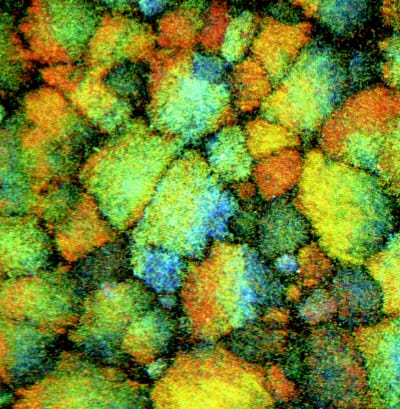
Scientists routinely use colloid suspensions to model solids and liquids, such as the way they melt and freeze. They are able to follow the motion of the individual colloidal particles during these processes because they are about 1000 times bigger than atoms and molecules. It is also possible to change and control the interactions between the colloid particles to a certain extent. However, it has been difficult to model long-range or ionic interactions until now because the attractive interactions between oppositely charged particles have always been too strong, which has lead to the formation of irregular clusters of particles called aggregates (figure 1).

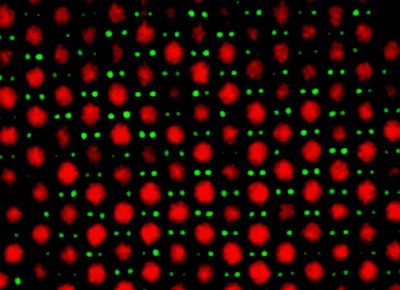
Mirjam Leunissen, Christina Christova and colleagues at Utrecht University have now overcome this problem. They started by making colloidal spheres with positive and negative charges, which they coloured differently with dyes. Then they mixed the spheres in a solution and followed their behaviour with a confocal microscope. They were able to tune the charge on the spheres by adding a small amount of a salt (tetrabutylammonium chloride) to the mixture: keeping the charges sufficiently low ensured that the particles did not form aggregates (figure 2).

As well as being able to study processes like crystallization and glass formation, the Dutch researchers were also able to create a number of unusual new structures that they had predicted on the basis of computer simulations (figure 3). “This is remarkable because we have only investigated two different sized particles so far,” says Leunissen.

In an ionic crystal, for instance, the total charge on the negative ions tends to cancel out the total charge on the positive ions. In some of the structures created by the Utrecht group, however, the total charges on the particles do not cancel each other out, although neutrality is maintained by the liquid they are suspended in.

The Utrecht group has also shown that it can melt the crystals in a controlled way by applying a low electric field — a process that would require unfeasibly high fields in a real atomic crystal. This is possible because the density of colloid crystals is a billion times smaller.

The team also observed for the first time that colloid particles moving quickly in the same direction group together to form stripes, again confirming the predictions of theorists. The new structures could be useful for display applications, such as e-ink, because they are sensitive to electric fields (figure 4).

Copyright © 2026 by IOP Publishing Ltd and individual contributors