Comets are the “undercooked leftovers” that remained after clouds of dust and gas condensed to form the Sun and planets some 4.5 billion years ago. Unlike other objects in the solar system, comets have barely changed with time and contain pristine material – such as ice, dust and gas – from the early days of the solar system. Some scientists also believe that comets could have carried the organic molecules needed to start life on Earth.
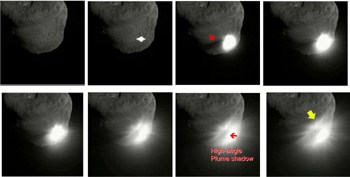
The first images of the collision between the impactor and Tempel 1, which took place about 133 million kilometres from Earth, showed clouds of dust and ice being ejected from the impact site. The impact was designed to disturb material inside the comet so that it could be analysed by the instruments on board the flyby spacecraft as well as various ground and space-based observatories. The first set of results from the mission will be published on Sciencexpress later this week.
Based on data from the flyby spacecraft and the impactor, Michael O’Hearn of the University of Maryland and colleagues say that Tempel 1 belongs to the Jupiter family of comets, although its overall shape and surface features are quite different from the nuclei of the two other comets that have been studied in detail — Wild 2 and Borelly. They also report that Tempel 1 consists largely of extremely fine particles that seem to be very loosely bound together: in other words, the comet is more like a pile of powder than a solid rock. The outer layer of the comet is composed of particles that are between 1 and 100 microns in size, while the density of the nucleus is about 600 kilograms per cubic metre (Sciencexpress 1118923).
In addition to the material ejected by the impactor, the flyby spacecraft also saw shallow outbursts of material – probably triggered by sunlight – with a mean radius of about 3 kilometres. This ejected material mainly contain water and carbon dioxide. Furthermore, a relatively high concentration of organic material, such as formaldehyde and methanol, was found to be more abundant than water and carbon dioxide during and after the impact.
Meanwhile Karen Meech of the University of Hawaii and an international team of colleagues used more than 70 different telescopes to follow the action from the ground. Again, these results suggest that the composition of the material ejected after the impact differed from that produced in natural eruptions. This means that the material inside the comet is different to that on the surface (Sciencexpress 1118978).
Finally, Horst Uwe Keller of the Max Planck Institute for Solar System Research and co-workers used the Rosetta mission – which is on its way to another comet called Churyumov Gerasimenko – to survey the collision at from a distance of 80 million kilometres over a period of 17 days. Again they found that the relative amount of organic material being ejected increased following the impact. Keller and co-workers also observed a dip in brightness about 200 seconds after the impact, which they say is related to the formation of a city-sized crater on the comet (Sciencexpress 1119020).
Rotblat was born in Warsaw in 1908 and obtained an MA from the Free University of Poland and a doctorate from the University of Warsaw. He moved to Liverpool in 1939, where he worked with James Chadwick. At Liverpool he started to work on the atomic bomb and later moved to Los Alamos. However, he resigned and returned to Liverpool after Germany had surrendered and he could see no justification for continuing to work on an atomic bomb.
He stayed in nuclear physics until 1950, when he moved to Saint Bartholomew’s Hospital in London and established a new career for himself as a medical physicist. He was professor of physics at Bart’s from 1950 until his retirement in 1976. He also served as editor of the journal Physics in Medicine and Biology and was president of both the Hospital Physicists’ Association and the British Institute of Radiology.
However, Rotblat was best known for his opposition to nuclear weapons and his role in Pugwash. Named after a small town in Nova Scotia, Canada, where the first meeting was held, Pugwash brought together scientists from both sides of the iron curtain and its meetings are credited with playing a role in ending the cold war.
In his later years Rotblat’s attention moved from nuclear disarmament to the elimination of the causes of all wars. As he wrote in the millennium issue of Physics World in December 1999: “This is truly a task fit for the next century.”
The laser would be used to compress and heat a small capsule of deuterium and tritium until the nuclei are hot enough to undergo nuclear fusion and produce helium and neutrons. In a reactor the energy of the neutrons would be used to generate electricity without the emission of greenhouse gases or the generation of long-lived nuclear waste.
The most advanced approach to fusion involves using magnetic fields to confine the deuterium–tritium plasma. This is the route to be taken by ITER, which will cost $10bn to build and run. The alternative “inertial confinement” technique, which uses lasers or ion beams rather than magnets to confine the plasma, will be investigated by the National Ignition Facility (NIF) in the US and the Laser Mégajoule (LMJ) in France. However, both these billion-dollar lasers will primarily be used for nuclear-weapons research, with only 15% of their time being available for other areas of physics.
In the conventional approach to inertial confinement, which will be used at NIF and LMJ, the lasers that compress the fuel capsule also heat it. Fast ignition, which was first proposed by Max Tabak of the Lawrence Livermore National Laboratory in the US, relies on different lasers for these two stages. According to Henry Hutchinson of the Rutherford Appleton Laboratory in the UK, who set up the European panel, fast ignition requires less laser energy than the conventional approach, which means that it is considerably cheaper.
“The energy problem is sufficiently urgent that we cannot afford to ignore different approaches to fusion,” he says. Hutchinson also stresses that any fast-ignition laser would be a civilian facility, and would be available for research on astrophysics, atomic physics and nuclear physics as well.
Fast ignition was first demonstrated at the Gekko XII laser at Osaka University in Japan in 2001, working with a team of UK scientists. Kodama and colleagues are now upgrading their laser system in order to approach “breakeven” – the point at which the energy output is equal to the energy needed to sustain the reaction. They then plan to further enhance their system so that it reaches ignition, which happens when the fusion reactions generate enough energy to sustain themselves without the need for further heating. Finally, they hope to build a demonstration fast-ignition facility. Physicists in the US are also studying fast ignition.
HiPER, as the European proposal is provisionally known, would be designed to achieve high energy gains, providing the critical intermediate step between ignition and a demonstration reactor. It would consist of a long-pulse laser with an energy of 200 kJ to compress the fuel and a short-pulse laser with an energy of 70 kJ to heat it.
If Hutchinson and colleagues can persuade research councils across Europe to back the proposal, construction could start around the end of the decade. Although the panel’s report does not discuss where the laser should be built, the UK would be a contender to host the facility.
When a dry strand of spaghetti is bent beyond its limit of curvature, it does not usually break in half but instead into several pieces, from as few as three to as many as ten. This behaviour has puzzled many scientists over the years, among them Nobel laureate Richard Feynman. To try and understand this behaviour, Basile Audoly and Sébastian Neukirch at the Laboratoire de Modélisation en Mécanique at the University of Paris 6 used the Kirchhoff equations to model how a thin elastic rod reacts to being bent.
According to Audoly and Neukirch, flexural – or elastic — waves travel along the length of the rod just after the initial break. These waves increase the local curvature of the rod and trigger an “avalanche” of new breakages, which in turn initiate more waves, so causing the rod to fragment.
“When a rod breaks, one would expect that the elastic waves triggered by the first crack would help the two halves of the rod to relax to equilibrium,” says Audoly. “Instead, we showed that these waves locally increase the stress, making the rod even more likely to fail again at a different place. Hence the many fragments.”
The French duo confirmed their predictions by taking high-speed images of individual strands of spaghetti as they broke (see movie). They say their model can be applied to other materials, such as fibre glass and the metal rods used in buildings and bridges, and could therefore help improve the safety of structures built using these materials.
From the halls of the Royal Astronomical Society to the shores of West Africa, Arthur Eddington was no ordinary scientist. He saw science not just as a series of intellectual goals but as a way of advancing humanity as a whole. He was the man who made Einstein famous and who first peered inside a star. He combined physics with astronomy to solve scientific mysteries, and helped to reconcile British and German scientists after the First World War. He inspired a generation to think about science not as a replacement for religion, aesthetics and emotion, but as a complementary partner contributing to a full appreciation of the world. Yet despite having played a major part in the growth of 20th-century science, Eddington’s legacy has often been misunderstood.
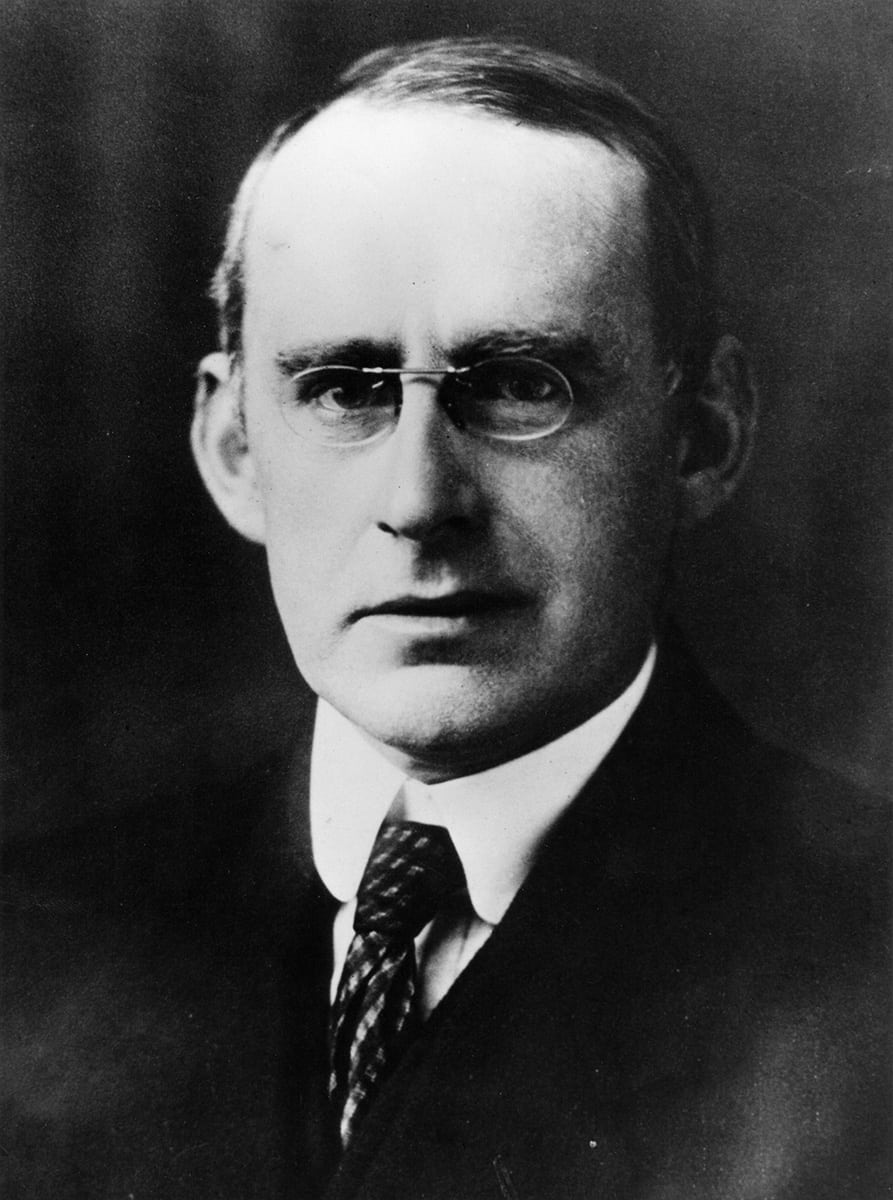
Great thinker: Eddington was a pacifist and Quaker who sought to heal the wounds between Britain and Germany after the First World War. (Courtesy: AIP Emilio Segrè Visual Archives)
Arthur Stanley Eddington was born on 28 December 1882 in Kendal, England, to the family of a Quaker schoolmaster. After moving to the seaside resort of Weston-super-Mare, he was educated at home and in several small schools in the town. His talent for mathematics was quickly evident, and he won many contests and prizes, including a scholarship to Owens College, Manchester, at the age of 16. There he studied physics and mathematics with two of the great figures of Victorian science – Arthur Schuster and Horace Lamb – from whom he gained the scientific skills that would serve him throughout his life.
While in Manchester, Eddington also studied with the great Quaker leaders of the day, from whom he absorbed the religion’s values of pacifism, internationalism, mysticism, pragmatism and tolerance. All his mentors saw great potential in Eddington, and encouraged him to pursue further schooling at Cambridge, where he could be closer to cutting-edge research and have a better opportunity to build a career in science. Thanks to a scholarship in natural sciences, Eddington entered Trinity College, Cambridge, in 1902.
Very few Quakers had attended either Oxford or Cambridge by this time, and Eddington became something of a hero back home. At Trinity he was coached by the famous mathematician R A Herman, and became the first ever second-year student to become a “senior wrangler” by coming top of the mathematics tripos. He graduated in 1905, and was quickly sought out by William Christie, who was then Astronomer Royal, to be chief assistant at the Royal Observatory at Greenwich. It was traditional for outstanding Cambridge maths students to be given this job at the start of their careers, and Eddington was encouraged to pursue his own research projects in addition to observations, calculations and the occasional journey to determine the longitude of far-flung outposts of the British Empire.
Eddington undertook theoretical investigations in the increasingly important field of statistical cosmology, which had been pioneered by the Dutch astronomer Jacobus Kapteyn. The aim was to infer the dynamical structure of the Milky Way from a mathematical analysis of the movement of stars. Eddington’s work won him wide acclaim in the astronomical community, and helped shed light on the mysterious phenomenon of “star streaming”, in which nearby stars seem to move in two preferential directions. The phenomenon was explained later in terms of the different ages and motions of stars within spiral galaxies.
In 1913, aged 30, Eddington’s achievements in statistical cosmology put him at the top of the list to fill the vacant Plumian Professorship at Cambridge, which included the directorship of the Cambridge Observatory. Eddington, who never married, quickly moved himself, his sister and his mother into the rooms attached to the observatory. He was to remain Plumian Professor until his death over 30 years later.
Seeing inside a star
Eddington’s greatest achievements concerned a problem that had bedevilled scientists for centuries: what are stars? At the beginning of the 19th century, the philosopher August Comte famously declared that a description of the interiors of stars was the very definition of unattainable knowledge. Despite some successes using spectroscopy, many astronomers at the turn of the 20th century were forced reluctantly to agree with him.
Eddington’s greatest achievements concerned a problem that had bedevilled scientists for centuries: what are stars?
The spectroscope had revealed that stars are made of roughly the same familiar elements that exist on Earth, but almost everything else was unknown. Were they liquid or gas? What made them shine? Where did their energy come from? In 1916 Eddington began tackling these problems with the aim of developing equations that would describe the conditions inside a star. With such a model in hand, he could plausibly say that he understood how stars worked. He was certainly not the first to have this idea, and made full use of the results of predecessors such as J H Lane, Robert Emden and Karl Schwarzschild.
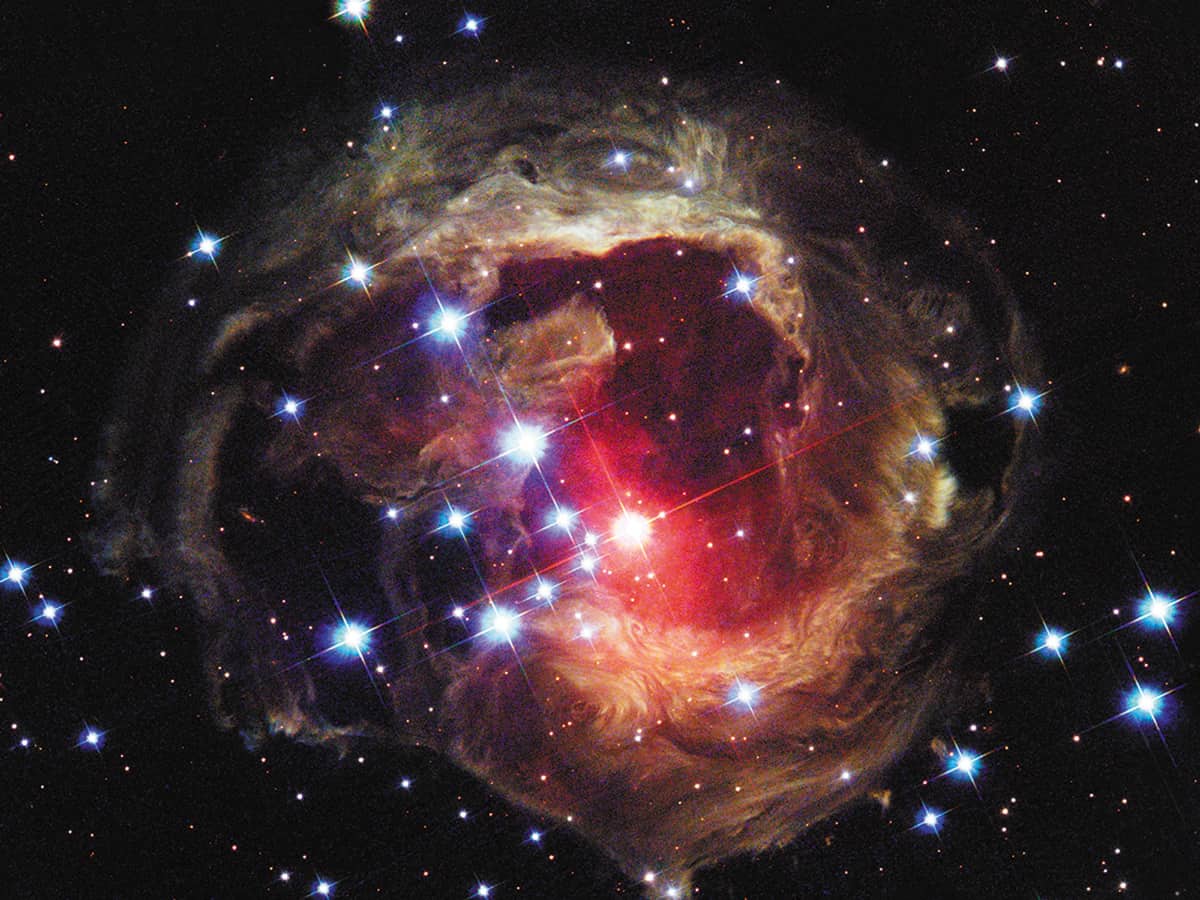
Universal insight: using a series of shrewd assumptions, Arthur Eddington devised an approximate mathematical model of stars that reproduced many of their chief characteristics, including their size and temperature. (Courtesy: NASA)
One of the perils of this project was that quantum mechanics was still in its infancy, which meant that a complete description of stellar interiors was impossible. This incompleteness led many physicists, such as James Jeans, to simply discard the problem as unworkable. Eddington, however, decided to press ahead and see what he could learn. To get round the problem of not knowing key facts, such as how stars generate their energy, he made a series of shrewd assumptions and approximations that allowed him to proceed as though he did know them. Although Jeans declared this approach to be unscientific, Eddington argued that if he found results that were consistent with observations, he would have learned something about which approximations were valid. The reach of astrophysics would thus have been extended.
Rather to his own surprise, Eddington found that his approximate model did reproduce many of the known characteristics of stars, including their size and temperature. Most dramatically, his model predicted a tight mathematical relationship between the masses and luminosities of stars. This calculation was based on the naïve assumption that stars obey the perfect-gas law, which is the simplest physical behaviour possible for a body of gas.
Eddington had hoped that any differences between his predictions and observations would indicate how stellar behaviour departed from the perfect gas law. However, his predictions seemed to apply to virtually all the stars then known – a dramatic success for a theory built on such tentative grounds. His complete theory allowed the temperature, density and pressure to be calculated at all points inside a star, and Eddington argued that it was so useful for further astrophysical investigation that it should be retained.
Eddington’s contemporaries were amazed at what he had accomplished, and marvelled at his physical intuition about which assumptions were useful and which were problematic. When criticized as a sloppy thinker, he would always respond that his theories were not meant to be complete, but were instead tools to allow further scientific investigation. His goal was not finality, but further exploration.
Critical comments
In the process of developing his stellar models, Eddington sought to overturn the then-current thinking about the sources of stellar energy. Jeans and others defended the model that had been developed by Lord Kelvin and Hermann von Helmholtz, in which a star’s heat and light come from the energy liberated as it contracts under gravity. This was the only energy source that seemed possible based on classical mechanics. Eddington, however, speculated broadly about the qualitative and quantitative consequences of phenomena that were then purely hypothetical, such as nuclear fusion and proton–electron annihilation.
When critics objected that the core of a star could not be hot enough to allow fusion to occur, Eddington told them to “go and find a hotter place”.
While admitting that his theories relied on unknown – and perhaps unknowable – facts about the interiors of stars, Eddington argued that simple pragmatism could help determine when speculation would be useful. He famously combined powerful common-sense reasoning with a rapier wit: when critics objected that the core of a star could not be hot enough to allow fusion to occur, he told them to “go and find a hotter place”. His models provided the foundation for the later investigations of Hans Bethe, Fred Hoyle and others, who finally grasped the details of stellar fusion.
Despite disagreements, Eddington’s models were eventually accepted as a powerful tool for further investigation, particularly concerning stellar evolution. When his predictions of the diameters of giant stars were confirmed by Albert Michelson in 1920, astronomers became convinced of Eddington’s intuitive, exploratory style. Fundamentally, this methodology allowed him to circumvent the poorly understood nuclear processes that were at work inside stars, while Jeans and others remained hamstrung by their attachment to classical physics. Eddington gave a full description of his theory in his 1926 book The Internal Constitution of the Stars, which became essential reading for an entire generation of astrophysicists.
Eddington’s subsequent work on astrophysics centred again on the structure of stars, which prompted further clashes with physicists like Jeans and E A Milne. He particularly wanted to extend his models to include new insights from quantum mechanics, notably “quantum degeneracy”, which governs the behaviour of particles in very dense materials. This work led to Eddington’s famous dispute in the early 1930s with the young Indian physicist Subrahmanyan Chandrasekhar, who was then a research student at Cambridge.
Eddington rejected Chandrasekhar’s conclusion that quantum degeneracy could limit the mass of stars, and Chandrasekhar’s description of this incident portrays Eddington as a rather cruel and dogmatic figure. But it was somewhat unfair to Eddington, whose students and colleagues remembered him as encouraging, welcoming and genial. He was, however, famously vigorous in intellectual debate, which Chandrasekhar may have mistaken for personal animosity. Eddington’s criticism seems to have been based on a suspicion that a purely mathematical derivation from quantum theory was not enough to explain the daunting physical paradoxes that were apparently part of degenerate stars. However, subsequent work upheld Chandrasekhar’s approach, for which he shared the 1983 Nobel Prize for Physics.
Eddington: in his own words
I believe there are 15 747 724 136 275 002 577 605 653 961 181 555 468 044 717 914 527 116 709 366 231 425 076 185 631 031 296 protons in the universe and the same number of electrons.
An electron is no more (and no less) hypothetical than a star.
We cannot pretend to offer proofs. Proof is an idol before whom the pure mathematician tortures himself. In physics we are generally content to sacrifice before the lesser shrine of Plausibility.
Life would be stunted and narrow if we could feel no significance in the world around us beyond that which can be weighed and measured with the tools of the physicist or described by the metrical symbols of the mathematician.
I could no more ram religious conviction into an atheist than I could ram a joke into [a] Scotchman.
If an army of monkeys were strumming on typewriters, they might write all the books in the British Museum.
There are no purely observational facts about heavenly bodies.
We do not argue with the critic who urges that the stars are not hot enough for this process; we tell him to go and find a hotter place.
Something unknown is doing we don’t know what.
Oh leave the Wise our measures to collate. One thing at least is certain, light has weight. One thing is certain and the rest debate. Light rays, when near the Sun, do not go straight.
Relativity and war
When Eddington began his pioneering investigations into stellar physics in 1916, Europe was being shaken by the horrors of the First World War. No scientist – not even Eddington – could escape its impact. As war raged, he became embroiled in a highly political controversy within the British astronomical and scientific communities. Many astronomers, notably H H Turner at Oxford, argued that scientific relations with Germany and Austria should be permanently ended due to their conduct in the war. Eddington, a Quaker pacifist, struggled to keep wartime bitterness out of astronomy.
He argued that the lines of longitude and latitude pay no heed to national boundaries and pointed out that science is a quest for truth that cannot be held back by crude matters of politics. He also reminded his colleagues that they knew many German scientists personally, and that it was absurd to claim that those friends were suddenly untrustworthy barbarians. Unfortunately, he was virtually alone among British scientists in advocating internationalism, and was the only astronomer to correspond with colleagues in enemy and even neutral countries throughout the war.
Eddington’s pacifism caused him severe difficulties, especially when he was called up for conscription in 1918. He claimed “conscientious objector” status based on his Quaker pacifism – a position that was recognized by the law, if somewhat despised by the public. However, Eddington’s conscription had already been deferred once before owing to the importance of his astronomical work, and the authorities refused to issue a second deferment based this time on religion. Only the timely intervention of the Astronomer Royal Frank Dyson and other high-profile figures kept Eddington out of prison.
Einstein and the eclipse
It was because of his determined efforts to maintain international scientific ties that Eddington was the only British scientist to receive news in 1916, via the Dutch physicist Willem de Sitter, of a new theory of gravity that was being developed in Berlin by a talented young physicist called Albert Einstein. The new theory was general relativity, which would eventually overhaul our conceptions of space, time, energy and matter. Eddington was fortunate in being one of a handful of astronomers with the mathematical skills to understand general relativity, and one of the few who would have been interested in pursuing a theory developed by a German physicist.
Eddington was excited by the scientific significance of general relativity, but, even better, Einstein was a pacifist.
Eddington was excited by the scientific significance of general relativity, but, even better, Einstein was a pacifist. Making the theory known would thus not only do a great service for physics, but also refute the racist stereotype of barbaric Prussians that was fuelling support for the war. Thus the values of internationalism would do double duty. They would help science by restoring the borderless quest for truth, and sooth the hatred that had emerged between nations. Eddington quickly became the chief supporter and expositor of relativity in Britain.
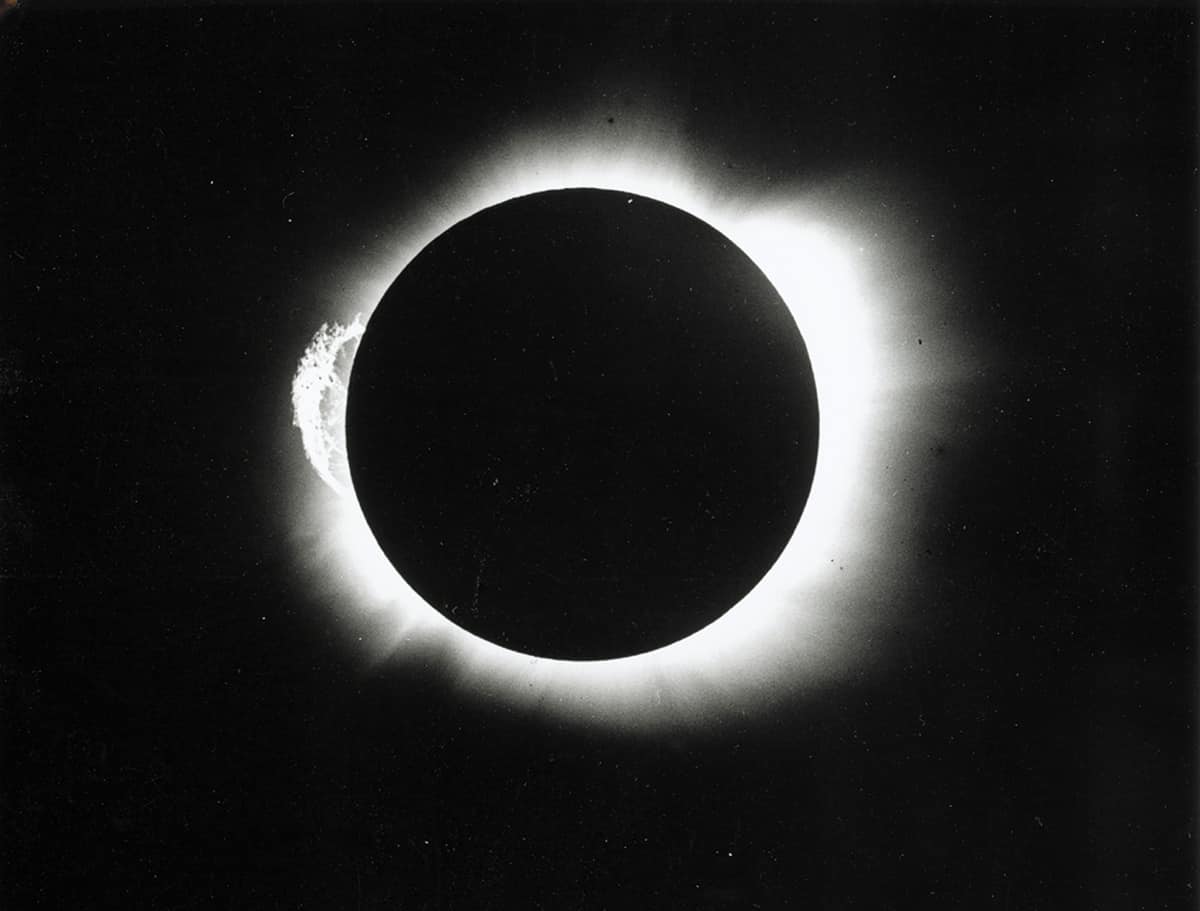
Star maker: Eddington’s expedition to study the 1919 solar eclipse confirmed that matter can bend light and propelled Einstein to fame. (Courtesy: Royal Astronomical Society Library)
German science was far from welcome in Britain, however, and Eddington faced an uphill battle in spreading news about Einstein and relativity. At the time, the theory remained highly speculative, and required a definitive test: would light passing by the Sun be deflected, as Einstein predicted? Unfortunately, this test could only be carried out during a solar eclipse, since stars close enough to the Sun to show a measurable deflection would otherwise be swamped by the solar glare. In a stroke of great luck, the next eclipse was due to appear in May 1919 – just months after the end of the war.
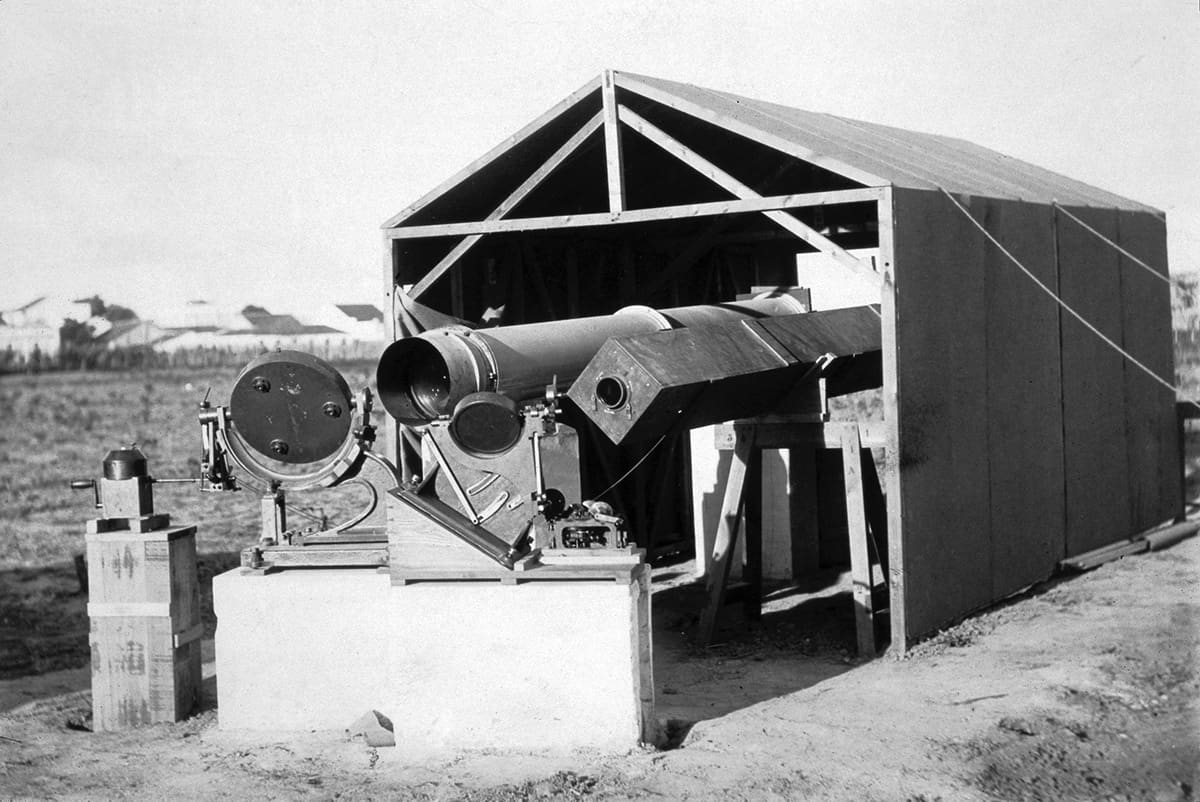
The eclipse would only be visible in Brazil and West Africa, and Eddington’s tireless efforts to organize and actually carry out the observation have become legendary in the history of science. The expedition was ultimately successful in observing the gravitational deflection and confirming relativity. Einstein was launched to worldwide stardom by the expedition’s results and by Eddington’s avalanche of lectures, books and articles popularizing both the theory and its German originator (see Physics World January 2005 pp25–26).
It is sometimes suggested that Eddington’s internationalism led him to “fudge” the data from the expedition to ensure a positive result for Einstein. There is, however, no reason to think this was the case. Usually those proposing this myth claim that Eddington threw out results that were unfavourable to Einstein, but the analysis of the data from the eclipse expedition involved many other people beside Eddington. Moreover, copies of the photographic plates were distributed to astronomers around the world for them to analyse. No contemporary accused Eddington of altering the results – this is purely a modern myth based on a poor understanding of the optical techniques in use at the time. The influence of Eddington’s pacifism is to be found in his championing of the expedition as a scientific goal and his popularization of Einstein as a major scientific figure, not in manipulated data.
In the English-speaking world, Eddington’s expositions of relativity were so famous that his name was associated with the theory as often as that of Einstein. His name even appeared in one of Dorothy Sayers’ contemporary murder-mystery novels. An important part of Eddington’s popularity was his idiosyncratic wit (see box on page 35). According to one well-known anecdote, he was approached at a scientific gathering by a self-styled expert on relativity. “Eddington,” the party-goer commented, “they say only three people in the world understand relativity. What do you think?” (The speaker was, of course, referring to Einstein, Eddington and himself.) Eddington demurred, whereupon the “expert” pressed on: “Oh, don’t be modest Eddington!” To which Eddington replied, “Not at all, I’m just trying to think who the third might be.”
Confirming relativity: the equipment that was used by Eddington’s team of astronomers to study the 1919 eclipse. (Courtesy: Science Museum)
As one of the world experts in both relativity and astrophysics, naturally Eddington was involved in the development of the first generation of general-relativistic cosmological models. In 1927 he learned of a paper written by the Belgian astronomer-priest Georges Lemâitre that postulated an expanding universe. When he later became aware of Edwin Hubble’s work on the recession of the spiral nebulae, Eddington quickly became an enthusiastic supporter of an expanding-universe cosmology, pointing to the nebular recession as evidence of a curved space–time. However, he never accepted the argument that an expanding universe required a beginning and rejected what would later be known as the Big Bang as “too aesthetically abrupt”.
Eddington instead favoured a cosmology in which primordial material began at rest, was then nudged out of equilibrium by processes such as star formation, and then began to expand under the influence of Einstein’s proposed cosmological constant. Although the constant was abandoned by almost all cosmologists after the expanding-universe model was accepted, Eddington focused his attention on it even more closely. He saw it as one of the keys to understanding the relationship between relativity and quantum mechanics, and his insistence on its significance increasingly left him behind the cutting edge of cosmology.
Uniting science and religion
During the 1920s and 1930s Eddington became one of the best known spokesmen for science. He gave innumerable lectures, interviews and radio broadcasts on relativity and, later, on quantum mechanics. His books, including Nature of the Physical World and New Pathways in Science, were immensely popular with the public, not only because of his clear exposition, but also for his willingness to discuss the philosophical and religious implications of the new physics. Eddington’s clear and entertaining description of the content, method and meaning of science helped to inspire a generation of readers, including Fred Hoyle, Ralph Alpher and Thomas Gold, to become scientists themselves.
Among his most provocative claims was that there was no conflict between science and religion – and even that relativity and quantum mechanics supported a religious outlook. According to Eddington, these theories accepted that science could only address those parts of the universe that were quantifiable. Thus, he concluded, those elements of human experience that could not be described by mathematics, such as religion, aesthetics and love, were by definition outside science. Religious experience was therefore no less real than physical experience, and it should be judged solely on an individual’s mystical outlook rather than any kind of scientific analysis. Based on this philosophy, Eddington completely rejected any claims to prove or disprove religion via science. Rather, religion and science were different realms of experience that could neither validate nor support each other.
Eddington argued that science and religion shared a motivation and a method – they are both continual searches for knowledge
Eddington also argued that science and religion shared a motivation and a method. In particular, he argued, they are both continual searches for knowledge: the former in the spiritual world; and the latter in the physical world. Adopting an idea from his Quaker faith, he called this “seeking” – describing an outlook on knowledge that was not concerned with final truth and certainty, but rather emphasized the importance of the process of exploration itself. Searching, not finding, was the basis of both religion and science. He described them as coming from the most basic elements of what it meant to be human, and their shared reliance on seeking meant that what made a good scientist also made a good mystic (and vice versa).
These twin pillars of support for mysticism and human values from a major scientific figure were tremendously popular, and Eddington’s writings were devoured by young and old alike. He was knighted and received the Order of Merit, and was a household name by the end of his prolific career in the 1930s. He also became active in trying to refute Marxist claims to scientific legitimacy and spent several years as head of the National Peace Council, which worked for, among other things, British withdrawal from India.
Towards a final theory
As the 1930s progressed, Eddington spent increasingly less time on astrophysics and instead focused his energies on attempts at unifying quantum mechanics and general relativity. He saw these theories as fundamentally “epistemological” in character, meaning that they provided insight into how we see the world, rather than what the world is. After all, Einstein had began his investigations into relativity questioning how we measure categories like space and time, while Heisenberg had formed his uncertainty principle by asking precisely how we measure position and velocity.
Eddington therefore sought to extend these approaches by developing a complex mathematical formalism that would describe the methods by which humans could measure anything about the physical world. He hoped that he would be able to derive all the laws of physics from this scheme, without recourse to experimentation. This was widely condemned by many of his contemporaries as neo-Aristotelianism and number mysticism, and very few other scientists took up his formalism. On 22 November 1944 Eddington died suddenly of stomach cancer before he had completed this work, and his book Fundamental Theory was only published after his death.
Eddington’s legacy is complex. When his name appears in physics textbooks or popular histories, it is usually in reference to the 1919 eclipse expedition – often including unfair suggestions of fraud.
Eddington’s legacy is complex. When his name appears in physics textbooks or popular histories, it is usually in reference to the 1919 eclipse expedition – often including unfair suggestions of fraud. The collective memory of the physics community seems to remember him chiefly for his spectacularly failed attempts to unify relativity and quantum mechanics, and his controversies with Chandrasekhar; he is often invoked as a warning against dogmatic confidence in one’s own theories.
Astronomers and astrophysicists, however, remember him differently. They recall his pioneering work on the physics and constitution of stars, which was a crucial foundation for the progress of their disciplines in the 20th century. In an important sense, Eddington’s theoretical modelling of stellar processes showed that modern astrophysics was a feasible field of scientific inquiry. He left behind no school of students, but his techniques became fundamental to astronomy as we know it today.
As a figure who moved smoothly between different realms – physics and astronomy, science and religion, politics and pacifism – Eddington never left a definitive footprint in any one area. But as the figure who made Einstein famous, who took us inside stars and who inspired a generation of scientists, his contributions to modern science have been far-reaching. He was as reassuring to laypeople worried about the encroachment of science into their everyday lives as he was provocative to colleagues unwilling to try new approaches. His goal was not just to understand the universe, but to understand how we can better go about the practice of science. For him, profundity lay not just in the results: it was in how we approached the questions.
At a Glance: Arthur Eddington
Born in 1882, Arthur Eddington was one of the world’s leading astrophysicists
He developed a successful mathematical model of stars that was based on shrewd assumptions, rather than detailed physical knowledge
Eddington shot to fame when his expedition to study the 1919 solar eclipse confirmed Einstein’s general theory of relativity
In the 1920s and 1930s he became a respected popularizer of science
A practising Quaker, Eddington saw much in common between science and religion
His later years were spent on an ultimately unsuccessful attempt to unify relativity and quantum mechanics
More about: Arthur Eddington
A V Douglas 1956 The Life of Arthur Stanley Eddington (London, Nelson)
A S Eddington 1920 Space, Time, and Gravitation (Cambridge University Press)
A S Eddington 1928 Nature of the Physical World (Cambridge University Press)
M Stanley 2003 An expedition to heal the wounds of war: the 1919 eclipse expedition and Eddington as Quaker adventurer Isis94 57–89
“There are few things more boring”, the editor of The Economist wrote in 2001, “than long articles by editors about how their redesigns are going to produce a sharper, more modern, publication, brightening readers’ lives and furthering world peace.” Although he has a point, it is still appropriate to outline the thinking behind the new design that is being introduced in Physics World this month.
The main change is that there will be fewer words per page plus bigger and better photographs, diagrams and illustrations. Many pages will now have an “active column” – a narrow band of white space that will introduce more variety into the visual appearance of the magazine and, in theory, make individual pages and articles look more inviting. There have also been subtle changes to the logo, which is now all in lower case, Dutch has replaced Baskerville as the main typeface, and a new colour scheme has been introduced.
There are other changes too. The Physics in Action section has been dropped to allow both the Post-deadline section (now renamed Frontiers) and the Features section to become larger. The Einstein 2005 page has also been moved to the front of the magazine and will be replaced there by a new one-page section in January.
Readers might ask if features articles will become shorter (i.e. have fewer words) to allow for these changes. The answer is no: there is no set length for features in Physics World and articles are edited to the length appropriate for that topic. Some features might be just two pages long, while others will run to six pages or more. The aim is always to ensure that a topic is covered in enough detail to give the reader a real insight into the state of progress in a given field, but written at a level that can be understood by someone who is not familiar with the subject matter and, crucially, edited in a way that maintains the interest of the reader all the way to the end of the article. As before, we believe that the best way to do this is to include as little mathematics and jargon as possible.
Our reader surveys confirm that you already appreciate the content and appearance of the magazine. The overall aim of the new design is to make the magazine an even better read than before.
High-mass stars — those that are more than eight times the mass of the Sun — are relatively rare, but are important because they create heavy elements (beyond carbon) through the process of nucleosynthesis. However, they are not as well understood as smaller stars. Moreover, they are difficult to observe because they are generally much further away than lower-mass stars, being typically 7000 light years from Earth. Two exceptions are the Orion constellation (1500 light years away) and Cepheus-A — a breeding ground for young, high-mass stars that is about 2400 light years from Earth
There are currently two rival theories for how massive stars form. The first — accretion — is a “scaled-up” version of what happens when small stars form and involves the gravitational collapse of a dense cloud of gas and dust. The second occurs when lower mass stars within crowed star-forming regions collide and merge. Some astronomers have been reluctant to believe in the accretion scenario because the intense pressure of radiation created by larger stars should stop the influx of new material, therefore putting an upper limit on a star created this way. Another argument in favour of merger is the fact that young high-mass stars are often found in very dense clusters of stars.
Using the eight radio telescopes that form the Submillimeter Array in Hawaii, Nimesh Patel of the Harvard Smithsonian Center for Astrophysics in the US and colleagues have observed a high-mass protostar (called HW2) in the Cepheus-A region that is about 15 times the mass of the Sun (Nature437 109). They discovered a rotating disk of dust and gas, which itself is quite massive — about one to eight times the mass of the Sun — at far-infrared wavelengths of 0.9-mm.
“These observations provide direct evidence favouring the accretion model for the formation of massive stars, at least those up to 15 solar masses,” says Patel. “Observing at submillimeter wavelengths — a relatively unexplored region of the electromagnetic spectrum — was crucial for this discovery.” These observations are currently only possible with the newly commissioned Submillimeter Array.
Meanwhile, a team led by Zhibo Jiang of the Purple Mountain Observatory in Nanjing, China, has discovered a similar disk structure around the Becklin-Neugebauer object — a star that is seven times more massive than the Sun (Nature437 112). This team used high-resolution near-infrared imaging polarimetry to obtain its results. “Our work suggests that stars up to seven solar masses can be formed though gravitational collapse and subsequent mass accretion,” says Jiang.
Both teams now plan to make further observations to see if stars that are more massive can also be formed this way.
Superconductivity is the complete absence of electrical resistance and is observed in certain materials when they are cooled below a superconducting transition temperature (Tc). Physicists agree that superconductivity relies on getting electrons to overcome their mutual Coulomb repulsion and form “Cooper pairs”. In the Bardeen-Cooper-Schrieffer (BCS) theory of low-temperature superconductivity, the electrons are held together because of their interactions with phonons – lattice vibrations in the material.
CaC6 is an example of a “graphite intercalated compound” – a class of electronic material in which foreign (or guest) atoms, such as calcium, sodium and potassium, are inserted into graphite. These materials consist of two-dimensional layers of graphite with layers of guest atoms in between. Graphite is a semi-metal, which means that electrons accepted or donated by the foreign atoms modify the properties of the graphite, making the final material metallic.
The first superconducting graphite-doped compound – potassium carbide (KC8) – was discovered 40 years ago and had a Tc of just 0.14 Kelvin. Earlier this year, researchers at UCL and Cambridge showed that ytterbium carbide (YbC6) also becomes superconducting at 6.5 Kelvin and obtained evidence that CaC6 superconducts at a temperature of 11.5 Kelvin, which is the highest Tc observed in a graphite intercalated compound so far (cond-mat/0503570). However, in that experiment the CaC6 formed in micron-thick layers on the surfaces and edges of the graphite host. Emery and co-workers have now developed a new method to make high quality bulk samples of CaC6. This development has resulted in sharpening of the superconducting transition.
The technique involves heating pyrolytic graphite with a molten lithium-calcium alloy at 350°C under an atmosphere of argon for 10 days (Phys. Rev. Lett.95 087003; also available as cond-mat/0506093). Using X-ray diffraction, the physicists showed that CaC6 is the only member of the MC6 family (where M is a metal atom) to have rhombohedral symmetry — the others are hexagonal. They also found a sharp drop in the magnetisation of the material below 11.5 Kelvin.
According to calculations by Matteo Calandra and Francesco Mauri from the University of Paris 6, who collaborated with Emery’s team, superconductivity in CaC6 is due to an electron-phonon mechanism (cond-mat/0506082). The charge carriers in the material are mostly electrons in the “Fermi surface” of calcium that couple to vibrations of the carbon atoms moving perpendicular to the graphite layers and calcium atoms moving parellel to the layers. Furthermore, the results suggest that this could be a general mechanism for all graphite intercalation compounds.
In an earlier theoretical paper Gabor Csányi and co-workers at Cambridge wrote that they had found “a striking correlation” between superconductivity in YbC6, CaC6 and similar materials and the occupation by doped electrons of an interlayer energy band that lies between the graphite sheets (cond-mat/0503569). Csányi and co-workers conclude that this “suggests the possibility of a pairing mechanism linked not to lattice but to soft charge fluctuations”.
The Silent Spring by Rachel Carson. An account of the effects of the overuse of DDT, this is a classic story of an unfolding environmental disaster. It was recommended by my chemistry teacher, who hardly seemed the activist type, so I was surprised to discover that a book dealing with a scientific subject could be both moving and compelling.
Brighter than a Thousand Suns by Robert Jungk. This was the first popular-science book on a physics topic to have an impact on me. Somehow my father had got hold of a copy. Recounting the story of the development of the atomic bomb, it conveyed the excitement of the birth of quantum physics in Europe. It also dealt with the tragedy of Hiroshima as well as Oppenheimer’s trial. I found it stimulating and thought provoking, and it helped to sway me from maths towards physics.
The Quest for Absolute Zero by Kurt Mendelsohn. I read this as a student, when it proved an antidote to the dryness of physics textbooks. By one of the experts in the field, it tells a fascinating detective story, blending history and real physics. It treats the reader with respect and so does not shy away from a few equations and graphs where they help to clarify the text.
What science books are you currently reading?
None. The last one I read was Fermat’s Last Theorem by Simon Singh; the next will be The Millennium Problems by Keith Devlin.
What else are you reading?
Baudolino by Umberto Eco. This is an entertaining reflection of Europe in the Middle Ages, seen through the eyes of a fictional adventurer, Baudolino, attached to the court of Frederick the Great. Less intense than Eco’s The Name of the Rose, it reflects the author’s intellectual breadth. It also refers to the scientific ideas that held sway at the time, although that is not why I chose it.
Which popular-science book have you never read, but feel you ought to have tackled?
A Brief History of Time by Stephen Hawking. I have never read it because of all the “hype” that has surrounded it. I have a copy that I bought in a charity shop with the intention of one day gaining a more informed opinion.
The hardness of a material is measured by its isothermal bulk modulus. Aggregated diamond nanorods have a modulus of 491 gigapascals (GPa), compared with 442 GPa for conventional diamond. Dubrovinskaia and two of her co-workers – Leonid Dubrovinky and Falko Langenhorst – have patented the process used to make the new material.
Diamond derives its hardness from the fact that each carbon atom is connected to four other atoms by strong covalent bonds. The new material is different in that it is made of tiny interlocking diamond rods. Each rod is a crystal that has a diameter of between 5 and 20 nanometres and a length of about 1 micron.
The group created the ADNRs by compressing the carbon-60 molecules to 20 GPa, which is nearly 200,000 times atmospheric pressure, while simultaneously heating to 2500 Kelvin. “The synthesis was possible due to a unique 5000-tonne multianvil press at Bayerisches Geoinstitut in Bayreuth that is capable of reaching pressures of 25 GPa and temperatures of 2700 K at the same time,” Dubrovinskaia told PhysicsWeb.
The Bayreuth team measured the properties of the samples with a diamond anvil cell at the European Synchrotron Radiation Facility at Grenoble in France. These measurements indicated that ADNRs are about 0.3% denser than diamond, and that the new material has the lowest compressibility of any known material.
In addition to working out why the new material is so hard, the Bayreuth team also hope to exploit its industrial potential. “We have developed a concept for innovative technology to produce the novel material in industrial-scale quantities and now we are looking for partners in order to realize our ideas,” said Dubrovinskaia.