Science and the EU

The fact that the EU spends about 40% of its budget on agriculture – a sector that only employs about 5% of its workers – is plainly crazy. The fact that India produces more science graduates than Europe should also be a cause for concern. The arguments for shifting resources from agriculture into science and innovation seem so self-evident that it is surprising that no-one kicked up a fuss about this a long time ago.

The UK, which is advancing this line of reasoning, has already indicated that it is willing to renegotiate its notorious rebate – which is currently worth about €5bn per year – as part of a wider package of budget reforms. France and other countries that benefit excessively from the common agricultural policy need to make a similar gesture. Germany is more likely to make such a concession if Angela Merkel, the physicist who heads the Christian Democrat party, replaces Gerhard Schröder as Chancellor later this year. No-one expects change to happen overnight, but planning for change needs to start now.

Similarly, no-one is saying that the Framework programmes are perfect and that they do not need to be reformed as well. Indeed, it should be embarrassing for the EU’s research directorate that, just as discussions about the Seventh Framework start in earnest, there are still complaints about the rules changing and about the increase in bureaucracy.

There are signs that things are moving in the right direction with plans for the ERC. This body will fund individual teams, who will be selected on the basis of scientific excellence through peer review in what the EU promises will be an “essentially bottom-up approach”. However, scientists should wait for the details – including the names of the 20 members of the governing council, which are due to be announced about now – before uncorking the virtual champagne. The real stuff will have to wait until Europe’s leaders finally come to their budgetary senses.

Shelf life: Paul Davies


What are the three best popular science books?

Frontiers of Astronomy by Fred Hoyle. At a time when there was very little popular-science writing, this was a classic, a model of clarity delivered in an engaging, exciting style.

Godel, Escher, Bach: An Eternal Golden Braid by Douglas Hofstadter. This book established a new genre of popular-science writing, replacing the methodical, didactic style of most texts with a swirl of startling ideas, interweaving diverse topics in a thoroughly mind-stretching way.

Consciousness Explained by Daniel Dennett. It wasn’t of course, but what a great read! Dennett is so lucid and thought-provoking, and organizes notoriously tricky concepts in a highly digestible form.

As the previous choice isn’t really a physics book, I would also like to nominate Theories of Everything by John Barrow. All of Barrow’s books are so thoroughly scholarly, yet such a joy to read. His prose is the most elegant of any physics writer I know.

What science books are you currently reading?

Time by Stephen Baxter. Although a work of fiction, it is as good an exposition of recent topics in multiverse cosmology and anthropic reasoning of any I have seen.

What else are you reading?

I have just finished Simon Mitton’s excellent biography of Fred Hoyle, entitled Conflict in the Universe. On the fiction front, I knocked off Michael Crichton’s Prey on the flight to a physics conference in Vancouver, and was able to use his definition of emergent systems in a lecture I gave at the conference!

Which popular-science book have you never read, but feel you ought to have tackled?

I have never read James Watson’s The Double Helix. Somehow it passed me by. I know it is a classic science-as-detective-story book, and discusses one of the great discoveries of the 20th century, but my interest in biology came too late and I had already seen the BBC TV dramatization of the topic, so I don’t now feel any compelling need to go back and read the book. But this is like failing to read Hamlet because you’ve seen the movie.

• A review of Conflict in the Universe will be published in a forthcoming issue of Physics World

Exotic meson challenges rules

If we had to name a modern-day Mendeleev, his name would surely be Murray Gell-Mann. In the 1960s, faced with a bewildering array of particles called hadrons that had been turning up in high-energy experiments around the world, Gell-Mann proposed that the particles were combinations of a few fundamental entities called quarks. This idea brought order into the hadronic chaos, a feat for which Gell-Man was awarded the 1969 Nobel Prize for Physics.

Ever since the quark model was introduced, physicists have wanted to find out how the six different types of quarks – up (u), down (d), strange (s), charm (c), bottom (b) and top (t) – combine to form the hadrons we observe. The simple hadronic structures that we see are easy to define: mesons such as pions and kaons consist of a quark and an antiquark pair, while baryons such as protons and neutrons are made up of three quarks or three antiquarks.

But the theory that describes quarks, quantum chromodynamics (QCD), also permits particles containing four or more quarks. Indeed, a meson can be more generally defined as a hadron that has an integer value of intrinsic angular momentum in quantum units, while baryons have half-integer multiples of spin. Discovering such exotic hadrons, particularly mesons with more than the minimal quark-antiquark structure, would therefore provide crucial information for our understanding of the strong force. In fact, physicists thought they had glimpsed a five-quark state called a “pentaquark” in 2003. Sadly this excitement looks as if it was misplaced, since the latest results from dedicated experimental searches suggest that pentaquarks are a purely statistical phenomenon (see Physics World May p7: print edition only).

Charming discoveries

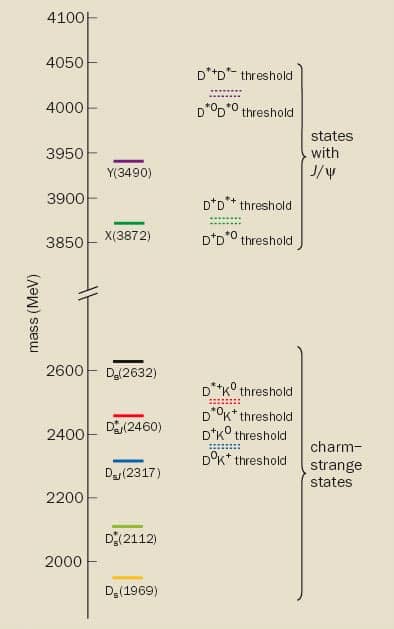
There have been some hints that nature might be hiding four-quark states under the guise of ordinary mesons, but until recently no compelling evidence for such particles had emerged. That situation changed dramatically two years ago when the BaBar experiment at the Stanford Linear Accelerator Center in the US reported an unusually long-lived excited meson called the DsJ(2317), where the number in brackets is the mass of the particle in MeV (see Physics World June 2003 p3: print edition only). Like atoms, mesons and baryons can exist in ground states and excited states, each of which can have different masses.

The DsJ particle consists of a charm quark – which makes it a type of D-meson – along with a strange antiquark (sbar), and revealed its presence via the way it decayed into lighter particles. These decays are analogous to Mendel’s rules of genetics: a parent carries a variety of attributes that show up differently in its offspring. A particle, on the other hand, can decay into a number of final states, which means that its properties – which are usually described in terms of quantum numbers such as spin and charge – can be inferred from its decay products.

The BaBar team found that the DsJ decayed into a ground state Ds-meson and a neutral π-meson. While this is a common decay mode for D-mesons, in the case of the DsJ the process took an extraordinarily long time because this particular decay does not conserve a quantity known as isotopic spin. What was also surprising about the new meson was that its mass was much lower than theory predicted – so low, in fact, that it could not decay into its preferred daughter products (a D0 and K+ meson) because the combined mass of these two particles is greater than that of the DsJ.

Within weeks, the CLEO experiment at Cornell had confirmed the BaBar discovery, and had also found a heavier partner called the DsJ(2460) that violated the same quantum rules when it decayed. Careful studies showed that both new mesons had the quantum numbers expected for the excited states of a cs-meson, but masses much lower than predicted. One explanation was that these particles might be four-quark states.

Now another unexpected meson called the Y(3940) has turned up, this time at the Belle detector at the KEK laboratory in Japan. The exciting feature of this new particle is that even though its mass is heavier than a D-meson and an excited D-meson (D*), it does not decay into these particles. Instead, in a sample of more than half a billion events the Belle researchers detected 100 examples in which it had decayed into a J / ψ-meson (ccbar) plus an ω-meson (ud).

The decay rate of the Y(3940) was found to be normal for a state of this mass, which tells us that its decay is not inhibited by any quantum selection rules. And the combination of its large mass and the appearance of a J / ψ-meson as a decay product strongly indicates that the Y-meson contains at least a ccw combination. The burning issue now is whether or not any additional quarks are needed to describe it.

The J / ψ and the ω are both spin-1 particles, which suggests that the Y(3940) is spin 0 (which is possible because spins add as vectors). However, if it is, then there must be some angular-momentum barrier that inhibits the decay into a D (spin 0) and a D* (spin 1). In other words, the Y-meson could simply be an excited ccbar state analogous to the excited states of the hydrogen atom.

But this idea flies in the face of three decades of research into the ccbar or “charmonium” system, which has well understood quantum numbers and decay modes. The Y(3940) just does not fit, and appears instead to decay as if it were a four-quark state containing two charm quarks, an idea originally proposed by David Horn of Caltech and Jeff Mandula of MIT back in 1978.

Four quarks or not four quarks?

To test whether the Y(3940) really is an exotic four-quark state, we need to turn to yet another recent meson discovery: the X(3872). This state was first seen at Belle towards the end of 2003 in the decay X → π + π + J / ψ, and was soon confirmed by the CDF collaboration at Fermilab (see Physics World December 2003 p3: print edition only). In contrast to the Y and DsJ mesons, the mass of the X(3872) is right at the threshold to produce a DD* pair.

This led Eric Swanson of the University of Pittsburgh to treat the X(3872) as a weakly bound DD* meson system – i.e. as a loosely bound system of four quarks. Last year, he predicted a series of other features of the decay that have subsequently been confirmed by some lovely experimental work carried out by the Belle group, and it now seems almost certain that the X(3872) is a four-quark system. Might the Y(3940) and the two DsJ systems also be four-quark states of this sort?

The short answer is “no”, because, like the DsJ states, the Y(3940) is tens of MeV lighter than the thresholds for nearby particle decays, compared with the X(3872), which sits right at threshold. Quantum mechanics tells us that related but slightly different forces will therefore act, which could push the DsJ and the Y masses to lower values than the relevant decay threshold. If coupled-channel interactions like these are indeed at work, then the DsJ and Y particles are effectively multiquark mixtures of other meson states.

In a completely different experiment, the SELEX collaboration at Fermilab has recently observed a long-lived cs-meson in interactions between high-mass baryons: the DsJ(2632), which decays into either a Dsη or a D0K. The first of these modes is highly unusual because decays involving h-mesons (which contain u and d quarks) are highly suppressed in conventional η-mesons. Moreover, the DsJ(2632) has not been seen at the Belle or BaBar “B-factories”.

These observations can also be explained by a four-quark model, such as that developed by Luciano Maiani and co-workers at University of Rome. This model makes some interesting predictions for other decay modes that are now being studied by the SELEX group, in the same way that the additional decay modes predicted by Swanson nailed down the character of the X(3872).

Decades ahead

The Y(3940) is an important find because its decay into a J / ψ and a ω is a clear statement that it cannot be a simple ccbar system. Physicists have long wondered why the strong force somehow saturates so that the observed particle spectrum is limited to two-quark mesons and three-quark baryons. This new particle, along with the other unusual D and X mesons that have been discovered, will therefore expand our understanding of meson structure.

The challenge now is to follow up the leads offered by the new mesons to build a consistent theoretical picture of what causes these more complicated states to form, and to find new experimental methods to clarify the systematics of these processes. The next 10 years should be an exciting period of discovery.


Swimming around in circles

E. coli swim in a fluid by using motors embedded in the cell wall to rotate bundles of slender hairs known as flagella (figure 1). If the motors all rotate counter-clockwise in a viscous liquid like water, the flagella bundle together and propel the cell forward in an approximately straight line. However, if one or more of the motors rotate in a clockwise direction, the flagella unbundle and the cell undergoes a tumbling motion.

When the cell is moving forward the thrust generated by the rotating bundle is opposed by the drag acting on the entire cell, while the counter-clockwise motion of the bundle is balanced by a clockwise rotation of the cell body. The swimming motion can therefore be described as force-free and torque-free. In the 1970s, however, Howard Berg, also of Harvard, discovered that E. coli does not swim in a straight line when it is close to a surface. Instead it moves in a clockwise direction, as viewed from above, tracing out a circle with a radius of the order of 25 microns.

The Harvard researchers model the bacteria by replacing the bundles with a single rigid helix and assuming that the body of the cell is spherical (figure 2). They go on to show that the circular motion is due to the hydrodynamic interactions of the swimming bacteria with the nearby surface. Moreover, their calculations demonstrate that the radius of the circle made by the bacteria increases with the length of its body. These results agree with experimental observations of E. coli (see movie).

“An immediate application of this work is to sort cells according to their size,” says team member Eric Lauga, who carried out the modelling part of the paper with Howard Stone. The next challenge, he says, is to understand what controls the distance the cells and the solid surface.

Meanwhile, two of the experimentalists — Willow DiLuzio and George Whitesides — and co-workers have just published a paper in Nature in which they show that E. coli “drive on the right” when confined between two interfaces in a micron-sized channel.

Crash exposes comet’s inner secrets

Comets are the “undercooked leftovers” that remained after clouds of dust and gas condensed to form the Sun and planets some 4.5 billion years ago. Unlike other objects in the solar system, comets have barely changed with time and contain pristine material from the early days of the solar system. Composed of ice, dust and gas, they are often known as “dirty snowballs”. Some scientists believe that comets could have brought with them the carbon-based organic molecules needed to start life on our planet.

The first pictures of Deep Impact’s collision with Tempel 1, which took place in the outer reaches of the solar system some 133 million kilometres from Earth, showed clouds of dust and ice being ejected from the impact site (see figure). The impact was designed to disturb material inside the comet so that it could be analysed by the instruments on board the mothership, which include an infrared and a radio camera.

At the moment the collision took place, the flyby spacecraft was monitoring events from safe distance of 500 km from the comet’s surface. For the following 14 minutes the flyby collected data as the comet approached. Then it stopped collecting data and entered a defensive posture called “shield mode” where its dust shields protect the spacecraft’s vital components during its closest passage through the comet’s inner “coma”.

Space-based observatories, including the Hubble Space Telescope, the Chandra X-ray Observatory and the Spitzer telescope also monitored the event, together with many ground-based telescopes. Meanwhile, the European Space Agency’s own comet chaser, called Rosetta, surveyed the collision at a distance of 80 million kilometres from the crash. Rosetta will reach its target — comet Churyumov Gerasimenko (CG) — in 2014. The results from this mission will complement those obtained by Deep Impact.

How do solids melt?

It is difficult to study what happens when a solid melts because the individual atoms are too small to see and because the action takes place inside the solid. However, Yodh and colleagues have overcome these problems by using large temperature-sensitive colloidal spheres, which measure almost one micron across, to represent the atoms in a crystal. When the density of the spheres suspended in a solution is high enough they form a close-packed crystalline solid. However, when the density is reduced, this crystal “melts”.

Yodh and colleagues used spheres that change size when they are heated, which in turn changes the volume they occupy in the suspension. Heating the spheres actually makes them smaller, which decreases their total volume within the crystal and ultimately causes the crystal to melt. Melting occurs when the spheres occupy approximately 55% of the available crystal volume. When the spheres are cooled they become larger, which leads to crystallization of the colloidal liquid.

“The spheres behave like enormous versions of atoms for the purpose of our experiment,” says team member Ahmed Alsayed. Moreover, an optical microscope can be used to follow the movements of the individual particles during the melting process.

The experiment shows that melting begins at defects — such as cracks, grain boundaries and dislocations — that are present in the otherwise orderly array of atoms in the crystal. Furthermore, particle tracking reveals increased disorder in the crystalline regions that border on these defects, with the amount of disorder depending on the type of defect.

According to the Pennsylvania-Swarthmore team, the existence of this “premelting” inside the solid implies that a small fraction of liquid exists within the crystal before the bulk melting temperature is actually reached. This suggests that solids that contain lots of defects might melt more easily.

“Our results improve our understanding of melting and allow more quantitative predictions of just how a substance might melt,” Yodh told PhysicsWeb. “The novel particle system we developed could also be used to study the evolution of defects and premelt regions under mechanical stress, as well as for controlled observation of quenching, annealing, crystallization and the glass transition temperature in solids.”

Magnetic surprise for liquids

Cage-diffusion occurs when an atom in a liquid bounces off neighbouring atoms and becomes confined to a “cage”. In self-diffusion, on the other hand, the atom simply moves through the liquid. Molecular dynamics simulations have shown that these two processes take place on very different time scales: cage-diffusion occurs on picosecond (10-12 s) time scales, while self-diffusion takes much longer. Neutron scattering can be used to observe both.

At first the results of neutron scattering experiments and molecular dynamics calculations on liquid mercury did not agree with each other. However, in 2003, Yaspal Badyal of the Oak Ridge National Laboratory and colleagues suggested that the discrepancy might be caused by the atoms in the liquid having a magnetic moment that fluctuates.

The basic idea is as follows: atoms can approach each other very closely in a liquid, which can cause an electron to be ejected from a filled inner shell. This results in the atom having an unpaired electron — and therefore a magnetic moment. Once the ions move away from each other, the shell fills up again. This means that the magnetic moment should pop in and out of existence on the same time scale as the ion “rattles around” in the cage formed by its neighbours.

Montfrooij and colleagues have now shown that the cage-diffusion process is indeed accompanied by a fluctuating magnetic moment in liquid metals. By re-analysing published neutron scattering data on various liquids, they found that ions in gallium, aluminium and lead show a large effect similar to mercury, which has unpaired electrons for up to 20% of the time.

“Not only do these magnetic moments provide an additional means for studying cage-diffusion by neutron scattering, they provide an additional long-range interaction mechanism for the ions in the liquid,” they write in a paper that will be published in Physical Review E.

Europe beats Japan to ITER prize

The decision on a site for the €10bn reactor comes after an 18-month-battle between the EU and Japan, and two decades after Mikhail Gorbachev, then leader of the Soviet Union, and US president Ronald Reagan first discussed plans to build an international fusion reactor in the mid-1980s.

ITER, which stands for the International Thermonuclear Experimental Reactor, will use magnetic fields generated by superconducting coils to confine a plasma of deuterium and tritium in a donut-shaped chamber called a tokamak. The plasma will be heated to a temperature of 100 million degrees so that the deuterium and tritium nuclei can overcome their mutual repulsion and undergo nuclear fusion – the process that powers the Sun.

ITER is designed to produce 500 MW of power and to demonstrate that it is feasible to generate power from fusion. However, it will not produce any electricity. The plasma volume will be 837 cubic metres, which is more than five times the volume of JET, which is currently the world’s biggest tokamak.

Supporters of nuclear fusion argue that it has the potential to be a safe and sustainable source of energy that does not produce any greenhouse-gas emissions or long-lived nuclear waste. A fusion reactor would need just 100 grams of deuterium and 3 tons of natural lithium to produce a power output of 1 GW, which is equivalent to a large power station. The lithium is needed to generate tritium.

The EU will pay half of the total cost of ITER, with the remaining five partners paying about 10% each. Most contributions will be “in kind” in the form of actual components for the reactor rather than money to pay for them. However, the EU has agreed to transfer 10% of its procurement to Japan, to support a Japanese candidate for the post of director-general of the ITER Organisation, and to support the right of Japan to have more staff in the project than its 10% share, including the possibility of part of the headquarters being located in Japan.

The ITER parties have also agreed on a “Broader Approach” for the supporting research that is needed to make fusion a commercially viable source of energy. As part of this approach the EU will contribute €339m to the costs of projects undertaken in Japan, which could include a materials test facility or a computational centre for fusion science. And if international agreement is reached to build a demonstration reactor, the EU will support Japan as the site.

Construction of ITER should start by the end of this year and should be complete by 2015. Cadarache is already home to Tore Supra, currently the world’s largest superconducting tokamak, and some 500 fusion scientists, engineers and technicians, plus another 4000 staff working in other areas. The Cadarache lab, which is close to Marseille, is run by the CEA – the French atomic energy commission.

The six partners have been discussing where to build ITER since December 2003. However, the situation was deadlocked because China and Russia supported EU plans to build the reactor at Cadarache, while South Korea and the US backed a Japanese proposal to construct it at Rokkasho-Mura, which is 600 km north of Tokyo.

Plasma accelerators move on

Conventional accelerators have to be hundreds of metres or longer to accelerate particles to energies in the GeV range or higher. Laser-produced plasmas could form the basis of next-generation “table-top” accelerators because they can support electric fields that are thousands of times stronger than those produced in traditional accelerators.

In the “laser wakefield” accelerator approach exploited by Krushelnick and colleagues at Imperial, the Ecole Polytechnique in Paris, the Rutherford Appleton Laboratory (RAL), the University of California at Los Angeles (UCLA)and AWE Aldermaston, the radiation pressure of an intense laser pulse is used to displace the electrons in a laser-produced plasma, leaving a large electric field in its wake. It is this field that accelerates the electrons. By using higher laser intensities than before it has been possible to accelerate electrons to higher energies.

However, the team has shown that at laser intensities above 1020 watts per square centimetre, the acceleration mechanism changes from the wakefield mechanism to one in which the laser directly accelerates the electrons. Computer simulations of the experiment show that the acceleration at these intensities is due to the radiation pressure of the laser “digging out” a hollow channel, which contains virtually no electrons, in the low-density plasma.

“One of the implications of these results is that simply turning up the laser power is not sufficient to produce really good quality electron beams,” says team member Stuart Mangles of Imperial. “Both theoretical and experimental work is underway to work out how we can make high intensity electron acceleration experiments push to even higher energies and better beam qualities.”

The experiments rely on the Vulcan Petawatt laser at RAL, which is currently the world’s highest intensity laser, and simulations carried out with the Osiris computer code. The team now plans to push to even higher electron energies.

New limits for exotic molecules

Dima Gridnev and Carsten Greiner of the Institute of Theoretical Physics in Frankfurt considered systems that contain two positive particles and two negative particles interacting with each other through electrical or Coulomb forces. Starting with a proton, an antiproton, an electron and a positron, for instance, it is possible to form two stable atoms: hydrogen, which contains a proton and an electron, and antihydrogen, which contains an antiproton and a positron. However, Gridnev and Greiner show that these two atoms cannot form a molecule because there is no molecular state with an energy that is less than the combined energy of the individual atoms.

Building on an idea by the Austrian physicist Walter Thirring and using variational methods, Gridnev and Greiner showed that molecules can only form in such systems if a certain function of the four masses is greater than a particular value. They go on to show that the hydrogen-antihydrogen molecule is not stable, and that replacing the hydrogen atom with heavier isotopes (deuterium and tritium) does not make it stable either. Moreover, other exotic systems, such as muonium-antimuonium, are also unstable.

“The hydrogen-antihydrogen molecule is unstable because the proton and antiproton get too close together and are therefore seen as a neutral combination by the other particles,” Gridnev told PhysicsWeb. Instead, when hydrogen and antihydrogen meet the result is protonium (a bound state of a proton and an antiproton) and positronium (an electron-positron bound state).

“There are two nice features about the result,” Gridnev adds. “First, our result is analytical, so no numerical calculations are needed. Second, it is very easy to use – just substitute the particle masses [into the equation] and check if the system is unstable.”

Copyright © 2026 by IOP Publishing Ltd and individual contributors