All atoms are either bosons or fermions depending on the value of their intrinsic angular momentum or “spin”, and the difference between the two becomes clear at ultracold temperatures. Bosonic atoms have integer spins in quantum units and can collapse into the same quantum ground state in a process known as Bose-Einstein condensation (BEC). This process is at the heart of both superconductivity – the flow of electric current without resistance – and superfluidity.
Fermions, on the other hand, have half-integer spins and obey the Pauli exclusion principle. This means that two fermionic atoms cannot occupy the same quantum state. However, they can bind together to form a bosonic molecule that can then undergo condensation. Similarly, electrons – which are fermions – can form “Cooper pairs” and undergo condensation in the Bardeen-Cooper-Schrieffer (BCS) theory of superconductivity.
It is the possibility of reproducing this Cooper-pairing process in a Fermi gas, and possibly learning more about the mysterious pairing mechanism that underpins high-temperature superconductivity, that has led to intense interest in these systems.
Ketterle and co-workers started with a lithium-6 gas that had been cooled to about 50 nanokelvin and then applied a magnetic field to change the strength of the interactions between the atoms. For certain field strengths the atoms formed molecules that subsequently condensed to form a molecular BEC.
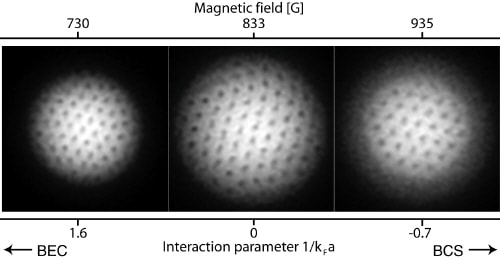
Next, the MIT team increased the strength of the magnetic field to convert the molecular condensate into a Fermi gas with strong interactions between the atoms. Finally, they used a green laser beam as a “spoon” to vigorously stir this gas and make it rotate.
In contrast to a normal fluid such as water, a superfluid can only rotate by forming a regular array of quantized vortices, each of which carries part of the total angular momentum of the superfluid. In addition to expelling atoms from their centres to leave a string-like hollow core, the vortices also repel each other to form a regular lattice pattern.
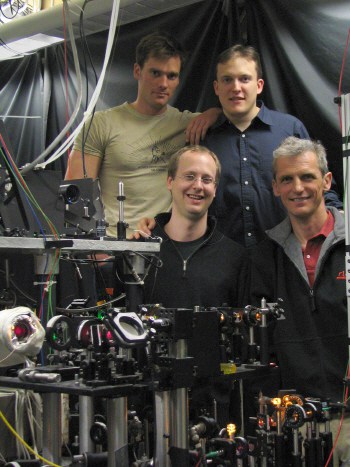
“When we observed the beautiful array of vortices, we instantly knew we had created a new form of matter – a high-temperature superfluid,” says Martin Zwierlein, lead author of the paper. “It might sound confusing to call it a high-temperature superfluid, but scaled to the density of electrons in a metal, the transition from a normal gas to a superfluid would occur well above room temperature.”
Zwierlein also points out that the size of the Cooper pairs in a superconducting material is fixed, whereas the properties of the atom pairs in a superfluid Fermi gas can be changed by simply changing the magnetic field. “Thanks to this unique level control,” says Zwierlein, “superfluid Fermi gases can serve as model systems for high-temperature superconductors and even more exotic forms of matter such as neutron stars or the matter that existed in the early stages of the universe.”
Born in Missouri on 8 November 1923, Kilby became interested in electrical engineering while at high school and applied to study the subject at the Massachusetts Institute of Technology (MIT). However, he fell slightly short in his score on the entrance examination in 1941 and instead joined the US Army, which assigned him to radio-repair duties at an outpost in north-east India.
When the war was over, Kilby took a degree in electrical engineering at the University of Illinois followed by a master’s at the University of Wisconsin. After a spell at Globe Union, he joined Texas Instruments in Dallas in 1958, where he began building an integrated circuit, in which different components of an electronic circuit were integrated on a single piece of semiconductor about half the size of a paper clip. He demonstrated the first working integrated circuit on 12 September 1958.
Although that circuit had just one transistor, one capacitor and three resistors linked via gold interconnects on a germanium substrate, techniques for miniaturizing integrated circuits were soon developed. Today’s integrated circuits now cram millions of components onto a single chip to form a market with sales totalling $179 billion in 2004. Kilby, who held over 60 patents, later helped to invent the hand-held electronic calculator and the thermal printer.
The late Robert Noyce, who died in 1990, is also widely credited with inventing the integrated circuit while working for Fairchild Electronics in California. However, he filed his patent in July 1959 — some five months after Kilby filed his patent for “miniaturized electronics” and was also aware of Kilby’s work at the time. But Noyce, who co-founded Intel in 1968, developed the circuit as it was later to be manufactured in practice, with silicon as the semiconductor and the components connected with aluminium. After years of legal battles, Texas Instruments and Fairchilld eventually cross-licensed their technologies.
The world of neutrino physics has come a long way in the last 30 years. Once a ghostly afterthought of particle physicists, introduced to explain something that was missing rather than something that was there, neutrinos have proved to be every bit as fascinating as quarks, gluons and all the other fundamental particles. Indeed, they might even be able to explain one of the biggest puzzles in physics: where did the matter in the universe come from?
According to the Big Bang model, the universe began 13.7 billion years ago as a tiny region of pure energy that expanded and cooled to create the cosmos we see today. Among the many successes of this model, however, there is at least one glaring problem: the universe is dominated by matter and contains very little antimatter. The laws of physics do allow energy to be converted into matter, but require that almost equal quantities of antimatter are produced in the process.
It is now becoming clear that the answer to this puzzle could come from a very unexpected quarter: the behaviour of neutrinos. How we have come to this startling conclusion is a fascinating tale and, as is so often the case in science, the story begins with a completely different problem.
The birth of the neutrino
The concept of neutrinos dates back to the 1930s, when researchers noted that energy seemed to disappear when one atomic nucleus decayed into another nucleus plus an electron. Wolfgang Pauli hit upon a “desperate remedy” to explain the situation, proposing that the missing energy was being carried away by a third particle emitted in the decay. To the modern reader this might not seem particularly revolutionary, but in Pauli’s day there were only two known particles – the electron and the proton – so introducing a third particle was radical in the extreme.
Understandably Pauli was initially reluctant to publish the idea, and even apologized afterwards for predicting a particle that he thought would be impossible to detect (if only modern theorists were similarly concerned!). This was because his “neutrinos”, as Enrico Fermi christened them, had no electric charge and would interact only weakly with other matter. Happily, Pauli was proved wrong and lived to witness the Nobel-prize-winning detection of neutrinos in 1953 by the late Fred Reines and Clyde Cowan.
But the emerging field of particle physics did not, of course, end there. We went on to discover the positron (anti-electron), the pion, the muon and many other novel particles. Along with the muon came another neutrino, now called the muon neutrino, νμ, which was found to be distinct from the electron neutrino proposed by Pauli (νe). Then, after the discovery of the tau lepton in 1975, it was apparent that there was a third “flavour” of neutrino: the tau neutrino, ντ, which was finally detected in 2000 by the DONUT experiment at Fermilab in the US.
Meanwhile, the plethora of strongly interacting particles such as protons and pions was brought into order by the quark model. Combined with a handful of other particles that could explain the forces between elementary particles, this left us with a rather simple but extremely powerful picture of particle physics called the Standard Model. In this model, neutrinos were initially considered to be strictly massless and to interact only via the weak interaction though the exchange of the “Z” and the “W” particles. Reality, however, has turned out to be somewhat more complicated than this.
A problem with the Sun
In the 1960s, while other particle physicists were investigating all these newly discovered particles, Ray Davis at the Brookhaven National Laboratory in the US was pursuing the idea of using neutrinos as a probe. For decades astronomers had thought that the most likely power source for the Sun and other stars was thermonuclear fusion, but no direct proof was available. Davis believed he could observe the fusion reactions directly by detecting the neutrinos they produced.
In the basic fusion reactions in the Sun, four protons are converted into a helium-4 nucleus, emitting two positrons and two electron neutrinos in the process. These neutrinos have a wide range of energies and vast numbers of them escape from the Sun without interacting with anything, hurtling towards the Earth at close to the speed of light. But it is precisely this extremely low probability of interacting with matter that makes neutrinos so hard to detect.
Davis tackled this problem using a technique from radiochemistry proposed by Bruno Pontecorvo while at the Chalk River Laboratory, Canada, in 1946: assemble a large mass of some target atom that will very occasionally undergo a nuclear reaction triggered by a solar neutrino. Davis chose an isotope of chlorine as the target, which he managed to obtain at an acceptable cost in the form of 600,000 litres of cleaning fluid. Neutrinos from the Sun would then react with the chlorine to produce radioactive argon atoms, which could be “gathered up” and individually counted. Knowing the probability that a neutrino would trigger the reaction in the first place, it would then be possible to infer the solar-neutrino flux.
The first results of this audacious experiment were announced in 1968, and surprised almost everyone. Davis’ team only detected about 30% of the neutrinos predicted by the best solar models available, namely those developed by John Bahcall and colleagues. At first, researchers were sceptical as to whether a few atoms of argon could really be seen in such a huge volume of liquid, but after rigorous tests it seemed the experiment was not at fault. Nevertheless, the real proof that the “solar-neutrino problem” was here to stay did not come until twenty years later, when the Kamiokande experiment in Japan confirmed Davis’ results. Davis and Kamiokande spokesperson Masatoshi Koshiba of the University of Tokyo shared the 2002 Nobel Prize for Physics for their pioneering work in neutrino astrophysics.
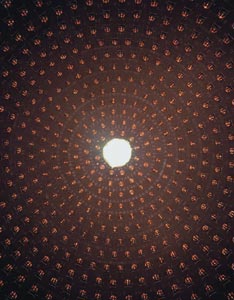
The Kamiokande experiment consisted of several thousand tonnes of pure water in a tank deep underground, and was originally built to search for proton decay. However, its designers realized that the experiment might also be able to detect highly energetic neutrinos from the Sun that interact with electrons via scattering reactions. These electrons can travel faster than the local speed of light in the water, causing them to emit the optical equivalent of a sonic boom – a glow of blue light called Cerenkov radiation that can be detected by ultra-sensitive photomultiplier tubes around the tank.
In 1989 the Kamiokande team confirmed that the flux of neutrinos from the Sun was indeed much lower than expected. But experimental particle physicists take a lot of convincing, and there was still the possibility that the solar-neutrino problem arose not from the neutrinos but from the solar models themselves. This is because the neutrino flux measured by the Davis and the Kamiokande experiments was dominated by high-energy neutrinos from a small side reaction involving the decay of boron-8. The rate of this reaction depends critically on the core temperature of the Sun, so a small error in this temperature could explain the low neutrino fluxes seen in both experiments. We therefore had to confirm that all solar neutrinos were suppressed, not just those at high energies.
This required two new experiments called SAGE and GALLEX, which followed the basic idea of Davis’ experiment except that they used gallium instead of chlorine as the target atom. Due to the more complex chemistry involved, these experiments were more difficult to perform, but in the early 1990s we eventually got the answer: the low-energy neutrinos were missing too. The problem did not lie with the solar models – it was something else.
Neutrino oscillations
If neither the solar models nor the experiments were at fault, then what was the source of the solar-neutrino problem? One solution, which was actually proposed by Pontecorvo the year before Davis had obtained his first results, was that neutrinos may change from one flavour to another on their journey from the Sun to the Earth (see box 1 below). Since the existing experiments were predominantly sensitive to electron neutrinos, rather than muon and tau neutrinos, this could explain why we only detected about a third of the solar neutrinos.
But there was one big problem with this neutrino-oscillation idea: it requires that neutrinos have mass, which they do not in the Standard Model. At the time this was an exciting prospect because it meant that neutrinos might explain the “dark matter” that is thought to dominate the universe. We now know that neutrino masses are too small to account for most of this strange, non-luminous substance (even so, there is roughly the same amount of mass in neutrinos as there is in all the visible matter in the universe). But these tiny neutrino masses are still of great interest because they might arise from some fundamentally different mechanism to the way the masses of other particles are generated – i.e. the Higgs mechanism.
The theory of neutrino oscillation contains a few underlying parameters: the masses of the three neutrino states ν1, ν2, and ν3 (see box 1 below) or rather the two independent differences between them, Δm122 and Δm232; three “mixing angles”, θ12, θ23 and θ13; and a critical parameter called the phase, δ. Measuring this phase could be one of the keys to answering the riddle of why the universe contains more matter than antimatter. But before physicists could explore this possibility, we still had to determine whether neutrino oscillations were simply nice mathematics or real physics. In particular, we needed to measure the mass differences and mixing angles.
While proof of neutrino oscillations was being sought, a separate problem began to unfold in experiments searching for proton decay. Proton decay may or may not take place, but it is certainly very rare (the lifetime of the proton is predicted to be at least 1032 years). Experimenters have therefore had to worry about other processes that might hide or even mimic the decay of a proton in their detectors.
The largest source of such background events are neutrinos from cosmic rays, the high-energy particles that constantly bombard the Earth’s atmosphere from sources in our galaxy and beyond. The debris of these collisions is dominated by pions, which decay into muons plus muon neutrinos in reactions such as π– → μ– + νbarμ, where the horizontal bar depicts a antineutrino. The muons themselves then decay into electrons and more neutrinos via the reaction μ– → e– + νbare + νμ.
This process should therefore produce two “atmospheric” muon-neutrino events for every electron-neutrino event. However, to the surprise of researchers working on a Kamiokande-like detector called the Irvine Michigan Brookhaven (IMB) experiment, and of the Kamiokande team itself, this ratio was not seen. Instead, the two experiments saw roughly the same number of both types of neutrino. As with the solar-neutrino problem, many physicists initially thought that this “atmospheric-neutrino anomaly” was simply due to a problem with the experiments, or possibly the models of atmospheric-neutrino generation. However, in 1998 a vastly larger version of Kamiokande called SuperKamiokande convinced almost everyone that the atmospheric anomaly must lie with the neutrinos themselves.
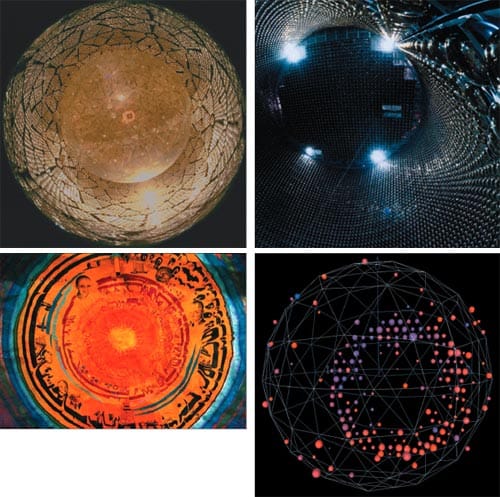
The breakthrough came because SuperK was able to compare the events that came “down” from the atmosphere with events that came “up” from below, and hence arose from interactions in the atmosphere on the other side of the planet (figure 1). The only significant difference between these two classes of neutrino is the distance they have travelled, but if neutrinos are massless this should make no difference.
However, for events coming from above, SuperK saw roughly the expected 2:1 ratio of muon to electron neutrinos, while for events coming from below it saw many fewer muon neutrinos. This was subsequently confirmed by the Soudan II and MACRO experiments, and demonstrated that nature really does satisfy the first condition for neutrino oscillations: that neutrinos have mass. But what about the second condition, that neutrinos change flavour?
Solving the solar-neutrino problem: SNO and KamLAND
Demonstrating that neutrinos can change flavour was the main purpose of the Sudbury Neutrino Observatory (SNO) in Canada, which was built by a large collaboration of Canadian, US and UK physicists (and which I have been a part of since 1988). SNO is a water Cerenkov detector like Kamiokande, but instead of using normal water it uses heavy water, D2O. The deuterons, D, in the heavy water are the most weakly bound of all nuclei, which gives SNO the chance to observe three different reactions induced by solar neutrinos.
The first of these processes is the charged-current reaction νe + D → p + p + e–, which is detected by observing Cerenkov photons from the energetic recoil electron, e–. This reaction is only sensitive to electron neutrinos, which is good because these are the only type produced by nuclear reactions in the Sun’s core. But what happens if these neutrinos oscillate on their way from the Sun to the Earth?
This is where the second reaction, the neutral-current reaction νχ + D → p + n + νχ, comes into play. This is observed via the emitted neutrons, n, and is independent of the flavour of the incoming neutrino, χ. It therefore provides a way to normalize the total flux of neutrinos being emitted by the Sun. In the absence of neutrino oscillations, the flux inferred from the charged-current and neutral-current reactions would be the same, while neutrino oscillations would lower the charged-current rate but not the neutral-current rate. As a result, SNO can determine whether or not neutrinos change flavour regardless of the details of solar models. The third interaction is the same electron-scattering reaction already observed by the two Kamiokande detectors, νχ + e– → νχ + e–, which has some sensitivity to all neutrino flavours but does not allow a clean comparison between them.
Building an experiment like SNO is no simple task. First, you need 1000 tonnes of heavy water, which is not generally found at your local hardware store. Luckily, Ontario Hydro uses large quantities of heavy water in its nuclear reactors and was willing to lend us one reactor’s worth on the condition that we give it back (it is worth hundreds of millions of dollars). Then you need to dig an enormous cavity at great depth in which to house your detector. Again, tremendous good fortune led us to the INCO nickel-mining company, which has been supernaturally tolerant of a bunch of physicists doing rather odd things in its extremely profitable mine. Finally, once you have secured many millions of dollars to fund all of this, you get to the hard part: building the detector itself.
The difficulty arises because of natural background reactions that can mimic neutrino signals. Gamma rays arising from the radioactive decay of ubiquitous uranium and thorium are a particular problem, as they can break up deuterons and release neutrons that cannot be distinguished from those produced by neutral-current reactions. The only way to control this background is to build the detector from specially selected materials in a giant cleanroom – a cleanroom 2 km underground in an active and very dirty mine.
Once all this was accomplished in 1999 the fun really began, because the detector does not just say, “Hey, there was a neutrino – add one to the charged-current list!” The problem is that you cannot directly measure the response of the detector in order to pick out the few – about 10 per day – solar-neutrino events from the tens of events per second coming from background processes. Instead, we had to laboriously understand the behaviour of the detector from first principles using optical and radioactive sources, and computer simulations. Once this effort was complete, actually fitting the neutrino signals was relatively straightforward.
The results, announced in 2001 and 2002, confirmed beautifully the neutrino-oscillation prediction. The number of neutral-current events matched the predictions of the solar models quite precisely, showing that the total neutrino flux is actually spot on. However, the charge-current reaction rate showed that only about a third of these neutrinos are electron neutrinos by the time they reach the Earth, which proved that neutrinos change flavour on the way.
In 2004 we improved this measurement by adding two tonnes of salt to the heavy water, which makes the neutrons from the neutral-current events much easier to detect. But just to be absolutely sure that solar neutrinos really do change flavour, we are now repeating the experiment yet again. This time, however, we will be able to detect the neutral-current events independently of the charged-current events using an array of very sensitive neutron detectors. This will make the detector more sensitive to the mixing between electron- and muon-type neutrinos (and hence improve the measurement of the angle θ12), while at the same time making extra sure that we have not been fooled by our first two measurements.
So, SuperKamiokande’s atmospheric-neutrino results from 1998 showed that neutrinos have mass, while, a few years later, SNO showed that neutrinos can change flavour. Does this prove that neutrino oscillations occur? Well, not quite, because a number of other models have been proposed that can also explain these data, ranging from new neutrino properties to the effects of higher dimensions. Luckily, in 1994 another Japanese group had proposed a very clever experiment called KamLAND, which provided the final piece of evidence for neutrino oscillations.
KamLAND is a large detector built in the old Kamiokande cavity that takes advantage of Japan’s nuclear reactors, which are powerful sources of electron antineutrinos (some 30% of Japan’s energy comes from nuclear power stations). Coincidentally, these reactors are at the right distance away for neutrino physics: close enough for their antineutrinos to be detected, but far enough away that neutrino oscillations should significantly suppress the number of electron antineutrinos detected.
The most recent results from KamLAND, reported last summer, clearly show not only a suppression of the detected flux, but also a distortion of the spectrum as a function of energy, which is precisely what the oscillation model predicts. The real clincher, however, is that the suppression is much less than that seen for solar neutrinos because their oscillation is modified as they pass through the dense matter of the Sun. This is exactly what is expected for a model of neutrino oscillations, but not for any of the other models, and seems to be the final piece of evidence needed to state that neutrinos really do oscillate. Furthermore, it allows us to measure Δm122 accurately, which, combined with the solar-neutrino measurements, constrains the values of the neutrino-oscillation parameters.
Long-baseline experiments
If terrestrial experiments like KamLAND can observe the neutrino oscillations originally seen by solar-neutrino experiments, are there terrestrial experiments that can detect the oscillations seen in atmospheric neutrinos? The answer is yes, but it means we have to make our own high-energy neutrinos, and this requires an accelerator.
The idea of creating a pure, collimated beam of neutrinos has been around since the muon neutrino was discovered in the early 1960s. The starting point is to send a beam of protons into some target to produce pions, which then decay to produce a beam of muons and muon neutrinos. By stopping the muons before all but a very few can decay, a beam consisting almost solely of muon neutrinos emerges. Two types of experiments can be done with such a beam. First, one can look for a reduction in the flux of muon neutrinos from the expected value as a function of energy or distance; and second, one can look for electron or tau neutrinos in the beam that could not have been there when it was generated.
Experiments of this latter type have a long history, but we now know they were looking in the wrong place. Guided by a theoretical prejudice that all the mixing angles would be small and by the belief that neutrino masses should be large enough to explain the missing matter in the universe, researchers were looking for small mixing angles and large mass differences. But we now know from the results of solar, atmospheric and reactor oscillation experiments that we should be looking for small mass differences and large mixing angles, and a new generation of experiments has been designed to do just that.
The first of these, called K2K, produced its first results in 2000. The proton beam is produced at the KEK laboratory just north of Tokyo, and the resulting muon-neutrino beam is fired 250 km under Japan to the SuperKamiokande detector. Sure enough, this experiment has seen too few muon neutrinos, exactly as would be expected if the atmospheric-neutrino anomaly really is caused by neutrino oscillations.
A number of other such long-baseline experiments are either under construction or being planned. The first of these, called MINOS, will fire an intense beam of muon neutrinos from Fermilab near Chicago to a detector in the Soudan mine in Minnesota (a distance of 735 km). Unlike water Cerenkov detectors, MINOS consists of a large iron calorimeter in the presence of a magnetic field, which can track and measure the momentum of charged particles as they pass through the detector. MINOS can therefore make a more precise measurement of the energy spectrum of the muons arising from interactions with the Fermilab neutrinos, and thus allow a more precise determination of the energy at which the oscillations are at a maximum. This will allow us make better measurements of Δm232, which is currently poorly determined.
Another long-baseline experiment called CNGS is under construction in Europe, where muon neutrinos will be fired from CERN in Geneva to the Gran Sasso National Laboratory near Rome (a distance of 730 km). The two large detectors being built at Gran Sasso – OPERA and ICARUS – will make extremely precise measurements of the resulting particle tracks. By actually observing tau neutrinos in the beam, this should enable the CNGS team to confirm a central prediction of our current models of neutrino oscillations – that the atmospheric-neutrino anomaly is caused primarily by the oscillation of muon to tau neutrinos.
I believe it was Eddington who said that anything that is consistent with all existing experimental data must be wrong, because some of the data are almost certainly wrong. For those who wish to believe in neutrino oscillations it is therefore a relief that one experiment – LSND at Los Alamos – does not fit into the neutrino picture outlined here.
In 1996 the LSND team claimed to see evidence for the appearance of electron neutrinos in a muon-neutrino beam, which suggested a small mixing angle and a relatively large value of Δm122. Although another experiment with similar sensitivity called KARMEN at the Rutherford Appleton Laboratory in the UK has seen no evidence for this effect, the results of a dedicated experiment called MiniBooNE are keenly awaited. The MiniBooNE detector is based at Fermilab, and will search for electrons in a beam of muon neutrinos produced by Fermilab’s proton accelerator. If MiniBooNE sees no effect, then everyone, except possibly Eddington, can breathe a sign of relief and believe the three-neutrino oscillation picture painted by the existing experiments. On the other hand, if MiniBooNE confirms the LSND result then we live in a very strange world indeed and the mixing phenomenon would have to be much more complex than our current understanding.
Measuring θ13: the next step in the story
So where do we stand with the measurements of the fundamental neutrino-oscillation parameters? Solar-neutrino experiments and KamLAND have measured the angle θ12 to be about 32° and the mass difference Δm122 to be about 8 x 10⁻⁵ eV2. Atmospheric-neutrino oscillation measurements have constrained θ23 to be nearly 45° (i.e. neutrinos oscillate as much as is possible) and also measured Δm232 to be about 2.5 x 10⁻³ eV2. This leaves the third mixing angle, θ13.
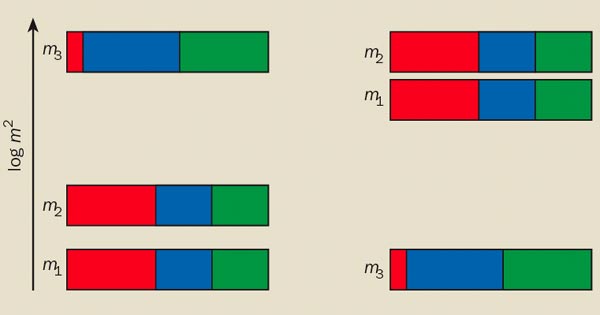
We also need to know a bit more about the neutrino-mass states. With three different masses there are only two independent mass differences, and since we have already measured two mass differences you might think we were done. Unfortunately, it is not that simple. The reason why is that we do not know a priori the ordering of the mass states, because the vacuum-neutrino oscillations we have measured depend on the square of the mass differences and are therefore independent of their sign. But matter effects, such as those present for neutrinos that escape the dense interior of the Sun, do depend on the sign of the mass difference. We therefore know from the oscillations of solar neutrinos that ν2 is more massive than ν1. But since we have not yet seen any matter effects in the oscillations of atmospheric neutrinos, because the Earth is not sufficiently dense, there are two remaining possible orderings (figure 2).
Determining θ13 and the mass hierarchy is the target of the next generation of planned experiments. We already know from experiments on shorter baselines than KamLAND that the angle θ13, unlike the other two angles, is small. New experiments plan to look for θ13 in the so-called sub-leading oscillations that arise when the effects of all three neutrinos are taken into account. These oscillations would produce small ripples on the primary oscillation pattern, and cause the additional appearance of electron neutrinos in a terrestrial muon-neutrino beam. New reactor and accelerator oscillation experiments have been proposed that will use a near detector and a far detector in order to improve the sensitivity to tiny suppressions and small appearance probabilities, and hence to smaller values of θ13.
Long-baseline experiments such as MINOS offer some sensitivity to these second-order effects, but to significantly improve on our existing knowledge we will require entirely new facilities using even more intense neutrino beams. The first of these “superbeam” experiments, called T2K, is currently being built in Japan, and will involve firing a neutrino beam with unprecedented intensity through 295 km of rock from the JPARC facility on the east coast of the country to SuperKamiokande on the west. At the energies and distances involved, the type of oscillations seen in solar neutrinos will not produce any significant effect, so any electron neutrinos seen in the muon-neutrino beam would be a signal of oscillations modulated by the third angle θ13.
Another new experiment called NOvA is planned at Fermilab, which will utilize the same beam used for MINOS. This experiment will be at higher energies and longer baselines than the T2K experiment, which will hopefully allow matter effects to be observed and enable us to determine the mass hierarchy.
The more distant future: the neutrino factory
So what does all this have to do with the excess of matter over antimatter in the universe, as promised all those words ago? A clue could lie in the parameter δ. Producing a matter-antimatter asymmetry requires the laws of physics to be different for matter and antimatter, and a non-zero value of δ would indeed lead to differences in the oscillations of neutrinos and antineutrinos. A related effect in the early universe called leptogenesis could then lead to a matter-antimatter imbalance. But leptogenesis depends on parameters that cannot be measured on Earth, so we must therefore first measure δ and then trust our theorists to find the right model to connect δ to leptogenesis.
The basic idea is simple: you start with a beam of muon neutrinos and measure the probability that they change into electron neutrinos, then switch to a beam of muon antineutrinos and measure the probability of a transition to electron antineutrinos at the same energy and baseline. Any difference would indicate that δ is not zero, provided that you pass the antineutrinos through an antimatter Earth and allow them to interact with an antimatter detector. Unfortunately this is beyond the science budgets of most countries, so we have to measure both neutrinos and antineutrinos with a detector made of ordinary matter and correct for the uninteresting differences that this introduces (which limits the sensitivity of the experiment).
Superbeam neutrino experiments may be sensitive to values of δ that are near π/2 or 3π/2, where CP violation is the largest (see box 2 below), but to really pin this angle down we need even more intense and “cleaner” neutrino beams. A feasibility study is currently taking place at CERN to find out if this can be achieved with beams of unstable nuclei, which undergo beta decay and produce pure beams of electron neutrinos or antineutrinos.
An even more ambitious plan is to build a “neutrino factory”, which would produce very pure and intense neutrino beams that could be fired thousands of kilometres through the Earth to distant detectors. Such a machine would make pions, which would decay into muons, as in a conventional long-baseline experiment. But it would then accelerate these muons to high energies so that they produce a collimated neutrino beam with a well-known energy when they decay. This would allow us to measure neutrino oscillations with a sensitivity that is orders of magnitude better than any other planned experiment, although the difficulty and expense of such an undertaking are considerable.
One major challenge is to find a way to collect and accelerate the muons before they have time to decay. Existing methods to “cool” particles by reducing their angular or energy spread are too slow to be used for muons (which rapidly decay into other particles). This has led to a major international experiment called MICE (Muon Ionization Cooling Experiment) at the Rutherford Appleton Laboratory that will test an entirely new type of cooling (see Physics World April p5). Technological developments such as MICE should make it possible to build a neutrino factory some time soon, hopefully before I retire in about 20 years.
The pay-off
So, neutrino oscillations have been discovered. But it is worth remembering that both confirmed observations of neutrino oscillations arose from experiments that were initially built to look for something else. In fact, when Ray Davis originally proposed his experiment, most people thought it was a waste of time (one reviewer even compared it to trying to measure the distance to the Moon by standing on a ladder and holding up your hand!). In today’s hypercompetitive funding system, it is very doubtful that Davis could have secured the resources to build the experiment at all. We must therefore be careful that we do not squeeze out the sense of adventure and curiosity that leads to the entirely new. Not finding exactly what you were looking for is not a risk to be mitigated in designing experiments, it is why we do experiments.
Neutrino oscillations may seem an odd quirk of quantum mechanics, but they could help us understand particle physics at a far deeper level. Paradoxically, the very smallness of neutrino masses leads many theorists to believe that they provide a window on physics at much higher energies than our accelerators can reach. The mixing of neutrinos, which can, in principle, be measured even more accurately than the more familiar mixing of quarks, may help explain the puzzle of why there are three versions of all the particles in the first place. Neutrino mass is important in our understanding of the universe as a whole, and, furthermore, neutrinos may have generated all the matter from which we are made. Not a bad pay-off for a tank of cleaning fluid and some wonky backgrounds in a proton-decay experiment.
Box 1: Neutrino oscillations in theory
If neutrinos have mass, then the identity of a given neutrino becomes a bit complicated. This is because in addition to the electron (νe), muon (νμ) and tau (ντ) “flavour” states that have well-defined weak interactions, neutrinos have another set of states – denoted ν1, ν2 and ν3 – that have well-defined masses. Any particular neutrino will appear either as a νe, νμ or ντ if a measurement is sensitive to weak interactions, or as a ν1, ν2 or ν3 if a measurement is sensitive to mass. It is possible for these two sets to be the same, but, in general, they will be “mixed”. In other words, a νe will be partly ν1, partly ν2 and partly ν3, and similarly for νμ and ντ.
If we consider mixing between just two neutrino states as an example, this mixing can be described in terms of a single mixing angle θ (see equation 1).
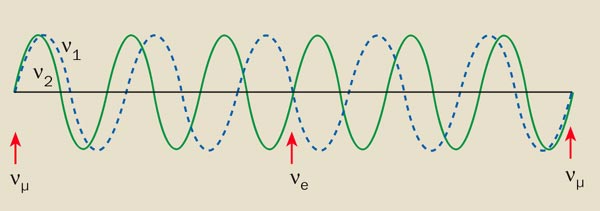
Real-life reactions produce flavour states: for instance, thermonuclear reactions in the Sun generate only νe. However, it is the mass states that propagate through space. If we take the simplest case of θ = 45°, the above equation states that νe = ν1 – ν2 and νμ = ν1 + ν2. Recalling that particles can also be described as waves, this means that the ν1 and ν2 waves are oscillating out of phase in the case of a νe, while ν1 and ν2 are in phase for νμ. If ν1 and ν2 have different masses, they will also have different wavelengths, and thus their relative phases will change with time or distance (see wavelength diagram).
Wavelength diagram
If we start with a pure νμ beam (left), the ν1 and ν2 waves will eventually become completely out of phase and appear as a ne (middle), before changing back into a νμ as the beam continues to propagate (right). The speed with which this change of identity takes place depends on the difference between the two wavelengths, which depends on the differences between the squares of the masses of ν1 and ν2, Δm122 = m22 – m12. In fact, the probability of finding a νμ in an initially pure nm beam with an energy E after it has travelled a distance L is given by (see equation 2).
When the neutrinos are travelling through empty space, the decrease in the overall νμ flux (and the corresponding increase in the νe flux) thus depends on the amount of mixing, θ. However, since a νe experiences slightly different interactions in matter compared with a νμ or a ντ, the oscillations can actually be enhanced when a neutrino passes through the Sun or the Earth. Real experiments also involve all three neutrinos, which can lead to “oscillations on oscillations” that will be significant in future experiments (see text). Three-flavour oscillations require more parameters to be measured than in the two-flavour case described here: three mixing angles (θ12, θ23 and θ13), two independent mass differences (Δm122 and Δm232) and one additional parameter, δ, which could produce differences in the oscillations of neutrinos and antineutrinos.
Box 2: Neutrinos and CP violation
In 1967 the Russian physicist Andre Sakharov showed that in order to get from an initial state dominated by energy to the matter-dominated universe we see today, three conditions have to be met. First, the laws of physics must produce matter and antimatter in different amounts; second, the number of baryons, such as neutrons and protons, must not be conserved; and third, the universe cannot be in thermal equilibrium. The latter two conditions seem easy enough to satisfy, but the first condition – which is also known as charge-parity (CP) violation – has proved more problematic.
CP violation had, in fact, already been observed in 1964 in the decays of neutral kaons and their antiparticles, and a mechanism to explain it was introduced into the Standard Model. More recently, observations of the decays of neutral B-mesons have confirmed that this simple and elegant explanation works more generally, which is a triumph for theoretical physics. But the amount of CP violation produced by the Standard Model is too small by many orders of magnitude to explain the observed excess of matter in the universe, forcing us to conclude that there must be some additional process that violates CP.
Neutrino physics offers one of the more attractive possibilities for this, and raises the prospect that neutrinos might be the first known example of what is called a Majorana particle – a matter particle that is its own antiparticle. One consequence of this might be a process known as leptogenesis, by which CP violation in the decays of very heavy neutrinos in the early universe could create an excess of matter over antimatter. This could, in turn, be related to the CP-violating phase, δ, that is potentially observable in neutrino-oscillation experiments.
Further reading
Q R Ahmad et al. (SNO Collaboration) 2002 Direct evidence for neutrino flavor transformation from neutral-current interactions in the Sudbury Neutrino Observatory Phys. Rev. Lett.89 011301
S N Ahmed et al. (SNO Collaboration) 2004 Measurement of the total active 8B solar-neutrino flux at the Sudbury Neutrino Observatory with enhanced neutral-current sensitivity Phys. Rev. Lett.92 181301
E Aliu et al. (K2K Collaboration) 2005 Evidence for muon-neutrino oscillation in an accelerator-based experiment Phys. Rev. Lett.94 081802
T Araki et al. (KamLAND Collaboration) 2005 Measurement of neutrino oscillation with KamLAND: evidence of spectral distortion Phys. Rev. Lett.94 081801
Y Ashie et al. (SuperKamiokande Collaboration) 2004 Evidence for an oscillatory signature in atmospheric-neutrino oscillations Phys. Rev. Lett.93 101801
G Drexlin 2003 Final neutrino oscillation results from LSND and KARMEN Nucl. Phys. B (Proc. Suppl.) 118 146–153
Y Fukuda et al. (SuperKamiokande Collaboration) 1998 Evidence for oscillation of atmospheric neutrinos Phys. Rev. Lett.81 1562
Quarks come in six different flavours — up, down, strange, charm, bottom and top. A proton contains two up quarks and one down quark that are held together by gluons, but occasionally these gluons can fluctuate into quark-antiquark pairs. Although these virtual quarks only exist for very short times, they can affect the properties of the proton, such as its magnetic moment. Since the strange quark is the next-lightest quark after the up and down quarks, it is the most likely to have a measurable effect.
One way to observe the influence of strange quarks on the proton is to compare measurements that probe the weak interaction with those that probe the electromagnetic force. In the G-Zero experiment, a high-energy beam of electrons was fired at a hydrogen target. The beam was polarised so that the spins of the electrons either pointed in the same direction as the beam or in the opposite direction. The team then measured the rate at which these electrons scattered off protons in the target.
The difference for the two beam polarizations was about 10 parts per million. This asymmetry occurs because the electromagnetic force conserves “parity” (that is, it does not change when all three directions in space are reversed), while the weak force does not.
According to the G-zero team — which includes physicists from Armenia, Canada, France and the US — this difference implies that strange quarks must be contributing to magnetic moment and charge distribution of the proton. The results agree with those recently reported by the HAPPEx experiment, the SAMPLE experiment at the MIT-Bates Lab in the US and the A4 experiment at Mainz in Germany.
Alexey Bezryadin and colleagues at the University of Illinois at Urbana-Champaign made the devices by arranging two DNA molecules across a trench about 100 nm wide that had been etched into silicon nitride and silicon dioxide layers on a silicon chip. The DNA molecules and the substrate were then sputter-coated with an alloy of molybdenum and germanium (Mo21Ge79).
The resulting nanowires became superconducting at low temperatures, with their resistance decreasing exponentially with temperature. As is typical for nanowires, they did not exhibit zero resistance.
The team built the device to search for phenomena known as Little-Parks oscillations but they found something completely different. In the absence of a magnetic field, the wires exhibited a nonzero resistance over a broad temperature range. However, when a magnetic field was present, the device showed regular and unexpected oscillations of resistance with the magnetic field. To investigate the effect, the researchers tested devices with different geometries, varying the width of the current leads and the spacing between the wires.
“The applied magnetic field causes a small current to flow along the trench banks, and this current then causes a large change in resistance,” explained team member Paul Goldbart. “The strength of the current is controlled only by the magnetic field and the width of the banks supporting the wires.”
The researchers say their device is very sensitive to magnetic fields and, if coupled to a scanning probe microscope, can be used to detect local variations in magnetic field. It could also be used as a gradiometer to measure properties of the order parameter in superconductors.
Conventional computers store information as “bits”, which can have a value of 1 or 0. However the ability of photons and other quantum particles to exist in two different states at the same time — such as horizontal and vertical polarization states — has lead to a new science of quantum information processing. Moving from two-dimensional qubit states to higher dimensional qudit states allows the particles to carry even more information and, for example, to increase security against eavesdroppers in quantum cryptography applications.
O’Sullivan-Hale and co-workers began by shining an ultraviolet laser beam onto a crystal with nonlinear optical properties that sometimes splits an ultraviolet photon into a pair of entangled infrared photons. Entanglement means that the properties of the photons — such as their polarization — are much more strongly correlated than is possible in classical physics. For instance, it is possible to entangle photons such that if one has clockwise circular polarisation, then the other will always be polarized in the anti-clockwise direction.
The Rochester team actually entangle the momenta of the photons, which means that their positions in real space, as measured by a detector, are also entangled. In their experiment they show that the photons can occupy any one of six momentum or position states (or pixels). With larger detector arrays, the team says that it could increase this to 16 states.
“Although entangled qudits have previously been made by various methods, our method is attractive because of its comparative simplicity and scalability,” O’Sullivan-Hale told PhysicsWeb. “We work with simple, off-the-shelf imaging optics without the need for holograms or interferometric stability as in previous experiments.”
The team now plans to demonstrate pixel entanglement in a quantum cryptographic system. “We would also like to use our ideas to create high-dimensional states using other variables such as energy and time,” he adds.
Just as the cosmic microwave background is made up of photons from the early universe, the cosmic neutrino background consists of neutrinos left over from the Big Bang. In a series of experiments over the past decade astrophysicists have measured the anisotropy of the microwave background – tiny fluctuations in its temperature at different positions in the sky – with increasing precision. These measurements have provided the most accurate data to date of the age and composition of the universe.
However, neutrinos are much more difficult to detect than photons, which is why much less is known about the cosmic neutrino background. Indeed, Trotta and Melchiorri rely on measurements of the microwave background and other astrophysical observations to find evidence for ripples in the neutrino background.
Theorists have predicted that the neutrino background should contain about 150 neutrinos per cubic centimetre and that they should have a temperature of around 2 Kelvin. Moreover, like the microwave background, the neutrino background should also be anisotropic. In both cases these anisotropies reflect the slight variations in the distribution of matter in the early universe that eventually grow to produce the large-scale structure of galaxies and galaxy clusters that we see today.
Trotta and Melchiorri take advantage of the fact that neutrino ripples have an indirect impact on the microwave background because they perturb the gravitational potential in the early universe, which in turn changes the energy or temperature of the microwave photons as they travel across the universe.
The neutrino anisotropy can be described by a viscosity parameter that relates the velocity of the neutrinos and to an anisotropic stress in the background. By carefully examining data from the Wilkinson Microwave Anisotropy Probe and the Sloan Digital Sky Survey, Trotta and Melchiorri have seen evidence for a non-zero viscosity parameter. If the viscosity parameter is zero the neutrino background does not contain any ripples.
“We were astonished by the fact that it was possible to achieve this result using present-day data, and so were the experts we spoke to,” says Trotta, who is also based at the University of Geneva. “It is proof of the extremely high quality of modern cosmological measurements, which allow us to investigate such subtle effects.”
Trotta and Melchiorri now plan to explore the anisotropy of the neutrino background in greater detail.
Most nuclei contain similar numbers of neutrons and protons, or more neutrons than protons. However, if an isotope of a given element contains too few or too many neutrons it will not be stable. The nuclear shell model, which was first proposed in 1949, explains that nuclei with certain magic numbers of neutrons and/or protons are especially stable because the neutrons and/or protons form closed shells. Nuclei that contain magic numbers of both protons and neutrons are even more stable and are said to be “doubly magic”. The magic numbers are 2, 8, 20, 28, 50 and 82.
However, it had been thought that highly unstable nuclei would have magic numbers that were different from those found in their more stable counterparts. To investigate this, Paul Cottle and colleagues at Florida State University, Michigan State University, the Lawrence Berkeley National Laboratory and Surrey University in the UK decided to study the silicon-42 nucleus, which has 12 neutrons more than silicon-30, the heaviest stable isotope of the element, and six protons fewer than calcium-48, the lightest stable nucleus to contain 28 neutrons.
“The surprise for us was that the magic number for protons in silicon-42, and also the full shell structure, are the same as in calcium-48,” Cottle told PhysicsWeb. “Silicon-42 is very close to the limit of nuclear existence – the heaviest silicon isotope ever observed is silicon-43 – and we anticipated significant changes in proton shell structure from calcium-48.”
Cottle and colleagues produced the silicon-42 nuclei by crashing sulphur-44 nuclei into a beryllium target at the National Superconducting Cyclotron Lab (NSCL) at Michigan State University. The experiment was made possible by the Coupled Cyclotrons Facility at Michigan, which produces the most intense beams of short-lived nuclei, like sulphur-44, that are available anywhere. The experiments also relied on the use of fast-beam “knockout” reactions, pioneered by Gregers Hansen of the NSCL and Jeffrey Tostevin of Surrey, to eject two protons from the sulphur-44 nuclei to produce silicon-42.
The results show that the silicon-42 nucleus remains stable despite containing a large excess of neutrons. The data also suggest that the proton number 14 is semi-magic because it corresponds to a closed subshell, which means that the nucleus is also spherical.
Enbo Wang of Northeast Normal University in Changchun and colleagues took grass from a field and heated it at 250 °C for one hour. The scientists then heated the resulting material at a higher temperature of 600 °C for around 20 minutes in a sealed container containing about 15 millilitres of oxygen. Next, they cooled the mixture and repeated the heat treatment. This cycle was carried out about 50 times and the estimated average yield for the process was roughly 15%.
Recently scientists have shown that water can simplify the synthesis and purification of nanostructured carbon based on the complex chemistry that is found in the carbon-hydrogen-oxygen system. “That inspired us to look for a new strategy for making carbon nanotubes directly from carbohydrates, based on the conversion from carbohydrate to pure carbon and water,” says Wang.
Many plants, including grass, contain tube-shaped bundles that are mostly made of cellulose and lignin and are used to transport fluids throughout the organism. The Northeast Normal team believes that pre-treating the grass removes its protein and grease components, while the treatment at high temperatures dehydrates the cellulose and converts it into nanostructured carbon.
The tubular structure of the carbon sources appears to be crucial because using the same heat treatment on non-tubular carbohydrates, such as glucose and saccharose, produced a much lower yield of nanotubes. However, wood and hemp, which do have tube-like structures, were also found to be good sources of nanotubes.
Understanding quantum chromodynamics or QCD – the theory of the strong force – at low energies requires knowledge of the scattering length that describes the interactions between particles at zero kinetic energy. However, the only direct way to determine this length is to measure the energy of the X-rays that are emitted when excited kaonic hydrogen atoms decay to their ground state.
The DEAR experiment at the INFN Laboratory in Frascati, Italy, fires low energy kaons onto a gaseous hydrogen target. The experiment relies on electron-positron collisions at the DAφNE accelerator that create φ-particles which, in turn, decay into kaons. Kaonic hydrogen forms when a negative kaon collides with a hydrogen atom, loses its kinetic energy and then replaces the electron in an excited orbit around the proton. The X-rays are emitted when the kaon drops into the ground (1s) state.
When the kaon reaches the ground state the strong interaction between it and the proton comes into play. This causes the energy of the 1s state to shift in energy and to become broader. The DEAR experiment has now used a new CCD X-ray detector to measure these values more accurately than ever before. Moreover, the DEAR team was able to identify X-rays caused by transitions from different excited states for the first time (see figure).
“A precise determination of the antikaon-nucleon scattering length puts strong constraints on the process of chiral symmetry breaking,” says DEAR spokesperson Carlo Guaraldo. “A better understanding of this process is, in turn, fundamental for our comprehension of QCD in the low-energy limit. ”
The DEAR collaboration now hopes to make measurements that are 10 times more precise at a new experiment called SIDDHARTA, which should also be able to probe the properties of kaonic deuterium for the first time. Meanwhile, the FINUDA experiment at Frascati has seen evidence for a bound state containing an antikaon and two protons (Phys. Rev. Lett.94 212303).