Lattice trap improves optical clocks

The gold standard in timekeeping is currently the caesium-133 atomic clock, which is accurate to 1 part in 1015 and is used to define the second. Optical clocks – based on single trapped ions or cooled atoms – are promising candidates to replace the atomic clock but they are hard to stabilize. However, this could be about to change thanks to work being carried out by Hidetoshi Katori and colleagues at the University of Tokyo and the National Metrology Institute of Japan.

By trapping a cloud of 10,000 cold strontium atoms at a temperature of just 2 microkelvin in a one-dimensional “optical lattice” the Japanese team says it has created a highly stable optical clock with an oscillator frequency of 429 terahertz. The lattice is formed by the peaks and troughs of the standing wave formed by reflecting light with a wavelength of 813.4 nm from a mirror. The atoms are trapped at the peaks of the standing wave.

“Our optical lattice clock demonstrates a line-width that is one order of magnitude narrower than that observed for neutral atom optical clocks and its stability is better than single ion clocks,” they write in Nature.

Trapping the atoms in the lattice enhances the stability of the clock by preventing the collisions between atoms that plague traditional neutral atom clocks. At the same time, the large number of atoms gives a strong signal. Single-ion clocks, on the other hand, emit a weak signal that needs to be averaged over a long time period.
Tackling hospital epidemics

Fredrik Lilijeros of the Karolinska Institute and Stockholm University, Petter Holme of the University of Michigan, and Johan Giesecke of the Karolinska Institute analyzed information about 295,108 in-patients at hospitals in Stockholm County during 2001 and 2002. They defined a “contact network” in which two patients were said to be in contact if they had been in the same ward at the same time.

“Traditional epidemiological modelling assumes that people meet with uniform randomness,” Holme told PhysicsWeb. “Our study is an example of a rather new type of epidemiological modelling that takes the contact structure of the population into account. This is by far the largest contact network studied, and the conclusion that the epidemic thresholds for some diseases like MRSA and tuberculosis (TB) are lower than in traditional epidemiological modelling is new and unexpected.”

The scientists say that their work could lead to better ways of detecting and controlling epidemics in health care systems in the future. They also plan to compare the predictions of the models with historical data.

New isotope doubles up

Nuclei decay when they contain too many neutrons or too many protons to be stable. The most commons forms of decay are nuclear fission and alpha, beta and gamma decay. However, some nuclei that contain more protons than neutrons can also decay by emitting a proton — a process that was first observed about 20 years ago.

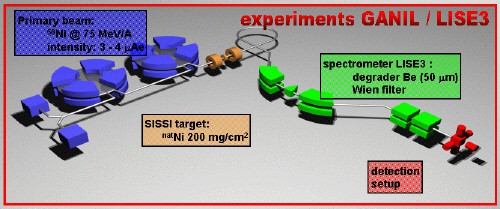
Single-proton emission is observed in nuclei with an odd number of protons. However, theorists also predicted that some nuclei that contain an even number of protons and/or neutrons could undergo two-proton emission. This process was seen for the first time in 2002 in iron-45, which contains 26 protons and 19 neutrons. The iron-45 nuclei were created by firing a beam of nickel-58 ions onto a nickel or beryllium target.

Now, Bertram Blank of the CENBG laboratory in France and colleagues have created zinc-54 — which contains 30 protons and 24 neutrons — in a similar experiment involving nickel-58 ions and a nickel target at the GANIL laboratory. The zinc-54 nuclei were created in about 1 in 1017 of the collisions, and Blank and co-workers found that the proton energy and decay half-life of about 3.7 milliseconds both agreed with predictions.

“Having a second two-proton emitter allows for a first real comparison between theory and experiment, which is somewhat difficult to make with just one case,” Blank told PhysicsWeb. “Two is better than one and hopefully there will be more.”

The group now plans to search for other two-proton emitters. It will also study iron-45 and zinc-54 in more detail with a time projection chamber that will be able to follow the paths of the two protons. “In this way we can study the correlations between the two protons and better understand the emission process itself,” says Blank.

Dots for data storage

Magnetic data storage is rapidly reaching the so-called superparamagnetic limit, beyond which the magnetic domains in conventional recording media become so small that they become unstable. The limit is predicted to occur at storage densities of about 200 gigabits per square inch.

Bruce Terris of the Hitachi San Jose Research Center and colleagues at the University of Konstanz and the BESSY synchrotron in Berlin began by making an array of silicon dioxide pillars. The array had a period of 300 nanometres and the pillars measured 150 nanometres in diameter and 80 nanometres high. Next, they deposited two magnetic layers made from cobalt-palladium onto the pillars, separated by a thick non magnetic spacer layer of palladium.

These two layers have different values for their magnetic coercivity: in other words, the strength of the magnetic field that is needed to reduce the magnetization of the upper magnetic layer to zero differs from that needed to do the same for the lower layer. This means that the magnetizations of the two layers can point in different directions. The end result is that the each pillar gives rise to four different magnetization states, which can be read back separately, thus doubling the storage density of the device (see figure).

The US-German team says that increasing the number of layers will further increase the storage density and it now plans to demonstrate that its technique works with three layers.

“This idea is interesting, particularly as we come to the limits of conventional recording,” says Kevin O’Grady of the University of York in the UK. “If it could work on continuous films then it could be of interest for the near future.”

Particle physicists discover new meson

The new meson was observed in electron-positron collisions by the international Belle collaboration at KEK and quickly decays into two well-known particles called the Omega and J/psi. The properties of the decay have led the Belle team to believe that it is not a standard quark-antiquark particle but may be a hybrid meson containing a charm quark, a charm antiquark and a gluon. The existence of such hybrid charm-anticharm-gluon particles was first predicted theoretically in 1978.

Although many of the properties of Y(3940) match those expected for a hybrid meson, its mass — which is about the same as that of a single helium atom — is much lower than theory predicts. The Belle collaboration now hopes to solve this enigma by further analysing its data.

The new meson is the latest in a list of recent surprising discoveries in particle physics. These include several particles called pentaquarks (which may or may not exist) that contain five quarks, a particle called the X(3872) that appears to be made of four quarks, and another meson called the Ds(2317) that does not behave as predicted.

Physicists tackle polluted rivers

The quality of water in a river can be analysed by measuring the amount of chemicals in it. If the level of chemicals from human, agricultural and industrial sources exceeds a certain threshold, this reduces the amount of oxygen in the water which, in turn, has adverse consequences for aquatic life.

The extent of pollution in a river can be quantified by two parameters: the biological oxygen demand and the chemical oxygen demand. Engineers frequently model these quantities, which obey a one-dimensional linear advection-dispersion-reaction equation. The coefficients in this equation depend on the flow of water in the river and on how the pollutants travel through the stream. Now, Abdellatif El Badia and colleagues at the University of Compiègne have looked at the inverse of this problem, which involves determining the source of the pollution by observing the effect it has on the river.

The new technique measures the concentration of pollutants at two points in the river, one upstream and one downstream of the stretch of river being studied. El Badia and colleagues derive a formula that yields the exact position of the source of pollution, and then expand this solution into a Fourier series to reconstruct how the intensity of the pollution has evolved over time.

“We have solved a mathematical problem that corresponds to a model that is used by engineers for the surveillance of pollution sources in rivers, whether they are of urban, agricultural or industrial origin,” says El Badia. “Our algorithm is simple enough to be implemented into software, which would allow scientists to detect accidental, or intentional, pollution spills.” The team is now working on a two-dimensional model that could be applied to estuaries.

Art turns to thermodynamics

Paintings age for a variety of reasons, such as exposure to high temperatures, humidity and light. Ageing is mainly caused by changes in the chemical and structural compositions of pigments in the paint as they gradually interact with each other and their environment over time. Now, Boris Zilbergleyt of the Systems Dynamics Research Foundation in Chicago has developed a new dating technique that simulates these interactions (arXiv.org/abs/physics/0505037).

Zilbergleyt analyses how various commonly used pigments, such as “yellow cadmium” (which contains cadmium sulphide) and “lead white” (lead carbonate), react with each other at room temperature and pressure. Typical pollutants such as carbon dioxide and hydrogen sulphide are also included in the simulations. According to Zilbergleyt, the results of the simulations agree well with colour changes observed in real paintings as they age.

“My method successfully predicts the chemical ageing of paintings and could therefore be used to relate a painting to a certain time or place — or even to a particular painting school,” Zilbergleyt told PhysicsWeb. “In some cases this could be a way to tell between real works of art and fakes that have been artificially aged — like the famous Han van Meegeren forgeries, for instance.” Zilbergleyt says he would now like to create special simulation software with its own specific database for art professionals.

Taking a close look at Titan

Titan’s atmosphere consists mainly of nitrogen, along with small amounts of organic material such as methane. The pressure at the surface is about 1.5 atmospheres, which is quite similar to the Earth, but the temperature is only about 90 K. At such low temperatures the methane in Titan’s atmosphere could play a similar role to the water in Earth’s atmosphere.

Titan’s surface appears to be young, with few impact craters, according to Steve Wall of the Jet Propulsion Laboratory and co-workers who used the Cassini Titan Radar Mapper to image about 1% of the surface. They also observed a variety of geological features such as volcanoes and surface flows with evidence for porous ice. Moreover, dark patches in the radar images imply that it could contain frozen hydrocarbons (Science 308 970).

Michael Flaser of the NASA Goddard Space Flight Center and colleagues used the Composite Infrared Spectrometer on Cassini to analyse the methane and carbon monoxide in Titan’s atmosphere, and found that the amount of these, and other hydrocarbon molecules present, vary with season. The atmosphere at Titan’s poles in winter may be similar to the ozone hole above the Antarctic, but with different chemistry (Science 308 975).

Other results show that the bulk composition of Titan’s upper atmosphere does not seem to have changed greatly since it was measured by the Voyager 1 spacecraft more than 20 years ago. Data from an ultraviolet imaging spectrometer and a neutral mass spectrometer provide evidence for the presence of several organic species, including molecular nitrogen, methane, molecular hydrogen, argon and a host of stable carbon-nitrile compounds.

Other papers report on how Titan’s atmosphere interacts with energetic particles, which come mainly from Saturn’s magnetosphere. These interactions provide energy for the continuous production of complex hydrocarbons and nitriles from atmospheric methane and nitrogen. Finally, results from a magnetometer show that Titan does not have an internal magnetic field.

A recipe for making strings in the lab

String theorists attempt to explain all the fundamental particles as vibrations on tiny strings on length scales of about 10-33 centimetres. The theory naturally includes “supersymmetry” – a symmetry that connects particles with integer spin, known as bosons, to particles with half-integer spin, which are known as fermions. The particles that carry the fundamental forces of nature, such as the photon and the gluon, are bosons, while the quarks and leptons that make up matter are fermions. Although superstring theory is the leading candidate for a theory of everything, there is no experimental evidence to date for strings or supersymmetry.

Now Michiel Snoek, Masudul Haque, Stefan Vandoren and Henk Stoof of Utrecht University have proposed making a “non-relativistic Green-Schwarz superstring” by trapping an ultracold cloud of fermionic atoms along the core of a quantized vortex in a Bose-Einstein condensate (BEC). A BEC is a special state of matter in which all the particles are in the same quantum ground state. Bosonic atoms such as rubidium-87 can enter such as state because, unlike fermions, they do not obey the Pauli exclusion principle.

The bosonic part of the superstring would consist of a vortex line created by rapidly rotating a one-dimensional BEC in an optical lattice (see figure). Next, a gas of fermion atoms, such as potassium-40, would be trapped within this vortex, which is possible under certain conditions. Snoek and colleagues say that it should be possible to observe the supersymmetry between the fermions and bosons by carefully tuning the interactions between the two types of atom with a laser.

Quantized vortices were first seen in superfluid helium. They are formed inside a rotating superfluid when it begins to spin faster than a certain critical speed. In the mid-1990s it was suggested that these vortices could simulate the formation of cosmic strings in the early universe.

Microscopes reach new depths

Most AFMs work in air or in ultrahigh vacuum but in some cases the sample needs to be kept in a liquid, such as biological samples that can die in air. Although researchers have made AFMs that work in liquid before, most of these devices work by placing a drop of liquid on the sample being measured, which limits the sample size and imaging rate. Now, Dongxian Zhang and colleagues at Zhejiang University in Hangzhou have made an AFM that can be completely immersed in liquid and which can image at high speeds in a wide range of corrosive solutions. Moreover, there is no restriction on the sample’s size.

An atomic force microscope works by measuring how the force between the sample and a tiny “tip” on a cantilever changes as the microscope is moved over the surface of the sample. This allows the AFM to record images with extremely high spatial resolution on the nanometre scale. The new device works in the same way as a conventional AFM and consists of a probe, a transparent window and a liquid cell made of Plexiglas, which is resistant to most acids and alkalis (figure 1).

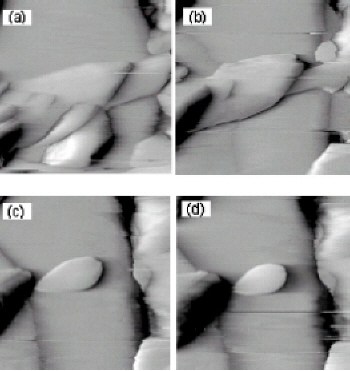
The window allows the scientists to immerse the probe into a liquid and scan under the surface. This means that surface tension effects (which can be strong enough to damage the probe) and vibrations coming from the surface (which can affect the stability of the device) are eliminated. Zhang and colleagues were able to obtain a 400 by 400 pixel image in just 10 seconds, which compares well with the scan rates of AFMs that work in air or vacuum. The Chinese team also measured the corrosion of a sample of lead in situ and in real time (figure 2).

Copyright © 2026 by IOP Publishing Ltd and individual contributors