White dwarf feels the heat – again

Stars like the Sun generate energy as a result of nuclear fusion reactions in which hydrogen nuclei fuse to form helium nuclei, which in turn undergo fusion reactions to produce carbon. As the star approaches the end of its life it ejects its outer layers into space to form a planetary nebula, before collapsing into a dense white dwarf. Most white dwarfs simply cool down over time but some can briefly re-ignite their helium, which makes them re-expand into giant stars for the second time. After this phase, which is calculated to last about 100 years, the stars contract again and become white dwarfs for good.

Using the Very Large Array in New Mexico, Zijlstra and colleagues elsewhere in the UK, Poland, United States, Belgium, Germany, Austria and Mexico have now detected radio emissions from inside the old planetary nebula of Sakurai’s object. According to the team, these emissions come from the ionisation of gases around the star – a process that requires temperatures of more than 20 000 K. These temperatures are much higher than those observed in the late 1990s and suggest that the star has started to contract and heat up again.

To explain the observations, the astronomers have developed a model in which convective mixing inside the star is suppressed. This means the star burns fuel lying closer to its surface and this, in turn, accelerates its evolution.

Zijlstra and co-workers have also found that the star has ejected a large amount of carbon from its inner core into space and speculate that such re-ignition events could be – along with supernovae – a major source of cosmic carbon. The measurement of identical carbon isotope ratios in meteorite inclusions backs up this hypothesis.

“Our models predict that Sakurai’s object will continue to reheat rapidly over the next decades and we will continue to observe the star to test our calculations,” Zijlstra told PhysicsWeb. “We also predict that after 2200 the star will evolve more slowly – but this prediction will take longer to test!”

Turning the lotus effect on its head

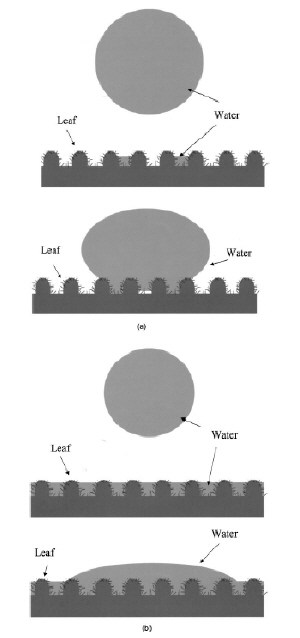
Microscope observations reveal that the waxy surface of the lotus leaf is made of micron-sized bumps that, in turn, are covered with nanoscale hair-like tubes (figure 1). This two-fold structure traps air under any rain drops that fall on the leaf, creating a surface that efficiently repels water. However, experiments on this so-called lotus-effect have only focused on how millimetre-sized droplets behave when they encounter the leaf’s surface.

Yang-Tse Cheng at General Motors Research and Development Center in Michigan and Daniel Rodak of Ricardo Meda Technical Services, also in Michigan, began by placing a lotus leaf above a source of water vapour. After just a few minutes the water began condensing onto the leaf in small droplets. Moreover, as condensation continued, some of these droplets merged to form bigger drops that remained on the surface of the leaf — contrary to what was expected.

Cheng and Rodak say the droplets become trapped between the nano-scale hairs on the leaf. The drops then coalesce with other drops and eventually begin to fill the cavities created by the micron-sized bumps (figure 2). Moreover, any new drops falling onto the leaf can then stick to it, making the surface hydrophilic rather than hydrophobic (figure 3).

“The question now is whether truly superhydrophobic surfaces can exist,” says Cheng. “Condensation experiments like ours are crucial to understanding the wetting behaviour of surfaces and should be included in any standard evaluation of hydrophobic materials.”

Breaking the ice

“In the past, I have participated in icebreaker activities that were not enjoyable and did not fit in with the tone of the meeting,” says Michelle Larson. “At one workshop, for example, we all had to remove our shoes, throw them into a pile in the centre of the room, pick out their owner and get to know that person. Icebreakers like these can be painful for some people and do nothing to enhance the agenda of the workshop.”

Larson and colleagues have already used their physics-based approach with examples from solar and cosmic-ray physics at gatherings of students and school pupils, and also at meetings involving the general public. Now they have extended it to gravitational-wave astronomy and the search for the tiny ripples in the fabric of space-time that are produced when massive bodies accelerate. Separating the very weak gravitational signal from the background noise is extremely difficult.

The new icebreaker activity aims to teach participants the basics of gravitational-wave astronomy and help them understand how astrophysicists interpret the data from their detectors. Different sources of gravitational waves should produce very different signals and the object of the icebreaker exercise is to match example signals with the appropriate astrophysical source (see figure). Each group in the class then has to discuss its results with the other groups.

“All the participants said they had enjoyed themselves and that they had learned something!” says Larson, who has tested the approach with both middle-school girls and high-school teachers. “And any critics we had changed their minds after seeing the activity in action,” she adds. Similar icebreaker activities could be designed around any scientific topic, she says.

Testing the gravitational inverse-square law

Nothing seems more certain than the “fact” that there are three dimensions of space. But can we be sure that there are only three dimensions? Imagine a tightrope walker balancing on a cable high above the ground. To the tightrope walker the cable is effectively a 1D object, because he only needs one coordinate to specify his position as he walks back and forth. But an ant, for instance, sees the cable as a 2D object, because it can crawl along and also around the cable.

Today, increasing numbers of physicists are seriously questioning whether we are like tightrope walkers, unaware of the true number of dimensions in space. New ideas from theoretical physics suggest that the best way to discover the actual dimensionality of space is to study how the gravitational attraction between two objects depends on the distance between them.

When Isaac Newton realized that the acceleration of the Moon as it orbited around the Earth could be related to the acceleration of an apple as it fell to the ground, it was the first time that two seemingly unrelated physical phenomena had been “unified”. The quest to unify all the forces of nature is one that still keeps physicists busy today. Newton showed that the gravitational attraction between two point bodies is proportional to the product of their masses and inversely proportional to the square of the distance between them: F = GMm/r2, where F is the force, G is Newton’s gravitational constant, M and m are the masses of the objects, and r is the distance between them.

Newton’s theory, which assumes that the gravitational force acts instantaneously, remained essentially unchallenged for roughly two centuries until Einstein proposed the general theory of relativity in 1915. Einstein’s radical new theory made gravity consistent with the two basic ideas of relativity: the world is 4D – the three directions of space combined with time – and no physical effect can travel faster than light. The theory of general relativity states that gravity is not a force in the usual sense but a consequence of the curvature of this space-time produced by mass or energy. However, in the limit of low velocities and weak gravitational fields, Einstein’s theory still predicts that the gravitational force between two point objects obeys an inverse-square law.

Extra dimensions, fat gravitons and new particles

General relativity has been tested with exquisite precision by astronomical observations, laboratory experiments and various spacecraft (see “Relativity at the centenary” by Clifford M Will in Physics World January pp27-32). Although Einstein’s theory has passed all these tests so far, it is clear that quantum effects will cause general relativity to break down at distances comparable to the Planck length, which is defined as LP = √(h barG/c3)≃ 1.6 x 10-35 m, where h bar is Planck’s constant divided by 2π and c is the speed of light. However, the Planck length is so small that it has no discernable effect in any practical gravitational experiment.

One of the outstanding challenges in physics is to finish what Newton started and achieve the ultimate “grand unification” – to unify gravity with the other three fundamental forces (the electromagnetic force, and the strong and weak nuclear forces) into a single quantum theory. In string theory – one of the leading candidates for an ultimate theory – the fundamental entities of nature are 1D strings and higher-dimensional objects called “branes”, rather than the point-like particles we are familiar with. String theorists seriously entertain the idea that there are actually six or seven additional spatial dimensions; these extra dimensions are needed to make the theory both mathematically consistent and capable of describing gravity.

Of course, these “extra” dimensions must differ from the three infinite dimensions we are familiar with, otherwise we would have noticed them before now. Until recently it was assumed that they were not infinite but curled up with a radius that is comparable to the Planck length. Although this means that the extra dimensions are essentially invisible, their presence prevents the troublesome infinities that plague conventional quantum field theories of gravity.

One of the big puzzles about gravity is the fact that it is so much weaker than the other forces: it is a factor of about 1040 times weaker than the electrostatic and magnetic forces. In 1998 three theorists – Nima Arkani-Hamed, Savas Dimopoulos and Gia Dvali – offered a bold explanation for this weakness (see further reading). Gravity appears weak, they said, because some of the extra dimensions predicted by string theory are surprisingly large compared with the Planck length.

Arkani-Hamed and co-workers argued that we live on a brane with three spatial dimensions that is embedded in a universe containing a total of nine spatial dimensions. All the particles in the Standard Model (including the photon) are strings the ends of which are stuck firmly to the brane. However, the graviton, the particle that is believed to carry the gravitational force, is a closed loop of string and is therefore free to travel throughout all nine spatial dimensions. Gravity appears to be weaker than the other forces because it acts in nine dimensions, not three, and this “dilutes” its strength.

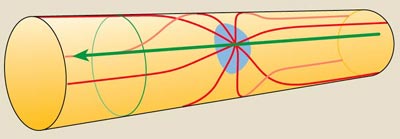
This “brane world” picture implies that we must use gravity if we want to discover the true number of spatial dimensions of our universe. A single, large extra dimension can be ruled out because it would need to have a size of 3 x 1012 m to explain why gravity is so weak. However, Arkani-Hamed and colleagues showed that if two of the extra dimensions were large, they would need to have a size of about 0.3 mm to account for the weakness of gravity. If the researchers are correct, Gauss’s law means that the gravitational force would vary as 1/r4, rather than 1/r2, at distances below 0.3 mm (see figure 1). In other words, gravity would become stronger at short distances.

Last year, however, Raman Sundrum of Johns Hopkins University in Baltimore made a completely different prediction. Sundrum was trying to understand “dark energy”, the mysterious substance that opposes gravity and is thought to be causing the expansion of the universe to accelerate. At first it was thought that quantum-mechanical vacuum energy – due to the creation of short-lived particle-antiparticle pairs, as permitted by Heisenberg’s uncertainty principle – was responsible for the dark energy. The only problem was that theorists predict the value of this vacuum energy to be at least 1060 times larger than the observed value of the dark energy, which has a density of about 4 keV in every cubic centimetre of space.

Sundrum showed that this value, Planck’s constant and the speed of light could be combined to define a length scale of about 0.1 mm, and went on to suggest that the factor of 1060 could be explained if gravity was much weaker at distances shorter than this. He suggested that the graviton in string theory might be a “fat” object that could not “see” most of the short-distance processes that are responsible for the conventional vacuum energy. This would also cause the gravitational interaction to become very weak for masses separated by less than the size of the “fat” graviton (see further reading).

Even without large extra dimensions and fat gravitons, string theories contain many new and as yet unobserved particles. These include the dilaton (which is the partner of the graviton in string theory), the radion (which stabilizes the size of the extra dimensions) and various “moduli” (particles that set the values of coupling strengths, particle masses and other parameters in the Standard Model). The quantum-mechanical exchange of these particles would lead to very strong, short-range forces that could show up in tests of the inverse-square law.

Putting the inverse-square law to the test

It is amazing that, until a few years ago, gravity had not even been shown to exist for objects separated by less than about 1 mm. There were two reasons for this: first, gravity is intrinsically very weak compared with the electrostatic and magnetic forces; second, seismic, thermal and other background effects make the experiments very difficult. Fortunately, electrostatic forces, unlike gravity, can be screened with a conducting shield, and recent experiments with a torsion pendulum have measured the gravitational force between objects separated by less than 65 μm.

Torsion pendulums have been used for over 200 years to measure weak forces between macroscopic objects, and they are still the most sensitive tools for making such measurements. Early versions of the instrument were used to measure the density of the Earth (John Mitchell in 1750), the electrostatic force (Charles Augustin de Coulomb, 1785) and G (Henry Cavendish, 1798). Later, in 1890, Baron von Eötvos used a torsion pendulum to test the equivalence of gravitational mass (i.e. the m in F = GMm/r2) and inertial mass (the m in F = ma). And today, modern versions of the torsion pendulum are being used in a variety of experiments, including high-precision measurements of G and tests of Lorentz symmetry (see “Breaking Lorentz symmetry” by Robert Bluhm in Physics World March 2004 pp41-46). A torsion pendulum has also been used to verify that “dark matter” obeys the equivalence principle.

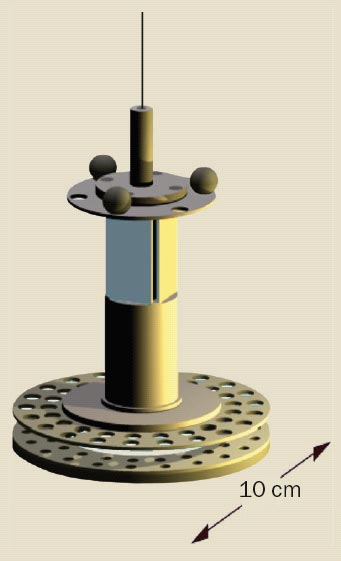
Although modern torsion pendulums take many different forms that the physicist of 200 years ago would not recognize, the basic principles have remained essentially unchanged (see box). In a traditional torsion pendulum the gravitational force between two test masses suspended on a fibre (the pendulum) and two fixed masses (the attractor) causes the fibre to twist by an amount that depends on the force. This twist is typically measured by reflecting a beam of light from a mirror on the pendulum.

Ironically, the instrument is suited to gravitational measurements because the rotational motion of the pendulum about the torsion-fibre axis is not sensitive to the Earth’s gravity. Moreover, it is insensitive to net forces acting on its centre of mass, which means that it can be substantially decoupled from external fluctuations, most of which are much larger than the effects of interest.

Modern torsion pendulums are sensitive to torques as small as 10-18N m. Since torque is defined as the product of a force and a length, and a typical length in a pendulum is about 1 cm, this is equivalent to a force sensitivity of about 10-16 N. This remarkably small force is roughly equivalent to 1/100th of the weight of a single piece of a postage stamp that has been divided into a trillion equal pieces! To date, the torsion pendulum is the only instrument that is capable of precisely measuring the properties of the gravitational interaction at length scales below 1 mm.

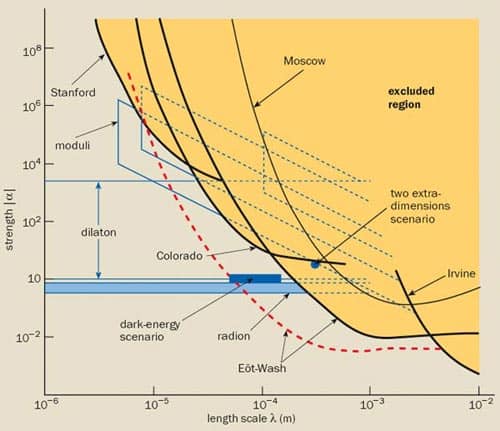
Since the mid-1980s, groups at the University of California at Irvine, Moscow State University and the present authors and colleagues in the Eöt-Wash group at the University of Washington in Seattle have been using torsion pendulums to perform ever-more-sensitive tests of the inverse-square law at short distances. If the inverse-square law holds, the gravitational potential energy of a pair of point masses can be written as: V = -GMm/r. Researchers generally look for a new force that violates Newton’s inverse-square law with a characteristic length scale: this involves looking for a potential of the form V = -(GMm/r)(1 + αe-r/λ), where α is a measure of the strength of the new force and λ is its range. This new “Yukawa potential” generally describes a short-range force that would be carried by a particle with a mass of h bar/cλ, and it is a good approximation to the effects of extra dimensions until separations become smaller than the size of those dimensions.

Measurements at separations as small as 0.14 mm by our group in Seattle have already ruled out the original scenario of Arkani-Hamed and co-workers for two large extra dimensions, and recent preliminary results show that any extra dimension must be smaller than about 60 μm (see figure 2).

The minimum separation between the pendulum and the attractor in this experiment – the most important experimental parameter – was limited by seismic vibrations, occasional dust particles and alignment uncertainties. Future efforts will probe gravity with separations of less than about 50 μm – a distance corresponding to roughly half the diameter of a human hair!

Smaller and smaller

Promising new techniques involving small oscillators and microcantilevers are also being introduced to search for new physics hidden in the behaviour of gravity over short distances. Although these devices have not yet achieved the sensitivity of torsion pendulums, modern fabrication techniques allow them to be much smaller and stiffer. This suppresses the problems associated with seismic noise and alignment, and allows much smaller separations of the test masses to be explored.

In 2003 John Price and co-workers at the University of Colorado in Boulder reported the first results from a torsion-oscillator experiment in which the test mass is a tungsten wafer, approximately 0.2 mm thick, that twists about a horizontal axis, and the source mass is a tungsten cantilever with dimensions 35 x 7 x 0.3 mm. The cantilever sits below the wafer on one side of the twist axis and the separation between the two masses is about 0.1 mm. The device is driven at the resonant frequency of one of the torsional modes of the wafer, which is about 1 kHz (compared with about 1 mHz for a torsion pendulum), and the response of the test-mass wafer on the other side of the twist axis is observed using capacitive techniques (see Long et al. in further reading).

The use of flat sheets for the test and source masses makes the Newtonian background in this experiment very small, so the detection of a spurious excitation at the resonant frequency could signify the existence of a new short-range effect. Although this device is not yet sensitive enough to detect gravity itself, it could detect new forces that are stronger than gravity at small distances, and the sensitivity should improve in the near future to the level needed to probe gravity directly at very small distances.

Meanwhile, Stephan Schiller and co-workers at the University of Dusseldorf in Germany have built a rotating-wheel attractor mass that resembles the one used in the Eöt-Wash torsion pendulum, while their detector resembles the wafer used in the Colorado experiment. New results from this group will be reported in the near future.

Elsewhere, Aharon Kapitulnik and co-workers at Stanford University have used semiconductor fabrication techniques to make microcantilever devices that sense the force between the masses directly, rather than measuring the torque (see Chiaverini et al. in further reading and figure 3). Their first results, obtained at a separation of only 25 μm, provide the most sensitive limits on any such forces at a range of distances below 10 μm. The Stanford group is currently developing a modified apparatus that will have a dramatically increased sensitivity.

Testing gravity with neutrons

Torsion pendulums and other mechanical oscillators have achieved the best sensitivity to short-distance gravity because they contain enormous numbers of atoms and the gravitational signal grows roughly as the square of the number of atoms. However, it is also possible, in principle, to probe the behaviour of gravity at short distances with single particles or small groups of particles. Most of these experiments have been carried out with neutrons because, being neutral, they do not experience significant electric forces caused by background fields or surfaces.

In 2001 Valery Nesvizhevsky and co-workers at the Institut Laue-Langevin neutron source in Grenoble, France, pointed a highly collimated beam of ultracold neutrons at the surface of a horizontal polished glass plate at a grazing angle. The neutrons travelled so slowly (less than 5 m s-1) that they were reflected by the potential-energy barrier associated with the strong nuclear force at the surface. The combined effect of gravity (acting downwards) and the surface (acting upwards) created a 1D potential well – qualitatively familiar to all physicists from their first lectures in quantum mechanics – in the vertical direction.

Nesvizhevsky and co-workers placed a neutron absorber above the plate and counted the number of neutrons that bounced off the surface and reached a detector on the far side as they moved the absorber up and down. They found that the number of neutrons increased significantly when the distance between the plate and the absorber became larger than the height of the quantum ground state of the gravitational potential well, and that it increased again when the absorber was raised above the height of the first excited state. This was the first time that quantum states had been observed in the Earth’s gravitational field.

Although this and subsequent experiments have not been sensitive enough to detect variations from the inverse-square law, Nesvizhevsky and co-workers have been able to place upper limits on new forces that are very much stronger than gravity for distances between 1 nm and 1 μm (see further reading). Such a force would change the potential well and therefore modify the vertical distribution of the neutrons.

Tests at astronomical distances

Although most attention has focused on the behaviour of gravity at short distances, it is possible that tiny deviations from the inverse-square law occur at much larger distances. In 2003 Dvali, who is now at New York University, and two colleagues, Andrei Gruzinov and Mattias Zaldarriaga, explored the possibility that non-compact extra dimensions could produce such deviations at astronomical distances (see further reading).

By far the most stringent constraints on a test of the inverse-square law to date come from amazingly precise measurements of the Moon’s orbit about the Earth. However, this marvellous sensitivity is obtained for values of the order of the Earth-Moon separation. These experiments involve reflecting laser beams off retroreflector arrays placed on the Moon by the Apollo astronauts and by an unmanned Soviet lander. Even though the Moon’s orbit has a mean radius of 384,000 km, the models agree with the data at the level of 4 mm!

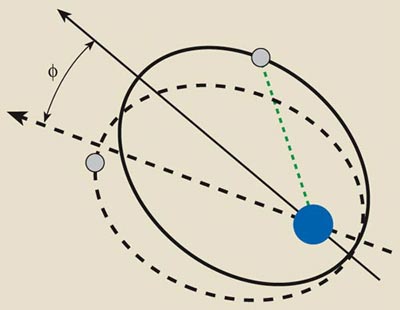
The observable that is best suited to testing the inverse-square law in this system is the precession of the major axis of the Moon’s orbit (see figure 4). According to classical mechanics, the major axis should not precess at all in the presence of a 1/r2 gravitational interaction. Indeed, it was a major triumph for general relativity when Einstein was able to explain the previously mysterious precession of the major axis of Mercury’s orbit by 420 milliarcseconds per year.

When the effects of general relativity and the influence of the Sun and the other planets are included, the predicted value for the precession of the Moon’s orbit (19 milliarcseconds per year) is in very good agreement with the measurements, and any discrepancy caused by a possible breakdown of the inverse-square law must be less than 270 microarcseconds per year. However, if we could measure the Moon’s orbit even more accurately, we might be able to detect small deviations from the inverse-square law at large distances that some theorists have predicted.

Tom Murphy of the University of California at San Diego and colleagues at Harvard University and the University of Washington have recently started a new lunar laser-ranging programme called APOLLO that will use a larger telescope at a better location (a mountain top near White Sands in New Mexico) and a more sophisticated photon detector in order to improve the precision of these measurements by a factor of 10. Instead of receiving about one reflected photon for every 100 laser shots, APOLLO should count several photons per shot (see Physics World June 2004 p9).

What if the inverse-square law breaks down?

Suppose that the next generation of experiments detects a force between two test objects that differs from what one would expect from conventional gravity. The discrepancy might be a new property of gravity itself, such as an extra spatial dimension or a large graviton, or it may be due to a new interaction that acts in addition to gravity. How might one distinguish between these possibilities?

The first step would be to see if the size of the discrepancy depended on the composition of the test objects. Gravity has the unique property that it couples equally to all materials, so that all objects, regardless of their composition, fall at the same rate in a uniform gravitational field. This is a consequence of the equivalence between gravity and acceleration, which is the fundamental principle on which Einstein based the general theory of relativity. Any new non-gravitational force will couple differently to different materials, so if we find that the deviation from the inverse-square law depends on composition, we can rule out extra dimensions as the origin of the effect. It would also be important to measure how any deviations changed with distance.

The explosion of ideas in recent years about new particles and new dimensions has reshaped the way we think about our universe. The discovery of dark energy also confirmed that there is a lot that we do not understand. Were Einstein still alive, he would certainly be curious to know if we were walking on a tightrope.


Phononic crystals go hypersonic

A phononic or sonic crystal is the acoustic equivalent of a photonic crystal. Just as the periodic variation of the refractive index in a photonic crystal means that only certain wavelengths of light are able to pass through it, a periodic variation in the acoustic properties of a phononic crystal means that only phonons with frequencies outside the phononic band gap can propagate. Such crystals are made by embedding cylinders of one material in a different background medium, with the properties of the phononic band gap depending on the size and periodicity of the cylinders.

As the periodicity of the crystal become smaller the gap moves to higher frequencies, and at hypersonic frequencies – between 1 and 100 gigahertz – the period becomes comparable with the wavelength of visible light. This means that such crystals should exhibit both phononic and photonic band gaps. However, hypersonic crystals are difficult to fabricate and characterise.

The MIT-lead team has now developed a complete “tool set” for designing and making hypersonic crystals, and for studying the motion of phonons in them. Gorishnyy and colleagues used a technique called holographic interference lithography to grow high-quality, defect-free single crystals that consisted of triangular arrays of cylindrical air holes in an epoxy polymer matrix about 6 microns thick. The team measured the phononic band gaps in the materials and followed the movement of phonons through them with a technique called Brillouin light scattering.

Controlling phonons in sonic crystals could be used to reduce noise in electronic circuits, control heat flow in nanostructures and enhance the interactions between light and sound waves in materials. “Acousto-optical interactions in hypersonic crystals are predicted to lead to a number of intriguing effects, such as optical cooling and shock-wave-mediated light frequency shifts,” Gorishnyy told PhysicsWeb. “Our results suggest a novel way to design a variety of acousto-optical devices, such as optical modulators and optically pumped acoustic oscillators.”

Einstein’s revolutionary paper

Einstein’s annus mirabilis of 1905 is rightly a cause for celebration. In less than seven months, Einstein wrote five history-making papers. He proposed the particle theory of light, developed a method to measure molecular dimensions, explained the long-puzzling Brownian motion, developed the theory of special relativity, and he finished his intellectual sprint by producing the world’s most famous equation, E = mc2.

The creative outpouring that Einstein exhibited in 1905 stands alone in the history of physics. After 100 years of sweeping advances in the subject since then, the content of these papers remains at the bedrock of our discipline (see Five papers that shook the world Physics World January 2005 pp16-17). But although all of Einstein’s 1905 papers were fundamental, only one paper was truly revolutionary.

What makes a physics paper revolutionary? Perhaps the most important requirement is that it contains a “big idea”. Next, the big idea must contradict the accepted wisdom of its time. Third, physicists capable of judging the intrinsic merit of the big idea typically reject it until they are forced to accept it. Finally, the big idea must survive and eventually become part of the woodwork of physics.

Only Einstein’s March paper “On a heuristic point of view concerning the production and transformation of light” (Ann. Phys., Lpz 17 132-148) meets these criteria.

Quantum beginnings

The big idea in Einstein’s March paper was his gentle suggestion that light consists of individual, discrete, localized and indivisible quantum particles. This blithely made, audacious claim contradicted a century of compelling empirical evidence, and it challenged the crowning achievement of 19th-century theoretical physics: the electromagnetic theory of light. It can be argued persuasively that Einstein’s March paper was the start of quantum physics.

The quantum idea had been introduced by Max Planck in 1900; however, he did this tentatively and under duress (see “Max Planck: the reluctant revolutionary” by Helge Kragh Physics World December 2000 pp31-35). Planck’s quantum had nothing whatsoever to do with the radiation he sought to explain. Rather, he divided the energies of the vibrating charged oscillators (the source of the black-body radiation) into finite energy elements so that he could find the entropy of the oscillators via Boltzmann’s probabilistic approach. For Planck, the “energy elements” were not physically real, but a mathematical means to his objective. Planck was adamantly opposed to the concept of light quanta.

Einstein’s path to the light quantum was not guided by experimental data: there were no data in 1905 that required light to be particulate. Einstein’s starting point was the obvious contradiction between continuity and discontinuity. Physicists were pleased with their electromagnetic wave theory of light, and were intrigued by atoms and the evidence for subatomic particles. But even the cleverest among Einstein’s contemporaries were not troubled by the continuity of light and the discontinuity of atoms. Einstein, however, was concerned. He recognized the fundamental problems that occur when extended light waves and point-like atoms are brought together – for example, when atoms emit or absorb light. It was this juxtaposition of light and atoms that he addressed in his March paper.

After acknowledging that the wave theory of light had “proved itself splendidly in describing purely optical phenomena”, Einstein immediately points out that “optical observations apply to time averages and not to momentary values”. However, he continues, observations associated with”the production [emission] or conversion [absorption] of light” are not time averages, but involve “momentary values”. Einstein then writes what the science journalist Albrecht Fölsing has called the most “revolutionary” sentence written by a physicist in the 20th century.

“According to the assumption to be contemplated here, when a light ray is spreading from a point, the energy is not distributed continuously over ever-increasing spaces, but consists of a finite number of energy quanta that are localized in points in space, move without dividing, and can be absorbed or generated only as a whole.”

Einstein’s light quantum does not come from a theory that ends with quod est demonstratum. The first two sections of his March paper are tangential to his purpose, and what follows comes from Einstein’s deep well of intuition; specifically, his quantum postulate emerges from an analogy between radiation and an ideal gas. Einstein derives the entropy change at constant temperature of both an ideal gas and radiation when each is compressed from a volume V0 to a lesser volume V. Employing the Boltzmann principle S = (R/N)lnW – where S is entropy, R is the ideal-gas constant, N is Avogadro’s number and W is the “relative probability” of a state – Einstein extends, by analogy, his results for a sample of an ideal gas to a sample of radiation. He concludes that “radiation…behaves thermodynamically as if it consisted of mutually independent energy quanta of magnitude Rβν/N“, where β is a constant and ν is the frequency of the quanta. The ratio Rβ/N is what we now call the Planck constant, h.

Einstein’s “revolutionary” paper has the strange word “heuristic” in the title. This word means that the “point of view” developed – that is, the light particle – is not in itself justified except as it guides thinking in productive ways. Therefore, at the end of his paper, Einstein demonstrated the efficacy of light quanta by applying them to three different phenomena. These were the photoelectric effect, the ionization of gases by ultraviolet light, and Stokes’ rule, which says that when light of frequency n1 is converted through photoluminescence to light of frequency ν2 then ν2≤ν1. But the phenomenon that demonstrated the efficacy of Einstein’s light quantum most compellingly was (and is) the photoelectric effect.

In time, the photoelectric effect became a staple of physics textbooks. Teachers like it because given all the experimental data, only part of which was known in 1905, the photoelectric effect provides the basis for a simple-minded step to the hypothesis of light quanta. The pedagogical prominence given to the photoelectric effect, as well as the oft-made assumption that Planck proposed the light quantum in his earlier black-body work, have led many physicists to refer to the March paper as the “photoelectric-effect paper”. The fact that Einstein won the Nobel prize for the photoelectric effect has also played a role; in truth, the photoelectric effect was a compromise solution because the Royal Swedish Academy of Sciences did not accept the quantization of light and would not recognize the theory of relativity.

All of this trivializes Einstein’s only revolutionary 1905 paper. Indeed, three reputable physicists who recently debated Einstein’s miracle year on Science Friday – a US radio show – did not once refer to his March paper during the one-hour programme.

Waiting for acceptance

Einstein’s big idea was universally rejected by contemporary physicists; in fact, Einstein’s light quantum was derisively rejected. When Max Planck, in 1913, nominated Einstein for membership of the Prussian Academy of Science in Berlin, he apologized for Einstein by saying, “That sometimes, as for instance in his hypothesis on light quanta, he may have gone overboard in his speculations should not be held against him.” Moreover, Robert Millikan, whose 1916 experimental data points almost literally fell on top of the straight line predicted for the photoelectric effect by Einstein’s quantum paper, could not accept a corpuscular view of light. He characterized Einstein’s paper as a “bold, not to say reckless, hypothesis of an electro-magnetic light corpuscle of energy hν, which…flies in the face of thoroughly established facts of interference” (1916 Phys. Rev. 7 355-358). About the time Millikan wrote these words, Einstein wrote a letter to his friend Michele Besso and said that the existence of “the light quanta is practically certain”.

In his 1922 Nobel address, Niels Bohr rejected Einstein’s light particle. “The hypothesis of light-quanta”, he said, “is not able to throw light on the nature of radiation.” It was not until Arthur Compton’s 1923 X-ray scattering experiment, which showed light bouncing off electrons like colliding billiard balls, that physicists finally accepted Einstein’s idea. Bohr, however, continued to reject the light particle until mid-1925, and had even been willing to sacrifice the conservation of energy to keep the light quantum off the stage of physics.

In 1926 Einstein’s light particle became the photon, named by Gilbert Lewis. Since then, the photon has become omnipresent in physics. Gone is the electromagnetic field spreading continuously through space, and in its place is a quantized field. Gone is Coulomb’s force continuously filling the space between two charges; in its place are two charges exchanging localized photons. With Einstein’s light particle leading the way, the other basic interactions now have their own “photons” that transmit forces through exchanges of specific field quanta. The photon is now ingrained in the woodwork of physics.

Revolutionary thoughts

In 1909, while Einstein’s light quantum was being ignored by physicists, he wrote a paper entitled “On the present status of the radiation problem” (Physikalische. Zeitschrift 10 185-193). In this paper, Einstein acknowledges Planck’s radiation law and writes that it “can be understood if one uses the assumption that the oscillation energy of frequency n can occur only in quanta of magnitude hn”. However, Einstein continues, “it is not sufficient to assume that radiation can only be emitted and absorbed in quanta of this magnitude, i.e. that we are dealing with a property of the emitting or absorbing matter only”.

Then, referring to results mentioned earlier in the paper, Einstein points out that those results are valid “if the radiation consisted of quanta of the indicated magnitude [hn]…The consequences of the theory of light quanta is, in my opinion, one of the most important tasks that the experimental physics of today must solve”.

In his “autobiographical notes” of 1951 – Albert Einstein: Philosopher-Scientist (edited by Paul Schillp) – Einstein said that when Planck introduced the quantum, it “was as if the ground had been pulled out from one, with no firm foundation to be seen anywhere, upon which one could have built”. In the years immediately following 1900, Einstein may well have been the only physicist to fathom the deep significance of Planck’s quantum. Einstein’s light particle forever changed physics by transforming Planck’s quantum from a mathematical convenience to a basic physical concept. That was a revolution.

Optics on a roll

Although computers have remained resolutely electronic, the growth of fibre-based optical communication between machines (and people) has been relentless. For a few years starting in the late 1990s this allowed the companies that produced the “picks and shovels of the Internet” – lasers, amplifiers and other optical components – to make huge sums of money, only to lose it again in the telecoms crash of 2002.

The semiconductor industry has become accustomed to such cycles, but the events of the past few years have been a baptism of fire for many companies producing optical components. However, many laser makers that had previously focused on telecoms applications are now beginning to diversify into other sectors. Those that produce fibre lasers, for instance, are moving into traditional heavy-laser applications such as welding and materials processing.

The use of semiconductor diode lasers for optical data storage has also grown to become a massive industry, driven by the rise of the DVD, and the global market for diode lasers is worth some $2bn. And last year sales of flat-panel displays – mainly liquid-crystal displays for computers and plasma screens for television sets – overtook those of that electron-based workhorse, the cathode-ray tube, for the first time.

Looking to the future, a new generation of solid-state lighting has the potential to replace traditional incandescent and fluorescent sources by offering improved energy efficiency, lower costs and greater versatility. Finally, the recent development of the first all-silicon laser capable of generating a continuous wave output represents a major breakthrough for the optoelectronics industry (see “Silicon chips light up”).

Fundamental research in optics is also thriving, continuing the revolution in quantum optics that Einstein started 100 years ago (see “Einstein’s revolutionary paper”). In this issue, for instance, you can read about new and surprising results in seemingly well-understood areas such as total internal reflection and the double-slit experiment (see “Young’s slits revisited”). Attosecond lasers, negative-index materials, bioimaging, and photonic crystals and fibres are other areas where progress is rapid.

Advice on pursuing a career in optics can be found on page 50. While it is impossible to predict what will happen next in either the academic or industrial world, it is sure to be interesting.

Shelf life: Nikos Prantzos


What are the three best popular-science books?

Selecting “the best” book of all time is like comparing the Real Madrid football team of the early 1960s with Brazil’s national side of 1970 or AC Milan in the 1990s: it is a simply impossible task! Having said that, here is my very personally biased judgement.

In first place I put De Raerum Natura(On the Nature of Things), which was written in about 50 BC by the Roman poet Titus Lucretius Carus. It is a wonderful exposition of what the great philosophers of antiquity thought about nature. Some chapters are real marvels, such as the one explaining why matter has to be composed of infinitesimal, indivisible entities (i.e. atoms). The book is an all-time classic and is now taught in high-school literature classes in many countries.

Galileo Galilei’s Dialogue on the Two Chief World Systems comes second. Written in about 1630, it is a scientific and literary masterpiece. It deals with the “hottest” topic of those days – the Copernican versus the Ptolemaic system – and convincingly presents arguments for both sides. It also appears in the form of a conversation between three people (Salviati, Sagredo and Simplicio). This makes the book easier to read and is a tactic that has been adopted by many other subsequent science authors for the same reason.

In the third place I have a very French choice – the Exposition du système du monde of 1780 by Pierre Simon de Laplace. It is a good, authoritative account of the “new world system” as it emerged in the days of Newton. Moreover, it includes the first ideas about the objects we now call “black holes” and what he called astres occlus or “dark stars”. If I could have a fourth choice, it would be Entretiens sur la pluralité de mondes, written by Bernard le Bovier de Fontenelle in 1686. It is also a beautiful presentation of the scientific ideas of his period, this time in the form of a dialogue between a philosopher and a marchioness.

In particular, it contains the first presentation (that I am aware of) of the “Fermi paradox” – almost three centuries before Fermi himself!

What science books are you currently reading?

I am reading (very slowly) two more recent titles: The Code Book by Simon Singh about cryptography through the ages; and Lyn Margulis’s The Symbiotic Planet, which examines issues of biology, evolution and ecology.

What else are you reading?

I am trying to read a collected work (in French) called La mort et l’immortalité or Death and Immortality. It is very thick – about 1600 pages long – but is a fascinating account of how death, after death, the soul and so on were perceived by various cultures across the world and over the ages. It has about 70 contributions by various people, including anthropologists, theologists, sociologists, medical doctors and philosophers. I particularly like the introduction by the French philosopher Edgar Morin and the epilogue by the Italian semiologist Umberto Eco. I have contributed a chapter to the book on the death of the Sun, the galaxy and the future of the universe as a whole.

Which popular-science book have you never read, but feel you ought to have tackled?

Many years ago I started reading Le hasard et la necessité (Chance and Necessity) by Jacques Monod, but I never finished it; I hope I will do so one of these days, because he had some quite profound ideas about evolution.

The last universal physicist

November 1954, Billings Hospital, Chicago. The great physicist Enrico Fermi is ill in bed, his life in a hopeless situation. His colleagues Subrahmanyan Chandrasekhar and Herb Anderson pay him a visit, and are at a loss for words. Fermi senses this and puts them at ease.

“Tell me, Chandra,” he asks, “when I die, will I come back as an elephant?”

Having broken the ice, the conversation proceeded smoothly.

This anecdote, which is recounted by the Nobel laureate Jerome Friedman, is one of many reported by Fermi’s students in Fermi Remembered. Friedman was just one of 10 Nobel-prize winners to have been students or lecturers under Fermi’s tutelage at the University of Chicago. As Friedman himself writes, “Fermi was truly a remarkable man in all respects.”

Born in Rome in 1901, Fermi was the last universal physicist – the most extraordinary of his century. He was at home in the workshop, the laboratory and among theoretical physicists. For the theorists he was a great theorist, and for the experimentalists he was a great experimentalist. What made Fermi so special as a physicist was his universality and versatility; what made him so special as a person was his modesty, realism and frugal lifestyle.

This book, which describes Fermi’s contributions to physics and the US period of his life, originated from a symposium that was held in Chicago in 2001 to commemorate the centenary of his birth. But it is not merely a volume of reminiscences. It combines essays, specially commissioned articles, as well as private material from Fermi’s research notebooks, correspondence and speeches. Together the material highlights the breadth of his impact on physics.

A classic biographical introduction by Emilio Segrè is followed by an article in which Frank Wilczek, who shared the Nobel Prize for Physics last year, puts into perspective Fermi’s huge contributions to physics. The list of his achievements is impressive. They include the introduction of Fermi statistics for half-integer-spin particles (1925) – now called fermions – that led to the concept of the “Fermi surface” in condensed-matter and nuclear physics; the vector-coupling theory for beta-decay (1933), which formulated the proper structure of the weak interaction where the “Fermi constant” measures the strength of the coupling; and the introduction, with his Rome group, of neutron-induced radioactivity and the study of slow-neutron interactions (1934).

In 1938 Fermi was awarded the Nobel Prize for Physics for “his demonstration of the existence of new radioactive elements produced by neutron radiation and for his related discovery of nuclear reaction brought about by slow neutrons”. However, in the same year Mussolini’s Fascist racial laws directly affected his wife Laura, who was Jewish. This fact – and his deep resentment of an injustice that offended his sense of fairness – convinced Fermi to leave Italy. After picking up his Nobel prize in Stockholm he travelled directly to New York to begin the second great period of his life.

Once in the US, Fermi’s achievements continued with the construction of the first controlled, self-sustaining nuclear reactor in Chicago in 1942. He also played a leading role in the wartime Manhattan atomic-bomb project at Los Alamos that led to the first self-sustained nuclear reaction and hence to the production of electric power and plutonium for atomic weapons. He later developed a theory for cosmic-ray acceleration and studied π-mesons and the π-interaction. Fermi died shortly after his 53rd birthday on 28 November 1954.

The articles by Fermi’s research colleagues and students tell us of his work in the US at Columbia, Los Alamos and Chicago. Although they discuss some aspects of the nuclear reactor at Chicago – and of his years at Los Alamos – the focus is very much on his Chicago days from 1945 to 1954. As the book’s editor James Cronin puts it, there was “no better physics department in the world” during this time. Cronin is another of Fermi’s students who went on to win a Nobel prize, and he concludes the book with an essay that compares Fermi’s prediction for the future of particle physics with what actually happened. The predictions, which Fermi referred to as “looking into a crystal ball”, were remarkably accurate. He felt that particle physics was on the cusp of a golden age, and that the key would be the development of new accelerators operating at higher energies.

Fermi’s outstanding scientific stature shines through in many of the contributions, as does his methodical and dedicated approach to physics. He was a “physics machine” who showed great humanity towards his students, family and friends. Many of the recollections, anecdotes and documents contained in the book will be relevant to historians of physics. Some even reveal unknown aspects of Fermi’s character. Who knew, for instance, that he enjoyed the Li’l Abner comic strips, as Murray Gell-Mann reveals?

As a researcher and a teacher, Fermi inspired two generations and two continents – a man whose charismatic nature attracted many talented scientists and students to Chicago. What emerges from this book is the gratitude of so many extraordinary physicists to their master, who instilled in them a passion that has lasted a lifetime: the passion for physics.

Saturn reveals its secrets

The long wait since the launch of humankind’s most ambitious planetary-exploration mission to date is finally paying off. Launched in 1997, NASA’s Cassini spacecraft succeeded spectacularly in entering Saturn’s orbit last July, and earlier this year its payload – the European Space Agency’s Huygens probe – successfully landed on Saturn’s largest moon Titan. Now, eight months into Cassini’s four-year tour, the team behind the orbiter mission has released its first results (Science 307 1226-1276 and Nature 433 717-725).

We now have the first detailed glimpse of the Saturn system for a quarter of a century, when the Pioneer and Voyager probes made three “fly-bys”. The much closer look from the orbiting Cassini probe reveals many surprises in Saturn’s magnetosphere – and its glorious by-product the aurora – as well as spectacular views of the giant planet’s rings, atmosphere and its numerous icy satellites.

Magnetic surprise

Saturn is only the third planet, after the Earth and Jupiter, to have its magnetic environment studied in detail. Such planetary magnetospheres, which extend for between tens to hundreds of thousands of kilometres around a planet, are influenced by two key factors. The first is a supersonic stream of plasma from the Sun called the solar wind, which sends about a million tonnes of ions and electrons per second through the solar system. The second is the planet’s own magnetic field, in particular its orientation, strength and rotation rate.

These factors help shape a planet’s magnetosphere, with striking consequences. In the case of the Earth, the pressure of the solar wind pushes against its magnetic field on the sunward side and produces a comet-like tail on the night side. At the top of the ionosphere a limited region of relatively high-density plasma rotates with the Earth, well inside the boundary of the magnetosphere. But when the magnetic field of the solar wind has a southward component – i.e. in the opposite direction to the Earth’s polarity – small-scale magnetic reconnection occurs between the solar and planetary fields. As a result, the Earth’s magnetic field lines are “opened”, creating stress and driving the electrical currents between the magnetosphere and ionosphere that power the aurora.

In contrast, the magnetosphere of the gas giant Jupiter is dominated by rotation, and is filled with ionized material from its volcanic moon Io. Magnetic reconnection, while present, plays a secondary role. It was expected that Saturn’s magnetosphere would have a form somewhere between that of the Earth and that of Jupiter. However, it seems that Saturn’s magnetosphere is different.

During Cassini’s approach to Saturn in January 2004, the mission team joined forces with Hubble Space Telescope researchers to make an ambitious set of observations. Bill Kurth of the University of Iowa and co-workers measured the radio emission, Frank Crary of Southwest Research Institute and colleagues used the plasma-wave system to measure the oncoming solar wind, and John Clarke of Boston University and co-workers used Hubble to image Saturn’s aurora. As usual, the solar wind was gusty, and large shocks occurred on both 17 and 25 January. These shocks caused changes both to the aurora seen by Clarke and co-workers, and in the associated radio emission measured by the Cassini team, and the results show that both the solar wind and Saturn’s rotation play an important role in the planet’s aurora and magnetosphere (see figure).

The big surprise is that the solar-wind pressure, rather than the magnetic-field direction, has the largest effect on Saturn’s aurora. This is in contrast to both the Earth, where the north-south magnetic field dominates, and to Jupiter, where rotation dominates. It means that reconnection, while it is important in the tail of the magnetosphere, does not play the dominant role on the sunward side. Crary and co-workers, who discovered this effect, also suggest that it may be due to the nature of the solar wind at such large distances from the Sun, whereby the effect of solar-wind shocks outweigh that due to the orientation of the field.

Magnetospheric inventory

It was expected that the solar wind and Saturn’s rotation would play important roles in shaping its magnetosphere. However, another crucial factor was thought to be the interaction of charged particles coming from Saturn’s icy satellites, from Titan and from dust in the planet’s rings. Before Cassini’s instrumentation was able to provide the answer, the relative importance of such processes was not known.

Now Dave Young of Southwest Research Institute and co-workers have found that the inner magnetosphere is dominated by water and its products, such as atomic oxygen, from the icy satellites and from the diffuse so-called E-ring. Surprisingly, Saturn’s magnetosphere bears some resemblance to the coma of a comet, and most of it rotates with the planet.

Meanwhile, Larry Esposito and colleagues at the University of Colorado have measured the ultraviolet emission from neutral atomic oxygen and estimated the total mass of oxygen in the Saturn system to be about a million tonnes. The neutral to ion mixing ratio is some 30,000 times more than in the Jupiter system, and supports the idea that Saturn’s inner magnetosphere is dominated by water products that come from water ice.

Another surprise to Young’s team is that the expected nitrogen-rich torus surrounding the orbit of Titan due to the satellite’s thick atmosphere is apparently absent. Nitrogen, probably from Titan, is seen in small quantities in the inner magnetosphere, although further work is needed to understand why.

Atmospheric rings

Saturn’s glorious rings are one of the main targets of the Cassini mission. It is anticipated that the ring particles, bombarded by magnetospheric particles and by meteorite impacts, may provide enough neutral material to offer a thin atmosphere and ionosphere. Cassini is the first spacecraft to fly close enough to Saturn’s rings to “taste” the composition of these regions.

Remarkably, Dave Young and co-workers, along with Hunter Waite’s team working with Cassini’s ion and neutral-gas spectrometer, have found that the atmosphere of the water-rich rings is dominated by molecular oxygen, just like the atmospheres of Jupiter’s moons Ganymede and Europa. The molecular oxygen, along with atomic oxygen and other water products, is thought to be produced when sunlight strikes Saturn’s rings, and, unlike other products, it does not stick back onto the frigid ring particles.

Young’s team also found that the intensity of photoelectrons seen from the far, sunlit side of a ring depends on the optical depth of the ring, and is found to peak in gaps between the rings. These features may be related to spokes in Saturn’s rings that were seen by Voyager but not yet observed by Cassini. According to Carolyn Porco of the Space Science Institute in Colorado, the lack of spokes could simply be due to a geometrical or seasonal effect. Meanwhile, Sascha Kempf and colleagues from the Max Planck Institute for Nuclear Physics in Heidelberg, using Cassini’s cosmic-dust analyser, detected a stream of dehydrated dust from Saturn’s rings during the probe’s approach, apparently charged and accelerated by the magnetosphere.

Saturn’s version of the Earth’s Van Allen radiation belts, which lie well within the magnetosphere, provide another surprise. We already knew that some of the energetic particles that are so hazardous to spacecraft in other magnetospheres are soaked up by Saturn’s rings. But Tom Krimigis of Johns Hopkins University and colleagues have discovered a new, unexpected belt inside the main rings. They suggest an exotic mechanism for this so-called double charge exchange: particles in the main radiation belt outside the rings first undergo a charge-exchange reaction with exospheric material, after which they cross the ring regions as neutral particles and then undergo a second charge-exchange reaction in the inner region. Finally they are trapped in the planet’s magnetic field.

Changing faces

Michele Dougherty and colleagues from Imperial College in the UK have concluded that the solar wind must have changed significantly during Cassini’s first orbit. On the way in to the orbit, the outer boundaries with the solar wind were observed to be much further away from the planet than usual, but these boundaries were much closer to the planet on the way out. The UK-lead team also detected the first artificially produced “ion cyclotron” waves at another planet, which were associated with the main engine burn used to slow Cassini into orbit.

Another study carried out by Don Gurnett of the University of Iowa and colleagues reveals that Saturn’s rotation period has apparently slowed by six minutes to 10 hours, 45 minutes and 45 seconds since Voyager’s visit in 1980. They suggest that the tilt between the spin and magnetic axes, confirmed to be less than 1 degree by Cassini’s magnetometer, may not be enough to explain this change, and that “slippage” in the magnetosphere may play a role. In other words, the magnetosphere may rotate slower than the upper atmosphere of the planet, perhaps due to the accretion of additional mass since Voyager’s visit.

Saturn’s atmosphere has also changed. The equatorial winds measured by Voyager had a speed of about 500 m s-1, while Hubble measurements taken between 1996 and 2004 showed slower winds at a speed of about 275 m s-1. By observing cloud features, Porco and colleagues have now found an intermediate value of 375 m s-1, attributing the change to seasonal variations or cloud activity.

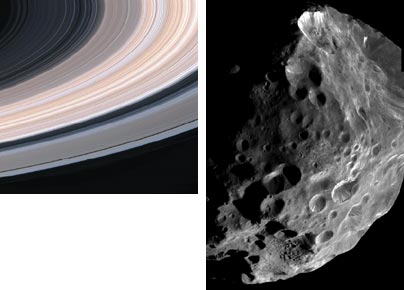
Saturn is second only to Jupiter in its number of moons. In addition to the planet-like Titan, there are currently 34 known icy moons – three of which were discovered by the Cassini probe. Phoebe, which orbits Saturn in the opposite direction from all the other major moons, was known to be a captured object from about 4 billion years ago. However, before Cassini arrived we did not know whether Phoebe was a captured asteroid or comet. The new results, from teams led by Porco, Esposito, Bob Brown and Mike Flasar, clearly show that Phoebe has cometary features – a dark surface with visible traces of ice. This means that the origin of the moon is the outer solar system.

Another one of Saturn’s major satellites is Iapetus, one face of which is 10 times darker than the other. Porco’s results imply that the darker face is probably due to the accumulation of external material, rather than an internal process. However, internal processes are also significant, leading, for example, to a newly discovered equatorial ridge on the dark face. Indeed, Porco and colleagues have unearthed a treasure trove of new data on Saturn’s rings and satellites. These include the discovery of new moons called Methone, Pallene and Polydeuces, new material near the “F-ring” and observations of the effects of moons on the rings.

Overall, the results presented from this early part of the Cassini mission provide an awesome taste of things to come, with new discoveries announced in several different fields. By the time Cassini has completed its 75 orbits, 45 Titan fly-bys and 8 close icy-satellite fly-bys in 2008, we will have re-written the textbooks on Saturn and its system. This is only the beginning.

Copyright © 2026 by IOP Publishing Ltd and individual contributors