New look for molecular transistors

In the quantum regime, particles can act like waves and interfere with each other. However, this quantum interference vanishes as we approach macroscopic length scales as the particles begin to interact with their environment. Physicists usually try to avoid this phenomenon, known as decoherence, when designing and building quantum devices. However, in the quantum interference effect transistor (QuIET) decoherence would act as the “knob” that controls the flow of current through the device.

The QuIET consists of two electrodes attached to an organic ring molecule, such as benzene, in the so-called meta positions on the ring. In this configuration, quantum interference completely suppresses current flow through the molecule and the transistor is effectively “off”. The device is switched “on” when the decoherence caused by a third electrode causes the quantum interference to disappear.

The Arizona team proposed two different ways of switching on the device: bringing the tip of a scanning tunnelling microscope close to the molecule, or attaching an acceptor or donor molecule to it via a short molecular “bridge” (see figure). In the latter approach a nearby gate electrode controls the decoherence through the polarization of this molecule.

“The technology needed to construct this device already exists,” Cardamone told PhysicsWeb. “Both the scanning tunnelling microscope and the mechanically-controllable break junction techniques have already been used to contact individual molecules in a two-terminal configuration. We simply propose combining these techniques to make a three-terminal device.”

One potential advantage of the QuIET approach is that it could work in aqueous environments, such as those inside living organisms, because it is made of organic molecules. The Arizona team are discussing how to make the devices with experimental colleagues.
Unconventional wisdom

A common feature of all superconductors — both the low-temperature and the high-temperature varieties — is that electrons in the material somehow overcome their mutual electrostatic repulsion to form Cooper pairs below a certain transition temperature. These pairs can then condense into a single quantum state and move without electrical resistance. In conventional superconductors, electrons pair up as a result of their interactions with vibrations of the crystal lattice known as phonons. In contrast, it is thought that the electron pairs in unconventional superconductors are formed as a result of interactions with magnetic fluctuations in the material.

In 2002, the same group at Los Alamos and co-workers discovered that an alloy of plutonium, cobalt and gallium (PuCoGa5) exhibited superconductivity below 18.5 K. However, it was not clear if the new material was a conventional or unconventional superconductor. Although it had a similar structure to the heavy-fermion systems, it had a much higher superconducting transition temperature.

In a conventional or low-temperature superconductor the total orbital angular momentum of the two electrons in a Cooper pair is zero — a so-called s-wave state. By contrast, the Cooper pairs in a high-temperature superconductor have two units of orbital angular momentum, which is known as a d-wave state. By measuring the spins of cobalt and gallium nuclei in the plutonium alloy at different temperatures, Curro and co-workers have now confirmed that the plutonium compound is an unconventional superconductor.

“Our results imply that the two classes of unconventional superconductors are not disparate extremes but rather part of a continuum,” Curro told PhysicsWeb. “Plutonium cobalt gallium appears to bridge these two extremes.”

In addition to allowing physicists to explore the phenomenon of unconventional superconductivity in more detail, the results also suggest that related classes of exotic superconductors may yet be discovered.

Cosmic rays enter the “dark” age

Cosmic rays are high-energy particles from outer space that continually bombard the Earth. Although they were first detected in 1912, astrophysicists still don’t know where the most energetic cosmic rays come from or how they are accelerated to such high energies. However, the acceleration of cosmic rays and the production of very high energy gamma-rays are thought to be connected.

Very high energy gamma rays have energies of 1011 eV or more and are thought to be produced by supernovae explosions, pulsars, quasars and massive star forming regions. However, these rays are quite rare and strike the Earth’s atmosphere only about once per month per square metre. The High Energy Stereoscopic System (HESS) measures the Cerenkov radiation — short flashes of blue light — that is produced when the gamma rays are absorbed in the air. This light is collected by the four telescopes in HESS and is then used to create images of astronomical objects as they appear in gamma rays (see figure).

Of the eight sources detected, at least two have no counterparts at radio, optical or X-ray wavelengths. According to the team, these sources could be a new class of “dark” cosmic accelerators. Moreover, the main particles accelerated in these objects are nucleons rather than electrons as in the more conventional sources.

“We have added a new part to the multiwavelength picture of the Milky Way,” team member Stefan Funk told PhysicsWeb. “This information from a new wavelength regime should spark activity in other wavebands such as X-ray and radio to better understand the processes at work in these new sources.” The HESS collaboration now plans to survey other parts of the galaxy.

First light from exoplanets

HD 209458b and TrES-1 were previously discovered using indirect methods: HD 209458b by measuring the “wobble” it causes in the star it orbits around and TrES-1 by so the so-called transit method — where a planet causes its host star to “blink” as it passes in front it. Both planets are known as “hot Jupiters” because they are about the same size as the gas giant but orbit their respective stars much more closely than Jupiter orbits our Sun. This means they receive large amounts of radiation from their host stars and subsequently emit strongly in the infrared part of the spectrum.

The two teams used the Spitzer Space Telescope to make their observations. First they measured the intensity of light coming from the star and planet combined. Next, they measured the intensity as the planet passed behind the star in a secondary eclipse. The difference between the two values was due to the light coming from the planet.

Based on its spectral signature, Deming’s team found that HD 209458b has a temperature of about 857°C (Nature advance online publication). Meanwhile, Charbonneau and colleagues found that TrES-1 is cooler with a temperature of around 787°C (The Astrophysical Journal at press).

“These are very exciting and highly significant new results,” says Andrew Collier Cameron of St Andrews University. “Not only do they represent the first direct detection of radiation emanated by extrasolar planets, but they also yield the brightness temperature in the thermal infrared.”

Since the size of the planets is well known, the observations will allow astronomers to probe the temperature and other properties of the atmospheres of the planets. The results should also help explain why some hot Jupiters like HD 209458b are oversized for their mass and age, while others such as TrES-1 are closer to the expected size for Jupiter-like planets.

New look for nanomotors

Surface tension becomes more important as objects become smaller and it is the dominant force on the micron scale and below. This is why, for instance, insects can walk on water whereas humans cannot. Although electric fields are already used to change the surface tension in droplets of liquid in applications such as inkjet printers, it has not until now been harnessed as a source of force.

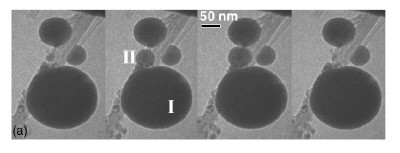
The nanoscale relaxation oscillator made by Zettl and colleagues consists of a “large” drop of molten indium measuring 90 nanometres across placed close to a smaller droplet some 30 nanometres across (figure 1). Relaxation oscillators typically cycle between a fast “relaxation” phase and a slow “recovery” phase. The Berkeley group begins with the slow part of the cycle by applying an electric field through the substrate, which transfers metal atoms from the larger drop to the smaller one.

Using a CCD camera inside a transmission electron microscope, Zettl and co-workers observe that the flow of metal continues until the smaller drop becomes big enough to touch the larger drop, which is shrinking. When this occurs, a hydrodynamic channel is created between the two drops and the pressure difference created between them drives fluid in the opposite direction, from the smaller drop to the larger one. This sets off the fast phase in the device, during which the larger drop quickly “consumes” the smaller drop, allowing the process to begin all over again (figure 2).

The team found it could increase the frequency of the oscillator by increasing the applied electric field from 1.3 volts to 1.5 volts. Relaxation occurs in about 200 picoseconds and 5 femtojoules of energy is released per relaxation event. According to the Berkeley team this means the device could operate at frequencies approaching the gigahertz range.

Einstein on CD

The centrepiece of the CD is a 25 minute eulogy to Einstein by the Irish playwright George Bernard Shaw recorded at a dinner in support of two Jewish charitable organizations at the Savoy Hotel in London on 28 October 1930. Shaw contrasts Einstein’s greatness with that of leaders like Napoleon. Men like Einstein, says Shaw, “are not makers of empires, but they are makers of universes. And when they have made those universes, their hands are unstained by the blood of any human being on earth.”

Shaw goes on to list eight such makers of universes – Pythagoras, Ptolemy, Aristotle, Copernicus, Kepler, Galileo, Newton and Einstein – before drawing a distinction between those who actually made universes as opposed to those who repaired them. “Ptolemy made a universe which lasted 1400 years,” says Shaw. “Newton also made a universe which has lasted 300 years. Einstein has made a universe and I can’t tell you how long that will last.” Einstein replied to Shaw, in German, with a speech entitled “Jewish community”.

The strangest item on the CD is a radio interview with Einstein after he had been made an American citizen in 1940. Recorded after the start of the Second World War, but before the United States joined the war, Einstein reflects on democratic freedom and the responsibilities of science in time of war.

Microscope zooms in on crystallisation

Mirkin’s team began by depositing a tiny drop of poly-DL-lysine hydrobromide (PLH) onto the mica substrate using the tip of an atomic force microscope (AFM) at room temperature. Next, they scanned the tip over the mica surface, covering an area measuring 8 microns by 8 microns, and observed that two triangular-shaped crystals, one of which was just 320 nanometres long, had formed. Then, as they continued to scan the tip across the surface, they saw these two “seed” crystals get bigger and other new crystals form (figure 1).

Overall they found that both the in-plane and out-of-plane growth rates of the crystals could be controlled by scanning the polymer-coated microscope tip across the surface. Control experiments, in which the mica was simply exposed to a solution containing the PLH, resulted in a haphazard formation of crystals with amorphous structures and triangles of various sizes.

When the temperature was increased to 35°C, the team observed that the triangular-shaped prisms changed into cubic-shaped ones (figure 2). Moreover, the size of the smallest crystal they studied was five orders of magnitude smaller than the minimum size that can be studied by X-ray diffraction techniques. This means that new features of crystallisation, which were previously too small to be detected, could now be observed for the first time.

Counting electrons one by one

Single-electron tunnelling events have been observed in experiments with tunnel junctions before now, but the electrons making up the current have never been directly counted one by one. In a tunnel junction two conducting islands of material are separated by thin insulating layers, through which the electrons can quantum mechanically tunnel. Since like charges repel, the electrons are forced to tunnel one by one through the junction.

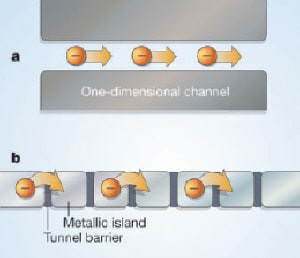
The new experiment also relies on tunnel junctions. Delsing and co-workers began by making a superconducting array that contained a one-dimensional chain of 50 tunnel junctions made of aluminium (figure 1). Electrons were only able to move through the array in one direction (figure 2).

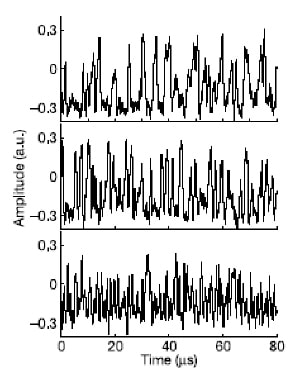
Next, the Chalmers team coupled a single-electron transistor (SET) to one of the islands and injected a current into the array. As the individual electrons pass the island, they modulate the source-drain current in the SET and this, in turn, modulates the radio-frequency power in the SET. By measuring these changes, Delsing and colleagues were able to detect single-electron oscillations in real time (figure 3).

According to the team, the technique could provide a new quantum-based primary standard for current. The oscillation frequency, f, is related to the current, I, by a simple equation, I = e f, where e is the charge on the electron. “This would close the so-called quantum metrological triangle that relates current, voltage and frequency,” says Bylander. Voltage and frequency can be related through the AC Josephson effect, while current and voltage can be related through the quantum Hall effect, with both these relationships including the same two fundamental constants — the Planck constant and the charge on the electron.

Photonic crystal slows down light

Photonic crystals are nanostructured materials in which a periodic variation of the dielectric constant of the material results in a photonic band gap. Photons with wavelengths or energies in this gap cannot travel through the crystal. By introducing defects into photonic crystals it is possible to build waveguides that can channel light along certain paths. It is also possible to construct microcavities that can localise photons in extremely small volumes. Altug and Vuckovic have now demonstrated that photonic crystal arrays can also be used to produce “slow light”.

Two types of velocity are used to describe the propagation of a wave in a dispersive medium: the phase velocity and the group velocity. The phase velocity is the speed at which light of a single wavelength moves. However, a pulse of light contains a range of wavelengths that all move at different speeds, so the group velocity is defined as the speed at which the pulse itself moves. Low group velocities are beneficial for many device applications because they enhance the interactions between the light and the material in the device.

Altug and Vuckovic made an array of 3600 microcavities in a slab of silicon that had an area of 100 square microns. The holes in the array were 400 nanometres across and the period of the crystal was 500 nanometres. The Stanford pair found that the group velocity of a laser pulse was reduced by more than a factor of 100 when it travelled through the array.

The duo is now testing lasers made from their array in an indium-phosphide material. “As a result of the phase-coupled operation of a large number of microcavities and increased interaction between light and the active medium, we can obtain output powers that are comparable to standard semiconductor lasers, but with significantly lowered threshold pump powers and with increased modulation speed,” Vuckovic told PhysicsWeb. “This is important for building optical interconnects for future computers operating at speeds above 20 gigahertz where presently used electrical interconnects have severe limitations.”

Chromium condensate makes its mark

Bose-Einstein condensation occurs when a gas of atoms is cooled to such ultra-low temperatures that the de Broglie wavelength of the atoms becomes comparable to the distance between them. As a result, the atoms collapse into the same quantum ground state. The first Bose condensate was created ten years ago with rubidium atoms, and researchers have since created condensates from eight other elements, including the alkali atoms sodium, lithium, potassium and caesium.

The properties of a Bose-Einstein condensate (BEC) depend on the interactions between its individual atoms. The strength of the magnetic dipole-dipole interaction in BECs made from alkali atoms is tiny, but the corresponding value for chromium — which is a transition metal — is 36 times higher. This is because chromium has a unique electronic structure: the valance shell of its ground state contains six electrons whose spins are aligned parallel to one another. As a result, chromium has a total electronic spin number of three and a very large magnetic moment of 6 Bohr magnetons.

Physicists will therefore be able to investigate not only short-range dipole-dipole interactions — using a so-called Fesbach resonance — but long-range interactions too. Furthermore, the chromium condensate will allow researchers to study many dipolar phenomena and new kinds of quantum phase transitions that have been predicted by theory.

Pfau and colleagues were able to produce condensates with up to 100,000 chromium atoms at a temperature of 625 nanokelvin, which they say provides an excellent base for several promising experiments. In particular, chromium is routinely used as a mask in atom lithography, which means that coherent sources of chromium atoms such as BECs could have applications in nanostructuring, and might even allow for controlled deposition of single atoms on a substrate.

Copyright © 2026 by IOP Publishing Ltd and individual contributors