Can stars become only so big?

At present there is no accepted upper mass limit for stars. Although stellar evolution models have predicted that stars as heavy as 1000 solar masses should be able to form, no such stars have ever been observed.

The probability of finding stars heavier than around 1 solar mass decreases as the mass of stars increases so heavy stars can only be found in massive clusters that contain large populations of stars. The Arches cluster, which lies around 25,000 light years away at the centre of our galaxy, is one such cluster. It contains about 150 hot, young, “single-aged” stars (which are no more than a few million years old) concentrated within a radius of about one light year, making it the most compact cluster of stars in our galaxy. In principle, it should contain a significant number of very heavy stars.

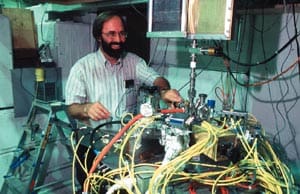
Using the Near-Infrared Camera and Multi-Object Spectrometer instrument on the Hubble Space Telescope, Figer began by measuring the amount of radiation coming from individual stars in this cluster. He used these measurements to calculate the stars’ power output, which in turn allowed him to directly estimate the mass of the stars. He found that no star was bigger than 150 solar masses.

Figer’s results agree with previous, indirect, observations of the “R136” cluster in a nearby galaxy called the Large Magellanic Cloud, where astronomers also did not find any stars heavier than 150 solar masses. However, R136 contains a “mixed-age” population of stars where most of the mass lies in older stars that may have already died and exploded to become supernovae.

“There is no clear explanation for why stellar masses should be limited to near 150 solar masses,” says Pavel Kroupa of the University of Bonn in a related News and Views article in Nature. “A nagging uncertainty remains: the details of supernova mechanisms are not fully understood, and it may be that stars more massive than 150 solar masses did exist [in the Arches cluster] but have already imploded to black holes.”

However, Figer says that stars in the Arches cluster are too young to have reached the supernova, let alone the black hole, stage in their lives.

Laser pioneer scoops religion prize

Born in 1915 in South Carolina, Townes grew up in a Baptist household that prized intellectual pursuits and vigorous debate about the Bible. He raced through the education system and graduated with degrees in physics and modern languages at the age of 19, before receiving a PhD from Caltech in 1939. After a war-time stint at Bell Telephone Laboratories in New York, Townes joined Columbia University in 1948. It was here in 1951 — while sitting on a park bench — that he had a moment of revelation.

Townes, who was using microwaves to study the structure of molecules, conceived a way of amplifying electromagnetic waves by the stimulated radiation emission. Coming like a bolt from the blue, Townes has repeatedly cited the event as a crystallization of how topics that are normally associated with religion or science — revelation, intuition, observation, faith and aesthetics — can easily apply to both disciplines. Townes helped to build the first working “maser” in 1954 and in 1957 he and his brother-in-law Arthur Schawlow at Bell Labs built the first “laser”, which operated at visible wavelengths.

In 1964 Townes was awarded the Nobel Prize for Physics with the Soviet physicists Aleksander Prokhorov and Nikolai Basov, who — working independently — had also conceived of the idea of a laser. In that year, Townes gave a talk on science and religion at his church in Manhattan. The talk, which was later published in an IBM journal called THINK, caused a storm among scientists when it was republished in an MIT magazine called Technology Review. They saw no room in their profession for anything to do with religion. Townes went on to write papers on the boundary of science and religion, including “Why are we here; where are we going?” in 1997.

“While science and religion may seem different, they have many similarities, and should interact and enlighten each other,” says Townes. “Science tries to understand what our universe is like and how it works, including us humans. Religion is aimed at understanding the purpose and meaning of our universe, including our own lives. If the universe has a purpose or meaning, this must be reflected in its structure and functioning, and hence in science.”

New look for the kilogram

Defining the kilogram in terms of the prototype – which is housed at the Bureau International des Poids et Mesures – means that the value of the kilogram changes if the mass of the prototype changes. This can happen if, for example, the object collects dust from the atmosphere, is cleaned or becomes damaged.

In contrast, the other six SI units are defined in terms of atomic or fundamental constants. For example, the metre is defined as the distance travelled by light in a vacuum in 1/299792458 of a second and the second itself is defined as the duration of 9192631770 cycles of the radiation emitted by a particular electronic transition in a caesium-133 atom. These definitions allow researchers to make measurements in SI units without the need for a single “master standard”.

Scientists have proposed two ways to redefine the unit of mass. The first is based on the Planck constant and requires a 1-kilogram mass to be supported against Earth’s gravity using a precisely measured magnetic force. The second technique is instead based on the Avogadro constant, and involves counting a certain number of atoms of a specific atomic mass. However, many believe that any new definition of the kilogram should not come into force until it at least equals the precision of the current definition – that is, 1 part in 108. So far, neither method has achieved better than 1 part in 107.

But Ian Mills of the University of Reading in the UK and colleagues at NIST in the US and the BIPM believe that the International Committee for Weights and Measures (ICWM), which is responsible for ensuring that units of measurement are uniform worldwide, should go ahead anyway and adopt one of the new definitions when it next meets in October 2007 (Metrologia 42 71).

Redefining the kilogram now would have immediate advantages, such as significantly reducing the uncertainties in the values of a large number of other important fundamental constants that are intimately related to the definition of the kilogram say the scientists. For instance, the precision of certain electrical measurements, such as the volt and ampere could be improved by a factor of 50.

A similar change was made in 1983, when the old definition of the metre – the distance between two metal scratches on a platinum bar – was withdrawn.

Atom bomb designer dies

Bethe was born in 1906 in Strasbourg, now in France but then part of Germany. He studied physics at the University of Frankfurt and then carried out research at the University of Munich. He spent time at several other universities but because his mother was Jewish he came into conflict with Nazi race laws. He left Germany in 1933 for England and then took up a position at Cornell University near New York in 1935, where he was to remain for the rest of his career.

Between 1935 and 1938 Bethe carried out research on nuclear theory, in which he predicted the probability of different reactions occurring. This led him to his Nobel-prize winning work, the discovery that stars get their energy from a series of six nuclear reactions, the so-called “carbon cycle”.

In 1943 he went to work on the Manhattan project, and as head of the theoretical physics division made a crucial contribution towards the development of the bomb. After the war he brought a number of outstanding young scientists from Los Alamos back to Cornell, including Richard Feynman, with whom he developed quantum electrodynamics. During his career, Bethe carried out research across the whole spectrum of physics, from solid state theory and disorder in alloys to solar neutrinos and supernovae.

Bethe was also a strong advocate of arms control. In particular he argued against the development of the hydrogen bomb and clashed with the inventor of that device, Edward Teller. He also helped to persuade the US government to ban atmospheric nuclear tests in 1963 and antiballistic missile systems in 1972, and later opposed President Reagan’s “Star Wars” missile defence system.

Total reflection doubles up

When a ray of light that is travelling through a piece of glass strikes the interface between the glass and the air, it changes direction according to Snell’s law. If the angle of incidence is less than a critical angle, which is determined by the refractive index of the glass and the air, the ray is refracted and leaves the glass. However, if the angle of incidence is greater than this critical angle, the ray undergoes total internal reflection and remains in the glass.

In his classic book on optics Newton suggested that the light ray should be slightly delayed in the second medium before re-entering the first. Later, in 1955, the Hungarian physicist Eugene Wigner made a prediction for the value of this delay, but it has not been measured in an experiment until now.

Le Floch and colleagues began by placing a container filled with mercury along the hypotenuse of a glass prism. They then passed a femtosecond laser beam, which was polarised perpendicular to the plane of incidence, through the prism onto the surface of the mercury (see figure). Wigner delays are extremely short so they can only be measured with ultrashort light pulses.

Next, the physicists timed how long it took the light beam to be reflected back through the prism using an autocorrelator. Since reflection from a metal does not involve a time delay, this measurement defines the “absolute zero” in the experiment. The team then removed the mercury and repeated the measurement. The difference between the two results gave an absolute value for the delay from the glass-air interface.

Le Floch’s group found that the delays increased as the angle of incidence approached the critical angle of 43.48°, with the largest measured value being 28 femtoseconds. Moreover, when the experiment was repeated with light that was polarised parallel to the incident plane, the delays reached 57 femtoseconds. This implies that there must be two Wigner delays at total reflection for unpolarised light.

“Newton would probably be surprised by the existence of two different delay times because at the end of the seventeenth century the transverse nature of light was still unknown,” team member Olivier Emile told PhysicsWeb.

The Wigner delays at total reflection could be used to study the new “left-handed” or negative refractive index materials, and materials with photonic band gaps. Moreover, they should also exist for beams of particles such as neutrons according to the Rennes team.

Bubbles feel the heat

In sonoluminescence, the bubbles in a liquid emit light when they are forced to expand and collapse by sound waves. Some physicists believe that the pressures and temperatures inside the collapsing bubbles could be high enough to initiate nuclear reactions. However, the experimental evidence for “sonofusion” remains controversial.

In the latest experiments Kenneth Suslick and Daniel Flannigan of the University of Illinois at Urbana-Champaign find evidence for the formation of a plasma in collapsing bubbles. According to Suslick and Flannigan the formation of a plasma is a prerequisite for a form of fusion known as inertial confinement fusion to take place inside the bubble.

The duo studied xenon- or argon-filled bubbles in sulphuric acid, which has a low vapour pressure, unlike the liquids studied in previous experiments. This means that few if any vapour molecules – which would otherwise absorb too much of the thermal energy inside the bubble and therefore lower its temperature – enter the bubbles.

By analysing the light emitted from a single bubble, Suslick and Flannigan were able to measure the temperature at its surface. To their surprise, they found temperatures could reach as high as 20,000 K. According to Suslick, the emission comes from the plasma formed by collisions of atoms and molecules with high-energy particles inside the bubble.

The scientists say that the temperature inside the collapsing bubble must be even higher than at its surface, but they did not detect any products from fusion reactions. In 2002, and again last year, Rusi Taleyarkhan and co-workers at Purdue University claimed to have seen deuterium nuclei undergo fusion reactions in bubbles in acetone.

“Our results are in such a different set of experimental parameters that they can neither confirm or deny Taleyarkhan’s claims to fusion,” Suslick told PhysicsWeb. “A plasma is a prerequisite but certainly not a sufficient condition for fusion.”

The Illinois scientists now plan to optimise cavitation and explore the conditions generated during bubble collapse. “Is inertial confinement fusion possible in a collapsing bubble? I think the verdict is still out,” says Suslick. “The underlying physics is solid – it is simply a question of whether the collapse can generate a shockwave that is sufficiently intense and remains spherical long enough.”

Galaxies break new records

Christopher Mullis of the University of Michigan and co-workers at the European Southern Observatory (ESO) discovered the distant cluster by sifting through old images from the XMM-Newton satellite. They looked for large X-ray sources that had not been studied before and then took a series of follow-up images of 30 candidate galaxies at optical wavelengths with ESO’s Very Large Telescope (VLT) in Chile. One of these galaxies – now named XMMU J2235.3-2557 – had a redshift of 1.4, which means that it is nine billion light years away and must have formed when the universe was less than a third of its present age. Moreover, the spherical shape of the cluster implies that it has a well-organised and mature structure (Astrophysical Journal to be published).

“By observing that ‘big cities’ were already in place in space nine billion years ago, and that they are not very different from present-day clusters, we can glean fresh information on how the universe evolved,” Piero Rosati of ESO told PhysicsWeb.

Meanwhile, James Houck of Cornell University and co-workers used a similar technique to find a population of extremely bright “young” galaxies in which stars are still forming. They combined infrared observations of thousands of galaxies by the Spitzer space telescope with optical images obtained by the ground-based National Optical Astronomy Observatory Deep Wide-Field Survey in the same region of sky. In this way, the astronomers identified 31 candidate galaxies that could only be seen by Spitzer.

Follow-up observations with Spitzer detected the presence of silicate dust in 17 of these galaxies, and by measuring the wavelengths of absorption features caused by this dust, the team were able to determine the redshifts of these objects. The galaxies date back to when the universe was just three billion years old, or a quarter of its present age (Astrophysical Journal Letters at press).

“This is the furthest back in time silicate dust has been detected around a galaxy,” says Thomas Soifer of the Spitzer Science Center. “Finding silicate dust at this very early epoch is important for understanding when planetary systems arose in the evolution of galaxies.”

Antimatter performs optical gymnastics

The philosopher William James once said that “if you wish to upset the law that all crows are black, you must not seek to show that none of them are – it is enough to produce a single white crow”. Likewise, if you wish to test the so-called CPT theorem, according to which a world constructed of antimatter behaves exactly the same as one constructed of matter, you do not need to create an entire “antiworld”. It would be quite sufficient to show that the frequency of just one transition in a simple anti-atom differs from the value of the same transition in the corresponding ordinary atom.

The question is, by how much? Any gross violations of the CPT theorem – which, more formally, states that a system remains unchanged under the combined operations of charge conjugation, parity reversal and time reversal – have already been ruled out experimentally. As a result, nobody expects any difference between matter and antimatter to be anything other than minute, if, indeed, there is a difference at all.

The laser-spectroscopy tools that have made it possible to measure transition frequencies in ordinary hydrogen to extraordinarily high precision should also be applicable to antihydrogen. This makes hydrogen anti-atoms excellent candidates to test the CPT theorem. Now, researchers in the ATRAP collaboration at CERN have taken an important step along the obstacle-strewn path towards this goal by using lasers to control the production of antihydrogen atoms (A H Storry et al. 2005 Phys. Rev. Lett. 93 263410).

Orbital obstacles

An antihydrogen atom consists of a positron (anti-electron) that is bound to an antiproton by the Coulomb force. Antihydrogen does not exist naturally, since it would immediately annihilate with ordinary matter. It was first produced at the PS210 experiment at CERN in 1995, but the anti-atoms formed were far too energetic to allow precise tests of the CPT theorem. This all changed in 2002, when the first “cold” antihydrogen atoms were produced by the ATHENA and ATRAP experiments, also at CERN (see Physics World October 2002 p3).

The idea behind these experiments can be likened to a space probe trying to enter into orbit around a distant planet: just as the probe has to perform some kind of manoeuvre to stop it just going around the planet and sailing out on the other side, a positron will not go into orbit around an antiproton unless it can jettison some energy and momentum as it passes. The space probe can do this by braking against the planet’s atmosphere or by burning fuel in reverse thrust. However, the positron can only do it if some third body – such as another positron or an electron – arrives just when the positron is near the antiproton to carry off the necessary energy and momentum.

The problem is that antiprotons and positrons are typically produced at speeds close to the speed of light. This means that even if they were to approach one another, they would not stay together for long enough to form a bound state, and during this short time the third body also has to come close. To produce a reasonable amount of antihydrogen the ATRAP team used a variety of decelerating and cooling techniques to reduce the relative velocity of the antiprotons and positrons from some 105 km s-1 to a fraction of 1 km s-1, corresponding to a temperature of about 4 K. The researchers then gave the positrons many chances to combine with the antiprotons by trapping both particles in an electrostatic potential well.

Since the positron has a positive electric charge, while the antiproton is negatively charged, a potential well for a positron is a potential “hill” for an antiproton. The ATRAP team therefore originally adopted a nested-trap configuration, consisting of a hill located in the middle of a well. This caused the antiprotons and positrons to settle into separate regions of the trap, so the particles then had to be coaxed into mixing with one another. It turned out, however, that this mixing procedure produced extremely hot anti-atoms, with velocities equivalent to a gas temperature of 2400 K (a kinetic energy of 0.2 eV). Moreover, being neutral these antihydrogen atoms quickly escaped from the electromagnetic trap.

This is precisely what has to be avoided for spectroscopic experiments, in which the atoms need to be held relatively still within the volume coverable by a laser beam. Magnetic “multipole fields” can do this job by producing central restoring forces on the magnetic dipole moment of antihydrogen atoms. But such magnetic traps cannot be made much deeper than about 0.5 K.

Positive solution

The solution to some of these difficulties was first proposed in 1988 by Mike Charlton, then at University College London, and Bernard Deutch of Aarhus University in Denmark. They pointed out that the positronium, which consists of an electron and a positron in orbit around one another, already carries with it the extra third body (the electron in this case) required to carry off the unwanted energy and momentum. However, since positronium is a matter-antimatter system, it rapidly self-annihilates. Worse still, it is electrically neutral, which means that it cannot be confined in a potential well. Each positronium atom will therefore only get a single shot at getting into orbit with an antiproton and making an antihydrogen atom.

By somehow increasing the radius of a positronium atom, however, these problems can be compensated for to some extent. A larger positronium atom would present a bigger “target” or cross-section to the antiproton, and the electron and positron – being further apart – would not annihilate so quickly.

The ATRAP team has now reported the first results using this new method of synthesizing antihydrogen. The researchers first accumulated some 2.5 x 104 antiprotons from the CERN Antiproton Decelerator and 1.4 x 106 positrons from a radioactive source. Then they placed the different clouds of antiparticles in adjacent potential wells that had opposite signs, rather than the nested structure of previous approaches. Both clouds were then cooled to 4.2 K using liquid helium.

The team then excited a beam of caesium atoms, the outer electron of which is bound by just 3.9 eV, with lasers at visible wavelengths. This produced caesium atoms with an outer electron bound by just 0.01 eV. When the atoms drifted through the potential well confining the positrons, these “loosened” electrons were able to jump into orbit around the positrons.

A well-known feature of such a charge-exchange reaction is a resonance effect that occurs when the electron binding energy in the final state is the same as that in the initial state. Consequently, about one in four of the positrons in the trap produced an excited positronium atom. It would require a photon with an energy of 6.79 eV to directly excite a positronium atom to such an excited state, but sufficiently powerful photon sources at this wavelength are impractical. Being neutral, the positronium atoms then drifted out of the positron well and through the adjacent well containing the antiprotons. Here, a second charge-exchange reaction produced antihydrogen atoms with the same binding energy as both the caesium and the positronium atoms (see figure).

A step closer

What are the advantages of these electromagnetic gymnastics over the original nested-trap method of producing antihydrogen? First, the equality of the binding energies in the two charge-exchange reactions ensures that the anti-atoms have little surplus kinetic energy and should emerge at a temperature of 4.2 K rather than 2500 K. Advanced cryogenic techniques could reduce this to perhaps a few hundred millikelvin in the future, enabling the anti-atoms to be enclosed and studied in a magnetic multipole well.

Second, it may also be possible to tune the principal quantum number, n, of the anti-atoms by adjusting the excitation of the caesium atoms. On the other hand, the very effect that at large values of n increases the positronium lifetime and radius, means that it would take a long time for these high-n antihydrogen atoms to decay to the ground state, which is crucial for high-precision spectroscopy. Such measurements have certainly moved a few steps closer, but it will be several more years before we see the published results in a journal.


Devices that make life modern

In recent decades it has become almost impossible to accomplish anything significant without employing semiconductor devices. New cars are rife with them, from the microchip regulating the fuel injector to light-emitting diodes (LEDs) illuminating the dashboard. Look up at a traffic light and you are increasingly likely to be staring at still more LEDs. Answer your mobile phone and you are invoking another complex chain of semiconductor devices.

Laser pointers and printers, CDs and DVDs, supermarket scanners and fibre-optic communications systems all rely on semiconductor lasers. At the heart of every digital camera and video camera sits a multi-megapixel charge-coupled device made of silicon that records the images falling upon it. Far-more sophisticated silicon detectors can be found at the focus of every major telescope today – as well as at the core of the gigantic particle detectors used at colliding-beam accelerators.

And, of course, we cannot forget computers. Semiconductor microprocessors and memories have converted them into personal, portable, ubiquitous devices that one can purchase for a week’s wages in many places. Without the microchips that made this transformation possible, only government-funded agencies and large corporations could ever have afforded to own and operate computers.

Semiconductors have delivered what not long ago was unimaginable computing and telecommunications power into the hands of the masses. In a certain very real sense, they define what it means to be modern today. Yet if I cast around for useful literature on this revolutionary transformation in human affairs, which has occurred in the 50 or so years since the invention of the transistor, I encounter great difficulty. I can count the good books about the history of semiconductor technology on the fingers of one hand. There are business books aplenty on the rise of Silicon Valley and its innovative culture, for example, but few of them delve very far into the materials science and technology behind this epochal emergence. By contrast, nuclear physics and technology can boast shelves full of good histories and biographies, including a Pulitzer Prize winner by Richard Rhodes.

Thus I am pleased to welcome the addition of John Orton’s new book, The Story of Semiconductors, to the small but growing collection of worthwhile literature on the history of semiconductor science and technology. A professor emeritus of electrical and electronic engineering at the University of Nottingham in the UK, Orton has pulled together a wide-ranging survey that covers nearly all the important technological aspects in the emergence of this oft-overlooked discipline.

And he does so with a fair amount of technical depth. This is not a book for the scientifically faint of heart. There is plenty of physics and chemistry involved in his discussions; readers wanting to crack this book will need a good general grounding in these fields, as well as a fair understanding of electrical circuitry. But I view that as a plus, for it is difficult to understand semiconductor history in depth without digging into the materials science and technology underpinning it.

After a brief summary of semiconductor prehistory in the 19th and early 20th centuries, Orton launches into detailed chapters on crystal rectifiers and the transistor, which was invented at Bell Labs in December 1947 by two solid-state physicists, John Bardeen and Walter Brattain. He includes the crucial contributions of chemists and metallurgists to transistor development during the 1950s – for example the zone-refining and crystal-growing techniques that provided uniform, high-purity germanium and silicon. I especially appreciated the sidebars in which he delves into more technical detail on such topics as “minority carrier diffusion”. This process is crucial to the behaviour of the junction transistor, which was conceived at Bell Labs in early 1948 by William Shockley.

A firm grounding in these basics enables readers to understand bipolar transistors and much of the rest of the succeeding material. There is the obligatory chapter on the development of silicon technology and integrated circuitry, where the focus shifts to field-effect and metal-oxide-silicon (MOS) transistors. After that, Orton provides thorough discussions of compound semiconductors, heterostructures and lasers, and light-emitting diodes. Here on his home intellectual turf he truly shines.

Until I digested the excellent sidebars accompanying these chapters, I never really appreciated the distinction between direct band-gap semiconductors such as gallium arsenide and indirect-gap semiconductors like silicon. Nor had I understood the different methods of epitaxial crystal growth that are used to make thin-film transistors and semiconductor heterostructures. Now I do.

In such a wide-ranging portrait of any discipline as diverse as semiconductor science and technology, however, something will necessarily be overlooked – or at least accorded only passing mention. Here it is the human element. Readers will get little feeling for the distinctive personalities involved in this intriguing story – such larger-than-life figures as Shockley and the co-inventor of the integrated circuit Robert Noyce.

Nor will they be able to appreciate very much of the sociological, political, military and economic impacts of events occurring beyond the field – what historians call “externalities”. This is definitely an “internalist” account of semiconductors focused on the devices they make possible and the materials science and technology behind these gizmos, not a full-fledged intellectual history of their emergence and application.

But that would be expecting too much – and would likely require another 500 pages to achieve! Orton has provided a valuable contribution for those of us studying semiconductor science, technology and industry by packing within a single volume most of what we need to know about its technical content. And he has accomplished this worthwhile task with considerable aplomb, without bogging down less-adept readers in needless jargon.

The Story of Semiconductors will go up onto my bookshelf next to the few other good volumes about semiconductor science and technology. It will come back down often, particularly when I need to understand some technical aspect of this field in greater depth.

Lessons from Beagle

Sometimes the explanations for the failure of a mission are simple and embarrassing, such as confusing metric and imperial units (Mars Climate Orbiter) or inserting sensors upside down (Genesis). Other times the causes are organizational, and the consequences tragic, as was the case with the Columbia Space Shuttle accident. In all cases a panel of experts is appointed to identify the reasons for the failure and make recommendations to prevent the same mistakes being repeated.

Such reports are often eagerly awaited, none more so than that into the loss of the Beagle 2 lander at the end of 2003. The lander, which was the brainchild of Colin Pillinger of the Open University (OU) in the UK, had been developed to search for signs of life on Mars, and it had received unprecedented media coverage for a science project. It was carried to the red planet by Mars Express, a European Space Agency (ESA) mission, and was due to land on Mars on Christmas day. Sadly, it has not been heard from since – although the orbiting Mars Express is currently the source of a steady stream of new results.

Initially, the UK government, which had invested some £25 m in Beagle, and ESA refused to publish the report of a commission of inquiry, arguing that it contained commercially sensitive information, although they did make public the recommendations from the report. However, the full report was finally published last month after New Scientist magazine requested it under the UK’s new Freedom of Information Act. Although the report contains information that is embarrassing for all concerned, it is difficult to understand why anyone would want to keep its contents secret. Last month also saw the publication of responses from the UK government and ESA to an earlier report on Beagle 2 by the science and technology committee of the House of Commons.

The ESA/UK report does not apportion blame for the loss of Beagle, but it does identify a number of “programmatic” errors: the decision to treat Beagle 2 as another scientific instrument as opposed to a spacecraft in its own right; poor management by ESA, the OU and others; and insufficient funding. The commission also identified a number of technical errors, although it is silent on the unhelpful tension that existed between the unashamedly British Beagle team and the space agency.

With the benefit of hindsight, the commission says that ESA should have insisted on full funding for the lander being in place by October 1998. Although the funding failed to materialize, the agency still approved Beagle 2. However, it is easy to imagine the outcry that would have followed any decision by ESA to cancel the project. In its report, the House of Commons committee had called for improvements in “the government’s capacity to respond to major financial commitments at short notice”, but the government’s response to this is luke-warm at best. Mechanisms should certainly be in place to respond rapidly and flexibly to new opportunities, but not at the expense of projects that have already passed through the necessary peer-review channels. It is essential, for instance, that any Beagle 3 mission has to compete with other projects for funding.

There are a number of other lessons for anyone who wants to go into space in the near future. First, university-based teams must concentrate on science and leave the hardware needed for space to the experts. Second, it is not a good idea to rely on the possibility of private support for expensive research projects, no matter how good a salesperson you are.

Copyright © 2026 by IOP Publishing Ltd and individual contributors