Mars Express gets busy

Different molecules reflect sunlight at different characteristic wavelengths and the OMEGA imaging spectrometer analyses reflected radiation in the near-infrared part of the spectrum to identify and map the distribution of various molecules and minerals on the surface of the planet.

Jean-Pierre Bibring and colleagues at the Institut d’Astrophysique Spatiale (IAS) near Paris and colleagues identified dark-coloured iron-bearing silicates in both the northern and southern Martian crust, and localised concentrations of hydrated “phyllosilicates” and sulphates. These minerals may have formed during the early evolution of Mars. They also found frozen water mixed with dust at both poles, covered by a thin veneer of carbon dioxide ice (Sciencexpress 1108806).

In a related study, led by Yves Langevin of the IAS, the OMEGA team found hydrated gypsum – sulphates that are rich in calcium – in the north polar region. This implies that water played an important role in the formation of these minerals. According to Langevin and co-workers the gypsum may have formed when acidic frozen ice reacted with calcium-rich minerals during periods of extensive volcanic activity in the past, or when salt-rich water evaporated from massive outflows of liquid water (Sciencexpress 1109091).

Another team led by Aline Gendrin, also of the IAS, identified hydrated sulphates at much lower latitudes: outcrops in Valles Marineris, Magaritifer Sinus and Terra Meridiani contain kieserite (hydrated magnesium sulphate), gypsum and polyhydrated sulphates. Again, the presence of these minerals is a direct record of the planet’s watery past (Sciencexpress 1109087).

The OMEGA team also reported on how bright, small-grained frost with grain sizes of less than 100 microns at the north pole gradually disappears during the Martian summer to reveal larger-grained permanent ice, with a grain size of about 1 millimetre, lying below (Sciencexpress 1109438). However, the team has not been able to explain why there is so little dust in this ice.

The two remaining papers report evidence for the presence of rock-forming minerals such as olivine and pyroxene, and the presence of water in surface materials such as kieserite. This last result confirms similar findings made by NASA’s Opportunity rover elsewhere on Mars last year.

Neutrinos for geophysics

Neutrinos come in three flavours — electron, muon and tau neutrino. They are also electrically neutral and only interact weakly with other particles, which means that they can pass through thousands of kilometres of matter without being absorbed. However, neutrinos can change flavour or “oscillate” as they pass through matter with, for instance, electron neutrinos oscillating into muon neutrinos and so on. Since the amount of oscillation depends on the electron density in the matter, and since the electron density is directly related to the overall matter density, it should be possible to determine the matter density of the Earth by making accurate measurements of the oscillations.

Winter proposes sending a beam of neutrinos from an accelerator tens of thousands of kilometres through the Earth to a detector on the other side of the globe. In principle, the beam would travel from a proposed “neutrino factory” in the northern hemisphere to a 50,000 ton iron detector in the southern hemisphere. For example, a beam could be sent from CERN in Switzerland through the inner core of the Earth to a detector in New Zealand (see figure).

The first “long-baseline” neutrino oscillation experiment was performed in 1999, when neutrinos were sent through the ground from the KEK laboratory in Japan to the SuperKamiokande detector 250 kilometres away. Plans are also underway to send beams from Fermilab near Chicago to the Soudan lab in Minnesota, 710 kilometres away, and from CERN to the Gran Sasso National Laboratory in Italy, 730 kilometres away.

The main challenge would be building the neutrino factory with a vertical decay tunnel so that the beams passed down through the centre of the Earth. Existing neutrino beams are only a few degrees below the horizontal, whereas the beam that Winter is proposing would have to travel directly downwards. However, he is confident that such an experiment could begin by 2035.

In 2003, physicists at KEK also proposed using neutrino beams to destroy nuclear weapons and last year, an astrophysicist in the US suggested using one of Jupiter’s moons to detect neutrinos.

Longer lives for organic LEDs

Organic light-emitting diodes (LEDs) are potentially attractive for applications because they are easy to process and can emit over the full visible spectrum. Light emission from organic materials relies on electrons and “holes” combining to form excited states called “excitons” that subsequently emit photons when they decay.

A typical LED contains a thin light-emitting layer sandwiched between layers that transport the holes and the electrons. One way of improving the performance of organic LEDs is to increase the mobility of the holes in the hole-transport layer by adding a dopant. This should lead to more holes combining with electrons in the device.

Jun Yeob Lee and Jang Hyuk Kwon at Samsung’s Corporate R&D Center in Yong-In City studied the effect of carbon-60 doping in phosphorescent devices that rely on an organic material called “TDAPB” as the hole-transport layer. Lee and Kwon varied the concentration of carbon-60 in the TDAPB from 0 to 3% while measuring the properties of the device with a spectrophotometer.

They found that the mobility of holes in devices doped with 3% carbon-60 was five times higher than that of pure TDAPB. The current density also increased by a factor of three, and there was a 30% increase in the luminance of the LED.

Doping with 3% carbon-60 also increased the lifetime from 700 hours for the undoped device to 1400 hours. Carbon-60 is an electron acceptor that protects the TDAPB from being “attacked” by excess electrons ejected from the light-emitting layer.

The team says the lifetime can be improved and now plans to optimise the device. The minimum lifetime for real-world applications is 5000 hours.

Astronomers find smallest exoplanet

The discovery was announced by Alex Wolszczan of Pennsylvania State University and Maciej Konacki of the California Institute of Technology at a meeting in Aspen, Colorado, this week. Wolszczan also discovered the first exoplanets — three terrestrial-sized bodies orbiting around PSR B1257+12 — in 1992. Since then astronomers have found more than 100 exoplanets, mostly around conventional stars rather than extreme objects such as pulsars.

The orbits of the three planets discovered around the pulsar in 1992 were almost in exact proportion to the spacings between Mercury, Venus and Earth. The orbit of the new planet is close to the average distance from the Sun to the asteroid belt between the orbits of Mars and Jupiter. Wolszczan and Konacki say that the new planet could mark the fringes of the pulsar’s planetary system, just like Pluto marks the edge of ours.

“Surprisingly, the planetary system around this pulsar resembles our own solar system more than any extrasolar planetary system discovered around a Sun-like star,” says Konacki.

The existence of the pulsar planets provides strong evidence that Earth-mass planets can form just as easily as the much larger gas giants which are known to orbit around more than 5% of nearby Sun-like stars. However, the formation of Earth-like planets requires special conditions, making such planets a rarity, says Wolszczan.

Pulsars are rapidly rotating neutron stars that are formed from the collapsed cores of supergiant stars that have exploded as supernovae. Typically they measure just 20 kilometres across, but are extremely dense and send out highly regular beams of radio waves that are detected as a series of pulses on Earth.

The presence of an object like a planet will cause small changes in the arrival times of the pulses. The new planet was discovered with the Arecibo radio telescope in Puerto Rico.

Global terrorism follows a power law

Clauset and Young analysed a database that contains details of more than 19,900 terrorist events that occurred in 187 countries between 1968 and 2004. According to the database, which is maintained by the National Memorial Institute for the Prevention of Terrorism (MIPT), at least one person was killed or injured in some 7,088 of these events.

The New Mexico pair found that the probability of an event with a severity of x or higher was proportional to x-α, where the scaling parameter α has a value close to two (see figure). Moreover, they showed that the distributions did not fit other “heavy-tailed” distributions like a log-normal curve. According to Clauset and Young, the results show that extreme events like September 11 are not “outliers” but part of the overall pattern of terrorist attacks that is “scale invariant”.

“Unfortunately, the implications of the scale invariance are almost all negative,” Clauset and Young told PhysicsWeb. “For example, because the scaling parameter is less than two, the size of the largest terrorist attack to date will only grow with time. If we assume that the scaling relationship and the frequency of events do not change in the future, we can expect to see another attack at least as severe as September 11 within the next seven years.” Clauset and Young also suggest that the behaviour they observe is an extension of the still unexplained scale invariance between the frequency and intensity of wars.

“I have to say I was quite skeptical at first, if only because so many power laws one sees reported are nothing of the kind – or rather, they might be, but the evidence just isn’t there,” says Cosma Shalizi, a physicist at the University of Michigan who helped Clauset with the work. “The usual methods that physicists employ to fit power-law distributions to data are quite unreliable, but Clauset and Young used reliable estimation methods. Personally, I would be a little more cautious than they are about claiming the distribution is scale-invariant, if only because the range and size of the data set is comparatively small, but this is definitely very careful and important work, and deserves to be taken quite seriously.”

Nanobelts tackle nerve gases

Metal oxide sensors work by measuring the changes in electrical conductance that take place when gas species undergo reduction or oxidation (redox) reactions with the surface of the sensor. The detection sensitivity increases as the sensors are made thinner, but a process called grain boundary poisoning limits the reliability and long-term stability of thin-film sensors.

Metal oxide sensors require high operating temperatures to enhance redox reactions. Shi and co-workers therefore integrated tin oxide nanobelts — ribbon-like single-crystal structures that are as little as 10 nanometres across — with microfabricated heaters. This method reduces power consumption and means that battery-operated miniaturised sensor arrays can be made.

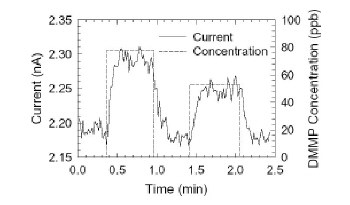
The Texas-Georgia Tech researchers trapped a nanobelt between a pair of platinum electrodes and then deposited a thin platinum coating on the contacts between the nanobelt and the electrodes (figure 1). They then mounted the sensor in a small flow-through chamber and tested its sensitivity to low concentrations of dimethyl methylphosponate (DMMP), a compound that is often used to simulate nerve agents, and nitrogen dioxide in air.

The electrical conductance though the device increased by about 5% when it was exposed to 78 parts per billion (ppb) of DMMP in air at 500°C and changed with the concentration of the nerve agent stimulant (figure 2). Moreover, it was sensitive to concentrations of nitrogen dioxide as low as 200 ppb at 200°C. This is an order of magnitude more sensitive than similar devices.

The current through the nanobelt recovered less than 3 minutes after the gas flow was shut off and the chamber purged with air. In contrast, previous devices took as long as 40 minutes to recover. According to the team, this improvement is due to the absence of grain boundaries in the nanobelt structure and the use of the platinum coating.

“The mass production of devices based on ‘bottom-up’ synthesised nanomaterials has remained a challenging task,” says Shi. “Our work shows that integration of bottom-up synthesised metal oxide nanobelts with ‘top-down’ fabricated microelectromechanical systems (MEMS) can be a viable and efficient approach to large-scale manufacturing of well-organised sensor arrays.”

Optics enters the single-cycle regime

Stephen Harris and colleagues started by shining YAG and Ti:Sapphire laser beams into a cell containing deuterium gas. This produced a set of “sidebands” at wavelengths between 2.94 microns in the infrared and 195 nanometres in the ultraviolet. A liquid-crystal phase modulator was used to change the phase of seven of these sidebands, which were then focussed onto a cell containing xenon gas (see figure).

When the phases of all seven sidebands were the same the experiment produced a train of pulses with durations of 1.6 femtoseconds, separated by 11 femtoseconds. Since the duration is extremely short, the pulse contained wavelengths between 410 and 1560 nanometres – a range of 1.9 octaves. The peak power was 1 MW. By changing the relative phases of the sidebands it was also possible to produce pulses with different time profiles.

“Our light source is unique and may allow the observation of new physical processes,” says lead author Miro Shverdin. “Moreover, shorter pulses could allow faster processes, such as ultrafast molecular dynamics, to be observed.”

The team also plans to investigate various nonlinear optical processes, such as harmonic generation and multiphoton ionisation, with single-cycle pulses.

“End states” come into view

Just as the surface of a material has very different properties from the bulk, the atoms at the end of a one-dimensional structure should behave differently to the other atoms in the structure. However, these zero-dimensional “end states”, which are predicted to be localised to a single atom, had never been seen until now.

Jason Crain and David Pierce at the National Institute of Standards and Technology (NIST) in Boulder created one-dimensional chains of gold atoms by placing small amounts of gold onto a slightly mis-cut silicon surface at high temperature. Each chain contained between three and nine atoms. By making the chains on a semi-insulating surface, as opposed to the metal surfaces used in previous experiments, Crain and Pierce were able to observe the end states with scanning tunnelling microscopy (STM) and scanning tunnelling spectroscopy (STS).

In STM a sharp tip is scanned over the surface while keeping the tunnelling current between tip and sample constant at a given bias voltage. This maintains the tip at constant height and provides an image of the sample’s surface topography. For STS, the tip is held fixed and the bias voltage between the tip and sample is varied. The change in the tunnelling current with the bias voltage gives a measure of the local density of states for the electrons in the sample.

The NIST team found that electrons in the end states had lower energies than those in the inner atoms. Moreover, they were localised to the end atoms, as predicted by theory (see figure).

“Because electrons confined in one-dimensional chains interact strongly with each other, very interesting and unusual properties are expected,” Crain told PhysicsWeb. “Our detailed study of the electronic structure is a first step toward understanding the electronic properties in one dimension. Ultimately, it may be possible to create atom wires for applications in nanoelectronics.”

The duo now plans to explore how the quantum states in the chains change as the temperature is lowered to absolute zero.

Astronomers find missing baryons

According to the standard model of cosmology, the universe is made up of about 70% dark energy, 25% dark matter and 5% ordinary baryonic matter. The nature of this dark energy and matter is the biggest mystery in cosmology today. However, there were also puzzles about the ordinary component of the universe: luminous matter in stars and galaxies accounts for less than 10% of the baryonic matter, with hot gas in galaxy clusters and intergalactic hydrogen accounting for another 30-40%. Until recently the rest of this matter had escaped detection.

Computer simulations of galaxy formation predict that a large number of the remaining baryons should be found in hot, low-density intergalactic gas. One way to detect this missing matter directly is to look for the characteristic absorption lines of heavy elements, such as oxygen and nitrogen, in the spectra of objects known as blazars.

Fabrizio Nicastro and colleagues at the Harvard-Smithsonian Center for Astrophysics, Ohio State University, the University of California at Berkeley, UNAM in Mexico and the Massachusetts Institute of Technology used the space-based Chandra telescope to observe X-rays from a blazar called Markarian 421.

Nicastro and co-workers detected oxygen and nitrogen absorption lines in the spectrum of two filaments of “warm-hot intergalactic medium” at distances of 150 million and 380 million light-years from the Earth. In 2003 the same team found similar evidence for the missing baryons much closer to home in our “local group” of galaxies.

“Only now with the discovery of these two filaments of warm-hot intergalactic medium at cosmological distances can we definitely claim to have observed these baryons and estimate the mass density of this component in the universe,” Nicastro told PhysicsWeb. “This turns out to be fully compatible with predictions and with the amount of missing baryons. However, our observations also seem to suggest that the actual number of baryons could actually be larger. This would of course pose a problem in our current, widely accepted, cosmology scenario.”

The observations could also allow astronomers to start studying the chemical history of the universe. “This is something for which we do not really have ‘a theory’,” says Nicastro.

A genius who knew nothing

Sir Lawrence Bragg was my professor in my student and early teaching days. To his family he was Willie, and only became Sir Lawrence because his father was already Sir William. If I refer to him as Willie it is simply to avoid ambiguity; of course, I never thought of him or addressed him so. The two Braggs had shared the 1915 Nobel Prize for Physics for inventing X-ray crystallography; Willie, at 25, was the youngest winner ever. His pride, however, became tinged with regret since it was assumed too easily by others that his father was the originator who was generously recognizing help from his son.

In fact it was Willie – a research student at the time – who had the big idea about reflection from crystal planes, and who was later to show such skill in interpreting the diffraction patterns. Sir William’s principal contribution lay in instrument development. Theirs was a real collaboration, but not without tensions. We youngsters who knew him as Cavendish Professor in post-war Cambridge knew nothing of the bouts of depression, the sense of inadequacy and the rare but explosive angers of the suave and kindly Edwardian gentleman who had charge of our destinies.

Having become famous at the very outset of his career, Willie – who was then not yet 30 – succeeded Rutherford first at Manchester and then, 20 years later, at Cambridge. But unlike Rutherford, he had little knowledge of nuclear physics or a desire to learn more. Bragg had been a student long before the discovery of quantum mechanics, and was too busy to catch up following its appearance. So when Linus Pauling came on the scene as a very real rival in the 1950s, Bragg faced a skilled quantum theorist and unquestionably a greater chemist. We cannot be surprised to learn of a German scientist in the 1930s wondering “How does Bragg discover things? He doesn’t know anything”. The only possible answer is that he loved what he was doing, believed research was his most important task, and was prepared to spend all the time needed for his powerful and distinctive imagination to get to grips with a problem. As the Cambridge geophysicist Teddy Bullard once remarked, “Bragg can’t stand having anyone cleverer around, and it’s lucky for the Cavendish he’s so clever himself”.

With his limitations and hatred of administration, how well did he cope at the Cavendish Laboratory? In the vernacular of the time, jolly well. He had to reconstruct everything in 1945, with no hope of recovering the lab’s pre-eminence in nuclear physics but with a queue of talented wartime graduates longing to get their teeth into research. With Norman Feather’s aid, he took his pick and encouraged individual research groups to make their own way, breaking from the monolithic Rutherford tradition (which was not, in fact, quite so monolithic as legend has it).

From this initiative sprang conquests in radio astronomy, low-temperature physics, metal physics and, in due course, molecular biology – the finest Cavendish achievement of all. He also got the university’s agreement to appoint a laboratory secretary and an accountant so that in the end, and against the odds, he himself could find time for research – encouraging and inspiring Max Perutz and John Kendrew in their all-but-impossible ambition to resolve completely the structure of a protein.

“When I was stuck,” Perutz told me, “I’d talk to Bragg and he always had a suggestion for overcoming the difficulty.” From the few conversations that I had with Bragg at the time, I know this was true – the old buffer was not past it by a long chalk.

Bragg left the Cavendish in 1953 to become director of the Royal Institution (RI), just as his father had done in his time. His immediate predecessor, the spasmodically likeable Edward Andrade, had very nearly wrecked it. The story of his dismissal and of Bragg’s appointment is told in the book in some detail and is wryly amusing if one can forget the accompanying private agonies.

It was at the RI that Bragg fully developed Michael Faraday’s tradition of lectures “to a juvenile auditory”. He had never been wholly successful in lecturing to students but he threw himself into the task of making science exciting to schoolchildren and revealed an enviable gift for analogy and metaphor. He was, perhaps for the first time in his life, really happy while at the RI – having a duty that was a pleasure, a talented team of researchers, and a wife, Alice, who had always given him the love and support he needed. She had talents of her own, and a commanding but friendly presence that had earlier graced her stint as mayor of Cambridge. As a Justice of the Peace, she had expected students to set a good example; to one, charged with a cycling offence, the policeman on duty whispered, “You’re for it, my lad, Lady B’s on the bench”.

I have said little about the science, which is central to the book. The pioneering analysis of mineral structures by X-ray crystallography was a cerebral sport demanding severe concentration, trial and error, and the special genius that was Bragg’s. In this first-ever biography of Bragg, Graeme Hunter – a biochemist at the University of Western Ontario – has done his best to explain the science without a mathematical deluge. However, I fear that many readers – including those who are scientifically literate – will find the details heavy going, even if they will thoroughly enjoy the human story. Bragg himself might have done the trick, but it takes a certain familiarity with crystallography to follow the account with confidence.

All the same, the reticent academic gent was a very important creator, whose life story makes excellent reading.


Copyright © 2026 by IOP Publishing Ltd and individual contributors