Do pentaquarks really exist?

In 2003 evidence for a novel family of particles called pentaquarks was reported by researchers working on a number of different experiments. The prospect of such a particle – which contains four quarks and one antiquark – has generated a huge amount of interest among theorists because, if confirmed, it would prove that quarks experience powerful correlations that had not been anticipated (see “Quarks, diqaurks and pentaquarks” Physics World June 2004 pp25-30).

Last year, however, the experimental pendulum swung the other way: several experiments with large data samples saw no evidence for the claimed pentaquark. As 2005 begins, we anxiously await news from what could prove to be a definitive experiment with the CLAS detector at the Jefferson Laboratory in Virginia.

Novel combination

Most particles are either mesons, which contain a quark and an antiquark, or baryons, which comprise three quarks. A proton, for example, is a baryon that contains two “up” quarks and one “down” quark, while a positive kaon is a meson that contains an up quark and a “strange” antiquark. But the theory of the strong force – quantum chromodynamics (QCD) – allows for other types of baryons, providing that the number of quarks minus the number of antiquarks is a multiple of three. In particular, it allows for particles containing four quarks and one antiquark.

The pentaquarks reported in 2003 contained two up quarks, two down quarks and a strange antiquark. Such a particle is said to possess positive strangeness. The trouble is that the novel particle should decay into two lighter particles (i.e. a baryon and a meson) so quickly that these exotic states would effectively be unobservable. Indeed, it was the absence of baryons with positive strangeness that, in part, helped to establish the quark model in the first place.

Particle physicists think of the lifetime of a particle in terms of its “width”, which is basically the spread in its rest energy or mass: the larger the width, the shorter the lifetime. Conventional baryons that decay by the action of the strong force have widths of the order of hundreds of MeV, but the claimed pentaquarks turn out to have widths of less than 10 MeV. It is perhaps this feature of pentaquarks that creates the most tantalizing challenge from the perspective of QCD: while it is possible to interpret the pentaquark as a combination of four quarks and an antiquark, the challenge is to explain why it survives of the order of 100 times longer than expected.

In more than 10 experiments worldwide, researchers have found evidence for a pentaquark state known as θ+(1540), where 1540 is the mass of the particle in MeV (see, for example, A R Dzierba et al. 2004 arXiv.org/abs/hep-ex/0412077). Several of these, such as the LEPS experiment at the SPring-8 facility in Japan, reported a signal in the decay channel θ+ →K+n, where K is a kaon and n is a neutron. In this “photoproduction” reaction, a beam of photons is directed at a stationary target such as deuterium or carbon-12, and researchers effectively count the number of times a positive kaon plus a neutron is produced.

Other experimental groups, such as the DIANA collaboration at the ITEP laboratory in Moscow and the CLAS team, saw the same narrow state in reactions that produced neutral kaons and protons: θ+ →K0p. And although not seen at other experiments, the NA49 collaboration at CERN claimed evidence for a heavier version of the θ+ called the Ξ—(1860), which contains two strange quarks, two down quarks and one up antiquark. Similarly, researchers working on the H1 experiment at the DESY laboratory in Germany claimed to have seen a “charmed” cousin of the θ+ pentaquark, which is made up of two up quarks, two down quarks and one charm antiquark.

Experimental doubts

At first sight these results are impressive. However, in 2004 a series of theoretical criticisms and, perhaps more significantly, negative experimental searches began to appear. These include “hadroproduction” experiments at Fermilab, Los Alamos and Brookhaven, in which beams of protons, nuclei and kaons are bombarded with other hadrons; “electroproduction” experiments at the HERA accelerator at DESY, in which electron beams are used; and high-statistics studies of the decay of the Z boson using the now dismantled LEP accelerator at CERN.

Moreover, there appear to be inconsistencies with the experiments reporting evidence for pentaquarks. For instance, one of the potential pentaquark peaks has a width that appears to be much larger than the upper limit of 1 MeV inferred from other data, and there are also some tantalizing variations in the reported mass of the θ+. For the nK+ signals it is unambiguous that any θ+ state must have a strangeness of +1, but signals seen in pK0 decays could come from strangeness +1 or -1, and could therefore be due to a θ+ or a conventional state known as the Σ+.

In some experiments the narrow state has been assumed to be θ+ on the grounds that no narrow Σ+ is known at such masses. However, one has to note that until recently there was no evidence for a narrow θ+ either; the absence of an established Σ+ therefore proves little about the interpretation of such a narrow state. Furthermore, there appears to be a systematic mass shift between signals in the nK+ and pK0 data, with the former suggesting a slightly higher mass for the θ+ than the latter (see figure).

Special signal

The first and subsequent sightings of the θ+ pentaquark have tended to be in photoproduction experiments. Indeed, the signal with the best statistical significance comes from experiments in which high-energy photons collide with protons to produce a pion, a kaon and a θ+, which then decays into a neutron and a positive kaon (nK+). This decay has a peak with a statistical significance of seven standard deviations at a mass of 1550 ± 10 MeV and a width that is smaller than the resolution of the detector. Could it be that there is something special about photoproduction that aids the appearance of the θ+, whereas hadroproduction is disfavoured?

If photoproduction is special, then the θ+ should be clearly visible in dedicated high-statistics experiments that are currently under way at the CLAS spectrometer at the Jefferson Laboratory. It had been hoped that the first of these experiments would be ready to report results last summer, but this has been delayed. A positive signal from this experiment in 2005 would be very significant; a negative result could be potentially even more so.

Claims for the existence of pentaquarks have inspired intense studies of the theory and phenomenology of QCD in the so-called strong-interaction regime. In particular, it has led to the discovery that the strong regime may contain unexpected correlations among groups of two or three quarks and antiquarks. These experiments have thus opened up new lines of theoretical investigation that may survive even if their original inspiration – the exotic θ+ pentaquark – turns out to have been a chimera.

Einstein calling

Of all the Einstein-related events planned for academic physicists this year, the Physics 2005 conference (10-14 April, University of Warwick, UK) certainly has the most impressive programme so far. A stellar array of speakers will report from the cutting edge of modern physics and astronomy under four broad themes: relativity and cosmology; physics in biology; light and matter; and quantum physics. More details about the meeting, which is being organized by the Institute of Physics (the publishers of Physics World), are available at www.physics2005.iop.org.

Goals for the year of physics

Good physics teachers in schools, it goes without saying, are essential if physics is to remain in a healthy state. People become interested in physics for all sorts of reasons (parents, science fiction, something they read or see on television), but who has ever studied for a physics degree despite having a bad physics teacher? Sadly, many countries are in a vicious circle when it comes to physics teachers: fewer physics students leads to fewer physics teachers, leads to fewer students and so on. The different education systems in different countries mean that there is no single solution to these shortages, so the relevant national physical societies need to work with professional teaching organizations and governments to tackle the problem.

We should also recognize that there is something different about people who want to study physics at university: it is more than innate curiosity or mathematical ability, it is a streak of idealism or independence that takes them down a path that does not lead to a well-defined career. The physics community must ensure that such students are not somehow deterred from studying physics at university. It must also do more to tap into this mixture of curiosity and independence in girls and various minorities that are currently underrepresented in physics.

As already mentioned, good teachers are essential. So are lively and relevant curricula for schools: there is plenty going on in modern physics and astronomy to excite the young – the Huygens mission, iPods, DVDs and more – and it is possible to include the latest developments without sacrificing the basics (see “Back to the future” Physics World January 2004 p33). Better careers advice is also needed: many students and parents have little or no idea about the range of careers in education, research, business, industry, the City and elsewhere that are open to physics graduates.

Professional physicists must also tailor their material when speaking to young people: while it was good to see so many students at the launch of the International Year of Physics in Paris last month, too many of the talks were too difficult for the predominantly young audience. Finally, all these efforts must continue after 2005. It will be several years before we know if the year of physics has been a successful experiment. There has certainly been a lot of media coverage of physics and Einstein in the past month, but the acid test will be the numbers of young people studying physics at schools and universities in years to come.

Shelf life: John Singleton


What are the three best popular-science books?

Popular-science books are often flawed in that the author uses the final few chapters to promote his or her often very dated or extremely shallow “philosophical” views on life, the universe and everything. The problem is not that physics has no bearing on life, the universe and everything – of course it does. What annoys me is the seamless transition from what is generally accepted by the physics community to speculation.

In my experience, budding physicists at school often skip the conceptually difficult chapters and end up in the “philosophy” at the end. This material rarely offers a widely accepted world view but is just another scientist sounding off about “the mind of God” etc. And if students then takes another book and land in another author’s rant, they become very confused indeed.

So a popular-physics book should (a) convey enthusiasm, (b) clearly delineate speculation and reasonably widely held opinion, and (c) perhaps educate. Having interviewed many prospective undergraduates, my choices are as follows.

The Mr Tompkins books by George Gamow, as revised by Russell Stannard. Although the approach may appear dated, the books convey the excitement and apparent counterintuitiveness of our subject very well indeed.

A Short History of Nearly Everything by Bill Bryson, who has emerged as the most successful popular-science writer for many years. His explanatory work is excellent, and appeals to many non-scientists I know who were completely defeated by, for example, Stephen Hawking. It completely outclasses the outpourings of most scientists attempting to write for a popular audience.

Last, but not least, is The Physics of Musical Instruments by Neville Fletcher and Thomas Rossing. Many physicists and mathematicians are amateur musicians; and many musicians have an instinctive grasp of maths. This book is good for dipping into. (I keep it in the bathroom.)

What books are you currently reading?

Too Hot to Handle – Frank Close’s book about cold fusion, which I picked up second-hand.

Power from the Wind by Palmer Putnam, which examines early attempts with large-scale windmills and describes the spectacular failure of the amusingly named Grandpa’s Knob turbine.

The Story of Semiconductors by John Orton – a worthy book, although it is daunting to find that things on which I was working are now history.

What else are you reading?

For entertainment, The Cunning Man by Robertson Davies. For edification, the Old Testament, for the sixth time.

Which popular-science book have you never read, but feel you ought to have tackled?

I have Stephen Wolfram’s A New Kind of Science on my bookshelf but have not yet succeeded in starting it. I think that the length and the style have something to do with it, but I will get into it one of these days. A flight to Japan might be a good starting point, although the thing is very large and heavy.

Surviving graduate school

Anyone who has done a PhD knows that you go through an educational phase transition. You are no longer instructed by others, but instead teach yourself. You cease acquiring basics and begin assimilating values and behaviours that allow you to participate in the scientific way of life. It is an apprenticeship that cannot be condensed into a set of rules.

Survivors of graduate education, however, come to appreciate the fact that certain valuable maxims distil much wisdom. I don’t mean vague injunctions like “persevere”, “adapt” or “network”; they are good and true but possess all the functionality of your horoscope. Nor do I mean the practical advice on shelter, food and companionship (“choose a romantic partner who knows PowerPoint”) that is generic to graduate life. What I mean are useful maxims for the blossoming physicist. Let me illustrate.

Never means three months

I once learned an important lesson from Andrew Kevey, who used to be chief spectrometer engineer at the High Flux Beam Reactor (HFBR) at the Brookhaven National Laboratory in the US. While learning the ropes at the lab’s previous neutron source – the Graphite Research Reactor – Kevey’s advisor had told him to design and build a small calibrated turntable on which to mount crystals for a spectrometer. Kevey asked how much load it would have to bear. A few ounces, came the reply – never more than a pound.

Three months later, the advisor – whose research programme now involved magnetic properties – handed Kevey a 50 pound magnet and asked him to install it on the turntable. Kevey protested, citing the advisor’s earlier remarks about the load.

“You idiot,” the advisor exploded, “don’t you know that, in physics, never means three months?”

This important maxim, Kevey explained to me, is a condensed way of saying be prepared for rapidly changing demands and revised expectations.

Build in the centre of the room

Brookhaven physicist Laurence Passell discovered a related lesson while a graduate student at Berkeley. His advisor, who was conducting experiments in low-temperature physics, had instructed Passell to prepare an experiment in a new basement laboratory. When Passell first walked into the still-empty lab and began to set up, he ran into a more experienced graduate student who cast a disdainful eye on Passell’s first efforts. “Let me give you a piece of advice,” the student said. “Always start building your experiment in the centre of the room.”

“I laughed at the time,” Passell recalls, “but the advice was extremely useful.” For doing physics, he explains, means embarking on a random walk. Regardless of the direction in which you set out, you rarely know where you will end up. And experimental divagations expand radially. So lesson two is: give yourself as much space as possible.

Don’t make it better than necessary

Passell learned another important lesson at Berkeley: don’t make your equipment better than it needs to be. “The best piece of scientific apparatus is one that falls apart the day after you finish using it,” he explains. Violation of this principle cost Passell a research programme at the HFBR in the late 1960s. He was planning to use a new neutron spectrometer that was being built by a perfectionist retired navy officer who was aiming to build the best of its kind in the world. But as Passell recalls, the officer never asked himself “Is it good enough?”. Instead, he asked “Is it as good as I can make it?”.

“The answer, of course, was always no,” says Passell.

At one key juncture, for instance, the officer became dissatisfied with the crude but effective shielding method that had to be realigned each time the beam direction was shifted. As the spectrometer drum turned to change the angle of the neutron beam, a series of wedges would lift up out of the way of the beam before dropping back down on the other side. Unhappy with this rudimentary design, the officer instead began installing an elegant system in which a rotating cone block inside the drum automatically realigned all the shielding.

Passell looked on, horrified, as the device tore up the spectrometer’s budget and wrecked its construction schedule. His research programme was soon terminated.

“An experiment is perfect when the equipment is just good enough,” he concluded.

Over-extend yourself

A fourth key maxim that I have often heard scientists mention is: if you really know what you are doing, you should not be doing it. For if you know that much, someone else has probably already done – or is about to do – what you are intending. Your results, in other words, will soon be obsolete. As Fermilab’s former director Robert Wilson liked to say, “Something that works right away is over-designed, and consequently will have taken too long to build and will have cost too much.” Doing science effectively and efficiently requires you to over-extend yourself to the point where some things will not go as planned.

This principle is, of course, a secret. You won’t find it in textbooks, nor will you hear science administrators publicly endorse it. Their job is to know it and cover it up.

The critical point

Shacheenatha Jha, a physicist from Case Western Reserve University, liked to tell his graduate students that “When you start telling me what you want to do, instead of me telling you what I want you to do, you are ready to graduate.” Acquiring the requisite autonomy to do that cannot be captured in a finite set of rules.

Nevertheless, every scientist who has successfully endured the process learns a set of maxims for effective action. These ought to be compiled and passed on for the benefit of future generations. I therefore invite you to send me the most important one you learned in the course of your PhD training or other learning period, along with an example. I shall discuss your comments in a future column.

• What is the most important thing you learned in graduate school? Send your advice to Robert P Crease at the address given below, or by fax to +1 631 632 7522, or by e-mail rcrease@notes.cc.sunysb.edu

Friction at the nano-scale

In the scramble to revolutionize the world with nanotechnology we must not ignore friction. Nano-scale devices based on moving molecular components have the potential to radically alter technologies such as energy storage, drug delivery, computing, communications and chemical manufacture. But getting these devices from the laboratory to the marketplace is far from guaranteed.

It is simply not clear if nano-scale structures can be made mechanically and chemically resistant enough to withstand the extreme conditions that can exist inside the human body, or in any of the other hostile environments where nanomachines might be expected to operate. The shearing-off or melting of even a single layer of atoms can easily spell death for a nanomachine, and this is before commercial issues such as energy efficiency or profitability are addressed (see “The future of nanotechnology” Physics World August 2004 pp25-29).

The chemical and mechanical stability of moving nanostructures underlie the field of nanotribology – the study of friction and wear at atomic length and time scales. Last year turned out to be a banner year for this field, with an impressive upsurge in both experimental and theoretical work. This included substantial progress in our understanding of how mechanical instabilities contribute towards overall friction levels, and pioneering experimental techniques for bridging the gap between nano-scale and macroscopic phenomena.

Centuries-old friction

Historically the study of friction has been driven by economic considerations. For example, by paying more attention to what is already known about friction and wear, developed countries could save up to 1.6% of their gross national product. The loss – which is estimated to be as much as $100 billion per year in the US alone – arises because entire mechanical systems are routinely discarded whenever only a few of their parts are badly worn. And the energy consumed in the manufacture of a car, for example, is equivalent to that consumed in 100,000 miles of operation.

Given how little actually is known about friction, the potential impact on the economy and society associated with an improved knowledge of tribology is nothing less than mind-boggling! But progress in this field has been slow, and the interest of physicists in tribology has waxed and waned over the centuries.

Modern tribology began some 500 years ago, when Leonardo da Vinci deduced the laws governing the motion of a rectangular block sliding over a planar surface. Hundreds of years later, in 1699, the French physicist Guillaume Amontons published the first formal account of the classical, macroscopic friction laws. He found that the frictional force that resists the sliding motion between two interfaces is directly proportional to the perpendicular force that squeezes the surfaces together. Moreover, the frictional force is independent of the apparent area of contact. A brick standing on its end, for example, experiences the same friction as when it is laid flat. Charles Augustin de Coulomb later proposed a third law of macroscopic friction, which states that at ordinary sliding speeds the frictional force is independent of velocity.

These classical laws of friction hold for a remarkably wide range of materials, but they are equally remarkable in terms of how difficult it is to derive them from fundamental atomic or molecular principles. It is reminiscent of the situation in thermodynamics before statistical mechanics came to the rescue. The roughness of a surface was ruled out as a possible mechanism for most types of friction by the 1970s, and was replaced by the notion that the atoms in two materials may bond together and resist sliding as the materials are pressed into contact. Unfortunately, this “adhesive bonding” view of friction, which was promoted by Philip Bowden and David Tabor of Cambridge University in the 1960s, does not make any predictions about the magnitude of the frictional force or the mechanism of energy dissipation that gives rise to it.

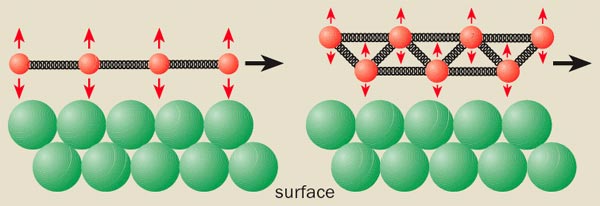
Tabor ultimately became convinced that friction in the absence of wear – the tearing off of fragments along the sliding interface – must be due to the build up of strains between the interfaces that were then released in the form of atomic vibrations called phonons. Phonons, which were first suggested as a mechanism for friction by G A Tomlinson in 1929, are produced when the mechanical energy required to slide one surface over another is converted to sound, which is eventually transformed into heat (figure 1). Tabor was aware of no experimental evidence that such phononic friction existed, but he was soon to be vindicated by a growing community of surface scientists.

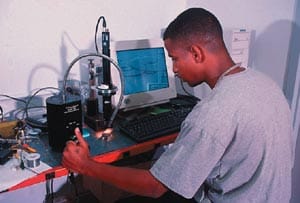
Today, there are perhaps 100 physicists and other scientists worldwide who lead work on nanotribology (figure 2). This situation has come about largely due to the availability of new experimental and theoretical techniques in the 1970s and 1980s, which gave rise to a renaissance in experiments exploring the microscopic origins of friction. Devices such as the quartz crystal microbalance and the lateral force microscope, for example, can measure the friction due to a single contacting interface. This scenario is vastly simpler to study than that of macroscopic objects, where friction reflects the collective behaviour of a multitude of contacts.

In 1991 the present author and colleagues, then at Northeastern University in Boston, used a quartz crystal microbalance – a device that is so sensitive that phonons modify its vibrational properties – to measure the friction of krypton monolayers that were sliding on a gold surface. Our results ultimately proved the existence of phononic mechanisms of friction, whereby phonons are excited in the adsorbed layers. Indeed, to the best of my knowledge, the term “nanotribology” first appeared in print in the title of the paper announcing these results (see Krim et al. in further reading).

To stick or to slip

One of the most common types of friction at the macroscopic scale, and also one of the most frustrating, is static friction. This is the force that is needed to get an object to move in the first place, and it is almost always larger than the force that is needed to keep the object moving. Among other factors, static friction can depend on how long the two surfaces have been in contact with one another.

A closely associated phenomenon is that of “stick-slip” friction, whereby the transition from static to sliding friction leads to repetitive sticking and slipping at certain speeds. This is the mechanism responsible for the familiar screeching noises associated with car brakes.

For monolayers sliding along atomically uniform substrates, however, there is essentially no static friction. Indeed, the friction in these systems can be up to 105 times less than that for macroscopic lubricants such as graphite. This raises questions about the fundamental dissipation mechanisms that are at work in systems at different scales. For example, do these mechanisms play a substantive role in wear-free friction at the macroscopic scale, or do they dominate only in simple geometries? Is a lack of a stick-slip phenomenon always associated with exceptionally low friction levels, and, if so, can the results be applied to meso- (intermediate) and macro-scale systems? A series of new experiments is now under way to unravel these mysteries.

In 2004 Ernst Meyer and co-workers at the University of Basel used a lateral force microscope to observe the transition between stick-slip and continuous sliding for the first time. This instrument, which is common in nanotribology research, is a modification of an atomic force microscope and consists of a sharp tip mounted on a flexible cantilever. As the tip is dragged over the surface of a sample, the cantilever is deflected by an amount that depends on the friction between the tip and the substrate.

Meyer and colleagues monitored silicon-tipped cantilevers as they slid along atomically uniform crystals of sodium chloride. By varying the normal load on the cantilever tip, the system could be made to enter (and return from) a state of ultralow dissipation with no mechanical instabilities or stick-slip behaviour. These data were modelled successfully using a Tomlinson model, in which friction is the result of mechanical instabilities that give rise to phonons. While the results support the idea that vibrational mechanisms can cause energy dissipation in a variety of geometries, they do not completely rule out other mechanical models.

For example, Alexander Filippov of the Donetsk Institute for Physics and Engineering in the Ukraine and colleagues at Tel Aviv University in Israel have developed a mechanical model of friction at the micro-scale that is based on two rigid plates separated by elastic springs. The springs can spontaneously break and reform upon contact to represent the collective behaviour of the constituent molecules. An external “drive” force is then applied to the system, and the rate of bond rupture and formation with respect to the sliding speed determines the macroscopic response. Filippov and co-workers found that stick-slip behaviour is present in cases where there is a co-operative rupture of bonds, and the presence of static friction depends on experimental conditions and timescales.

Their model therefore establishes a relationship between macroscopic observables and the dynamics of microscopic bonds at the sliding interface. Force measurements alone do not allow one to establish a microscopic picture of friction, but it will be essential to understand the links between macroscopic response and microscopic dynamics if we are eventually going to unravel the origins of friction.

Superlubricity has stuck

The relative structure of two surfaces that are in sliding contact with each other also has a profound influence on the phononic contributions to friction. For instance, friction is especially great when the surface atoms are equally spaced and aligned with the counterface atoms against which they are sliding. Although the vast majority of sliding interfaces do not meet these conditions, friction in such “commensurate” systems can be more than 1010 times greater than the friction between “incommensurate” surfaces.

The possibility that phononic friction can be exceptionally small between two atomically incommensurate surfaces has been referred to as superlubricity by some researchers. This is unfortunate, since the “resistance” does not drop to zero, as in the case of superconductivity or superfluidity, but instead simply arises from low levels of phononic friction associated with the structural incompatibility of the sliding surfaces. Even if phononic friction was to drop to zero, a very small amount of frictional energy would still be dissipated due to electronic and/or photonic excitations.

In March last year, Martin Dienwiebel and co-workers at Leiden University in the Netherlands found evidence for “superlubricity” in graphite using a purpose-built force microscope that could measure forces as low as 15 pN (15 x 10-12 N). The Leiden team captured a graphite flake on the end of a tungsten tip and measured the friction as it was slid along a crystalline graphite substrate (the contact area of the flake was estimated to be a mere 96 atoms). The researchers then brought the flake in and out of perfect commensurability with the graphite surface by rotating it into positions where the atoms were no longer aligned. As expected, high levels of friction were present in the commensurate positions and extremely low friction was found when the surfaces were incommensurate.

The Leiden experiment provides further evidence that Tomlinson-type mechanical vibrations are a fundamental source of macroscopic friction, and Dienwiebel and co-workers claim that such vibrations could account for the lubricity of graphite at the macroscopic scale. However, this is not the first time that nanotribologists have linked nano-scale lubricity to macroscopic friction, the tacit assumption being that extremely low friction coefficients and/or extremely high interfacial slip levels at the atomic level are in some way linked to macroscopic lubriciousness. The trouble is that the coefficients of friction measured in nanotribological experiments and in macroscopic “tribotests” routinely differ by orders of magnitude.

To test this microscopic hypothesis, our group recently used a quartz crystal microbalance to monitor the nano-dynamical motion of molecules in organophosphate film samples in which the macroscopic friction coefficients are well known. We were astonished to discover that molecules that could flex or slide even just a little in response to the oscillatory motion of the microbalance were linked to low friction levels at the macro-scale. Put another way, exceptionally low friction at the atomic scale was not a prerequisite for the substantial reduction in macroscopic friction.

Last year Martin Muser of Johannes Gutenberg Universitat in Mainz, Germany, explored theoretically what happens when two chemically inert materials slide with respect to one another. Muser allowed the interactions between the two materials to vary, which had a great impact on overall friction levels. For example, whenever elasticity dominates at all length scales, the two solids move essentially as rigid blocks. In the absence of wear this would result in exceptionally low friction levels, which suggests that 3D crystals that form a perfectly flat 2D interface should exhibit super-low friction levels. Muser points out, however, that this “structural lubricity” is very likely to be lost in its entirety for the vast majority of everyday surfaces. The applicability of nanotribological results for meso and macro applications thus remains open to debate.

The meso-scale regime

Microelectromechanical systems (MEMS), which integrate mechanical and electronic components, are currently fuelling a billion-dollar industry. But tribological issues are holding back the development of a myriad of MEMS devices – such as rotary gears, microturbines and relay switches – that could form the building blocks for more sophisticated “on-chip” systems. Indeed, there are no commercially available MEMS devices that contain surfaces that are in sliding contact simply because MEMS are exceptionally susceptible to friction and wear. And you cannot simply add traditional lubricants such as oil because these microfabricated structures succumb rapidly to capillary forces in the presence of liquids (figure 3).

Michael Dugger and co-workers at Sandia National Laboratories in the US have recently developed on-chip MEMS friction testers capable of detecting friction forces as small as 5 μN. A MEMS friction tester typically consists of tens of contact regions, while nanotribological techniques typically involve only one. The devices therefore help to bridge the gap between nano- and macro-scale phenomena. Although this approach only works for simplified contact geometries, the surface structure and chemistry of the devices duplicate those found in more complicated systems that have been targeted for certain applications. The testers are also proving to be useful in fundamental studies of friction.

Maarten de Boer and colleagues, also at Sandia, have recently developed an on-chip MEMS “nanotractor” that is dedicated entirely to fundamental studies of friction. This instrument, which is able to creep along a surface in nanometre steps, was designed specifically to study the validity of Amontons’ law – which states that the frictional force is proportional to the weight of the moving object – at the micro- to meso-scale (figure 4).

The nanotractor can measure both static and sliding friction coefficients, and is capable of progressive movements that mimic decreasing “weight”. Boer’s group, in collaboration with Bob Ashurst at the University of California at Berkeley, found that Amontons’ law holds for normal forces ranging from 50 μN to more than 1 mN. For forces less than 50 μN, the researchers found deviations from Amontons’ law indicative of the increased significance of molecular forces for very low external loads.

In addition, the Sandia team has discovered a “gross slip” phenomenon that happens before the static-friction limit had been reached. The gross sliding, which is about 100 times larger than theoretically expected, is very important in MEMS design, especially in cases where an object must be positioned with nanometre accuracy for optical applications. Work is now in progress to cast the experimental observations onto a firm theoretical footing.

The future for friction

The potential for nanotechnology to transform civilization as we know it is breathtaking, and the nanomechanical systems of the future will all require new atomic lubrication schemes to overcome the debilitating effects of friction. But in order for this impending revolution to be fully realized, we need a fundamental understanding of friction at the atomic to meso-scale.

Moreover, the tribological considerations of these systems will be an integral aspect of the system design, rather than the “after the fact” application of lubricants that is so common at the macro-scale. Finally, the dreams of a nanotechnological revolution will only be realized by training both existing and future scientists and engineers in nano-scale phenomena – an area that is largely absent, for instance, in the present curriculum. The time to start is now.


Making a splash

Scientists have been interested in splashes since at least the late 19th century when A M Worthington photographed what happens when drops of milk or mercury hit a smooth surface. Harold Edgerton and colleagues also photographed drops hitting thin layers of fluid in the 1950s. In general, when a drop hits a solid surface it spreads out and breaks up, creating a splash of smaller droplets.

Sidney Nagel and colleagues at Chicago have now seen something that no one has seen before by releasing drops of alcohol from various heights onto a glass microscope slide inside a vacuum chamber and recording what happens with a high-speed video camera. The team used three liquids with different viscosities (methanol, ethanol and 2-propanol) and four gases with different molecular weights (helium, air, krypton and sulphur fluoride) inside the vacuum chamber. Moreover, they varied the pressure in the chamber from just 1 kilopascal up to 100 kilopascals (atmospheric pressure).

To their surprise, the Chicago physicists found that the surrounding gas played a key role in the splashing process. In particular, they found fewer droplets were ejected from the surface as the pressure was lowered, and that no droplets emerged below a threshold pressure (see figure). They also found that the threshold pressure scaled with the molecular weight of the surrounding gas. Moreover, they found that 2-propanol, which has the largest viscosity of the three liquids, had the lowest threshold pressure.

Cosmologists win Crafoord award

In the standard model of cosmology the big bang was followed by an extremely short period of exponential expansion called inflation, after which the universe continued to expand at a slower rate. During inflation quantum fluctuations in the very early universe were stretched into the density variations that eventually led to the clusters of galaxies and other structures we see in the universe today.

The first traces of this structure can be seen in the tiny variations in the temperature of the cosmic microwave background — the radiation left over from the big bang. Maps of the cosmic background — which provide a picture of the universe as it was 380,000 years after the big bang — also lend support to the “concordance model” in which 5% of the universe is made of ordinary baryonic matter, 25% is dark matter and 70% is dark energy. The nature of dark matter and dark energy remains a mystery.

Peebles, now at Princeton University, predicted some of the most important properties of the cosmic background in the 1960s. He also quantified how galaxies clustered together to form large-scale structures over time and played a leading role in developing theories of “cold dark matter”.

Gunn, also at Princeton, studied theoretical aspects of galaxy formation and proposed important observational tests for dark matter candidates in galaxies. He has also been closely involved in the Sloan Digital Sky Survey, which is the most extensive 3D map of the universe to date.

In 1968 Rees — who has spent most of his career at Cambridge University — was the first to predict, with the late Dennis Sciama, that fluctuations in the microwave background were due to the uneven distribution of matter in the universe. And with Simon White, he was the first to identify the central role of dark matter in the formation of large-scale structure. More recently, he has developed theories about the formation of the first stars and galaxies. He has also written several popular science books.

The three scientists will receive the prize, which is worth US$500,000, from the King of Sweden in September in Stockholm.

Winters warm up

Martin Beniston of the University of Fribourg analysed data from 11 climate recording stations in Switzerland and found that the incidence of warm winter spells has increased since 1970. In 2003, for instance, the average temperature recorded at Saentis, a town in the northwest of Switzerland, was 15°C above the seasonal average during the winter, compared with 11.5°C for the summer. A similar pattern was observed in data from other stations. Moreover, climate simulations for the period 2071–2100 suggest warm winter spells are going to become more common.

Beniston says that these anomalies could be caused by the North Atlantic Oscillation or Atlantic El Niño – a cyclic pattern of atmospheric pressure variability that affects the weather of North America and Europe. According to pressure records from Bern and Zurich, persistent high pressure over Switzerland has more than doubled since the 1960s, leading to higher mean temperatures, lower than average precipitation and reduced snow cover in the Alps.

“Warm winter spells can lead to early snow melt, winter-time floods, problems for the ski industry, an early start to the vegetation cycle of alpine plants and so on,” says Beniston. “Understanding the causes and consequences of these events could lead to environmental and economic strategies for the future as the climate continues to warm.”

Antiprotons galore

The antiprotons are produced when high-energy protons collide with an iridium target, and are then decelerated from 3.5 GeV to 5.3 MeV by the AD, which delivers about 20 million antiprotons in short pulses or “shots” at 100 second intervals. However, these antiprotons are still too energetic for most experiments, including the “recombination” of antiprotons and positrons to form antihydrogen. Previous efforts to reduce the energy to the keV range by passing the beam through a “degrader” foil have only been able to capture about 25000 antiprotons in a typical AD shot.

Yamazaki and colleagues replaced the degrader foil with a radio-frequency quadrupole decelerator (RFQD) — a device that slows the particles with a series of electric fields. This allowed the team to decelerate between 5 and 9 million antiprotons to keV energies in a single AD shot.

The antiprotons were then injected into a multiring trap (MRT), where they were confined by a combination of an electric field and a strong magnetic field. Since the antiprotons have already been decelerated by the RFQD, it is easier to contain them in the MRT. The antiprotons can be cooled further through collisions with cold electrons that have been preloaded into the trap.

Yamazaki and co-workers obtained as many as 1.2 million cold antiprotons per AD shot using this method. Moreover, they were able to extract a small number of monoenergetic antiprotons with energies in the range 10 to 250 eV as the particles continued cooling.

“I believe we are about to open up a new research field with ultraslow antiproton beams”, says Yamazaki, who is based at RIKEN and the University of Tokyo. In addition to performing the most accurate ever tests of CPT (charge-parity-time) symmetry by comparing the spectra of hydrogen and antihydrogen atoms, the antiprotons could be used to study how antimatter interacts with gravity and to make the best ever measurement of the magnetic moment of the antiproton.

Copyright © 2026 by IOP Publishing Ltd and individual contributors