Making microscopes go faster

An atomic force microscope (AFM) works by measuring how the force between the sample and a tiny “tip” on a cantilever changes as the microscope is moved over the surface of the sample. This allows the AFM to record images with extremely high spatial resolutions. Previous attempts to increase the time resolution of AFMs have focused on scanning the tip over the sample as quickly as possible, but these techniques have had time resolutions of a few tens of milliseconds at best.

Higher temporal resolutions can be obtained by using the AFM in a “force-sensing” mode, which can detect movements from a single point on a sample. Moshiur Anwar of the Massachusetts Institute of Technology (MIT) and the University of California at San Francisco and Itay Rousso of MIT and the Weizmann Institute of Science have now developed a technique in which a series of individual force-sensing measurements are combined to construct images.

The new “step-scan” technique relies on breaking down a sample into individual pixels and then measuring the dynamics of each pixel separately with the AFM. The method, which only works for period processes, can resolve features 10 nanometres across with a time resolution of 5 microseconds.

“The temporal resolution is not affected by the scan area and is limited only by the resonance frequency of the AFM cantilever and the data acquisition electronics – which is often not a limiting factor,” Rousso told PhysicsWeb. “The beauty of the technique is that it does not require any complicated and expensive modifications to the microscope and can be applied to almost any commercial system.”

Anwar and Rousso demonstrated the technique with a calibration grid, but they have also produced images of biological samples. “Applying this technique to biological systems will be very powerful because we will be able to image the processes in real time under physiological conditions,” said Rousso.

Nanotubes respond to gas attacks

Carbon nanotubes are rolled up sheets of graphite that display novel electronic properties as a result of their one-dimensional structure. Nanotubes also display mechanical strength along their length, but can be easily deformed in the radial direction.

Hugh Romero and Peter Eklund of Pennsylvania State University, and Kim Bolton and Arne Rosen of Göteborg University and Chalmers University of Technology have now shown that the tiny deformations or dents caused by collisions with various gas species can change the electronic properties of the nanotubes.

The team measured how the thermoelectric power and electrical resistance of thin films containing bundles of single-wall nanotubes (SWNT) changed when they were exposed to the various gases at a pressure of around one atmosphere. The nanotubes in the sample were between 1 and 1.6 nanometres in diameter and several microns long.

Romero and co-workers studied the effects of collisions of inert gas atoms (helium, neon, argon, krypton and xenon) and small molecules (methane and nitrogen), and found that changes in both the thermopower and the resistance increased with the cube root of the mass of the atom or molecule.

“Our work shows that carbon nanotubes can be used to detect gases that are very difficult to observe with current measurement techniques,” says Bolton. “When the walls are deformed by collisions with a gas, the flow of electricity is hindered and this allows us to measure the presence — and pressure — of the gas.”

Nanowires form atomic switch

“Our device can solve all problems that today’s semiconductor devices have,” says Tsuyoshi Hasegawa of the National Institute for Materials Science (NIMS). “By reducing the size of the mechanical device to the atomic scale, it shows much better performance than that of the semiconductor devices.”

Hasegawa and colleagues at NIMS, ICORP-SORST/Japan Science and Technology Agency and RIKEN operated their “quantized conductance” atomic switches by controlling the formation of an atomic bridge between two wires spaced about 1 nanometre apart. One wire was platinum while the other was silver sulphide (Ag2S), which is a solid electrolyte. Applying a positive bias voltage to the silver sulphide caused a silver nano-protrusion to form, creating a bridge between the two wires.

The presence of this bridge boosted the conductance between the wires, putting the switch into its “on” state. Applying a negative voltage, on the other hand, caused the silver bump to shrink, breaking the atomic bridge and switching off the device. The conductance through the device can be as small as one quantum unit of conductance, which suggests that the silver bridge can touch the platinum lead with just one atom.

The team found that the devices worked repeatedly – more than 105 times – and in both air and a vacuum. The switches worked at speeds of 1 megahertz, similar to those of today’s semiconductor devices. The team believes its switches could function at 1 gigahertz, although the capacitance of the wires meant that it was not possible to measure speeds this fast.

“Since an atom is much heavier than an electron, people think that atomic switches should show less performance than electronic devices,” says Hasegawa. “We had to break the common sense by showing the data.” The researchers also made AND, OR and NOT logic gates by combining the switches. “Our device can be used in most electronic products, such as memories and logic circuits for computers,” he said.

By using pulsed bias voltages to tailor the length of the nano-protrusion, the team was able to switch between four of the quantized conductances of each device in a 1 x 2 array. The system worked as an adder circuit, and also as a multi-state memory – it memorized 16 states using just two switches. According to Hasegawa, the researchers are now aiming to use their switches in commercial devices, in conjunction with an electronics company. In the longer term, they plan to work on conceptually new computers.

All-silicon laser makes its debut

Silicon dominates the microelectronics industry but it is not used in photonic applications because it does not emit light efficiently. Last year, however, researchers at the University of California at Los Angeles discovered a way to exploit the Raman effect and achieve laser action in silicon, although their device needed an eight metre long optical fibre to work. The Raman effect, which uses vibrations in a material to create optical gain, is routinely used in the telecommunications industry to amplify optical signals.

Now, Haisheng Rong and colleagues at Intel labs in Santa Clara, California and Jerusalem in Israel have made a compact all-silicon Raman laser on a single silicon chip. Rong and co-workers started by making an S-shaped silicon waveguide with standard photolithography and etching techniques. The waveguide had an effective core area of about 1.6 square microns and was around 4.8 centimetres long. Next, they fabricated the Raman laser optical cavity by coating one of the waveguide facets with a highly reflecting material.

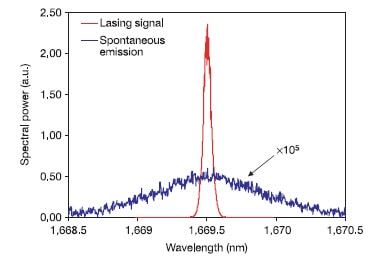
The Intel team then pumped the cavity with pulses from a laser operating at a wavelength of 1536 nanometres (figure 1). The optical cavity began to lase at a wavelength of 1669.5 nanometres when the pump power reached 0.4 microwatts (figure 2). At present the device can only operate for about 100 nanoseconds before a process called two-photon absorption stops the laser action.

“The laser was fabricated in an existing Fab using standard high-volume manufacturing processes,” says Victor Krutul, technology strategist for silicon photonics at Intel. “Intel, as well as other researchers, is now working to solve the two-photon absorption problem so that the real breakthrough — a continuous-wave silicon laser — can be attained.” Krutul adds that the goal of the company’s silicon photonics research programme is to “siliconize” all the components needed to build a device known as a transceiver.

Einstein’s quest for unification

The definitive scientific biography of Einstein, Subtle is the Lord…, which was written by Abraham Pais in 1982, delivered an unequivocal verdict on Einstein’s quest for a unified field theory. Pais wrote that the time for unification had not come, and that Einstein’s work “led to no results of physical interest”. But a lot of water has flowed under the bridge of unification since then, allowing us to look back with perhaps more indulgence as we celebrate the centenary of Einstein’s 1905 papers.

Let us briefly recall the relevant physics that was known in the 1920s, when Einstein embarked on his quest. The only known subatomic particles were the proton and the electron: the neutron and the neutrino, for example, were not predicted or discovered until the 1930s. Most “fundamental” physicists were striving to understand quantum physics – an endeavour from which Einstein stood apart. The structure of the nucleus was regarded as an interesting but secondary problem, and the unification of forces was considered, in the words of Pais, a minor issue.

For Einstein and his few unification-minded colleagues the big issue was to unify general relativity – a theory of gravity – with Maxwell’s electrodynamics. Theodor Kaluza and Oskar Klein proposed starting from a 5D theory, which contained an extra “compactified” spatial dimension in addition to the three spatial and one temporal dimensions of everyday experience. Electromagnetism then emerged naturally from this extra dimension.

Perhaps more so than Pais, we now recognize these early theories as breakthroughs in unification because of their many echoes in the supergravity and string theories of the past 20 years. Einstein was an early enthusiast; as he wrote to Kaluza in April 1919, “The idea of achieving unification by means of a five-dimensional cylinder world would never have dawned on me…At first glance I like your idea enormously”. Kaluza published his idea in 1921, which Einstein pursued in his first unification paper with Jacob Grommer the following year. Indeed Einstein was to return to 5D theories every few years for the rest of his life.

However, even Einstein had to admit that his unification papers were not always ground breaking. For example, after some initial confusion he recognized that the two papers he wrote in 1927 were equivalent to the work of Klein. But he might have been happy to know that some of today’s particle physicists will search for Kaluza-Klein excitations using the Large Hadron Collider at CERN. Einstein had hoped to identify quantum fields with such higher components that only arose in the 5D theories.

Another recurring theme in Einstein’s quest for unification was to generalize the “metric” of relativity – the symmetric tensor that describes the curvature of space-time – so that it could also describe the electromagnetic field. He pursued many apparently blind alleys, such as asymmetric generalizations of the metric, and even postulated that there might be no tensor at all. As Einstein himself said in a letter to Klein in 1917, “this process of deepening the theory has no limits”.

Unfortunately, these ideas were unsuccessful. For example, in his first unification paper in 1925 the antisymmetric part of his tensor field was not suitable for describing all the components of the electric and magnetic fields. Indeed, none of Einstein’s unification attempts ever reproduced the free-field Maxwell equations. In Einstein’s defence, it should be mentioned that we now recognize that other types of antisymmetric tensor fields emerge naturally from string theory. However, this type of theory had not been invented in Einstein’s day.

A more basic problem with many of Einstein’s proposals was that they did not include the general theory of relativity itself. However, in his final years following 1945 he returned to a theory with a fundamental tensor that was not symmetric and would include both the metric and the electromagnetic tensor, which avoided some of these problems.

No stone left unturned

It is difficult to accuse Einstein of leaving stones unturned – no matter how unpromising they might appear. For example, in the early 1940s he even toyed with the idea that nature might not be described by partial differential equations. Modern theorists can hardly be accused of excessive conservatism, but even they have not revived this startling speculation!

What is most impressive about Einstein’s quest for unification was his persistent indefatigability. He tried many different ideas, and often returned to earlier theoretical haunts, such as Kaluza-Klein theories, with something new to say. However, the truth is that he was adrift from many of the most important developments in physics at the time. For instance, he was famously sceptical – if not downright hostile – towards quantum physics, and he does not seem to have followed closely the discoveries of new particles and interactions. More surprisingly, perhaps, he seems to have missed out on some of the most far-reaching new theoretical ideas of that period, which now play key roles in modern approaches to unification.

For example, Einstein recognized Hermann Weyl’s seminal 1918 work on scale transformations in four dimensions, even paying it the backhanded compliment that “apart from the agreement with reality, it is at any rate a grandiose achievement of the mind”. Weyl’s ideas led to the discovery in the late 1920s of local phase transformations, which laid the foundations for the gauge theories of the weak and electromagnetic interactions in the 1950s and beyond. However, Einstein was never involved personally in these far-reaching developments.

He also seems to have been affected by frequent mood swings during his quest for unification. On several occasions he switched rapidly from unwarranted optimism about the prospects of a new idea to complete rejection. More alarmingly, his mood often swung in the full glare of publicity. For many years a new scientific paper by Einstein was a major public event, with hundreds of journalists hanging on the utterances of the great man. The closest present-day parallel would be Stephen Hawking and his recent comments on black holes and quantum mechanics.

Einstein’s legacy

Why were Einstein’s papers on unification not more successful? It is surely insufficient simply to say that only young theorists have brilliant new ideas. The many distractions of fame in his later years should also not get all the blame. Einstein himself wrote in his early years that “formal points of view…fail almost always as heuristic aids”. But later he seems to have abandoned this insight in his quest for unification, and instead was seduced more by mathematical novelty than by physical intuition.

It could be, however, that Einstein was simply ahead of his time, since even if he had been following contemporary physics more closely, the information available before his death was probably insufficient to make significant progress in unification. For example, the unification of the weak and electromagnetic interactions in the 1960s required many unforeseen experimental discoveries as well as new theoretical ideas. Even now, the unification of gravity with the other interactions – which was Einstein’s true dream – still eludes us.

Following Einstein, most theoretical physicists assign a central role to geometrical ideas. Most of the particle-physics community believes, for example, that string theory provides the appropriate framework for realizing Einstein’s dream. Here, fascinating generalizations of Kaluza and Klein’s hidden dimensions, such as “Calabi-Yau manifolds”, are able to dispose of the several extra dimensions required by the theory. However, not all general relativists are convinced, and there is absolutely no experimental evidence for string theory. Are we also in danger of being seduced by formal beauty?

Although some of the unification ideas pursued by Einstein are now recognizable in developments such as string theory, this is not to say that Einstein’s work actually inspired these modern unification attempts. It seems to me that the real significance of Einstein’s quest for unification lies in its quixotic ambition. Einstein, more than any of his contemporaries, put unification on the theoretical map and established it as a respectable intellectual objective. Even if we do not have all the necessary theoretical tools or experimental information, unification is the “holy grail” towards which our efforts should be directed.

Do you play dice?

Note added 1 April 2005: The winner of the quiz below was Diego Castedo of the Department of Physics at the Universidad Mayor de San Andrés in La Paz, Bolivia. He got all but two of the questions right, including the fact that Einstein was not left-handed, was not a vegetarian (except in the last year of his life), and did not approve the patent for the Toblerone chocolate bar while working in the Swiss patent office; the latter story appears to be an urban myth. The correct answers are given at the bottom of this page.

Facts and figures

All the answers to the following questions appear somewhere in this issue.
1. From which university did Einstein receive his PhD?
2. How many children did Einstein have with his first wife Mileva?
3. Which two musical instruments did Einstein enjoy playing?
4. How many references did Einstein include in his first 1905 paper on special relativity?
5. What part of Einstein’s body was not cremated after he died?
6. Which university currently owns Einstein’s papers?

Who said that?

7. Who told Einstein to “stop telling God what to do”? (A. Niels Bohr B. Paul Dirac C. Werner Heisenberg)
8. When asked if it was true that only three people in the world understood Einstein’s theory of relativity, who is reported to have said, “I’m just trying to think of who the third person might be”. (A. Arthur Eddington B. Edwin Hubble C. Max Planck)
9. Who declared during a colloquium by Einstein, “You know, what Mr Einstein said is not so stupid!”. (A. Paul Ehrenfest B. Wolfgang Pauli C. Erwin Schrödinger)
10. Shortly after Einstein first became known in the physics community, who said, “I only hope and wish that fame does not exert a detrimental influence on his human side”. (A. His friend Michele Besso B. His sister Maja C. His first wife Mileva Maric’)
11. Who declared in 1966 that Einstein “was almost wholly without sophistication and wholly without worldliness”? (A. Robert Oppenheimer B. I I Rabi C. Victor Weisskopf)
12. Who said that Einstein’s work on general relativity was “one of the greatest – perhaps the greatest – achievements in the history of human thought”? (A. W H Bragg B. Ernest Rutherford C. J J Thomson)

Mix and match

About whom did Einstein say the following? Match the six quotes to the six people.
13. “He was one of the finest people I have ever known…but he really did not understand physics.”
14. “[He] was as good a scholar of mechanics as he was a deplorable philosopher.”
15. “She has a sparkling intelligence, but despite her passionate nature she is not attractive enough to present a danger to anyone.”
16. “He is truly a man of genius…I have full confidence in his way of thinking.”
17. “She is an unfriendly, humourless creature who gets nothing out of life.”
18. “He was one of my dearest acquaintances, a true saint, and talented besides.”
A. Niels Bohr
B. Marie Curie
C. Paul Langevin
D. Ernst Mach
E. Mileva Maric’
F. Max Planck

True or false?

19. The FBI kept a file on Einstein.
20. Einstein was left-handed.
21. Einstein was a vegetarian.
22. Einstein approved the patent for the Toblerone chocolate bar while working in the Swiss patent office.
23. Einstein won the Nobel prize for his work on special relativity.
24. Einstein worked on the Manhattan nuclear-bomb project for the Allies.

Answers
1 Einstein’s PhD was from the University of Zurich.
2 His first wife Mileva had three children.
3 The two instruments he could play were the violin and the piano.
4 There were no references in Einstein’s first 1905 paper on special relativity.
5 Einstein’s brain was not cremated after his death.
6 His papers are currently owned by the Hebrew University of Jerusalem.
7 A (Niels Bohr)
8 A (Arthur Eddington)
9 B (Wolfgang Pauli)
10 C (Mileva Marić)
11 A (Robert Oppenheimer)
12 C (J J Thomson)
13 F (Max Planck)
14 D (Ernst Mach)
15 B (Marie Curie)
16 A (Niels Bohr)
17 E (Mileva Marić)
18 C (Paul Langevin)
19 True
20 False
21 False
22 False
23 False
24 False

Relativity at the centenary

When I was a first-term graduate student in the late 1960s, it was said that the field of general relativity was “a theorist’s paradise and an experimentalist’s purgatory”. There were some experiments – Irwin Shapiro, for instance, had just measured the effects of general relativity on radio waves as they passed the Sun – but the field was dominated by theory and by theorists. This seemed to reflect Einstein’s own attitudes: although he had a keen insight into the workings of the physical world, he felt that the bottom line was the theory. As he once famously said, when asked how he would have reacted if an experiment had contradicted the theory, “I would have felt sorry for the dear Lord. The theory is correct”.

Since that time the field has been completely transformed. Today, at the centenary of Einstein’s annus mirabilis, experiment has become a central component of gravitational physics. I know of no better way to illustrate this than to cite a paper by the LIGO Scientific Collaboration that was published in Physical Review D last year (see Abbott et al. in further reading). This was one of the papers reporting results from the first science run of the Laser Interferometer Gravitational-wave Observatory (LIGO), but with 374 authors from 41 institutions in 8 countries it is reminiscent of particle physics, not general relativity.

The breadth of current experiments – ranging from tests of classic general relativity such as the Shapiro delay and the bending of light, through space-based measurements of “frame-dragging” to searches for gravitational waves or violations of the inverse-square law – attests to the ongoing vigour of experimental gravitation. With all this data, can we still be sure that Einstein was right?

Testing the foundations

At the heart of the general theory of relativity is the equivalence principle – an idea that came to Einstein two years after he developed special relativity and led him to the dramatic conclusion that mass and gravity are intimately linked to the curvature of space-time (see figure 1 and Box 1: Special and general relativity).

Put in simple terms, the equivalence principle states that gravity and acceleration are equivalent. Embellished over the years, this idea is now called the Einstein equivalence principle and encompasses three separate principles: the weak equivalence principle, and the principles of local Lorentz and local position invariance.

The weak equivalence principle states that test bodies fall with the same acceleration independent of their internal structure or composition: in other words gravitational mass (the m in F = GMm/r2, where F is the gravitational attraction between two masses a distance r apart and G is the Newtonian gravitational constant) and inertial mass (the m in F = ma, where a is the acceleration caused by any force F) are the same. There is also a strong version of the equivalence principle that goes beyond the weak version by stating that gravitational energy will fall with the same acceleration as ordinary matter and other types of energy in a gravitational field (see Box 2: Self-energy and the strong equivalence principle).

The principle of local Lorentz invariance states that the outcome of any local non-gravitational experiment carried out in a freely falling reference frame is independent of the velocity of that frame, while the principle of local position invariance holds that the outcome of any local non-gravitational experiment is also independent of where and when in the universe it is performed. In this context “local” means confined to a suitably small region of space and time, while “freely falling” means falling freely under gravity with no other forces acting.

Although Einstein used it to derive general relativity, his equivalence principle implies only that gravitation must be described by a “metric theory” – a theory in which matter responds to the geometry of space-time and nothing else. However, general relativity is not the only metric theory of gravity, and other examples include the “scalar-tensor” theory developed by Carl Brans and Robert Dicke at Princeton University in 1961, building on earlier work by Markus Fierz and Pascual Jordan.

When it comes to testing metric theories of gravity, we need to distinguish between the weak-field limit, which is valid in the solar system (see figure 2 and Box 3: Testing metric theories in the solar system), and the strong-field regime that is needed to describe regions where gravity is extremely strong, such as in the vicinity of a black hole or a neutron star. If we are being really ambitious, we might also try to describe situations where gravity is strong and quantum effects are important, such as during the Big Bang, but that is a separate story (see “Welcome to quantum gravity”).

In non-metric theories matter can respond to something other than the geometry of space-time, and this can lead to violations of one or more pieces of the Einstein equivalence principle. For instance, in the string theories that seek to unify gravity with the other three forces of nature, the equivalence principle is violated because matter can respond to additional long-range fields. Searching for violations of the Einstein equivalence principle is therefore a good way to search for new physics beyond the standard metric theories of gravity.

In the balance

To test the weak equivalence principle one compares the accelerations of two bodies with different compositions in an external gravitational field. Such experiments are often called Eötvös experiments after Baron von Eötvös, the Hungarian physicist whose pioneering experiments with torsion balances provided a foundation for Einstein’s ideas on general relativity.

In a torsion balance two bodies made of different materials are suspended at the ends of a rod that is supported by a fine wire or fibre. We then look for a difference in the horizontal accelerations of the two bodies as revealed by a slight rotation of the rod. The source of the horizontal gravitational force could be the Sun, a large mass in the laboratory, a nearby hill, or, as Eötvös recognized, the Earth itself. The best test of the weak equivalence principle to date has been performed by Eric Adelberger and the Eöt-Wash collaboration at the University of Washington in Seattle, who have used an advanced torsion balance to compare the accelerations of various pairs of materials toward the Earth, the Sun and the Milky Way.

A completely different test of the weak equivalence principle involves bouncing laser pulses off mirrors on the lunar surface to check if the Earth and the Moon are accelerating toward the Sun at the same rate. Lunar laser-ranging measurements actually test the strong equivalence principle because they are sensitive to both the mass and the gravitational self-energy of the Earth and the Moon. The bottom line of these experiments is that bodies fall with the same acceleration to a few parts in 1013 (see figure 1).

In the future, the Apache Point Observatory for Lunar Laser-ranging Operation (APOLLO) project, a joint effort by researchers from the University of Washington in Seattle and the University of California at San Diego, will use enhanced laser and telescope technology, together with a good, high-altitude site in New Mexico, to improve the lunar laser-ranging test by as much as a factor of 10 (see Williams et al. in further reading and Physics World June 2004 p9, print version only).

The next major advance may occur in space, if two satellite missions are successful. MICROSCOPE, which could be launched in 2008, aims to test the weak equivalence principle to 1 part in 1015, while a later mission called the Satellite Test of the Equivalence Principle (STEP) could improve on this by a factor of 1000. These experiments will compare the acceleration of different materials moving in free-fall orbits around the Earth inside a drag-compensated spacecraft. Doing experiments in space means that the bodies are in perpetual fall, whereas Earth-based experiments at “drop towers” are over in seconds, which leads to much larger measurement errors.

Many of the techniques developed to test the weak equivalence principle have been adapted to search for possible violations of the inverse-square law of gravity at distances below 1 mm. Such violations could signal the presence of additional interactions between matter or “large” extra dimensions of space. No deviations from the inverse-square law have been found at distances between 100 μm and 10 mm, but there are enough well-motivated theoretical predictions for new effects at these distances to push experimentalists towards better sensitivities and shorter distances.

Tests with atomic clocks

The predictions of general relativity can also be tested with atomic clocks. Local position invariance requires that the internal binding energies of all atoms, and thus the time given by atomic clocks, must be independent of their location in both time and space when measured in a local freely falling frame. However, if two identical atomic clocks are placed in different gravitational potentials, they will be in different local frames and, according to the Einstein equivalence principle, they will give slightly different times.

In 1976 Robert Vessot, Martine Levine and co-workers at the Harvard Smithsonian Astrophysical Observatory and the Marshall Space Flight Center compared a hydrogen maser clock on a Scout rocket at an altitude of 10,000 km with one on the ground, and verified Einstein’s 1907 prediction for this “gravitational redshift” to a few parts in 104. This redshift actually has an impact on our daily lives because it must be taken into account (along with the time dilation associated with special relativity) to ensure that navigational devices that rely on the Global Positioning System (GPS) remain accurate. Relativistic effects mean that there is a 39 ms per day difference between ground-based atomic clocks and those on the GPS satellites.

Recent clock-comparison tests of local position invariance undertaken at the National Institute of Standards and Technology (NIST) in Boulder, Colorado, and the Observatory of Paris have shown that the fine-structure constant – which determines how fast the atomic clocks “tick” – is constant to 1 part in 1015 per year. The NIST team compared laser-cooled mercury ions with neutral caesium atoms over a two-year period, while the Paris team compared laser-cooled caesium and rubidium atomic fountains over five years. Plans are being developed to perform such clock comparisons in space, possibly on the International Space Station.

Atomic clocks can also be used to test the two pillars of special relativity – Lorentz symmetry and position invariance. At the centenary of special relativity, it is useful to recall that acceptance of this theory was slow in coming – Einstein’s 1921 Nobel Prize was for the photoelectric effect, another of his 1905 triumphs, not for relativity. However, special relativity is now such a foundation for modern physics that it is almost blasphemy to question it, although that has not stopped a growing number of theoretical and experimental physicists searching for violations of Lorentz and/or position invariance (see “Breaking Lorentz symmetry”). In earlier times, such thinking would have been called “crackpot”, but these new ideas are well rooted in attempts to find a quantum theory of gravity and, ultimately, a unified theory of the four fundamental forces of nature.

Various string theories, for instance, allow for the possibility of long-range fields that are linked to the average matter distribution of the universe. If these fields couple weakly to local matter, they could lead to effects that can be observed in experiments. In particular, we know from observations that the Earth moves through the cosmic background radiation at a speed of 350 km s-1. With the right kind of long-range field, this motion could produce an effective interaction that has a preferred direction associated with it. If this long-range field were then to couple weakly to, say, electromagnetism, then the electromagnetic fields in atoms could be changed by an amount that depends on the orientation of the atom relative to our direction of motion through the universe.

During the late 1980s researchers at Seattle, Harvard and NIST looked for these effects by checking if atomic transition frequencies change over the course of a year as their orientation changes relative to our cosmic velocity. Exploiting the then newly developed techniques of atom trapping and cooling, the researchers found no effects down to a few parts per 1026.

These “clock anisotropy” experiments are latter-day versions of the classic Michelson-Morley experiments of 1887. In the Michelson-Morley experiment the “clocks” being compared were defined by the propagation of light along each of the two perpendicular arms of an interferometer. Einstein took the null result of these experiments for granted in his 1905 paper on special relativity, although he never referred to them by name.

Looking to the future, the discreteness of space-time at the Planck scale that is found in some quantum theories of gravity could also lead to effective violations of Lorentz invariance. However, a wide range of experiments, including tests of CPT (charge-parity-time) symmetry in particle-physics experiments and careful observations of gamma rays and synchrotron radiation from astrophysical sources, have ruled these out to a high-level of precision.

Does space-time do the twist?

A central prediction of general relativity is that moving matter generates a gravitational field that is analogous to the magnetic field generated by a moving charge. Thus, a rotating body produces a “gravitomagnetic” field that drags space-time around with it, and this “frame-dragging” may play an important role in the dynamics of matter spiralling into supermassive black holes in quasars and other active galaxies. Frame-dragging might also be partly responsible for the collimated relativistic jets seen in such systems.

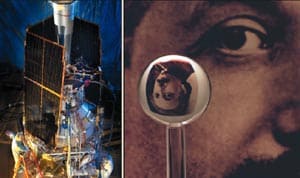
The Gravity Probe B satellite is currently measuring this effect near the Earth. Launched on 20 April 2004, its goal is to measure the precessions of four gyroscopes relative to a telescope trained on a nearby guide star called IM Pegasi over the course of a year (until the liquid helium that is used to cool the experiment runs out). The gyroscopes are spheres that are perfect to a few parts in 10 million and are coated with a thin layer of superconducting niobium. When the spheres rotate, the superconducting films develop magnetic moments that are precisely parallel to their spin axes. This means that any precession of the spins can be measured by monitoring changes in the magnetic flux through superconducting current loops fixed in the spacecraft.

General relativity predicts that frame-dragging will lead to a precession of 41 milliarcseconds per year, and the Gravity Probe B team hopes to measure this with an accuracy of 1%. The experiment will also measure the “geodetic” precession caused by the ordinary curvature of space around the Earth. General relativity predicts a value of 6.6 arcseconds per year for this effect. Gravity Probe B has been designed so that these precessions are perpendicular to one another, and the first results from the mission are expected in early 2006 (see figure 3).

Meanwhile, last October Ignazio Ciufolini of the University of Lecce in Italy and Erricos Pavlis of the University of Maryland used techniques in which laser beams were reflected from satellites to make a measurement of frame-dragging on the orbit of a satellite. Their result agreed with general relativity, with errors at the level of 10% (see Physics World November 2004 p7).

The binary pulsar

In 1974 Russell Hulse and Joseph Taylor, then at the University of Massachusetts, discovered a binary pulsar called PSR 1913+16 that was to play a crucial role in tests of general relativity. Pulsars emit pulses of radio waves at very regular intervals and are thought to be rotating neutron stars. PSR 1913+16 was special because it was a pulsar that was in orbit around another compact object.

By carefully measuring small changes in the rate of the pulsar “clock”, Hulse and Taylor were able to determine both non-relativistic and relativistic orbital parameters with extraordinary precision. In particular they were able to measure three relativistic effects: the rate of advance of the periastron (the analogue of the perihelion in a binary system); the combined effects of time-dilation and gravitational redshift on the observed rate of the pulsar; and the rate of decrease of the orbital period.

If we assume that general relativity is correct and make the reasonable assumption that both objects are neutron stars, then all three relativistic effects depend on the two unknown stellar masses. Since we have, in effect, three simultaneous equations and just two unknowns, we can determine the mass of both objects with an uncertainty of less than 0.05%, and also test the predictions of general relativity. If we assume that the orbital period of the system is decreasing due to the emission of gravitational waves, then theory and experiment agree to within 0.2%. Hulse and Taylor shared the 1993 Nobel Prize for Physics for this work.

Binary pulsars can also be used to distinguish between different theories of gravity because they have very strong internal gravity (see Stairs in further reading). Indeed, several tenths of the rest-mass energy of a neutron star is contained in the gravitational forces that hold the star together, while the orbital energy only accounts for 10-6 of the total mass energy of the system. In the Brans-Dicke theory this internal self-gravity leads to the prediction that binary pulsars should emit both dipole and quadrupole gravitational radiation, whereas general relativity strictly forbids the dipole contribution. The emission of dipole radiation would have a characteristic effect on the orbital period of the system, but such an effect has not been seen. Several recently discovered binary-pulsar systems may allow new tests of general relativity.

Gravitational waves

One of the outstanding challenges in physics today is to detect gravitational waves, and new gravitational-wave observatories in the US, Europe and Japan hope to achieve this, possibly before the end of the decade. In addition to exploring various astrophysical phenomena, these observatories might also be able to carry out new tests of fundamental gravitational physics (see Physics World January 2005 p37, print version only).

General relativity makes three predictions about gravitational radiation that can be tested: gravitational waves have only two polarization states, whereas other theories can predict as many as six; gravitational waves travel at the speed of light, while other theories may predict different speeds; and the emission of gravitational waves acts back on the source that is emitting them in a characteristic manner.

For example, as is described above, scalar-tensor theories and general relativity make different predictions for the nature of the gravitational waves emitted by binary pulsars, and it may be possible to detect these differences. Moreover, if gravitational waves with long wavelengths travel more slowly than those with shorter wavelengths, then it might be possible to observe this behaviour – which is generally associated with massive (as opposed to massless) elementary particles – in the gravitational radiation from binary systems.

Although the collision of two compact objects to form a black hole is too complex to allow precision tests of general relativity, analysis of the gravitational waves produced in the collision will reveal information about the masses and spins of the compact objects themselves, and also about the mass and angular momentum of the final black hole. Such observations will therefore reflect dynamical, strong-field general relativity in its full glory.

Making firm predictions for this situation involves solving Einstein’s equations in a regime where weak-field methods fail, and therefore requires large-scale numerical computations. This challenging task has been taken up by many “numerical relativity” groups around the world. The discovery and study of the formation of a black hole through gravitational waves would provide a stunning test of general relativity.

Relativity and beyond

Einstein’s special and general theories of relativity altered the course of science. They were triumphs of the imagination and of theory, with experiment playing a secondary role. In the past four decades we have witnessed a second triumph for Einstein, with general relativity passing increasingly precise experimental tests with flying colours. But the work is not done. Tests of strong-field gravity in the vicinity of black holes and neutron stars need to be carried out. Gamma-ray, X-ray and gravitational-wave astronomy will all play a critical role in probing this largely unexplored aspect of the theory.

General relativity is now the “standard model” of gravity. But as in particle physics, there may be a world beyond the standard model. Quantum gravity, strings and branes may lead to testable effects beyond general relativity. Experimentalists will continue to search for such effects using laboratory experiments, particle accelerators, instruments in space and cosmological observations. At the centenary of relativity it could well be said that experimentalists have joined the theorists in relativistic paradise.

Box 1: Special and general relativity

When Einstein introduced the concept of “relativity” in 1905 – the notion that there is no absolute motion in the universe, only relative motion – he overthrew ideas that had been in place since the time of Newton some 200 years before. In addition to E = mc2, special relativity predicted various novel effects that occurred when bodies moved at close to the speed of light: time slowed down (an effect known as time-dilation) and lengths became shorter (Fitzgerald contraction). With the general theory Einstein then went on to show that we do not reside in the flat (Euclidean) space and uniform time of everyday experience, but in curved space-time instead.

Special relativity helped us to understand the microworld of elementary particles and interactions, while general relativity revolutionized our view of the universe by predicting astrophysical phenomena as bizarre as the Big Bang, neutron stars, black holes and gravitational waves.

The theory of relativity is a single, all-encompassing theory of space-time, gravity and mechanics, although special relativity and general relativity are often viewed as being independent. Special relativity is actually an approximation to curved space-time that is valid in sufficiently small regions called “local freely falling frames”, much as small regions on the surface of an apple are approximately flat, even though the overall surface is curved.

Einstein’s great insight was to realize that gravity and acceleration are equivalent in free fall, and he then went on to show that the laws of physics, such as the equations of electromagnetism, should have built-in local Lorentz and local position invariance.

In special relativity the “distance” between two points in space–time is given by the line element, ds, which is defined as ds2 = –c2dt2 + dx2 + dy2 + dz2, where t is time and c is the speed of light in a vacuum. In the curved space-time of general relativity ds is defined as ds2 = gμνdxμdxν, where x1, x2 and x3 are the three spatial dimensions, x0 = ct, and gμν, which is called the metric, is a function in space–time. The right-hand side of the equation must be summed over all values of μ and ν between 0 and 3.

General relativity provides a set of field equations that allow us to calculate the space-time metric (i.e. the amount of curvature) from a given distribution of matter – something that is not defined by the equivalence principle. Einstein’s aim was to find the simplest field equations that made this possible. The result was a set of 10 equations, symbolized by the seductively simple equation Gμν = 8πGTμν/c4, where Gμν is Einstein’s curvature tensor, which can be obtained directly from gμν and its derivatives, and Tμν is the stress-energy tensor of normal matter. Sweating the details hidden in this equation has kept generations of relativists occupied.

In the past it was customary to speak of the three classical tests proposed by Einstein: the deflection of light by a massive body; the advance of the perihelion of Mercury; and the gravitational redshift of light (although this is actually a test of the Einstein equivalence principle rather than general relativity itself). Many new tests have been developed since Einstein’s time: in 1964 Irwin Shapiro, then at the Massachusetts Institute of Technology, predicted a delay in the propagation of light past a massive body; and in 1968 Kenneth Nordtvedt Jr of Montana State University showed that theories other than general relativity do not necessarily obey the equivalence principle in certain situations. One of the most striking predictions of general relativity is the black hole: when a massive star collapses under its own gravity it can warp space-time to such an extent that nothing, not even light, can escape. There is now convincing observational evidence for these objects.

One of the outstanding problems in physics is to unify general relativity, which is our best theory of gravity, with the quantum field theories that describe the three other fundamental forces. Although this challenge defeated Einstein, it should not surprise us that all the leading candidates for a unified theory – string theory, branes and loop quantum gravity – are all fundamentally geometrical.

Box 2: Self-energy and the strong equivalence principle

Special relativity and E = mc2 tell us that energy and mass are essentially the same. The mass of a proton and an electron is greater than that of a hydrogen atom because energy must be supplied to break the electromagnetic bond in the atom. The weak equivalence principle asserts that this difference will change both the gravitational mass and the inertial mass by the same amount. This means that all forms of energy at microscopic scales – electromagnetic, strong and weak – respond to gravity in the same way. But what about large bodies like the Earth and Sun, or even extreme gravitational bodies like black holes, which also have measurable gravitational binding energy? The strong equivalence principle goes beyond the weak version by stating that gravitational energy falls with the same acceleration as ordinary matter and other forms of energy in a gravitational field. Although the gravitational self-energy contained in the gravitational forces that hold the Earth together only changes its total mass energy by less than 1 part in a billion, lunar laser-ranging experiments (see main text) can achieve a precision of 1 part in 1013 and can therefore test the strong equivalence principle. General relativity obeys the strong equivalence principle, whereas the Brans–Dicke theory and many other alternative theories do not.

Box 3: Testing metric theories in the solar system

General relativity is one of several “metric” theories in which gravity arises from the geometry of space-time and nothing else. If we want to distinguish between different metric theories in the weak-field limit, it is customary to use a formalism that dates back to Arthur Eddington’s 1922 textbook on general relativity and was later extended by Kenneth Nordtvedt Jr and the present author. This parametrized post-Newtonian (PPN) formalism contains 10 parameters that characterize how the predictions of the different metric theories differ from those of Newtonian gravity, and therefore from each other, for various phenomena that can be measured in the solar system.

Six of these parameters are shown in the table below. For instance, γ is related to the amount of spatial curvature generated by mass and determines the size of classic relativistic effects such as the deflection of light by mass, while β is related to the degree of nonlinearity in the gravitational field. Another four parameters – ξ, α1, α2 and α3 – determine if gravity itself violates a form of local position invariance or local Lorentz invariance (such as G depending on our velocity through the universe).

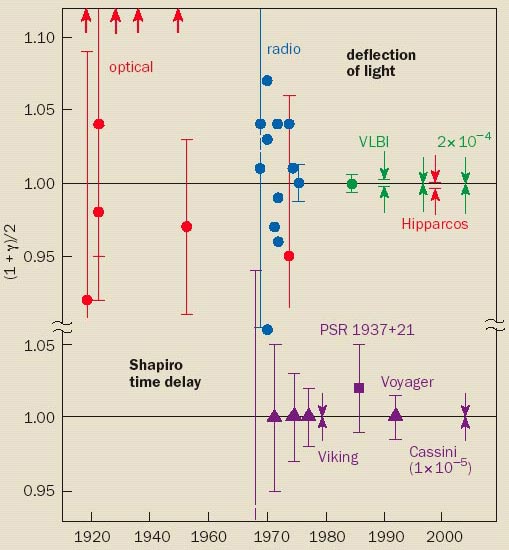
In the PPN formalism the deflection of light and the Shapiro time delay are both proportional to (1 + γ)/2. The “1/2” corresponds to the so-called Newtonian deflection (i.e. the deflection that a body moving at the speed of light would experience according to Newtonian gravity). This result was derived over two centuries ago by Henry Cavendish, who never published it, and then discovered again by Johann von Soldner in 1803, who did publish it. The “γ/2” comes directly from the warping of space near the massive body.

The PPN parameters can have different values in the different metric theories of gravity. In general relativity, for instance, γ and β are exactly equal to one and the other eight parameters all vanish. Four decades of experiments have placed bounds on the PPN parameters that are consistent with general relativity (see figure 2).


Five papers that shook the world

Most physicists would be happy to make one discovery that is important enough to be taught to future generations of physics students. Only a very small number manage this in their lifetime, and even fewer make two appearances in the textbooks. But Einstein was different. In little more than eight months in 1905 he completed five papers that would change the world for ever. Spanning three quite distinct topics – relativity, the photoelectric effect and Brownian motion – Einstein overturned our view of space and time, showed that it is insufficient to describe light purely as a wave, and laid the foundations for the discovery of atoms.

Perhaps even more remarkably, Einstein’s 1905 papers were based neither on hard experimental evidence nor sophisticated mathematics. Instead, he presented elegant arguments and conclusions based on physical intuition. “Einstein’s work stands out not because it was difficult but because nobody at that time had been thinking the way he did,” says Gerard ‘t Hooft of the University of Utrecht, who shared the 1999 Nobel Prize for Physics for his work in quantum theory. “Dirac, Fermi, Feynman and others also made multiple contributions to physics, but Einstein made the world realize, for the first time, that pure thought can change our understanding of nature.”

And just in case the enormity of Einstein’s achievement is in any doubt, we have to remember that he did all of this in his “spare time”.

Statistical revelations

In 1905 Einstein was married with a one-year-old son and working as a patent examiner in Bern in Switzerland. His passion was physics, but he had been unable to find an academic position after graduating from the ETH in Zurich in 1900. Nevertheless, he had managed to publish five papers in the leading German journal Annalen der Physik between 1900 and 1904, and had also submitted an unsolicited thesis on molecular forces to the University of Zurich, which was rejected.

Most of these early papers were concerned with the reality of atoms and molecules, something that was far from certain at the time. But on 17 March in 1905 – three days after his 26th birthday – Einstein submitted a paper titled “A heuristic point of view concerning the production and transformation of light” to Annalen der Physik.

Einstein suggested that, from a thermodynamic perspective, light can be described as if it consists of independent quanta of energy (Ann. Phys., Lpz 17 132-148). This hypothesis, which had been tentatively proposed by Max Planck a few years earlier, directly challenged the deeply ingrained wave picture of light. However, Einstein was able to use the idea to explain certain puzzles about the way that light or other electromagnetic radiation ejected electrons from a metal via the photoelectric effect.

Maxwell’s electrodynamics could not, for example, explain why the energy of the ejected photoelectrons depended only on the frequency of the incident light and not on the intensity. However, this phenomenon was easy to understand if light of a certain frequency actually consisted of discrete packets or photons all with the same energy. Einstein would go on to receive the 1921 Nobel Prize for Physics for this work, although the official citation stated that the prize was also awarded “for his services to theoretical physics”.

“The arguments Einstein used in the photoelectric and subsequent radiation theory are staggering in their boldness and beauty,” says Frank Wilczek, a theorist at the Massachusetts Institute of Technology who shared the 2004 Nobel Prize for Physics. “He put forward revolutionary ideas that both inspired decisive experimental work and helped launch quantum theory.” Although not fully appreciated at the time, Einstein’s work on the quantum nature of light was the first step towards establishing the wave-particle duality of quantum particles.

On 30 April, one month before his paper on the photoelectric effect appeared in print, Einstein completed his second 1905 paper, in which he showed how to calculate Avogadro’s number and the size of molecules by studying their motion in a solution. This article was accepted as a doctoral thesis by the University of Zurich in July, and published in a slightly altered form in Annalen der Physik in January 1906. Despite often being obscured by the fame of his papers on special relativity and the photoelectric effect, Einstein’s thesis on molecular dimensions became one of his most quoted works. Indeed, it was his preoccupation with statistical mechanics that formed the basis of several of his breakthroughs, including the idea that light was quantized.

After finishing a doctoral thesis, most physicists would be either celebrating or sleeping. But just 11 days later Einstein sent another paper to Annalen der Physik, this time on the subject of Brownian motion. In this paper, “On the movement of small particles suspended in stationary liquids required by the molecular-kinetic theory of heat”, Einstein combined kinetic theory and classical hydrodynamics to derive an equation that showed that the displacement of Brownian particles varies as the square root of time (Ann. Phys., Lpz 17 549-560).

This was confirmed experimentally by Jean Perrin three years later, proving once and for all that atoms do exist (see Einstein’s random walk). In fact, Einstein extended his theory of Brownian motion in an additional paper that he sent to the journal on 19 December, although this was not published until February 1906.

A special discovery

Shortly after finishing his paper on Brownian motion Einstein had an idea about synchronizing clocks that were spatially separated. This led him to write a paper that landed on the desks of Annalen der Physik on 30 June, and would go on to completely overhaul our understanding of space and time. Some 30 pages long and containing no references, his fourth 1905 paper was titled “On the electrodynamics of moving bodies” (Ann. Phys., Lpz 17 891-921).

In the 200 or so years before 1905, physics had been built on Newton’s laws of motion, which were known to hold equally well in stationary reference frames and in frames moving at a constant velocity in a straight line. Provided the correct “Galilean” rules were applied, one could therefore transform the laws of physics so that they did not depend on the frame of reference. However, the theory of electrodynamics developed by Maxwell in the late 19th century posed a fundamental problem to this “principle of relativity” because it suggested that electromagnetic waves always travel at the same speed.

Either electrodynamics was wrong or there had to be some kind of stationary “ether” through which the waves could propagate. Alternatively, Newton was wrong. True to style, Einstein swept away the concept of the ether (which, in any case, had not been detected experimentally) in one audacious step. He postulated that no matter how fast you are moving, light will always appear to travel at the same velocity: the speed of light is a fundamental constant of nature that cannot be exceeded.

Combined with the requirement that the laws of physics are the identical in all “inertial” (i.e. non-accelerating) frames, Einstein built a completely new theory of motion that revealed Newtonian mechanics to be an approximation that only holds at low, everyday speeds. The theory later became known as the special theory of relativity – special because it applies only to non-accelerating frames – and led to the realization that space and time are intimately linked to one another.

In order that the two postulates of special relativity are respected, strange things have to happen to space and time, which, unbeknown to Einstein, had been predicted by Lorentz and others the previous year. For instance, the length of an object becomes shorter when it travels at a constant velocity, and a moving clock runs slower than a stationary clock. Effects like these have been verified in countless experiments over the last 100 years, but in 1905 the most famous prediction of Einstein’s theory was still to come.

After a short family holiday in Serbia, Einstein submitted his fifth and final paper of 1905 on 27 September. Just three pages long and titled “Does the inertia of a body depend on its energy content?”, this paper presented an “afterthought” on the consequences of special relativity, which culminated in a simple equation that is now known as E = mc2 (Ann. Phys., Lpz 18 639-641). This equation, which was to become the most famous in all of science, was the icing on the cake.

“The special theory of relativity, culminating in the prediction that mass and energy can be converted into one another, is one of the greatest achievements in physics – or anything else for that matter,” says Wilczek. “Einstein’s work on Brownian motion would have merited a sound Nobel prize, the photoelectric effect a strong Nobel prize, but special relativity and E = mc2 were worth a super-strong Nobel prize.”

However, while not doubting the scale of Einstein’s achievements, many physicists also think that his 1905 discoveries would have eventually been made by others. “If Einstein had not lived, people would have stumbled on for a number of years, maybe a decade or so, before getting a clear conception of special relativity,” says Ed Witten of the Institute for Advanced Study in Princeton.

‘t Hooft agrees. “The more natural course of events would have been that Einstein’s 1905 discoveries were made by different people, not by one and the same person,” he says. However, most think that it would have taken much longer – perhaps a few decades – for Einstein’s general theory of relativity to emerge. Indeed, Wilczek points out that one consequence of general relativity being so far ahead of its time was that the subject languished for many years afterwards.

The aftermath

By the end of 1905 Einstein was starting to make a name for himself in the physics community, with Planck and Philipp Lenard – who won the Nobel prize that year – among his most famous supporters. Indeed, Planck was a member of the editorial board of Annalen der Physik at the time.

Einstein was finally given the title of Herr Doktor from the University of Zurich in January 1906, but he remained at the patent office for a further two and a half years before taking up his first academic position at Zurich. By this time his statistical interpretation of Brownian motion and his bold postulates of special relativity were becoming part of the fabric of physics, although it would take several more years for his paper on light quanta to gain wide acceptance.

1905 was undoubtedly a great year for physics, and for Einstein. “You have to go back to quasi-mythical figures like Galileo or especially Newton to find good analogues,” says Wilczek. “The closest in modern times might be Dirac, who, if magnetic monopoles had been discovered, would have given Einstein some real competition!” But we should not forget that 1905 was just the beginning of Einstein’s legacy. His crowning achievement – the general theory of relativity – was still to come.

Box: Elsewhere in 1905

Einstein’s annus mirabilis tends to overshadow other scientific developments that took place in 1905. So what else was going on in the year that cellophane was invented, the neon sign made its debut, and people were getting to grips with tea bags for the first time? In terms of the number of citations in physics and physical-chemistry journals since 1945, three of Einstein’s 1905 papers feature in the top five, according to Werner Marx and Manuel Cardona of the Max Planck Institute for Solid State Research in Stuttgart. Indeed, his papers on Brownian motion and special relativity take first and second place, respectively, with 1467 and 642 citations (his papers on the photoelectric effect and E = mc2 are fifth and 11th). The fourth most-cited paper of 1905 was by Paul Langevin, who derived a fundamental formula in kinetic theory – clearly a popular subject at the time – while Lawrence Bragg published a paper about the energy loss of alpha particles in different media, which became the sixth most-cited paper of the year.

Hendrik Antoon Lorentz, who was influential in the development of special relativity, was elected as a fellow of the Royal Society in 1905 and published several papers, including one on the motion of electrons in metallic bodies. Nuclear physics was also a subject of intense interest at the time, with Ernest Rutherford and Frederick Soddy publishing their theory of nuclear transmutation and Bertram Boltwood demonstrating that lead is the final product of uranium decay. Further afield, Victor Goldschmidt introduced a method to reduce metallic oxides to metals, while Haldane and Priestley demonstrated the role of carbon dioxide in the regulation of breathing.

Outside the world of science, an unsuccessful revolution was beginning in Russia, Antonio Gaudi began two of his famous buildings in Barcelona, and H G Wells had written Kipps. Meanwhile, Jean-Paul Sartre and Henry Fonda were born, as was the Nobel-prize-winning physicist Emilio Segrè, who 40 years later would witness the application of E = mc2 with the detonation of the first atomic bomb.

Ahead of his time


As someone who disliked the limelight, he would probably be embarrassed by the celebrations that are planned as part of the International Year of Physics to mark the centenary of his remarkable achievements in 1905. As a theorist who was interested in experiments, in his early career at least, he would be pleased to know that a small band of 21st-century physicists are still trying to find flaws in the special theory of relativity, while others are busy checking out the predictions of the general theory. And having spent the final years of his life trying to unify general relativity with electromagnetism, without success, he could be forgiven for thinking that criticisms of his relative non-productivity in those years were somewhat unfair. No-one else has succeeded where he failed.

It is impossible to overstate the importance of what Einstein did in 1905. His work on Brownian motion provided the theoretical framework for experiments to prove that atoms were real. Hard as it might be to believe now, at the time the majority of physicists did not believe in atoms. The special theory of relativity completely changed our notions of space and time, while E = mc2 led to the remarkable conclusion that mass and energy are one and the same. And his work on the photoelectric effect was the start of a love-hate relationship with quantum mechanics that still fascinates physicists today.

And 1905 was just the beginning. The general theory of relativity – his truly outstanding achievement – followed 10 years later, with its predictions for the bending of light by mass being confirmed a few years after that during the solar eclipse of 1919. But even then Einstein did not abandon his interest in atoms, photons and quantum mechanics. The Einstein A and B coefficients for spontaneous and stimulated emission – without which we would not have lasers – made their debut in 1916, and the prediction of Bose-Einstein condensation – one of the hottest topics in experimental physics for the past decade – followed in the 1920s.

This special issue of Physics World covers all this and more. Mark Haw describes Einstein’s theory of Brownian motion as a “slower, subtler revolution” than his work on relativity or quantum mechanics, but just as influential nonetheless. Clifford M Will provides an update on the renaissance in experimental gravitational physics and reports how the general theory has so far survived all scrutiny, although it has not yet been tested in the strong-field limit. Most exciting, however, is the fact that theories that seek to unify gravity with the three other fundamental forces of nature predict departures from general relativity that will soon be within experimental reach.

Of course, the outstanding prediction of general relativity that has yet to be confirmed is the existence of gravitational waves: Jim Hough and Sheila Rowan describe the almost superhuman efforts that are being made to find out if Einstein was right on this occasion (p37, print version only). And as if to show that the great physicist could also be wrong, Harald Weinfurter reports on the state of the art in quantum entanglement – the phenomenon that Einstein once dismissed as “spooky action at a distance” (p47, print version only). Other topics covered range from Einstein’s love of music to the way his image is protected by the Hebrew University of Jerusalem and a Hollywood agent.

These articles are obviously preaching to the physics converted, but the organizers of the International Year of Physics – also known as World Year of Physics and Einstein Year – have much loftier ambitions. Through a world-wide programme of events, demonstrations and other activities they hope to inspire the next generation of physics students. Einstein would have approved.

Microlever feels the chill

Microlevers are used in a variety of devices, including various atomic force and magnetic-resonance force microscopes. Cooling the microlevers in these devices improves their sensitivity. Moreover, if the microlevers could be cooled to sub-millikelvin temperatures, they could be used to perform a range of fundamental tests of quantum theory with macroscopic objects.

The mirrors in the Munich experiment are separated by about 34 microns (see figure). The first mirror is made by coating the cantilever – which is 223 microns long, 22 microns wide and 0.46 microns thick – with a thin film of gold. The gold-coated optical fibre that acts as the second mirror also transports the laser radiation, which has a wavelength of 633 nanometres, into the cavity.

The force exerted by the laser on the cantilever is proportional to the intensity of the light inside the cavity, and is at its strongest when the laser and the cavity are in resonance. The force exerted by the laser can, under the right conditions, reduce the Brownian motion of the cantilever by a factor of 100.

Höhberger Mezger and Karrai were able to determine the temperature of the cantilever by analysing the thermal noise spectrum of the radiation that escapes from the cavity through the optical fibre. By changing the geometry of the lever, the size of the cavity and the materials used in the device it may be possible to reduce the thermal vibrations to a minimum so that only quantum fluctuations remain.

Copyright © 2026 by IOP Publishing Ltd and individual contributors