Optical tweezers think big

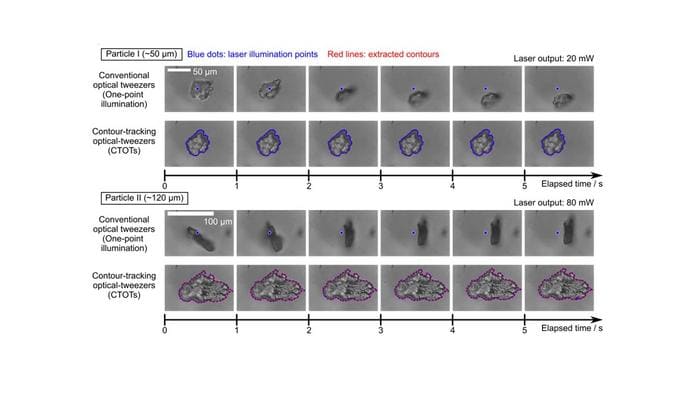
A series of images showing the location and orientation two different irregularly-shaped particles over time. When trapped by the new optical tweezers, the location and orientation of the particles does not change, whereas with conventional optical tweezers, the particles quickly drift away from the laser focus and are not confined.

Optical tweezers – already a mainstay of biological research for their ability to hold and move nano-sized objects – can now trap larger items such as cell clusters, bacteria, plankton and microplastics thanks to a new technique developed at the University of Tokyo in Japan. Known as contour-tracking optical tweezers (CTOTs), the new method produces stable traps for irregularly shaped particles bigger than 0.1 mm – something that was challenging to do using conventional optical tweezers. According to team leader Satoru Takahashi, the technique could expand the technology’s applications to include environmental research as well as biology.

“This new capability enables the observation and analysis of these different types of samples with precise manipulation, contributing to a deeper understanding of their behaviours in various settings, crucial for advances in biology and environmental science,” Takahashi says.

Powerful tools for biological research but limited

Optical tweezers were invented by the American physicist Arthur Ashkin, who received a share of the 2018 Nobel Prize for Physics for his work. These devices use a highly focused laser beam to generate forces that hold and move micron-or nano-sized objects near the beam’s focus, and they have become powerful tools for biological research.

Standard optical tweezers come up short, however, for particles bigger than 10 μm. This is because the optical forces available cannot create a big enough gradient to trap and manipulate such large objects in three dimensions. Another weakness is that tweezers work best for symmetrical shapes like spheres and rods. In this case, the reason is that the forces light exerts on irregularly shaped objects are unbalanced due to complex interactions between the light and the particle, Takahashi explains. This imbalance tends to make the object rotate uncontrollably or move out of the laser focus spot altogether.

Determining the contour of the target particle

In CTOT, the incident light hits the edge of the particle. Even if the particle has, overall, an irregular shape, its shape in the illuminated region can be locally approximated as a curved surface. “Our system determines the contour of the target particle from microscope images and then scans the laser focal point along this contour in real time, balancing the optical forces around its irregular shape,” Takahashi tells Physics World. “It also automatically adjusts the size of the scanning light patterns to fit the target’s size, allowing it to be applied to particles bigger than 0.1 mm.”

The researchers tested their technique on irregularly shaped polystyrene microparticles, which they collected by polishing a polystyrene spoon with a rasp. CTOTs do not require any prior information about the particles’ shape. They do not have to be illuminated by laser light from two sides either, as is the case for conventional methods for larger particles, making the method easier to implement.

The new optical tweezers could be used with living organisms such as plankton and cultured biological cells as well as environmental samples, adds Ryohel Omine, who did the bulk of the work on the study. For example, Omine suggests that analysing the behaviour of microplastics could inform more effective measures to mitigate pollution, thereby improving human health and aiding environmental conservation.

The CTOTs technique is detailed in Optics Letters.

Nuclear physicists tame radius calculation problem

Image showing three clusters of spheres, representing nucleons, within a 3D grid

A new way of calculating the size of atomic nuclei has helped solve a longstanding problem in nuclear theory. Previously, all so-called ab initio approaches to this problem “under-predicted” the sizes of nuclear radii, but the new method produces answers in line with experimental results for the radii of elements with atomic numbers from 2 to 58. Among other possibilities, the improved method should enable astrophysicists to make more precise calculations of how stars convert helium into heavier elements via nuclear fusion, which the researchers who developed the method describe as a “holy grail” of nuclear astrophysics.

To study atomic nuclei, physicists often use ab initio calculations. These calculations begin with the nucleons – neutrons and protons – that make up the nucleus, and incorporate the strong force, which is one of the four known fundamental forces. The strong force is responsible for binding protons and neutrons together, and it is also responsible for “gluing” together the quarks that make up protons, neutrons and other baryons. At very short distances, the strong force is attractive and much stronger than the electromagnetic force, which works to push protons and other like-charged particles apart.

While ab initio calculations are excellent at describing the properties of atomic nuclei and how their structure affects their interactions when the number of nucleons is small, they fail when the number of nucleons gets too high or when the nucleons’ interactions become too complex. In particular, a class of ab initio calculations known as quantum Monte Carlo simulations, which use stochastic (random) processes to calculate desired quantities, suffers from something called the sign problem. This problem appears when positive and negative statistical weights of a certain configuration of components start to cancel each other out. The result is a huge increase in statistical errors that severely limits the size of the systems physicists can study.

Simple method

Researchers at the University of Bonn, Germany, together with an international team of collaborators at other institutions in Germany, the US, Korea, China, France, Georgia and Turkey, have now solved this problem using an approach called wavefunction matching. “The method is simple,” says Ulf-G Meißner, who co-led the team together with Serdar Elhatisari. “Below some radius R, we substitute the wavefunction of a complex interaction [with] one that is simpler (and free from ‘sign oscillations’), assuming that such a simple interaction does exist.”

This transformation is done in a way that preserves all the important properties of the original, more realistic interaction, he adds. Any errors introduced into the new wavefunction can be dealt with using a standard method known as perturbation theory.

The researchers applied their new technique to quantum Monte Carlo simulations for light- and medium-mass nuclei, neutron matter and nuclear matter and found that they could predict the nuclear radii of elements with atomic numbers ranging from 2 to 58 (hydrogen, with atomic number 1, is a special case). Their results agree with experimental measurements in the existing literature.

The new approach will allow physicists to make precision calculations in nuclear structure and dynamics, Meißner says. “One much sought after issue is in determining the structure and the precise locations of the neutron and proton drip lines (the so-called edges of stability which describe the maximum number of nucleons an isotope of each element can contain),” he explains. “Another is in reaction theory for the calculation of radiative alpha-capture on 12C at the ‘Gamov peak’ (astrophysical energies), which is the ‘holy grail’ of nuclear astrophysics.”

The researchers now plan to test their framework on structure and reaction calculations. “We will eventually refine the values of the three-nucleon forces in our calculations if disagreements appear,” Meißner tells Physics World.

The team reports its work in Nature.

Scientists identify a ‘sugar world’ beyond Neptune

Now here’s a discovery that’s pretty sweet: the most distant Solar System object ever visited by a spacecraft appears to be dusted with sugar. Known as Arrokoth, this small, irregularly shaped world is reddish in colour, and scientists in the US and France say that its unusual hue may be due to the presence of glucose and other forms of sugar on its surface. The discovery has implications for the origins of life, as comets could have delivered organic molecules from “sugar worlds” like Arrokoth to the early Earth.

Arrokoth orbits the Sun as part of the Kuiper belt of objects beyond the planet Neptune. Because it formed when two objects collided and fused together, it looks a little like a flattened snowman, with a “head” and “body” 15 and 21 km in diameter. Nicknamed “Ultima Thule” by scientists working on the New Horizons mission, it gets its formal name from a word meaning “sky” or “cloud” in the Powhatan language spoken by Native Americans who lived on what is now the US East Coast before European settlers arrived there.

Apart from its knobbly shape, Arrokoth’s most distinctive feature is its colour. Unlike pink-tinged Pluto – the largest Kuiper belt object (KBO), and the subject of New Horizonsfirst flyby in 2015 – Arrokoth is darker and reddish. The cause of this unusual colouring, which also occurs in a few other KBOs, is not fully understood. However, New Horizons detected abundant frozen methanol (CH3OH) on Arrokoth’s surface when it flew past in 2019, and scientists had previously found that irradiating methanol with ions significantly reddens its spectrum.

Enter the energetic electrons

In the new study, a team led by chemists Ralf I Kaiser of the University of Hawai’i at Mānoa and Cornelia Meinert of the Université Côte d’Azur, France, together with planetary scientist Leslie A Young of the Southwest Research Institute in Boulder, Colorado, US, explored this possibility further by bombarding samples of methanol ice at 10 K and 40 K with energetic electrons. After exposing the samples to the equivalent of 1.8 billion years of galactic cosmic rays, they used a variety of spectroscopic methods to characterize the composition and colour of the organic molecules that formed.

The results showed that radiation bombardment can indeed replicate the colouration found on Arrokoth, with a dose of 57 eV per atomic mass unit creating an especially good colour match. Using gas chromatography and time-of-flight mass spectrometry, the team also identified sugar-related compounds such as glucose (C6H12O6) and ribose (C5H10O5) in residues of the radiation-exposed methanol ices. Some of these compounds, the researchers note, are incorporated into the molecules that make up RNA and lipids, providing what they call “a plausible source of this key class of prebiotic molecules for the evolution of life on early Earth”.

As for how these chemicals got from Arrokoth or other Kuiper belt objects to Earth, in a PNAS paper describing the study, the researchers point out that the Kuiper belt is thought to be a major source of short-period comets. “These sugars and their derivatives could have been delivered by KBOs like Arrokoth in the form of short-period comets impacting the early Earth, thus providing a source of a variety of sugars and the feedstock for important biomolecules,” they write. Future experiments on more complex ice mixtures containing ammonia, water and carbon dioxide as well as methane could, they suggest, yield further insights on the optical spectra and composition of KBOs not visited by spacecraft.

Ultrasound patch continuously tracks blood flow in the brain

Wearable ultrasound patch

Monitoring changes in cerebral blood flow provides a valuable tool for diagnosing brain disorders. Transcranial Doppler (TCD) ultrasound offers a low-cost, non-invasive way to evaluate blood flow in the brain, but the rigid design and manual operation of conventional systems make continuous use impractical. And because TCD probes generally employ a single transducer or linear transducer array, they can only image part of the complex 3D network of cerebral arteries.

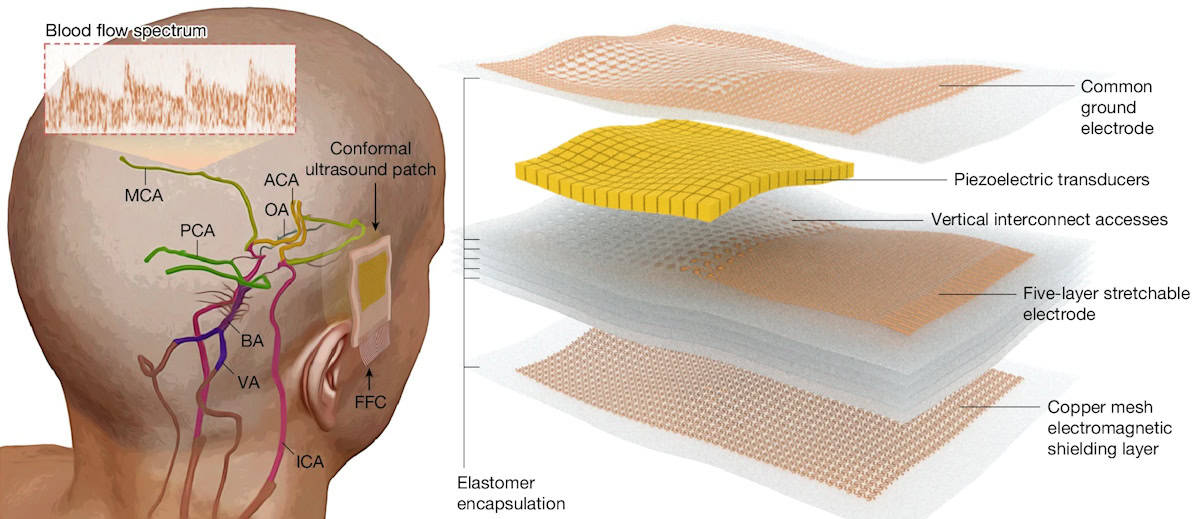
To address these limitations, Sheng Xu and colleagues at the University of California San Diego have developed a wearable ultrasound patch for hands-free volumetric imaging of cerebral arteries and long-term monitoring of blood flow in the brain, describing the device in Nature.

“The continuous monitoring capability of the patch addresses a critical gap in current clinical practices,” says co-first author Sai Zhou in a press statement. “Typically, cerebral blood flow is monitored at specific times each day, and those measurements do not necessarily reflect what may happen during the rest of the day. There can be undetected fluctuations between measurements. If a patient is about to experience an onset of stroke in the middle of the night, this device could offer information that is crucial for timely intervention.”

Device design and functionality

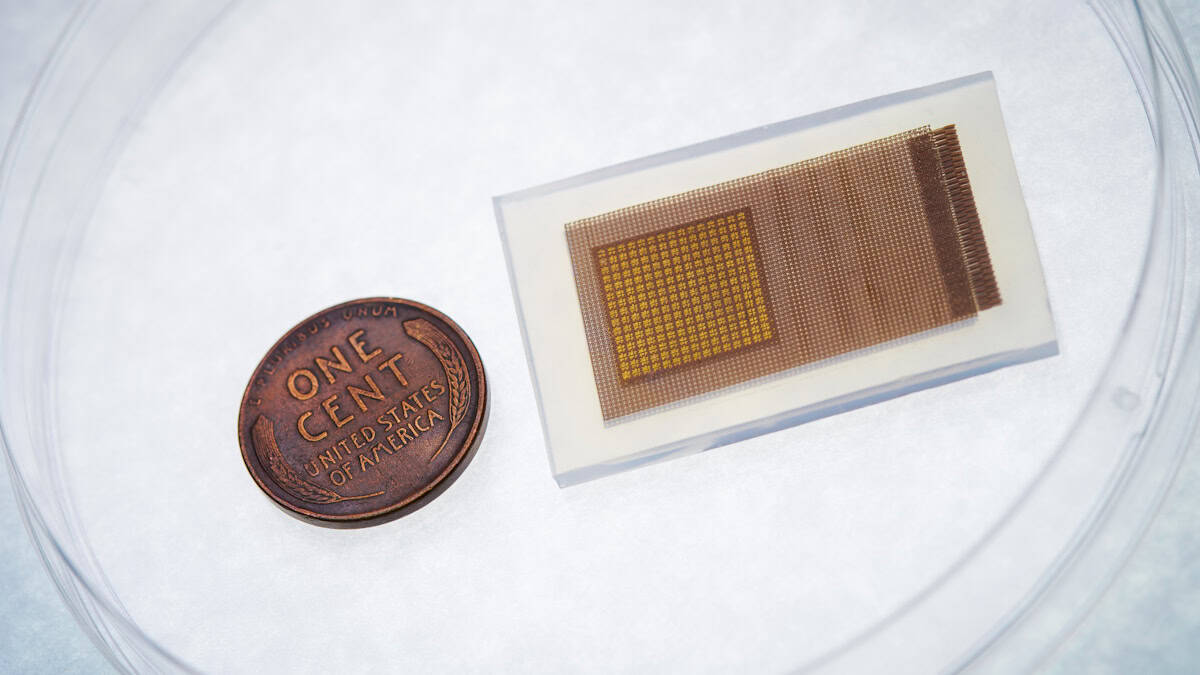
The postage stamp-sized ultrasound patch comprises a 16 x 16 array of piezoelectric transducers with a 2-MHz centre frequency, chosen to minimize attenuation and phase aberration as the signal passes through the skull. The researchers incorporated a layer of copper mesh to provide electromagnetic shielding and increase the signal-to-noise ratio, and encapsulated the entire device in a waterproof silicone elastomer. During use, the patch is linked via shielded cables to a commercial ultrasound machine.

Wearable ultrasound patch

The cerebral vasculature is a complex network comprising multiple arteries, most of which are deep and widely distributed inside the brain. To examine this entire network in 3D, the patch performs ultrafast ultrasound imaging (3000 images per second) and simultaneously emits five diverging waves at different angles, extending the imaging field to about 60 x 60 mm at 50 mm depth.

When attached to a volunteer’s temporal window (in front of the ear), the patch could insonate the terminal internal carotid artery (TICA), which delivers blood from the neck to the major arteries in the brain, as well as the anterior cerebral arteries (ACA), middle cerebral arteries (MCA) and posterior cerebral arteries (PCA), which deliver blood to most of the four brain lobes.

Following signal acquisition, the researchers used customized algorithms to process the data and reconstruct a volumetric power Doppler image of this large vascular network. This 3D reconstruction can then be used to focus the ultrasound beam on targeted arterial sections for long-term monitoring of blood flow spectra.

To validate the performance of the ultrasound patch, the researchers compared blood flow measurements with those recorded by a conventional TCD probe. They recorded blood flow velocities of 10 arterial segments in 36 healthy volunteers, using four transcranial windows (temporal, orbital, submandibular and suboccipital) to target different arterial segments.

Volunteer testing of a wearable ultrasound patch

The mean differences between blood flow velocities measured by the ultrasound patch and the conventional TCD probe were −1.51±4.34, −0.84±3.06 and −0.50±2.55 cm/s for peak systolic, mean flow and end diastolic velocity, respectively – demonstrating good agreement between the two devices.

Tracking blood flow changes

Next, the team used the ultrasound patch while participants conducted various activities that modulate blood flow in specific cerebral arteries.

When performing a handgrip, for example, contraction of the forearm muscles activates the sympathetic nervous system, increasing blood supply to the brain and blood flow velocity in the contralateral MCA. As the volunteer began a handgrip, the left MCA mean flow velocity increased rapidly then slowly plateaued at around 119% baseline velocity when the handgrip was maintained. Immediately after releasing the handgrip, the velocity swiftly decreased.

The researchers carried out similar measurements while volunteers performed the Valsalva manoeuvre, word generation and visual stimulation. In all cases, the patch recorded cerebral blood flow changes in accordance with the activities being performed.

Such transient changes in cerebral blood flow can be impaired or inhibited by brain disease or disorders, indicating the potential clinical benefit the ultrasound patch offers for diagnostic applications.

Finally, the researchers demonstrate the potential for long-term surveillance using the ultrasound patch, monitoring cerebral blood flow spectra in the MCA in a participant continuously for 4 h. The patch identified a cascade of B waves (slow oscillations in cerebral blood flow velocity that are related to waste removal in the brain and disease recovery) when the participant felt drowsy.

“Next, we will collaborate with clinicians to recruit pregnant participants with different conditions, and validate the performance and efficacy of our device compared with handheld clinical ultrasound devices,” Xu tells Physics World. “Additionally, we will try to integrate customized electronics to make the patch wireless, so that people can wear it without any cable tethering.”

MRI technique detects light-emitting molecules deep inside the brain

A new magnetic resonance imaging (MRI) technique maps the location of cells labelled with light-emitting molecules even when they are located deep within organs and other tissues. The technique, which works by detecting changes in blood vessels triggered by the presence of bioluminescent proteins, overcomes a major limitation of optical imaging. It could find use in biomedical applications such as probing tumour growth, measuring changes in gene expression and studying brain cell function.

Biologists often use light-emitting proteins to label cells, as it enables them to follow processes such as cell signalling, metabolism and many other cellular functions by tracking where these proteins go. However, while these bioluminescent proteins work well as indicators within cells, they are not as good for imaging structures deep in tissues and organs because these objects absorb and scatter visible light too much.

Locating the source of light emission

Biological engineer Alan Jasanoff and colleagues of the Department of Biological Engineering at the Massachusetts Institute of Technology (MIT) in the US have now developed a new way to detect bioluminescence. Their method begins with genetically engineering blood vessels to carry a photosensitive protein – in this case, an enzyme known as Beggiatoa photoactivated adenylate cyclase (bPAC).

When the engineered blood vessels are illuminated with light, the protein within them makes them dilate. This has the knock-on effect of altering the balance of oxygenated and deoxygenated haemoglobin within the vessels. Because these forms of haemoglobin have different magnetic properties, the shift between them can be detected using MRI. This enables the researchers to locate where light emissions are happening with high precision.

Jasanoff and colleagues tested their technique on the blood vessels in rat brains. “Blood vessels form a network in the brain that is extremely dense. Every cell in the brain is within a couple dozen microns of a blood vessel,” Jasanoff explains. “Our technique, which we have dubbed bioluminescence imaging using haemodynamics, or BLUsH, works by essentially turning the vasculature of the brain itself into a three-dimensional camera.”

Blood vessels become light amplifiers

Each blood vessel is like a pixel, he adds, responding to nearby sources of light in the tissue. “Since vascular changes are readily detectable by noninvasive readouts like MRI, BLUsH enables us to perform optical imaging through tissue that wouldn’t normally be easily accessible with optical techniques.”

The most difficult part of getting the technique to work, he tells Physics World, is getting the genetic modification of blood vessels properly targeted. “We are working on simplifying this,” he says.

By making luminescent proteins detectable via MRI or other noninvasive imaging techniques, BLUsH could help scientists study how cellular level processes lead to emergent phenomena such as brain-wide activity dynamics. It could also be useful for discovery-oriented science and clinical research in animal models. For example, the researchers suggest that studies of how gene expression changes during embryonic development and cell differentiation, or when new memories form, might benefit. Luminescent proteins could even help map anatomical connections between cells, revealing how cells communicate with each other.

For its part, the MIT team hopes to use BLUsH to study brain plasticity — the process that underlies learning and memory. “We also want to use this technique to read out measures of neural signalling,” Jasanoff says.

The work is detailed in Nature Biomedical Engineering.

Laser-driven accelerator benefits from clever use of light pulses

Physicists in Germany say they have passed an important milestone in the development of laser-driven, plasma-based particle acceleration. Proton pulses with energies as high as 150 MeV were created by Tim Ziegler and colleagues at Helmholtz Centre Dresden–Rossendorf (HZDR). This is about 50% higher than the previous record for the technique, and was achieved by better exploiting the temporal profile of laser pulses.

Conventional particle accelerators use radio-frequency cavities to create the high voltages needed to drive particles to near the speed of light. These facilities tend to big; energy hungry; and often require expensive cryogenic cooling. This limits the number of facilities that can be built and where they can be located. If accelerators could be made smaller and less expensive, it would be a boon for applications as diverse as cancer therapies and materials science.

As a result, there is a growing interest in laser-driven plasma-based accelerators, which have the potential to be far more compact and energy efficient that conventional systems.

Ripping away electrons

These accelerators work by firing intense laser pulses into wafer-thin solid targets. The pulse rips away electrons from the target, leaving behind the positively charged atomic cores. This creates a very large voltage difference over a very small distance – which can be used to accelerate pulses of charged particles such as protons.

While these voltage gradients can be much larger than those in conventional accelerators, significant challenges must be overcome before this technique can be used in practical facilities.

“The adoption of plasma-based proton acceleration has been hampered by the slow progress in increasing ion energy,” Ziegler explains. One challenge is that today’s experiments are done at one of just a few high-power, ultrashort-pulse lasers around the world – including HZDR’s DRACO-PW facility. “Firing only a few shots per day, access and availability at these few facilities is constrained,” adds Ziegler.

One curious aspect of the ultrashort laser pulses from DRACO-PW is that some of the light precedes the main pulse. This means that the full power of the laser is not used to ionize the target. But now, Ziegler’s team has turned this shortcoming into an advantage.

Early arrival

“This preceding laser light modifies our particle source – a thin plastic foil – making it transparent to the main laser pulse,” Ziegler explains. “This allows the light of the main pulse to penetrate deeper into the foil and initiates a complex cascade of plasma acceleration mechanisms at ultra-relativistic intensities.”

The researchers tested this approach at DRACO-PW. When they previously to irradiated a solid foil target, the plasma accelerated protons to energies as high as 80 MeV.

In their latest experiment, they irradiated the target with a pulse energy of 22 J, and used the leading portion of the pulse to control the target’s transparency. This time, they accelerated a beam of protons to 150 MeV – almost doubling their previous record.

This accelerated proton beam had two distinct parts: a broadband component at proton energies lower than 70 MeV; and a high-energy component comprising protons travelling in a narrow and well-defined beam.

Linear scaling

“Notably, this high-energy component showed a linear scaling of maximum proton energy with increased laser energy, which is fundamentally different to the square-root scaling of the lower energy component,” Ziegler explains. The experiment also revealed that the degree of transparency in the solid target was strongly connected with its interaction with the laser – providing the team with tight control over the accelerator’s performance.

Ziegler believes the result could pave the way for smarter accelerator systems. “This observed sensitivity to subtle changes in the initial laser-plasma conditions makes this parameter ideal for future studies, which will aim for automated optimization of interaction parameters,” he says.

Now that they have boosted the efficiency of ion acceleration, the researchers are hopeful that laser-driven facilities could be built a fraction of the space and energy requirements of conventional facilities.

This would be particularly transformative in medicine, says Ziegler. “Our breakthrough opens up new possibilities to investigate new radiobiological concepts for precise, gentle tumour treatments, as well as scientific studies in efficient neutron generation and advanced materials analysis.”

The research is described in Nature Physics.

Ask me anything: Daniel Hook – ‘The skills I learned as a researcher are applicable and helpful in any walk of life’

What skills do you use every day in your job?

As the chief executive officer (CEO) of Digital Science – a company that improves the information and software tools for all stakeholders in the research ecosystem – I use a variety of skills every day. Many of these are exactly what most people would expect: managing people, reading financial statements – all the usual CEO activities. Thankfully for all concerned, I don’t programme anymore. It’s more than a decade since my code was in a production environment.

However, perhaps surprisingly to some, I do a lot of data analysis. Digital Science’s core strength is our passion for understanding the research world as a route to offering better tools. For me, that means looking at what research is trending, understanding collaboration patterns, and gaining insight into how the scholarly record is changing. Not only are the data completely fascinating, but they are also the start of so many interesting discussions.

What do you like best and least about your job?

Let’s start with what I like least – which is travel, specifically the jet lag. While I do love spending time in different cultures, meeting people and seeing the beautiful nature and architecture in the places that I’m fortunate to visit, I find the jet lag to be very difficult and I’m constantly worried about my carbon footprint.

Last year I managed to do almost every trip in Europe by train and felt very good about it. But trips to Australia, New Zealand, Japan and the US still managed to make their way into my diary. This is somewhere I’m hoping that hybrid meetings find their feet soon.

As for what I like best about my job – that’s easy.  Not only do I work with the most talented, kindest and most passionate team, but we also serve those who are the positive agents of change in our world.

What do you know today that you wish you knew when you were starting out in your career?

Like many people who started off working toward a research career, I defined my success very narrowly – specifically, in terms of being successful in a classically defined research setting. However, the skills that I learned as a researcher are all generally applicable and helpful skills in any walk of life.

They include having an entrepreneurial spirit, a willingness to try to solve a problem, the capacity to work hard and focus on that problem, and not give up when you don’t find a solution with the first approach that you take. Success looks different for everyone and the problems that we contribute to solving, in any context, have the capacity to make people’s lives better.

So, sometimes it’s not good to “buy in” to what we’re so often taught success should look like.

‘Cavendish-like’ experiment could reveal gravity’s quantum nature

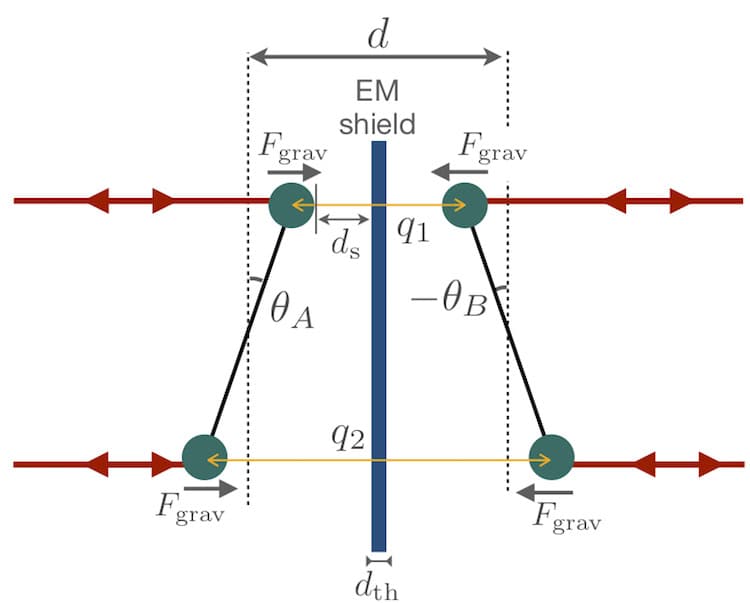
Diagram of the new "Cavendish-like" gravitation experiment

Mathematical physicists in the Netherlands and Germany have proposed a new “Cavendish-like” gravitation experiment that could offer an alternative means of determining whether gravity is a classical or quantum phenomenon. If built, the experiment might bring us closer to understanding whether the theory of gravity can be reconciled with quantum-mechanical descriptions of the other fundamental forces – a long sought-after goal in physics.

Gravity is one of the four known fundamental forces in nature. It is different from the others – the electromagnetic force and the weak and strong nuclear forces – because it describes a curvature in space-time rather than interactions between objects. This may be why we still do not understand whether it is classical (as Albert Einstein described it in his general theory of relativity) or governed by the laws of quantum mechanics and therefore unable to be fully described by a local classical field.

Many experiments that aim to resolve this long-standing mystery rely on creating quantum entanglement between two macroscopic objects placed a certain distance from each other. Entanglement is a phenomenon whereby the information contained in an ensemble of particles is encoded in correlations among them, and it is an essential feature of quantum mechanics – one that clearly distinguishes the quantum from the classical world.

The hypothesis, therefore, is that if massive, distant objects (known as delocalized states) can be entangled, then gravity must be quantum.

Revealing gravity’s quantum nature without generating entanglement

The problem is that it is extremely difficult to make large objects behave as quantum particles. In fact, the bigger they get, the more likely they are to lose their quantum-ness and resort to behaving like classical objects.

Ludovico Lami of the University of Amsterdam, together with Martin Plenio and Julen Pedernales of the University of Ulm, have now thought up a new experiment that would reveal gravity’s quantum nature without having to generate entanglement. Their proposal – which is so far only a thought experiment – involves studying the correlations between two torsion pendula placed close to each other as they rotate back and forth with respect to each other, acting as massive harmonic oscillators (see figure).

This set-up is very similar to the one that Henry Cavendish employed in 1797 to measure the strength of the gravitational force, but its purpose is different. The idea, the team say, would be to uncover correlations generated by the whole gravity-driven dynamical process and show that they are not reproducible if one assumes the type of dynamics implied by a local, classical version of gravity. “In quantum information, we call this type of dynamics an ‘LOCC’ (from ‘local operations and classical communication’),” Lami says.

In their work, Lami continues, he and his colleagues “design and prove mathematically some ‘LOCC inequalities’ whose violation, if certified by an experiment, can falsify all LOCC models. It turns out that you can use them to rule out LOCC models also in cases where no entanglement is physically generated.”

An alternative pathway

The researchers, who detail their study in Physical Review X, say they decided to look into this problem because traditional experiments have well-known bottlenecks that are difficult to overcome. Most notably, they require the preparation of large delocalized states.

The new experiment, Lami says, is an alternative way of realizing experiments that can definitively indicate whether gravity is ultimately fully classical, as Einstein taught us, or somehow non-classical – and hence most likely quantum. “While we don’t claim that our method is completely and utterly better than the others, it is quite different and, depending on the experimental platform, may prove easier to practically set up,” he tells Physics World.

Lami, Plenio and Pedernales are now working to bring their analyses closer to real-world experiments by taking into account other interactions besides gravity. While doing so will complicate the picture and make their analyses more involved, they recognize that it will eventually be necessary for building a “bulletproof” experiment.

Plenio adds that the approach they are taking could also reveal other finer details about the nature of gravity. “In our work we describe how to decide whether gravity can be mimicked by local operations and classical communications or not,” he says. “There might be other models, however – for example, where gravity follows dynamics that do not obey LOCC, but still do not have to create entanglement either. This type of dynamics is called ‘separability preserving’. In principle we can also solve our equations for these.”

Simulations point to the existence of a charming and beautiful tetraquark

Supercomputer simulations done by a trio of physicists in India provide strong evidence for the existence of new type of tetraquark. Dubbed Tbc, the tetraquark comprises two heavy quarks (charm and beauty) and two light antiquarks (up and down). The simulations focused on the interaction of two mesons: one composed of a charm quark and a down antiquark, and the other made of a beauty quark and an up antiquark. A detailed analysis shows that the strong nuclear force should bind these mesons into a Tbc, which the trio believes could be discovered in accelerator experiments in the near future.

“Traditionally composite subatomic particles are categorized as mesons (comprising a quark and an antiquark) and baryons (comprising three quarks),” explain the researchers. “However, starting [in] 2003, there have been a large number of discoveries of exotic hadrons that defy the conventional picture of baryons and mesons, and calls for a description beyond these two simplest categories.” These exotic hadrons include tetraquarks ( comprising two quarks and two antiquarks) and pentaquarks (comprising four quarks and an antiquark).

One recent discovery is the Tcc+ tetraquark – two charm quarks, an up antiquark and a down antiquark – which was spotted by the LHCb collaboration. “Its bottom flavored cousin, designated Tbb, has long been hypothesized to be a strongly bound hadron, but finding it in experiments will be difficult in the near future because of its large mass,” say the researchers. However, the possible existence of the Tbc tetraquark had been unclear until now.

Lattice simulation

To find out whether the two mesons could combine to form Tbc, Padmanath Madanagopalan of the Homi Bhabha National Institute for Science Education and Archana Radhakrishnan and Nilmani Mathur of the Tata Institute of Fundamental Research, used a standard computational method for studying bound states of elementary particles. This involved simulating meson collisions in order to deduce how they could bind to each other to form a Tbc.

While this technique is ideal for studying electromagnetic and weak interactions, it requires enormous computing power to calculate the strong interactions involved in meson collisions. Such calculations involve approximating continuous space using a discrete lattice with a step size of a few hundredths of a femtometre – with quantum fields defined in its nodes and links between them.

“Calculation of the binding energies of tetraquarks is extremely challenging because of the nature of the strong interaction,” explains Tim Gershon of the UK’s University of Warwick, who was not involved in this latest study. “At high energy, strong interaction processes can be calculated ‘perturbatively’, which means considering exchange of one particle (the gluon – the mediator of the strong interaction) to be dominant with small corrections from two or more gluons exchanges.”

Very sophisticated algorithms

“Unfortunately, this does not work at lower energies where the strong interaction is ‘non-perturbative’, which means that interactions involving very large numbers of gluons need to be considered,” Gershon adds. “Various approximate methods exist to solve this puzzle. However, complete calculations can only be done using what is called lattice QCD (where QCD stands for quantum chromodynamics – the theory of the strong interaction). This involves using supercomputers and very sophisticated algorithms.”

By performing lattice QCD calculations of the two mesons scattering, the trio deduced the strength of the interaction and found that it is attractive and about 100 times stronger than the attraction between mesons in Tcc+. This is a strong indication of the existence of the Tbc, and that the tetraquark is much more strongly bound and long-lived than Tcc+.

“In our work using a first principles method of lattice QCD we provide compelling evidence in the existence of this novel subatomic particle, and remove any earlier doubts,” conclude the trio. They add that their calculations should motivate experimentalist to search for the tetraquark. Indeed, the trio believes that there is a realistic prospect that the tetraquark could be discovered within the next 5–10 years.

The research is described in Physical Review Letters.

Baltimore bridge collapse: engineers explain how failures can be avoided

Earlier this year, the Francis Scott Key Bridge in the US collapsed after being struck by a large container ship. Six people were killed in the disaster and many around the world were left wondering how such an important piece of infrastructure could collapse in such a catastrophic way.

We investigate in this episode of the Physics World Weekly podcast, which features Erin Bell and Martin Wosnik. They are both engineers at the University of New Hampshire (UNH) and they are in conversation with Physics World’s Margaret Harris.

Bell specializes in the structural design and dynamics of bridges and she explains why the bridge collapsed and talks about what can be done to avoid future catastrophes. Wosnik is an expert in fluid flow and along with Bell, is involved in the UNH Living Bridge Project. They explain how the project has transformed a lift bridge into a living laboratory that investigates, among other things, how a bridge can be used to generate tidal energy.

They also talk about the Atlantic Marine Energy Center, which is developing new ways to extract useful energy from the motions of the oceans.

Copyright © 2026 by IOP Publishing Ltd and individual contributors