Fermilab names new director

Oddone, who was born in Peru, received his first degree from the Massachusetts Institute of Technology and his PhD from Princeton University, and has spent most of his career at Berkeley. He has been deputy director of the laboratory since 1989, and was also director of the physics division between 1987 and 1991. At present he is responsible for scientific programmes at Berkeley and oversees major laboratory initiatives and strategic planning.

Oddone, who is 60, is best known for proposing an asymmetric electron-positron collider as a way to study the difference between matter and antimatter in B mesons — a proposal that earned him the 2005 Panofsky Prize of the American Physical Society. The collider is called asymmetric because the electron and positron beams have different energies; it is also known as a B factory because it produces enormous numbers of B mesons. The B factories currently operating at the Stanford Linear Accelerator Center (SLAC) in the US and the KEK particle physics lab in Japan are both based on Oddone’s approach.

Oddone, who will take up his position on 1 July next year, succeeds Michael Witherell, who is moving to the University of California at Santa Barbara to become vice-chancellor for research. Fermilab is owned by the US Department of Energy and operated by Universities Research Association, a consortium of 90 universities.

Swift takes off

Gamma-ray bursts are violent explosions that give off intense flashes of gamma rays that can last for times that range from a few milliseconds to about a hundred seconds. The initial burst of gamma rays is then followed by an afterglow of longer wavelength radiation that can last for weeks or even years. It is thought that an average of about one gamma-ray burst takes place every day in the universe, and many believe that they happen when a massive star undergoes a supernova explosion at the end of its life and collapses to form a black hole.

The Swift observatory has three instruments. The Burst Alert Telescope (BAT) will continually observe the sky for flashes of gamma rays. Within 20-75 seconds of spotting an event the spacecraft will be able to “swiftly” reposition itself so that its other two telescopes point towards the burst to observe its afterglow at optical/ultraviolet and X-ray wavelengths. The X-ray telescope will also be used to perform the most sensitive survey to date of the sky at wavelengths below about 10 Angstroms and possibly discover as many as 400 new supermassive black holes.

There are thought to be two main types of burst: long bursts lasting for over two seconds, and shorter bursts with durations of just a few milliseconds. Swift will be fast enough to identify afterglows from short bursts for the first time. Moreover, it will be able to detect fainter – and therefore more distant – bursts than previous satellites. Information from these distant bursts will help astronomers to understand how the first generation of stars formed in the universe.

Previous missions have carried out gamma-ray astronomy but Swift has been designed to respond to gamma-ray bursts faster than any of these. The mission, which has a total cost of $250m, is a joint effort by NASA, the Italian Space Agency and the Particle Physics and Astronomy Research Council in the UK.

Good news for causality

Two types of velocity are used to describe the propagation of a wave in a dispersive medium: the phase velocity and the group velocity. The phase velocity is the speed at which light of a single wavelength moves. However, pulses of light contain a range of wavelengths, which all move at different speeds in a dispersive medium. The group velocity is the speed at which the pulse moves. In particular, the energy travels at the group velocity rather than the phase velocity.

In recent years, physicists have shown that both these velocities can exceed the speed of light in certain situations without breaking the laws of special relativity. This means, therefore, that neither the group nor the phase velocity can be used to describe the speed at which the information in the pulse travels, and we need to define it by another velocity – the “signal velocity”. This is defined as the speed at which the “front” of the pulse travels. According to relativity, this speed can never exceed the speed of light in a vacuum because, if it did, it would be equivalent to sending the signal backwards in time, which would violate causality.

In their experiment, Gisin and colleagues sent a pulse of polarized photons into an optical fibre that was sandwiched between an input and an output polarizer. The fibre is birefringent, which means that it splits the pulse into two pulses that are orthogonally polarized to each other. By carefully choosing the correct input and output polarizations, the Geneva team found that it could obtain constructive interference for photons at the front of the pulse and destructive interference for photons at the rear. Since only photons at the front give rise to a signal, the team was able to measure the time it took for these to arrive at a detector.

Gisin and colleagues plotted counts against the time-of-arrival of the photons (see figure). Using this graph, they calculated a mean group velocity that was 1.76 times the speed of light in vacuum. More importantly, they measured the signal velocity for the first time and showed that the increase in the group velocity does not increase the speed at which information travels.

Neutrino oscillations are here to stay

Neutrinos come in three flavours – electron, muon and tau neutrinos – that are assumed to have no mass in the Standard Model of particle physics. However, the evidence for neutrino mass is now so strong that this model needs to be revised.

Large numbers of electron neutrinos are produced by the Sun, and all three flavours are generated in supernova explosions. However, neutrinos are extremely difficult to detect because they are electrically neutral and only interact with other matter through the weak interaction.

Antineutrinos are the antiparticle equivalents of neutrinos and can be created in fission reactions in nuclear power plants. The Kamioka Liquid scintillator Neutrino Detector (KamLAND) is only sensitive to electron antineutrinos, and previous measurements at the facility have shown that it detects fewer of these particles than it would if they did not oscillate into other flavours.

In the current study, the KamLAND team plotted the number of antineutrinos detected as a function of L/E, where L is the distance travelled by the neutrino and E is the energy measured in the detector. According to Stuart Freedman, who is the spokesperson for KamLAND’s US team, L/E can be viewed as being proportional to time in the rest frame of the antineutrino.

The oscillations in the graph show that the antineutrinos disappear, and then reappear again. Moreover, the shape of the plot is consistent with neutrino oscillation and inconsistent with a no-oscillation hypothesis and two other models that seek to explain the disappearance (see figures).

The results confirm earlier work at the Sudbury Neutrino Observatory in Canada and Super-Kamiokande in Japan that also provided strong evidence for neutrino oscillation. “We are moving away from an exploratory era of neutrino physics to an era where we actually measure detailed parameters of neutrino oscillation,” Freedman told PhysicsWeb. “This is important in light of how the Standard Model will have to be amended.”

Equivalence principle passes atomic test

The weak equivalence principle is a cornerstone of general relativity and states that, in the absence of other forces, all objects fall with the same acceleration under the influence of gravity. Experiments that involve bouncing laser beams off mirrors on the Moon have confirmed that the Earth and the Moon accelerate toward the Sun at the same rate to better than one part in 1013. However, some theorists have predicted that new physics might emerge when gravitational experiments are performed with quantum objects such as atoms.

A conventional interferometer works by splitting a coherent beam of light and then recombining the different components at a detector. If the two components are in phase when they recombine, the interference is constructive and the two components reinforce each other. However, if the two components are out of phase, they cancel the each other out. This leads to a characteristic pattern of bright and dark fringes, and this pattern can be used as a “ruler” to measure small distances.

Atomic interferometry is similar but relies on beams of atoms rather than beams of light. Moreover, standing optical waves are used to split and recombine the beams. Atomic interferometers have already been used to measure the Earth’s gravitation to an accuracy of 10-9.

Fray and co-workers began by capturing about two billion rubidium-85 or rubidium-87 atoms in a magneto-optical trap. Then they used laser beams to accelerate the atoms upwards. When the laser beams were switched off, the atoms fell back down under the influence of gravity. The interferometer allowed the team to measure the accelerations, g85 and g87, of both types of atoms.

The team found that (g85-g87)/g85 = 1.2 x 10⁻⁷, with error bars of 1.7 x 10⁻⁷, which is consistent with the two accelerations being the same, in accordance with the equivalence principle. Fray and co-workers also found that the relative acceleration of rubidium-85 atoms in two different internal states were the same within error bars. The new experiments are a factor of three more accurate than previous tests of general relativity with atoms.

Hall effect takes a spin

The classic Hall effect occurs when an electric current flows through a conductor in a magnetic field. If the current and magnetic field are at right angles, the Lorentz force deflects the electrons and charge builds up on one side of the conductor. This in turns produces a Hall voltage across the sample that is perpendicular to both the current and the magnetic field.

To detect the spin Hall effect David Awschalom and colleagues at the University of California at Santa Barbara used a scanning optical microscope to look for signs of spin accumulation in the characteristics of light reflected from semiconductor samples. If the sample is illuminated with a linearly polarized laser beam, any region where spins have gathered will rotate the polarization in a process known as “Kerr rotation”. The electric fields in the experiment were typically about 10 millivolts per micron.

The Santa Barbara physicists began by focusing the laser beam – to a spot size of about two microns – on two wafers of gallium arsenide and indium gallium arsenide. Then they scanned the spot across the wafers and measured the Kerr rotation at each position. The results showed that oppositely polarized spins did indeed accumulate at the edges of the sample when an electric field was applied.

“The existence of the spin Hall effect shows it is possible to direct spins depending on their orientation within conventional semiconductor circuits in the absence of a magnetic field,” Awschalom told PhysicsWeb. “Although the effect we observed is small, it offers a new pathway to shuttle spin information in semiconductors and may be useful in developing practical spintronics devices.”

Superconductors take an odd turn

A common feature of all superconductors – both the low-temperature and high-temperature varieties – is that electrons in the material somehow overcome their mutual electrostatic repulsion to form Cooper pairs below a certain transition temperature. These pairs can then condense into a single quantum state and move without electrical resistance.

In a low-temperature superconductor the total orbital angular momentum of the two electrons in a Cooper pair is zero – a so-called s-wave state. By contrast the Cooper pairs in a high-temperature superconductor exist in a d-wave state with L=2, where L is the total orbital angular momentum. The latest results confirm that the Cooper pairs in strontium ruthenate form a p-wave state with L=1. States with p-wave symmetry are also formed when liquid helium-3 becomes a superfluid.

According to the laws of quantum mechanics, the wave function of a pair of electrons must change sign when the electrons are exchanged. This means that only certain combinations of orbital and spin angular momentum are possible. If the L is an even number, then the two spins must point in opposite directions to form a “spin-singlet” or “even-parity” state. However, if L is an odd number, the spins must point in the same direction in a “spin-triplet” or “odd-parity” state. Although evidence for odd-parity superconductivity has been seen in strontium ruthenate before, other explanations are also possible.

Liu and colleagues connected a sample of superconducting strontium ruthenate to a conventional superconductor through two Josephson junctions. Cooper pairs are able to tunnel through the junctions in both directions and the entire ensemble is known as a superconducting quantum-interference device (SQUID). By measuring the current through the SQUID as a function of an applied magnetic field, the Penn State-Kyoto team was able to confirm that the Cooper-pair currents passing through each junction had interfered destructively. This is only possible if the Cooper pairs in the strontium ruthenate are in a spin-triplet state.

“Our work completes a 40 year quest to find an odd-parity superconductor,” Liu told PhysicsWeb. “We now have a new playground to study such superconductors, which may lead to further discoveries.”

A train that runs on feathers

The lift force experienced by red cells as they move through capillaries is similar to that experienced by a snowboarder, even though blood cells and human beings differ in mass by a factor of 1015. For a snowboarder friction drag is reduced by a micron-thick fluid film that becomes trapped in the layers of snow beneath the snowboard.

Similarly, the drag on a red cell is reduced because a thin film of fluid is trapped between the cell and the endothelial surface layers in the blood vessel. However, the New York team found that soft porous materials – such as the inside of a blood vessel or soft snow – can generate lift forces that are a million times greater than the predictions of classical lubrication theory.

To measure the pressures that develop during snowboarding, Weinbaum and colleagues used a piston cylinder apparatus that was capable of reproducing the dynamic forces experienced by a moving snowboard (figure 1). They calculated that the air trapped in the snow can easily support the weight of a 70-kg snowboarder. They also found that the pore pressure underneath a snowboard with a surface area of 5000 square centimetres is about 1.4 kilopascals.

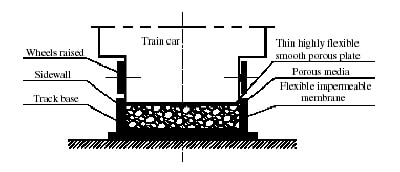
Extrapolating these results to the case of a 50-ton high-speed train, Weinbaum and co-workers calculated that 9.8 kilopascals of pore pressure would be needed to support a train that was 25 metres long and 2 metres wide. According to the scientists, a porous material with a permeability of 10-8 metres squared or smaller – such as goose down – could be used as a track that was capable of supporting the weight of the moving train (figure 2).

“Our work shows that soft porous layers filled with air or water can generate lift forces that can be a million times more than classical lubrication theory predicts,” Weinbaum told PhysicsWeb. “These forces could be sufficient to lift a train car on something as soft as a bed of feathers.” Although goose down is too expensive for practical applications, the team points out that there are many synthetic fibres with comparable mechanical properties.

The researchers say they applied ideas from blood flow to snowboarding and the design of a futuristic train track because of their “novelty”, but they stress that the basic concepts could be relevant in any application that involves bearings and lubrication.

IBM tops supercomputing table

The supercomputers on the list are used for a wide range of purposes from basic research to weather forecasting and military applications. The TOP500 list is published every six months and is based on the Linpack performance test, which measures how many floating point operations per second (flops) a machine is capable of. All the performances in the list are quoted in teraflops, where one teraflop is a trillion flops (or 1012 flops).

Blue Gene/L currently contains 16,384 processors, but this number is due to increase by a factor of four to 65,536, which should make it capable of 360 teraflops. Currently located at an IBM facility in Minnesota, Blue Gene/L will be moved to the Lawrence Livermore National Laboratory in California where it will mainly be used to study how nuclear weapons age as part of the US stockpile stewardship programme.

“BG/L will reduce the time-to-solution for many computational problems, allowing DOE scientists to explore larger, longer and more complex problems than ever before,” said Spencer Abraham, head of the DOE. “For example, a heroic 30-day calculation on what was the number three supercomputer in summer 2003 would now be completed on BG/L in about three days.”

NASA’s Columbia machine, which was built by Silicon Graphics, will be used for hurricane predictions, studies of global warming and astrophysics research. Meanwhile, the Earth Simulator – an NEC machine that is based at the Earth Simulator Center in Yokohama – is used for climate modelling and simulating seismic activity. It was number one in the TOP500 for two-and-a-half years before being overtaken by Blue Gene/L and Columbia.

The highest ranked European machine is an IBM-built MareNostrum cluster at the Barcelona Supercomputer Center in Spain, which is capable of 20.53 teraflops.

A new type of solar cell

Conventional solar cells need a secondary device, such as a battery, to store the electrical power generated from light. The photocapacitor combines the photoelectric and storage functions in a single structure.

The Japanese device consists of two electrodes — a light-absorbing photoelectrode made of semiconducting titanium dioxide and a counterelectrode made of platinum coated glass — separated by a resin film. Both electrodes include a porous layer of activated carbon that has a large surface area. All three layers are filled with an ionic solution and form a capacitor that has a light collection area of 0.64 square centimetres (see figure).

Photons are collected by photoreceptor dye molecules on the surface of the titanium dioxide layer. When exposed to light, electrons from the dye molecules are transferred to the conducting band in the titanium dioxide layer, thus producing a current. They then transfer to the activated carbon layer at the counterelectrode via an external circuit.

Conversely, the positively charged holes left behind are transferred to the carbon layer at the photoelectrode. The accumulation of positive and negative charges at different carbon layers therefore allows the device to store energy or charge like a capacitor. The energy can be released by simply discharging the device.

“The photocapacitor is twice as efficient as traditional silicon-based solar cells in utilising weak light,” Miyasaka told PhysicsWeb. “This means that it can utilise indirect sunlight, for example on cloudy or rainy days, and even indoor light. Moreover, it can release electrical energy anytime, even in the dark.”

Miyasaka says that the next goal is to increase the charging voltage and the charge-discharge capacity to a practically and industrially useful level for applications.

Copyright © 2026 by IOP Publishing Ltd and individual contributors