Geomagnetic or auroral storms happen on the Earth when the solar wind interacts with the geomagnetic field. However, coronal mass ejections — violent eruptions on the surface of the Sun — can trigger interplanetary shock waves that compress the Earth’s magnetosphere and lead to auroral storms. These storms are routinely monitored by the “Space Weather” satellites. Other planets with magnetic fields also experience geomagnetic storms but these are difficult to observe.
In early December 2000, Renée Prangé of the Observatoire de Paris and co-workers used the STIS instrument on the Hubble Space Telescope to image an aurora on Saturn. This aurora contained bright features that had never been seen before and led the French–US team to believe that it had observed an auroral storm.
Working backwards in time, the team traced this storm back to a series of coronal mass ejections that occurred between 1 and 10 November. These ejections triggered a sequence of five shocks, which were detected near the Earth by the WIND, ACE and POLAR spacecraft about two days later.
Using a new magnetohydrodynamic computer code Prangé and co-workers at the University of Michigan, the US Naval Research Laboratory and the Jet Propulsion Laboratory predicted that these shocks — which later merged into a single long shock — should have passed Jupiter’s magnetosphere between 18 and 24 November. The Cassini mission — then on its way to Saturn — was near Jupiter at the time and was able to confirm this. The team then calculated that the shock must have passed Saturn between 2 and 8 December. The Hubble STIS images of the storm were taken on December 7 and 8.
There were some similarities between the storms on Saturn and those seen on the Earth, like brightening of the aurora around midnight, which suggests that similar processes could be at work on both planets. However, there were also differences, such as the lack of expansion of the aurora towards lower latitudes on Saturn. The team now hopes to make further observations with Cassini, which is currently in orbit around Saturn.
How things have changed. Two breakthroughs in the fairly recent past – the discovery of the fullerenes (starting with carbon-60) in the mid-1980s, followed by the production of the first carbon nanotubes in the early 1990s – have led to an explosion in the number of research papers on the mechanical, electronic and other properties of carbon-based materials.
On page 33 Michael Coey and Stefano Sanvito describe the mysterious magnetic properties of carbon. At first sight carbon seems to be a most unpromising raw material for making magnets. The basic ingredients of any magnet are atoms that contain unpaired electrons, and the six electrons in a typical carbon like to form pairs.
However, ever since a team at the Ioffe Institute in St Petersburg found signs of ferromagnetism in carbon-60 samples in 2001, the evidence that carbon can be magnetic has grown stronger. Indeed, Coey and co-workers have even found evidence for magnetic carbon in fragments from a meteorite that crashed into the Earth 50,000 years ago. Defects are thought to be the most likely source of the magnetism, although this has yet to be confirmed.
This year alone has seen a long list of carbon-based breakthroughs in physics: the use of carbon nanotubes as filaments in light bulbs; a carbon-based foam that has the lowest density ever reported for a solid; nanotube-based sensors that are capable of measuring tiny forces; ballistic electron transport in layers of graphite just an atom thick; and the use of single carbon atoms to improve the resolution of atomic force microscopes to better than 0.1 nm (see physicsweb.org/articles/world/17/11/1 for links to these and other stories).
Moreover, the results are not restricted to condensed-matter and device physics. Japanese physicists have used carbon-60 molecules to change the radioactive half-life of beryllium nuclei, while carbon-70 molecules are being employed in experiments in Austria to explore the boundary between quantum and classical mechanics.
Of course, some physicists were interested in carbon long before fullerenes and nanotubes arrived on the scene. In the 1950s, for instance, Fred Hoyle famously predicted the existence of a previously unknown excited state of the carbon nucleus to explain how elements could be formed inside stars. The state was found in experiments shortly afterwards. The search for carbon-based life forms in space has been less successful, but the current enthusiasm for all things carbon on Earth shows little sign of fading away.
As a young geologist, I remember sitting in the mission control room of NASA’s Jet Propulsion Laboratory with Carl Sagan in 1976, waiting for the first colour images of Mars from the Viking lander spacecraft to scroll down the television screen. I was glued to the emerging details of the rock colours but Carl, ever the cosmic observer, turned to me and said, “Jim, we have just confirmed one of the findings of Palaeolithic man: Mars is red!”. Despite this welcome confirmation, we soon became frustrated by the unchanging view provided by the stationary lander and our inability to glance over the Martian horizon.
In 1997, some 21 years after the Viking landings, Pathfinder touched down on Mars and the Sojourner rover excited millions of Web viewers with its ability to explore and respond to new information with daily commands from Earth. But this was only the third landing site on Mars, and the distance travelled by Sojourner was frustratingly short.
Enter the Mars rovers Spirit and Opportunity, which were successfully delivered to the red planet in January by NASA’s Mars Exploration Rover mission. Designed to explore over much longer distances and to carry many more instruments than before, these twin rovers are a geologist’s dream. Since they landed, there has been months of frenzied activity as the information that is sent back daily is analysed and digested, and new commands are sent to the planet’s surface. And after 90 Martian days of operation (1 Martian day equals 24 hours and 39 minutes), researchers on the Spirit team have reported the initial results of this fascinating journey of discovery in a series of 11 papers (Science305 794-845).
Global view
On Earth, geologists begin their analyses with the small, looking at one rock exposure after another and slowly building up a picture of the processes that have shaped the planet during its long and complex history. For planetary geologists studying Mars, however, technology has dictated that this learning sequence is reversed. First we had fuzzy telescopic views, followed by global perspectives from orbiting spacecraft and, finally, spacecraft that could descend onto the surface to perform the vital close-up work.
Our view of Mars from the various orbiting missions and analyses of Martian meteorites is one of a cold, dry desert that was once warmer and wetter, and that may even have harboured life (see Physics World January 2003 pp35-40). To find out what Mars was like back then, how its climate changed so drastically, and to look for the candidate abodes for primitive life, researchers chose to explore Mars by “following the water”. As a result, the landing site chosen for the Spirit rover was an ancient impact crater named Gusev, which has river-like channels entering and leaving it, and a smooth floor thought to be paved with ancient sedimentary rocks. This makes it a good place to examine the deposits of ancient rivers and lakes, and, perhaps, even find fossils.
Armed with sophisticated instruments to probe the characteristics of the local rocks and soils it encountered, Spirit also has a variety of multiwavelength cameras to put these results into the context of its surroundings. What has begun to emerge in the Martian soil is a true discovery, not just a simple confirmation of previous ideas.
Soils are loose surface materials that originate from wind-blown material from other regions, or from chemical weathering of the underlying bedrock. Understanding the nature of this underlying bedrock is fundamentally important because it tells you about the local subsurface composition. After examining the adjacent soil and fully documenting its surroundings with panoramic images, Spirit left its landing site – which is named the Columbia Memorial Station – and headed for a nearby large rock.
Like explorers throughout history, the intrepid Spirit team led by Steven Squyres of Cornell University began to apply informal names to the rocks and features they encountered. The first stop was a mountainous boulder called Adirondack, followed by a sprint to a small crater-like depression called the Laguna Hollow, where Spirit dug a small trench. Next, the solar-powered rover investigated the rim and floor of another crater known as Bonneville, before finally traversing in the direction of the “Columbia Hills” some 2.6 km southeast of the landing site, with a stop along the way to examine a light-toned rock dubbed Mazatzal. So far, Spirit has covered over 600 m, and it continues to rove.
Rocky surprise
Throughout the region explored, Spirit found soil that was similar in composition to that seen by the Viking and Pathfinder missions. The ubiquitous soil is dominated by basalt, which is a rock type indicative of volcanic lava flows and not ancient lake sediments. But the soil also appears to contain tantalizing enhancements of sulphur and chlorine together with evidence of minor amounts of sulphates and carbonates. All of these are consistent with the ancient presence of water. As if to verify the prescient imagination of science-fiction writer Frank Herbert, numerous ripples and drifts of dust and sand dotted the landscape.
The rocky landscape offers many opportunities to visit individual rocks, which have been mostly excavated by countless meteorite impacts and strewn around the craters. Most of the rocks are coated with bright materials and have been eroded and shaped by the incessant Martian winds. Adirondack, for example, stuck out because of its size and its two-toned appearance, which is reminiscent of a 1950s automobile. The upper part has a fresh and dark-appearing tone, while the lower part is paler and coated, indicating that some of the surrounding soil has been removed by wind.
Anticipating such rock coatings from the earlier Viking and Pathfinder missions, engineers had designed a rock-abrasion tool to penetrate through the coatings and investigate the composition of the solid rock. Adirondack provided the first surprise: the local rocks were not, in fact, sediments from an ancient lake, but volcanic rocks of basaltic composition analogous to lava flows on, for example, Hawaii. This finding was later confirmed by analyses of other rocks along the journey.
So where were the anticipated sedimentary deposits? Impact craters provide natural drill-holes into planetary surfaces, and Spirit explored several of these in order to examine materials brought up from shallow depths below the surface. But here too, there appeared to be nothing but volcanic rocks.
The summary of the mission findings to date suggest that the geological history of the Gusev crater floor explored by Spirit is dominated by three processes. The first is the volcanic extrusion of lava flows, which cooled and hardened to create a region of smooth, dark plains. The second is the subsequent cratering events, which disrupted and excavated portions of the underlying lava-flow bedrock. Finally, wind-related abrasion modified the surface and ejected impact blocks, and also deposited dust from distant sources. Although coatings and veins that may have resulted from reactions with aqueous fluids were found, no evidence for ancient lake deposits was revealed.
These unexpected results are the true rewards of exploration. As the late planetary scientist Tom McGetchin used to say, the geological processes that were thought to have shaped Mars turned out not to be option a, b or c, but option d – “none of the above”. These results provide important confirmation that areas showing evidence of water erosion have also been heavily influenced by lavas. Furthermore, they have prompted significant rethinking in the research community.
Some researchers now think that many of the channels extending into and out of ancient craters could be caused by lava flows, not water erosion. Others believe that the lava flows on this part of the Gusev crater floor are simply a surface coating on ancient lake deposits, some of which may be exposed at the Columbia Hills. Still others believe that the evidence for ancient flowing water is overwhelmingly demonstrated by ever-higher-resolution views of the surface from orbit, including strong evidence for river channels and Mississippi-like sedimentary deltas.
Spirit’s twin spacecraft, Opportunity, is searching for evidence of ancient water in a totally different geological environment. Preliminary findings include evidence of rock layering, which could be the result of running water, and several minerals have been discovered that might have formed due to the action of Martian groundwater. We now anxiously await the first official reports from the Opportunity team.
Ham and eggs belong together, no question; and so, with equal assurance, do yin and yang or law and order. But when it comes to pairing science with art, things have become more tricky since Leonardo da Vinci embodied both. Few of us nowadays can achieve this, and it has become harder to emulate Leonardo. Nevertheless, we try, because there is fascination and value in exploring the messages that science and art can exchange with each other. That was one reason I attended a conference called “Theatres of Science: Crossovers and Confluences”, which was held in September at the University of Glamorgan in the UK. A total of 70 delegates attended from the UK and beyond.
I have been to conferences before that combine science with literature or the visual arts, but “Theatres of Science” is the first I know of to celebrate connections between science and the dramatic arts. The conference was organized by Michael Carklin, who – along with his Glamorgan colleagues – accepted presentations from directors, actors, performance artists and dancers as well as from playwrights, scientists, educators and literary scholars. The result was a highly varied meeting. I attended as a physicist who has written plays and performance pieces with scientific themes; I also gave a presentation with the playwright Lauren Gunderson.
The conference was partly a response to the recent artistic and commercial successes of so-called science plays, notably Michael Frayn’s Copenhagen. Not all the delegates agreed that science plays constitute a distinct genre. But putting science into a play does present special opportunities and problems. Recognizing this, Gunderson and I offered the following definition at the conference. A science play is one in which scientists and scientific ideas, ethical issues or interactions with society are important dramatic elements, but where the science is confined to known limits or reasonable projections. (The science in a science-fiction play, in contrast, does not need to be real.)
Stories or lectures
Stage works with scientific elements date back to ancient Greek drama. Some are well known, such as Friedrich Dürrenmatt’s The Physicists and Bertolt Brecht’s Life of Galileo. However, the success of Copenhagen, coupled with today’s growing scientific awareness, has encouraged a recent spate of science plays (see “When science takes to the stage” Physics World November 2002 pp32-33). No single person could attend all the conference sessions or show expertise in all the sciences covered, which ranged from psychology and biomedicine to hard-edged physical science. I attended a cross-section of events, but was especially interested in physical science, and so, it appears, are playwrights. Topics from physics, chemistry and astronomy are popular, especially the seminal ideas of quantum mechanics and chaos theory, possibly because these ideas are broad enough to support a range of dramatic uses.
Scientists might expect a play involving quantum physics to explain the quantum basics, but playwrights want to tell dramatic stories, not offer scientific lectures. If an idea like “chaos” appears, it is likely to be as an organizing scheme that a playwright uses to construct a play, as in Tom Stoppard’s Arcadia. Expanding this theme in his talk “Storytelling in a quantum world”, Jim Maiwurm of the Department of Theater Arts at the State University of New York at Stony Brook noted that whereas religion and mythology once provided significant metaphors for storytelling, now audiences expect science to explain the world. This drives and justifies the metaphorical use of scientific concepts in Copenhagen, Arcadia and other works such as Penny Penniston’s Now Then Again, which draws on the many-worlds hypothesis of quantum theory. Taking this metaphorical approach probably as far as it can go, Zachary Dunbar of Royal Holloway, University of London, presented an elaborate analysis of the role of the chorus in Sophocles’ Oedipus Tyrannus in terms of the late Ilya Priggogine’s ideas about non-equilibrium thermodynamics.
Gunderson’s play Background, part of which was performed at the conference, uses a scientific process as a metaphor in a different way. The play tells of Ralph Alpher, the US physicist whose calculation of the cosmic background radiation preceded its actual discovery by years but who still remains relatively unknown in the physics community. A centrepiece of the play is a scene where time is counted in reverse from the present to the instant of creation in the Big Bang, much as cosmologists work backwards to understand how today’s world arose from the early universe.
Theatrical explanations
Not everyone, however, is ready to abandon the direct educational value of science plays. This was the view expressed in the keynote address by Carl Djerassi – the Stanford University chemist who invented the birth-control pill and who now, having written several plays, describes himself as a playwright. Djerassi focused somewhat narrowly on his own works, but did treat one broad question: how much science can a science play contain and still be a commercial success? Noting that some successful science plays do not display much science, he opined that for a play to become true “science-in-theatre”, it should present science in pedagogical terms. But that approach, says Djerassi, “usually irritates or terrifies theatre professionals”.
A good science play should indeed give the audience an expanded view of science within a dramatic experience, but, along with the professionals, I am wary of too much explanation, which can be the death of drama. Instead, I showed at the conference how I put scientific concepts into theatrical terms.
An example of this comes from my play Friedmann’s Balloon, which was presented in 2002 by Theater Emory in Atlanta. The play relates to events that took place in the 1920s when the Soviet mathematical physicist Alexander Friedmann challenged Einstein’s conclusion from general relativity that the universe is static. Einstein came to accept Friedmann’s result and called his own original conclusion his “biggest blunder”, making Friedmann (and not Einstein) the grandfather of the expanding universe.
In the play, Friedmann’s mathematician friend Lev finds general relativity incomprehensible and challenges Friedmann to explain what it means. Rising to the bait, Friedmann bets Lev 10 rubles that he can do so. He then calls in a Soviet army sergeant and uses the soldier’s experience in making up a barracks cot with a tautly stretched blanket to show how the shape of space-time produces gravity. Lev is convinced, and ruefully pays Friedmann the 10 rubles.
Another example of putting science into a theatrical context is my play Glory Enough, which was also excerpted at the conference. It centres on the work of Rosalind Franklin and examines who should have received proper credit for the discovery of the structure of DNA. By incorporating an edgy discussion between Franklin and her friend Anne, members of the audience are able to grasp how X-rays can probe molecules and why Franklin’s X-ray images were important.
The human angle
The conflict inherent in Franklin’s story is a reminder that an engrossing science play should make us care about people as well as ideas. Human stories were prominent in many works shown at the conference. For example, Gunderson’s Leap – portions of which she presented at the conference – contrasts a young Isaac Newton’s intellectual activities with his human relationships or lack of them by introducing Brightman – a kind of female scientific muse who falls in love with Newton but finds that he does not return the feelings.
Meanwhile, Comet Hunter by Chiori Miyagawa of Bard College in New York focuses on Caroline Herschel – the sister of the 19th-century astronomer William Herschel who discovered the planet Uranus. Although textbooks note only that Caroline contributed to William’s astronomical observations, the play scenes shown at the conference made both Herschels more real by showing their loving brother-sister relationship. It also deepened our sense of Caroline’s place in the all-male scientific world of her time.
In writing Comet Hunter, Miyagawa collaborated with James Lattis, a historian of astronomy at the University of Wisconsin Madison. As the two spoke about their interaction, the scientists and artists began to appreciate each other’s concerns as they connected. Another example of scientists and artists changing each other came from Einstein’s Gift, by Vern Thiessen of the Citadel Theatre in Edmonton, Canada. The play is partly about the chemist Fritz Haber’s Nobel-prize-winning work that established the process of “nitrogen fixing”, which can be used to create ammonia from air and is essential in the production of agricultural fertilizers. In Thiessen’s presentation at the conference, actors playing Haber and his colleagues were taught the chemical basics of the fixing method by Nigel Hodge, who teaches general science at Glamorgan. Armed with this new knowledge, the troupe brought enhanced authority and commitment to the scene where the research team works out the chemical parameters for the process.
Successful mixing
Despite such good interactions, I suspect that many scientists would prefer didactic science on stage, rather than metaphorical and qualitative science. Scientists, it seems to me, want their science to be correct and to be explained correctly. That did not always happen at “Theatres of Science”, where dubious or speculative science was occasionally presented as fact. But while it is essential that accuracy should not be sacrificed, the conference showed me once again that scientists and artists can act as each other’s muses – and that the stimulus provided by a muse should be judged less by some standard of correctness than by the quality of what it inspires.
An example of such inspiration came in the presentation “Choreography and theoretical physics” by dancer Rita Marcalo of University College Chichester. She found that the ideas of the philosopher Henry Bergson and the physicist David Bohm refined her thinking about time and space – not as abstract physical entities but as the medium in which she dances. Bergson’s concept of heterogeneous time validated a new choreographic approach – the creation of works based on memories of previous works. They also influenced her piece Crooked Angels.
Ending this report with the likes of Bergson might suggest a heavily academic conference, but the mix of attendees kept it lively and engaging. Science and art came together in energetic discussions that began at breakfast and continued throughout the day, often into the early morning. And although none of us alone could match Leonardo, he too, I think, would have been a happy delegate.
Dialogue Concerning the Two Chief World Systems by Galileo, which is brilliant and very amusing as literature, even leaving aside its scientific and historical importance. It is the book that got Galileo into trouble. We should be grateful for his courageous willingness to engage questions that really cut into people’s prejudices and upset their world-views in ways they found disturbing.
Origin of the Species by Charles Darwin. It is not just a popularization, of course, but it is self-contained, written in simple prose, and is accessible to the general reader.
Chemical History of a Candle by Michael Faraday. This is one of his Christmas lectures that he gave at the Royal Institution. It is a wonderful laying-bare of surprising facts and intricate structure in a (superficially) familiar process – the burning of a candle. I think it exhibits a marvellously creative mind at work on its home ground, poking into details and following peculiarities to their root with carefully crafted experiments.
If I could, I would also mention the scientific writings of Benjamin Franklin, especially his letters to Collinson on electricity, as well as Erwin Schrödinger’s What is Life?.
What popular-science books are you currently reading?
I am currently about a fifth of the way through Roger Penrose’s new book The Road to Reality. It is huge – over 1000 pages long – but very interesting. I also enjoyed John Derbyshire’s Prime Obsession, which is about the solving of the Riemann hypothesis.
Which popular-science book have you never read, but feel you ought to have tackled?
I can’t say that I feel the least bit guilty about not having read any particular popular-science book. I tend to read at least “one level up” from what you would call truly popular science – books such as Edward Wilson’s Sociobiology, and John Gerhart and Marc Kirschner’s Cells, Embryos, and Evolution. I also read in fields that are closer to theoretical physics or where I have a special interest (such as computation and neurobiology) that is much higher.
The exception is older books; I very much enjoy reading the old masters, although obsolete technical terminology and notation can get in the way and much of the material goes in directions that have not proved so fruitful. I therefore wind up looking at the less intimidating, more reflective portions, such as the “Optics” and the “Scholia” in Newton’s Principia.
The role of expert testimony in court has been widely discussed in the UK in recent years, fuelled by the highly emotive subject of “cot death”. However, the debate is not a new one. After all, the legal process has, for many centuries, turned to scientists for guidance in court. The problem is that scientists – especially in a new field – can strongly disagree about the underlying science and its interpretation. There can be a mismatch: the law requires certainty, while science looks for an absolute truth.
In Laws of Men and Laws of Nature, Tal Golan explores this mismatch – and much more – in a thorough and entertaining review of the history of the partisan expert witness in England and the US. The legal instinct, he says, is suspicious of extrapolating from artificially created facts to the original events of the case under consideration. This has been the short-coming of many pre-eminent scientists who have acted as expert witnesses. Indeed, it is as true today as it is was when, for example, Michael Faraday’s testimony was mocked in court during a dispute between a sugar manufacturer and its fire insurers in the early 19th century.
The case was brought by Severn King & Co, which had used a new process for refining its sugar that led to a spectacular fire in 1819 that devastated its factory. As cynics may have guessed, the company’s insurers refused to honour the policy because they had not been notified about the use of the new process. The case turned on whether the new process was safer than the old process, which led the insurers to engage Faraday as their lead expert witness.
Although Faraday carried out experiments relating to the cause of the fire, he ignored those factors that he considered to be scientifically irrelevant. This gave the sugar manufacturer’s lawyers plenty of scope to deconstruct his evidence on the basis that these factors were relevant. Several other scientists gave evidence for the manufacturer, which won its claim. The judge, however, expressed his exasperation regarding the vast body of contradictory evidence that the scientists had amassed.
Today, scientific expert witnesses are used throughout legal practice in, for example, patent disputes and in criminal cases. However, it was not always so. Although the law had, since the Middle Ages, acknowledged the importance of the assistance of science, there was – bizarrely – nothing to distinguish an expert witness from a witness of fact. A scientist had no legal basis for expressing their opinion, where, of course, their expertise lies.
This changed following a dispute that took place in the 1780s concerning the silting-up of Wells harbour in Norfolk. Golan provides a brilliant and detailed account of the litigation, in which the claimants argued that the silting-up was a consequence of land reclamation near the harbour. The court accepted evidence from a civil engineer named John Smeaton, who acted on behalf of the landowners that this was not the case. Although the jury was ultimately not swayed by Smeaton’s argument, the decision by the court to accept his evidence is widely cited as the root of modern rules on expert evidence. Golan’s analysis of the relevance of this case is one of the book’s outstanding contributions.
Having established the birth of expert testimony, Golan then examines the use of expert witnesses and the problem of contradicting experts. Legal theory accepted that – in the words of Lord Gilbert’s seminal text Laws of Evidence – the “best evidence that the nature of the thing is capable of could be produced by science and science alone”. Of course, experts can openly express different opinions and the usefulness of scientific experts in court was doubted: how is someone who is not a scientist – such as a judge or jury – to know which of two contradicting opinions is correct? The court is looking for certainty and yet the expert scientists dispute the scientific truth.
During the 19th century, scientists discussed how to maintain the public’s perception of their integrity, impartiality and objectivity. A common view of scientists was given in the 1860s by the chemist Robert Smith, who said that “the [scientist in a courtroom] simply becomes a barrister who knows science. But this is far removed from the idea of a man of science. He ought to be a student of the exact sciences who loves whatever nature says in a most disinterested manner”. This altruistic view was widely held. For example, in November 1885 the editor of Nature launched a scathing attack on “professional scientists”, especially those appearing as witnesses in court.
A minority of scientists, however, thought differently. Some, such as the experienced expert witness William Odling, argued that the truth “could only be arrived at by the conflict of testimony”. Golan’s work demonstrates that today’s debate about whether party-appointed experts are better than court-appointed experts was just as alive – possibly even more so – in the 19th century.
This sabre-rattling continued for sometime, but was essentially sidelined in England by legal reforms to court procedure that, for example, reduced the use of juries. In the US, however, these reforms were not introduced, and Golan describes how evidence from scientific expert witnesses evolved there. He does this by examining how scientific evidence – in the form of blood micrographs, X-ray images and experimental psychology such as lie-detector tests – were used in court. In doing so, he demonstrates how the law accepts new science as evidence and the development of tests for assessing expert evidence.
Golan manages to deal with what can be dry subjects – law and science – in a readable format. At times he deviates into the full background history of an aspect, which may well serve his primary purpose as a historian. Tensions between scientific practice and the legal process are identified, and he recognizes how science and technology have been used successfully and unsuccessfully in court. Although he describes the present position in the US, he does not appear to deal with the current issues in England.
This is a valuable, well researched and entertaining account of the history of scientific expert evidence. Both lawyers and scientists should find it illuminating, but scientists who are thinking of acting as an expert in legal proceedings should look elsewhere for guidance. As the English rules of court procedure put it, the overriding duty of an expert is to help the court on matters within his or her expertise. An honest expert who remembers this should steer clear of trouble.
Ferromagnetism, that most mysterious of the common properties of solids, has long known its place in the periodic table: down among the transition metals. These elements, which include iron and cobalt, have a net magnetic moment in the solid state because their atoms contain unpaired electrons. One of the last places you would expect to find ferromagnetism is in carbon, because its electrons love to pair up to form covalent bonds. These bonds are the antithesis of magnetic order, so how can we explain the increasing number of reports of magnetism in carbon?
Quantum mechanics links magnetism inextricably with the intrinsic angular momentum or “spin” of electrons. However, unlike classical angular momentum, which can take on any value, the spin of an electron can have only one of two values: “up” or “down”. Electrons therefore behave like tiny magnetic dipoles, and atoms have a net magnetic moment, m, if they contain more spin-up electrons than spin-down electrons, or vice versa. This often happens if the atom contains partially filled electron shells. However, matters become more complicated in the solid state.
Depending on the way the spins of different atoms in a material couple together, their magnetic moments can lead to a magnetically ordered state below what is known as the Curie temperature. Above this temperature the order is destroyed by thermal fluctuations. These exchange interactions, J, between the spins lead to two distinct phases in a solid depending on their sign: a ferromagnetic phase where the electron spins all point in the same direction, or an antiferromagnetic phase where alternate spins point in opposite directions.
Our current description of magnetic order is based on this “m–J” paradigm, but recent observations of magnetism in certain forms of carbon are stretching this picture to its limits. Furthermore, magnetic carbon could be used to make cheap, metal-free magnets for applications in medicine, nanotechnology and telecommunications, and also offers the prospect of carbon-based electronics.
Magnetic inventory
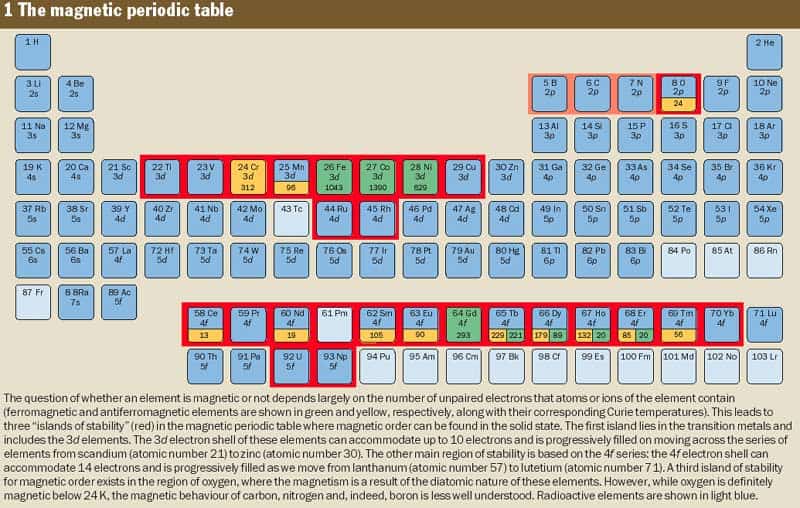
Normally the only elements that are ferromagnetic at room temperature are iron, cobalt and nickel, joined by gadolinium if the weather is not too hot. A few other rare earth elements, the “4f” series, become ferromagnetically ordered at lower temperatures, and almost all of these elements have a ferromagnetic or antiferromagnetic “ground state” at sufficiently low temperatures. Chromium and manganese, which lie in the “3d” series, are also antiferromagnetic. These series represent electron shells in the atom, which determine the overall structure of the periodic table. The innermost “1s” shell holds up to two electrons, the “2p” shell holds up to six electrons, and the 3d and 4f shells can hold 10 and 14 electrons, respectively (figure 1) .
Many useful ferromagnetic or antiferromagnetic materials are alloys of the 3d metals. Some examples are silicon steel (which is used for electromagnetic machinery), nickel iron (magnetic shielding and sensors), neodymium iron boron (high-performance permanent magnets), and iridium manganese (spin valves and magnetic tunnel junctions). The rest are oxides of the 3d elements, which have a slightly different “ferrimagnetic” order and include iron oxide (magnetic tapes) and barium iron oxide (fridge magnets and small motors).
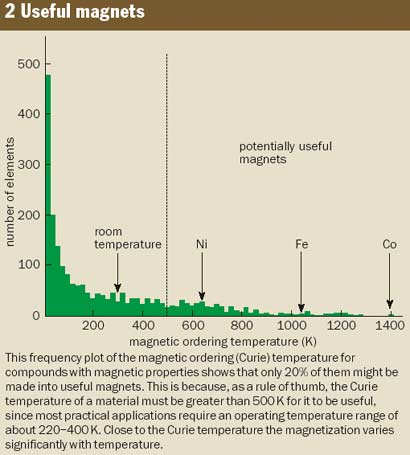
Besides these useful materials, of which no more than about a dozen are manufactured in industrial quantities, there are thousands of others that are known to have a magnetically ordered ground state. However, most of these compounds have relatively low Curie temperatures, and the chances of finding a useful new magnetic material – i.e. one that retains its order above a temperature of 500 K – is less than one in five (figure 2). Magnetic materials involve numerous chemical combinations of the 3d and 4f elements, but the overwhelming majority of magnetically ordered alloys and compounds include magnetic elements from two “islands of stability” in the periodic table. One island encompasses the 3d series and a few 4d elements, and the other includes the 4f series and a few 5f elements (see figure 1).
So where does all this leave carbon? Not only is carbon the most covalent of the elements, it is not even magnetic in the atomic state since the spin and the angular momentum of its six electrons cancel to produce a net magnetic moment of zero. Given such anti-magnetic tendencies, carbon hardly seems likely to become the ferromagnet of the future. Yet, at a glance, the magnetic periodic table suggests that there may be a third island of magnetic stability in the region of oxygen.
1 The magnetic periodic table The question of whether an element is magnetic or not depends largely on the number of unpaired electrons that atoms or ions of the element contain (ferromagnetic and antiferromagnetic elements are shown in green and yellow, respectively, along with their corresponding Curie temperatures). This leads to three “islands of stability” (red) in the magnetic periodic table where magnetic order can be found in the solid state. The first island lies in the transition metals and includes the 3d elements. The 3d electron shell of these elements can accommodate up to 10 electrons and is progressively filled on moving across the series of elements from scandium (atomic number 21) to zinc (atomic number 30). The other main region of stability is based on the 4f series: the 4f electron shell can accommodate 14 electrons and is progressively filled as we move from lanthanum (atomic number 57) to lutetium (atomic number 71). A third island of stability for magnetic order exists in the region of oxygen, where the magnetism is a result of the diatomic nature of these elements. However, while oxygen is definitely magnetic below 24 K, the magnetic behaviour of carbon, nitrogen and, indeed, boron is less well understood. Radioactive elements are shown in light blue. (Copyright: IOP Publishing)
This is because elements such as oxygen can have a magnetic moment when they form molecules, as the molecular orbits form a spin triplet in their ground state. Drops of liquid oxygen, for example, are easily deflected by a permanent magnet, and solid oxygen orders in a complex antiferromagnetic structure when it is cooled below 44 K. Is oxygen an isolated case, or can its neighbours in the periodic table also form spin-triplet molecular states that order magnetically?
Reports of magnetic carbon
There have been a number of reports of magnetism in carbon, mostly in Russian and Japanese chemical literature. The idea is that various organic molecules can produce a ferromagnetic, carbon-based material after they have been heated in a vacuum. However, these reports have largely been ignored by physicists interested in magnetism, perhaps because the researchers were unaware of them but more likely because the results seemed implausible and were not readily reproducible. How could carbon possibly be magnetic?
The main cause for suspicion was that many of the reports claimed to have detected only small magnetic moments, which can simply be due to traces of natural magnetic contaminants. Iron, for example, is the fifth most common element in the Earth’s crust, and its black oxide magnetite is everywhere in the air. The magnetization of iron and magnetite are 220 and 100 A m2 kg-1, respectively, so a sample magnetization of 10-3 A m2 kg-1 or less can be easily dismissed as the consequence of magnetic contamination at the level of a few parts per million. Unfortunately, it is moments of just this magnitude that are often reported.
2 Useful magnets This frequency plot of the magnetic ordering (Curie) temperature for compounds with magnetic properties shows that only 20% of them might be made into useful magnets. This is because, as a rule of thumb, the Curie temperature of a material must be greater than 500 K for it to be useful, since most practical applications require an operating temperature range of about 220-400 K. Close to the Curie temperature the magnetization varies significantly with temperature. (Copyright: IOP Publishing)
It is also difficult to separate these small moments from the underlying “diamagnetism” of carbon. This is a very weak form of magnetism exhibited by almost all forms of carbon (and, indeed, by many other elements) in the presence of an external magnetic field. The external field alters the orbital motion of electrons and induces a small magnetic moment in a direction opposite to that of the field itself. For insulating forms of carbon, such as diamond or buckyballs (carbon-60), the ratio of magnetization to applied field – the “diamagnetic susceptibility” – is very small. However, the susceptibility of conducting forms of carbon, such as graphite and some carbon nanotubes, is two orders of magnitude greater and second only to that of superconductors.
This large diamagnetism occurs because graphite is a semi-metal, which means its valence and conduction bands overlap by a tiny amount. The number of electrons and holes in small overlapping regions is only about 10-5 per carbon atom, compared with one conduction electron per atom in copper. We need to apply a magnetic field to the samples to see if they are magnetic, but for perpendicular applied fields the susceptibility of graphite sheets is so high that the diamagnetic signal completely swamps the ferromagnetic signal. The situation is even worse for conducting nanotubes. As a result, small ferromagnetic moments are most easily detected in the insulating forms of carbon, or in graphite with the magnetic field applied in the plane of the sheets.
Firm evidence
In 2003 Pablo Esquinazi and co-workers at the University of Leipzig in Germany found evidence for magnetic order in a series of graphite samples in the presence of a parallel magnetic field. The magnetization ranged in strength from 0.3-2.5 × 10⁻³ A m2 kg-1, and in half of their samples the magnetization was greater than could possibly be accounted for by iron impurities. But the magnetization varied from one sample to the next, which meant that is was unlikely that the ferromagnetism was an intrinsic property of the carbon.
However, it was an experiment performed two years earlier with carbon-60 that proved to be the catalyst for the current interest in magnetic carbon. Tatiana Makarova of the Ioffe Physico-Technical Institute in St Petersburg, Russia, and co-workers, including Esquinazi, found a small ferromagnetic signal in a form of carbon-60 that had a rhombohedral structure. Although the samples showed a magnetization of just 10-3 A m2 kg-1, the result suggested that pure carbon could somehow be ferromagnetic.
But where did the magnetism come from? The Curie temperature of 500 K did not correspond to that of any obvious impurity, and the magnetism appeared only in a narrow range of temperatures and pressures. Indeed, the team was not even looking for signs of magnetism in carbon but for superconductivity.
Then in 2002 one of us (MC) and co-workers at Trinity College Dublin thought of checking graphite-rich fragments from the Canyon Diablo meteorite, which crashed into the Arizona desert 50,000 years ago. We found that only about two-thirds of the magnetization – which has an average value of 20 A m2 kg-1 – in this remarkable source of extraterrestrial carbon could be accounted for by the magnetic minerals present. This meant that the rest of the magnetization was somehow associated with the carbon content of the meteorite, which had presumably existed for billions of years before experiencing the shock of the impact (see Physics World December 2002 p3).
Earlier this year, John Giapintzakis of the University of Crete and colleagues found evidence for ferromagnetism in an ultra-low-density carbon “foam”, which was prepared by blasting a high-power laser onto an extremely pure carbon target. Using electron microscopy, Giapintzakis and co-workers observed that the material consists of randomly interconnected carbon clusters with average diameters of between 6-9 nm. The “nanofoam” had a Curie temperature of 90 K and a magnetic moment of about 0.4 A m2 kg-1 at room temperature, although this disappeared within a few hours of the foam being produced (see Physics World May p3).
The suspects
One of the most likely explanations for magnetic ordering in carbon is that it is caused by some kind of defect structure. Following the m–J paradigm, researchers have therefore been trying to find out whether defects in carbon can sustain a magnetic moment, m, and whether these moments order magnetically due to some form of exchange coupling, J. If this is the case, it should be possible to start with a nonmagnetic specimen and then make it magnetic by appropriate irradiation.
In 2003 Esquinazi’s group in Leipzig did just that by irradiating spots on a sheet of highly oriented graphite with protons and alpha particles. The researchers found that irradiation with protons led to a measurable magnetic moment but alpha particles did not. Signs of magnetism also appeared in the proton-irradiated spots when they were scanned with a magnetic force microscope. Defects in irradiated graphite have also been a topic of interest in nuclear technology, because they are produced in large quantities in the graphite moderators of nuclear reactors. It seems as if some of the defects in the moderator material can trap two electrons and form a triplet state.
There are three possible defect “suspects” that might be involved in the magnetic order in graphite (figure 3). Suspect 1 is the adatom, a carbon atom that lies on a graphene plane and that, in its stable configuration, occupies a bridge-like position in the middle of a carbon-carbon bond. Two of its four valence electrons participate in covalent bonds with the graphene carbon atoms: one goes to a “dangling” sp2 orbital that forms no bond, and the other is shared between this dangling orbital and the remaining p orbital. This last orbital lies parallel to the graphene surface, where it does not form any bond but possesses a magnetic moment of about 0.5 Bohr magnetons (μB). In terms of the atomic magnetization, 1 μB per carbon atom is equivalent to a magnetization of 465 A m2 kg-1.
3 The usual suspects The magnetic order in carbon could be due to magnetic defects that have a magnetic moment. For example, a graphene sheet – which is the building block for many of the carbon polymorphs – can have three types of defects: a carbon “adatom” on the surface of the sheet (A); a carbon vacancy (B); and an unevenly terminated zigzag edge (C). The dashed line encloses the “unit cell” of a magnetic graphene ribbon, which has a spin angular momentum of 1/2, and the protusions represent hydrogen atoms (see text). Each of these defects is thought to be able to induce a magnetic moment, but researchers have yet to find a mechanism by which these moments interact to produce a magnetically ordered state. (Copyright: IOP Publishing)
Suspect 2 is a carbon vacancy, which is obtained by removing an atom from the graphene sheet. Two of the three carbon atoms adjust their bonds to accommodate the vacancy and the remaining atom moves slightly out of the graphene plane. A singly occupied, dangling sp2 orbital is left, which generates a magnetic moment of about 1 μB. Earlier this year, Sumio Iijima of the National Institute for Advanced Industrial Science and Technology in Tsukuba, Japan, and co-workers visualized both adatoms and carbon vacancies with a transmission electron microscope.
The third suspect – zigzag edges in graphitic ribbons that have “flat” energy bands – has been around for 10 years, but it has generated a lot of excitement recently. This is because flat bands are known to split such that the “spin-up” band becomes lower in energy than the “spin-down” band, causing the material to become ferromagnetic.
The study of these edge states has been stimulated by a theorem developed decades ago by Elliott Lieb, now at Princeton University. This theorem states that the ground state of a lattice, such as a graphene sheet, that divides into two sublattices is magnetic. For this to happen, electrons must only be able to hop from lattice A to lattice B and vice versa, but without direct A-A or B-B hopping. The total spin is then ½ (NA–NB), where NA and NB are the number of sites on the two sublattices.
If the edge states in a graphitic ribbon with only two bonds are terminated in different ways, for example with one hydrogen atom on one edge and two hydrogen atoms on the other, then NA≠NB and the ribbon possesses a magnetic moment (see figure 3). Calculations of electronic structure have confirmed that such high-spin graphitic fragments do exist, although, interestingly, both the band formation and the magnetic ground state appear to be rather sensitive to the stacking of the graphene planes. However, there is no direct experimental evidence for these magnetic edges so far.
Indeed, there has been little progress in the search for a motive for any of these suspects to couple together to create a ferromagnetic state in carbon, since there is no obvious reason for strong exchange interactions to take place between the defects. In other words, the J part of the m–J paradigm is missing. One may speculate that the magnetic defects are coupled over long distances by indirect exchange with some conduction electrons, as happens in diluted magnetic semiconductors. However, the conduction electrons in graphite form a quasi 2D electron gas, giving a Curie temperature of about 1 K, so such a mechanism can hardly be responsible for room-temperature magnetism. The same argument applies to magnetic transition-metal impurities in graphite: they may have a high spin state but their magnetic coupling is likely to be very weak.
Clearly, the theoretical search for the suspects and motive for ferromagnetism in graphite-based systems is in its infancy. Perhaps one should consider more complex defects beyond the “usual suspects”. Or perhaps we need a completely new mechanism that goes beyond the m–J paradigm, such as a Bose-Einstein condensation of molecular triplet states.
Contact-induced magnetism
There is another way in which conducting carbon could become magnetic: by contact with a ferromagnetic metal. Whenever two metals touch, electrons flow between them in order to equalize their chemical potentials. If one of the metals is a ferromagnet with different densities of spin-up and spin-down electrons, this charge transfer is accompanied by a net transfer of spin. (The extreme case is a half-metal that contains conducting electrons with only one spin, which means that the charge transfer is completely spin polarized.) This contact-induced magnetism should always be present at interfaces, and it has been proposed as an explanation for the magnetization of graphite in the Canyon Diablo meteorite.
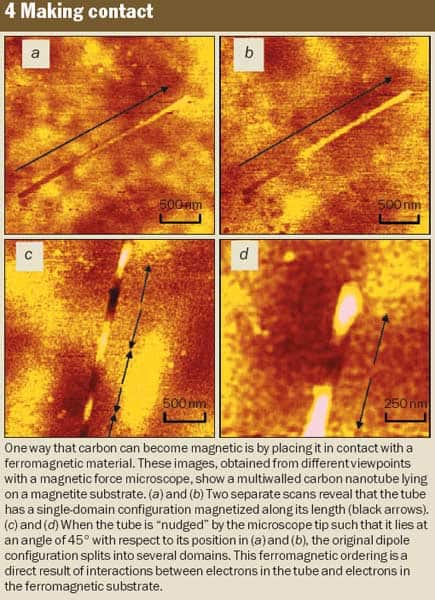
4 Making contact One way that carbon can become magnetic is by placing it in contact with a ferromagnetic material. These images, obtained from different viewpoints with a magnetic force microscope, show a multiwalled carbon nanotube lying on a magnetic substrate. (a) and (b) Two separate scans reveal that the tube has a single-domain configuration magnetized along its length (black arrows). (c) and (d) When the tube is “nudged” by the microscope tip such that it lies at an angle of 45 degrees with respect to its position in (a) and (b), the original dipole configuration splits into several domains. This ferromagnetic ordering is a direct result of interactions between electrons in the tube and electrons in the ferromagnetic substrate.
This year, contact-induced magnetism was demonstrated independently by two groups. In the first, Oscar Céspedes and the present authors in Dublin placed a carbon nanotube on a smooth film of a ferromagnetic metal. Provided the magnetization is uniform, the film produces no stray field (figure 4). However, if spin-polarized electrons are transferred to the nanotube, it looks like a tiny bar magnet and creates a stray field in its vicinity. The stray field was detected by the force exerted on the vibrating magnetic tip of a magnetic force microscope, which revealed that the nanotube had a magnetization of 0.5 A m2 kg-1.
In the other experiment, Hans-Christoph Mertins of the University of Applied Sciences in Munster, Germany, and co-workers produced a material made from alternating layers of iron and carbon layers with thicknesses of 2.55 and 0.55 nm. Then, by measuring the absorption of polarized electromagnetic radiation, they showed that the carbon had a magnetic moment of approximately 20 A m2 kg-1.
The crucial point in both these experiments is that no magnetism is found unless a ferromagnetic material is present (carbon nanotubes on copper or silicon substrates, for example, do not show any magnetic moment). However, a successful explanation for magnetic carbon in terms of contact-induced magnetism needs more than just the presence of high-spin impurities in carbon. We also need evidence for a ferromagnetic second phase, such as iron dispersed in tiny drops throughout the carbon.
Magnetic prospects
As we have shown, there are various pieces of evidence that suggest carbon can be magnetically ordered. But what about the other elements in the third island of stability in the magnetic periodic table? Do they exhibit high-temperature ferromagnetism too?
Some two-electron defect centres in oxides have long been known to have a spin triplet as a low-lying excited state. Recently, our group found that thin films of hafnium oxide and calcium boride are ferromagnetic, although neither compound contains magnetic ions or is magnetic in bulk form. Furthermore, the magnetization of these films does not increase with thickness beyond a few nanometres, and the moment is a few 100 μB per square nanometre of substrate area.
The origin of this magnetism seems to lie in defects in the film near the interface with the substrate. The problem, as with carbon, is less finding magnetic defect centres than finding a reason why they should order magnetically at such high temperatures.There may be a novel explanation.A clue may be provided by the hafnium-oxide films, which have a remarkable anisotropy in their magnetization that suggests there is a large orbital contribution to the magnetic moment.
Unlike the spin magnetic moment, the magnetic moments associated with the electron orbital motion are usually destroyed in solids. The prospect of ordered orbital magnetic moments is therefore an exciting one.
The possibility of creating magnetic carbon in a systematic and controllable way is a tantalizing prospect. Based on currently reported values of magnetization, however, it seems unlikely that the magnetism of carbon will ever bestrong enough to make it useful as a bulk magnetic material. A magnetization of 1 Am2 kg-1 is some two orders of magnitude lower than that of the materials used in high-performance magnets.
The prospects for spin-electronics are brighter, since carbon could, in principle, provide the way to integrate spin and molecular electronics. The weak spin-orbit and hyperfine interactions in carbon promote long diffusion lengths and coherence times, and therefore offer ideal conditions for coherent spin manipulation. In addition, the contact-induced magnetic effect paves the way for devices where the magnetic contacts used for the spin manipulation can be decoupled from the current/voltage probes. The carbon era of spinelectronics may be dawning.
Neutrinos are one of the fundamental constituents of matter, and come in three flavours — electron, muon and tau neutrinos. Large numbers of electron neutrinos are produced by the Sun, and all three flavours are produced in supernova explosions. However, all three types of neutrino are extremely difficult to detect because they are electrically neutral, have very little mass and only interact with other matter through the weak interaction.
The Super-Kamiokande experiment consists of 50, 000 tons of ultrapure water in a tank some 1000 metres below ground in central Japan. It can detect both electron neutrinos and muon neutrinos — but not tau neutrinos — from the flashes of Cerenkov radiation that are emitted when the neutrinos interact with electrons in the water molecules in the detector. Using the new method, Super-K will also be able to identify antineutrinos — the antiparticle equivalents of neutrinos — for the first time.
Electron antineutrinos currently interact with protons in the water molecules to produce a neutron and a positron for each interaction. However, the neutrons cannot be seen at present and the positrons cannot be distinguished from the background radiation of electrons and gamma rays.
Beacom and Vagins have proposed that these problems can be overcome by adding just 0.2% GdCl3 by mass — which is roughly 100 tons — to the water in the detector. This is because gadolinium is much more efficient at capturing neutrons than free protons. Indeed, gadolinium has a cross-section of 49,000 barns for thermal neutron capture, compared with just 0.3 barns on protons.
“Existing experiments can only detect supernova neutrinos produced within our own galactic neighborhood,” Beacom and Vagins told PhysicsWeb. “We have identified a method that will extend the reach of these experiments to about half the known universe. Instead of waiting for years or decades for a nearby explosion, we will record a continual stream of supernova neutrinos from distant galaxies.” The GdCl3 method would also make Super-Kamiokande 50 times more sensitive to the antineutrinos from nuclear reactors than the dedicated KamLAND detector that is located in the same mine.
Beacom and Vagins are currently performing R&D on handling and filtration techniques for the GdCl3 at Irvine, and hope to apply these techniques to a 1000 ton detector in Japan next year, and to the Super-Kamiokande detector itself in the summer of 2006.
Last year physicists at the Sudbury Neutrino Observatory (SNO) in Canada reported that they had increased the sensitivity of their detector by factor of three by adding 2000 kilograms of ultrapure table salt (sodium chloride). By using heavy water rather than ordinary water SNO is able to detect all three flavours of neutrino. However, it is much smaller than Super-Kamiokande, which means that it cannot detect as many events.
With a half-life of 230 000 years, 81Kr is a highly attractive tracer isotope to help earth scientists pinpoint key climate changes and characterize ancient aquifers. 81Kr is mainly produced when cosmic rays interact with particles in the Earth’s upper atmosphere. The radioisotope then falls to the ground where it is stored in layers of ice, oceans and shallow ground water.
To date their samples, researchers measure the capture rates of 81Kr and a control isotope, 83Kr or 85Kr. The ratio of these rates is known as the 81Kr abundance, and a comparison of sample and atmospheric 81Kr abundance reveals the sample’s age.
However, the low abundance and solubility of 81Kr in water have presented a significant challenge. Previous attempts at 81Kr dating using other methods have demanded large amounts of sample material. For example, in a groundwater study of the Great Artesian Basin, Australia, scientists had to process 16 tons of water to generate sufficient krypton gas (0.5 milliletres) for analysis.
The team has now refined its ATTA method into a very sensitive measurement technique that requires only 50 to 178 microlitres of krypton gas (equivalent to around 2 tons of groundwater). At its heart is the laser-based magneto-optical trap which selectively captures individual 81Kr atoms for 100 millisecond. Fluorescence is then induced and collected from the atoms in order to quantify the presence of the isotope.
Recently, the ATTA technique was used to determine that the water from a well in the Western Desert of Egypt has been underground for half a million years. Motivated by this success Zheng-Tian Lu at the Argonne National Lab (ANL) and colleagues are keen to use the apparatus to study ancient polar ice. “By analysing regions of trapped air in the ice we can learn a lot about the Earth’s climate,” said Lu.