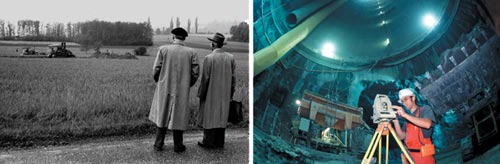
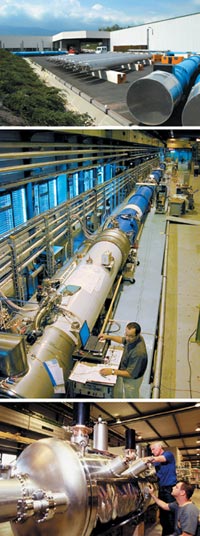
CERN at 50: the highlights

Pion decay: observed at CERN’s first accelerator, the synchro-cyclotron, in 1958, the decay of a pion into an electron was CERN’s first major physics discovery and an important development in our understanding of the weak force.

Neutrino horn: in 1961 accelerator expert Simon van der Meer discovered a way to make intense beams of neutrinos. The technique is still widely used in neutrino experiments today.

Aces: in an internal CERN report in January 1964, George Zweig published his theory about nucleons being made of smaller particles called aces. Unfortunately for him, Murray Gell-Mann had a similar idea at about the same time and we now call these particles quarks instead.

Multiwire proportional chamber: developed by Georges Charpak in 1968, this new approach to detecting charged particles increased the data-collection speed by a factor of 1000 compared with previous techniques, and was recognized with CERN’s second Nobel prize in 1992.

Strings: originally proposed by Gabriele Veneziano in 1968 as a model of the strong force, strings – and later superstrings – have dominated searches for a unified theory of the fundamental forces for the past 20 years.

Proton-proton collisions: first achieved at the Intersecting Storage Rings (ISR) in 1971, six months ahead of the rival AGS machine at Brookhaven. However, the ISR lost out to its US rival, which went on to discover the charm quark in the J/ψ meson.

Weak neutral currents: discovered by the Gargamelle detector in 1973, this result clinched the 1979 Nobel prize for Sheldon Glashow, Abdus Salam and Steven Weinberg by confirming a key prediction of the electroweak theory, although it was never recognized with a Nobel prize of its own.

Supersymmetry: in 1973 Bruno Zumino and Julius Wess proposed a new form of symmetry between fermions and bosons that is still the preferred option for physics beyond the Standard Model. Searching for evidence of supersymmetry is one of the top priorities for the LHC.

Stochastic cooling: this technique, developed by Simon van der Meer in 1978, was crucial in achieving an antiproton beam of high enough quality to discover the W and Z bosons in proton-antiproton collisions at the Super Proton Synchrotron five years later.

W and Z bosons: discovered by the UA1 and UA2 experiments in 1983, again confirming the predictions of the electroweak theory, the W and the Z brought CERN its first Nobel prize in 1984. The prize was shared by Carlo Rubbia, leader of UA1, and van der Meer.

LEP: it is difficult to do justice in a few words to the achievements of the Large Electron Positron (LEP) collider, which ran from 1989 to 2000. Data from LEP proved that there are only three generations of neutrinos, and its precision measurements of electroweak and strong physics greatly increased faith in the Standard Model of particle physics. LEP almost certainly played a role in the award of the 1999 Nobel prize to Gerard ‘t Hooft and Martinus Veltman for their theoretical work on electroweak interactions. At the end of its life, LEP revealed tantalizing hints of the Higgs boson.

The Web: in 1990 Tim Berners-Lee, a British physics graduate, and Robert Cailliau, a Belgian computer scientist, developed a way to link related pieces of information stored on different computers. The Web took off in the mid-1990s and the world was never the same again.

Anti-atoms: antihydrogen was created for the first time at the Low Energy Antiproton Ring (LEAR) in 1995. Although only nine anti-atoms were created in this experiment, by 2002 teams using the Antiproton Decelerator were able to trap hundreds of thousands of antihydrogen atoms.

On the road with Roger Penrose

The subtitle of Roger Penrose’s new book modestly promises “a complete guide to the laws of the universe”. Remarkably, it almost succeeds in delivering on this promise. Of course, no book – even one that weighs in at just under 1100 pages – can hope to encapsulate all the laws of the universe. First of all, if one includes the laws of chemistry and biology, not to mention the unwritten laws of how to get a date on Saturday night, then there are simply too many natural laws to include in such a space. Second, and more importantly, we do not yet know all these laws.

But Penrose manages to do good job of presenting a basic guide to the known laws of mathematics, quantum mechanics, particle physics and general relativity. Where the laws are as yet unknown, as in the case of quantum gravity, he does not hesitate to supply us with his own personal guesses as to how those laws are likely to turn out.

Like scientific knowledge itself, The Road to Reality divides roughly into two parts. The first consists of mathematical and scientific ideas that are universally accepted and well nailed down. The second part consists of ideas that are speculative, provisional and exhibit a tendency to float away. For the scientific expositor, these two different types of scientific idea – the accepted and the provisional – require somewhat different approaches.

Before discussing Penrose’s success as an expositor in dealing with well established and less well established ideas, I must warn the prospective reader that this is not a book for someone who does not like mathematics. The text is full of formulae and knotty mathematical concepts. To appreciate the conceptual flow, however, it really helps to attempt the exercises that accompany the text; these range from exercises that are easy with high-school mathematics, to those that would stump a professor.

If you like mathematical puzzles, these exercises are fun to do – even if you fail to solve them. Reading the book and doing the problems along the way is like learning the mathematics for modern physics by reading 12 years’ worth of Martin Gardner’s “Mathematical games” section of Scientific American. In other words, for the mathematically motivated and knowledgeable reader, The Road to Reality is a lot of fun.

But if you do not like going carefully through equations and conceptual arguments, I suspect that this book is not for you. Penrose manfully suggests that if you have little taste for equations, you might still enjoy the book in the way that he used to enjoy his parents’ chess books: although not interested in the game himself, he would uncomprehendingly skim through the moves to get some sense of the drama. Imagine yourself skimming chess books and I think that you will discover that Penrose’s metaphor is all too apt for the profit you will get from skimming his book.

If, by contrast, you like mathematical games (and chess books), Penrose’s loss in readership is your very considerable gain. Because he allows himself both simple and complex equations, he can provide a much deeper and more complete picture of mathematical and the physical laws than he could without them. After an introductory chapter in which he explains his world view (on which more later), Penrose dives directly into non-Euclidean geometry. Nor does he condescend to present us with the most easily visualizable form of non-Euclidean geometry – geometry on a sphere. Rather, he gives us a full dose of hyperbolic geometry ? geometry on a space of negative curvature – for which there is no simple visualization. It is heady stuff, and fairly representative of the rest of the book: if you can take this, you can take most of what follows on the next 1000 pages.

When he represents the well established, nailed-down parts of mathematics and physics, Penrose is a joy to read. As an undergraduate and a graduate student, I took courses on almost all of the material presented here, and Penrose’s treatment is simply much more fun than what I learned at university. He is deep; he is witty; he provides elegant insights. After reading these sections, I appreciated in his expository writing those qualities that have made Penrose a superbly prolific and broad-ranging mathematician and physicist throughout his career.

When he comes to the sections on less well established scientific concepts, Penrose is less joyful. The forefront of scientific research is a kind of “floating world” of ideas, in which mutually contradictory ideas collide with each other and are punctured by inconvenient experimental fact. Many, if not most, of these ideas – including ones that we as scientists may cherish dearly – are destined to deflate and to sink out of sight.

When it comes to areas of considerable scientific uncertainty, such as quantum gravity or the problem of measurement in quantum mechanics, Penrose does not hesitate to provide us with his own preferred answer from the many possible solutions floating around. He is honest to the reader that he is presenting his own prejudice, and he clearly states the reasons for his prejudice. Nonetheless, the reader who is familiar with these problems may find some of Penrose’s proposed answers non-standard, to say the least.

In fact, the very non-standard nature of some of these solutions provides an insight into the sources of Penrose’s own strong intuitions about the physical world. For example, Penrose abhors the ontological fuzziness that surrounds the foundations of quantum mechanics. What is real and what is not? The conventional accounts of quantum mechanics are ambiguous on this point. Like many mathematicians, Penrose has a strong Platonic streak: he believes in the independent reality of mathematical constructs. He so detests the possibility that the “floating world” of contemporary physics rests on an unfirm philosophical footing that he introduces a new physical effect – gravitationally induced decoherence – that would allow our world to attain some respectable semblance of Platonic reality.

Of course, if you are writing a book entitled The Road to Reality, it is important that that road leads you to somewhere real. But reality is itself a fuzzy concept. Introducing new physical effects to compensate for philosophical fuzziness is a tricky game – medieval science operated by this technique for centuries, with dubious results.

But Penrose is an honourable man, and, like a good scientist, proposes an experiment to test his non-standard predictions. The idea of the experiment is to create a “Schrödinger’s cat” by placing a massive object – a mirror in an interferometer – in a superposition of two places at the same time. Penrose’s prediction is that gravity will introduce decoherence and spoil the interference pattern.

Who knows? Maybe he will turn out to be right! While we are awaiting the results of the experiment, we can all enjoy the elegance and delight in mathematics and physics that fills The Road to Reality.

Pioneer anomaly put to the test

Since 1998 astronomers have known that the space probes Pioneer 10 and Pioneer 11 are following trajectories that cannot be explained by conventional physics. Launched in 1972 and 1973, respectively, to explore the outer planets, the Pioneer craft are now at the edge of the solar system, with Pioneer 10 being some 86 astronomical units (about 13 billion kilometres) from the Sun. But they are not quite where they should be, based on the gravitational pull of the known bodies in the solar system.

When the craft were at distances of between 20 and 70 astronomical units, researchers found that the Doppler frequency of microwave signals that were bounced off the craft drifted at a small, constant rate (see “Spacecraft anomalies put gravity to the test”). This drift meant that the craft were experiencing a constant acceleration directed towards the Sun, at a level that is 10 billion times weaker that the Earth’s gravitational pull. The most obvious explanation for this anomalous deceleration is some mundane systematic effect, such as heat radiating from the craft or leakage from the propulsion thrusters. But no such mechanism has been found.

Attempts to test the anomaly using other spacecraft such as Galileo and the Voyager probes have proved unsuccessful, and the deep-space missions that are currently being developed – for example the Laser Interferometer Space Antenna (LISA) and the Jupiter Icy Moons Orbiter (JIMO) – will not be designed to test the properties of the Pioneer anomaly. Given this situation, we concluded that the anomaly could no longer be ignored.

At its Cosmic Vision workshop in Paris this month, the European Space Agency (ESA) will consider plans for a number of experiments and missions that will test gravity in new ways, one of which is designed to test the Pioneer anomaly directly. If the anomaly is an indication of new physics, finding its origin might change our understanding of the laws of nature at a very basic level and turn our cosmic backyard into the new terra incognita.

Theoretical proposals

The inability to explain the Pioneer anomaly with conventional forces has led to several theoretical proposals. One is that the deceleration is due to the gravitational attraction of “dark matter” – the invisible matter that astronomers think is responsible for the excess gravity that appears to affect objects on galactic scales.

Other explanations involve modifying Einstein’s general theory of relativity, which many theorists think is necessary in order to merge gravity with quantum mechanics. Some of these theories suggest that gravity might attract a little harder than expected at large distances or small accelerations, so the concept of dark matter may not even be necessary.

Meanwhile, there are a number of attempts to go beyond the Standard Model of particle physics. String theory and/or supersymmetry, for example, involve higher dimensions of space that introduce new degrees of freedom and possible violations of space-time symmetries such as Lorentz symmetry. This could result in very weak forces that act on the scale of the solar system, although different theories make different predictions of the precise corrections to the spacecraft trajectories.

Some of these theoretical proposals have recently been given support by experimental results. For example, we now know that the expansion of the universe is accelerating, and some researchers have detected possible variations in the values of the fundamental constants (see “Dark energy” and “Are the laws of nature changing with time?”). However, no current proposal can explain the Pioneer anomaly. It is therefore vital to test our understanding of gravity more precisely, which is best carried out in the isolation and apparent weightlessness of space.

We have argued that it is time to settle the Pioneer issue with a new deep-space mission that will test for, and decide on, the origin of the anomaly (Class. Quantum Grav. 21 4005-4023). Any result would be of major significance. If the anomaly is a manifestation of new or unexpected physics, it would be of fundamental importance. But even if it turns out to be due to an unknown systematic mechanism, understanding the anomaly could help engineers build more stable and less noisy spacecraft that can be navigated more precisely for the benefit of deep-space experiments.

Pioneering mission

Thanks to new technologies such as precise accelerometers, improved launch techniques and optical navigation methods, we have come up with a proposal for the most precisely tracked spacecraft ever to go into deep space. The craft is also designed to eliminate essentially all on-board effects that might mask the result, such as forces due to radiated heat. And its hyperbolic orbit, like that of the Pioneer probes, will allow it to distinguish between the different types of effect that might be causing the anomaly.

Such a mission could also be an excellent opportunity to develop and test new technologies for spacecraft design, in-space propulsion, on-board power and many other developments that may ultimately find their way into many other space and terrestrial applications.

In what turned out to be a gratifying and most encouraging surprise, a number of our European colleagues had also became interested in developing technologies that would enable the precise testing of the Pioneer anomaly. So now, almost seven years after we and our co-workers Philip Laing, Eunice Lau and Tony Liu published the initial analysis of the anomalous deceleration, interest has grown to the point that ESA is considering a mission that would test the Pioneer anomaly to the level of a thousand times better than the announced value of this mysterious force.

Researchers at NASA’s Jet Propulsion Laboratory, the University of Bremen and the Los Alamos National Laboratory are also preparing to reanalyse earlier, less precise, Pioneer data from the time when the craft were closer to the Sun. This should provide valuable information about the anomaly in earlier stages of the trajectory, and could also reveal other interesting properties of the effect – particularly during planetary fly-bys.

Dispassionately, the most likely cause of the anomalous acceleration of the Pioneer spacecraft is on-board systematics, but the smoking gun has not yet been found. The only other possibility is the existence of new physics. This dichotomy represents a healthy win-win situation because either one of these two explanations for the Pioneer anomaly would constitute an extremely important discovery.

To the LHC and beyond

Next month, figures from the worlds of physics, politics and beyond will gather in Geneva to celebrate the 50th anniversary of CERN. As they toast half a century of European collaboration and achievement in particle physics, including two Nobel prizes and the invention of the Web (see “CERN at 50: the highlights”), those assembled will inevitably start thinking about the future of the lab. Will the Large Hadron Collider (LHC) be finished on time? Will it find the Higgs boson? And what will CERN be like 50 years from now?

The origins of CERN are generally traced back to 1949, when the French theorist and Nobel laureate Louis de Broglie proposed setting up a new European laboratory to halt the exodus of physics talent from Europe to North America. A year later, at a UNESCO conference in Florence, the American Nobel-prize winner Isidor Rabi put forward a resolution calling on UNESCO “to assist and encourage the formation and organization of regional centres and laboratories in order to increase and make more fruitful the international collaboration of scientists”.

The resolution was unanimously adopted and, after two more UNESCO conferences, 11 European governments agreed to set up a provisional Conseil Européene pour la Recherche Nucléaire (CERN). The new council met in Amsterdam and a site near Geneva in Switzerland was selected. By 1953 the physicists who would build CERN’s first accelerators had already started collaborating with their opposite numbers at the Brookhaven lab in the US, although the new laboratory did not formally come into existence until the CERN convention was ratified by the first 12 member states on 29 September 1954. The new lab was called the Organisation Européene pour la Recherche Nucléaire but it has been known as CERN ever since.

Initially the European lab found it difficult to compete against Brookhaven and was beaten to the punch by its US rival on several occasions. But bolstered by the discovery of weak neutral currents in 1973 and the W and Z bosons in 1983, confidence grew and the Geneva laboratory is now a magnet for particle physicists from around the world (see Further information and “CERN, the US and the W”). Indeed, there are now more Americans working at CERN than there are Europeans at particle-physics labs in the US. And when the LHC starts colliding beams of protons at an energy of 14 TeV (14 x 1012 eV) in 2007, CERN will have the high-energy frontier to itself for at least a decade.

Aymar makes his mark

In June the CERN council agreed a new seven-point strategy for the laboratory. Completing the LHC on schedule in 2007 is the top priority, followed by consolidating the lab’s infrastructure to guarantee reliable operation of the LHC; examining the lab’s experimental programme apart from the LHC; co-ordinating research in Europe; building a new injector for the LHC in 2006; increasing R&D on the Compact Linear Collider (CLIC); and working on a long-term strategy for the lab.

The man charged with making sure that all of this happens is Robert Aymar, who started a five-year term as director general of CERN in January. Although Aymar is not a particle physicist, he is no stranger to the LHC. He chaired the committee that assessed and recommended the project for approval in 1996 and also led the external review committee that was set up in 2001 when it became clear that the LHC was behind schedule and over budget.

That committee’s recommendations – to delay the start date from 2005 to 2007 and to cut back on all non-LHC activity – were accepted by the CERN council in March 2002. The lab also borrowed €300m from the European Investment Bank to pay for the SwF 2.9bn (about €1.9bn) accelerator. When detector costs, computing costs and the money spent by the member states and others are all added up, the total price tag is about SwF 5bn. One thing that CERN does not have to build is a new tunnel: the LHC is being installed in the same 27 km circular tunnel that housed the highly successful Large Electron Positron (LEP) collider.

So is the LHC on track and on budget? “Yes,” says Aymar. “It is now on schedule to be completed in 2007 within the new cost to completion.” And what are the biggest challenges between now and 2007? “The detectors are on schedule but there is no ‘float’ or slack in the schedule. However, it is possible to start with a detector that is not 100% complete and finish it after the first experimental run. The situation is different for the accelerator – the final bolt has to be in place for the accelerator to work. For now, the manufacturing of every component is on time.”

One problem has been that some of the companies supplying components for the LHC have gone out of business. “This happens most months,” Aymar says matter-of-factly. However, the biggest difficulty so far has been the delay in fitting the distribution line for the liquid helium that will cool the accelerator’s 6000 superconducting magnets to just 1.9 K. This has, in turn, held up the installation of the magnets, because the distribution line cannot be accessed once the magnets have been positioned in the tunnel.

Brian Foster of Oxford University, chairman of the European Conference for Future Accelerators (ECFA), recognizes these problems: “There are always irritating things that go wrong in large projects like the LHC, sometimes with hi-tech components and also with low-tech stuff like welding.” However, Foster is also confident that the LHC will come online in 2007.

The delays in installing the magnets have forced CERN to store many of them above ground, which was never intended. This is not a trivial matter because there are 1232 dipole magnets, each 15 m long. Moreover, the magnets, which will bend the two beams of protons in opposite directions around the ring, will now have to be installed in two or three different sectors of the tunnel at the same time, rather than sector by sector as originally planned.

To overcome these problems, more staff – both accelerator-magnet specialists from CERN and contractors from industry – will be needed to install the magnets. CERN now faces a choice: it either has to borrow staff from other accelerator labs or cancel the fixed-target experiments at its other accelerators in 2006 (see below). A decision is expected before the end of the year. Aymar says he is concerned about the problem but that he is confident it can be solved without having to delay the start of LHC operations.

Watching the detectors

Meanwhile, the LHC’s four detectors – ATLAS, CMS, ALICE and LHCb – are on schedule to “close” by April 2007, according to Jos Engelen, chief scientific officer and deputy director general at the lab. “Now that they are in the production phase it is possible to follow their progress quite accurately,” he says, “but there is no slack in the schedule and there is no scope for mishaps.”

ATLAS and CMS are massive “general-purpose” detectors for particle physics that will be used to search for the Higgs boson and supersymmetric particles (see “The LHC detector challenge”). With masses of 7000 and 12 500 tonnes, respectively, ATLAS and CMS are two of the biggest and most sophisticated pieces of physics kit ever built.

Elsewhere, the LHCb experiment will measure aspects of charge-parity (CP) violation – the process that is thought to explain why the universe is made of matter rather than antimatter – that cannot be measured by the “B-factories” at the Stanford lab in the US and KEK in Japan. The ALICE experiment will also study proton-proton collisions, but its main goal will be to collide lead atoms together to produce a quark-gluon plasma – a novel state of matter in which quarks are no longer confined inside larger particles. A smaller experiment called TOTEM will be installed near the CMS detector to measure the total collision rate, which is an important measurement in any new energy range.

The biggest obstacle on the detector front is being faced by the CMS collaboration, which needs 75,000 lead-tungstate crystals to make high-resolution measurements of photon energies. There are already 40,000 crystals at CERN, but the Russian factory that is supplying them can only produce 1200 per month, which will not be enough to complete the detector on time. CERN initially agreed a price with its Russian supplier – a military firm that was going commercial with help from the European Union – but the company is now trying to increase the price. CERN hopes to bring in two other suppliers to introduce commercial competition and increase capacity.

Getting to know the Higgs

So what about the physics: will the LHC find the Higgs boson, the particle that is thought to be responsible for other particles having mass? Engelen thinks that it will. “The success of the Standard Model in explaining the results of so many experiments needs the Higgs boson, and the Higgs mass is like the last piece in the jigsaw,” he says. “LEP showed that the Higgs was heavier than 114.4 GeV, and we can also guess its mass from other experiments. Within the Standard Model we know that it is not heavier than 240 GeV at the 95% confidence level. That makes me very confident that we will find the Higgs boson, or, if there is no Higgs mechanism, that we will be able to understand how symmetry is broken in nature to generate the mass of particles.”

The Higgs signature depends on its mass. A relatively light Higgs with a mass of about 120 GeV will decay into pairs of B-mesons, tau leptons or photons, which will be easy to produce but hard to detect among the background of other processes and particles. If the Higgs is heavy, about 160 GeV, it will decay to pairs of W or Z bosons. These will be harder to produce, says Engelen, but easier to spot. If there is no Higgs mechanism, the LHC will see scattering events between pairs of W bosons that would otherwise be “absorbed” by the standard Higgs mechanism.

But there will be more to finding the Higgs than measuring its mass. “We want to measure its coupling to other particles,” says Engelen, “and to understand how it decays to other particles.” The ultimate goal, however, is to measure the Higgs potential, which will involve producing two Higgs bosons to see how they interact with each other. (The Higgs potential, which is shaped like a Mexican hat, explains why the Higgs field has a non-zero value in the vacuum.)

Engelen says that the LHC will only be able to produce pairs of Higgs bosons if the Higgs mass is less than 500 GeV. However, measuring the Higgs potential will also require precision measurements for which “the LHC does not provide the ideal environment”. A linear electron-positron collider of high enough energy would be better suited to such measurements.

However, he is less confident about finding evidence for supersymmetry – the theory that predicts that all fundamental particles have “superpartners” with different spins (see “CERN: the next 50 years”). “Supersymmetry is a theoretical idea that is attractive for several reasons – dark matter, unification of the forces, explaining the mass hierarchy – but is not compelling in the way that the Higgs is,” Engelen says. “New physics needs to happen between 100 GeV and 1015 GeV to get the forces to unify, and there are crude theoretical arguments that suggest that there is a threshold at about 1 TeV.”

A neutral supersymmetric particle would interact very weakly with ordinary matter, so it could only be detected by looking for any “missing” transverse momentum in collisions. This approach is already used to detect neutrinos, which have similarly weak interactions with matter. The initial transverse momentum at the LHC will be zero, so the sum of the transverse momenta of all the particles produced in any collision should be zero as well. If it is not, then a supersymmetric particle might be responsible. However, there is no classic signature for supersymmetric particles like there is for the Higgs. “That is where the creativity of the experimenters comes in,” says Engelen.

Besides the Higgs and supersymmetry, ATLAS and CMS will also measure various properties of the top quark and explore the strong interaction at 14 TeV. “This is not as important as the Higgs,” says Engelen, “but it is still important. Analysis of the data from the LHC will keep us off street corners for a long time to come.” Handling all the data from the LHC will also require a completely new approach to computing dubbed the “Grid”.

Back to basics

The protons involved in collisions at the LHC will have already passed through four accelerators before they reach the giant collider. They start in a machine known as Linac 2 and are then accelerated to progressively higher energies by the Booster, the Proton Synchrotron (PS) and Super Proton Synchrotron (SPS) before arriving at their destination.

Some of these machines date from 1959, and, not surprisingly, basic components such as coils, power supplies and electronics are prone to failure. In the past the lab has tended to repair equipment after it has failed, rather than maintaining it. Aymar now wants to increase maintenance to ensure that he LHC works reliably.

And once the accelerator is up and running, CERN will start to think about the work needed to increase the luminosity. A new linear-accelerator injector will be built during 2007-2010 to replace Linac 2, and the lab will explore the possibility of replacing the Booster with a Superconducting Proton Linac (SPL). In addition to its role in the LHC, the SPL could be used for neutrino physics and nuclear. A decision on the SPL is expected in 2010.

Many of the buildings at the laboratory also need extensive maintenance – “It sometimes rains inside, and windows have fallen off,” says Aymar – but this is unlikely to be tackled until after the LHC is paid for in 2011.

Another challenge for the Geneva lab is to increase its small non-LHC research programme, which was cut back to help pay for the new accelerator. Currently this work includes a “fixed-target” programme at the SPS, nuclear physics, work on anti-atoms, and the construction of a facility that will send a beam of muon neutrinos to the Gran Sasso laboratory, some 730 km away in Italy, in 2006. However, the only non-LHC work planned for next year are nuclear-physics experiments with rare isotopes at the ISOLDE facility.

“We are looking for ideas for an exciting new non-LHC programme rather than a business-as-usual approach,” says Engelen. Astroparticle physics would seem an obvious area to move into, and some astroparticle-physics experiments are already “recognized” by CERN, but Engelen says that the lab has no big ambitions in this area.

One for all – or all for one?

One of the more controversial elements of CERN’s new seven-point strategy is its intention to have a role in the “co-ordination of research in Europe”. CERN has traditionally been responsible for designing and building accelerators, and has played only a limited role in the detectors, which are run and built by a large number of labs across Europe. Aymar would now like to see more collaboration in the design and construction of accelerators as well, with other labs sharing more responsibility. This would, he adds, help to rebuild accelerator skills and knowledge outside the large accelerator labs like CERN.

As examples of co-ordination, Aymar cites the Co-ordinated Accelerator Research in Europe (CARE) project, which could contribute to an upgrade of the LHC in about 2012, and EUROTeV, which is investigating generic R&D issues related to a possible future linear collider. “CERN’s new co-ordination role will not mean giving orders”, says Aymar, “but it will allow long-term plans and priorities to be established for the discipline across the whole of Europe.” He adds that CERN’s ambitions will not clash with the role of the European Conference for Future Accelerators (ECFA) because the CERN council includes representatives of the funding agencies that actually pay for the machines, as well as particle physicists.

But is there a conflict between the council running CERN as a lab in it own right and its co-ordination role, which could involve overseeing competition between CERN and other particle-physics labs like DESY in Germany? After all, there are sure to be fewer big accelerators in the future than there are now. “I do not see it like that,” says Aymar. “People should not think that there is a ‘CERN view’. CERN is just a place where big machines can be built – its ownership is distributed across Europe. CERN should not be in competition with other European accelerator labs. The real competition”, he says, “is between ideas within a co-operative framework.”

ECFA chairman Brian Foster agrees that CERN needs to rethink its role and relationships with the rest of the particle physics community. “CERN needs to be imaginative and creative in this area,” he says. “CERN is an excellent laboratory and the LHC will be the dominant facility in particle physics for 15-20 years, but it will not be possible for every large accelerator to be built at CERN.”

Linear thoughts

Where CERN does seem to be in competition with the rest of the particle-physics community is the question of what should be the next big accelerator after the LHC. The ECFA and its equivalents in the US and Japan have stated that a “sub-TeV” linear collider – a 500 GeV electron-positron collider that could be upgraded to 1000 GeV (1 TeV) – should follow the LHC.

However, CERN wants any decision about constructing a linear collider to wait until 2010, even though an International Technology Recommendation Panel (ITRP) is due to decide between different approaches to a sub-TeV collider before the end of this year. CERN is keen for its own Compact Linear Collider (CLIC) technology, which is potentially capable of reaching 3-5 TeV, to have time to demonstrate that its novel two-beam approach to particle acceleration is feasible before any irreversible decision to construct a lower-energy collider is taken.

“There is a large community that is enthusiastic about a linear collider,” says Engelen, “but no major funding agency or nation has stood up yet and taken the lead in committing a major fraction of the resources required for such a project. CERN would prefer for a decision to wait until 2010 because we would know more about the Higgs and the best energy for a linear collider – a 600 GeV Higgs would be embarrassing for sub-TeV linear collider. In 2010 we will also know if CLIC will work – I am sure that it will.”

An “accelerated R&D effort towards CLIC” is the fifth point in the new CERN strategy. Historically, the CLIC project has had an annual budget of SwF 3m per year, with about 25 staff working on it, but it is going to receive an extra SFr 30m plus 100 man-years’ effort between now and 2009. Most of the extra resources are coming from outside the CERN budget.

ITRP chairman Barry Barish of Caltech still believes that a 500-1000 GeV linear collider should be the next big machine for particle physics, but he stresses that it is important to keep other options open. “All evidence points to the new physics we seek in the 500-1000 GeV energy range,” he says, “but we will know once the LHC is doing physics. This is really a probe into the unknown, and our best guidance could be wrong – that is why we need to keep our options open until the LHC is operational.”

Even if all goes to plan for CLIC, it could not come online before 2021 at the earliest. As for where CLIC might be built, Aymar says that CERN will certainly bid to host it.

An efficient future

In his first message to CERN staff as director general, Aymar acknowledged that CERN is perceived as a place of privilege. “CERN has been lucky in the support it has received from member states,” he says. “They have provided continuity in funding for physics and in making decisions – there are lots of labs where this has not happened. We should show that we recognise this by producing results, and by being efficient and organized.”

Might this involve a reduction in staff? “Staff numbers have been reduced continuously and considerably over the last decade and the current staff head count is the minimum needed for the current programme, and is probably too small,” he says. “There are areas like technology transfer were a small number of extra staff could make a big difference.”

And what about the lab’s famously high salaries? A CERN fellow in their early 30s with a PhD can expect to take home about SwF 6000 per month. “In physics we are in competition with other labs for the most brilliant people,” says Aymar, “so we need to pay a premium to make sure we get the right staff, although we could discuss the size of the premium. It is the same with engineers, where we are in competition with industry. To get the best people you have to know what the competition is paying and set your salaries accordingly.”

The final item in CERN’s seven-point strategy is to prepare a comprehensive review of the lab’s long-term activity. Aymar says that this review, which will be available by 2010, will cover funding, global capacity and the plans of the member states, as well as physics. “We need to avoid what is happening in neutrino physics,” he says, “where there is too much redundancy between experiments of similar potential.”

How do others see the future of CERN and particle physics in Europe? Will there still be two big particle labs in Europe in 2050? “I think there will,” says Foster. “DESY will have a small particle-physics activity, but it will be much broader, doing all sorts of accelerator-based stuff including free-electron lasers. CERN will still be a major, and probably the dominant, particle-physics laboratory in the world – it will be a bit more diverse than now, but probably not much.”

By the time he retires at the end of 2008, Aymar hopes to have achieved three things. “I want to make sure the LHC is running reliably and that its performance is improving to the design values and better. I also want to improve the culture of the lab, making it more goal-oriented and more cost-conscious. Lastly I want to prepare it for the future.”

Further information

CERN at 50: bringing nations together

It is often said that CERN helped to bring Europe together after the Second World War, and East and West together after the Cold War. “I fully subscribe to this theory, even if I have no ‘scientific’ proof of it,” says Jos Engelen, CERN’s chief scientific officer, who first came to the lab in 1971. “There is something magic about the atmosphere at CERN – you learn how to collaborate. Today you can see Indians and Pakistanis working together, and students from the United Arab Emirates working with physicists from Israel.”

Former CERN director general Herwig Schopper agrees. “It is not well known that CERN was established with two objectives: to promote science and to bring nations together,” he says. “I am convinced that all the money that has been spent on CERN is justified by what has been achieved in improving understanding between nations.”

The 12 member states that signed the CERN convention in 1954 were Belgium, Denmark, France, Germany, Greece, Italy, the Netherlands, Norway, Sweden, Switzerland, the UK and Yugoslavia. Since then Yugoslavia has left and Austria, Spain, Portugal, Finland, Poland, Hungary, Slovakia, the Czech Republic and Bulgaria have all joined, bringing the number of member states to 20. Spain actually left CERN in 1969 but rejoined in 1983. India, Israel, Japan, the Russian Federation, Turkey and the US all have observer status, as do the European Union and UNESCO.

It is estimated that about half of the 13,000 particle physicists in the world are involved in experiments at the lab. Some 4499 come from the 20 member states, and there are also large contingents from Russia (744), the US (586) and Japan (103).

CERN also brings European countries together in more obvious ways. Part of the laboratory is in Switzerland and part is in France. The main site at Meyrin straddles the border, but you can only enter and leave through the main gate, which is in Switzerland, although the French president Charles de Gaulle is said to have entered and left the main site through a gate on the French side of the border. There is also a second site at Prevessin in France.

Most of the 27 km long Large Hadron Collider will be in France: the control room will be at Prevessin and all the detectors, apart from ATLAS, will also be on (or under) French soil. One little-known fact is that there is a special tunnel that goes from the Meyrin site, under the St Genis road, and emerges in France. The tunnel is under CERN’s control, but is restricted to authorized personnel and all material transported through it is recorded.


CERN, the US and the W

“The discovery of the W was a turning point for CERN from the point of view of the self-confidence of its physicists, the confidence of its fund-raisers, and its reputation in the US,” says John Krige, a historian at the Georgia Institute of Technology. “And it shows why competition meant different things for the Europeans and the Americans.”

Competition can come in two different forms, as I outlined in a previous column (September 2000 p17). In political competition – the kind at election time – the aim is a particular prize. Gaining the prize requires vanquishing your opponents, and your strength is inversely proportional to theirs. The aim of performance competition, in contrast, is to achieve a superior level of performance: you boost your performance by sharing with others, and your strength increases with theirs. Science involves both, ideally only the latter.

But in a fascinating article about the discovery of the W boson – a feat that earned CERN its first Nobel prize – Krige argues that CERN’s history reveals complexities in that picture (2001 Isis 92 517). The rivalry between CERN and the US initially concerned performance. In 1953 – a year before it was officially founded – CERN sent a team of researchers who were planning the lab’s first synchrotron to study the 3 GeV Cosmotron at the Brookhaven National Laboratory. While brainstorming improvements for CERN, Brookhaven’s scientists found a radical innovation called “strong focusing”. Both CERN and Brookhaven embarked on projects to build strong-focusing accelerators of about the same energy – the Proton Synchrotron (PS) and the Alternating Gradient Accelerator (AGS) – with both sides sharing information, personnel and experience.

But although the two racehorses started at about the same time – CERN’s PS was even six months ahead – the AGS benefited from years of US experience in scientific organization and management. It was to make the lion’s share of discoveries.

Two decades later the situation was changed – but only slightly. Only one horse could race at a time, but the US was still reaping the major finds. CERN chose to build an innovative type of proton collider – the Intersecting Storage Rings – and in 1971 it came on easier than expected. This inspired Brookhaven to abandon its plans for a large fixed-target accelerator and build instead a 200 x 200 GeV – later a 400 x 400 GeV – proton-proton collider named ISABELLE.

One of ISABELLE’s most important targets was the W boson, which had been predicted by the electroweak theory of Sheldon Glashow, Abdus Salam and Steven Weinberg. Unfortunately for Brookhaven, problems with ISABELLE’s innovative superconducting magnets delayed construction. Although these were solved by 1983, the lab lost time and credibility. Meanwhile, Fermilab near Chicago was making strides in its collider programme. And CERN began working on a clever way of accumulating antiprotons and injecting them into the new Super Proton Synchrotron (SPS), where they would collide with a beam of protons travelling in the opposite direction. The lab embarked on this risky project in part, wrote CERN’s director-general for research Leon van Hove, to keep its physicists from “repeating at improved level the experiments already done or in progress at Fermilab”. Krige arrived at CERN in autumn 1982, which was to prove to be a turning point in the lab’s history. That October and November, the SPS ran at sufficient energy and intensity to produce and detect the W. And in January 1983, Krige was one of those sitting in CERN’s main auditorium to hear Carlo Rubbia announce the discovery of the W, for which he and Simon van der Meer won the 1984 Nobel prize (see “Carlo Rubbia and the discovery of the W and the Z”). Four months later the Z boson was also found at CERN. A headline in the New York Times summed the situation up: “Europe 3, U.S. Not Even Z-Zero”.

Here the complexities enter. Unused to such competition – their accelerators were supposed to have found the W boson – US physicists grew unsure of themselves. Some who had backed ISABELLE now wavered. George Trilling of Berkeley wrote that ISABELLE was “likely to condemn US high-energy physics to second-rate status”. Fermilab’s director Leon Lederman, saying that ISABELLE would hold the US programme “hostage”, promoted the idea of

a huge new machine – soon called the Superconducting Super Collider (SSC) – to allow America to seize back the lead. US physicists decided to cancel ISABELLE in favour of the SSC. Some 10 years later, suffering magnet, budget and political problems of its own, the SSC was terminated by the US Congress. A half-dug tunnel in the Texas desert is all that remains of the project.

The critical point

Ironies permeate this story. One is that the US physics community decided to put all its eggs in the SSC basket out of a fierce desire to avoid playing second fiddle, so to speak, to CERN – but ended up in that role anyway after the project was terminated. But this development, Krige pointed out, forced the US into serious collaboration with CERN. “The success of CERN’s competition with the US was a precondition for true collaboration,” he says.

Today there is no more political competition over accelerators. It is not simply that only one horse – at most – can run at the same time, but that it requires an international collaboration just to get it there in the first place. Political competition is even vanishing from the large experiments.

Still, Krige argues, we can learn from exploring the complexities of stories such as this. One lesson is that scientists will only collaborate seriously and over the long term with those whom they trust and respect as their peers: this will necessarily limit the “international” scope of any “world accelerator”. Another lesson is that, since they supply the funds, governments will have to see international collaboration in such projects as coherent with their foreign-policy aims. In the current, rather tense, state of US-European relations, therefore, a world accelerator may be just an idle dream – or an instrument to paper over cracks between traditional allies.

A small step for extrasolar planets

Paul Butler of the Carnegie Institute of Washington, Geoffrey Marcy of the University of California at Berkeley and colleagues discovered one of the new planets orbiting around a small star called Gliese 436 every two-and-a-half days. Barbara McArthur of the University of Texas in Austin discovered the second new planet orbiting around a nearby star called 55 Cancri with a period of just under three days. It is the fourth planet to be discovered around this star. The results have been accepted for publication in the Astrophysical Journal.

The latest discoveries come a week after a group led by Michel Mayor of the Geneva Observatory announced that it had found a planet 14 times as big as the Earth orbiting around the star mu Arae.

Astronomers think that the new planets will be made of rock, or rock and ice, like the Earth, rather than gas. The new planets were all discovered using the radial velocity technique, which relies on measuring tiny Doppler shifts in light from the parent star, caused by its motion around the centre of mass of the combined star-planet system.

“These Neptune-sized planets prove that Jupiter-sized, gas giants aren’t the only planets out there,” says Marcy. “We are beginning to see smaller and smaller planets,” adds Butler. “Earth-like planets are the next destination.”

Looking inside a laser pulse

The oscillation of the electric field in a laser pulse has been measured for the first time by physicists in Austria and Germany. The technique could be used to study ultrafast dynamics in atoms and molecules (E Goulielmakis et al. 2004 Science 305 1267).

The electromagnetic field of visible light performs about 1015 oscillations per second. Although it is possible to measure the amplitude of these oscillations, and also their frequency or wavelength, the variation of the electric field itself has not been measured directly until now.

Ferenc Krausz and co-workers at the University of Vienna, the University of Bielefeld and the Max Planck Institute for Quantum Optics sent an extreme-ultraviolet laser pulse with a duration of just 250 attoseconds (250 × 10-18 s) into a gas of neon atoms, along with the longer femtosecond (10-15 s) pulse that they wanted to measure. This second pulse contains only a few cycles of the electromagnetic field. The attosecond pulse ionises the neon atoms, and the electrons that are released are then accelerated by the electric field of the longer pulse. The duration of the electron bunch is much shorter that the timescale over which the electric field of the femtosecond pulse changes.

The energy of the accelerated electrons – which can be measured with a spectrometer – depends on the strength of the electric field in the femtosecond pulse. By varying the relative timing of the two pulses and measuring how the electron energy changes, it is possible to build up a picture of the electric field in the longer pulse (see figure). The method reveals that the light pulse has a duration of 4.3 femtoseconds.

“Our technique can measure the dynamic evolution and the exact value of the electric field for few-cycle light waves that extend from the infrared to the ultraviolet,” Krausz told PhysicsWeb. “It paves the way for using these waves for accurate studies in ultrafast atomic and molecular physics.”

Taking a chance on physics

“Physics bets are not just the preserve of big names like Stephen Hawking,” says Valerie Jamieson of New Scientist, “now everyone can join in”. Last month Hawking, who is famous for placing bets on physics with colleagues and co-workers, admitted defeat in a bet about information and black holes.

Warren Lush, who deals with special bets at Ladbrokes, says that setting the odds was difficult. “I canvassed expert opinion and then formed the odds the way a bookmaker does,” he says. “This means that they are not the true odds of a breakthrough, more the odds that we are willing to lay bets on.”

From tomorrow physicists and members of the public outside the US will be able to place bets of up to £25 on five physics projects at the odds shown in brackets, although these will change over time:
• The Cassini-Huygens spacecraft finding intelligent life on Titan (Saturn’s largest moon) by 2010 (10,000/1)
• The Laser Interferometer Gravitational Wave Observatory (LIGO) detecting gravitational waves by 2010 (500/1)
• Building a fusion power station by 2010 (100/1)
• The ATLAS experiment at CERN finding the Higgs Boson by 2010 (6/1)
• Understanding the origin of cosmic rays by 2010 (4/1)

Lush says that the physicists he asked about cosmic rays were very positive about the chances of a breakthrough, but opinions about finding the Higgs swayed dramatically. However, at 100/1 the odds of building a fusion power station are the same as those offered for finding Elvis alive, which is deemed five times more likely that detecting a gravitational wave by 2010. Meanwhile, the discovery of life on Titan could cost Ladbrokes thousands, but Lush says that he is not losing any sleep.

New look for NMR

In conventional NMR, a sample is placed in an external magnetic field, which aligns the spins of any nuclei with magnetic moments in the sample. Radio-frequency (RF) pulses are then sent into the sample, causing the spins to point in different directions. After a certain time the spins return to their equilibrium positions and re-align with the magnetic field, re-emitting RF waves as they do so. Measuring this radiation shows how abundant these nuclei are in the sample.

BOOMERANG, on the other hand, measures a force and not a RF signal. Moreover, it uses a homogenous magnetic field, whereas many NMR methods rely on magnetic fields that have a gradient. Imaging liquids with conventional NMR techniques is difficult because gradient fields can cause molecules with a nuclear magnetic moment to diffuse through the liquid. The new method, devised by Daniel Weitekamp and colleagues at Caltech, reduces de-phasing caused by this diffusion to almost zero.

The uniform field is produced by two millimetre-sized permanent magnets, between which the sample is placed (see figure). When pulses of radio waves are applied, nuclear spins in the sample interact with magnet moments in one of the ferromagnets. This causes the magnet in question to move slightly and this force – the signal – is then detected by a fibre-optic interferometer. The Caltech team used its device to successfully distinguish signals from hydrogen and fluorine-19 nuclei in a millimetre-sized drop of liquid fluoroacetontrile (CH2FCN).

The BOOMERANG technique can easily be extended to the micron and nanometre scales, says Weitekamp, which means it could be used for imaging single biological cells, microfabricated structures and other samples with sub-millimetre features. Weitekamp and co-workers are now collaborating with the NASA Jet Propulsion Lab to extend the method for use on 60-micron samples. The group is also working on new designs to further improve the sensitivity of the device.

German lab wins linear collider contest

The 30-km-long International Linear Collider (ILC) will collide electrons and positrons together at energies of at least 500 billion electron volts. Particle physicists will use the ILC to make detailed studies of the Higgs boson and any other new particles, such as supersymmetric particles, that might be discovered at the Large Hadron Collider (LHC). It is envisaged that the ILC will turn on by around the middle of the next decade, about eight years after the start up of the LHC, which is currently being built at CERN in Geneva.

The rival technologies are based on different types of cavities for the acceleration of the electrons and positrons in the collider. The DESY technology is based on superconducting cavities operating at 2 Kelvin, while the US/Japanese approach makes use of room temperature “X-band” technology. The two different technologies have been developed in parallel over the past decade but particle physicists have had to choose between them because the world can only afford one linear collider. That choice fell to a panel of 12 experts, known as the International Technology Recommendation Panel and chaired by Barry Barish of the California Institute of Technology.

“Both the ‘warm’ X-band technology and the ‘cold’ superconducting technology would work for a linear collider,” Barish said. “The decision was not an easy one, because both technologies were well advanced and we knew the selection would have significant consequences for the participating laboratories. On the basis of our assessment, we recommended that the linear collider design be based on the superconducting technology.”

Now that the ITRP has made its decision, particle physicists plan to carry out three more years of R&D and hope to complete an engineering design for the ILC by 2010. Construction of the collider could then begin, assuming that funding agencies and politicians can agree on where to build the machine. This timescale also assumes that the LHC finds evidence for the Higgs. If the Higgs is not seen at the LHC physicists may instead decide to opt for a higher-energy technology being developed at CERN. However, this technology is at an earlier stage of development and a collider based upon it would not be operational until about 2021.

Copyright © 2026 by IOP Publishing Ltd and individual contributors