Cryptography system goes underground

Andreas Poppe at the University of Vienna and colleagues at ARC Seibersdorf Research in Austria and Ludwig-Maximillians University in Germany used an entangled-state quantum cryptography system that relies on entangled photon pairs. Entangled photons are unpolarized while they travel and only assume a polarization state when measured. Because they are entangled, measuring the polarization of one photon determines the polarization of the other.

At Alice, a 405-nm laser diode pumps a nonlinear crystal to produce entangled photon pairs with a wavelength of 810 nm using the process of “down-conversion”. One of the photons is locally analysed in Alice’s detection module, while the other is sent over the 1.45 kilometre link to the remote site (Bob). It took about 30 seconds to transfer the photons need to establish a secure “key” for the transaction.

According to the authors, one advantage of their system is that the key comes into existence at both Alice and Bob and does not have to be transferred between the two. With the key safely in hand, the team was able to securely wire money from the City Hall to the bank. “The exposure of the fibres to realistic environmental conditions such as stress and strain during installation, as well as temperature changes were important features of this experiment,” says Poppe. “The successful operation of the system shows that it works in a realistic quantum cryptography scenario.”

The Vienna team has also recently demonstrated quantum teleportation over a distance of 600 metres along an optical fibre that runs beneath the Danube (R Ursin et al. 2004 Nature 430 849).

New moons galore for the solar system

Each giant planet in the solar system has two main types of moon. “Regular” moons are typically large and follow circular orbits. They also rotate in the same direction as their planet in “prograde” orbits. Irregular moons, on the other hand, are smaller, have highly elliptical and inclined orbits, and rotate in “retrograde” orbits.

Until now the two known irregular moons of Neptune — Triton and Nereid — appeared to be different to the irregular moons of other planets. Triton, which was discovered in 1846, is as big as Pluto and traces a circular but retrograde orbit. Nereid, discovered in 1949, is small with a highly eccentric prograde orbit. However, the discovery of the five new irregular moons — two with prograde and three with retrograde orbits — means that Neptune’s moons are more like those of the other giant planets after all.

A team of astronomers led by Matthew Holman of the Harvard-Smithsonian Center for Astrophysics discovered the moons using wide-field mosaic CCD cameras on the 4-meter telescope at the Cerro Tololo Inter-American Observatory in Chile and the 3.6-meter Canada-France-Hawaii telescope in Hawaii (M Holman et al. 2004 Nature 430 865). These cameras are capable of detecting objects that are more than a hundred million times dimmer than a bright star. The astronomers took long series of images, which they then combined using software, to look for small, unresolved moving objects that were too faint to see in single exposures.

The team investigated the entire stable region of space around Neptune in which satellites are able to orbit. This region, known as the “Hill Sphere”, is where the planet’s own gravitational forces outweigh the tidal forces of the Sun. For Neptune, the Hill Sphere radius extends out to about 1.15 x 10¹¹ kilometres.

Holman and co-workers calculated that all the new moons have relatively small diameters — between 30 and 50 kilometres. According to Holman, this suggests that they could be fragments left over from collisions between larger progenitors that were later captured by Neptune. Most irregular moons around the giant planets are thought to form in this way.

The two new moons found around Saturn are only three and four kilometres across, which makes them the smallest bodies seen around the ringed planet so far. Their discovery raises Saturn’s satellite count to 33.

Colder, slower, better

The ATRAP collaboration, led by Gerald Gabrielse of Harvard University, first produced antihydrogen atoms from antiprotons and positrons in 2002. By using a series of magnetic and electrostatic cooling traps, the team was able to produce about 170 000 antihydrogen atoms. However, the energy, velocity or temperature of the anti-atoms were not measured at the time — it was simply assumed that they were at the same temperature (4.2 K) as the apparatus used to confine the antiprotons and positrons.

In their latest experiments Gabrielse and colleagues started by producing antihydrogen atoms as before. Next, they applied an oscillating electric field and counted the fraction of anti-atoms that passed through the field as the oscillation frequency was increased (see figure). Atoms moving too slowly were ionised before they could cross the field and therefore did not reach the detector. Faster atoms, on the other hand, could pass through if the field was too weak to ionise them.

The ATRAP team calculated that any anti-atoms that managed to reach the detector had energies of about 200 millielectronvolts, which meant that they were travelling around 20 times faster than the antiprotons used to produce them. The group speculate that this relatively high speed is due to the fact that they could only measure the most weakly bound anti-atoms, which may have had less time to cool.

The ultimate goal of such experiments is to trap cold antihydrogen atoms in their ground state and compare their atomic structure with that of ordinary hydrogen. Studying the transition from the ground to the first excited state in particular would allow scientists to perform the most accurate tests of CPT (charge-parity-time) symmetry. Any violation of CPT symmetry would require new physics beyond the Standard Model of particle physics.

Closing in on planet formation

Astronomers believe that planets form from the dust and debris that surround young stars. As this material rotates around the star, gravitational forces cause the dust to clump together into planets.

AU Microscopii weighs just half a solar mass and is only the fourth star ever — and the closest to Earth — to have its dust disk imaged. Since 85% of all stars in the Milky Way are low-mass stars like AU Microscopii, observations of its disk may provide important clues about how the majority of planetary systems evolve.

Earlier this year Liu and colleagues discovered AU Microscopii’s dust disk using a 2.2-metre telescope. The images they obtained showed that the disk extended out to about 210 astronomical units from the star, where 1 astronomical unit (AU) is the average distance between the Earth and the Sun.

Now, using the 10-metre Keck II telescope, Liu has obtained new images of the disk that are 30 times sharper. The images have an angular resolution of 0.04 arcseconds, which means that features as small as 0.4 AUs can be distinguished.

Liu found that the star’s disk was uneven and contained clumps lying between 25 to 40 AUs from the star. These distances correspond to the size of Neptune’s and Pluto’s orbits in our solar system. The clumps are made of dust, which may be shaped by the gravitational influence of newly formed planets, he says.

AU Microscopii is about 12 million years old, which is the age at which planets are thought to form around stars. In contrast, the Sun is 4.6 billion years old.

Glass breakthrough

Glass is formed when a molten material is cooled so quickly that its constituent atoms do not have time to align themselves into an ordered lattice. However, it is difficult to make glasses from most materials because they need to be cooled — or quenched — at rates of up to 10 million degrees per second.

Silica is widely used in glass-making because the quenching rates are much lower, but researchers would like to make glass from alumina as well because of its superior mechanical and optical properties. Alumina can form glass if it is alloyed with calcium or rare-earth oxides, but the required quenching rate can be as high as 1000 degrees per second, which makes it difficult to produce bulk quantities.

Rosenflanz and colleagues started by mixing around 80 mole % of powdered alumina with various rare-earth oxide powders — including lanthanum, gadolinium and yttrium oxides. Next, they fed the powders into a high-temperature hydrogen-oxygen flame to produce molten particles that were then quenched in water. The resulting glass beads, which were less than 140 microns across, were then heat-treated — or sintered — at around 1000°C. This produced bulk glass samples in which nanocrystalline alumina-rich phases were dispersed throughout a glassy matrix. The new method avoids the need to apply pressures of 1 gigapascal or more, as is required in existing techniques.

The 3M scientists characterised the glasses using optical microscopy, scanning electron microscopy, X-ray diffraction and thermal analysis, and tested the strength of the materials with hardness and fracture toughness tests. They found that their samples were much harder than conventional silica-based glasses and were almost as hard as pure polycrystalline alumina.

Moreover, over 95% of the glasses were transparent (see figure) and had attractive optical properties. For example, fully crystallized alumina-rare earth oxide ceramics showed high refractive indices if the grains were kept below a certain size.

Physicists stop forgers in their tracks

Handwriting is usually analysed by studying the sequence of individual strokes made during the process of writing, but a good forgery is still difficult to detect using these techniques. The 3D method developed by Schirripa Spagnolo and co-workers, on the other hand, can identify features that go unnoticed in simple 2D analyses.

The Italian physicists used a commercially available “conoscopic range finder” to scan samples. Conosocopic holography is similar to conventional holography except that it can work with non-coherent sources of light as well as coherent sources (figure 1).

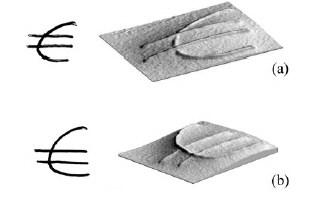
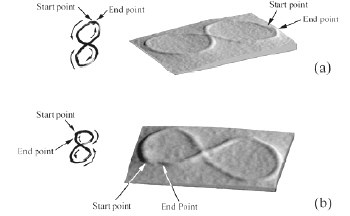
After scanning, the team reconstructed 3D images of the writing in which the strokes show up as grooves caused by the pressure of the pen on the paper. Schirripa Spagnolo’s team looked for “bumps” in the grooves because these are characteristic of an individual. This is particularly true at cross-over points, such as those found in the figure 8 or the Euro symbol . Analysing these bumps can reveal forgeries because it is difficult for a would-be forger to reproduce the exact variations in pressure made by the original writer. The technique is also able to differentiate between strokes made in a clockwise or anticlockwise direction (figures 2 and 3).

The team analysed samples from more than 120 authors using different types of paper — including ordinary paper and the paper that cheques are printed on — and a variety of pens that included ball points, felt tips and ink pens. They found they could detect forgeries in over 80% of cases. The success rate was 100% for ball-point pens writing on ordinary paper.

“We believe this type of 3D micro-profilometry is one the most promising ways of detecting forged handwriting,” says Schirripa Spagnolo. “It will be a powerful tool for forensic experts around the world.”

Particle theorists win Dirac Medal

In the 1960s, Bjorken formulated a law to explain how deep inelastic scattering — a powerful technique for studying the internal structure of protons, neutrons and other hadrons — scaled with energy. The discovery of “Bjorken scaling” in electron-proton collisions led to the identification of point-like particles, which we now know to be quarks, inside the proton. The quarks are confined inside the protons by the strong force. Working with Sheldon Glashow in 1964, Bjorken also presented arguments for the existence of a fourth quark, which they called the charmed quark.

Callan, together with the late Kurt Symanzik, reinvented the so-called perturbative renormalization group. Renormalization is a mathematical procedure that removes infinities from certain equations in the Standard Model of particle physics. Callan applied these methods to deep inelastic scattering and made significant contributions to the foundations of quantum chromodynamics (QCD), the theory of the strong force. In more recent years, he has worked on string theory, quantum gravity and the theory of magnetic monopoles.

The medal is awarded each year on Paul Dirac’s birthday — August 8 — and is worth $5000.

Another annus mirabilis?


To mark the centenary, the United Nations has declared 2005 “International Year of Physics”. The professional physics community will celebrate the anniversary in the way it knows best – by organizing conferences at which people will give talks showing how clever they are. The organizers of meetings for which the programmes are available have responded impressively in their efforts to present 21st-century physics with an Einstein-circa-1905 twist.

“Quantum information” and “From random walks to the complexity of financial markets” will be just two of the topics at the European Physical Society’s “Beyond Einstein” meeting in Bern in July (www.eps13.org). The Institute of Physics, meanwhile, has organized sessions on “beyond relativity”, “single-molecule biophysics” and more at the “Physics, a century after Einstein” meeting in Warwick in April (www.physics2005.iop.org).

Of course, the last thing that the legend of Einstein needs is further gilding by the physics community. His legacy as the greatest physicist of all time is guaranteed, despite the regular claims that “Einstein was wrong” or that he stole his ideas from someone else. The real opportunity presented by 2005 is the chance to sell Einstein and physics to the young. Physicists have to realize that physics needs the “outside world” more than it needs physics.

The biggest problem facing the world of physics right now is not the fact that quantum theory is incompatible with general relativity, or that we do not know what “dark energy” is. Rather it is the ongoing decline in the number of students studying physical sciences at schools and universities, and the effect that this is having on the supply of those qualified to teach physics in schools. 2005 is an opportunity to reach the next generation of physics students and teachers, and to reverse the trends of recent years, by presenting the subject in a way that is exciting and relevant in the 21st century.

Einstein Year in the UK, for instance, is “all about enthusing young people about physics, exploding the myth that physicists are white, middle-aged men with mad hair, and highlighting the contribution of contemporary physics to society”. The main target audience will be 11-14 year olds, and each month in 2005 will have a different theme that, it is hoped, will attract and retain their attention. Some of these themes will be obvious (such as time, space and energy), but others will be different (for example physics and music or sport). Details about other events around the world are given in the news story on pages 10-11. Some of these events have already been organized, but others need energy and imagination now.

Physics as a subject is lucky in having Einstein as a “brand”, and if anyone can make 2005 another annus mirabilis, it is him.

Lessons from Three Mile Island

The emergency began at 4.00 a.m. on 28 March 1979. By 6.30 a.m. a dramatic increase in radiation levels indicated that the uranium core had been severely damaged, although this went unrecognized at the time. Some 30 minutes later, much of the core had melted and had begun to flow to the bottom of the steel vessel that holds the reactor core and its cooling water. By about 9.00 a.m. hydrogen that had been generated in the core collected in the reactor’s concrete and steel “containment” – and caught fire.

The emergency at the Three Mile Island nuclear reactor in Pennsylvania was caused by the reactor’s operators shutting down its emergency systems. Although they later regained control, the operators did so without understanding what was going on. Analysis, conducted many years later, indicated that the vessel could have failed at about 9.00 a.m. At this time only one barrier – the containment – stopped millions of curies of radioactive material from being released into the environment. While the chance of a containment failing is small – roughly 1% – we now know there are many ways it could fail, none of which can be predicted.

So from about 7.00 a.m. on that fateful day 25 years ago there was a small, but non-trivial chance of a major radioactive release occurring without warning. Fortunately, that did not happen and only about 15 curies of dangerous iodide-131 were emitted. In contrast, the 1986 Chernobyl disaster, which was also caused by operators closing off the emergency systems led to about 40 million curies of the isotope being released.

Although Chernobyl was a far bigger catastrophe, many of the efforts to prepare for an emergency at a nuclear power plant have been driven by the experiences gained during the response to the Three Mile Island crisis. This new book by J Samuel Walker, who is historian with the US Nuclear Regulatory Commission (NRC), provides a fascinating description of how the state of Pennsylvania and the NRC decided how best to protect the public and address their concerns. (In fact, they fell down on both counts – not only failing to take decisions but also communicating badly with the public.) However, the book does not, as the author claims, provide “the first comprehensive scholarly account of the Three Mile accident” because it does not cover all the facets of the emergency or how it was resolved.

The most effective way of protecting the public from the release of a large amount of radiation is to evacuate the area near the plant before the release takes place. If you wait until high levels of radiation are measured in the environment, you are guaranteeing that the public will be exposed to doses that could otherwise have been avoided. In the case of Three Mile Island, the operators declared a maximum (general) level of emergency at about 7.00 a.m. However, this did not lead to any action to protect the public; meetings on what to do were held instead.

These discussions dragged on for days, during which time the only advice was for pregnant women and pre-school children to leave the surrounding area. No attempts were made to administer stable (non-radioactive) potassium iodide, which can protect the thyroid to some extent from inhalation of radioactive iodine if it is taken before, or shortly after, a release of radiation. Although the federal government and private industry provided potassium iodide to local officials a few days later, it was placed in a warehouse where it could not be promptly distributed if needed.

But why did the NRC or the state of Pennsylvania not act? Today it is standard practice to have pre-determined criteria in place, based on plant conditions, that define whether a particular incident should be classified as an emergency, and, if so, what action should be taken. At the time of the Three Mile incident, however, no such criteria for taking protective action existed. The NRC did develop evacuation criteria, but only several days after the start of the accident.

State officials therefore relied on the NRC for advice. The NRC, however, did not have a defined role for itself during an emergency and was not prepared. Communication between the NRC, state officials and the site was very poor – normal phone lines were overloaded – and the NRC was not prepared to perform real-time assessments of accident conditions. In addition, the NRC was not used to making decisions promptly – it normally spent months or years reaching a conclusion. Indeed, early on in the emergency, the NRC was asked for advice on evacuation to which it never actually provided an official answer.

The emergency saw a continuous stream of public statements from “official” sources that were conflicting and confusing. The chief offender was the NRC. This facet of the response is described well in the book as a fascinating tale of how not to communicate with the public. NRC officials were making public statements from at least three different locations – the Three Mile Island site itself, the NRC headquarters in Bethesda, Maryland, and the Pennsylvanian state capital of Harrisburg. These statements were often speculative, uninformed, based on poor or incorrect information, unintelligible and conflicting.

The confused public not surprisingly became angry and ultimately lost confidence in public officials. Matters were resolved only when President Jimmy Carter designated Harold Denton – a senior manager within the NRC – as the sole source of information. The need to co-ordinate, hopefully from a single location, all official statements is now a fundamental concept of emergency preparedness. Fortunately, Denton turned out to be a good communicator, who was highly adept at dealing with the press and public.

Although this book will provide invaluable preparation for anyone who has to formulate an official response to an emergency, it does have several flaws. In particular, Walker does not say why neither the operators nor the NRC recognized that the core of the reactor had melted, despite numerous indisputable indications. Another omission is how the NRC overlooked the real threat of Three Mile Island – namely that tonnes of melted core could form an uncoolable mass that could destroy the reactor vessel.

Walker also does not discuss in detail how misleading information, poor procedures and training, control-room crowding and questions from the NRC all contributed to the operators’ confusion. All of these problems resulted from the belief that severe emergencies – such as a core melt – were so unlikely that they did not need to be considered when preparing for emergencies.

Overall, this is an interesting book that gives a fascinating description of the decision-making process during radiological emergencies and how one should communicate with the public. However, major problems with both issues continue to be seen to this day. Indeed, poor communication can create psychological problems that are in many ways more severe than the physiological problems that arise from accidental exposure to radiation. This book should therefore interest anyone who finds themselves at the centre of a technological emergency – scientists, journalists and public officials alike.

Nanotechnology: separating fact, fiction, hype and hope

Nanotechnology is once again in the spotlight. Within the past few months, we have had the House of Commons Science and Technology Committee report Too Little Too Late?: Government Investment in Nanotechnology, which criticizes the low level of UK funding for nanotechnology research. We have had the government’s reply and a subsequent debate in the House of Commons. And, most recently, we have had the extraordinary media fuss surrounding comments made by the Prince of Wales linking nanotechnology with the possibility of a thalidomide-like disaster. His previous pronouncement on this subject last year led to banner headlines about the impending doom threatened by self-replicating nanorobots transforming the planet into “grey goo”. Hardly a week seems to go by without another scare story emerging or the announcement of a breakthrough that promises a new technology with large economic potential.

What are we to make of all this? How are we to separate fact from fiction, and hype from hope? The new report from the working group on nanotechnology set up by the Royal Society and the Royal Academy of Engineering, of which I am a member, provides a welcome dose of common sense. Commissioned last year by science minister Lord Sainsbury, the report is an independent study of the potential health, safety and environmental impact of nanotechnology, and an assessment of the social and ethical issues surrounding its development.

Entitled Nanosciene and Nanotechnologies: Opportunities and Uncertainties, the report reviews the current state of the field in a way that is accessible to non-scientists and describes realistic future developments. It does not find evidence of significant health risks, but it recognizes that no evidence of risk is not equivalent to evidence of no risk. The report also finds that there are no new ethical issues arising from the introduction of nanotechnology, but that the broader issue of public acceptance of new technology is once again brought into focus.

Its recommendations will be regarded as being both cautious and pragmatic: there is no justification for a moratorium on nanotechnology research, as called for by some environmental groups, and there is no need to appoint a special regulatory body to oversee nanotechnology. But there are important issues that scientists and politicians should pay urgent heed to.

Monitoring the risks

One area of concern is the use of manufactured nanoparticles and nanotubes in new composite materials, pharmaceuticals and cosmetic products. As their use increases, it is inevitable that such nanoparticles will be released into the environment. Yet there is very little available information on the health and environmental risks that they might pose. There are, of course, vast numbers of nanoparticles in the air that arise from fuel combustion, vehicle exhaust emissions and so on, but even here we do not know the full extent of the health risk. It is known that nanoparticles can reach places that larger particles cannot reach: inhaled nanoparticles are found in the bloodstream, and they have been found to cross through the olfactory nerve system (which senses smell) and to disperse throughout the brain. However, it is not known if this poses a health risk.

Nanotubes have some similarities with asbestos fibres, and so there is a possibility that asbestosis-like disease may result from their inhalation. Again, very little information is available. What is reassuring is that, by normal industrial standards, only small amounts of nanomaterials are currently produced – and since they are expensive to manufacture, physical containment is an economic necessity. Nevertheless, the working group has recommended that there should be a major injection of funds for research into the possible toxicity of nanoparticles and nanotubes by setting up a new interdisciplinary research centre.

The lack of detailed toxicology data places regulators in a difficult position. Where nanostructures are used in pharmaceutical applications, it is felt that the existing testing and validation procedures are sufficient to identify any significant risk. However, there are problems with the regulation of chemicals. In some circumstances, nanoparticles are deemed to have the same properties as bulk material of the same composition: this is evidently wrong since one of the primary motivations for using nanoparticles is their enhanced catalytic activity. The working group has recommended that such nanostructures should be classed as new chemicals for the purposes of regulation.

Public dialogue

The success of any new technology depends critically on public acceptance – the benefits must clearly outweigh the risks. The working group found that less than 30% of the population has heard of nanotechnology, and that far fewer individuals know what it is. The race to put nanotech products into the market place, coupled with this lack of public awareness, has provoked some pressure groups to label nanotech as “the next GM”. Technically this comparison is nonsense: genetic modification is a single technology, whereas nanotechnology is a range of technologies, or, arguably, an enabling technology.

The intention to discredit nanotechnology is clearly evident. Public opinion is based on trust, and, in this respect, it depends on scientists reporting accurate and reliable data, free from interference or external pressure. Although the public attitude to science is one of declining interest, verging on indifference, scientists are still held in relatively high esteem, second only to medical doctors if opinion polls are to be believed, but this applies only to scientists not funded by industry. As soon as there is a commercial link, the level of public trust drops.

This raises a difficult issue for academic researchers. There is considerable government pressure to increase the extent of commercial participation in projects funded by the research councils: the Engineering and Physical Sciences Research Council, for example, wants to achieve 50% industrial participation by 2007. The independence of academic researchers is therefore in danger of being compromised. This situation calls for a re-assessment of funding mechanisms, and the need to retain a strong independent research effort in our universities.

Public indifference to science may be a symptom of its lack of participation in the scientific process. New technology is invariably presented on a take-it-or-leave-it basis, and, in the case of GM technology, the latter option has been exercised. It would be irresponsible if this outcome was to be repeated with nanotechnology. There are lessons to be learned from the GM debacle, and they need to be taken on board by the scientific and political establishments.

Lessons for scientists and politicians

First, scientists must do a much better job in communicating their work to the public, and in being open and frank about the uncertainties. The much-hyped advantages of nanotechnology have led to inflated expectations, which will almost certainly lead to disappointment and disillusionment.

But while communication is necessary, alone it is not sufficient: the public must somehow become more involved in the decision-making process. It is unrealistic to appoint lay members to research-evaluation panels, but is it unreasonable to have more lay involvement at a strategic level? The question now facing the scientific community is how far upstream can this process go? This will undoubtedly be an issue that comes under increasing scrutiny in the months to come.

The question of democratic accountability also figures in this discussion. In parliamentary terms, science and technology issues have a very low priority. The nanotechnology debate in the House of Commons, for example, was poorly attended: only seven members of parliament contributed to the debate, including the government minister. Yet issues such as global warming, stem-cell research, therapeutic and reproductive cloning, GM and now nanotechnology are among the most important social issues facing politicians.

With the parliamentary summer recess fast approaching, the traditional cabinet re-shuffle is undoubtedly being contemplated at this moment. Is it not time that the importance of science and technology is recognized and afforded a cabinet-level appointment?

• www.nanotec.org.uk

• See “The future of nanotechnology” on pages 25-29

Copyright © 2026 by IOP Publishing Ltd and individual contributors