

The future of nanotechnology

Nanotechnology is slowly creeping into popular culture, but not in a way that most scientists will like. There is a great example in Dorian – novelist Will Self’s modern reworking of Oscar Wilde’s The Picture of Dorian Gray. In one scene, set in a dingy industrial building on the outskirts of Los Angeles, we find Dorian Gray and his friends looking across rows of Dewar flasks, in which the heads and bodies of the dead are kept frozen, waiting for the day when medical science has advanced far enough to cure their ailments. Although one of Dorian’s friends doubts that technology will ever be able to repair the damage caused when the body parts are thawed out, another friend – Fergus the Ferret – is more optimistic.

– Course they will, the Ferret yawned; Dorian says they’ll do it with nannywhatsit, little robot thingies – isn’t that it, Dorian?

– Nanotechnology, Fergus – you’re quite right; they’ll have tiny hyperintelligent robots working in concert to repair our damaged bodies.

This view that nanotechnology will lead to tiny robotic submarines navigating our bloodstream is ubiquitous, and images like that in figure 1 are frequently used to illustrate stories about nanotechnology in the press. Yet today’s products of nanotechnology are much more mundane – stain-resistant trousers, better sun creams and tennis rackets reinforced with carbon nanotubes. There is an almost surreal gap between what the technology is believed to promise and what it actually delivers.

The reason for this disparity is that most definitions of nanotechnology are impossibly broad. They assume that any branch of technology that results from our ability to control and manipulate matter on length scales of 1-100 nm can be counted as nanotechnology. However, many successes that are attributed to nanotechnology are merely the result of years of research into conventional fields like materials or colloid science. It is therefore helpful to break up the definition of nanotechnology a little.

What we could call “incremental nanotechnology” involves improving the properties of many materials by controlling their nano-scale structure. Plastics, for example, can be reinforced using nano-scale clay particles, making them stronger, stiffer and more chemically resistant. Cosmetics can be formulated such that the oil phase is much more finely dispersed, thereby improving the feel of the product on the skin. These are the sorts of commercially available products that are said to be based on nanotechnology. The science underlying them is sophisticated and the products are often big improvements on what has gone before. However, they do not really represent a decisive break from the past.

In “evolutionary nanotechnology” we move beyond simple materials that have been redesigned at the nano-scale to actual nano-scale devices that do something interesting. Such devices can, for example, sense the environment, process information or convert energy from one form to another. They include nano-scale sensors, which exploit the huge surface area of carbon nanotubes and other nano-structured materials to detect environmental contaminants or biochemicals. Other products of evolutionary nanotechnology are semiconductor nanostructures – such as quantum dots and quantum wells – that are being used to build better solid-state lasers. Scientists are also developing ever more sophisticated ways of encapsulating molecules and delivering them on demand for targeted drug delivery.

Taken together, incremental and evolutionary nanotechnology are driving the current excitement in industry and academia for all things nano-scale. The biggest steps are currently being made in evolutionary nanotechnology, more and more products of which should appear on the market over the next five years.

Grey goo and radical nanotechnology

But where does this leave the original vision of nanotechnology as articulated by Eric Drexler? Back in 1986 Drexler published an influential book called Engines of Creation: The Coming Era of Nanotechnology, in which he imagined sophisticated nano-scale machines that could operate with atomic precision. We might call this goal “radical nanotechnology”. Drexler envisaged a particular way of achieving radical nanotechnology, which involved using hard materials like diamond to fabricate complex nano-scale structures by moving reactive molecular fragments into position. His approach was essentially mechanical, whereby tiny cogs, gears and bearings are integrated to make tiny robot factories, probes and vehicles (figure 2).

Drexler’s most compelling argument that radical nanotechnology must be possible is that cell biology gives us endless examples of sophisticated nano-scale machines. These include molecular motors of the kind that make up our muscles, which can convert chemical energy to mechanical energy with astonishingly high efficiencies. There are also ion channels (see figure 3) and ion pumps that can control the flow of molecules through membranes. Other examples include ribosomes – molecular structures that can construct protein molecules, amino acid by amino acid, with ultimate precision according to the instructions on DNA.
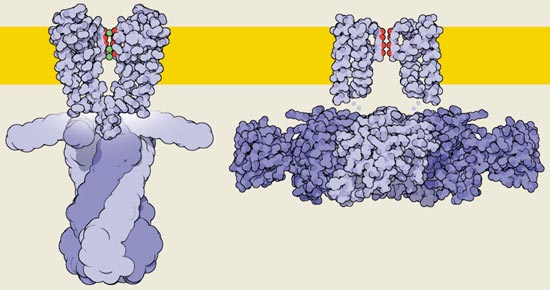
Drexler argued that if biology works as well as it does, researchers ought to be able to do much better. Biology, after all, uses unpromising soft materials – proteins, lipids and polysaccharides – and random design methods that are restricted by the accidents of evolution. Motion is created by changes to the shapes of these molecules, rather than through the cogs and pistons of macroscopic engineering. Furthermore, molecules are moved around through their continual bombardment by other molecules – what is known as Brownian motion – rather than via pipes and tubes. We researchers, however, have the best materials at our disposal. Surely we can create what are, in effect, synthetic life forms that can reproduce and adapt to the environment and overcome “normal” life in the competition for resources?

Drexler’s book raised one big spectre. By engineering a synthetic life form that could create runaway self-replicating machines, we might eventually render all normal life extinct. Could we make, by accident or malevolent design, a plague of self-replicating nanorobots that spreads across the biosphere, consuming its resources and rendering life, including ourselves, extinct? This scary possibility was dubbed by Drexler as the “grey goo” scenario. It is what triggered much of the public’s doubts about nanotechnology and was the inspiration for Michael Crichton’s novel Prey, which is shortly to be turned into a film.

However, many scientists simply dismissed Drexler’s visions of tiny nano-scale robots as science fiction, so self-evidently absurd as not to be worth considering. Indeed, Drexler himself has recently declared that self-replicating machines are not, after all, necessary for molecular nanotechnology (see Phoenix and Drexler in further reading).

Flaws in Drexler’s vision

It is nevertheless worth examining the shortcomings of Drexler’s original vision because this may give clues as to how we might make radical nanotechnology feasible. Why, for example, do illustrations of nanosubmarines look so absurd to a scientific eye? The reason is that these pictures assume that the engineering that we employ on macroscopic scales can simply be scaled down to the nano-scale. But physics looks very different at such dimensions. Designs that function well in our macroscopic world will work less and less well as they shrink in size. A nanosubmarine would operate in a very different environment to its macroscopic counterpart.

Small objects have lower Reynolds numbers – a dimensionless quantity proportional to the ratio of the product of the size and flow speed to viscosity. The dominating force opposing motion therefore arises from viscosity rather than inertia. Fluid molecules, meanwhile, will continually bombard the object because of Brownian motion. The submarine would therefore be perpetually jostled around, while its internal parts and mechanisms would bend and flex in constant random motion. Another difference at the nano-scale is that surface forces are very strong: the nanosubmarine would probably just stick to the first surface it encountered. These three factors – low Reynolds numbers, ubiquitous Brownian motion and strong surface forces – are what makes nano-scale design very challenging, at least at ambient temperatures in the presence of water.

So is radical nanotechnology simply impossible? What biology teaches us is that, contrary to Drexler’s implicit position, life is highly optimized, by billions of years of evolution, for the particular type of physics that operates at the nano-scale. The principles of self-assembly and molecular shape change that cell biology uses so extensively exploit the special physics of the nanoworld – namely ubiquitous Brownian motion and strong surface forces. In other words, if we want to fulfil the goals of radical nanotechnology, we should use soft materials and biological design paradigms. We should also stop worrying about grey goo, because it is going to be very hard to produce more highly optimized nano-scale organisms than nature has already achieved.

The path to radical nanotechnology

Even if the most extreme visions of the nanotechnology evangelists do not come to pass, nanotechnology – in the form of machines structured on the nano-scale that do interesting and useful things – will certainly play a growing part in our lives over the next half-century. How revolutionary the impact of these new technologies will be is difficult to say. Scientists almost always greatly overestimate how much can be done over a 10 year period, but underestimate what can be done in 50 years.

Sometimes the contrast between the grand visions of nanotechnology – robotic nanosubmarines repairing our bodies – and the reality it delivers – say an improved all-in-one shampoo and conditioner – has a profoundly bathetic quality. But the experience we will gain in manipulating matter on the nano-scale in industrial quantities is going to be invaluable. Similarly, there is no point being dismissive about the fact that lots of early applications of nanotechnology will be essentially toys – whether for children or adults – just as data-storage technology is currently being driven forward by the needs of digital TV recorders and portable music players like Apple’s iPod. These apparently frivolous applications will provide the incentive and resources to push the technology further.

But which design philosophy of radical nanotechnology will prevail – Drexler’s original “diamondoid” visions or something closer to the marvellous contrivances of cell biology? One way of finding the answer would be to simply develop the existing technologies that have driven the relentless miniaturization of microelectronics. This “top-down” approach, which uses techniques like photolithography and etching, has already been used to make so-called microelectromechanical systems (MEMS). Such systems are commercially available and have components on length scales of many microns – the acceleration sensors in airbags being a well known example. All we need to do now is shrink these systems even further to create true nanoelectromechanical systems, or NEMS (see Roukes in further reading).

The advantage of this top-down approach is that a massive amount of existing technology and understanding is already in place. The investment, both in terms of plant, and research and development, is currently huge, driven as it is by the vast economic power of the electronics and computing industries. But, as we have seen, the disadvantage is that there are both physical and economic bounds to how small this technology can go. Although industry has shown extraordinary ingenuity in overcoming seemingly insurmountable barriers already – new ultraviolet light sources and phase-shifting masks have made feature sizes below 100 nm a commercial reality – maybe its luck will soon run out. A more fundamental problem is the importance in the nanoworld of Brownian motion and surface forces. Strong surface forces may make the moving parts of a NEMS device stick together and seize up.

Taking a lead from nature

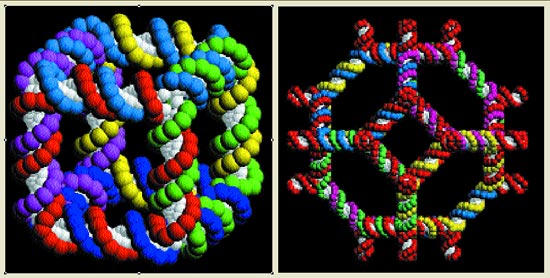
So how could we follow biology’s example and work with the “grain” of the nanoworld? The most obvious method is simply to exploit the existing components that nature gives us. One way would be to deliberately remove and isolate from their natural habitats a number of components, such as molecular motors, and then incorporate them into artificial nanostructures. For example, Nadrian Seeman at New York University and others have shown how the self-assembly properties of DNA can be used to create quite complicated nano-scale structures and devices (figure 4). Another approach would be to start with a whole, living organism – probably a simple bacterium – and then genetically engineer a stripped-down version that contains only the components that we are interested in.
One can think of this approach – often called “bionanotechnology” – as the Mad Max or Scrap Heap Challenge approach to nano-engineering. We are stripping down and then partially reassembling a very complex and only partially understood system to obtain something else that works. This approach exploits the fact that evolution – nature’s remarkable optimization tool – has produced very powerful and efficient nanomachines. We now understand enough about biology to be able to separate out a cell’s components and to some extent utilize them outside the context of a living cell – as illustrated in the work of Carlo Montemagno at the University of California at Los Angeles and Harold Craighead from Cornell University (figure 5). This approach is quick and the most likely way to achieve radical nanotechnology soon.

As we learn more about how bionanotechnology works, it should be possible to use some of the design methods of biology and apply them to synthetic materials. Like bionanotechnology, such “biomimetic nanotechnology” would work with the grain of the special physics of the nanoworld. Of course, the task of copying even life’s simplest mechanisms is formidably hard. Proteins, for example, function so well as enzymes because the particular sequence of amino acids has been selected by evolution from a myriad of possibilities. So when designing synthetic molecules, we need to take note of how evolution achieved this.

But despite the difficulties, biomimetic nanotechnology will let us do some useful – if crude – things. For example, ALZA, a subsidiary of Johnson and Johnson, has already been able to wrap a drug molecule in a nanoscopic container – in this case a spherical shell made from double layers of phospholipid molecules – and transport it to where it is required in the body. The container can then be made to open and release its bounty.

I do not think that Drexler’s alternative approach – based on mechanical devices made from rigid materials – fundamentally contradicts any physical laws, but I fear that its proponents underestimate the problems that certain features of the nanoworld will pose for it. The close tolerances that we take for granted in macroscopic engineering will be very difficult to achieve at the nano-scale because the machines will be shaken about so much by Brownian motion. Finding ways for surfaces to slide past each other without sticking together or feeling excessive friction is going to be difficult. Unlike the top-down route using silicon, we have no large base of experience and expertise to draw on, and no big economic pressures driving the research forward. And unlike the bionanotechnological and biomimetic approaches, it is working against the grain, rather than with the grain, of the special physics of the nanoworld. Drexler’s approach to radical nanotechnology, in other words, is the least likely to deliver results.

Concerns and fears

Assuming that some kind of radical nanotechnology is possible and feasible, the question is whether we should even want these developments to take place. Some 50 years ago it was generally taken for granted that scientific progress was good for society, but this is certainly not the case now. In some quarters, there are calls for a cautious approach to nanotechnology; at the most extreme, there are demands for a complete moratorium on the development of the technology. In the light of these concerns, the UK government last year asked the Royal Society and the Royal Academy of Engineering to carry out a major survey into the benefits and possible problems of nanotechnology. The report, which is based on extensive collaboration with the public, has just been published.

There are two key concerns as far as the public is concerned. The first relates to the kind of incremental nanotechnology that is already at or near market – namely that finely divided matter might be intrinsically more toxic than the forms in which we normally encounter it. If the properties of matter are so dramatically affected by size, the argument goes, matter that is harmless in bulk quantities might be more toxic and more effective at getting into our bodies when it is in the form of nano-scale particles.

We know that the physical form of a material can drastically affect its toxicity. One sobering example is asbestos, which comes in two chemically identical forms – serpentine and chrysotile asbestos. While the former is a harmless mineral that consists of flat sheets of atoms, the latter contains nano-scale tubes of atoms. Exposure to this tubular form is what has killed so many people from lung cancer and other diseases. Carbon nanotubes, like chrysotile, are the rolled-up version of a sheet-forming mineral that itself is not toxic – in this case, graphite. Although we have no definitive evidence that carbon nanotubes are dangerously toxic, prudence certainly suggests that we should be careful when handling them. After all, every new material has the potential to be toxic.

Regulations controlling the introduction of new materials into the workplace and the environment are, rightly, much stricter now than in the past, and we should appreciate that the properties of materials depend on their physical manifestation as well as their chemical content. But we do not have to assume that all nano-scale materials are inherently dangerous. Imposing a blanket ban would be absurd and unenforceable, simply because we have enough experience of many forms of nanoparticles to know they are safe. If we wanted to avoid nanoparticles completely, we would have to give up drinking milk, full as it is of nano-scale casein particles.

Evolutionary nanotechnology is certainly going to lead to far-reaching changes in society, which we should get to grips with now. It will allow computing that is so cheap and powerful that every product or gadget – no matter the price – will be able to process, sense and transmit information. Radio-frequency identification chips, which are already available, are just the beginning. But the prospect of cheap, powerful, computing – when combined with mass storage and automated image processing – is a totalitarian’s dream and a libertarian’s nightmare.

The public’s second big fear of nanotechnology – beyond these concrete social, environmental and economic factors – concerns the proper relationship between man and nature. Is it right to take living organisms from nature and then reassemble and reconstruct their most basic structures, possibly with additional synthetic components? By replacing living parts of the body with man-made artefacts, are we blurring the line between man and machine? These fears are at the root of the most far-reaching concern about nanotechnology – the grey-goo problem. Of course, fear of loss of control is a primal fear about any technology. The question is whether it is realistic to worry about it.

We should be clear about what this proposition implies: that we can out-engineer evolution by making an entirely synthetic form of life that is better adapted to the Earth’s environment than life itself is. Such a feat is unrealistic in the next 20 years – and probably for a lot longer. We simply do not have a detailed enough knowledge of how life itself works. We have the “parts list”, but very little understanding of how it all fits together and operates as a complex system. Still, our appreciation of how nature engineers at the nano-scale will grow rapidly, and attempts to mimic some of the functions of life will help us to appreciate how biology operates.

But is it even possible in principle to develop a different form of life that works better than the one that currently exists? To find out, we need to take a view on how perfectly adapted life is to its environment. We need to know how many times life got started and how many alternative schemes were tried and failed. We need to know if any of these other schemes, which might possibly have been eliminated by chance or accident, could have done better. Evolution is a very efficient way of finding the optimal solution to the problem of life. Does it always find the best possible solution? Maybe not, but I would be very surprised if we can do better.

Olympians look to physics

In Athens swimmers hope to take advantage of improvements to the full-body swimsuits, introduced at the Sydney games four years ago, that reduce so-called surface friction drag. This effect is caused by water flowing along the surface of the swimmer’s body as he or she moves through the water. Although surface friction drag is a relatively small part of the overall drag experienced by the swimmer, it is large enough to add several hundredths of a second to a competitor’s time and could therefore make a crucial difference in the race for medals.

British company Speedo has developed a swimsuit known as Fastskin, the surface of which is made up of a series of grooves that mimic the dermal denticles – microscopic fin-like structures – found on a shark’s skin. These grooves create microscopic vortices in the water next to the swimmer, thereby disturbing the flow of water along the body and reducing the surface friction drag.

But new studies carried out by Speedo and the Natural History Museum in the past four years have revealed that the texture of a shark’s skin varies across its body to match the flow of water at different parts of its anatomy. The latest version of Fastskin, called FSII, also varies the type and textures of fabric along the swimmer’s body, and is specific to the swimmer’s gender, as well as the type of stroke employed. The outfit is made of rough material around areas where the drag is greatest, such as the chest and buttocks, but makes use of a smoother fabric in regions where the water flows more slowly, such as the inner legs.

To optimize the performance of its FSII suit, Speedo used computational fluid dynamics (CFD) to assess the flow characteristics of numerous combinations of fabrics. It also tested a number of prototype suits on manikins and elite swimmers at a water flume – the equivalent of a swimmers’ treadmill – at the University of Otago in New Zealand.

According to Speedo, the FSII suit reduces surface friction drag by up to 4% compared with the original suit. US swimmer Michael Phelps, who will wear the FSII suit at Athens, will be hoping that this improvement can help him in his quest for seven gold medals. If he succeeds, he will pick up a $1m bonus from Speedo.

In the frame for medals

As with swimming, technology can make all the difference between winning and losing in cycling. For example, two cyclists with the same physical power, identical physique and matching technique travelling at 65 kph could be separated by just a couple of hundredths of a second at the finish line – equivalent to the difference of half a wheel – if the aerodynamic properties of their bikes are different.

The British Cycling team now has what is considered to be the best bike in the world. Designed by Metron Advanced Equipment in the UK, and containing numerous carbon-fibre components manufactured by the Advanced Composites Group, the bike first made its appearance at the Manchester Commonwealth games in 2002. At its heart is a carbon-fibre frame designed using a technique called finite element analysis. This computational method allows the designers to predict the stresses and deformations taking place within the components by breaking a model of the bike down into tens of thousands of individual elements and calculating the forces acting on each element. The designers can then optimize the weight and strength of the bike by distributing the material throughout the frame to match the corresponding variations in the stress.

Recently the designers have enhanced the bike by using CFD to model the complex airflow round it. Previously they had to rely on wind tunnels, but these are expensive to run and require prototypes to be made for each different design under consideration. CFD instead creates a “virtual” wind tunnel that allows the designers to optimize the size and shape of components such as the handlebars and front forks without building numerous prototypes (see figure).

Getting the laser treatment

The development of both Speedo’s swimsuit and the British Cycling bike relied on state-of-the-art laser-scanning systems to create 3D images of either components or the athletes themselves. These scanners generate a 2D fan of laser light that illuminates the object in question at a series of points along its length. At each point the shape of the leading edge of the laser fan matches the profile of the object. This shape is captured by placing a camera at an angle to the laser beam and recording the light reflected from the surface of the object. Joining the profiles together then produces the desired 3D image.

Speedo used a laser scanner belonging to CyberFX, a Hollywood special-effects company that has helped create digital images for films such as the Matrix and Spiderman. Laser scans of a male and female elite swimmer were used to create full-size manikins for tests in the water and to generate the computer models for the CFD studies. The British Cycling team, meanwhile, used the scanner belonging to our group at the University of Sheffield. The scanner was attached to an articulated arm to aid manoeuvrability. It was used to generate 3D models of many of the bike’s components, including its forks, handlebars and even the cyclists’ helmets.

Technology impacts on many sports at the Olympics, not just swimming and cycling. Some say it is cheating, but the use of such technology is a much less invidious aspect of modern sport than performance-enhancing drugs. Strict rules in each sport limit the use of advanced technologies to ensure that competition remains fair. The same cannot be said of advanced pharmaceuticals.

Examining Newton’s darker side

The 30-year-long dispute between Leibniz and Newton over who invented calculus first is a famous tale. However, little is usually mentioned about the 11 fellows of the Royal Society who published a report defending Newton’s claims to priority in 1712. In this new play, Carl Djerassi re-opens the case and revisits history through the eyes of its lesser characters. It is also the final play of his “science-in-theatre” trilogy, following An Immaculate Misconception and Oxygen, which was co-written with Roald Hoffmann.

The main characters in Calculus are not, as might be expected, Leibniz and Newton, who was then president of the Royal Society. The play centres instead on three of the “minions” whom Newton may have manipulated into publishing a report in his favour: John Arbuthnot, Abraham de Moivre and Louis Frederick Bonet. Following in the steps of Tom Stoppard, who explored Hamlet from the viewpoint of two minor characters in Rosencrantz and Guildenstern Are Dead (and Rosencrantz and Guildenstern are duly mentioned in Calculus), Djerassi has chosen to debunk the myth surrounding Newton, showing him to be a “tainted hero” through the eyes of the lesser-known players of history.

The intimate space of the New End Theatre in London is an excellent venue for this exploration of the human side of history, as it strengthens the play’s atmosphere of secrecy and confession. Set in the back room of the Drury Lane Theatre, the plot takes us, quite literally, behind the scenes of history. The action begins in 1725, when Sir John Vanbrugh visits the theatre manager Colley Cibber (who were both real playwrights) to ask him to stage a play about Newton’s manipulation of the committee.

The events of 1712 are then presented as a play-within-a-play, with the two playwrights providing commentaries and occasionally acting the parts of Newton and Leibniz. The committee’s lack of authenticity is thus highlighted by a plot full of artifice and a stage covered with cardboard clouds, period costumes and other obvious theatrical props. Djerassi uses the device of the play-within-a-play to denounce the Royal Society’s deliberations as no more than a drama written by Newton himself. The latter’s manipulating role is made obvious by the fact that the same actor (David Gant) plays both the playwright Vanbrugh and Newton.

As in Tom Stoppard’s Arcadia and Michael Frayn’s Copenhagen, science is used as a metaphor: “calculus” refers not only to maths, but to the characters’ moral and political calculations. In fact, the play contains very little maths, with the exception of a comical scene in which de Moivre illustrates calculus by eating an apple (of course) at varying speeds and then calculating his velocity at a given point in time.

Djerassi has written that his plays aim to be both entertaining and instructive, and to bring serious scientific content to the stage. Supported by an excellent cast, Calculus is certainly entertaining, but its scientific content is historical rather than mathematical: the play is more concerned with the politics and power-struggles of science than with Newton’s invention.

“There are no heroes in this play,” remarks one of its characters. By insisting that we do not separate a scientist’s ethics from his achievements, Djerassi not only undermines Newton’s status as national hero, but also criticizes our need for mythical scientists — the fact that “a country requires heroes…unsullied ones”.

Calculus, directed by Andy Jordan, will be on at the New End Theatre until 28 August (tel. +44 (0)870 033 2733; Web www.newendtheatre.co.uk). The text of the play appears in the book Newton’s Darkness (2004 Imperial College Press), which also contains a transcript of Newton’s Hooke by David Pinner

New tools for blocked arteries

Certain surgical procedures can now be carried by inserting tiny surgical instruments through small cuts in the human body. Known as “minimal access surgery”, a surgeon carries out the procedure by watching a monitor showing images taken by a fibre-optic camera inserted into the body. The technique would, however, benefit from improved imaging methods. Although magnetic resonance imaging (MRI) can provide good images of tissue below the surface of the body, the scanning equipment is usually far too big to be used in an operating theatre.

The new device made by Dickinson and Kitney takes images using ultrasound. It contains 64 crystal piezoelectric transducers that are made to generate pulses of sound waves, which reflect off the tissue under investigation. This pulse is then received by the transducers working in “reverse”, which convert the mechanical vibrations into an electrical signal. A detailed 3D image of the structure producing the echo can be built up by measuring the time taken for the pulse to return, together with the position of the transducer.

Dickinson and Kitney were able to make their tiny probe thanks to an improved fabrication method. They started by assembling all the necessary components on a flat flexible substrate — a 0.019-mm thick polyimide sheet with a 3-4 micron copper layer, etched using photolithography techniques. Next, they bonded a 2.4-mm squared rectangle of metallized piezo-electric transducer, 0.05-mm thick, to the substrate. They then diced the transducer using a carefully controlled diamond saw to create 64 elements, each 0.8-mm long, 0.03-mm wide and 0.05-mm thick. Finally, they rolled the substrate into a cylinder (figures 1 and 2).

The scans provided by the new probe will provide information on the extent to which diseased arteries are thickened and blocked (figure 3). The team also plans to investigate other applications such as keyhole surgery of shoulder and knee joints.

Rover reveals magnetic Mars

The Spirit rover — and its companion Opportunity — both landed on opposite sides of Mars earlier this year, each carrying permanent magnets to collect airborne magnetic dust particles and magnetic particles in the surfaces of rocks. One set of magnets was carried by a tool that grinds into rock surfaces. Another two magnets, meanwhile, were mounted on the front of the rover at an angle so that all non-magnetic airborne particles slipped off, while retaining any magnetic airborne dust.

Both of these two magnets are positioned near a panoramic camera that measures how the dust absorbs light as a function of wavelength. The scientists found that the dust collected by the stronger, “filter” magnet had a lower reflectance. It is therefore intrinsically darker in colour and contains either magnetite or maghemite (γ-Fe2O3). However, the dust collected by the weaker, “capture” magnet, is mostly haematite (α-Fe2O3), which is red. The results were obtained from dust in the Gusev crater landing site, which lies 15 degrees south of the equator and is thought to have once been a water-filled lake.

The Danish-German-US group now hopes to obtain chemical and mineralogical information on the dust collected by the two magnets when alpha-particle X-ray and Mössbauer spectra are recorded and analysed. “We believe that after this mission, we will know why Martian dust is magnetic,” says team member Preben Bertelsen from the University of Copenhagen. “Furthermore, we will compare the magnetic properties results from the two rovers to see if the atmospheric dust has the same composition on both sides of the planet.”

Since all airborne dust particles are magnetic, the magnets might also be used as dust shields to keep nearby surfaces clean during a long mission to Mars. “They may even help to protect future astronauts from dust,” adds Bertelsen. With additional collection and analysis of magnetic dust, scientists now hope to identify how water, volcanic activity and erosion have altered the surface of Mars. The results are presented in a special issue of Science, which contains a total of 10 papers by researchers based on the first 90 Martian days of the Spirit rover’s mission to the Gusev crater.

Faint gamma-ray bursts on the horizon

Gamma-ray bursts (GRBs) are the most powerful explosions in the universe, but continue to baffle scientists over 30 years after they were first discovered. Most gamma-ray bursts are even brighter than the massive supernovae explosions that occur when a star dies and collapses to form a black hole. However, some astronomers believe that gamma-ray bursts and supernovae are in fact related. Although most supernovae do not have enough energy to produce gamma rays, the additional energy could be supplied by material falling into the black hole.

Now there is new evidence that gamma-ray bursts and supernovae could be related. On 3 December 2003 a gamma-ray burst lasting about 30 seconds was detected by the European Space Agency’s INTEGRAL satellite in a small galaxy about 1.6 billion light years away. A record 18 seconds after the start of the burst — named GRB 031203 — its location on the sky was sent out by the automatic burst alert system on INTEGRAL. Although the burst initially looked like an ordinary gamma-ray burst, the astronomers later found that it had an energy of about 0.6-1.4 1043 Joules, which is a thousand times lower than a typical high-energy burst.

This result was even more unexpected given that GRB 031203 is only the second closest gamma-ray burst ever to be found. The previous closest burst, which was discovered in 1998, was also found to be very faint, although astronomers were not sure if it was some sort of “freak” explosion. Now, however, the two teams of researchers — one from the US and the other from Germany and Russia — think that both bursts belong to a completely new population of gamma-ray bursts that lie somewhere in energy between supernovae and other gamma-ray bursts.

“Our discovery of GRB 031203 suggests that there is a significant population of sub-energetic gamma-ray bursts that we do not typically see since they are below our detection thresholds,” says Alicia Soderberg, a graduate student from the California Institute of Technology who is a member of the US team and lead author of one of the Nature papers. “GRB 031203 was only detectable since it was so nearby and suggests that sub-energetic gamma-ray bursts may in fact be more common than high energy counterparts.” The finding also rules out the idea that all gamma-ray bursts have the same energy.

Future missions dedicated to the detection of gamma-ray bursts — like SWIFT, which will be launched by NASA in October — might be able to detect many more events like these. “It will be interesting to see whether low energy events are more frequent than ordinary high-energy ones and whether there is a continuous distribution of gamma-ray burst energies,” adds Sergey Sazonov, a member of the Russia-Germany group at the Space Research Institute in Moscow and the Max Planck Institute in Garching.

Women needed for bed-rest study

With the development of the International Space Station and plans for future missions to Mars, astronauts are likely to spend ever longer periods in space. However, little is known about how the female body is affected by weightless conditions. This is because most previous ground-based studies have been carried out on male volunteers and because relatively few women have flown in space to date.

The new study is a joint venture between ESA, NASA and the French and Canadian space agencies. It will be carried out by the French Institute for Space Medicine and Physiology at a hospital in Toulouse, France. Volunteers must be non-smokers aged between 25 and 40, less than 185 cm in height, and have no addictions to drugs or alcohol. They should be fluent in French or English and citizens of the European Union, Norway, Switzerland or the US. They will earn a total of €15 200, which will be paid in instalments over a four-year period.

The 24 test subjects will be split into three groups of eight. One — the control group — will have no extra stimulus over the 60-day best-red period. The second group will carry out an exercise regime whilst in bed. The third group will be fed a nutritional supplement during the 60 days. An international team of scientists, doctors and nurses will look after the women, whose fitness, heart and muscle function, mood, hormonal status, nutritional requirements, reflexes, balance and immune system will all be monitored. Volunteers will be videoed during the entire study and will have to carry out three-week long tests before and after the period in bed.

ESA hopes to use the results in its plans for human space exploration. It already wants to send astronauts to the Moon before launching a manned mission to Mars by 2035 as part of its ambitious Aurora programme. According to ESA, lying in bed for extended periods induces changes similar to those experienced by astronauts during and after space flight — including poorer blood circulation, weaker muscles, changes in gait and balance, and a reduced ability to perform physical exercise. Tests will start in January 2005.

Dramatic differences found in matter and antimatter

Cosmologists believe that equal amounts of matter and anti-matter were created in the big bang. If matter and anti-matter particles were exact opposites of each other, they should have annihilated to leave only photons. However, the existence of our matter-dominated universe suggests that matter and anti-matter underwent different processes after the big bang. To account for this excess of matter, the Standard Model of particle physics predicts that matter and anti-matter decay at slightly different rates. Known as charge-parity (CP) violation, this effect was first seen indirectly in kaons in 1964.

Three years ago, the BaBar team — and independently the Belle collaboration at the KEK laboratory in Japan — discovered indirect CP violation in another family of particles, known as B mesons, for the first time. BaBar produces large numbers of B and anti-B mesons by firing a beam of positrons into a beam of electrons. B mesons and their antiparticles are very short lived and decay quickly into other, lighter particles, such as kaons and pions. By measuring these decay rates extremely accurately, BaBar was able to show that B mesons decay slightly slower than their antiparticle equivalents.

Now, BaBar scientists have observed “direct” CP violation by analyzing the decays of more than 200 million pairs of B and anti-B mesons. Among the many ways that the mesons can decay, they were looking for rare events that turn B mesons into K+pi– pairs and anti-B mesons into K–pi+ pairs. Theory suggests that the two events should have the same odds of happening — and hence that one should get equal numbers of pairs of K+pi– and K–pi+ pairs. However, the BaBar scientists discovered that this was not the case — they found 910 K+pi– pairs but only 696 K–pi+ pairs. In other words, there was a big difference in the number of matter and antimatter decays.

Although direct CP violation has been observed before in experiments on kaons, the new observation with B mesons is much stronger. The new measurement is a result of the improved performance of SLAC’s PEP-II accelerator and the efficiency of the BaBar detector, which is now able to detect about 98% of collisions. “This observation is a significant step forward in assembling the pieces of the puzzle of matter versus antimatter in the universe,” says SLAC director Jonathan Dorfan.

“We have observed a clear, strong signal for asymmetrical behavior of matter and antimatter resulting from the direct CP violation mechanism,” adds James Olsen of Princeton University, one of the leaders of the analysis.

Lunar rock sheds new light on the Moon

The meteorite, called Sayh al Uhaymir (SaU) 169, weighs about 200 grams and was found in Oman in January 2002. It is one of only 30 such lunar meteorites to be found. Edwin Gnos at the Institut für Geologie in Bern in Switzerland and colleagues from the US, UK, Germany and Sweden analyzed its thorium, uranium and potassium composition and found that it almost certainly comes from the Imbrium crater.

Gnos and co-workers were then able to pinpoint the origin of the meteorite within the Imbrium crater by comparing the chemical composition of the lunar soil attached to the meteorite with data from NASA’s Clementine and Lunar Prospector missions — from 1994 and 1998 respectively. Using electron microprobe analysis, Raman and gamma-ray spectroscopy, X-ray tomography and data from satellite images, they found that the meteorite was launched from a smaller crater near the so-called Lalande impact crater, which itself lies south of the Imbrium basin.

The researchers also used ion-probe dating techniques and mass spectrometry of the mineral zircon to calculate that the meteorite is around 3.9 billion years old, and were able to do this with unprecedented precision. In addition, by measuring the ratio of carbon-14 to carbon-12 within the meteorite (which originated from carbon dioxide within the Earth’s atmosphere), they calculated that the meteorite arrived on Earth about 9700 years ago.

According to Gnos, the improved dating of the age of the Imbrium basin will lead to a better understanding of how different layers in the lunar soil have evolved over time. “This is important, not only for the Moon, but also for related crater age dating on Mars and the entire inner solar system because such age estimations are based on data from the Moon,” he says.

DNA pioneer dies

Crick was born in Northampton, UK, in 1916. He received a degree in physics from University College London in 1937 but had his PhD research cut short by the outbreak of the Second World War. During the war he worked as a scientist for the British Admiralty and in 1947 joined Cambridge University to carry out research on biology.

After two years at the Strangeways Laboratory, he joined a team at the Cavendish physics laboratory headed by Max Perutz that was using X-ray diffraction to study protein structure. Then in 1951 he met the young American scientist James Watson, and two years later the pair published a short letter in Nature describing the structure of the DNA molecule. This work drew on X-ray diffraction data obtained by Rosalind Franklin and Maurice Wilkins at King’s College London.

Crick and Watson discovered that DNA is structured in two helical strands coiled around the same axis and held together by pairs of the four DNA bases — adenine, guanine, thymine and cytosine. They realized that adenine always pairs with thymine and guanine is always linked with cytosine, which means that the ordering of the bases can be reproduced and that strands of DNA can therefore replicate themselves.

In contrast to Crick’s reputation for being upfront and abrasive, the opening two lines of the Nature paper were distinctly understated. “We wish to suggest a structure for the salt of deoxyribose nucleic acid (DNA),” wrote Crick and Watson. “This structure has novel features which are of considerable biological interest.”

Lord May, president of the Royal Society, says that “Francis Crick made an enormous contribution to science and his discoveries helped to usher in a golden age of molecular biology. His death is a sad loss to science.”

Following his ground-breaking discovery, Crick spent the next 13 years working with Sydney Brenner on understanding how the sequence of base pairs within a DNA molecule is used to determine protein structure. In 1977 Crick moved to the Salk Institute in San Diego to work in the field of neurobiology, attempting to produce a scientific understanding of consciousness.

Copyright © 2026 by IOP Publishing Ltd and individual contributors