UK study calls for extra safety measures for nanotechnology

“There is a gap in the current regulation of nanoparticles,” said Ann Dowling, chair of the working group that carried out the study. “They have different properties from the same chemical in larger form, but currently their production does not trigger additional testing. It is important that the regulations are tightened up so that nanoparticles are assessed, both in terms of testing and labelling, as new chemicals.”

The report proposes that UK and European legislation should treat nanoparticles and nanotubes as new chemicals. In addition, it recommends avoiding “as far as possible” the release of such nanomaterials into the environment until more is known about their impact, and that the UK’s Health and Safety Executive considers setting lower exposure levels for people who work with manufactured nanoparticles.

“The lack of evidence about the risk posed by manufactured nanoparticles and nanotubes is resulting in considerable uncertainty,” states the report. With this in mind, it suggests that a new interdisciplinary centre should research the “toxicity, epidemiology, persistence and bioaccumulation of manufactured nanoparticles and nanotubes as well as their exposure pathways” and instruments for monitoring the materials in the environment. It’s likely that such a centre would bring together several existing research institutions.

Nanoparticles and nanotubes should also be approved by an independent scientific safety committee before their use in consumer products such as cosmetics, according to the study. And industry should make details of its nanomaterial safety tests publicly available if the toxicological data available in peer-reviewed journals is incomplete.

In addition, the working group proposes a public dialogue about the development of nanotechnologies “before deeply entrenched or polarized positions appear”. Market research conducted during the course of the study indicated that only 29% of the UK population had heard of nanotechnology.

The UK government commissioned the two bodies to conduct a study on nanotechnology back in June 2003. According to UK science minister David Sainsbury, the government plans to respond formally to the report by the end of the year.

The UK Health and Safety Laboratory is holding a conference on the occupational health implications of nanomaterials in October.

Table-top synchrotron defies convention

The device, dubbed a polarization synchrotron by its inventors, consists of a 2 metre-long gently curving arc of alumina (a dielectric material), with a series of electrodes fitted at regular intervals along its length. Applying a sinusoidal voltage across each electrode and displacing the phase of the voltage very slightly from one electrode to the next generates a sinusoidally-varying polarization pattern that propagates along the device. By carefully adjusting the frequency of the voltage and the phase displacement the researchers say they can make the wave travel at greater than the speed of light (even though no physical quantity of charge travels superluminally).

This principle is based on a model of pulsars — rapidly spinning neutron stars — developed by one of the group, Houshang Ardavan of Cambridge University. Ardavan believes that the well-defined pulses of radio waves emitted by these astronomical objects are caused by the pulsar’s rotating magnetic field polarizing the surrounding plasma. As the magnetic field sweeps round so too does the region of polarized plasma, and far enough away from the pulsar this region will sweep round at faster than the speed of light.

Singleton’s group — which includes Ardavan’s son, Arzhang Ardavan (of Oxford University) — believes that its polarization synchrotron, like a pulsar, emits radiation in a well-defined beam. They argue that the electromagnetic wavefronts generated by each point within the polarization pattern build up behind that point like sound waves from a supersonic aircraft. Interference between these wavefronts then reinforces the radiation along a spiral trajectory — the beam — that travels away from the source.

The researchers claim that the intensity of this beam is proportional to 1/r, where r is the distance from the transmitter, rather than the 1/r2 associated with spherically decaying radiation. They carried out tests on their device at the Turweston Aerodrome in Northamptonshire between May 2003 and February 2004, measuring the intensity of the emitted radiation at a range of distances up to 900 metres and mapping the three-dimensional shape of the emission.

According to Singleton, the polarization synchrotron could transmit radio messages with very little power or over vast distances. A scaled-down version of the device could be used in mobile phones to allow direct communication with satellites, rather than having to rely on relay stations. He says the device could also be used in radar systems, since the beam’s unusual shape would make it difficult to trace the beam back to its source.

However, other researchers are sceptical. John Hannay, a theoretical physicist at Bristol University points out that conventional radio sources can generate slowly decaying radiation over limited distances. He has previously said that Singleton and co-workers must test their device over tens of kilometres rather than hundreds of metres.

Liquid separation goes electric

Separating out two liquids from a mixture — such as oil and water or a polymer and its solvent — is a process often employed by industry. It is usually achieved by lowering the temperature of a mixture to its so-called phase transition temperature, at which point the thermal vibrations that naturally sustain the mixing process are minimized. However, there are many situations where it would be useful to use other methods of separation — when it is necessary to keep the temperature constant, for example.

Leibler and colleagues, on the other hand, have shown that non-uniform fields couple up to 50 times more strongly than uniform fields because the coupling is direct. To demonstrate this they placed their mixture in a cell made of two glass slides, the lower slide containing an array of 25 nanometre-thick indium-tin-oxide electrodes. The electrodes were arranged so that they were unevenly separated from each other, which meant they produced a highly non-uniform field.

Using a potential difference of 100 volts, they observed that the silicone oil moved towards the electrodes, while the paraffin remained further away. Moreover, the liquid reverted to its mixed state once the electric field was switched off. Leibler predicts that the effect could also be induced by electromagnetic radiation, such as laser beams, thus opening up the possibility of applications in electro-optics.

Graphite magnets get ready for applications

Graphite and other forms of carbon can have ferromagnetic properties. However, the effects are weak, and usually only seen at very low temperatures, so physicists are not sure if the magnetism is due to tiny amounts of iron-rich impurities, or if it is an intrinsic property of the carbon.

Recently it was predicted that it should be possible to induce magnetism in carbon by introducing defects, such as pores and stacking structures, into the honeycomb structure of graphite. To produce such material, the team mixed a sample of highly pure powdered graphite with powdered copper oxide and then heated the mixture at 1200°C for 24 hours in a tube furnace containing either nitrogen or argon.

Mombrú and co-workers characterised their graphite samples using scanning electron microscopy, together with magnetic force microscopy and magnetometry, at different temperatures. They found that pores, and other complex microstructural defects, were distributed non-uniformly throughout the sample. Furthermore, they calculated that the magnetization of the graphite was just 500 times weaker than iron at 4.2 kelvin, and 800 times weaker at room temperature.

Mombrú believes that magnetic impurities are not responsible for the magnetization because iron concentrations of nearly 2000 parts per million (ppm) would be required to produce the values observed, yet they only measured around 60 ppm of iron.

“In addition to being of fundamental interest, our work will be important for technological applications in engineering, nanotechnology, sensors and detectors, and telecommunications,” says Mombrú. “It will also have uses in medicine and biology as a unique biocompatible magnetic material.”

STM turns atoms into ions

“In 1990, Don Eigler of IBM’s Almaden Research Center showed that, using an STM, atoms can be placed on top of a surface with atomic precision,” says Jascha Repp of IBM. “Now the next step has been achieved by manipulating the charge state of an atom without moving it to another adsorption site and without changing its chemical surrounding.”

Repp and colleagues used a home-built STM with an electrochemically etched tungsten wire as the tip, operating the kit at temperatures between 5 and 60 kelvin. They adsorbed gold atoms onto an insulating film of sodium chloride just two or three atomic layers thick on top of a copper single-crystal. The adatoms positioned themselves on top of the Cl– ions.

To alter the charge state of a gold adatom, the researchers simply applied a voltage pulse to it using the STM tip. Applying a voltage of +0.6 volts for a few seconds caused the tunnelling current to drop by about a third. The image of the adatom also took on a sombrero-like shape, with a protrusion about 0.5 Angstrom less high than before and a trough appearing around it. Applying a negative voltage of about -1 volts returned the adatom to its original state.

The experiments indicated that the original gold adatoms were in a neutral state while applying a positive voltage gave the adatoms a negative charge. “The chemical and physical properties of ions in general are qualitatively different from those of the corresponding neutral atoms,” said Repp. “Therefore our findings will have an impact not only on physics, but also on chemistry.”

Repp says that the controlled deposition and removal of an electron charge onto and from an individual atom is a decisive step towards future atomically small devices. “For instance, it could lead to a non-volatile memory cell at the ultimate spatial limit, where one bit of information is stored on a single atom,” he explained. “Practical atomic-scale memories would increase the amount of data that can be stored on a given area by at least ten thousand times.”

The technique could perhaps also tailor material properties at the atomic level. “The switching between different charge states of an individual atom enables the control of, for example, chemical reactivity, optical properties, or magnetic moment,” said Repp. “Owing to the long-range nature of electrostatic forces, even the properties of molecules may be controlled through the change in charge state of an atom nearby.”

The aim of the Swiss-Swedish researchers is to study electron current through man-made atomic structures that are electronically decoupled from a metal substrate and perfectly arranged down to the atomic-length scale. “To reach this goal we study the controlled lateral positioning of atoms as well as larger molecules on ultra-thin insulating films,” said Repp. “We want to use the control of the charge state of individual atoms to influence the assembly of such atomic-scale structures and also to switch or guide the electron current through them.”

Fermi gas goes superfluid

All atoms are either bosons or fermions depending on the value of their spin, and the difference between the two becomes clear when they are cooled to almost absolute zero. Bosonic atoms have integer spin and can collapse into the same quantum ground state to form a Bose-Einstein condensate: this condensation process is at the heart of superconductivity — the flow of electric current without resistance.

Fermionic atoms, on the other hand, have half-integer spin and obey the Pauli exclusion principle. This means that two fermionic atoms cannot occupy the same quantum state. However, if two fermionic atoms are bound together, the resulting molecule will be a boson — because it will have an integer spin — and will therefore be able to undergo condensation.

Since electrons are fermions they must form Cooper pairs — named after Leon Cooper of the Bardeen-Cooper-Schrieffer (BCS) theory of superconductivity — before they can undergo Bose-Einstein condensation (BEC). If this Cooper-pairing process could be reproduced in a gas of fermionic atoms, it should be possible to learn more about one of the biggest mysteries in modern physics — the nature of the pairing mechanism in high-temperature superconductivity.

Grimm and co-workers started with a gas of fermionic lithium-6 atoms that had been cooled to about 500 nanokelvin, and then applied a carefully tuned magnetic field that caused the fermionic atoms to pair up and form bosonic molecules. These molecules subsequently condensed to form a molecular BEC.

Next, the Innsbruck team changed the magnetic field, which controls the coupling strength between the atoms, to convert the BEC into a strongly interacting Fermi gas. Finally they applied a radio-frequency (RF) wave to break up the pairs.

By observing which RF wavelengths were absorbed by the system, Grimm and co-workers were able to calculate the binding energy of the pairs — which shows up as a “pairing gap” in the spectra — and show how it changed with temperature (C Chin et al. 2004 Sciencexpress 1100818). New theoretical work by Paivi Törmä and co-workers at the University of Jyväskylä confirms that the results are consistent with the formation of Cooper pairs and the onset of superfluidity in the gas (J Kinnunen et al. 2004 Sciencexpress 1100782).

“For the first time, we can check theoretical models on strongly interacting Fermi systems — the so-called BEC-BCS crossover phase,” Grimm told PhysicsWeb. “If we are lucky, the research could show us a way to make superconductors at room temperature”.

Hawking loses black hole bet

Classical black holes are regions of space where gravity is so strong that nothing, not even light, can escape from them. The region beyond which nothing can escape is known as the event horizon. All the information in the light and matter that falls through the event horizon is lost forever because the black hole can be described by just three numbers: its mass, electric charge and angular momentum.

In the 1970s, however, building on earlier work by Jacob Bekenstein and applying quantum theory to black holes, Hawking showed that these mysterious objects also have a temperature, which means that they give off thermal radiation. The black holes should therefore eventually disappear. The problem is that this thermal radiation does not contain any information, which means that the information that originally fell into the black hole disappears. However, this is not allowed by quantum theory.

In their bet, which was made in 1997, Hawking — who is based at Cambridge University — and Thorne argued that information was lost in a black hole, whereas Preskill said that it was not. The winner or winners of the bet had to provide the loser or losers with an encyclopaedia of their choice “from which information can be recovered with ease”.

Now Hawking has conceded defeat by saying that information can escape from a black hole and therefore is not lost. If he is right, making a such a significant breakthrough in the search for a quantum theory of gravity should overcome the disappointment of losing the bet and having to hand over an encyclopaedia of baseball to Preskill. “It is great to solve a problem that has been troubling me for 30 years,” said Hawking, “even though the answer is less exciting than the alternative I suggested.”

Hawking presented his solution to the 17th International Conference on General Relativity and Gravitation in Dublin. His solution relies on a black hole being able to have more than one topology at the same time, and when he performs a quantum mechanical “path integral” over all the topologies, he finds that information is not lost. “The way the information gets out [of a black hole] seems to be that a true event horizon never forms,” said Hawking, “just an apparent horizon.”

Hawking also dismisses his previous suggestion that the information might have leaked into a different “Baby” universe. “The information remains firmly in our universe,” he told the conference. “I am sorry to disappoint science fiction fans, but if information is preserved, there is no possibility of using black holes to travel to other universes. If you jump into a black hole, your mass energy will be returned to our universe, but in a mangled form which contains the information about what you were like, but in an unrecognisable state.”

Cancer detection made faster

Tumour cells can be found in the bloodstream in the early stages of cancer. However, their low concentration — around one in a million — means that detecting these “rare cells” is very difficult. The best technique available today, automated digital microscopy, is too slow for practical diagnosis because it can take up to 32 hours to scan a typical sample, which contains around 50 million blood cells. In contrast, the new FAST scanner — which relies on various techniques developed for laser printing — can scan a similar sample in only two minutes.

The technique works by first tagging cancer cells with a fluorescent label, as in conventional imaging methods. This is done with a special antibody reaction that is specific to the cancer cells. A laser is then used to excite the sample and any fluorescence is collected in an array of optical fibres. The field of view in the FAST approach is 50 millimetres, compared with around 1 millimetre for digital microscopy, and this translates into an increase of 500 for the speed with which samples can be scanned.

Initially, the FAST scanner will be used as a pre-screening device to identify candidate tumour cells that would then be examined in more detail with digital microscopy. The device could also be used to detect other rare cells, such as foetal cells in the mother’s bloodstream and viral-infected cells.

“Our goal is to enable identification of rare cells in the clinic,” says team leader Richard Bruce. “Because the FAST cytometer uses simple, robust technology and enables cost-effective operation, we believe it could make screening for cancer and other rare cells as routine as an annual blood test”.

Negative refraction goes acoustic

First proposed over thirty years ago, negative index materials bend light in the opposite direction to ordinary materials. However, they were only demonstrated experimentally in 2000. Now, Zhang and Liu have shown that negative refraction is also possible with sound waves.

A phononic or sonic crystal is the acoustic equivalent of a photonic crystal — a material that contains a periodic arrangement of air-filled voids that have a lower refractive index than the host material. It is the periodic variation of the refractive index that creates an optical band gap in the photonic crystal, which means that only certain wavelengths of light are able to pass through it. Similarly, phononic crystals — which consist of cylinders of one material embedded in a different background medium — contain acoustic gaps, which means that only certain wavelengths of sound can pass through the material.

Zhang and Liu showed that negative acoustic refraction should occur in two systems: steel cylinders in an air background, and water cylinders in a mercury background. Moreover, they also have designed a two-dimensional acoustic “superlens” that should — like its optical equivalent — be capable of sub-wavelength resolution and reflection-free operation. The Chinese team believes that its acoustic system will offer similar advantages.

“Extensive applications of such a phenomenon to acoustic devices are anticipated,” Zhang told PhysicsWeb. “It is well known that acoustic devices that focus and image sound waves are very important for medical, military and civilian applications”.

Single spins come into view

Although an atomic force microscope can image individual atoms, it can only be used to provide information about the surface of a sample. Magnetic resonance imaging (MRI), on the other hand, can probe deeply into an object and provide three-dimensional images. MRI measures the signal produced by the magnetic moments or “spins” of protons that have been aligned by a magnetic field. However, the spatial resolution of the technique is still limited to about a micron. The new technique is better than this by a factor of 40.

Dan Rugar and colleagues at the IBM Almaden Research Center have now combined both these techniques to make a magnetic resonance force microscope (MRFM) and have used it to detect the spin of a single electron some 100 nanometres below the surface of a sample made of vitreous silica. “An electron spin is easier to measure than a proton spin because the magnetic moment of the electron is some 600 times larger than the proton’s,” Rugar told PhysicsWeb. “We eventually hope to reach single proton sensitivity.”

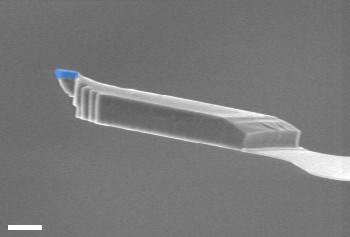
The IBM microscope consists of a nanometre-sized magnetic tip, made of samarium and cobalt, attached to a vibrating silicon cantilever that is 85 microns long and 100 nanometres thick. Rugar and co-workers positioned the cantilever about 125 nanometres above the silica sample and then applied a high-frequency magnetic field of 3 gigahertz to it. This excited electron spins inside the sample and flipped their direction (see figure 1).

The technique is able to distinguish between individual spins. The force produced by a single electron as it flips — which can be as small as 10-18 Newtons — switches from being attractive to repulsive and causes the cantilever frequency to change slightly. This change can be then be measured using a laser beam.

The scientists now hope to improve the sensitivity of the technique so that it is able to detect and image individual nuclear spins, which are much weaker than electron spins. “By coupling the powerful concepts of MRI with the exquisite sensitivity we have developed for detecting magnetic forces, we are hoping that MRFM can be developed into an atomic resolution instrument,” said Rugar.

Copyright © 2026 by IOP Publishing Ltd and individual contributors