New light on dark energy

The acceleration of the universe is driven by a force that has repulsive rather than attractive gravitational interactions. But although this so-called “dark energy” is thought to account for around two-thirds of the universe, no one knows what it is made of. The first evidence for dark energy came from supernovae observations in 1998. Further evidence arrived in 2002 from a survey of 250,000 galaxies and later from observations of gravitational lensing.

Some explanations for dark energy — such as quintessence, modified gravitational theories that include extra dimensions, or string physics — suggest that dark energy could change with time. If dark energy became progressively weaker, the universe would eventually collapse in on itself in a “big crunch”. If it became stronger, on the other hand, the universe would tear itself apart in a “big rip”.

Tegmark and Wang used a novel model-independent approach to measuring the dark-energy density. They analysed data from type 1a supernovae, recorded with the Hubble Space Telescope; the cosmic microwave background (CMB) taken with the Wilkinson Microwave Anistropy Probe (WMAP) and the Sloan Digital Sky Survey (SDSS); and from large-scale galaxy cluster observations.

The results agree with recent observations on supernovae that suggested that dark energy remains constant with time. Moreover, the physicists calculated that if the dark energy density were to change with time, a big crunch or big rip could not occur for at least 50 billion years for models that allow such events. “I’m struck by the fact that the dark energy seems so ‘vanilla’,” Tegmark told PhysicsWeb. “Theorists have invented scores of elegant models where it increases or decreases its density over time, yet even with this new improved measurement, it remains perfectly consistent with Einstein’s Lambda model where its density is a mere constant.”

Thomas Gold: 1920 – 2004

Gold, Hoyle and Bondi revealed their steady-state theory of the universe in two separate papers in the Monthly Notices of the Royal Astronomical Society in 1948. The trio had developed the theory because they could not believe that all the matter in the universe was created at the initial singularity (the big bang). But to account for the fact that the universe is continually expanding, the theory requires that matter is continually created at the rate of a few hydrogen atoms per cubic metre per billion years. The theory initially seemed plausible, but the discovery of the cosmic microwave background in 1965 dealt it its first big blow.

Gold again sparked controversy in 1955 when he suggested that the Moon’s surface is covered with a fine rock powder. It was not until 1969 that he was vindicated when the Apollo 11 crew brought the first samples of lunar soil back to Earth. Analyses revealed that it is indeed powdery, with each grain covered in a thin metal coating caused by the penetration of the solar wind. Gold also designed the stereo camera that was carried on the lunar surface by the US astronauts.

Another of Gold’s ideas that is widely believed to be correct is his theory of pulsars — astronomical objects that produce regular pulses of radio waves. In 1967 he argued that pulsars are neutron stars that emit the waves as they spin. His view was initially considered so implausible that he was not even allowed to defend it at a conference. However, the discovery of a pulsar in the Crab Nebula later led to the theory being accepted.

Gold got his first taste of controversy while a graduate student at Cambridge in 1946 when he spotted a flaw with the classical theory of hearing that had been developed by the German physicist Hermann von Helmoltz in the mid-19th century. It assumed that the inner ear consists of a set of “strings”, each of which vibrates at a different frequency. Gold, however, realised that friction would prevent resonance from building up and that some active process is needed to counteract the friction. He proposed that the ear operates instead like a “regenerative” radio receiver — adding energy at the very frequency it is trying to detect. Ignored for over 30 years, his research was rediscovered in the 1970s when physiologists discovered the tiny hair cells that act as amplifiers in the inner ear.

His most recent far-out idea, which he discussed in his 1998 book The Deep Hot Biosphere, was that oil and coal are not remnants of ancient surface life that became buried and subjected to very high temperatures and pressures. Gold instead argued that these deposits are produced from primordial hydrocarbons dating back to when the Earth was formed. He claimed that volatile gases then migrate towards the surface through cracks in the crust, and either leak into the atmosphere as methane, become trapped in sub-surface gas fields, or lose their hydrogen to become oil, tar or coal. In other words, there must be reserves of fuel vastly in excess of the quantities that the gas and petroleum industry estimates.

Born in Vienna in 1920, Gold attended secondary school in Switzerland, before going to Cambridge University shortly before the Second World War. Although held in a British internment camp as a suspected enemy alien for a year, Gold later helped to develop radar for the British Admiralty. He then moved to Harvard University in the US, before being recruited by Cornell University in 1959, where he chaired the astronomy department and was director of the Center for Radiophysics and Space Research. Gold retired in 1987 but continued to carry out research.

Gold received many honours in his lifetime, having been made a fellow of the Royal Society and elected to the US National Academy of Sciences. He also served on the President’s Science Advisory Committee.

Extraterrestrial impact created in the lab

Lohse and colleagues first prepared a sand bed, around 25 cm thick, from fine sand grains measuring on average 50 microns across. The sand was “decompactified” by blowing air through it and then allowed to settle in an extremely loose-packed structure, so that it essentially behaved like a fluid. Next, the scientists dropped a steel ball, with a diameter of 2.5 cm, onto the sand from various heights and angles while taking images with a high-speed digital camera.

The Twente team observed a series of well-defined steps: on impact, sand is blown away in all directions to form a crown-shaped splash. The ball then penetrates the sand and creates a void, which then collapses under the influence of the hydrostatic-like pressure of the sand. This pressure subsequently ejects sand grains into the air to form jets (see figure). Using numerical simulations the scientists developed a theory to explain how the void collapsed.

“We have shown that the impact of an object on loosely packed granular material can be well described by a simple, fluid dynamical continuum model. So in our system sand behaves like water!” team member Devaraj van der Meer told PhysicsWeb. “This is very surprising since it has often been argued that, in general, no continuum description of granular materials is possible,” he added.

“There is a striking similarity with the large-scale impact of meteors and other celestial objects on the surface of the Earth — for example the Chixulub impact crater in Yucatan, Mexico, thought to be responsible for the extinction of the dinosaurs — and our experiment,” said van der Meer. “Our scaled-down granular experiments under laboratory conditions possibly capture the essential features of these crucial events in the history of our planet.”

New particle baffles physicists

Mesons are particles that contain a quark and an antiquark held together by the strong nuclear force. There are six different “flavours” of quark — up, down, strange, charm, bottom and top — so it is possible to create a large number of different mesons. The new meson found by SELEX (Segmented Large X baryon Spectrometer) contains a strange quark, which is a light quark, and a charm antiquark, which is much heavier.

The SELEX physicists analysed data collected in proton-antiproton collisions at the Tevatron collider at Fermilab. To their surprise, they found that their new meson — which has a mass of 2635 MeV — had a lifetime that was three times longer than that of lighter mesons. Normally, the half life of a meson gets shorter as the mass increases. Moreover, the new meson decayed into another meson known as the eta meson six times more often than predicted by theory.

“This new particle is showing a possible deviation from the expected path that most mesons take,” said Christopher Hill, a theorist at Fermilab. “It suggests that some intriguing new dynamical aspect of the strong force is at work, and it opens the door for many future explorations, at Fermilab and around the world.”

The new meson is the latest in a list of recent surprising discoveries in particle physics. These include several particles called pentaquarks that contain five quarks, a particle called the X(3872) that appears to be made of four quarks, and another meson called the Ds(2317) that does not behave as predicted.

Teleportation breaks new ground

In quantum teleportation, the sender, normally called Alice, instantaneously transfers information about the quantum state of a particle to a receiver called Bob. The uncertainty principle means that Alice cannot know the exact state of her particle. However, another feature of quantum mechanics called “entanglement” means that she can teleport the state to Bob.

Entanglement allows particles to have a much closer relationship than is possible in classical physics. If two particles are entangled, we can know the state of one particle by measuring the state of the other. For example, two particles can be entangled such that the spin of one particle is always “up” when the spin of the other is “down”, and vice versa. An additional feature of quantum mechanics is that the particle can exist in a superposition of both these states at the same time.

David Wineland and colleagues from the National Institute of Standards and Technology (NIST) in Colorado began by creating a superposition of spin up and spin down states in a single trapped beryllium ion (Nature 429 737). Using laser beams, they teleported these quantum states to a second ion with the help of a third, auxiliary ion (see figure). The NIST technique relied on being able to move the ions within the trap.

Meanwhile, Rainer Blatt and co-workers at the University of Innsbruck performed a similar experiment using trapped calcium ions (Nature 429 734). However, rather than moving the ions, they “hide” them in a different internal state.

The success of a teleportation experiment is judged by its fidelity value — a figure of merit that shows how faithfully the quantum state of the first system has been reproduced in the second system. Both the Innsbruck and NIST groups achieved fidelity values of around 75%. By comparison, approaches that do not use entanglement cannot achieve fidelity values above 66.6%.

“Teleporting the quantum state of an atom is important and exciting for scaling up quantum computers,” Blatt told PhysicsWeb. “It can be applied to distributed quantum information processing, and together with interfacing techniques — which are still under investigation — for networking between different nodes in a quantum computer.”

Astrophysics project wins outreach award

Cosmic rays are particles from outer space that continually bombard the Earth. They interact with particles in the Earth’s atmosphere, creating an “air shower” of other particles that are eventually detected on the ground. The nature and origin of cosmic rays with energies below 1015 electron-volts (eV) are well understood, but little is known about cosmic rays with much higher energies.

HiSPARC involves the design and development of low-cost cosmic-ray detectors that will be built by schoolchildren, and then linked to other detectors throughout the Netherlands and the rest of Europe. The data collected by the detectors will be analysed by the students themselves with the help of university physicists and the results will be published. The project’s leader, Bob van Eijk of the National Institute for Nuclear Physics and High Energy Physics (NIKHEF) in Amsterdam, hopes that exposing youngsters to hands-on experiments that yield real results will encourage more of them to become interested in science.

“The HiSPARC team has shown us that it is serious and determined,” said Jean Audouze, co-president of the jury for the prize, “and we are convinced that Altran’s help will be employed to advantage in this project.” Van Eijk received the prize at UNESCO in Paris yesterday.

Bill Bryson bags book prize

Bryson’s book starts with a description of the Big Bang and the origins of the universe, before going on to describe how scientists discovered the size, mass and age of the universe. It then tackles relativity, quantum theory, quarks and the Standard Model, followed by plate tectonics, life on Earth, evolution and finally, human civilization.

When the book was published Bryson said that his aim was to “take subjects that normally bore the pants off most of us, like geology, chemistry and particle physics, and see if there isn’t some way to render them comprehensible to people who have never thought they could be interested in science”.

The chair of the judging panel, Robert Winston of Imperial College, described Bryson’s book as “ambitious” and said that it would “communicate science to the widest possible audience in an intelligent and highly accessible way.”

Previous winners of the prize include two books written by theoretical physicists: The Universe in a Nutshell by Stephen Hawking (2002) and The Elegant Universe by Brian Greene (2000).

Self-assembly made easy

Mesoscale components have dimensions that lie between those of individual molecules, which are nanometres across, and millimetre-sized macroscopic objects. Light emitting diodes and other systems that contain mesoscale components are assembled by micro-robotic “tweezers” that pick up individual devices and place them on pre-selected positions on a chip surface. A typical commercial optoelectronic assembly machine, for instance, can make up to 250 devices per hour and can pick-and-place devices with dimensions of around 250 microns by 300 microns.

However, as devices continue to decrease in size, manipulating them in this way will become more difficult. This is because adhesive forces — electrostatic, van der Waals and capillary forces — between the device and the tweezers will begin to dominate the gravitational forces needed to release the device.

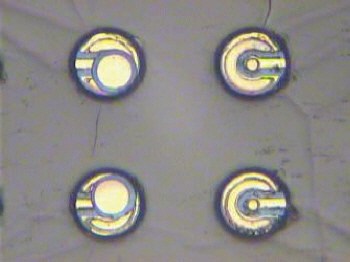
The method developed by Alan O’Riordan and colleagues at the National Microelectronics Research Centre (NMRC) in Cork exploits the fact that most devices are charged and therefore respond to an appropriately configured electric field. This field can be used to direct and accurately position a device on a chip substrate, eliminating the use of tweezers altogether (see figure 1). To test their technique, the team assembled a semiconductor-based light emitting diode on a silicon chip (see figure 2 for a video of the process).

“Field configured assembly (FCA) is an integration technology inspired by self-assembly processes in nature,” O’Riordan told PhysicsWeb. “However, it is compatible with contemporary optoelectronic manufacturing methods and permits low cost, rapid and scalable assembly and integration of devices.”

Microscopy moves to the picoscale

Scientists routinely use scanning tunnelling microscopes to obtain topographic maps of surfaces, and it is possible to identify individual atoms in these images. A scanning tunnelling microscope (STM) works by measuring the currents produced by electrons as they tunnel from the sample to the tip of the microscope. However, scanning tunnelling microscopes can only probe some of the electrons in the surface. In an atomic force microscope (AFM), on the other hand, electrostatic forces between the microscope tip and the sample are measured. All the electrons on the surface contribute to these forces.

Franz Giessibl and colleagues at the University of Augsburg used a single carbon atom as a probe in their AFM to image an individual atom on the surface of a sharp tip made of tungsten. This tip is normally the probe in an AFM and the carbon atom is usually the sample, but in the Augsburg experiment the roles of tip and sample have been reversed.

As the tungsten tip is made to oscillate at sub-nanometre amplitudes, the interaction between the tip atom and the carbon atom produces higher harmonic components in the underlying sinusoidal wave pattern. Giessibl’s team measured these signals to obtain an ultrahigh resolution image of the tip atom that showed features just 77 picometres (77 x 10-12 metres) across.

The team now plans to try other light atoms as probes, such as beryllium and hydrogen. “Advances in microscopy have, in many cases, spurred further breakthroughs in the natural sciences, and we are confident that our work will also enable new progress in nanoscience,” Giessibl told PhysicsWeb.

How Cambridge grew mathematically

Beginning in the early 19th century, a series of reforms transformed Cambridge University, which had become a mathematical backwater in the 18th century, into a pre-eminent centre for mathematical physics. How the Cambridge “miracle” came to be lies at the heart of these two books, both of which have been written by professional historians of science. Based on good selections of primary and secondary sources, these are authoritative works that tackle current and significant historical issues, and also make important contributions to historical scholarship.

For the reader who is not a historian, however, both books pose certain difficulties. From Newton to Hawking is an edited volume that looks at the history of the Lucasian professorship in mathematics at Cambridge – from its establishment in 1663 to the present day. Each author deals with the life and work of one or more of the Lucasian professors, presenting admirably complete and balanced synopses of the relevant themes and events. However, the material is often not sufficiently explained or developed to be truly informative to the non-expert reader.

Another drawback is that, with individually authored chapters, the overall flow of the book is a bit choppy. Moreover, the chronology of the individual chapters is often a bit complex. Some readers may therefore find it hard to follow the thread of the story. Nevertheless, unifying themes do emerge, and the synoptic overview of three and a half centuries of the Lucasian professorship is highly worthwhile.

Masters of Theory has a tighter chronological focus, dealing mainly with the 19th and early 20th centuries, when mathematical physics flourished at Cambridge. However, it suffers from the opposite problem by offering perhaps a bit too much detail. Nevertheless, the motivated reader will discover a rich, deep and altogether fascinating historical reconstruction of a critical period. The book also benefits from the continuity and thematic control that can be achieved by a single author – Andrew Warwick – of great knowledge and skill.

Most studies of the rise of mathematical physics at Cambridge tie events to the “analytical revolution” of 1815-1825 when Charles Babbage, John Herschel, George Peacock and others introduced the Leibnizian approach to calculus into the Cambridge curriculum. This period is generally regarded as the dividing point between the desuetude of the 18th century, when science and mathematics at Cambridge languished, and the subsequent “miracle” of the 19th century.

Both books acknowledge this periodization – with some caveats – and develop it further in various ways. A strength of From Newton to Hawking is its illuminating treatment of the earlier, 18th-century period. With its emphasis on the politics of the Lucasian professorship, the book gives us a good understanding of how a pious Newtonianism came to dominate the Cambridge enterprise, leading to its isolation from larger currents in European science. Cambridge, for example, doggedly stuck to the “fluxional” approach to calculus, with its characteristic notation, and to the “central force” approach in mechanics, which explained phenomena ranging from chemical combination to celestial motions in terms of push-pull forces between particles.

The analytical revolution itself is better treated in Masters of Theory. The author pays particular attention to the circumstances and aspirations of the students and to the pedagogical techniques that were used to educate them. A central theme is the important contribution of “private teaching” at Cambridge by various tutors and coaches, which helped mathematical physics to flourish. This climaxed with Edward Routh, who was the most influential and productive coach from the 1860s to the 1880s.

Also important was the exam system in the form of the mathematical tripos. It led to a positive-feedback loop in which the tripos drove the coaching and the coaching drove the tripos. The loop was reinforced by the students’ desire to do well in the tripos for the enhanced social standing that such success would bring.

Masters of Theory also shines light on the development of Maxwell’s theory of electromagnetism. His Treatise on Electricity and Magnetism has always been a bit of a puzzle, comprised as it is of pieces that do not quite fit together. The key is to see how the book was related to Cambridge pedagogy, and how it was studied and developed at various Cambridge sites, including the “coaching rooms”, the intercollegiate lectures of W D Niven at Trinity College, and the Cavendish Laboratory. This helps one to understand the purpose and structure of the book. The pedagogical perspective also sheds light on the further development of Maxwellian theory by J J Thomson, J H Poynting, Joseph Larmor and others.

A final theme is how special and general relativity were received by scientists at Cambridge, which brings the story up to the 1920s. The interaction of Cambridge traditions with the novelties of the 20th century is also central to From Newton to Hawking, which takes the story further to Stephen Hawking’s professorship and the present day.

Reflecting current trends in the history of science, both books argue against traditional claims for the universality of science, emphasizing instead how time and place set the tone and agenda for scientific endeavour. Nevertheless, both books furnish strong evidence of continuity and universality: academic readers will find that the politics of university life described in From Newton to Hawking are still in evidence today; scientists – especially physicists – will recognize the competitive atmosphere of 19th-century Cambridge described in Masters of Theory. It is the interplay of the universal and the particular that engages our attention in a variety of narrative forms, and the history of science is no exception.

Both of these books, with their particular strengths and weaknesses, deserve to be in any serious library and to be consulted by anyone with an interest in the history of mathematical physics at Cambridge.


Copyright © 2026 by IOP Publishing Ltd and individual contributors