The trouble with discussions of paranormal phenomena is that opinions are always polarized, with physicists generally lying in the dismissively sceptical camp. Most of the rest of society – with the possible exception of fellow scientists – tends to have views that range from “firm believer” to “one must keep an open mind on these issues”. This polarization leaves little room for dialogue.
Sceptics are unlikely to be able to contribute to an informed debate because they do not have enough knowledge of the topics that they have rejected as nonsense. And arguments based on purely theoretical grounds are generally ineffectual, given that some phenomena that are now widely accepted – such as meteorites and plate tectonics – were once also dismissed for similar theoretical reasons. In my view (and as an experimental physicist perhaps I am biased) sceptics must deal with the evidential basis for paranormal phenomena where appropriate. But we should also be able to suggest reasonable alternative explanations for apparently extraordinary phenomena.
Debunked! written by French Nobel laureate Georges Charpak and fellow physicist Henri Broch is a valiant attempt to arm readers with some of the weapons necessary to contribute to this debate. The title of the original French edition of the book – Devenez Sorciers, Devenez Savants – better encapsulates the authors’ philosophy than does the English title. “By learning to fool others,” the authors suggest, “you will be better prepared to judge the blandishments of the merchants of deception, who try to persuade you of their special and extraordinary knowledge, whether it’s in the area of health, love or politics. Remain scientists – and become sorcerers!”
Charpak and Broch cover a number of topics, including telepathy, metal-bending, astrology, coincidence, fire-walking and dowsing. They even stray into areas such as the public perception of the dangers of nuclear power. An important aspect of the book is its attempt to enable readers to devenir sorciers – become sorcerers – by exposing a number of conjuring tricks used by certain latter-day proponents of the paranormal. After finishing this book, the reader should be able to demonstrate telekinetic metal-bending, push sharp objects through body parts, and read minds at a distance. (With the aid of the memory alloy Nitinol, a good mechanical workshop, and a confederate, respectively.)
The section on dowsing is particularly useful, given that this is the one area where physicists tend to move from the sceptical to the gullible camp. The authors discuss some of the numerous blind experiments that have been done on dowsing. Readers who believe that they have water-divining abilities should contemplate setting up a blind experiment of the type described in the book, in which water is allowed to run through one of a number of (preferably buried) pipes.
All the dowser has to do is to determine the pipe in question. To the total surprise of the practitioners, such experiments have yielded – and will continue to yield – results that can only be attributed to chance.
I strongly agree with the authors that many ordinary phenomena are regarded as extraordinary because most of us lack an intuitive understanding of probability and statistics. For instance, if we were to guess the probability that an individual, on any particular night, dreams of an aeroplane crash, we might come up with a number between one in a few thousand and one in a million. On any given night, therefore, perhaps between 60 and 6000 people in the UK dream of such an event. So far, entirely unsurprising. But if a catastrophic air accident does occur in the day following the one night in my life that I dream of a plane crash, this statistically insignificant event may give me an unshakeable, lifelong conviction that I have experienced a precognitive dream. This theme is explored effectively and at some length in the chapter entitled “Amazing coincidences”.
The section on fire-walking is less well done. Although the authors correctly identify the factors that enable anyone to walk on hot coals without injury – including coal’s low heat capacity and poor thermal conductivity – they begin by focusing on the spheroidal shape of water droplets, which they themselves acknowledge as having little relevance to fire-walking. This just confuses the reader.
Overall, this is a somewhat quirky book that provides a fairly uneven coverage of pseudoscience and the paranormal. For a more comprehensive coverage of these topics, I would recommend Pseudoscience and the Paranormal by Terence Hines (2003 Prometheus) or The Psychology of the Psychic by David Marks and Richard Kammann (1994 Prometheus).
On the other hand, Debunked! does have a certain Gallic charm, particularly in the way in which it is written – to such an extent that I bought the French version of the book to see if the quaint language was present in the original. Even on fairly factual topics, French writers seem to prefer a much more literary style than their British or American counterparts, and translator Bart K Holland has done a fair job of rendering the text into English. Nonetheless, sentences such as “Now we are going to set sail amid islands of ignorance, which are perfectly well charted in any good atlas of superstition – and which are objects of veneration and pious pilgrimages nonetheless” do take a little digesting by someone more used to prosaic English text.
Despite these reservations, I enjoyed reading this book (in two languages) and was particularly interested to learn about purportedly paranormal events that have not been covered elsewhere, such as the mysterious sarcophagus at Arles-sur-Tech. For centuries this marble tomb has been miraculously accumulating water, without plumbing or any other obvious source. However, for the price of the book in the UK or the US, it is possible to buy a paperback version of the original French edition (for just €5.70), a good French/English dictionary, and still have enough left over to buy a dowsing rod and a couple of Nitinol teaspoons.
In the summer of 1988 a major heat-wave in the US alerted the world’s media to the issue of climate change. Ever since, climate scientists have been asked whether such extreme weather anomalies, which include catastrophic floods and hurricanes, occur naturally or whether they are the result of a rise in global temperature due to human activity. The problem is that climate is a statistical phenomenon, which makes it difficult to find definitive answers to these questions.
With a few exceptions, such as the six-monthly forecasts of the El Niño phenomenon, climate anomalies cannot be predicted. Climate models can, however, predict the probability distributions of variables such as precipitation and temperature, and the changes they predict are indeed consistent with recently recorded anomalies. Although the total number of observed climate extremes is small, the data suggest that the increase in the frequency of such events is most likely due to the global warming caused by the emission of greenhouse gases such as carbon dioxide.
This anthropogenic, or man-made, climate change is predicted to occur by climate models and, moreover, it is clearly evident today. This is based not on extreme events but mainly on measurements of the global mean temperature. These measurements extend over longer times and provide a more reliable estimate of the ratio of the predicted anthropogenic climate-change signal to the natural-variability “noise”. Even without sophisticated statistics, the signal is now well above the noise.
The emergence of the anthropogenic signal has changed both the public and the scientific perception of the climate issue. Climate change due to human activity is no longer the abstract possibility that experts had been discussing since the end of the 19th century, when Svante Arrhenius – the Swedish chemist who won the Nobel prize in 1903 – first pointed out that carbon-dioxide emissions from fossil fuels were warming the Earth. People now expect politicians to act. Moreover, climate researchers have started to realize that their ever more detailed and expensive computations cannot be carried out independently from the debate on climate policy. The concern is not so much the temperature increase of 0.7°C that has occurred since the end of the 19th century, but the projected 3°C warming that will happen this century if greenhouse- gas emissions continue to grow unabated. Climate researchers now have to interact with economists, sociologists and political scientists in order to assess the full implications of climate change for sustainable development.
In the June issue of Physics World Klaus Hasselmann, director emeritus of the Max Meteorology in Hamburg in Germany, Hans Joachim Schellnhuber, scientific director of Change Research in Norwich in the UK and Ottmar Edenhofer at the Potsdam Institute for Climate Impact Research describe this work in more detail. All authors are members of the European Climate Forum.
In the early 1960s particle physicists found that they had wandered into a jungle. They were confronted by a bewildering array of particles called hadrons that did not appear to follow any discernible pattern. Murray Gell-Mann eventually tamed this hadronic jungle by proposing that all hadrons are made up of combinations of more fundamental particles called quarks: mesons contain a quark and an antiquark, while baryons contain three quarks. Some physicists found this bold hypothesis difficult to swallow at first, but for four decades these two basic “body plans” have been more or less adequate to accommodate the many new hadrons that have turned up in experiments.
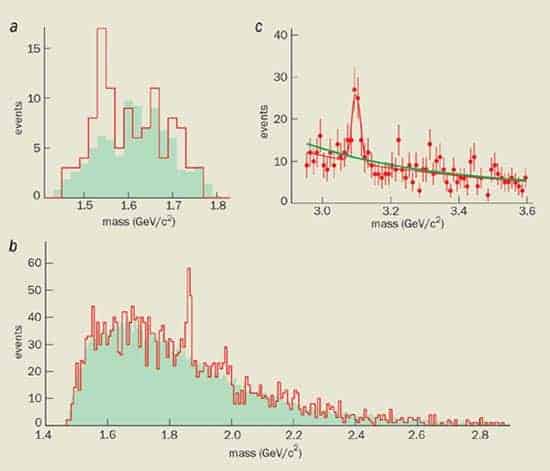
Now, however, we are finding that the closely tended garden of hadrons is abloom with exotic new growths. Last year, researchers working on the LEPS experiment at the SPring-8 laboratory in Japan announced the discovery of a new particle called the θ+(1540) that does not conform to either the meson or baryon body plan (figure 1). Physicists have speculated about such particles – for which the “1540” represents the mass of the particle in MeV – from time to time. In fact, the possibility of an exotic particle with such a mass was suggested by Dmitri Diakonov and colleagues at the Petersburg Nuclear Physics Institute in 1997, although this was based on a rather different view of hadrons from the one described here.
The LEPS result was quickly confirmed by other experiments, including the CLAS experiment at the Jefferson lab in Virginia and the DIANA experiment at the ITEP lab in Moscow. Soon afterwards, the NA49 collaboration at CERN found evidence for a family of heavier particles that appear to be close relatives of the θ+, and this March the H1 collaboration at the DESY laboratory in Hamburg caught a glimpse of what could be a more exotic cousin of the new particle.
The fundamental properties of these particles and the way in which they form are not known. Indeed, there is still debate about whether they exist at all. One popular interpretation is that the new particles contain four quarks and one antiquark in a bound state. Whether or not this picture turns out to be correct, coming to terms with the possibility of such “pentaquarks” is offering exciting new insights into the subtleties of the strong interaction.
An exotic challenge
Everyone agrees that the fundamental theory of the strong interaction is a quantum field theory known as quantum chromodynamics, or QCD for short. QCD is remarkable theory in a variety of ways. Firstly, it consistently embodies both special relativity and quantum mechanics. Quantum electrodynamics (QED), and its expansion to the electroweak Standard Model of particle physics, is also a quantum field theory. However, QED is known to break down and develop inconsistencies at short distances. The quantum field theory of gravity that we obtain from general relativity also suffers from a similar complaint, in an even more virulent form. QCD is unique in that it does not suffer from this problem, and as such it forms our most logically perfect theory of nature.
Figure 1
QCD is also a beautiful theory. Its equations possess an extraordinary degree of symmetry called colour gauge invariance that fixes their structure quite precisely. As a consequence, QCD is extremely well defined: quarks interact with gluons, and gluons interact with each other in a fixed pattern (see Further information). A very small number of parameters, namely one universal coupling strength and one mass for each kind of quark, specify QCD completely. One cannot change the equations in any way without spoiling their symmetry, and ultimately their consistency. This means that the quantitative predictions of QCD, which in principle cover all the phenomena of the strong interaction, are unambiguous: no fudge factors are available.
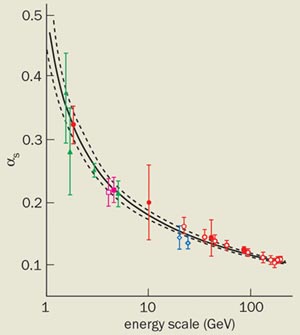
On the empirical side, QCD has earned our confidence by surviving thousands of rigorous tests. For example, the results of different kinds of experiments involving hundreds of independent measurements can all be interpreted consistently within QCD using only the parameter that describes the strength of the interaction (figure 2). Another notable success of QCD is the prediction of “asymptotic freedom”, which means that the coupling strength between quarks and gluons should decrease at high energies or, equivalently, short distances. This is in stark contrast to the coupling strength in QED, which gets larger at short distances.
So what is the problem? Quite simply, the equations of QCD are very difficult to solve. Their most striking consequence is that neither quarks nor gluons can appear in isolation: instead they are forever confined in hadrons such as protons and neutrons. This bizarre property of QCD involves complex and highly nonlinear dynamics. While there are circumstances in which we can make quantitative predictions directly from the fundamental theory, such as those shown in figure 2, there are also many physically important questions that cannot be answered this way.
To put it crudely, we can do a good job of predicting the properties of energetic quarks and gluons, and of the “jets” of hadrons that they leave behind. However, we find it difficult to describe the way that quarks and gluons bind together to form hadrons. We have a hard time calculating the masses and properties of familiar particles such as protons, neutrons and pions from first principles, and we have an even harder time with the many baryon and meson relatives of these particles. As for atomic nuclei, we have had no success at all in calculating their properties directly from the equations of QCD.
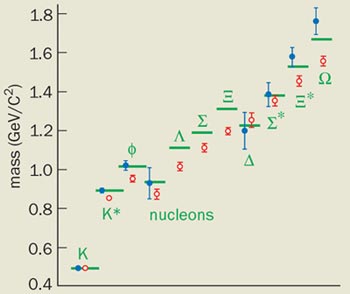
However, by exploiting the latest supercomputers, researchers have been able to calculate the masses of a few of the lightest and simplest strongly interacting particles (figure 3). These calculations provide us with profound insights into the origin of mass in matter. For example, protons and neutrons have masses of almost 1000 MeV, yet they are built from up quarks and down quarks that have a combined mass of about 20 MeV, and from gluons that have precisely zero mass! Unfortunately, however, the techniques employed in these calculations are specialized, fragile and hugely demanding in terms of computer power. They allow us to calculate a few quantities very accurately, but so far they are useless for most others.
This situation – a beautiful fundamental theory that is hard to work with – is quite common in science. Paul Dirac famously remarked that with the advent of quantum electrodynamics we had in our hands a theory that covered “all of chemistry, and most of physics”. There is some truth in this. In a few cases, such as the magnetic moment of the electron, we can calculate the predictions of QED to within a few parts per billion or less, and then compare these with experiments. The agreement is remarkable (see “Muons: particles of the moment”).
However, QED also has practical limitations. The fundamental coupling strength in the theory, α ~ 1/137, is weak, and this allows us to calculate the properties of simple atoms and molecules as a power series in a. We are therefore reasonably sure that we can write down equations that, if we were able to solve them, would describe the shape and stability of large molecules. But this is a big if. In practice, neither theoretical nor experimental chemistry has been replaced by supercomputers cranking away at the equations of QED. Instead, chemists have developed concepts such as chemical valence, and models such as the ball-and-stick picture of molecules. The relationship between these models and fundamental QED, however, is not entirely straightforward.
In QCD the challenge is even more daunting. There is no useful scheme of successive approximation, no starting place for an order-by-order attack on the structure of hadrons. The coupling strength that is analogous to α in QED is small at short distances, but it grows larger as we approach the distances at which hadrons form. The size of the proton, for example, is the distance at which the coupling strength between quarks becomes so large that their mutual attraction overcomes the natural tendency of quantum objects – which are described by waves – to spread out. If QCD theorists want to describe hadrons, they have to turn to models from the start.
The quark model
One famous and successful model, which actually predates QCD, is the quark model. As we mentioned earlier, this model was invented in response to the discovery in the 1960s of hundreds of very short-lived particles. The quark model postulates that the basic entities in the strong interaction are not the particles that we observe directly, but rather quarks and antiquarks. The observed particles are supposed to follow one of two basic “body plans”: mesons are assembled from a quark and an antiquark, denoted qq-bar, while baryons are assembled from three quarks, qqq.
These basic plans allow for several elaborations. Each quark can be chosen from any of six flavours: up, down, strange, charm, bottom and top. Furthermore, their spins can be aligned in various ways, and each quark can also be in different spatial orbitals. Each combination of quark flavours, for example, has a lowest energy state and a “tower” of higher-energy states, in much the same way that a particular atom has a ground state and various excited states. By making simple hypotheses for the masses of the quarks and their interactions, the quark model can account semi-quantitatively for the masses and properties of many hundreds of such higher-energy states, which are known as “resonances”.
The quark model thus succeeds in trimming a vast jungle of experimental material into a manageable garden, but its relation to fundamental QCD is loose at best. It does not provide the starting point for a systematic approximation to QCD, nor a reliable way to estimate the uncertainty in its predictions. However, QCD explains why individual quarks or gluons are not observed, because it allows only those body plans in which the number of quarks minus the number of antiquarks is equal to a multiple of three. The simplest possibilities are therefore qq-bar and qqq, which correspond to the mesons and baryons in the quark model, respectively.
This rule of three is a generalization of the concept of “opposite charges” that exists in QED: both the electron and the proton are electrically charged, but their charges are opposite so they can be combined to make a neutral state. In QCD the same principle holds: a quark and an antiquark can form a “colour neutral” state. Moreover, three quarks or three antiquarks can also make a neutral state. (One reason why the charge in QCD is called colour is that red, green and blue can be mixed together to make white.) At a deeper level, however, the more detailed assumptions of the quark model do not sit entirely comfortably within the concepts of QCD as a rigorous quantum field theory.
According to quantum field theory, gluons and pairs of light quarks and antiquarks should be spontaneously emitted and re-absorbed by the quarks and gluons inside hadrons. The body plans of the quark model gloss over this deeper structure, but it is definitely present. When we examine protons closely by bombarding them with electrons, we find that they contain plenty of gluons and light quark-antiquark pairs. In fact, they contain an infinite number. And even if we ignore these quantum fluctuations, and accept the “rule of three” for quark–antiquark combinations, we must wonder: why are exotic body plans such as tetraquarks (qqq-barq-bar) or pentaquarks (qqqqq-bar) not found in the spectrum of hadrons?
Another well known and highly successful model, which predates even the quark model and whose success partly explains why quarks took so long to discover, is the traditional model of atomic nuclei. In this model, nuclei are pictured as loose aggregates of nucleons (protons and neutrons) each of which, according to the quark model, has three quarks locked inside it. The success of this model forces us to add an epicycle to the quark model in which a practically unlimited number of bound states containing three-quark combinations is allowed. In other words, as well qqq states, we also have to allow (qqq)n states.
The traditional nuclear model forces us to ask what prevents two separate three-quark bags from merging to form a single six-quark bag? To answer this we first need to understand the origin of the strong repulsion between nucleons. This repulsion is of fundamental importance in conventional nuclear physics because it prevents mergers that would obliterate the identity of individual nucleons. In particular, we need to know why the H “dibaryon”, which has a quark composition of uuddss, is not observed. The straightforward quark-bag model suggests the H dibaryon ought to be relatively light, stable and easy to observe, but it has not been observed experimentally.
As this discussion makes clear, the issue of exotic hadrons exposes profound weaknesses in our current understanding of the strong interaction. Why do we not observe more particles that do not conform to the quark-model body plans? And if such “exotics” do exist, what form might we expect them to take? We believe that the answers to these questions lie in a careful consideration of the interaction between quarks. The traditional quark model treats interactions between quarks as an afterthought, or as a perturbation to be more precise. In QCD this is justified at high energies, or short distances, but not in general. Indeed, the fundamental equations of QCD suggest some rather specific properties of the quark interaction.
For instance, the force between two quarks is attractive when both the colours and the spins of each quark are different, or (more precisely) antisymmetric. When two quarks are correlated in this way they form an especially low-energy configuration, which we call a diquark. These correlations are strongest when they involve the light quarks (u, d and s), and are more prominent for u and d quarks than they are for s quarks. As a result, diquarks come in three varieties: [ud], [us], and [ds], where the square brackets reflect the antisymmetry of the quark wavefunctions.
Diquarks should not be considered as particles in their own right. Although they contain two quarks, they are not colour neutral and therefore cannot exist as isolated bound states. Instead they float around inside hadrons as composite entities with a size of about 1 fm, which is approximately the same size as the hadrons. Diquarks are thus conceptual building blocks, which give us a useful ordering principle for the most important states in the hadronic spectrum. A similar concept is familiar in chemistry: electrons with opposite spins like to form pairs, and it is often useful to think of paired electrons as loosely bound units inside atoms or molecules.
Power laws like these, which describe how many events will occur on average in a given time period, date back to 1894 and the work of Fusakichi Omori, and they apply not just to earthquakes, but to many other natural phenomena too. Now Sumiyoshi Abe of the University of Tsukuba and Norikazu Suzuki at Nihon University, both in Japan, have discovered similar behaviour in the spatial distribution of earthquakes. Moreover, they have found that the overall correlation between earthquakes in a particular region is 10 times larger than it would be between events on a random network (Europhys. Lett.65 581, Physica A 337 357).
In the June issue of Physics World Dietrich Stauffer of Cologne University in Germany describes this work in more detail.
The problem is that the necessary behaviour for a fluidic rectifier only applies to flows that have a large Reynolds number – the ratio of inertial and viscous forces in the fluid. As the Reynolds number is proportional to both the size of the system and the average velocity of the flow, and inversely proportional to the viscosity, a large Reynolds number means either a large system (e.g. the turbulent flows in the Earth’s atmosphere), high velocities (e.g. the flows behind fast moving cars and planes) or low viscosities (e.g. the flow of water compared with thick oil).
In microfluidics, however, the Reynolds number is very small, which means that the flows are supposed to be perfectly reversible and display exactly the same behaviour when moving from left to right and vice versa. This is because a low Reynolds number implies a time-reversible flow: changing the sign of time is equivalent to changing the sign of the velocity, and this gives exactly the same flow in the pipe but in the opposite direction. As a result, one usually concludes that it is impossible to build a fluid rectifier that operates on small scales.
However, these arguments are only valid for common or Newtonian fluids. Alexander Groisman and Stephen Quake of the California Institute of Technology have now devised a special pipe and fluid combination in which the flow is non-symmetric. The device – the basic geometry of which was patented by Nikola Tesla in 1920 – has no moving parts, and could find applications in microfluidic pumps and valves (Phys. Rev. Lett. 92 094501).
In the June issue of Physics World Nicolas Garnier at the Ecole Normale Supérieure de Lyon in France describes this work in more detail.
In February 1998 Thomas Ebbesen and co-workers at NEC in Princeton found that the transmission properties of sub-wavelength holes change dramatically when they form a 2D array. The researchers studied what happened to light when it was incident on a piece of thin gold foil that was peppered with 100 million identical holes, each with a diameter of 300 nm and separated by 1 µm. For light with a wavelength slightly larger than the period of the array –known as a resonant wavelength – the NEC team discovered that the holes transmitted more than 100% of the light that fell directly on them. According to standard aperture theory, such a metallic film should only let about 0.1% of the incident light through, but it appeared that the apertures were able to “funnel” some of the light that fell on the metal between them.
Four years later the same group, in collaboration with the present author and colleagues at Louis Pasteur University in France and the University of Zaragoza in Spain, demonstrated that you do not need millions of holes to funnel light through the metal foil: one hole will do the job, provided it is properly flanked by a regular pattern, such as a bull’s-eye. Even more surprisingly, when both sides of the foil are patterned, we discovered that the light emerges in a very narrow beam instead of spreading out. In other words, it seems as if the diffraction limit can be overcome by just texturing both the entrance and exit surfaces around a sub-wavelength aperture.
In the June issue of Physics World Francisco Garcia-Vidal at the Universidad Autónoma de Madrid, Spain describes this work in more detail.
A major breakthrough in the search for new worlds beyond our solar system happened recently with the discovery of a planet using a technique known as gravitational lensing. The new planet is about 1.5 times the mass of Jupiter, and is about half way between the Sun and the centre of the Milky Way. This makes it the most distant extrasolar planet detected by astronomers to date.
The discovery, made by Ian Bond and co-workers in the MOA and OGLE collaborations, represents the debut of a new and faster technique for discovering cool planets that orbit stars at large distances from the Sun (Astrophys. J. at press). Most significant of all, however, is the unique capability of gravitational lensing to discover Earth-like planets from the ground.
Cool planet detector
Today the encyclopedia of extrasolar planets contains about 120 gas giants with masses between about 0.5 and 10 Jupiter masses. Almost all of these were found using the “Doppler wobble” method in which the gravitational pull of a large planet swings the star around the centre of mass of the star–planet system (see “Extrasolar planets”). This wobble introduces periodic Doppler shifts of a few tens of metres per second in the light from the star, and such shifts can now be routinely detected by large telescopes equipped with high-precision spectrographs. A handful of extrasolar planets have also been found using the “transit method”: if the orbit of the planet is such that it passes directly between the host star and the Earth, the planet can be detected by measuring the tiny amount of starlight it blocks as it passes in front of the host star.
However, both the Doppler and transit methods are only sensitive to large planets that orbit relatively close to their parent stars. Smaller and cooler planets that are similar to the Earth escape discovery because their Doppler signatures are small and because they take several years to orbit their host star. On the other hand, gravitational lensing – in which light from a distant star is bent by a massive intervening object – can reveal small, cool planets without having to wait for them to complete an orbit.
The bending of starlight by a massive object is one of the most important predictions of general relativity. In particular, Einstein predicted that the Sun would cause a grazing light ray from a distant star to be deflected by 1.7 arcseconds – a prediction that was famously confirmed by Eddington’s measurements during the total solar eclipse of 1919. Einstein later showed that more distant stars can act as gravitational lenses, and today astronomers routinely use this technique to “weigh” a distant object by simply looking at the effect it has on light.
However, gravitational lenses are imperfect because the rays that pass closest to the lensing mass are deflected more than rays passing further away. This spherical aberration means that an observer looking at a background star through a gravitational lens sees two magnified and distorted images on opposite sides of the lensing star. When the background star, the lens star and the Earth are all perfectly aligned, the two images expand to form an “Einstein ring”.
Stars in our galaxy typically bend light from more distant stars by only a few milliarcseconds, which means that it is not possible to resolve the two images with conventional telescopes. However, the observed brightness of the distant star displays a symmetric rise and fall over a few weeks as the lens star slides past the line of sight. It is this magnification that allows extrasolar planets to be detected (figure 1).
Gravitational microlensing
Planets close to the lens star act like smaller gravitational lenses that can briefly increase or decrease the magnification of the lens. A cool planet in the “lensing zone” – which is typically between 1.5 and 6 times the Earth-Sun distance – can therefore be detected without having to wait for it to complete its orbit. Furthermore, both the duration and probability of planetary-lensing events scale as the square root of the mass of the planet, which means that the technique is also sensitive to low-mass planets.
Large planets like Jupiter, for example, have a 10% probability of being in the right place to act as lenses for a few days, while Earth-mass planets have a 1% probability of alignment and only act as lenses for a few hours. Unlike other methods, the magnification signal in a microlensing event can be large even though the planet is small. However, the finite angular sizes of the source stars mean that gravitational microlensing is not sensitive to planets smaller than Earth.
The MOA (Microlensing Observations in Astrophysics) and OGLE (Optical Gravitational Lensing Experiment) teams used small dedicated telescopes in Chile and New Zealand to scan rich star fields at the centre of our galaxy, and identified over 500 gravitational-lensing events during 2003. Ian Bond of Edinburgh University identified the new planet by noticing a sudden and unexpected increase in the brightness of one of the lensed stars. The signature of the planet was a pair of spikes in the brightness curve: the first occurs when the lensing effect of the planet causes two new images of the source star to appear, and the second spike – which appeared seven days later – happens when the extra images merge and disappear.
The main challenge in planet searches based on microlensing is to detect the brief and rare planet-lensing anomalies while scanning vast areas of the sky. Moreover, to be able to detect a Jupiter-sized planet the light curves must be measured at least twice per day – and at least twice per hour for Earth-sized planets. Bond’s vigilance enabled him to spot the planet anomaly in its early stages, and therefore to step-up the observational campaign before it was too late.
Now that gravitational lensing has secured its first new planet, we can expect the pace of discovery of extrasolar planets to increase as teams of astronomers join forces to build a network of dedicated observing facilities. The 1.3 m OGLE telescope at the Las Campanas Observatory in Chile and the MOA 0.6 m telescope at the Mount John observatory in New Zealand find 500-700 microlensing events each year. In addition, the PLANET and microFUN collaborations operate a series of smaller telescopes in Israel, South Africa, Chile and Australia to provide 24 hour coverage of the most promising lensing events. The RoboNet experiment in the UK has joined the quest this month, linking three 2 m robotic telescopes – the Liverpool Telescope on La Palma in the Canary Islands and the two Faulkes telescopes in Hawaii and Australia.
Beyond the excitement of discovering new worlds, the scientific goal of this work is to measure the abundance and mass distribution of cool planets with masses similar to the Earth and above. If cool Earth-like planets turn out to be relatively abundant, gravitational microlensing could uncover them within 3-5 years.
According to Francois-Marie Voltaire – Enlightenment France’s great writer and philosopher – Emilie du Châtelet “was a great man whose only fault was being a woman”. Du Châtelet has paid the penalty for being a woman twice over. In her own lifetime she fought for the education and the publishing opportunities that she craved. Since her death, she has been cast in the shadow of two men – Voltaire, with whom she lived and studied, and Isaac Newton, whose work she criticized and interpreted. Her translation from Latin of Newton’s Principia, his great work on gravity, remains the only complete version in French.
For more than two centuries, Du Châtelet (1706-49) has been cast as Voltaire’s mistress, as though she were his possession or at best an intelligent secretary. But Voltaire himself knew better – he celebrated her as a “great and powerful genius”. Together they wrote Elements of Newton’s Philosophy (1738), an extremely influential book that persuaded French experimenters to abandon their own national hero, René Descartes, and pledge allegiance to Newton instead.
Although only Voltaire’s name was on the title page, he paid tribute to Du Châtelet’s scientific superiority – their book’s frontispiece (shown) envisages her hovering above his head, casting Newton’s divine wisdom down onto his hand. Du Châtelet’s mirror identifies her as the goddess of truth, while Voltaire sports a poet’s laurel wreath as he assiduously transcribes the words of his female muse. “She dictated and I wrote,” he told a friend.
Tackling prejudice
Faced with overt exclusion from academic circles as well as ingrained doubts about her own ability, Du Châtelet was caught between conflicting, unsatisfactory stereotypes – the learned eccentric, the flamboyant lover, the devoted mother. Too many biographers have plumped for one or another of these hackneyed models, rather than listening to her quiet insistence of being “in my own right a whole person”.
“Judge me for my own merits,” protested Du Châtelet – but how should this be done?
Judging her by modern standards is not a valid approach. Women in the 18th century had virtually no educational opportunities and were believed to be intellectually as well as physically inferior to men. Just as importantly, there were no conventional career tracks to follow even for men who wanted to study science; like women, they had to carve out their own routes to success, especially if they were not born into rich families.
Trapped between the sexes, Du Châtelet conformed to the expectations of the time by loving to shop, dance and entertain. But she also transgressed social norms by dedicating herself to Newtonian natural philosophy. When submission deadlines were close she scarcely slept, plunging her hands into ice-cold water to keep herself awake.
In addition to her scientific research, she wrote and translated works on other subjects, such as ethics, the Bible and Greek poetry. The German philosopher Immanuel Kant admired her intellect, yet sneered that “a woman who conducts learned controversies on mechanics like the Marquise de Chatelier might as well have a beard”.
Like many clever women today, even in the midst of achievement she lacked self-confidence – “God has refused me any kind of genius,” she once confided. Despite her unconventional lifestyle, Du Châtelet still performed the traditional time-filling tasks expected of a wife and mother. Some of these she imposed on herself, but in other cases it seems that she yielded to pressure from her contemporaries, as if conditioned from birth into a form of psychological captivity. But she encouraged women to foster their own happiness by studying “to console them for everything that makes them dependent on men”.
A scientific mind
Obviously brilliant as a child, Du Châtelet resented the discrimination that made it impossible for her to pursue the same career as a man. Born into a wealthy aristocratic family, she benefited from an enlightened father. Instead of sending her to a convent school he decided that she should be taught at home, and she received the sort of education that was more typical for boys. She could apparently speak six languages when she was only 12, but it was not until she reached her late 20s that she started to immerse herself in Newton’s ideas. These were still extremely controversial: the Jesuits controlled France’s education system, and their Cartesian science based on swirling vortices of tiny particles reigned well into the second half of the century.
By the time that she started to tackle Newton, Du Châtelet was married to an older army officer, had given birth to three children, and was simultaneously developing friendships with two other men. She persuaded one of them to teach her mathematics privately, and fell passionately in love with the other, Voltaire. He was in serious trouble, hunted by the police because of his unpatriotic political views, and Du Châtelet sent him off to hide at her country estate. The next summer she joined him there, and for 15 years they lived together, embroiled in a private world of intense intellectual activity entwined with romance.
Their first priority was to stock their library. They amassed 21,000 books – more than in most European universities – and they each had separate rooms packed with scientific equipment. Du Châtelet took over the great hall, where she tested Newton’s theories with wooden balls swinging from the rafters and metal apparatus forged from the nearby iron mines.
In 1738 Voltaire published their extraordinarily successful Elements of Newton’s Philosophy. Well illustrated, it clearly explained the basic principles of Newton’s discoveries in mathematical astronomy and optics, so that for the first time the new physics became accessible to a wide range of French people. Voltaire hero-worshipped Newton but recognized that he himself could not match Du Châtelet intellectually. “I used to teach myself with you,” he wrote 10 years later, “but now you have flown up where I can no longer follow.”
Du Châtelet grappled with the philosophical relationships between the Cartesian, Leibnizian and Newtonian systems. Unlike Voltaire, she believed that good science needs metaphysical foundations. Newtonianism, she pointed out, purports to be based solely on experimental observations, yet inevitably entails metaphysical assumptions about the existence of scientific laws. For about a year and a half she prepared a new manuscript, Foundations of Physics, in which she tried to integrate the ideas of Descartes, Leibniz and Newton.
A tough world for female scholars
Du Châtelet wrote in complete secrecy, trapped in a dilemma: she desperately needed constructive criticism, but risked painful mockery by revealing that a woman was daring to engage in such innovative work. Many female scholars experienced similar conflicts. Almost 100 years later, the English mathematical physicist Mary Somerville was working on a mirror-imageproject – elucidating for an English audience the cosmological ideas of the self-styled “French Newton”, Pierre Laplace. “I hid my papers as soon as the bell announced a visitor,” Somerville confessed, “lest anyone should discover my secret.” Although she doubted her own genius, Somerville was valued so highly that an Oxford college was named after her.
By welding together three conflicting systems, Du Châtelet suggested a novel yet welcome approach. Helped by the book that Du Châtelet and Voltaire had published earlier, Newtonian ideas were spreading through Europe, but there were fundamental clashes between the clockwork universes proposed by Europe’s three most eminent natural philosophers. By incorporating Leibnizian ideas about active substances, Du Châtelet helped to forge a new version of Newtonian physics that resolved the problems of describing force and movement. Published anonymously, her book received glowing reviews in prestigious journals.
Finally she embarked on her most ambitious project – translating Newton’s Principia into French. Because the English translation was faulty, she worked directly from the original Latin. For Du Châtelet, translation meant more than just converting words into another language. She believed that she should create her own version of a text, one that incorporated her own ideas as well as those of the original author. Constrained by family duties, her work was intermittent – but it was very thorough.
Spreading the Newtonian word
Du Châtelet decided to undertake not only the literal translation of the text itself, but also three types of interpretation. For newcomers she converted the complex mathematics into elegant prose, supplemented by her own examples. Next, she turned to calculus, translating Newton’s geometry into the new continental algebra. Finally, she summarized recent mathematical research and experimental vindications of Newton’s theories.
But to her dismay, Du Châtelet discovered that she was pregnant. Then aged 43, she was an elderly women by contemporary standards. Although Voltaire was not the father, he helped Du Châtelet deceive her husband into thinking that the baby was legitimate. Plagued by gloomy premonitions, Du Châtelet intensified her work schedule, working 18 hours a day to finish in time. Although she did succeed, she died soon after the baby was born. On her last day she recorded the date on her Newton commentary. Her Principia was published 10 years later, in 1759, to coincide with the return of a comet vindicating Newton’s physics.
Good translations are vital for spreading new ideas, and modern international science could not have developed without them. To understand how science came to form the backbone of our modern world, we need to describe not only what happened inside laboratories and libraries, but also what happened outside. Science now dominates popular media as well as educational syllabuses, but this is only because female teachers, editors, illustrators and translators – women like Du Châtelet – enabled scientists and students to learn about the latest research. Understanding science’s past entails recognizing and crediting their involvement. Women made different contributions from men, but different need not mean insignificant.
Anyone who worries that physicists are running out of interesting challenges to tackle and important problems to solve should read the two, very different feature articles in this issue. In “Climate change: complexity in action”, Klaus Hasselmann and colleagues write about the challenges of including economic and political dimensions in computer simulations of climate change. It is hard to imagine a physics-based topic that has a greater impact on the world at large. In “Quarks, diquarks and pentaquarks”, Robert Jaffe and Frank Wilczek describe our current understanding of quantum chromodynamics and the strong nuclear force. In this case it is hard to think of many more difficult problems in fundamental physics.
Traditional climate modelling is difficult enough because a whole range of effects in the atmosphere and the oceans have to be taken into account. It typically takes weeks for a state-of-the-art supercomputer to simulate 100 years of climate change with a horizontal resolution of 100 km. But climate change is about much more than solving difficult differential equations – there are crucial social, political and economic influences as well. Some researchers, including a significant number of physicists, have started to look at this “integrated-assessment approach”. The first challenge is to develop climate models that take minutes to run on a laptop. The next challenge is to develop analogous models that work in the social, political and economic arenas – which is not a trivial task – and then integrate all these different models and explore all the possible global-warming scenarios.
Physicists also hope to integrate quantum chromodynamics (QCD) into the larger framework of a so-called theory of everything. Like climate modellers, particle theorists working on QCD require enormous computational resources for their calculations, and even then there are limits to what can be achieved (e.g. the mass of the proton has yet to be calculated from first principles). However, QCD can explain the results of an enormous range of experiments, and has recently been given some new particles – “pentaquarks” – to get its teeth into. Moreover, physicists searching for a theory of everything can take heart from the fact that, unlike researchers working on integrated-assessment models, they already have highly successful theories for the phenomena they are trying to unify.
However, the ultimate challenge for the climate community will be to persuade governments and big business that they need to do something to avoid the potentially disastrous consequences of climate change. The UK’s chief scientific advisor, David King, made headlines recently when he wrote that, in his view, “climate change is the most severe problem that we are facing today – more serious even than the threat of terrorism” (Science303 176-177). It is too soon to say if the message is getting through, but at least climate scientists now have an unlikely ally in the shape of the climate-change disaster movie The Day After Tomorrow.
The top quark was discovered at the Tevatron proton-antiproton collider at Fermilab in 1995 and is the heaviest elementary particle detected to date. The latest DØ result is based on data taken before the Tevatron was shutdown in 1999 for an upgrade. A new analysis of this so-called Run I data gives a new “world average” for the mass of the top quark mass of 178.0 GeV plus or minus 4.3 GeV. Strictly speaking the mass is 178.0 GeV/c2, where c is the speed of light, but particle physicists often drop the “c squared” term.
In the Standard Model the masses of particles are generated as a result of their interactions with a field called the Higgs field. It should also be possible to detect excitations of this field in the form of a particle known as the Higgs boson. Detecting the Higgs — the only particle in the Standard Model that has not been detected experimentally — is therefore one of the outstanding challenges in particle physics. However, careful measurements of the masses of the top quark and the W+ and W– bosons — two of the particles responsible for transmitting the electroweak force — allow particle physicists to place upper and lower limits on the likely mass of the Higgs.
The new value for the mass of the top quark is some 5.3 GeV higher than the previous value and causes the best-fit value for the expected mass of the Higgs boson to increase from 96 to 117 GeV. Moreover, the upper limit on the expected Higgs mass increases from 219 to 251 GeV, possibly placing the Higgs beyond the reach of the current generation of accelerators.
Detecting the Higgs would allow particle physicists to search for new physics beyond the Standard Model, such as supersymmetry. Supersymmetric extensions of the Standard Model predict that all fundamental particles — such as quarks, photons and electrons — have so-called superpartners.
“Not only has the most probable value of the Higgs mass moved up by a good 25%, but certain previous limits on supersymmetry parameters no longer apply with the new value of the top quark mass,” DØ group member Greg Landsberg of Brown University told PhysicsWeb. According to Landsberg the new analysis technique is equivalent to running the Tevatron for another three years. The new technique is now being applied by the CDF collaboration, the other detector team at the Tevatron, and on Run II data from the upgraded Tevatron.