When bosons behave like fermions

All atoms are either fermions or bosons depending on whether they possess half-integer or integer spin, and the difference between the two becomes clear when they are cooled to near absolute zero. Fermions obey the Pauli exclusion principle, which means that two of them cannot occupy the same quantum state, but no such restrictions apply to bosons. This means that large numbers of bosonic atoms can collapse into the same quantum ground state in a process known as Bose-Einstein condensation.

Belén Paredes of the Max Planck Institute for Quantum Optics in Garching and co-workers in Munich, Mainz, Paris and Amsterdam first made a Bose-Einstein condensate from rubidium-87 atoms. This condensate was then transferred to a two-dimensional optical lattice — an array of potential wells created by the interference of multiple laser beams — so that the atoms could only move in one dimension along narrow potential “tubes” (see figure).

When bosons are confined in this way, the repulsive interactions between them — which are normally weak in an ordinary three-dimensional cold gas — become important and tend to separate the atoms from one another. As a result, the bosons are prevented from occupying the same position in space and so effectively mimic the Pauli exclusion principle for fermions. To observe the Tonks-Girardeau regime, where this “fermionization” is even more pronounced, Paredes and co-workers introduced an additional optical lattice along the tubes that further increased the repulsive interactions between the bosons.

To confirm that a Tonks-Girardeau gas had been created the team measured the momentum distribution of the atoms in the tubes and found that it agreed with theoretical predictions. Paredes and co-workers now hope to tune the bosonic interactions in order to observe behaviour similar to that shown by correlated fermions. For instance, pairs of bosons might be coaxed into forming Cooper pairs like the electrons in a superconductor.

The turbulent life of dolphins

Any body or object moving through water experiences both friction and so-called form drag due to the pressure of water against it. The streamlined shape of the dolphin obviously helps it to glide through water. However, until now it was not known if the way that the skin of the dolphin flakes off — a process known as desquamation — also helped to reduce drag.

To investigate this, Hagiwara and co-workers built computer models that simulated how a dolphin’s skin interacts with turbulent water flow and how it flakes off. They calculated that the undulating shape of the skin helps to reduce drag. More importantly, they found that the flakes of skin shed by the dolphin lower the drag by reducing the number of vortices that form around the dolphin as it moves through water. Unchecked, these vortices would reduce the dolphin’s speed.

Hagiwara and co-workers then built a model to check their simulations. They used waterproof glue to attach small squares of plastic film, measuring 1.5 by 0.8 millimetres, onto a wavy metal plate that represented the skin of the dolphin. The plastic squares gradually detached from the plate as the glue dissolved in the flow of water in a tank.

“This research is important because it gives us a greater insight into the mechanisms dolphins have evolved to cope with travelling through water,” said Hagiwara. “The results could help us build boats, ocean liners and submarines using technology based on these natural solutions.” The Japanese team now plans to improve its models and build more realistic test apparatus that will use soft silicon-rubber to represent dolphin skin.

SLAC sees parity violation in electrons

An interaction conserves parity if it does not change when all three directions in space are reversed. Parity is conserved in three of the four fundamental forces — gravity, the electromagnetic interaction and the strong force — but not by the weak interaction that is responsible for radioactive beta-decay.

In the E158 experiment at the Stanford Linear Accelerator Center (SLAC), a high-energy beam of electrons was fired at a liquid hydrogen target. The beam was polarised with the spins of the electrons either pointing in the same direction as the beam (so-called right-handed polarisation) or in the opposite direction (left-handed polarisation).

The E158 team then measured the rate at which these electrons bounced off electrons in the target and calculated the difference, or asymmetry, in the scattering rates for right- and left-handed electrons. The difference was 175 parts per billion, with statistical errors of 30 parts per billion, making it the most precise measurement of asymmetry in an electron scattering experiment to date. Using this result, the team calculated the weak charge on the electron — which is a measure of the strength of the weak interaction between two electrons — to be -0.053 plus or minus 0.011. This agrees well with the Standard Model prediction of
-0.046.

However, the values of various parameters in the Standard Model determined by the team are not yet as precise as those obtained in electron-positron collisions at higher energies, and the E158 team now plans to reduce the uncertainty in its experiment to 10 parts per billion.

Entanglement beats the diffraction limit

Entanglement is a feature of quantum mechanics that allows particles to be correlated in ways that are not possible in classical physics. If two particles are entangled, then we can determine the properties of one by making a measurement on the other, no matter how far apart they are. For instance, photons can be entangled so that if one photon is vertically polarized, the other will always be horizontally polarized, and vice versa.

Physicists routinely entangle pairs of photons using a technique called ‘parametric down-conversion’. By shining a laser on a crystal with nonlinear optical properties, one photon can be “split” into two entangled photons. Now, Aephraim Steinberg and co-workers at the University of Toronto and Anton Zeilinger and colleagues at the University of Vienna have used this principle — but different experimental techniques — to produce entangled states of three and four photons respectively. These states have wavelengths of λ/N, where λ is the wavelength of a single photon and N is the number of entangled photons. Both teams say that their schemes are, in principle, extendable to higher values of N.

These results could, for example, lead to faster computer chips. Transistors and other features in chips are made using optical lithography, where light etches out patterns on a photosensitive substrate on silicon. The minimum feature size possible is approximately equal to the wavelength of the light used. This is the “diffraction limit”. By using entangled photons it could be therefore be possible to significantly reduce the minimum feature size.

Brain scans made easy


MEG is a non-invasive technique that provides detailed information on the brain in almost real time by using superconducting quantum interference device (SQUID) sensors to measure the magnetic fields generated by currents flowing in and around neurons. However, these magnetic field signals are extremely weak — typically between about 10-14 and 10-13 Tesla — and are therefore easily overwhelmed by background magnetic noise. Although various techniques exist to reduce this noise, none are entirely satisfactory because they can also reduce the size of the signals produced by the brain itself.

The helmet designed by the Los Alamos team is made from a layer of superconducting lead and is placed around the SQUID sensors (see figure). The helmet needs to kept at temperatures below 8 kelvin — in a liquid helium cryostat — for the lead to be superconducting. The device works on the principle that Meissner currents flow on the surface of the superconductors in the helmet. These currents expel magnetic flux, therefore preventing any external magnetic fields from penetrating the helmet. Moreover, unlike previous methods, the helmet can be placed close to the head without affecting signals produced by the brain.

The scientists have already tested their helmet on real patients and say that background noise signals can be reduced by more than six orders of magnitude, making it the most effective system to date. However, the device still needs to be improved because noise levels are still relatively high around the brim.

Atoms and light get intimate

Take, for example, a pair of boots. It is true that by looking at one boot you can probably tell what colour the other one is, or whether it is for the left or right foot. But the boots are nevertheless distinct objects because they interact distinctly with other things. For instance, turning the left boot around produces a different effect from turning the right boot around. If the boots were entangled particles, however, these two operations would be indistinguishable.

Now two teams in Germany and the US have performed contrasting experiments that exploit light–matter interactions at the level of single atoms and photons. Peter Maunz and colleagues in Gerhard Rempe’s group at the Max Planck Institute for Quantum Optics in Garching caught a single rubidium atom in a laser trap, and then demonstrated a new kind of laser cooling that is more efficient than existing techniques (Nature 428 50).

Meanwhile, Boris Blinov and colleagues in Chris Monroe’s group at the University of Michigan have detected quantum entanglement between the angular-momentum state of a single trapped cadmium atom and the polarization state of a photon that it had emitted. This is the first time that atom– photon entanglement has been directly observed. Moreover, the atom does not change position, which means that it can act as memory (Nature 428 153).

In the May issue of Physics World Andrew Steane at the Centre for Quantum Computation at the University of Oxford in the UK describes this work in more detail.

Beating the diffraction limit

In 1967 the Russian physicist Victor Veselago predicted the existence of a material with a negative index of refraction, which he termed “left-handed.” He concluded that in the presence of such a negative-index material nearly all known wave propagation and optical phenomena would be substantially altered, although negative-index materials were not known to exist at the time.

More than 30 years later, negative-index phenomena are finally being investigated. The reason for the intense activity in recent years is the emergence of a new class of artificially structured materials called metamaterials. The electromagnetic properties of metamaterials are governed by elements that are patterned on a macroscopic scale and that take the place of atoms or molecules in naturally occurring materials. They can therefore be engineered so that they have a much wider range of electromagnetic responses, including the elusive negative index.

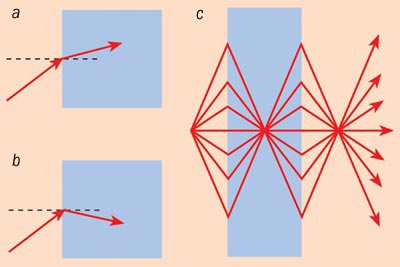
Veselago predicted that certain optical phenomena would be completely reversed in a negative-index material. Perhaps the most striking of these is refraction, in which an electromagnetic wave is bent when it passes through the interface between two different materials. Normally, the wave will emerge on the opposite side of the line that runs perpendicular to the interface (the “surface normal”). However, if one material has a positive index and the other has a negative index, the wave will emerge on the same side of the surface normal as the incident wave.

Focused refraction

Many groups have demonstrated negative refraction in metamaterials, confirming Veselago’s early prediction (see “The reality of negative refraction”). In particular, this initial work has demonstrated the enormous potential for a new generation of lenses, which function, of course, by refracting the rays of incident waves. Negative refraction implies that a converging lens made from negative-index material should have a concave surface rather than a convex one. While this change may not seem profound, a negative-index lens has remarkably different properties from a positive-index lens, stemming from an inherent asymmetry between the two. For instance, air or a vacuum has a refractive index of n = +1, so a piece of material with refractive index n = +1 does not refract rays, and thus cannot form a lens, whereas a material with n = -1 refracts rays strongly.

Recently, Claudio Parazzoli, Robert Greegor and colleagues in the Phantom Works division of Boeing have exploited this asymmetry to produce a plano-concave metamaterial lens with a negative refractive index that has unique advantages over equivalent positive-index lenses (Appl. Phys. Lett. at press). What is intriguing, however, is that the n = -1 material can form a lens without curved surfaces, as hypothesized by Veselago. The trajectory of each ray that leaves a nearby source is exactly reversed as it enters an n = -1 slab, such that all the rays are focused at the centre of the material and then once again outside it (figure 1c). The question is, can a negative-index lens produce an image that has a higher resolution than that of a conventional lens?

Perfect prediction

Unlike the source depicted in figure 1c, a real electromagnetic source has what are called near-field components in addition to the far-field, or propagating, components shown. These quasistatic field components decay with distance from the source, which means that the final image always contains less information than is contained in the source. This diffraction limit – which is associated with all positive-index optical components – means that the best resolution that is possible corresponds to about half of the incident wavelength of the light that is used to produce the image.

In 2000 John Pendry of Imperial College in the UK considered the negative-index planar lens in more detail and reached a remarkable conclusion. He found that in addition to refocusing the far-field propagating components, such a lens could also refocus the near-field components. In order to achieve this, however, the n = -1 lens would need to amplify the near-field components, causing them to grow exponentially within the slab. In principle, such a lens would provide perfect image reconstruction, prompting Pendry to dub the n = -1 slab a “perfect lens”.

Pendry’s prediction proved unsettling for many, and sparked a vigorous debate (see Physics World August 2002 pp8–9). Several researchers drew attention to apparent conflicts with known physical limitations, such as energy conservation or the uncertainty principle. As remarkable as Pendry’s prediction might seem, however, the prospect of a lens that can beat the diffraction limit has survived these challenges.

Negative circuits

As with most negative-index phenomena, the key to producing the near-field refocusing effect is to develop the metamaterial. Intrigued by the prospect of beating the diffraction limit, Anthony Grbic and George Eleftheriades of the University of Toronto have formed an analogous metamaterial based on electrical transmission lines. A standard transmission line consists of repeated cells that contain inductors in series and capacitors in parallel, so that it can support propagating electromagnetic waves with the same dispersion characteristics (i.e. frequency versus wavelength) as a positive-index material.

By reversing the positions of the inductors and the capacitors, the transmission line becomes the analogue of a negative-index medium. Grbic and Eleftheriades created a circuit equivalent to a perfect lens by placing a rectangular negative-index transmission-line between two positive-index transmission lines. With this metamaterial, they have managed to refocus the near-field components of a 1.057 GHz wave (Phys. Rev. Lett. at press).

To demonstrate this, the Toronto team placed an electromagnetic antenna (the source) on one side of the negative-index region and mapped the electromagnetic fields both within the slab and on the other side (the image plane). They found that the recovered image does indeed have a resolution that is better than that which the diffraction limit implies – in agreement with Pendry’s prediction (figure 2). However, the image is still broader than the source, which means it is not perfect. This is due to material losses in the transmission-line metamaterial, which place a limit on how well the near-fields can be recovered; build a better metamaterial, and the resolution will improve.

This latest round of experiments provides strong evidence that negative-index metamaterials have an important future in imaging. Negative-index lenses offer a new degree of flexibility that could lead to more compact lenses with reduced aberration. Furthermore, the remarkable phenomenon of near-field focusing demonstrated by Grbic and Eleftheriades implies that the diffraction limit – which is the most fundamental limitation to image resolution – may, in fact, be circumvented by negative-index materials.

While the results reported so far have demonstrated negative refraction at microwave frequencies, recent experiments and theoretical work suggest that photonic crystals may enable these wonderful effects to be demonstrated at visible wavelengths.


Lasers feel the Z-pinch

In a Z-pinch experiment, a plasma is generated by passing a short pulse of extremely high current – between 1 and 20 MA – in the z direction through a cylindrical array of thin metal wires. The current vaporizes the array and produces a strong magnetic field around the plasma, which compresses it at high velocity in the radial, or r, direction. The density and temperature of this “pinched” plasma are such that it generates total X-ray radiation yields of more than 1MJ.

The currents that power the Z-pinches are produced by large electrical pulsed systems, consisting of gymnasium-sized rooms filled with high-voltage capacitor banks and transmission lines, all immersed in huge tanks of oil and water for insulation purposes (see Physics World May 2003 p6).

Z-pinches driven on a timescale of 100 ns are sometimes referred to as fast Z-pinches. This is because they can create a plasma on a timescale that is quicker than it takes for plasma instabilities to grow, which can reduce the radiated power of the pinch. Now Farhat Beg of the University of California at San Diego, Karl Krushelnick, Bucker Dangor and colleagues at Imperial College, in collaboration with Eugene Clark of the Atomic Weapons Establishment and Peter Norreys of the Rutherford Appleton Laboratory, have produced a fast single-wire Z-pinch that is driven on a timescale of about 100 ps (100 x 10–12 s).

Furthermore, in contrast to conventional means of driving currents using large capacitor banks and low-inductance transmission lines, the team produced a “micro” Z-pinch drive current using a novel and extremely compact method: a high-intensity focused laser (Phys. Rev. Lett. 92 095001).

In the May issue of Physics World Michael E Cuneo at Sandia National Laboratories in Albuquerque in the US describes this work in more detail.

Quantum theory: no problem

The Copenhagen interpretation of quantum mechanics, as laid down by Niels Bohr in the 1930s, has survived intact despite the thousands of experimental tests that have since been performed. Granted, it flies in the face of common sense, stating as it does that you cannot predict with certainty the outcome of any experiment, you can only assign a probability. You cannot simultaneously know the position of a particle and also its velocity. By determining the state of one photon here on Earth, you fix the state of its entangled partner on Alpha Centauri – an action-at-a-distance effect that Einstein called “spooky”.

Yet if Bohr were alive today, he would note with satisfaction that all the developments of 20th-century physics – from the Standard Model of particle physics, superconductivity, quantum computing and teleportation to the inflationary model of Big Bang cosmology – have come about without the need to change his interpretation by one iota.

Consequently, theorists fall into two camps. There are the hand-wringers who constantly worry about the quantum-measurement problem, asking “What does it all mean?”. And then there are the rest of us, who, preferring our angstroms without the angst, have a hard time seeing exactly what the “problem” is. If it ain’t broke, don’t fix it.

It was with some scepticism, therefore, that I learned that superstring theorist Brian Greene – author of the phenomenal best-seller and accompanying TV mini-series The Elegant Universe – was planning a sequel devoted to the interpretational problems of quantum mechanics. Could he fill a book with a non-problem? Would this not just be a potboiler, designed to justify the extravagant royalty advances? Would The Fabric of the Cosmos be much different from The Fabric of Reality by David Deutsch – a book also devoted to quantum measurement?

Well, how wrong can you get? The Fabric of the Cosmos is a profoundly original contribution to popular understanding not just of quantum theory, but of space-time, cosmology, the “arrow of time”, unification and the modern view of physical reality. Greene’s writing skills in explaining abstract ideas in simple terms have, if anything, got even better. His treatment of superstrings, extra dimensions and even more speculative ideas, such as multiple universes and time travel, are all grounded in sound scientific principles.

Greene recalls that his mother – a non-scientist – could read only a few pages of The Elegant Universe before getting a headache, but The Fabric of the Cosmos takes no prisoners in the difficulty of the subject matter it attempts to convey to the layreader. Take Bell’s theorem on hidden variables and the Einstein-Podolsky-Rosen paradox, for example, to which pages 104 to 112 are devoted. These quantum-mechanical conundra are not for the faint-hearted. Yet Greene does not shy away from proving the theorem using “reasoning less sophisticated than working out the odds in a craps game”. Even his mother could work her way through it, although Greene provides a headache-saving opt-out. “Depending on your taste for detail,” he writes, “there may come a point when you just want the punchline. If this happens, feel free to jump to page 112.”

The arrow of time is a theme that is revisited on several occasions throughout the book. Through relativity, quantum mechanics, thermodynamics, black holes, cosmology and an 11D extension of string theory known as “M-theory”, the reader gains an ever more sophisticated take on the basic puzzle: if the laws of nature do not distinguish between past and future, why are eggs seen to break but broken eggs never seen to recombine?

Saying that the universe started out in a state of low entropy takes the problem back to the Big Bang, but hardly provides an explanation. Although Greene makes the case that inflationary models of cosmology may provide the missing logic, this seems to be a paradox the punchline of which cannot yet be jumped to.

And in contrast to some other popular expositions of superstrings, Greene does not promote the now discredited view – advocated by many theorists between the 1984 superstring revolution and the 1995 M-theory revolution – that 10D superstrings are the be-all and end-all of fundamental physics. He concedes that there are no superstrings in 11 space-time dimensions. If you want to go beyond 10 dimensions to 11 – as we now know you must – then you must go beyond string theory to M-theory, which incorporates extended objects such as membranes. While mentioning the important realization that M-theory unifies the five 10D superstrings, previously thought to be distinct, Greene also notes the equally important result that all five theories are incomplete compared with the full explanation offered by M-theory. It is a pity, then, that the doublespeak of an 11D universe composed only of strings was allowed to creep into the blurb on the inside cover.

Other criticisms? Just a few. The grainy black-and-white illustrations hardly do justice to the colourful text. Some names are misspelled, such as Marlin (instead of Marlan) Scully and John Steward (instead of Stewart). And although most non-American readers will be familiar with the TV shows to which Greene appeals to good effect, such as The Simpsons and The X-Files (which, confusingly, introduces a second Scully), some may be baffled by references to Tony Robbins’s seminars and Larry King’s marriages.

However, none of this detracts from one of the most entertaining and thought-provoking popular-science books to have emerged in the last few years. The Elegant Universe was a Pulitzer Prize finalist; The Fabric of the Cosmos deserves to win it.

Tales from the transneptunian sea

Most of the known objects in the far reaches of the solar system – including Pluto – seem to be confined to trajectories with low eccentricities that lie just beyond Neptune. The rest spend most of their time a significant distance away and take several millennia to orbit the Sun.

The principal constituent of these transneptunian objects is undoubtedly ice, and they should be regarded as inactive comets due to their enormous distances from the Sun. Indeed, the Caltech team thinks Sedna, which is named after an Inuit sea goddess, could be a member of the inner Oort cloud – a hypothetical collection of comets orbiting the Sun far beyond the orbit of Pluto (Astrophys. J. at press).

In the May issue of Physics World Brian G Marsden at the Harvard-Smithsonian Center for Astrophysics in Cambridge in Massachusetts in the US describes this latest discovery in more detail.

Copyright © 2026 by IOP Publishing Ltd and individual contributors