Physics goes to Hollywood

Efthimiou points to recent surveys conducted by the National Science Foundation in the US which show that 50% of Americans do not know, for instance, that it takes one year for the Earth to orbit the Sun, or that electrons are smaller than atoms. Even more worrying for Efthimiou is the fact that many non-science students – who need to take a core physics course as part of their degree – say that they find physics too difficult or plain boring.

“All this affected me deeply and I decided to do something,” Efthimiou told PhysicsWeb. “So I came up with the idea of using cinema as a learning tool.” In the course he focuses on fundamental principles using scenes from popular films. For example, he discusses the law of gravitation as used – or misused — in Independence Day, the conservation of momentum in Tango and Cash, and speed and acceleration in Speed 2. Science fiction films might be notorious for breaking the laws of physics, but Efthimiou believes that it is a good exercise for the students to discover this for themselves.

After running the course three times Efthimiou has found that the attitude of the students has changed and that they are more enthusiastic and interested in physics than before. Moreover, examination results have improved, and more and more students are enrolling on the course. Indeed, he is writing a textbook about his approach along with his head of department, Ralph Llewellyn, who also teaches the course.

Other institutions running similar courses include the University of Glamorgan in the UK, which runs a degree course in Science and Science Fiction, and the University of Minnesota-Twin Cities, which offers a course that teaches physics through the exploits of comic-book superheroes such as Spiderman.

Magnetic recording has a speed limit

Magnetic recording relies on using an applied magnetic field to reverse the magnetisation of a piece of magnetic material. The speed at which data can be written depends on how quickly the applied field can reverse the magnetisation of a grain of the material. However, basic physics means that the maximum speed is much lower than previous estimates according to researchers at the Stanford Synchrotron Radiation Laboratory (SSRL), SLAC, the Landau Institute for Theoretical Physics in Russia, and Seagate Technology.

Joachim Stöhr of SSRL and colleagues used the magnetic field associated with ultrashort bunches of high-energy electrons from the two-mile long linear accelerator at Stanford to study how quickly the magnetisation of a grain can be reversed. The pulses have a magnetic field strength of about 10 Tesla and last for just 2 picoseconds (2 x 10-12 seconds).

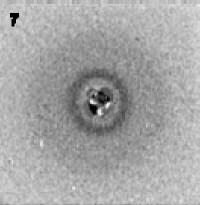
The researchers fired the pulses through different magnetic recording materials and observed the images that were produced. They expected to see well-defined dark and light areas arranged in co-centric rings around the focal point of the pulse beam. These areas would correspond to magnetic grains being magnetised in one of the two possible directions – 1 or 0. However, they only saw diffuse shades of grey (see figure 2).

According to Stöhr and co-workers, this indicates that some grains had switched and others had not. This means that 2 picoseconds is not long enough to allow a bit to be recorded reliably, and this places an upper limit on the recording speed. The team says the data are characteristic of a chaotic system, but such behaviour was only expected to appear with femtosecond (10-15 seconds) pulses. The maximum recording speed is therefore at least a 1000 times slower than previously thought. The result could help physicists understand more about the basic nature of magnetic recording and possibly lead to new types of recording media.

Gravity Probe B takes off

In 1915, Einstein published his general theory of relativity, which showed that mass is caused by the curvature of space-time. The theory was able to explain features in the orbit of Mercury that Newtonian mechanics could not, and its prediction that light from distant stars would bend as it travelled past massive objects like the Sun was confirmed in 1921.

General relativity also predicted that massive bodies such as planets and stars would actually distort the fabric of space and time. This phenomenon – known as the geodetic effect – has already been tested by various experiments, but Gravity Probe B will be the most precise yet. However, Einstein predicted that such massive bodies would also “drag” space-time with them as they rotate. This so-called frame-dragging or Lense-Thirring effect is extremely small and has never been measured before.

Gravity Probe B will use superconducting quantum interference devices (SQUIDs) to measure tiny changes in the orientations of four perfectly-spherical, quartz gyroscopes as the experiment orbits the Earth. The gyroscopes are housed inside a vacuum chamber and will be maintained at 1.8 Kelvin using liquid helium. The probe also includes a telescope that will be trained on a distant “guide star” to provide a reference direction for measurements on the gyroscopes. General relativity predicts that the frame-dragging effect will cause the direction of the gyroscopes to change by a tiny 0.041 of an arc second.

Designing an experiment that can survive a rocket launch and still measure such a miniscule change of direction has posed enormous technical and financial challenges for the GP-B team. The launched has been delayed a number of times and the experiment has come close to being cancelled several times – most recently last year. The project has also gone $130 million over budget since 1999.

Spiders get a grip

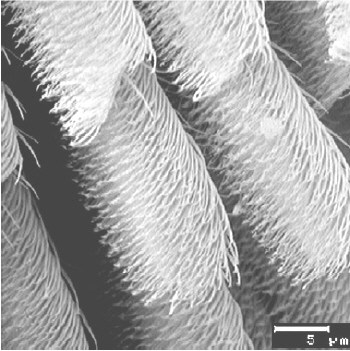
Antonia Kesel at the Institute for Technical Zoology and Bionics in Bremen and colleagues at the University of Zurich used a scanning electron microscope to image the foot of the spider, E. arcuata. This species is a member of the jumping family of spiders (Salticidae) that catches its prey without building a web.

The scientists found that the spider’s legs contain a tuft of hairs, and that each individual hair in the tuft is covered by hundreds of thousands of smaller hairs – called setules – just hundreds of nanometres in width. The spider uses these setules to stick to surfaces (see figure 2).

By using atomic force microscopy, Kesel and co-workers then showed that each setule can produce a force of over 40 nanonewtons. This is extremely high considering that a spider typically has a mass of only about 15 milligrams. According to the Bremen-Zurich group, van der Waals forces between individual molecules – which are only nanometres apart – in the setules are responsible for this adhesive force. These individual forces combine to produce a very strong overall force on each of the spider’s eight feet.

The team calculated that if 600 000 tips are in contact with a surface, a spider can produce a total force of about 0.025 Newtons, which means it could carry 173 times its own body weight. Moreover, the forces are not affected by the environment and this allows the spiders to walk across wet or slippery surfaces.

“One possible application of our research would be to develop Post-it notes based on the van der Waals force, which would stick even if they got wet or greasy,” said Kesel. “You could also imagine astronauts using spacesuits that help them stick to the walls of a spacecraft – just like a spider on a ceiling.”

The spiders’ sticking ability is superior to that of other arthropods (insects and crustaceans), who use a fluid adhesive to attach themselves to a surface. In contrast, E. arcuata’s behaviour is similar to that of geckos.

“We carried out this research to find out how these spiders have evolved to stick to surfaces, and found that it was all down to a microscopic force between molecules. We now hope that this basic research will lead the way to new and innovative technology,” said Kesel.

Fermi gases approach superfluid regime

A colour strip showing the oscillation

Atoms behave very differently at temperatures near absolute zero depending on the value of their intrinsic angular momentum or spin. Bosons have spins with integer values in units of the Planck constant divided by 2π, while fermions have spins of 1/2, 3/2, 5/2 and so on. A molecule made of two fermionic atoms will be a boson because it will have an integer value of spin.

All fermions obey the Pauli exclusion principle, which means that they cannot occupy the same quantum state. However, there are no such restrictions on bosons, so they can all collapse into the same quantum ground state. This process, known as Bose-Einstein condensation (BEC), is at the heart of superconductivity – the flow of electric current without resistance.

Since electrons are fermions they must form Cooper pairs – named after Leon Cooper of the Bardeen-Cooper-Schrieffer (BCS) theory of superconductivity – or strongly bound atom pairs before they can collapse into a Bose condensate. The fermionic condensates produced in these new experiments represent a novel phase – where there is yet no theory – that lies in the crossover between the BCS and BEC regimes.

John Thomas and colleagues at Duke University started by confining a gas of lithium-6 atoms in a magneto-optical trap and then reduced the temperature of the gas by using a technique known as evaporative cooling (J Kinast et al. 2004 Phys. Rev. Lett. 92 150402). When the gas reached 400 nanokelvin they made it vibrate by briefly switching off the optical trap, and then turning it on again.

The gas behaved like a hydrodynamic “jelly” and it continued to oscillate in and out – as one unit – for a long time. According to Thomas, this indicates collective behaviour rather than the independent behaviour shown by individual, non-interacting, atoms. More importantly, the jelly vibrated at precisely the frequency predicted by some theories for a fermionic superfluid.

The Duke team says its experiment provides the most direct ever evidence for superfluidity. Earlier this year, a group at Boulder in the US created a Bose-Einstein condensate from a strongly interacting Fermi gas and studied the pairs of fermions that formed. “That was a good experiment, but it doesn’t establish superfluidity,” said Thomas in a press release. “To have superfluidity you’ve got to observe something like hydrodynamics, like we observed.”

Thomas admits that the work could be criticised because it does not demonstrate a well-defined transition at the point where the gas becomes a superfluid. In contrast, the experiment performed by Rudolf Grimm and colleagues at the University of Innsbruck shows an abrupt change – in the collective excitation frequency – at this crossover point (M Bartenstein et al. 2004 arXiv.org/abs/cond-mat/0403716). The transition is also accompanied by oscillations that last a long time.

“Thomas’ team has reported on interesting experimental findings for which superfluidity could be the only explanation,” Grimm told PhysicsWeb. “However, as for both our experiments, it is difficult to know whether the hydrodynamic behaviour observed is due to simple collisions between atoms in a normal gas phase, or to superfluidity. This is a complicated many-body regime that needs further careful investigation,” he said.

Terahertz radiation targets skin cancer

85% of all cancers lie in the epithelium – that is, on or near the skin – but their small size can make them difficult to detect. Moreover, skin tissue must be surgically removed for analysis, which is both time consuming and invasive.

The technique developed by Emma Pickwell and colleagues at Cambridge University and TeraView could overcome these problems by exploiting the fact that water strongly absorbs radiation at frequencies between 0.1 and 3 terahertz. Since cancerous tissue tends to have a higher water content than healthy tissue, terahertz radiation could be used to differentiate between the two. Furthermore, the team have shown for the first time that terahertz imaging can be used in vivo.

Healthy skin contains about 70% water, so Pickwell and co-workers first developed a computer model that simulated the interaction of terahertz radiation with water. They tested the model by comparing its predictions with the results of tests on 20 healthy volunteers.

By measuring how terahertz pulses were reflected from skin on the forearms and palms of the volunteers, Pickwell and co-workers were able to distinguish between different types of skin, such as dry and normal skin. More importantly, they found that their simulation method was able to successfully model the interaction of terahertz light with normal skin.

“The success of applying the simulation to skin aids the understanding of the interaction of terahertz radiation with biological tissue,” Pickwell told PhysicsWeb. “Exploiting the differences in the response of terahertz light to normal and diseased skin may lead to terahertz imaging being used in hospitals as a clinical tool for identifying regions of cancer.”

Reversal of fortune for Turin Shroud

The Turin Shroud is a piece of linen, some 4.4 metres long and 1.1 metres wide, that contains images of the body and face of a man. The Shroud is believed by many to be the cloth Jesus was wrapped in before being buried. Although the front of the Shroud has been extensively studied, its back has remained hidden beneath another piece of linen, which was sewn on by nuns to cover up damage caused by a fire in 1532. However, this protective layer was removed in 2002, allowing the back of the cloth to be photographed.

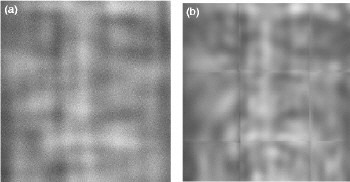
Fanti and Maggiolo have now studied these photographs, together with others taken at various times since the 1930s. Because the images are extremely faint, the duo has used an array of image-processing techniques — including Gaussian filters, Fourier transforms and template matching — to highlight human features.

They found that the face of the man that can be seen on the reverse of the Shroud matches that observed on the front. The image shows faint details of a nose, eyes, hair, beard and moustache (figures 2 and 3). The Italian duo was also able to make out weak images of the man’s hands, but could not produce images of his shoulders or back.

These new findings could help to shed light on the origins of the cloth but are more likely to fuel further debate over it. In 1979, carbon-dating techniques revealed that the Shroud dated from medieval times and therefore could not have been used to bury Christ. However, many scientists have argued that the carbon-dating techniques used to study the Shroud were flawed.

Fanti and Maggiolo are now saying that the Shroud is unlikely to be a fraud because the image of the face is superficial on both sides of the cloth and only involves the topmost fibres of the material. “It is extremely difficult to make a fake with these features,” says Fanti.

Arguing about Einstein’s wife


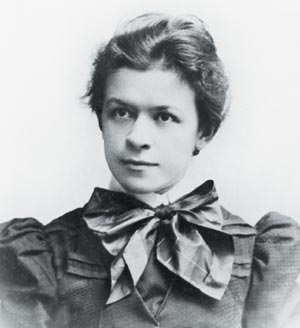
Public-broadcasting television stations across the US recently aired a documentary called Einstein’s Wife. The programme examined the life of Mileva Maric – Einstein’s first wife. There has been speculation about whether she tacitly collaborated on his research into relativity, quantum theory and Brownian motion in his famous papers of 1905.

The documentary is accompanied by an online poll on whether Maric collaborated with Einstein. “Was it really possible for Albert alone to produce all of the phenomenal physics generated during 1905?” the website asks. The site includes material to encourage users to learn about “the scientific accomplishments” of Maric, to compare them with those of Marie Curie, and to speculate on why Maric did not receive any recognition.

This multimedia venture stems from ostensible evidence: allegedly, a physicist once claimed that Maric co-signed the 1905 papers. Early letters suggest a collaboration: one from Albert to Mileva mentions “our work on relative motion”. “Given these facts,” the producers say, “each observer must then decide, on their own, whether or not Einstein robbed Mileva of her due.” As Physics World went to press, 70% of all respondents to the poll believe that Maric had indeed collaborated with Einstein.

Conspiracies and carelessness

An Australian company, Melsa Films, created the documentary. Its producers interviewed various historians of Einstein’s life, including Gerald Holton, Robert Schulmann and John Stachel. They also talked to proponents of Maric. Then they edited these interviews to foster the impression that Einstein and Maric co-created the famous papers.

The facts of the matter, unfortunately, are poorly presented. Many of the claims are misapprehensions, speculations and hearsay. Einstein did not fail his final exams at the ETH Zurich. Neither did he “disregard” Maric’s prospective career. He helped her study and encouraged her repeatedly to complete her degree. Moreover, her existence was no secret and she appears even in early biographies of Einstein.

The documentary and website state “In 1955, a Soviet physicist (now deceased) claimed that he personally saw the original manuscripts and that Mileva’s name appeared as co-author.” They refer to Abram Joffe and reproduce a fragment of a page on which the name “Einstein-Marity” appears in Russian. (Maric used her surname in the form “Marity” when Joffe met her when once seeking Einstein in Switzerland.)

But Joffe made no such claim. What he actually wrote, in an obituary for Einstein in 1955, was “In 1905, three articles appeared in the Annalen der Physik which began three very important branches of 20th-century physics. Those were the theory of Brownian motion, the photon theory of light, and the theory of relativity. The author of these articles, an unknown person at the time, was a bureaucrat at the Patent Office in Bern, Einstein-Marity (Marity – the maiden name of his wife, which by Swiss custom is added to the husband’s family name).”

On this shred of non-evidence, some proponents of Maric have speculated that Joffe subconsciously believed that she was a co-author. This conspiracy theory is buoyed by carelessness. For example, the excerpt shown on television and on the website with the name Einstein-Marity is not even from Joffe’s note, but from that of another writer, Danil Semenovich Danin, who mistakenly paraphrased in 1962 that the papers were “signed” Einstein-Marity. Yet neither writer claimed that Maric had contributed to any papers, nor that they (or anyone) had seen her name on the manuscripts.

Maric’s life included misfortunes. She failed ETH diploma examinations twice. Einstein’s parents antagonized her. Before her marriage she had a baby, apparently given up for adoption. That birth, and then another, greatly weakened Maric. Thus she had reasons to drift away from physics and did not go on to have a career in the field.

Was Maric a victim of intellectual theft? She studied physics at least until 1901. And during those years she worked with Einstein and they shared some projects. The most suggestive bit of evidence is one letter, written in 1901, in which Einstein expressed his hope that the pair would someday complete “our work on relative motion”. Non-specialists might conclude that this statement refers to relativity theory. But it does not. At the time Einstein believed in the existence of the ether. He wanted to devise experiments to test its relative motion – a puzzle that drew the attention of many physicists.

Examining the evidence

So did Maric help Einstein change the direction of his research? All documentary evidence suggests that he did so on his own. He pursued many fruitless attempts to explain the problems of relative motion. After ditching his efforts to detect the ether, he tried to devise a theory in which the speed

of light depends on that of its source. Later, he tried to formulate a theory by modifying that of Hendrik Lorentz. He discussed his evolving ideas not only with Maric, but with friends, professors and co-workers. After 10 years of reflection, he abruptly formulated his special theory of relativity in 1905.

There is just no evidence of any contribution from Maric towards the substantive content of any of Einstein’s papers. Yet the producers of Einstein’s Wife doubt that a single person, Einstein, could have been so prolific. But the hypothesis of a secret and extraordinarily tacit co-worker does not explain the matter. Einstein was just very creative and had an obsessive obstinacy in pursuing and completing his investigations.

Moreover, Maric herself did not claim credit for the work. In late 1906, in a letter to an intimate friend, she commented about Einstein that “the papers he has written are already piling quite high”. As for glib online polls, it is disturbing to think that some people believe that history can be decided by votes. Authority does not decide the past. And neither does ill-informed opinion.


Dark sides and golden ages

Astronomers first started talking about a “golden age” of astrophysics and cosmology in the late 1990s. Half a decade later the golden age is still going strong and shows no sign of ending. The past month has seen an impressive list of new results, including the unveiling of the Hubble Ultra Deep Field and the detection of Abell 1835 IR1916 – a galaxy with a record-breaking redshift of 10. Both of these findings tell us about the very early or very distant universe. Closer to home, meanwhile, space scientists have reported the first direct evidence for water on Mars and what might be the 10th planet in the solar system.

And as the results roll in from existing telescopes and spacecraft, a whole new generation of facilities is ready to join the fray. The Rosetta “comet chaser” took off on 2 March, and at least five other missions are planned for launch later this year: Gravity Probe-B will test various predictions of general relativity; Messenger will orbit Mercury; Double Star will study the Earth’s magnetosphere; Swift will analyse the afterglows of gamma-ray bursts; and Deep Impact will set off for comet Tempel 1. Add in various ground- and balloon-based telescopes and instruments, plus the plans for 2005 and beyond, and you have to ask, where will it end?

Of course, it is not all good news. It looks as if there will be no more missions to service the Hubble Space Telescope (HST) following the introduction of new safety procedures at NASA in the wake of the Columbia accident. Disappointing as the eventual demise of Hubble will be, it is not entirely unexpected. As long ago as June 1999 the then NASA administrator Daniel Goldin warned astronomers that “too many of you are hugging Hubble. HST is not your most important optical telescope today”. Even without Hubble, astronomers will have an extraordinary array of instruments at their disposal.

Ironically, the outstanding questions in the golden age concern the dark side of the universe – what are the “dark matter” and the “dark energy” that cannot be seen but which make themselves known through their gravitational influence? These questions cannot be answered by astronomers alone. Astroparticle physicists have been searching for dark-matter particles in underground laboratories with increasing sensitivity for over a decade, albeit without success, and dedicated experiments to learn more about dark energy – the mysterious energy that is thought to account for almost two-thirds of the universe – are just beginning to take shape.

But dark matter and dark energy are just two puzzles, albeit two extremely difficult and important ones, in a galaxy of questions that still have to be answered. How do planets form? What about stars, galaxies, gamma-ray bursts and ultrahigh-energy cosmic rays? And what can astrophysical measurements tell us about quantum gravity? Answering these questions is sure to guarantee that the golden age continues well into the future.

Multiferroic materials tower up

Magnetic materials are ubiquitous, from the huge transformer cores in electrical power sub-stations to the tiny magnetic particles that are used to store data on our computer disks. The widespread applications of magnets stem from two basic properties. First, they have a spontaneous magnetic moment, which enables magnetic flux to be concentrated in transformers. Second, the orientation of the magnetism can be switched back and forth by an applied magnetic field, and can therefore be used for data storage.

Similarly, ferroelectric materials have a spontaneous electric polarization, the direction of which can be switched with an applied electric field. In fact, the “ferro” part of the name arises because their electrical properties are similar to the magnetic properties of iron-based magnetic materials; most, however, are not ferrous in the sense that they contain iron. Ferroelectrics are used to make capacitors with high dielectric constants, and also have applications in nonvolatile data storage and sonar.

Now, Haimei Zheng of the University of Maryland and colleagues in the US have adopted a different approach, which I believe is much more promising for producing useful magneto-electric multiferroics. Instead of trying to produce a single compound, they grow a closely interwoven composite material from magnetic cobalt ferrite (CoFe2O4) and ferroelectric barium titanate (BaTiO3). To do this, the team used a well established growth technique called pulsed vapour deposition, in which an oxide target containing the correct ratios of barium, titanium, cobalt and iron is bombarded with a laser. This releases atoms from the target that fortuitously self-assemble into nanometre-sized 3D pillars of cobalt ferrite within a barium titanate matrix (H Zheng et al. 2004 Science 303 661).

In the April issue of Physics World Nicola Spaldin from the University of California at Santa Barbara describes this work in more detail

Copyright © 2026 by IOP Publishing Ltd and individual contributors