Nanomechanics weighs in

We tend to associate mass with the quantity or size of an object. At the microscopic scale, however, mass measurements are a powerful tool that can provide information about the molecular and atomic composition of an object. While measurements of macroscopic masses traditionally rely on the fact that the gravitational force is directly proportional to the mass of the object, the Earth’s gravitational field is too weak to produce reliable measurements of the force in the case of molecular-scale objects.

A better way to measure the mass of a microscopic sample is to quantify the sample’s inertia as it is forced into motion. This is the principle behind mass spectroscopy, in which the trajectory of an ionized particle in a strong electromagnetic field provides a precise measure of the particle’s inertia, and therefore a measure of its mass. Mass spectroscopy is able to distinguish ionized particles that differ by a single atomic-mass unit – about 1.66 x 10⁻²⁷kg, or 1.66 yoctograms. However, many researchers have pondered whether a less complex and more versatile measurement technique could be devised that has a similar level of sensitivity.

Harold Craighead and co-workers at Cornell University in the US have now built a mechanical device that suggests such an alternative could eventually be possible. Following the basic idea of placing particles in a strong field, they studied how the inertia of a nanoelectromechanical cantilever changed when it was loaded with small masses. As heavier objects were added the oscillation frequency of the device decreased, which enabled the Cornell team to measure the mass of a particle with a precision of one attogram (10-18 g). This is three orders of magnitude more sensitive than the previous record (R Ilic et al. 2004 J. Appl. Phys. at press).

Mass oscillation

Nanoelectromechanical devices (NEMS) are tiny structures that have mechanical degrees of freedom. They can be batch fabricated in a similar way to electronic chips, and a typical NEMS device used for mass measurements looks a bit like a diving board. This structure resonates at a frequency that is precisely defined by its stiffness, mass and geometry. Any additional mass that is added to the suspended portion of the device tends to slow down this oscillatory motion.

In 1992 researchers at Simon Fraser University in Canada demonstrated for the first time that such resonators can be used to detect masses less than 0.5 ng. Michael Roukes of the California Institute of Technology and co-workers developed NEMS devices further with the goal of detecting masses in the femtogram regime (see “Nanoelectromechanical systems face the future”). These studies showed that the sensitivity of NEMS devices could reach the level of a single atomic-mass unit. Recently Roukes and co-workers also demonstrated attogram-mass sensitivity, although their experiments were performed in an ultrahigh vacuum and at cryogenic temperatures (arXiv.org/abs/cond-mat/0402528).

A useful rule of thumb in the NEMS mass-detection business is that the smallest theoretically detectable mass roughly corresponds to a millionth of the mass of the cantilever. This reflects the fact that the smallest meaningful change in the resonance frequency of a nanomechanical device at room temperature is limited by thermal noise. While predictions of very high sensitivity using nanomechanical resonators have abounded in the literature, experimental NEMS that can operate under “normal” ambient conditions have clearly lagged behind the theory. It appears that approaching the theoretical limit is a very challenging experimental task.

One of the main reasons for this is the difficulty in reading-out the NEMS data. The frequency of nanomechanical resonators is generally determined by reflecting a laser off the resonator. As a result, reading-out the data becomes increasingly complicated as the widths of the resonators become smaller than the wavelength of visible light. While UV lasers with smaller wavelengths could be used, they tend to be less experimentally friendly than visible lasers and much more expensive.

The operation of mass-sensitive NEMS also needs to be optimized, which involves a difficult trade-off between several factors. For instance, thicker and stiffer resonators are less susceptible to thermal noise, but they are also more difficult to read-out because they tend to oscillate with smaller amplitudes and at higher frequencies. Resonators as thin as 50 nm and just several microns wide offer a reasonable compromise between the requirements of mass sensitivity and suitability for an optical read-out.

In 2003 the present authors took all these requirements into account and used a technique called focused ion milling to carve tiny slivers out of much larger commercially available silicon cantilevers (top figure). The result was a number of lightweight resonators that could undergo readily measurable changes in resonance frequency when they were loaded with a few femtograms of an organic material (2003 Appl. Phys. Lett. 82 2697-2699).

New order

Craighead and co-workers have now taken the optimization of NEMS for mass detection to new levels. Using their extensive experience with nanofabrication techniques, and by experimenting with various types of NEMS devices, the Cornell team has managed to improve the limit of mass detection by three orders of magnitude compared with our group’s previous world best. The resonators were made of silicon, were 4 µm long and 0.5 µm wide, and had a suspended mass of less than one nanogram (bottom figure). This allowed the researchers to achieve attogram-mass sensitivity, which is consistent with the rule of thumb of approximately one millionth of the mass of the resonator. Despite this minute mass, the devices were still large enough to accommodate a very convenient optical read-out.

Attogram-sensitive NEMS have immediate applications for novel chemical and biological sensors. Real-time trace analysis of highly hazardous agents, such as toxins, explosives and pathogens, may finally become possible without the need for expensive instrumentation, and this would allow hazardous agents to be detected before dangerous amounts of them accumulate. Such devices could also be used to detect large protein molecules, and to differentiate between individual viruses simply by weighing them. In short, an attogram-sensitive NEMS is an excellent addition to the toolkit of any scientist interested in studying interactions at the level of individual molecules.

To improve the sensitivity of mass-detecting NEMS still further, we will have to rely on even smaller resonators. But Craighead and co-workers have good reason to be optimistic. They have built a variety of NEMS devices with features as small as 20 nm, including the world’s smallest guitar (see Physics World December 2003 p3).

The next milestone in nanoelectromechanical mass detection is achieving zeptogram (10-21 g) sensitivity, which will prove whether nanomechanical mass spectroscopy is feasible. We anticipate this prize will attract even more researchers to join the mass-sensitive NEMS community in the next few years.

Organic growth in spintronics

The first step towards exploiting the spin degree of freedom in electronics was taken in 1988 with the discovery of giant magnetoresistance (GMR) in magnetic multilayered structures.A typical GMR structure consists of a metallic sandwich in which two magnetic layers are separated by a thin, non-magnetic spacer. Mobile electrons near the magnetic layer that have spins parallel to the magnetization are weakly scattered, and can therefore carry current with a low resistance. Electrons that have spins in the antiparallel direction are strongly scattered, which results in a high resistance.

By changing the orientation of one of the magnetic layers with an external magnetic field, such a device behaves as a spin valve: electrons with one spin direction will be let through, while those with opposite spin will be blocked. This means that the electrical resistance of the device can be changed dramatically using a very small magnetic field.

Metallic spin devices like these have been used to store and read information in computer hard disks since 1997. But hybrid devices that combine the magnetic layers with semiconductors could offer a great wealth of possibilities because they can bring together logic, storage and sensor applications in a single chip. Now Jing Shi of the University of Utah and co-workers have found a dramatic GMR effect in spin-valve devices that incorporate organic-semiconductor spacers (Z H Xiong et al. 2004 Nature 427 821).

In the April issue of Physics World Min Ouyang and David D Awschalom at the Center for Spintronics and Quantum Computation at the University of California, Santa Barbara, describe this work in more detail

Quantum gases in optical lattices

Imagine having an artificial substance in which you can control almost all aspects of the underlying periodic structure and the interactions between the atoms that make up this dream material. Such a substance would allow us to explore a whole range of fundamental phenomena that are extremely difficult – or impossible – to study in real materials. It may sound too good to be true, but over the last two years physicists have come extremely close to achieving this goal.

This breakthrough has been made possible by the convergence of two related but previously distinct realms of research in atomic physics: quantum gases and optical lattices. The new-found ability to confine ultracold quantum gases in optical lattices is already having a major impact in fields as diverse as condensed-matter physics and quantum information processing.

An optical lattice is essentially an artificial crystal of light – a periodic intensity pattern that is formed by the interference of two or more laser beams. The simplest optical lattice consists of the region of dark and bright stripes that is formed when two laser beams with the same wavelength travelling in opposite directions meet each other and form an interference pattern. This optical lattice has a period that is equal to half the laser wavelength. With more lasers – and enough care – it is possible to form a perfectly periodic 3D spatial structure. It is more difficult, however, to use these interference patterns to trap atoms.

An optical lattice is able to trap an atom because the electric fields of the lasers induce an electric dipole moment in the atom. The interaction between this dipole moment, which is oscillating, and the electric field of the laser modifies the energy of the atom. If the laser frequency is less than a specific electronic transition frequency within an atom, the atoms are pulled towards the regions of maximum laser intensity. However, if the laser frequency is higher than the transition frequency, the atoms are pushed away from the maxima. Either way the atoms can be trapped in the bright or dark regions of the optical lattice, and the strength of the optical potential confining the atoms can be increased by turning up the laser intensity (see Rolston in further reading).

Confining condensates

While some atomic physicists were experimenting with optical lattices, others were exploring what happens when atoms in magnetic traps are cooled so close to absolute zero that quantum statistics becomes important. The study of quantum gases has been one of the hottest – and coolest – areas of physics research since the first Bose-Einstein condensates were created in 1995, and remains so to this day (see “Fermionic first for condensates”). Over the past two years experimental groups in Europe and the US have learned how to transfer a quantum gas from a magnetic trap to an optical lattice, and this has led to a new generation of remarkable experiments.

The behaviour of a gas at temperatures close to absolute zero depends on whether the atoms in the gas are fermions or bosons. Fermions obey the Pauli exclusion principle, which means that two of them cannot occupy the same quantum state. No such restrictions apply to bosons, which means that large numbers of them can collapse into the same quantum ground state. This process – known as Bose-Einstein condensation – happens when bosonic atoms are cooled such that their de Broglie wavelength becomes comparable with the average distance between them.

In a Bose-Einstein condensate the de Broglie waves of the individual atoms “beat” in the same way, such that all the particles can be described by a single macroscopic wavefunction. Similar to laser radiation, condensates show a high degree of phase coherence. This means that if you know the phase of the matter wave at one point in space and time, you can predict what it will be at other points and times. Phase coherence is crucial for observing interference patterns.

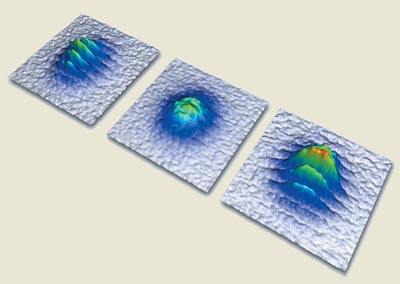
To transfer a Bose condensate from a magnetic trap to an optical lattice, the condensate is illuminated by the six laser beams needed to form a 3D lattice and the laser intensity is increased to the required value over a period of about 100 ms. This “loading” process is computer controlled to ensure perfect reproducibility between different experiments, but it is difficult to prove that the condensate has actually been transferred because the typical spacing between sites in the lattice is too small (about 430 nm) for the atoms to be imaged directly. However, a periodic pattern can show striking interference effects when illuminated with coherent waves, and we can use this approach to check that the condensate has indeed been transferred. We can also turn off the lattice potential and use the diffraction pattern to follow how the atoms on the different lattice sites expand and overlap. Since the wavefunctions in the condensate are phase coherent, an interference pattern builds up as they overlap (figure 1a).

Neutral atoms in optical lattices

In 1998 Peter Zoller of the University of Innsbruck in Austria and co-workers published an influential paper in which they suggested that it should be possible to convert a weakly interacting Bose gas into a Mott insulator – a strongly interacting quantum state – by loading the atoms into an optical lattice (see Jaksch et al. 1998 in further reading). Three years later, Ted Hänsch, the author and co-workers at the Max Planck Institute for Quantum Optics (MPQ) in Garching observed such a transition for the first time (see Greiner et al. in further reading). This publication is currently one of the most cited papers in physics according to the Science Watch newsletter.

But how does this change from a superfluid to an insulator actually come about? The potential depth in the optical lattice is almost always too large for the atoms to overcome the potential barrier between two neighbouring sites. On the other hand, quantum-mechanical tunnelling allows the atoms to spread through the lattice to some degree. In a Bose-Einstein condensate, this tunnelling process dominates the behaviour of the atoms, which causes the system to form a giant matter wave with perfect phase coherence between the matter waves on different lattices sites.

The number of atoms at each lattice site is a crucial factor in determining the properties of the system. If you tried to measure the number of atoms on each lattice site for a Bose-Einstein condensate, you would find that each site is filled with a random number of atoms according to Poisson statistics. In other words, the phase of the coherent matter wave is well defined but the number of atoms fluctuates from site to site. This is not due to technical imperfections, but rather a fundamental uncertainty in macroscopic quantum fields: whenever the phase of the macroscopic field is well defined, the number of atoms fluctuates and vice versa.

Although repulsive interactions between the neutral atoms are usually weak, they can be made to dominate the behaviour of the system by increasing the lattice depth and therefore reducing the amount of tunnelling. Placing two atoms at the same lattice site then becomes extremely costly in terms of energy, and the many-body system therefore tries to avoid doing it.

The best way to achieve this situation is to form a Mott insulator in which each lattice site is occupied by a single atom. The atoms are then isolated from each other, which results in the interaction energy being zero. In a Mott insulator the number of atoms on each lattice site is the same and does not fluctuate. However, this means that the phase coherence between atoms on neighbouring lattice sites has been completely lost, which makes it impossible to observe a matter-wave interference pattern (figure 1b).

In our experiments at MPQ we were able to convert a superfluid Bose-Einstein condensate to a Mott insulator and back again several times by controlling the depth of the optical lattice. One remarkable aspect about this phase transition is that it can occur even at a temperature of absolute zero. A classical system cannot change its configuration at zero temperature because the thermal fluctuations that drive such a transition are absent. For a quantum system, however, intrinsic vacuum fluctuations create a kind of quantum-mechanical “jitter”, which allows the system to change state even at absolute zero. Such quantum phase transitions are currently of great interest in condensed-matter physics and have also been observed in superconductors and quantum spin chains (see “Quantum criticality in metals”).

The quantum gases in our experiments were cooled to almost absolute zero, but they still had some finite temperature, and this allows defects to form in what would otherwise be a perfect Mott insulator. This is relevant to applications of optical lattices in, for example, quantum information: if the Mott insulator is to be used as a quantum register, then it is important that each site in the lattice contains the same number of atoms. We are also trying to find out which experimental parameters change most significantly at the transition to a Mott insulator, with the aim of gaining a more profound understanding of the phase transition itself.

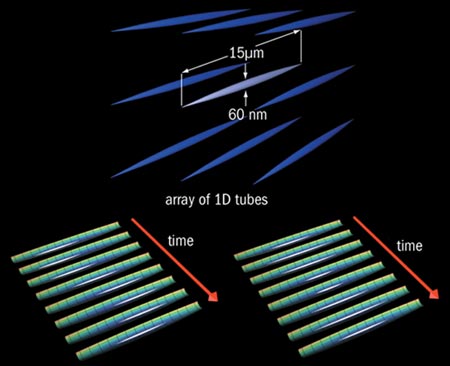
Optical lattices have also been used to investigate various intriguing aspects of 1D quantum gases. The dimensionality of a macroscopic quantum system can have a large impact on its physical behaviour, and it is therefore crucial to understand the role and effects of reduced dimensionality. Until recently, very few clean experimental systems had been developed in which such dimensionality effects could be studied. Now, however, arrays of 1D quantum gases can be produced using 2D optical-lattice potentials. In these gases the atoms are confined in tubes such that their radial motion is completely fixed and they can only move along the axial direction of the tube.

1D quantum gases often behave counterintuitively. For instance, unlike a 3D gas, the interactions between the atoms become stronger as the density of the gas is reduced. Tilman Esslinger and colleagues at the ETH in Zürich have recently demonstrated that 1D quantum gases with extreme aspect ratios (of about 250:1) can indeed be created in the lab. The ETH team has compared the oscillation frequencies of an axial “sloshing” motion, known as the atomic dipole mode, to that of a “breathing” motion of the atomic cloud (figure 2). For a 1D quantum gas one expects the oscillation frequencies of the two modes to have a distinct ratio, which was indeed observed in the experiment (see Moritz et al. in further reading).

Meanwhile, William Phillips and co-workers at NIST in Gaithersburg, US, have studied the initial effects on 1D quantum gases as they become more strongly interacting – a process called fermionization. This striking effect is caused by the repulsive interactions between the particles, which tends to separate the atoms from one other along the axial direction. As a result, atoms cannot be located at the same position in space, which effectively mimics the Pauli exclusion principle. This allows rubidium-87 atoms, which are bosons, to behave in some respects as if they were fermions (see Laburthe Tolra et al. in further reading).

As 1D bosonic quantum gases become even more strongly interacting, it should be possible to enter the regime of a Tonks-Girardeau gas, in which the fermionization is even more pronounced. The detection of such a gas would provide a textbook example of how a system of strongly interacting bosons can essentially be described by a free-fermion picture, and it is currently one of the most challenging goals in the ultracold field.

Quantum simulators

In addition to displaying novel quantum phases of many-body states, Bose-Einstein condensates in optical lattices offer great opportunities for quantum information processing. Atoms in a Mott insulating state can be viewed as a natural quantum register, in which each quantum bit (qubit) is represented by a single atom. The Mott transition can therefore be used to initialize a large set of qubits (up to 100,000) in a single experimental step. The challenge is to construct quantum logic gates between atoms that are trapped on different lattice sites (figure 3).

In 1999 Dieter Jaksch, now at Oxford University, Ignacio Cirac, now at MPQ, Peter Zoller and co-workers suggested an ingenious way to do this (see further reading). They proposed that state-dependent optical potentials could be used to bring neighbouring atoms together on a single lattice site. The idea was that both atoms would undergo a collision that would result in a precisely defined phase shift of the two-particle state. By setting this collisional phase shift equal to π, the system would constitute a quantum phase gate.

You might think that using atomic collisions for the delicate quantum control of two particles is not such a good idea, since collisions usually destroy the fragile coherence properties of quantum objects. However, collisions in the ultracold temperature regime are almost always fully coherent and therefore do not destroy the underlying quantum coherence. In the experiments one exploits the fact that atoms have an internal structure and can therefore exist in different internal states. In our experiments at MPQ these states correspond to different hyperfine states of the atom. To create spin-dependent potentials we use two counter-propagating lasers with polarizations that can be rotated relative to one another in a few microseconds. By exploiting this control over the beams, both internal states of the atom can experience different lattice potentials such that the atoms can be moved relative to one another.

If some atoms in the lattice that are initially in, say, a red internal state are converted into atoms in a blue state, these blue atoms can now be moved relative to the red atoms. Furthermore, they can be brought into contact with other red atoms in the lattice by moving the blue lattice potentials relative to the red lattice potential. By controlling such lattice shifts it is possible to move the atoms over a precisely defined separation and to bring them into contact with very distant neighbouring atoms.

This has allowed an exquisite degree of control over atoms in an optical lattice. For the first time we can completely control the interaction between two atoms that would otherwise never have interacted. Moreover, the periodic structure of the potential that the atoms experience has a powerful “parallelism” built into it: with just a single lattice-shift operation one can bring each atom into contact with its neighbouring atom, thereby forming a powerful quantum-gate array. Such quantum-gate arrays could be highly useful for generating entangled many-body states, which are a fundamental resource for quantum information processing (figure 4).

A major challenge in using optical lattices for quantum information processing is to address single atoms on different lattice sites. This would allow us to read and write information into selected atoms in the same way that an individual bit is used in a classical computer register. Recently Dieter Meschede and co-workers at the University of Bonn in Germany have shown that magnetic fields can be used to select single atoms that are separated by a few lattice sites, although it remains to be seen whether such an advanced level of control can be extended to the quantum register of a Mott insulator.

Phillips and co-workers at NIST are exploring other ways to address single atoms. In one experiment they have loaded atoms into every third site in the lattice by superimposing a so-called superlattice on top of a regular lattice pattern (see figure 5 and Peil et al. in further reading). The increased distance between the atoms should make it possible to use a focused laser to manipulate single atoms. The same team has also changed the spacing of the lattice by controlling the angle under which the laser beams interfere. In such an “accordion lattice” one could quickly change from a small lattice spacing to a large lattice spacing to address the atoms in the lattice.

Ultracold fermions in optical lattices

Spectacular advances in the field of degenerate Fermi gases now offer the possibility of loading ultracold fermionic gases into optical lattices. Last year, for instance, Massimo Inguscio and co-workers at the University of Florence in Italy studied the peculiar transport properties of bosons and fermions in periodic potentials. Here the cold fermionic quantum gas was slightly displaced from the optical trapping potential. The Florence team showed that the non-interacting fermions cannot support a DC current, which is what is expected given their special collisional properties and leads to a pinning of the atoms to their local displaced position. However, by adding a slight admixture of bosonic particles, the fermionic atom cloud relaxed towards the centre of the trap due to collisions between the bosons and the fermions.

Meanwhile, Misha Lukhin and colleagues at Harvard University have pointed out that degenerate Fermi gases in higher-dimensional optical lattices could be used to investigate high-temperature superfluidity. This could shed light on whether or not high-temperature superconductivity is contained within the “Hubbard model” that describes how interacting fermions behave in period potentials.

Unique systems

Ultracold atoms in optical lattices have the potential to impact on a broad range of physics. Not only can they be used as efficient quantum simulators for problems in condensed-matter physics, but it seems that the unique level of control that is available in these systems will also ensure their place in atomic physics and quantum optics. The huge quantum register provided by a Mott insulator, for example, offers unique possibilities for quantum information processing, although we still need to develop ways in which to address single atoms.

Another major challenge remains to engineer new many-body quantum phases, and to combine optical lattices with the recently observed condensation of molecules made from fermionic atom pairs. This special combination could allow us to explore some of the most fundamental many-body systems in condensed-matter physics. Our understanding of and ability to control quantum systems have never been so good.


Praising Alexandrians to excess

In The Forgotten Revolution Lucio Russo makes the extraordinary claim that our entire perception of the history of science from the death of Aristotle in 322 BC to Newton’s Principia is completely wrong. He argues that between 300 BC and 150 BC there was an extraordinary flowering of science, and of what we would today call the scientific method, in the Hellenistic world, centred on Alexandria. This is supposed to have far exceeded anything achieved by the Greeks of the classical period (500-300 BC).

What makes Russo’s thesis hard to prove or disprove is that very little of this later Hellenistic work has survived. According to the author, who is a physicist at the University of Rome Tor Vergata, Roman writers had these original texts but could not understand what they meant. The texts were later lost, and Russo speculates at length about what they might have contained. He then makes a further startling claim that most of the breakthroughs of the Renaissance were primarily due to the possession by Copernicus, Kepler, Galileo and others of these great works, which have regrettably been lost again since then. But although these scientists owed a debt to the Greek past that we know about, to say that they owed everything to texts now lost is pure and unconvincing speculation.

The leading figures in this book are Euclid, Aristarchus, Herophilus, Ctesibus, Archimedes, Eratosthenes, Appolonius, Hipparchus and Poseidonius. Of this group, only the work of Euclid (c.300 BC) survives in any major form, and there can be no disputing that his Elements – together with the Conics of Apollonius and the invention of trigonometry by Hipparchus – represents a monumental achievement of the classical and Hellenistic period. Even Newton was still using Euclidean proofs in Principia, and the Elements were still being taught at school when I was a child. However, these achievements were triumphs of mathematics, rather than science, and Russo relies on a rather unfocused definition of science to allow him to include Euclid in his case.

If we first take Hipparchus, who lived from about 190-120 BC, nothing of any importance survives from his many texts, although we know a great deal about his work from the Almagest of his disciple Ptolemy. As Arthur Berry wrote in 1898, “An immense advance in astronomy was made by Hipparchus, whom all competent critics have agreed to rank far above any other astronomers of the ancient world, and who must stand side by side with the greatest astronomers of all time.” If anything, Russo underestimates the achievements of Hipparchus. For example, the author does not even mention his discovery of the precession of the equinoxes.

Russo’s main interest is instead to show that the Alexandrians had a fully developed theory of the solar system that placed the Sun at the centre, and that most of the ingredients of a theory of gravity – even including an inverse-square law – were in place. Frankly this seems far-fetched.

We know that Aristarchus (c.320-250 BC) proposed a heliocentric view, because this was mentioned by Plutarch and Simplicius in the Roman period and by Seleucis and others during the Middle Ages. However, Aristarchus’s heliocentric world does not seem to have had much impact in the Hellenistic world since Ptolemy scarcely bothers to mention it. Copernicus was, of course, fully aware of Aristarchus’s heliocentric proposal, and probably of Arab commentary on it, but the fully worked-out heliocentric model that he published in De Revolutionibus in 1543 was a remarkable achievement in its own right.

Another important figure of the Hellenistic period is Archimedes, who lived in the third century BC. His work on hydrostatics and on the mechanics of pulleys and levers represent a major advance from the discussions of Aristotle. From Heron’s Mechanica, a book mainly about mechanical toys written in the first century AD, and other sources, Russo weaves a picture of amazing mechanical and hydraulic engineering achievements in the intervening period. Given the many Roman efforts in hydraulic engineering, these achievements are certainly possible, but I would have expected there to be more archaeological artefacts to support this picture, if it were true.

So some elements of Russo’s thesis are not implausible. Others more expert than I will have to comment on how impressive the medical and biological achievements of Herophilus (born c.320 BC) are likely to have been, given that we mainly depend on the reports of the Roman writer Galen four centuries later. What is grating about this book, however, is the need for Russo to denigrate the work of Aristotle and other classical writers, and to belittle the achievements of Roman engineering and Renaissance science, at the altar of glorification of the presumed Alexandrian heyday (see “Was Aristotle the first physicist?”).

When we read Galileo and Newton, we find a new and modern approach to understanding the universe that is absent from anything surviving from the Greek world. Galileo describes his experiments and observations in detail so that anyone can repeat them. Newton gives the full mathematical basis for his theories so that anyone can check the calculations and apply them to other problems. If Newton were influenced by any of the ancient Greeks it was Aristotle, as Russo admits rather perplexedly given that elsewhere he has characterized Aristotle’s work as pretty worthless.

The Forgotten Revolution is full of fascinating detail, and the reconstruction of lost work is ingenious. But caveat emptor. What should have been a splendid hymn to Alexandrian achievement is undermined by the author’s excessive claims of its influence on Renaissance science, and by his underestimation of the importance of the seeds sown by Aristotle and others in the classical period.

Geophysicists turn up the pressure

The Earth’s mantle is usually divided into three parts: the upper mantle, which extends to a depth of about 410 km below the surface; the transition-zone between 410 and 670 km; and the lower mantle, which extends to a depth of 2898 km. Although the mineralogy of the upper mantle and transition-zone are relatively well known, the lower mantle remains a mystery because no samples are available from this region.

To study the lower mantle, geophysicists must probe it remotely using seismic tomography. This technique produces 3D maps of seismic velocities and densities from which the properties of the mantle can be determined. However, such measurements have revealed features in the lowermost mantle that cannot be explained. The best known of these is a seismic discontinuity called the D” discontinuity that is found some 2700 km below the Earth’s surface.

Motohiko Murakami of the Tokyo Institute of Technology and colleagues used X-ray diffraction to analyse artificially synthesised magnesium silicate at pressures up to 134 gigapascals and temperatures up to 2600 kelvin. These conditions correspond to those that are found at the D” discontinuity. They found that the magnesium silicate undergoes a phase transition in which it changes from a distorted cubic structure to a structure that contains stacked octahedral sheets of silicate.

According to Murakami and co-workers, this new “post-perovskite” structure — which is anisotropic and stable at the pressures and temperatures studied — can explain the existence of the D” discontinuity and other features of the lower mantle.

When did stars form?

Alan Heavens, Benjamin Panter and James Dunlop of Edinburgh University and Raul Jimenez of the University of Pennsylvania analysed spectra from the Sloan Digital Sky Survey for the stellar populations of almost 100 000 stars to obtain a complete history of star formation over time. The astronomers built theoretical models of how the galaxy spectra should look and compared them to observations. “It is a bit like fingerprint identification, one looks for the best match,” Jimenez told PhysicsWeb.

Using a computer program called Multiple Optimised Parameter Estimation and Data Compression (MOPED), Jimenez and colleagues were able to compare the observed and predicted spectra of 96 545 galaxies in just four weeks. Without the program such a feat would have taken eight years.

The astronomers calculated that star formation in the universe reached its peak about five billion years ago. It has since declined by around a factor of 10 to its present-day value. Moreover, they found that galaxies with a high mass, which include our Milky Way, formed most of their stars much earlier than galaxies with a lower mass.

“The mass dependence of star-formation history explains why previous surveys showed a much earlier date for star formation, since those studies were only able to examine more massive galaxies,” said Jimenez.

The Pennsylvania-Edinburgh team now plans to look at more spectra and develop better theoretical models. “We need to understand how galaxies got the star formation history we find, we really do not know yet,” he said.

Gravitational-wave detector goes underground

Gravitational waves are ripples in the fabric of space-time that are produced when massive bodies accelerate through space. However, the waves are very weak – even for events as extreme as supernova explosions or collisions between neutron stars and black holes – and are therefore extremely difficult to detect.

Gravitational-wave interferometers are designed to detect these very weak waves by using lasers to monitor the movement of test masses placed at the ends of the perpendicular arms of the interferometer. The arms in LISM are only 20 metres long, which is relatively short compared with the 3 kilometre arms of the VIRGO detector in Italy, and the 4 kilometre arms of the two LIGO detectors in the US.

When a gravitational wave passes through the detector, it causes the distance between the test masses to increase in one direction and decrease in the other. However, the changes caused by any gravitational wave are extremely small – only about 10-21m – so the detector must be very sensitive. But extremely sensitive detectors are easily disturbed by environmental noise – such as seismic motion and temperature variations – in its surroundings.

Now, Shuichi Sato and colleagues at the LISM collaboration have tried to overcome this problem by going underground. Preliminary tests show that, despite its short arms, LISM has a displacement sensitivity comparable to that of the TAMA detector in Japan and GEO600 experiment in Germany.

The collaboration now plans to build another detector, which will contain cryogenic instrumentation to reduce thermal noise effects (T Uchiyama et al. 2004 Class. Quantum Grav. 21 S1161). This new machine will be sensitive enough to compete with LIGO-II – the upgraded version of the US detectors. “If this project is approved by the [Japanese] government, it will be part of an international network of gravitational-wave detectors that will open new eyes on the universe,” Sato told PhysicsWeb.

Physicists move closer to the quantum limit

The uncertainty principle states that we cannot simultaneously know both the position and velocity of a particle with complete certainty. The principle is used to describe the motion of particles at the atomic level, but has thus far not been observed in the behaviour of macroscopic objects. Such behaviour is described by classical physics.

To find out whether or not the uncertainty principle extends up to the macroscopic world, Schwab and colleagues studied the motion of a vibrating mechanical arm made from silicon nitride. At just 8 microns (8×10⁻⁶m) long, the arm is tiny by everyday standards but still macroscopic (having the mass equivalent to 1012 hydrogen atoms).

The researchers positioned the arm about 600 nanometres away from a single-electron transistor – which acts as a motion detector – and coupled the two together via a capacitor. They then applied a voltage to make the arm vibrate and cooled the system down to a few millikelvin. Cooling the system to such low temperatures reduced thermal vibrations close to the point where just “zero-point” quantum fluctuations remain. This zero-point motion results from the uncertainty principle, which prevents the arm from remaining completely at rest.

As the arm moved towards the detector, and then away from it, the amount of current flowing through the transistor changed. By measuring this current, the physicists were able to measure the displacement of the arm with a sensitivity that is only about a factor of 4.3 larger than the amplitude of zero-point fluctuations.

The NSA physicists now plan to increase the sensitivity of the detector and further reduce thermal vibrations in the arm. They also hope to extend their study to larger objects. “These experiments address a deep mystery in physics: where does the quantum world stop and the classical world begin?” Schwab told PhysicsWeb. “Success at manipulating the quantum state of a mechanical device would suggest that there is no boundary and encourage us to pursue even larger objects.”

Schwab says his team would like to exploit the system for quantum computing applications.

Superconducting diamond turns up in Russia

Diamond is usually an electrical insulator and well known for being exceptionally hard. It also conducts heat well and can withstand strong electric fields. These properties make it attractive for electronics applications — especially when doped with charge carriers, such as boron. By reacting boron carbide (B4C) with graphitic carbon at around 8 gigapascals and 2500 kelvin for a few seconds, Sidorov and co-workers were able to create boron-doped diamond . Nuclear magnetic resonance and mass spectrometry revealed that the diamond contained between 2 and 3% boron.

By measuring the electrical resistivity and magnetic susceptibility of the diamond, the Russian physicists calculate that it has a superconducting transition temperature (Tc) of about 4 kelvin. This is the temperature at which the resistance of a superconductor drops to zero. Moreover, the material remains superconducting in magnetic fields of more than 3.5 tesla.

Sidorov and co-workers say their that data are consistent with the Bardeen-Cooper-Schrieffer theory of superconductivity. This theory states that interactions between electrons and vibrations of the crystal lattice — known as phonons — allow electrons to overcome their mutual electrostatic repulsion and bind together to form pairs, leading to superconductivity.

Proving that such samples are superconducting is far from easy and the findings are likely to fuel debate in the diamond community. In particular, the observed behaviour could simply be due to foreign substances percolating in the bulk of the material. Sidorov’s group will now need to conclusively prove that its material is superconducting. It also hopes to unearth superconductivity in other group-IV elements with the diamond structure, such as silicon and germanium.

Claustrophobics breathe sigh of relief at new MRI scanner

Conventional MRI scanners require a patient to lie inside the tight bore of a strong magnetic field of several teslas. The field forces the magnetic moments, or spins, of all the hydrogen nuclei (protons) present in tissue to line up. Pulses of radio waves are then directed at the patient, which disturb the alignment of the spins. When the protons line up again, they emit radio waves that are analysed to reveal the sample’s structural and chemical properties.

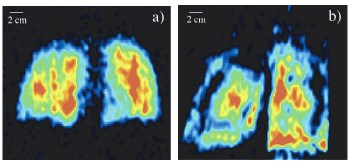
The strength of the signal depends on the amount of water in the tissue being studied. It is thus difficult to get clear images of the lung, which is a relatively dry organ. In recent years, however, a new technique that uses ‘hyperpolarized’ noble gases — such as helium-3 and xenon-129 — has been developed to overcome this problem. These gases — when breathed in by a patient — produce much stronger signal than protons.

Walsworth and colleagues realised that patients who have inhaled spin-polarized gases do not need to be studied with the large magnetic fields of traditional MRI systems. Their new scanner therefore uses much lower magnetic fields of less than 10 milliTesla, which can be arranged around the patient in an ‘open geometry’ (see figure 1). This means that the patient does not have to lie down but can be studied standing up or sitting down, which also allows the lung to be studied in more detail (see figure 2). Patients have to breathe in hyperpolarized helium-3 gas through a plastic tube and a typical scan lasts just 30 seconds.

The team is now building a second-generation system with more homogeneous magnetic fields, which they will use for research on pulmonary physiology and respiratory diseases. “Eventually, portable low-field MRI scanners may be possible,” Walsworth told PhysicsWeb. “These could image the lungs of patients too ill to visit a conventional MRI machine – like premature babies, who often suffer from lung ailments.” The system could also prove useful for patients with pacemakers, who cannot be exposed to the high fields of conventional MRI scanners.

Meanwhile, another US group, led by Alex Pines at the University of California at Berkeley, has discovered a new technique – called remote detection – that has significantly improved the image resolution and sensitivity of MRI (J A Seeley et al. 2004 Journal of Magnetic Resonance 167 282). The technique depends on physically separating the two basic steps of magnetic resonance – signal encoding and detection. The scientists used laser-polarized xenon gas as the medium for ‘memorizing’ the encoded information, which was then carried to a remote detection site. The team improved the image resolution of MRI by several orders of magnitude and also increased the overall sensitivity of the technique.

Copyright © 2026 by IOP Publishing Ltd and individual contributors