

Ultrasound imaging goes supersonic

Ultrasound is best known for providing the first images of unborn babies in the womb but it also widely used in many other medical applications. Most ultrasound machines convert an electrical signal directly into mechanical vibrations through the piezoelectric effect. However, these devices produce longitudinal sound waves and only operate within a narrow range of megahertz frequencies. Shear sound waves – which could provide more information about the object being scanned – cannot be used at these frequencies because they are absorbed by human tissue.
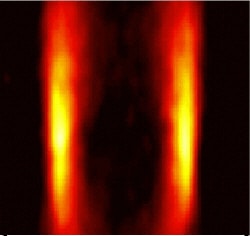

Now, Fink and colleagues have overcome this problem by generating shear sound waves at sonic frequencies. They focus an ultrasound beam in the tissue being studied to create a local vibration that acts as a source of further shear waves. This source can be moved by focusing the original ultrasound wave at different depths in the tissue, and if the source is made to move faster than the speed of shear waves in the tissue, the beam can reach supersonic speeds in just tens of milliseconds. The waves – which initially propagate in a so-called Mach cone – are distorted by any inhomogeneities they encounter in the tissue, and these distortions are analysed to produce an image (see figures).

“Our ultrafast echographic device is the only prototype in the world that is able to generate a supersonic regime and also image the resulting shear waves that propagate in the body,” Fink told PhysicsWeb. “This system is able to compute 5000 ultrasound images per second, which is more than 100 times faster than conventional ultrasound techniques.”

Fink says the technique has already been successfully tested on healthy human breast tissue and could prove useful in diagnosing cancer. His team now plans to test the method on patients with tumours.
Rare kaon decay hints at new physics

K mesons or kaons are unstable and can decay in a number of ways. In one important but very rare decay, a positive kaon – a bound state of an up quark and a strange antiquark — decays into a positive pion plus a neutrino and an antineutrino. The Standard Model predicts that this particular decay should occur only once in every 13 billion decays. However, the decay rate might be influenced by particles and processes that are not included in the model. Therefore, any discrepancies between the predictions of the model and experiment could be evidence for these new particles and processes.

The E949 team uses the AGS accelerator at Brookhaven to produce an intense beam of kaons and a detector that is capable of examining 1.6 million decays every second. In particular, the detector can filter the pion-neutrino-antineutrino event from all the other possible decays that the kaon can undergo.

The new result suggests that the rare event could occur once in every 7 billion decays – almost twice the rate predicted by the Standard Model. It follows two earlier sightings of the decay at Brookhaven in 2002 and 1997.

“It is very important to establish whether these first few events represent a statistical fluke or an important breakthrough,” said Douglas Bryman of the University of British Columbia and a spokesperson for the experiment. “Additional running of the experiment would resolve the issue and firmly establish whether we are seeing an extremely significant departure from standard theory,” he added.

“If our findings continue at the current pace, 20 or more events would be observed,” according to a press release issue by Brookhaven. “Such a result could profoundly alter our current picture of particle physics, forcing an expanded view of the fundamental constituents of the universe and their interactions.” The E949 collaboration includes physicists from Canada, Russia, Japan and the US.

Nano-foam makes magnetic debut

John Giapintzakis of the University of Crete, Andrei Rode of the Australian National University in Canberra and colleagues in Crete, Canberra and the Ioffe Physico-Technical Institute in St Petersburg blasted a high-power ultrafast laser onto an extremely pure glassy carbon target in an argon environment. They collected the carbon nano-foam that was produced in a fused silica tube. According to Giapintzakis the laser facility in Canberra is the only facility in the world capable of making the material.

Using electron microscopy, the team observed that the nano-foam consists of randomly interconnected carbon clusters with average diameters of between 6 to 9 nanometres arranged in a web-like structure. The Greek-Australian-Russian team also found that the nano-foam was semiconducting with a band gap of 0.5 to 0.7 electronvolts. Moreover, freshly produced foam had a strong permanent magnetic moment at room temperature, but this disappeared within a few hours. The material has a Curie temperature – the temperature below which it becomes ferromagnetic – of 90 Kelvin.

The team says that the combination of the narrow band gap and a high Curie temperature could prove useful in spintronics applications. Tiny ferromagnetic clusters of the material could also be injected into blood vessels to improve the quality of magnetic resonance images.

“The novel magnetic behaviour found in this material could also occur in other nanostructured solids,” Giapintzakis told PhysicsWeb. “We have preliminary indications that it occurs in another compound comprised of two non-magnetic elements, boron and nitrogen.” The team now plans to optimise their fabrication technique to create nano-foams whose initial ferromagnetic properties last longer.

Prizes reward cosmologists

The theory of inflation was proposed to explain various observations that could not be accounted for by the highly successful Big Bang theory of the Universe. For instance, how did the structure of the Universe become so uniform over large length scales? Based on ideas from particle physics and working at the Massachusetts Institute of Technology, Guth proposed that the Universe underwent an extremely short period of extremely rapid expansion immediately after the Big Bang. This inflationary period was able to explain the uniformity of the Universe and also solve other puzzles such as the “horizon problem”.

Linde, who is now at Stanford University, developed inflation further to explain the existence of objects such as stars and galaxies in this universe. Recent observations of the cosmic microwave background have agreed with the predictions of inflation and confirmed the Big Bang plus inflation model as the cornerstone of modern cosmology. Guth and Linde will receive their prize, which consists of a gold medal and $200 000, at the Smithsonian Institute in Washington, DC, in June.

Ellis is currently professor of applied mathematics at the University of Cape Town. The Templeton prize is awarded to “encourage and honour those who advance spiritual matters”, and the Templeton Foundation describes Ellis as being “renowned for his bold and innovative contributions to the dialogue between science and religion and [someone] whose social writings were condemned by government ministers in the former apartheid regime of his native South Africa.” Ellis – who plans to donate half of his $1.4 m prize money to charity – will receive the award at Buckingham Palace in May.

Femtosecond lasers aid frequency standards

The work was a joint effort between the National Institute of Standards and Technology (NIST) in the US and the Bureau International des Poids et Mesures (BIPM) in France, along with scientists from East China Normal University (ECNU) in Shanghai and OFS Laboratories in the US.

At present, microwave frequency standards based on atomic transitions have an uncertainty of 1 part in 1015 while optical standards based on single ions are approaching 1 part in 1018. “Such an extremely stable and accurate standard is of little value if its frequency cannot be readily distributed to users and compared to those of other standards based on various atomic species operating at different frequencies,” say the authors.

The team believes that optical synthesisers based on femtosecond lasers can overcome the issues of reproducibility and accessibility. To back up this claim, the researchers compared four optical synthesisers: two made at NIST, one from BIPM and one from ECNU. All four synthesisers rely on a modelocked femtosecond laser to generate a comb of precisely-spaced frequencies.

Having compared the systems on 6 days over a 2 month period, the team suggests that the synthesisers are a reliable tool for optical frequency comparisons with uncertainties approaching 1 part in 1019 (equivalent to about 1 second in 320 billion years).

“Considering the very different designs of these synthesisers – broadband operation versus nonlinear microstructure fibre – it is notable that our data do not point to the existence of any fundamental limitations to the uncertainty,” say the scientists in their paper. “Our results appear to be limited mainly by noise of a technical nature – thermal and mechanical fluctuations – and total integration time.”

Mars Express finds water – official

Early observations of Mars led space scientists to believe that the planet’s North Pole was composed mainly of water ice, while the South Pole contained only frozen carbon dioxide. However, recent missions – like Mars Global Surveyor and Odyssey – suggested that the South Pole might also contain frozen water. But until now, all observations had only ever provided indirect evidence for water.

Different molecules reflect sunlight at different characteristic wavelengths, and the OMEGA imaging spectrometer on Mars Express determines the composition of the planet’s surface by analysing this light in the near-infrared part of the spectrum. Bibring and co-workers identified the spectral fingerprints of water and carbon dioxide ice, and then mapped their distribution on the planet.

They found that the south pole of the planet has three distinct regions that all contain frozen water. The central ‘bright cap’ consists of a mixture of water ice and frozen carbon dioxide surrounded by a second region of almost pure frozen water. Around this – in zones tens of kilometres wide –is an area of ‘dirty’ water ice containing dust particles (see figure).

The OMEGA team hopes to make an inventory of the entire Martian surface in the coming months. The results could improve our understanding of the planet’s climate, and might also answer one of the oldest questions about the red planet: was it ever capable of sustaining life in the past, and could it host life in the future?

Charmed pentaquark appears at DESY

Quarks and antiquarks come in six different flavours – up, down, strange, charm, bottom and top – and normally combine in twos and threes to form other particles. Mesons contain a quark and an antiquark, while baryons contain three quarks or three antiquarks. The proton, for instance, contains two up quarks and a down quark, whereas a negative kaon contains a strange quark and an up antiquark.

Last year, however, evidence emerged for two new particles made of four quarks – the Ds(2317) and the X(3872) – and for a third new particle containing five quarks. This pentaquark contained two up quarks, two down quarks and a strange anti-quark, and led theorists to predict that other pentaquarks containing heavier quarks – such as the charm quark – could exist. Such particles may now have been seen in collisions between protons and electrons at the Hadron-Electron Ring Accelerator (HERA) in Hamburg.

The H1 team at HERA detected events in which the electron-proton collisions produced an excited D– meson (which contains a down quark and a charm antiquark) and a proton, or their antiparticles. When the number of such events is plotted as a function of the collision energy, there is a narrow peak at 3099 MeV. This peak corresponds to the creation of a particle that contains two up quarks, two down quarks and a charm antiquark, or the equivalent antiparticle.

Both the HERA and ZEUS teams plan to do further experiments in an effort to confirm the observation. Experimental measurements of pentaquarks will provide new insights into the strong force that binds quarks together.

DNA detection made easy

Bockelmann and colleagues exploited the fact that most biological molecules are charged in solution by building an array of 100 field-effect transistors (FETs) that were spaced tens of microns apart. Each transistor had an active surface area of tens of microns squared and was covered by a layer of silicon dioxide 10 nanometres thick.

The group placed the biomolecules on the surface of the array and measured the electronic properties of each transistor in the network. DNA molecules produce a negative shift in potential between the source and drain electrodes in the transistors because they are negatively charged in aqueous solution. By measuring the size of this potential shift, it is possible to identify the molecules in the solution.

Bockelmann and co-workers demonstrated the sensitivity of the technique by detecting and identifying a genetic mutation called 35delG that is responsible for hereditary deafness. The detection of specific mutations relies on the use of a polymerase chain reaction to increase the size of the sample.

Single molecules pass doping test

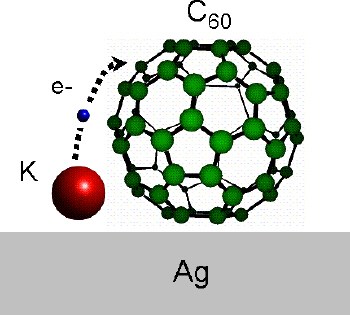
The doping of materials with atoms that accept or donate electrons, and therefore modify the electronic behaviour of the material, plays a crucial role in semiconductor electronics. Crommie and colleagues have now applied this idea to the fullerenes — molecules that consist of 60 carbon atoms arranged in a spherical shell (figure 1).

The Berkeley team used a scanning tunnelling microscope to drag a carbon-60 molecule over a silver surface containing potassium atoms. They found that they could attach an arbitrary number of potassium atoms to a single molecule. Each potassium atom donates a well-defined number of electrons to the molecule and so allows the electronic structure of the resulting potassium-fullerene complex to be controlled (figure 2). The process can be reversed by simply moving the structures back over the surface, where impurities – such as oxygen – can remove the potassium atoms one by one.

“Previously only extended monolayers and bulk crystals of carbon-60 have been modified through alkali metal adsorption,” Crommie told PhysicsWeb. “Our work opens a completely new regime by showing that it is possible to controllably dope a single, isolated molecule. This puts us in the unique position of knowing and controlling precisely how many dopant atoms are attached to a specific molecule.”

The team now hopes to extend its technique to more complex molecules and other dopant atoms. “We expect that our paper will inspire a whole new class of experiments on new and exciting nanostructured systems,” added Crommie.

Looking inside planets

The magnetic fields of the Earth, Jupiter and Saturn resemble the field that would be created by a massive bar magnet located at the centre of the planet and roughly aligned with its spin axis. On Uranus and Neptune, on the other hand, the magnetic poles are tilted away from the spin axes and towards the equators. Moreover, the magnetic fields of these planets seem to be produced by two north and two south poles.

The magnetic field of the earth is generated by convection in a thick fluid shell – made of molten iron and nickel – that surrounds a small, electrically conducting solid inner core. Similarly, the magnetic fields on Jupiter and Saturn are produced by a thick layer of convecting metallic hydrogen that surrounds a small rocky centre.

Stanley and Bloxham have developed a different model for Uranus and Neptune. They suggests that convection in these planets is produced in a thin fluid outer shell – probably made of “ice” containing water, methane, ammonia and hydrogen sulphide – that surrounds a non-convecting fluid interior. The simulation generates magnetic fields similar to those observed on the planets by the Voyager 2 spacecraft in the 1980s. “This shows we can learn about a planet’s interior by studying the morphology of its magnetic field,” Stanley told PhysicsWeb.

Copyright © 2026 by IOP Publishing Ltd and individual contributors