Solid leaves a super signature

Mathematically, it is easy to describe the process of Bose–Einstein condensation for a weakly interacting system of particles, such as an ideal gas. Actually creating such a condensate is more difficult, but this was finally achieved in 1995 for a gas of ultracold rubidium atoms.

Bose–Einstein condensation in the liquid phase has been around for much longer. Superfluidity – the state in which a fluid flows with zero viscosity – was discovered in liquid helium-4 at 2.2 K in the 1930s and in helium-3 at the much lower temperature of 3 mK in 1972. As far as we know, superfluidity is a unique consequence of Bose–Einstein condensation, although condensation does not necessarily produce a superfluid.

The theoretical description of the condensation process in liquids is much more complicated than for an ideal gas because the atoms are strongly interacting. For decades researchers have speculated that Bose–Einstein condensation could also occur in a system of spatially localized atoms – in other words in a solid. Now it seems that such a “supersolid” phase may have been observed in solid helium-4. Eun-Seong Kim and Moses Chan at Pennsylvania State University claim that solid helium-4 can behave as if part of it is a superfluid, even though atoms in the solid are known to be localized in the regular array of a crystalline lattice (Nature 427 225). If confirmed, their results will mean that Bose–Einstein condensation has now been achieved in the gas, liquid and solid phases.

In the March issue of Physics World John Goodkind in the Physics Department at the University of California at San Diego describes this work in more detail.

French researchers put pressure on the government

The researchers left their resignation letters at the research ministry in Paris following a demonstration attended by thousands of scientists at the Town Hall. The demonstrators included directors of research and team leaders at a number of France’s top laboratories, including several physics labs.

The scientists say that research in France is facing a financial crisis because the government has cancelled, frozen or withheld public funds over the last two years. This has led to the loss of 550 permanent junior research positions this year and has resulted in a number of projects being put on hold.

In response to the petition, research minister, Claudie Haigneré has said that the research budget would rise by 3.9% this year. However, researchers are unconvinced and want to see more “concrete” actions. In particular, they would like the 550 research posts to be re-established. The scientists have given the government until March 19 to meet their demands or they threaten to organize another, bigger, demonstration.

Breaking Lorentz symmetry

Imagine you are about to create a universe. How would you do it? As soon as you say “let there be the laws of physics” you would immediately face a problem. Do the same laws hold for everyone in your universe regardless of where they are? Or do the laws change as you move about or face in different directions? Clearly the most equitable and fair way to proceed would be to make the laws of physics the same for all observers. To a physicist such equality and fairness of physical laws is called a symmetry, and the symmetry that requires the laws of physics to be the same for all observers is known as Lorentz symmetry.

Symmetry is one of the most important concepts in physics, and it is closely linked to the conservation of quantities such as energy, momentum and charge. However, symmetry breaking is also incredibly important. The breaking of electroweak symmetry, for example, is responsible for the generation of mass in the Standard Model of particle physics.

It was Einstein who, in 1905, first used Lorentz symmetry to describe the laws of physics in our universe. He took Lorentz symmetry as a postulate of special relativity, whereby he assumed that the laws of physics – including the speed of light in a vacuum – are the same for all inertial observers. An inertial observer is anyone with a system of calibrated clocks and rulers that is at rest in a frame of reference that is not accelerating. Einstein worked out the consequences of Lorentz symmetry and came to the startling conclusion that measurements of length and time intervals are different when they are made by inertial observers moving relative to each other. The extent of this distortion of space and time is described by a set of equations that are now known as Lorentz transformations (see “Lorentz and CPT symmetry” in Further information).

These transformations had actually been discovered the previous year by Hendrik Antoon Lorentz when he was attempting to explain the null results of the Michelson-Morley experiment. Although the context in which he used them turned out to be incorrect (it appears that there is no ether), the equations themselves are the same as those Einstein derived in 1905 to describe transformations in space and time in relativity theory.

Lorentz symmetry has so far withstood the tests of time, but in recent years theorists have begun to question whether it is indeed an exact symmetry of nature. They are motivated primarily by one of the biggest unsolved problems in physics: how can we make gravity compatible with quantum physics (see “Welcome to quantum gravity”.

The leading contender for a theory of quantum gravity is string theory, which replaces point particles by 1D strings or by higher-dimensional objects known as branes. In addition to incorporating gravity in a quantum theory, string theory also attempts to combine the four forces of nature – the strong and weak nuclear forces, electromagnetism and gravity – into one unified theory. A different approach, known as loop quantum gravity, describes the gravitational interaction in terms of variables on a loop. Both of these theories allow for the possibility that Lorentz symmetry might not hold exactly.

The energy scale where gravity meets quantum physics is called the Planck scale. The Planck energy is defined as (h-barc5/G)1/2, where h-bar is Planck’s constant divided by 2π, c is the speed of light and G is Newton’s gravitational constant. The Planck energy is approximately equal to 1019 GeV, which is many orders of magnitude beyond the reach of even the most powerful particle accelerator. Some physicists have therefore concluded that physics at the Planck scale can never be tested. However, as we shall see, this view is short-sighted. A number of recent experiments that test Lorentz symmetry are already sensitive to physics at the Planck scale. Indeed, the search for Lorentz violation has become the main focus of recent work in quantum-gravity phenomenology.

Theory of Lorentz violation

For the past 15 years Alan Kostelecky and co-workers at Indiana University in the US have been pioneering the search for Lorentz violation as a signature of Planck-scale physics (figure 1). Their work has spanned a number of areas that include string theory, gravity theory, quantum field theory, cosmology and phenomenology, and they have uncovered a number of new ways to test Lorentz symmetry. Meanwhile, technological advances have led to an improvement in the sensitivity of experiments looking for Lorentz violation. As a result, several exceptionally accurate Lorentz tests have recently been conducted, and other experiments are currently under way.

To begin to understand Kostelecky’s work on Lorentz violation it is important to realize that there are actually two ways to view Lorentz symmetry. The statement that the laws of physics are the same for all inertial observers is what is known as observer Lorentz invariance. This elegant symmetry simply says that nature’s laws cannot depend on the perspective of an observer: a person on a moving train and a person waiting at a station, for example, obey the same laws of physics. But what happens if the person on the train gets up and starts to walk about? Giving a particle or object a motion with respect to a fixed inertial frame (the train in this case) is called a particle Lorentz transformation.

From the fixed perspective of a moving train, do a seated passenger and a moving passenger experience the same laws of physics? In the absence of Lorentz violation, the answer is yes. The moving passenger simply introduces a third observer frame, and the particle Lorentz transformation and the observer Lorentz transformation are basically the same. However, Kostelecky has shown that these two types of transformation are not equivalent if Lorentz symmetry is violated. In other words, the laws of physics experienced by the moving passenger can be different to those felt by the passenger who remains seated.

To get a better sense of this, imagine you are able to zoom inside a magnet. You would see that it is made of lots of small magnetic dipoles that are all aligned in a particular direction. The definition of observer Lorentz invariance states that a physical interaction cannot depend on how you orient yourself with respect to the magnet. Therefore, the motion of a charged object such as an electron will not depend on whether you stand with the dipoles pointing to your left or with the dipoles pointing straight ahead of you.

However, the force acting on a charged particle that is moving to your left will be different to that acting on a particle that is moving straight ahead of you. This is because the magnetic force depends on the direction of the motion with respect to the magnetic field. In this magnetic example, we say that the particle Lorentz symmetry is broken by the background magnetic field, while the observer Lorentz symmetry is not.

The alignment of a magnet is a classic example of what is called spontaneous symmetry breaking. The interactions of the individual dipoles in a magnet do not depend on any particular direction, and their dynamics are rotationally invariant. For the magnet to form, however, the dipoles must spontaneously align in some direction, which “spontaneously breaks” the rotational symmetry.

In 1989 Kostelecky and Stuart Samuel of the City University of New York showed that string theory allows for Lorentz symmetry to be spontaneously broken in the early universe. If Lorentz symmetry is spontaneously broken, small relic background fields – which are called tensor-valued vacuum expectation values – would permeate the universe and point in spontaneously chosen directions. An elementary particle in the presence of one of these relic fields would then experience interactions that have a preferred direction in space-time. In particular, there could be preferred directions in 3D space in any fixed reference frame, such as an Earth-based laboratory.

At a fundamental level, Lorentz symmetry would still hold dynamically, and all interactions would remain invariant under observer Lorentz transformations. However, the presence of the relic fields would break the particle Lorentz invariance, leading to variations in physical interactions as the motion or orientation of a particle changes with respect to the relic fields.

If Lorentz symmetry is broken by some mechanism originating at the Planck scale, is there any hope of detecting such an effect? Surprisingly, the answer is yes. Over the past decade Kostelecky and co-workers have been exploring how a violation of Lorentz symmetry might provide evidence for new physics arising at the Planck scale. However, rather than smash particles together at high energies to explore this, researchers are turning to ultrahigh-precision experiments at low energies to search for signs that Lorentz symmetry has been broken. The idea is that such low-energy effects are caused by corrections involving inverse powers of the Planck scale.

Possible violations of Lorentz invariance are an ideal signal of new physics because nothing in the Standard Model of particle physics permits the violation of special relativity. Therefore, no conventional process could ever mimic or cover up a genuine signal of Lorentz violation.

Since a viable theory of physics at the Planck scale remains elusive, it is difficult to make precise predictions for the small corrections that could occur due to Lorentz violation. However, we can obtain a rough estimate. The rest-mass energy of the proton, for example, is about 1 GeV, and the ratio of this energy to the Planck scale is about 1 part in 1019. If an experiment with protons is sensitive to effects at or below this level, then it is effectively probing the Planck scale.

Standard Model Extension

To test whether or not Lorentz symmetry is violated it is useful to have a general theoretical framework that incorporates Lorentz violation into the Standard Model. Some 10 years ago Don Colladay, Alan Kostelecky and Robertus Potting at Indiana University worked out such a theory and called it the Standard Model Extension (SME). The SME describes all the particle interactions that maintain observer Lorentz invariance but not particle Lorentz invariance. The theory is also compatible with the Standard Model and any modifications that arise from a more fundamental theory, such as string theory.

Furthermore, the SME contains all the possible interactions that could arise from spontaneous breaking of Lorentz symmetry. In this case the SME coefficients become the constant background fields that permeate the universe and which lead to particle interactions that have preferred directions. This means that the physical properties of a particle, such as its energy and momentum, will change as the motion or spin orientation of the particle changes with respect to the background SME coefficients.

Each type, or “flavour”, of particle in the SME can have different Lorentz-violating interactions. For instance, electrons might have Lorentz-violating interactions, while photons do not. This is analogous to the way in which electrons experience the weak force while photons do not. These interactions also behave differently under the individual space-time symmetries: charge conjugation (C), parity (P) and time reversal (T). Therefore, the SME includes a large number of parameters depending on the species of a particle; its C, P and T properties; and its direction in space and time.

One of the most attractive features of the SME is that it can incorporate the different theoretical ideas involved in different types of experiments. For example, the SME includes terms that break the combined symmetry CPT, as well as terms that preserve CPT. It has recently been shown by Oscar Greenberg at the University of Maryland that any field theory that breaks CPT must also break Lorentz invariance. This means that any theory that contains CPT symmetry breaking and is compatible with the Standard Model must be contained in the SME. Therefore, CPT experiments that compare matter and antimatter can provide tight bounds on Lorentz symmetry that might not be attainable with only matter.

The generality of the SME also makes it an umbrella theory for other theoretical models of Lorentz violation. For example, a phenomenological model formulated in 1949 by Howard Robertson of the California Institute of Technology (and generalized in 1976 by Reza Mansouri and Roman Sexl of the University of Vienna) was based on the notion that a preferred frame of reference exists. A set of Lorentz-violating parameters was introduced, which is often used to analyse velocity-of-light experiments, but it can be shown that these parameters are directly related to a subset of SME parameters.

Similarly, in 1998 a set of Lorentz-violating interactions were used by Sidney Coleman and Sheldon Glashow at Harvard University to show that the apparent observation of cosmic rays above a high-energy threshold might be due to Lorentz violation. These interactions also turn out to be a limiting subset of SME coefficients. Being able to express these results in terms of the SME enables researchers to compare results from different types of experiments. A good illustration of this comes from the possibility of Lorentz breaking in loop quantum gravity, which was investigated by Daniel Sudarsky of the Universidad Nacional de Mexico and co-workers in 2002. They showed that Lorentz tests in atomic and nuclear experiments can provide tight bounds on any modifications to particle propagation with respect to the cosmic background radiation that are due to quantum-gravity effects.

This kind of crossover between the results of astrophysical, high-energy, nuclear and atomic experiments only becomes possible when the measurements are expressed in the common language of the SME.

Testing Lorentz symmetry

In discussing some of the recent experimental tests of Lorentz symmetry it is important to keep in mind that there is no single best test of Lorentz symmetry. This can be troubling for some people because they want to view Lorentz symmetry as a statement about the abstract nature of space and time in the absence of any particles or interactions. However, as relativity teaches us, Lorentz symmetry is really all about measurements, which ultimately must involve the interactions of elementary particles. Furthermore, since it is possible for one type of particle in the Standard Model to have interactions that violate Lorentz symmetry while another type does not, an exhaustive investigation of Lorentz violation involves a large number of experiments in order to probe every particle sector.

The most famous tests of Lorentz symmetry – the Michelson-Morley experiments – use photons. A beam of light is split into two beams that travel at right angles to each other, are reflected by mirrors and then recombined with each other to produce an interference pattern. The pattern that is produced depends on the different lengths of the two paths. Researchers look for a change in this pattern as the interferometer is rotated. This effectively acts as a test of Lorentz symmetry because it is sensitive to any dependence of the speed of light on direction in space. Closely related to Michelson-Morley experiments are Kennedy-Thorndike experiments, which use an interferometer that is held fixed in the laboratory. Here, researchers look for a change in the interference pattern over time due to the Earth’s motion around the Sun. This acts as a test of Lorentz symmetry because it is sensitive to any dependence of the speed of light on velocity.

Modern-day versions of these laboratory experiments with light have recently been performed. The most sensitive of these look for small changes in the resonant frequency of a microwave cavity as it rotates and moves due to the Earth’s orbit around the Sun. In 2003 John Lipa and co-workers at Stanford University compared the resonant frequencies of two orthogonal cryogenic optical resonators over the course of several months. In a similar experiment, Achim Peters and colleagues at Humboldt University in Berlin compared the resonant frequencies of two orthogonal resonators constructed from crystalline sapphire over a period of a year. The signal for Lorentz violation in these experiments would be a difference between the two resonator frequencies that varies with the same periodicity as the Earth’s motion.

In a third experiment, Peter Wolf and co-workers at the Observatoire de Paris compared the frequencies of a sapphire crystal resonator and a hydrogen maser over a period of nearly a year. In this case it is the difference in the sensitivities of the crystal and the hydrogen maser that would provide a Lorentz-violating signal. Together these experiments showed that any violation of Lorentz symmetry must be smaller than 1 part in 1011 for a number of different SME parameters in the photon sector – and smaller than 1 part in 1015 for some of these parameters (see Lipa et al., Muller et al. and Wolf et al. in further reading).

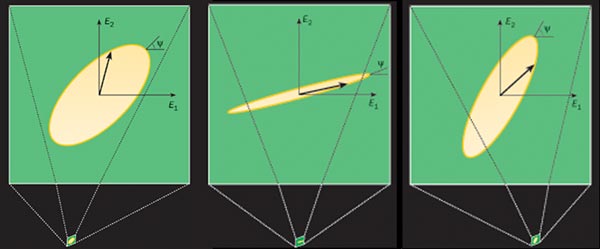
Some alternatives to these laboratory-based experiments – which yield bounds on a different subset of the SME coefficients for the photon – use light from distant astrophysical sources. These experiments have a much higher precision than laboratory-based experiments because the light travels across vast regions of space. The long propagation time can magnify any small differences in the properties of the light – such as its wavelength or polarization – due to Lorentz violation (figure 2).

In 1990 Roman Jackiw of the Massachusetts Institute of Technology and co-workers showed that SME parameters that violated CPT symmetry could be tested with a precision of 1 part in 1042 in measurements of light from distant galaxies. In the CPT-preserving photon sector, on the other hand, a sensitivity of one part in 1032 was obtained by Kostelecky and Matthew Mewes at Indiana. By analysing infrared, visible and ultraviolet light from distant galaxies, they studied a Lorentz-violating effect that causes the polarization of light to change in a way that depends on its wavelength (see Kostelecky and Mewes in further reading).

Atomic precision

When it comes to investigating Lorentz violation in matter, it is atomic physicists who are able to make the most precise measurements. This is because small frequency shifts that depend on the state of a nucleus can be measured with exquisite accuracy in atomic experiments. Resolutions of 1 mHz or better are common, which corresponds to a sensitivity of about one part in 1027 relative to the proton-mass scale. Such accuracy means that these experiments are highly sensitive to small corrections that could originate from the Planck scale.

Signals of Lorentz violation in matter can occur due to the coupling of the atomic constituents – protons, neutrons and electrons – to the background fields in the SME. In particular, the spin orientation of the constituent particles relative to the fixed background fields would vary as the Earth moves, leading to small frequency variations that can be measured.

The current record holder for Lorentz tests with both neutrons and protons is Ronald Walsworth’s group at the Harvard-Smithsonian Center for Astrophysics (figure 1). In one experiment, the frequencies of helium and xenon masers operating within the same cavity are compared. The energy-level corrections in these atoms depend sensitively on how the neutrons within the nuclei are oriented with respect to the background SME coefficients. As the Earth rotates, these orientations change and the small difference between the helium and xenon frequencies would therefore change with time. In 2000 the Harvard team achieved a sensitivity to Lorentz violation of about one part in 1031 for the neutron by monitoring this frequency difference for sidereal time variations, i.e. variations as the Earth moves with respect to the fixed stars (see Bear et al. in further reading). A similar approach is to compare two hyperfine Zeeman transitions in a hydrogen maser, and this has produced a sensitivity of one part in 1027 for the proton.

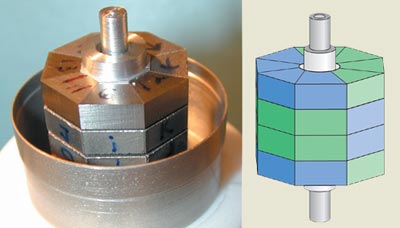
Interestingly, the sharpest bounds on Lorentz violation for the electron do not come from measurements of atomic transitions, but from experiments with a spin-polarized torsion pendulum (figure 3). This remarkable device consists of a torus of alternating magnetic materials that are chosen so that the torus has a huge net spin – 1022 aligned electron spins – yet produces no magnetic field. It can therefore be used to measure anomalous spin couplings without the usual accompanying magnetic-dipole effects. The pendulum is placed on a rotating turntable so that the collective motion of the electron spins with respect to the background SME coefficients induces a small but measurable torque. Eric Adelberger and Blayne Heckel at the University of Washington have reached sensitivities to Lorentz violation for the electron of one part in 1029 using this experiment.

Clocks in space

As spectacular as these sensitivities are for Lorentz violation in ordinary matter – i.e. protons, neutrons and electrons – most of the SME coefficients for these particles escape detection in the experiments. One reason is that experiments looking for sidereal time variations are insensitive to SME coefficients that are aligned along the Earth’s rotation axis. Another reason is that stationary Earth-based experiments do not typically involve Lorentz boost effects, which involve relative motion at a constant velocity. Both these limitations can be overcome by performing clock-comparison experiments in space, and there are plans for a number of missions – ACES, PARCS, RACE and SUMO – that will place atomic clocks on board the International Space Station (ISS). The tilt of the ISS orbit allows all spatial directions to be sampled, and its velocity – orbiting the Earth every 92 minutes – also allows for boost effects to be tested.

A clock-comparison experiment on board the ISS would compare two co-moving atomic clocks that use different atomic species and that therefore have different sensitivities to Lorentz violation. The difference in the clock frequencies would be monitored for time variations corresponding to those of the orbiting spacecraft, which would provide sharp sensitivity to many of the SME coefficients that are currently not tested.

Another important test of Lorentz symmetry is to perform experiments with antimatter. This is because the experiments on matter particles alone typically have sensitivity to a combination of CPT-preserving and CPT-breaking forms of Lorentz violation, while comparisons of particles and antiparticles are directly sensitive to interactions that violate CPT. As a result, high-precision CPT tests with antimatter complement those performed on matter.

A number of such high-precision CPT experiments have been conducted in recent years. These include comparisons of the anomalous magnetic moments of electrons and positrons in Penning traps by Hans Dehmelt’s group at the University of Washington, and proton-antiproton experiments at CERN performed by Gerald Gabrielse of Harvard and co-workers. Experiments are also under way at CERN that intend to make high-precision spectroscopic comparisons of hydrogen and antihydrogen, such as the ATHENA, ATRAP and ASACUSA collaborations (see “The subtle secrets of exotic helium”).

Party on

This brief survey of recent Lorentz tests only lists those experiments involving light, ordinary matter, and antimatter. However, a number of additional experiments – many of which have exceptional sensitivity – are searching for Lorentz and CPT violation using other particles, such as mesons, muons, cosmic rays and neutrinos. Each of these tests provides a broad range of sensitivities for second-generation quarks and leptons in the Standard Model.

One particularly noteworthy result involves the neutrino sector, where recent experiments have shown that neutrinos can oscillate between different flavour states as they propagate. Recently, Kostelecky and Mewes showed that the observed neutrino oscillations can actually be explained by Lorentz violation rather than the neutrino having mass. Proposals have been put forward for experiments that will be able to test the unique signals of Lorentz violation in the neutrino sector.

There is no question that the coming years will remain an active and exciting time for Lorentz symmetry, especially in its role in quantum-gravity phenomenology. Theoretical and technological advances will lead to new tests that will continue to challenge the robustness of this symmetry at all levels.

Throughout the coming year, as physicists gather to celebrate 100 years of Lorentz symmetry, they will commemorate its illustrious history as one of the greatest discoveries of the 20th century. But just as relativity arose out of inconsistencies between Newtonian mechanics and electromagnetism, it could well be that resolving the incompatibility between gravity and quantum theory will lead to an even more elegant theory in which Lorentz symmetry is broken. In this respect, far from spoiling the party, the discovery of a tiny blemish in Lorentz symmetry would instead set the stage for even better parties yet to come.

Further information

Lorentz amd CPT symmetry

Lorentz transformations are continuous transformations consisting of relative motion at constant velocity (boosts) and rotations.

A general Lorentz transformation involves both of these at the same time, which leads to a mixing of space and time intervals, and ultimately to a blurring of the distinction between space and time. What emerges in relativity is a 4D geometry, where the fourth dimension becomes the product of the time, t, multiplied by the speed of light, c (note: ct has units of length). In four dimensions an invariant notion of distance called a space-time interval can be introduced. Lorentz transformations between different co-ordinate frames ensure that the space-time interval and the value of the speed of light are the same for all inertial observers. Crucial to these equations is the Lorentz factor, 1/(1 – v2/c2)1/2, where v is the relative velocity of the frames. A muon that is travelling at 99% of the speed of light, for example, will have a lifetime that is about seven times longer than a muon at rest.

Lorentz symmetry is closely linked to another symmetry called CPT symmetry. CPT is the combined discrete symmetry consisting of interchanging particles and antiparticles (C, or charge conjugation), reflection in space (P, or parity), and reversal of the direction of time (T, or time reversal). While violation of each of the individual transformations C, P or T and the combination CP have been observed in experiments, CPT violation has never been detected. A famous theorem, called the CPT theorem, proved independently by John Bell, Wolfgang Pauli and Gerhardt Luders, states that any Lorentz-invariant field theory describing point particles must be CPT invariant. More recently it has been shown that if CPT is broken in field theory, then Lorentz symmetry must also be broken.


Fermionic first for condensates

Since the first gaseous Bose-Einstein condensate was created in 1995, the field of ultracold matter has developed rapidly. We all knew from the start, however, that the potential for the field would explode if condensates could be made from fermions as well as bosons. For this reason, we were stunned and delighted to learn that Deborah Jin, Cindy Regal and Markus Greiner at the JILA laboratory in the US have created the first fermionic condensate by cooling a gas of potassium atoms to nanokelvin temperatures (Phys. Rev. Lett. 92 040403). Known as “holy grail two” in the ultracold-matter community, fermionic condensates could have an enormous impact on other areas of physics as well.

A Bose-Einstein condensate is a peculiar phase of matter in which all the particles in a system occupy the same quantum state. However, this can only happen if the particles are bosons – particles that have spins of h-bar, 2h-bar and so on, where h-bar is Planck’s constant divided by 2π. Bose-Einstein condensates have been made from several different types of bosonic atoms, such as rubidium and sodium, by cooling the atoms to just above absolute zero.

Atoms like potassium-40, on the other hand, are forbidden by quantum mechanics from occupying the same state because they are fermions – particles with spins of h-bar/2, 3h-bar/2 and so on – and must therefore obey the Pauli exclusion principle. The only way to make a fermionic condensate is to try and persuade the fermionic atoms to form bosonic pairs. The pairing of electrons (which are fermions) to produce a condensate is a crucial feature of superconductivity, so a fermionic condensate would give us crucial insights into the mechanisms behind superconductivity, as well as superfluidity.

The magic technique

To say that making a fermionic condensate is tough is to severely understate the experimental challenges involved. The prospect of achieving it, however, was so exciting that it became the goal of many groups around the world.

The first observation of degenerate Fermi gases was made by Jin and colleagues at JILA – which is run jointly by the University of Colorado at Boulder and the National Institute of Standards and Technology – in 1999. This ultracold result was very encouraging, but it was not quite cold enough. To be precise, it was cold enough for the particles to display the effects of the exclusion principle, as discerned from the shape of the atomic cloud, but not cold enough for the fermions to pair up (see “A Fermi gas of atoms”).

In 1998 Wolfgang Ketterle and co-workers at the Massachusetts Institute of Technology (MIT) had first demonstrated the technique that allows the interactions between ultracold atoms to be controlled, thus making a true fermionic condensate possible. This technique takes advantage of resonant scattering between atoms, and allows the strength of the interactions between the atoms to be tuned with an external magnetic field (see “Quantum gases come of age”). The phenomenon – which is known as a Feshbach resonance – arises when the kinetic energy of a pair of colliding atoms that have one particular spin orientation is close to the kinetic energy corresponding to a quasi-bound pair of atoms with a different spin configuration.

During a collision, the incoming atoms with one spin configuration are coupled to the other configuration, and the pair may or may not form a bound state. It turns out that on one side of the resonance – which corresponds to lower magnetic-field values in the case of potassium-40 – there is a conventional, yet very weakly bound, molecular state. On the other side of the resonance there is no bound state, even though the long-range interaction between the particles is effectively attractive.

It might seem at first that the force between atoms is always attractive at long distances due to van der Waals interactions, but this is not the case. At the very long distances relevant for ultralow-energy encounters, the effective interaction between particles can be attractive or repulsive. The combined effect of such an effective attraction and the presence of other particles is known to produce Bardeen-Cooper-Schrieffer (BCS) pairing, which is the generic mechanism behind superfluidity and superconductivity.

In 2001 theorists, in particular Murray Holland at JILA and Eddy Timmermans at Los Alamos, showed that the Feshbach-resonance technique could be used to observe superfluidity in atomic fermionic systems. This set the stage for a frantic race to produce such a state, which included the groups at the LENS laboratory in Florence, Duke University in North Carolina, the University of Innsbruck, Rice University in Texas and the Ecole Normale Supérieure in Paris, as well as the MIT and JILA teams.

A smoking gun

In 2003 the last five of these groups produced ultracold molecules by causing pairs of fermionic atoms to associate with one another at a Feshbach resonance. The next question was whether these weakly bound molecules could survive long enough for the gas to be cooled down to the temperatures required for Bose-Einstein condensation?

Fortunately, the lifetime of these molecules increases as one approaches a Feshbach resonance, and towards the end of 2003 the JILA, Innsbruck and MIT teams observed Bose-Einstein condensation in molecules. This was a fantastic advance, but little did we know of the excitement ahead: the other side of the resonance, which does not support a bound state for individual pairs of atoms, was still hiding its treasures. On this side, which is explored by applying higher magnetic-field values, long-range pairing between atoms is possible due to the combined effect of interactions and the exclusion principle.

To form the new fermionic condensate, the JILA researchers exploited the Feshbach resonance in two ways in a gas of potassium-40 atoms. First, they tuned the magnetic field to a value corresponding to an effective interparticle attraction, and allowed the gas to equilibrate. Next, they rapidly decreased the value of the magnetic field, sweeping it across the Feshbach resonance to the side that supports a weakly bound molecular state. The magnetic field is spatially constant, so it does not change the speed of the centre-of-mass of an atomic pair. The sweep is also sufficiently rapid to avoid any changes in the overall speed of the atoms due to collisions.

As a result, the initial distribution of the centre-of-mass speeds of the fermionic pairs is the same as the distribution for the molecules after the magnetic sweep. Jin and co-workers then measured this speed distribution and found that it was exactly the type one gets from of a Bose-Einstein condensate. In this way, the JILA result is the “smoking gun” of a fermionic condensate.

One of the most important consequences of the production of a fermionic condensate is that it enables ultracold atoms to be used to study the crossover between conventional superfluidity in the BCS limit and the superfluidity of molecules. This crossover may well be relevant to high-temperature superconductivity. It will also allow us to study strongly interacting many-body systems, such as “Bertsch nuclei” in nuclear physics. With such an exquisite degree of control over ultracold matter, we can also hope that it will ultimately be possible to elucidate the internal structure of the fermionic pairs.

Rich or famous: you choose

“I wish someone would just give us five million dollars and leave us alone.”

Those words were recounted to me by a distinguished scientist at a national laboratory in the US who had a technology that I was helping to commercialize. I replied by explaining that if we did find someone who was willing to give us five million dollars, he (the scientist) should be prepared to give up 80% of his company in return. A discussion followed, he harrumphed a bit, and I tried to explain how venture economics works. Failing to make my point, I concluded the conversation by saying that even if we did find someone prepared to hand over the money, they sure as heck wouldn’t leave us alone.

My consulting work over the past few years has mainly involved helping universities and federal labs to form businesses around their technologies. I have been the “business guy”, working with teams of scientists and academics to develop technologies that may (or may not) have commercial potential. As a result of my interactions, I have uncovered

a number of differences in perspective – cultural issues, if you will – between the way that academics and entrepreneurs think. I have coined the phrase “rich or famous?” to describe the tension that exists between creating a successful commercial product (i.e. being rich) and developing the best possible technology just for the sake of it (i.e. being famous). Let me explain.

Different perspectives

Academics make their reputations based on what they know. They do not “profit” from this knowledge until they publish it and can explain to others how to reproduce their work. Only then is their professional reputation enhanced. Publication success is often a key factor in deciding whether an academic wins research grants or is offered a tenured post at a university. For many academics the recognition they gain by advancing knowledge in their field is sufficient. But they will not see a meaningful financial reward for their work unless it is commercialized, usually by founding a successful business. And, with very few exceptions, successful businesses do not get created unless an academic teams up with an experienced entrepreneur.

Business people and entrepreneurs have very different incentives and perspectives from academics (see figure 1). Business people do not profit from their work until they create something that has commercial value, which often comes from exploiting privileged information. The best entrepreneurs I know are not concerned about getting credit for their ideas – the financial pay-off is reward enough. The typical behaviour of an academic – “Let’s publish!” – is the exact opposite of what one would want if the same technology were developed inside a commercial organization.

However, the pursuit of money by business people is often repugnant to dyed-in-the-wool academics, especially if it requires protecting, and not revealing, information. Filing for patent protection is one way to bridge this gap. Information can then be disseminated and maintained for the exclusive use of the patent holder. Generally, though, patents need to be filed before publication.

The real world

In my experience, the process of starting a business usually throws academics far outside their comfort zone. It is a very unsettling feeling to have the fate of one’s technology put in the hands of someone else. Scientists tell me it is like putting your child up for adoption. This loss of control is a great obstacle to making progress because, to alleviate their anxiety, scientists often make decisions that are counter-productive.

For example, researchers who have already begun the process of commercialization are often reluctant to give up a meaningful slice of their company to their investors or management team, even though wealth can only be created by bringing in new resources and using the talent of other people. Scientists prefer instead to take whichever investment offer dilutes their ownership the least, even if it is unlikely to maximize their earnings in the long run. Having seen this issue cause great harm on several occasions, I currently tell scientists to find a trusted advisor who can help set their expectations appropriately and assure them that they are not being taken advantage of. This is as true for new fields like nanotechnology (see figure 2) as it is for more traditional research areas.

Scientists habitually overvalue their technology because they do not appreciate the time and money needed to turn it into something that can be profitably offered for sale. One of my clients, for example, developed a hardness coating that could extend the life of rotating machinery. The scientists had developed a prototype that they had tested in the laboratory, which performed wonderfully for three weeks. Sensing a purchase order was right round the corner, they formed a business to commercialize the technology.

But when my firm got involved to help craft a business strategy, write a business plan and raise venture capital, we discovered that – according to industry practice – such coatings have to be subjected to extended wear-testing for at least 2.5 years before they are even allowed to be sold. That is over 160 times longer than the original lab tests – and at the time our client did not even have the foggiest notion of what it would cost to produce.

People build businesses

We often ask our clients if they are governed by the laws of gas dynamics or the laws of competitive dynamics. By assembling a great team of people you can often give yourself a competitive advantage in the marketplace. But if your technology strategy depends on violating the laws of nature, you have got a big problem.

I remember once talking to my high-school physics teacher, who had been a leading educator in our district for decades.

“Don’t you get tired teaching physics?” I asked him one day.

“I don’t teach physics,” he replied. “I teach students.”

The same wisdom applies to securing financing for start-ups: investors do not fund technologies, they fund people. That is possibly the most important point to take away from this article. The corollary is that companies do not bring technologies to market, they bring products to market.

If you form a company, the business will take on the priorities and goals of the people who put in the money, not the people who contribute the technology. As Kenneth Suslick, a chemistry professor at the University of Illinois at Urbana-Champaign and founder of ChemSensing Inc, says “Control equals capital. If you want capital, then you must yield control. Academicians, alas, are control freaks.”

How mature your technology is will be reflected in the valuation you receive from your investors. That is how the merits of technology are calibrated. While it is almost always better to have patents than not to have them, the existence of patents does not necessarily make a business. Patents tend to be positioned on the low end of the valuation scale, much to the disappointment of the scientists, particularly if much development work lies ahead or if the markets for the technology are not yet mature.

In all of the companies that I have seen become successful, the venture capital arrived with the management team, not the technology. But even outstanding management teams need a technology platform on which to build.The scientists need management, and vice versa.

Working together

So are scientists capable of abandoning their natural tendencies to publish and instead become filthy rich? Can entrepreneurs build great businesses while being honourable stewards of the underlying technology? Yes, but both sides need to understand each other’s motives and recognize the contributions that each party brings to the table.

Scientists who fancy themselves as business people often make elementary mistakes such as evaluating investment offers based on the highest valuation. Similarly, business people who alienate the technical team are also in for trouble – because technology obviously dominates the early days of a business, long before it has any power in the market. So both parties need one another.

Scientists who found companies can be both rich and famous, but having one’s cake and eating it requires working with the business team empowered to run the company. Without good two-way communication, an already challenging endeavour becomes nearly impossible. If you do take the plunge, keep the following points in mind.
i) Entrepreneurs and scientists need to understand each other’s motives and incentives;
ii) venture capital arrives with the management team, not the technology;
iii) scientists need trusted advisors;
iv) you can be famous but not rich, but if you are rich enough, you will be famous;
v) nothing rewards scientists like having their technology become ubiquitous;
vi) scientific exploration with an eye toward commercialization is permissible;
vii) giving away information helps no one;
viii) communication is paramount;
xi) without a profit motive, nothing will get manufactured, and there is no wealth creation until something is sold.

Superconducting duo

Superconductivity was first discovered in CeCu2Si2 in 1979 by Frank Steglich, who now leads the Dresden group. His discovery ignited research into the physics of “heavy fermion” metals, which are a class of alloys that usually involve cerium or uranium. At low temperatures these metals have bizarre properties that would be expected if their electrons were tens or hundreds of times heavier than they are in free space.

Heavy-fermion metals are typically found near the boundary between a magnetically ordered state and a non-magnetic state, and at first the mystery of CeCu2Si2 was that superconductivity was appearing in a metal with strong magnetic signatures. In all of the superconductors known at the time, magnetism and superconductivity were mortal enemies, so CeCu2Si2 seemed to violate a fundamental property of superconductivity.

Further heavy-fermion metals were subsequently discovered, and it emerged that superconductivity is actually a rare phenomenon in these systems. However, a magnetic metal can become a superconductor when it is exposed to high pressure, which can reduce the critical temperature at which magnetic ordering occurs to absolute zero. Around such a “quantum critical point”, superconductivity has been seen over a small range of pressures in a few heavy-fermion metals.

In CeCu2Si2, however, the superconductivity can survive pressures of more than 5GPa above the magnetic quantum critical point, and actually gets stronger as the pressure is increased, showing a distinct peak at about 4GPa . The mystery of CeCu2Si2 therefore gradually evolved from being a question of why sperconductivity exists so close to a magnetic state, to a question of why it survives so far away from it. Indeed, the robustness of the superconductivity was seen by some as evidence that magnetism never supports superconductivity in heavy-fermion metals.

Huiqui Yuan and co-workers at Dresden have now deliberately weakened the superconductivity of CeCu2Si2 by substituting small concentrations of germanium for silicon, and found that the broad superconducting region described above resolves into two separate features. Each of these has the appearance of a superconducting dome that is associated with a quantum critical point, which strongly suggests that there is not just one but two quantum critical points in the phase diagram of CeCu2Si2 (Science 302 2104). Meanwhile, Alex Holmes and colleagues in Geneva have found key signatures of quantum-critical behaviour in the normal (i.e. non-superconducting) phase of CeCu2Si2, which again points to the existence of a second quantum critical point (Phys. Rev. B69 024508).

In the March issue of Physics World Stephen Julian at the Cavendish Lab at the University of Cambridge in the UK describes this work in more detail.

Time for big decisions


A decision on ITER had been expected last December and again last month, but deadlock prevailed – as it has before. A decade ago the EU, Japan and US were unable to decide where to locate the ITER engineering-design activities, with the result that the work was split between Garching, Naka and La Jolla. There has been talk of something similar happening again – such as the tokamak and the control room being on different sites – but such a compromise should not be repeated.

A more meaningful consolation prize would be hosting IFMIF – an accelerator-based neutron source that will be used to check if materials are suitable for use in a fusion reactor. However, plans for IFMIF are still at an early stage, so it may not be available as the silver medal in the fusion Olympics. Logic dictates that ITER should be located an existing fusion lab, such as Cadarache, rather than at a green-field site like Rokkasho, but logic does not always prevail in such situations.

The ILC and ITER decisions are linked in that Japan is unlikely to be able to afford both – especially as it is already spending $1.5bn on the J-PARC accelerator complex. The US is not in the running to host ITER, even though the fusion experiment is the Department of Energy’s (DOE) top near-term priority in its 20 year plan for new facilities. However, the US would like to host the linear collider, which is the highest mid-term priority for the DOE. This might explain American support for Japan as the site for ITER, although the US could also be extracting revenge for French opposition to the war in Iraq.

Once the ITER and ILC decisions have been taken, there is still an impressive array of other projects in physics and astronomy waiting to be funded. The German government, for instance, has promised to pay 75% of the cost of a new accelerator for nuclear physics in Darmstadt and 50% of a free-electron laser in Hamburg, but is expecting other European countries to fund the rest. In the US, meanwhile, most of the 28 projects in the DOE’s 20 year plan are physics-based, although many are upgrades to existing facilities. Astronomers are also working on plans for telescopes with diameters of 30 m and larger.

Not all of these projects will be funded – and that is how it should be. It is essential that there are always more good projects than there are funds available, and that only the best ones get built – and get built in the best place.

Revolving around Léon Foucault

William Tobin has written a biography of Léon Foucault, whom time and science forgot. The fact that Foucault has been overlooked is obvious from the book’s subtitle and the defensive preface. Clearly Tobin thought it necessary to inform the reader of Foucault’s major scientific accomplishment, namely his proof that the Earth rotates. He also makes a convincing case that Foucault and the scientific world in which he worked mattered. However, the book is far less satisfactory or convincing as a biography.

Divided chronologically into 17 chapters with four appendices, this handsomely illustrated book takes the reader inside the faction-ridden, status-conscious world of international science in the mid-19th century. Born in Paris in 1819, Jean-Bernard-Léon Foucault grew up there and in Nantes. He began – but did not complete – medical training and instead started using photography for astronomy. He later experimented with the electric arc light. During the mid-1840s Foucault worked as a scientific reporter for the respected Journal des Débats, where his interests shifted from the technological and the medical to the more scientific. He received his doctorate in 1850 from the University of Paris for devising experiments debunking the corpuscular theory of the emission of light.

The next brief phase of Foucault’s career was when he explored the movement of the Earth; this proved to be the most productive period in terms of recognized contributions to science. Tobin briefly traces Foucault’s 1851 experiments to demonstrate the Earth’s motion using pendulums and then delineates the spread of “pendulum mania” across the world. In 1852 Foucault successfully perfected the gyroscope to confirm the Earth’s rotation.

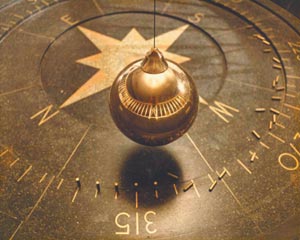
As a scientific spectacle, the pendulum strongly affects anyone who has witnessed one in motion (see “Seeing our own world rotate” by Robert P Crease Physics World July 2003 p16). Indeed, the image of this experiment became the centrepiece of Umberto Eco’s 1990 best-seller Foucault’s Pendulum.

The rest of Foucault’s career was one of solid accomplishment but no other major breakthroughs. Like so many other scientists of the time, he was held back by his mediocre mathematical skills. Foucault’s insights came instead from his expertise at figuring out experimental or technological means of illustrating a scientific problem; his best science was almost always applied.

In the aftermath of his work on the pendulum and the gyroscope, Foucault found – through the patronage of Emperor Napoleon III – official employment as physicist for the Paris Observatory in 1855 and the Bureau of Longitudes in 1862. Three years later he was elected to the Academy of Sciences. This era saw Foucault experiment with induction coils, circuit-breakers, heliostats, governors for steam engines and the design of large-scale telescopes. He also made an excellent approximation of the speed of light. Foucault died prematurely in 1868, aged 48.

Tobin, who is an astronomer at the University of Canterbury in New Zealand, has extensive experience of working in (and directing) observatories. This background as a professional scientist – rather than a biographer or historian – has its strengths and weaknesses as far as this book is concerned. Judged as a work of popular physics, Tobin does an admirable job, clearly explaining in a lively style many relatively complex processes, concepts and gadgets. Professional historians will, however, be troubled by his use of sources, particularly his willingness to take contemporary comments at face value. The author frequently uses phrases like “Foucault must have felt…” or “we can sense that…” to fill in the gaps in his evidence. Numerous errors of historical fact, especially in the early chapters, also do not inspire confidence in his non-scientific judgments.

The major problem with this book is that the reader does not really get a sense of the man behind the science that fascinates Tobin so deeply. We learn that Foucault was independent-minded, prickly, bad at mathematics, and emotionally and mentally fragile.

He liked the company of women, enjoyed drinking coffee, “probably did not smoke”, and made many more friends than enemies. But lurking beneath these broad judgments and statements of fact, the essence of the individual does not emerge from this book.

The trouble seems to be fragmentary documentation rather than any negligence on the part of the author. Still, the lack of personal touches and intimate thoughts – in an era in which most biographies are rife with them – is extraordinary. On those occasions where the links between personality and science can be drawn (page 129), the narrative is greatly enriched. It is worth noting that Tobin himself is fully aware of this flaw (pages 278-283).

Tobin’s account is most successful in its depiction of mid-19th-century science and its growing professionalization. There are long and detailed descriptions of all sorts of experiments and the development of various mechanical devices of greater or lesser importance. The narrative is clear and usually free of jargon. Readers will not need much prior scientific knowledge to follow the text. But without more editorial guidance – or an in-depth understanding of the development of the history of science and technology in this period – it is hard to separate the wheat from the chaff in Tobin’s exuberance for his subject.

For those without this background, some of the depictions of outmoded procedures and instruments can be more than a little dry. Evoking a scientific world that no longer exists is a difficult task, and Tobin has succeeded well at it. Making us care about an individual and how his life exemplifies an era – while placing that individual’s accomplishments in a wider context – are different missions that await another swing of the pendulum or perhaps a further spin of the gyroscope.

Photonic-crystal lasers light up

Now researchers in the US have brought the dream of all-optical circuits a little closer. Raffaele Colombelli of Bell Labs and co-workers at the California Institute of Technology and Harvard University have developed a new type of light source by combining a quantum cascade laser with a photonic crystal (Science 302 1374).

The team used lithography to etch an array of holes in the semiconductor laser, which allowed the spectral and spatial properties of the output radiation to be controlled. The marriage of these two devices could form miniature chemical sensors for medical or environmental applications.

In the March issue of Physics World Jerome Faist at the Institute of Physics in the University of Neuchatel in Switzerland describes this work in more detail.

Carbon nanotubes go magnetic

It is widely believed that graphite and other forms of carbon can have ferromagnetic properties, but the effects are so weak that physicists are not sure if the magnetism is due to tiny amounts of iron-rich impurities, or if it is an intrinsic property of the carbon. In 2002 Coey’s group measured the magnetic properties of a meteorite sample and found that only two-thirds of the magnetization could be accounted for by magnetic minerals present in the sample. The rest, they argued, must come from the carbon. In particular, they proposed that ferromagnetic nanocrystals in the sample induced a magnetic moment in the carbon via proximity effects.

Subsequent theoretical work by Mauro Ferreira and Stefano Sanvito showed that a measurable magnetic moment could be produced in carbon nanostructures if they were placed close to a ferromagnetic surface. Now, the team has confirmed these predictions in experiments with multi-walled carbon nanotubes that have been shown to be free from magnetic impurities.

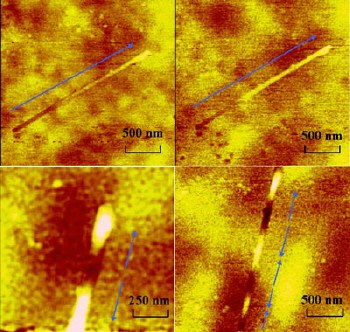
Coey says that the main challenge in his experiment was to measure the tiny magnetic moment of the nanotubes over the large background magnetic moment coming from the magnetic material. To overcome this, the team placed the nanotubes onto ferromagnetic substrates that had been uniformly magnetized in one direction. This ensured that no stray fields were produced by the substrate. However, the nanotubes did produce a sizeable stray field when placed on the surface, and the Dublin team was able to measure this with a magnetic force microscope. Moreover, nanotubes placed on non-magnetic substrates, such as silicon or gold, showed no magnetization.

The group calculated the average room temperature magnetization in the nanotubes to be 0.1 Bohr magnetons per carbon atom. By comparison, the figure for iron is 2.2. “This work opens new avenues for magneto-electronics,” Coey told PhysicsWeb. “For instance, one can foresee devices where the magnetic and electrical contacts are separated. The magnetic contact could be used to magnetically polarize the nanotubes – and to manipulate the spins – while the non-magnetic contacts are used as current/voltage electrodes.”

Copyright © 2026 by IOP Publishing Ltd and individual contributors