For the last 200 years the bulk of our energy has come from the burning of fossil fuels. However, this finite reserve is running out, and the only way to meet the world’s increasing energy demands is to develop alternative energy sources, such as renewable energy, nuclear fission and nuclear fusion. Fusion is the least developed of these but it has the potential to provide a virtually inexhaustible source of energy. It is also safer than fission, and would produce no “greenhouse gasses” such as carbon dioxide. A fusion reactor burning just 1 kg of fuel per day could produce a sustained power output of 1 GW.
The idea behind controlled fusion is to use magnetic fields to confine a high-temperature plasma of deuterium and tritium. One way to do this is to use a tokamak – a doughnut-shaped vessel in which a strong, helical magnetic field guides the charged particles around it (see Further reading). The nuclei in the plasma undergo fusion reactions that convert some of their rest mass into energy – in the same way that energy is produced by the Sun. In order to overcome the mutual Coulomb repulsion experienced by the two nuclei, the plasma temperature, T, must be extremely high – typically about 10 keV, which corresponds to almost 108K. However, the density of the plasma, n, can be relatively low at about 1020 m-3. The resulting pressure in the plasma is therefore only about one atmosphere.
Although a fusion reactor will use the deuterium-tritium reaction, for operational convenience most current experiments are based on plasmas that contain only deuterium. However, we do have experience of working with deuterium-tritium fuel mixtures from the Tokamak Fusion Test Reactor (TFTR) experiment at Princeton in the US and the Joint European Torus (JET) at Culham in the UK. In the mid-1990s the TFTR produced a peak fusion power of 10.7 MW, while JET – which is the world’s largest tokamak – reached 16 MW.
The next big step in fusion research will be the International Thermonuclear Experimental Reactor (ITER), which is designed to produce up to 500 MW of fusion power. The ITER collaboration – which consists of researchers from Canada, China, Europe, Japan, South Korea, Russia and the US – is currently negotiating where ITER will be built. Although ITER will not be used to generate electricity, it will allow us to explore the plasma conditions in a fusion reactor. A commercial fusion reactor would be only slightly larger than ITER and would produce a power of about 4 GW.
When a deuterium and a tritium nucleus undergo fusion they produce an alpha particle, a neutron and 17 MeV of energy. The aim is to use the energy of alpha particles to maintain the plasma at a steady temperature, thus allowing the reactions to be self-sustaining and leaving the neutrons – which carry 80% of the fusion energy – to boil water and drive steam turbines. For this “ignition” condition to be met, however, the triple product of the plasma density, plasma temperature and the energy confinement time – nTτE– must be greater than 3 x 10²¹ keV m-3s. The energy confinement time, τE, is the characteristic time that it takes for the plasma to cool once the heating is switched off; a typical value for a fusion reactor is a few seconds.
This triple product, which is used to describe the performance of a reactor, has increased by almost four orders of magnitude since the first generation of tokamaks in the late 1960s. It is a little-known fact that this progress is slightly faster than that in other high-technology fields (figure 1). For example, the energy of particle accelerators has doubled every 3 years, and the number of transistors that we can fit on a piece of silicon has doubled every 2 years (Moore’s law). The performance of fusion plasmas, on the other hand, has doubled every 1.8 years.
Superconducting tokamaks
Most current fusion experiments run in a “pulsed” mode that lasts a few tens of seconds, but a fusion reactor needs to be able to operate continuously. The pulse length in these experiments is limited by the magnetic-field coils, which are usually made of copper and therefore consume a lot of electrical energy just to maintain the steady magnetic fields. A fusion reactor will use superconducting coils and will therefore be able to operate continuously with very low power consumption. Superconducting-coil technology has been used in several deuterium-deuterium plasma experiments, including the T7 and T15 experiments in Russia (T7 has been rebuilt as HT7 in China), and the TRIAM-1M tokamak and Large Helical Device (LHD) in Japan.
The Tore Supra tokamak at Cadarache in France is the largest operating superconducting device in the world, with a radius of 2.4 m and a toroidal magnetic field of 4 T. The superconducting magnets of Tore Supra, which are cooled by superfluid helium at a temperature of 1.8 K, have performed reliably for 16 years. Indeed, their innovative technology has formed the basis for the cryogenic systems of the CEBAF particle accelerator in the US and the Large Hadron Collider currently being built at CERN.
Almost all the fusion devices that are either planned or under construction rely on superconducting-coil technology, including Europe’s Wendelstein 7-X (W7-X), China’s HT7-U (now renamed EAST), Japan’s JT60-SC, South Korea’s KSTAR and India’s SST-1. When it comes online in 2015, ITER will be the first large superconducting facility that has the capacity to use deuterium-tritium plasmas under reactor-like conditions. The challenge between now and then is to learn how to control fusion plasmas for longer periods with a view to full, steady-state operation.
A plasma in a tokamak is initially heated by its own plasma current, which is induced by the primary transformer. But the heating power that can be drawn from this inductive source is limited because it depends on the resistivity of the plasma, which decreases as the temperature rises. In order to obtain the temperatures required for fusion we need to use external heating methods. A non-inductive plasma-current drive is also necessary for a fusion reactor to operate continuously, rather than in short pulses, otherwise the plasma duration is limited by the capacity of the primary transformer. Heating and current-drive methods have been successfully demonstrated using neutral-beam injection, in which high-energy beams of deuterium or tritium ions are injected into the plasma, and radio-frequency (RF) heating, in which the plasma is subjected to radio waves at resonant plasma frequencies.
Fortunately, a tokamak has a natural current known as the “bootstrap” current, which is driven by the pressure gradient in the plasma. A fusion reactor is likely to rely heavily on the bootstrap current, along with neutral-beam injection and RF heating.
Recent results have greatly improved our understanding of the role played by the plasma current in both stabilizing the plasma and confining its energy. In earlier tokamaks most of the current was driven inductively and the current distribution was determined by the resistivity, and therefore the temperature, of the plasma. By modifying the current distribution non-inductively we can reach regimes in which energy losses are reduced and confinement time is increased. The heating and current-drive systems for ITER require a pulse duration of at least 1000 s, and a vigorous R&D programme is under way to develop suitable systems.
Powerful negative-ion sources for neutral-beam injection have already helped researchers reach the long-pulse target. A beam of deuterium ions with a current of 80 A m-2 – which were then neutralized in a gas cell so that they could penetrate far into a dense plasma – has been produced for 1000 s at Cadarache. In addition, RF power generators developed by Thales Electron Devices for W7-X have produced a power of about 0.3 MW for almost 22 minutes while operating at 140 GHz.
Keeping components cool
A further limiting factor for plasma duration is the need for the “plasma-facing components” (PFCs) to withstand very high fluxes of particles. These components include the exhaust systems, the vacuum-vessel walls, and the heating and current-drive antennae. The average power flux in a reactor might be about 1 MW m-2, but the load is not uniformly distributed and some PFCs could receive a flux 10 or 20 times larger than this value. This corresponds to a surface temperature of thousands of degrees, which would cause serious damage to the machine.
In fusion experiments, however, the problems of heat removal are simplified when the plasma duration is of the same order as the thermal time constant of the PFCs (typically a few tens of seconds). Most current machines can therefore rely on inertial cooling – in other words the components are simply allowed to heat up adiabatically and then cooled slowly between pulses. A fusion reactor, on the other hand, will have to run under steady-state conditions, and will therefore need active cooling systems that can maintain the PFCs at a stable temperature. A prototype plasma-facing component for ITER has already been tested to withstand 2000 cycles at a power flux of 20 MW m-2, which is almost one quarter of the heat flux on the surface of the Sun. But going from hi-tech prototypes like this to large-scale production presents a formidable industrial challenge.
During a recent upgrade, all the internal plasma-facing components in Tore Supra were replaced with ones that are actively cooled with water (see Garin et al. in further reading). A major part of this work was the installation of a “toroidal limiter” that has a heat-exhaust capability of up to 15 MW at a peak power flux of about 10 MW m-2. The limiter is a continuous belt around the torus that is in contact with the plasma and is made up of 574 individually cooled elements called fingers (see box: “How a tokamak works”). The device had to be installed with a positional accuracy of about 1 mm to ensure an even distribution of the heat load. ITER will use an internal component called a divertor to handle similar fluxes of heat and particles.
Developing the limiter involved close co-operation with industry. Each of the 574 elementary components is armoured with 21 tiles made of a carbon-fibre composite, which are bonded to a water-cooled heat sink made of a chromium-zirconium-copper alloy (see Schlosser et al. in further reading). Such was the complexity of the components that it took four years to manufacture them.
Tore Supra’s cryostat – which contains the superconducting-magnet system – was also upgraded with small poloidal limiters called bumpers to cope with transient loads at the beginning and end of the plasma discharge. In addition, a set of 10 actively cooled neutralizers were installed below the toroidal limiter. These devices intercept the particles coming from the region between the plasma and the walls, and then neutralize them before directing them into pumping ducts. The peak heat flux on these neutralizers can reach 15 MW m-2. The surface temperatures of the PFCs at Tore Supra are now monitored by actively cooled infrared endoscopes.
Steady-state operation
Tore Supra is now able to provide new information on long-pulse operation that will be relevant for a fusion reactor. Deuterium plasmas with durations of up to 390 s have recently been obtained with the machine, corresponding to a world record for injected energy of 1.1 GJ – four times higher than its previous record in 1996. The pulse length is mostly limited by the radio-frequency power emitters (or klystrons), which were only intended to operate for about a minute at a time. These klystrons will be replaced by devices designed to operate for a duration of 1000 s, which are currently being tested.
The world record for pulse duration is held by the TRIAM-1M tokamak in Japan, which ran for more than three hours. However, the machine performed with an injected energy of only 110 MJ and at a very low current, temperature and density. Real-time feedback control of plasmas has also been demonstrated in Tore Supra over a period of more than three minutes in steady-state conditions, where the plasma current was completely replaced by a non-inductive current driven by RF waves. This control has allowed researchers to constrain the relevant plasma parameters – such as current and density – to follow the optimum path towards steady-state operation. Real-time control will be essential for ITER.
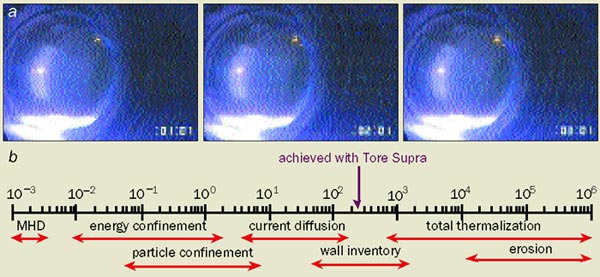
One advantage of using the actively cooled PFCs is that their surface temperature remains fairly stable, as well as low. At Tore Supra the cooled elements remained at a temperature of 320 °C during 3 MW of plasma heating for four minutes, which meant that the density of the plasma was perfectly controlled (see figure 2a). This is one of the crucial issues for a fusion reactor, in sharp contrast to inertially cooled PFCs in which the plasma density often increases over time and hinders tokamak performance. Actively cooled PFCs also allow us to control impurities such as oxygen, carbon and metallic ions in the plasma, which dilute the main ion-plasma density and therefore the fusion reaction rate.
New physics
The complex interplay between physics and technology can only be seen in discharges with a long duration. Events in fusion plasmas take place on many different timescales, from milliseconds for the magneto-hydrodynamic (MHD) instabilities to several hours for the whole device to reach equilibrium (figure 2b). In between these timescales, the energy and particles in the plasma are transported over a period of seconds, while the plasma current reaches a steady-state distribution in a few tens of seconds. Most fusion experiments have a plasma duration time that is long enough to study MHD instabilities, and many also allow the various energy-transport processes to be studied. But only a few tokamaks have pulses that are long enough for the plasma current to reach a steady-state distribution.
Subtle effects can also occur because fusion plasma physics is complex and highly nonlinear. This means that a small change in the profiles of key plasma quantities, such as the density, temperature and current, can have a significant impact on the stability of the plasma and its energy confinement. Furthermore, current tokamaks cannot fully study the interactions between the plasma and the in-vessel components, such as the erosion of plasma-facing surfaces and hydrogen saturation. For example, when plasma-facing components get hot they release deuterium and other materials that enter the plasma and become ionized. This can cause undesirable effects such as increasing the plasma density and enhancing energy losses through plasma radiation.
As discussed earlier, full steady-state operation in a tokamak requires that the inductive plasma current is completely replaced by a non-inductive one. In other words, the toroidal electric field induced by the primary transformer must be made to vanish. At Tore Supra we have successfully achieved this, and discovered many important physics issues along the way. For example, an anomalous inward flux of particles that is responsible for the peaked radial profile of the plasma density has been seen for the first time. Such “peaking” is important because the fusion rate is proportional to the square of the density. Furthermore, a density profile that is strongly peaked helps to increase the bootstrap current, which will form an important component of the non-inductive current required for steady-state operation. The origin of this inward particle flux is still not fully understood, but the Tore Supra results suggest that it is related to turbulence in the plasma (see Garbet et al. in further reading). Particle transport is a subject of the utmost importance in fusion plasma physics, and it is now being studied in many other laboratories.
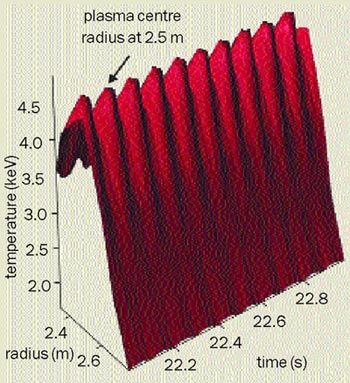
There were more surprises when the electron temperature was measured at the centre of the plasma during a long-pulse run (figure 3). The temperature of a very narrow central region was observed to oscillate in a sinusoidal manner for over two minutes. These oscillations – which were present with a variety of different current-drive combinations – cannot be explained by MHD instabilities. Computer simulations indicate that they might be caused by a nonlinear predator-prey interaction between the local heat transport and the current-density profile.
Furthermore, some plasma numbers did not add up. By carefully accounting for the particles injected into the machine and for those exhausted in the pumping system we found a deficit, indicating that a large fraction of deuterium gets trapped in the walls and components inside the torus. Carbon plasma-facing components are able to trap deuterium particles by different mechanisms, but the direct implantation of energetic deuterium ions does not explain the large retention observed since this mechanism should eventually saturate.
It could be that complex chemical reactions coming from the erosion and subsequent redeposition of material in the PFCs are involved. A vital clue to this was the observation of deposited carbon layers and carbon flakes in the machine. Plasma-wall interactions such as these have far-reaching implications for next-step devices, especially for the lifetime of PFCs due to carbon erosion or the build up of tritium in the walls. We need long-pulse operation to investigate such long-timescale issues. The next major challenge for the fusion community is to integrate various fields of physics and technology to produce a steady-state fusion plasma. The performance of the plasma could be further improved by suppressing turbulence in the plasma to improve the energy-confinement properties. Tokamaks with such an improved energy confinement would be smaller and could therefore significantly reduce the cost of a commercial reactor. The physics of fully non-inductive current plasmas – relevant for fusion reactors – is being studied intensively in current tokamak devices.
A rich harvest of new results is expected from several major projects around the world, especially from ITER and also from further upgrades to Tore Supra. This will open the way to the science and engineering of future fusion power plants. The next major challenge for the Tore Supra team, for example, will be to upgrade the heating and current-drive systems in order to operate at a higher injected power of 19 MW for 1000 s.
After several decades of research, we are confident that fusion energy is scientifically feasible. Plasma conditions that are very close to those required in a fusion reactor are now routinely reached in experiments. ITER will be the next major step forward. Its primary role will be to demonstrate a fusion power gain – i.e. the ratio of the fusion power produced to the power used to heat the plasma – of 10 for very long periods of time. ITER will also bring together all the necessary physics and technology required to build a fusion reactor. While it is under construction, however, many other issues will continue to be addressed in smaller-scale experiments that can operate with very long pulses.
Developing fusion as a viable, clean and unlimited energy source has taken a long time – much longer than early researchers envisaged – but the next few decades will see the realization of their dream.
Box: How a tokamak works
The main challenge in fusion is to create a self-sustaining reaction in which deuterium and tritium nuclei undergo fusion and release useful energy. One way to achieve this is to use magnetic fields to confine a hot plasma in a torus-shaped vessel called a tokamak. The strongest field (typically about 5 T) points in the direction that goes “the long way” round the torus and is called the toroidal magnetic field (red lines). This field is generated by external coils. The second component of the magnetic field points “the short way” round the torus and is called the poloidal field (green). This is typically less than 1 T and is generated by an electric current flowing through the plasma in the toroidal direction. The combination of these two fields creates a helix that twists round the torus (blue). Additional, weaker magnetic fields are used to control the shape and position of the plasma.
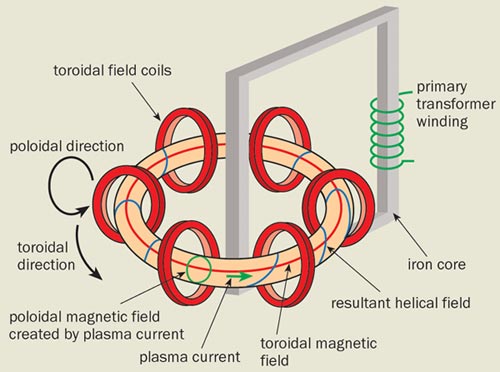
The plasma current, which is typically several mega-amps, is usually driven by a toroidal electric field induced by a transformer. Most of the available flux from this arrangement is used in configuring the magnetic fields, and in driving the plasma current in the early stages when the plasma is cold and resistive. Thereafter, relatively little flux is consumed in maintaining a steady current in a highly conducting hot plasma. This allows tokamaks to be driven inductively for long pulses – up to 1000 s for a fusion reactor. However, the current could be maintained indefinitely using non-inductive plasma currents. The current also heats the plasma by resistive (or ohmic) heating, but the maximum temperature that can be reached is too low to enable fusion to take place. A fusion reactor will be self-sustained by internal heating from alpha particles that are produced in the deuterium-tritium reaction. However, it will require some external heating and current-drive systems for start-up and plasma control. Various heating and current-drive methods, such as radio-frequency heating and neutral-beam injection, have allowed experimental tokamaks to achieve temperatures well above the fusion requirement.