Creating better seats of learning

Let’s try a test. If I were to tell you that this article is about academic-staff development, would you: (a) laugh and move on; (b) initiate a group discussion on the decline of physics; (c) read on, but only after checking that no-one is watching; or (d) look forward to an opportunity to talk about how to reform teaching? I suspect that few academic physicists would answer (d). Why the negativity? Is it because we think of staff development as something that is done to us (usually at great length) rather than something we do for ourselves?

Let me put it differently: this article is about developing the teaching of physics and about how we can communicate the “tingle factor” of physics to a larger number of potential students. That ought to be important to us. But the impression I get is that teaching is often considered to be easy, even though much of it proves to be ineffective. If we continue to believe that poor learning is all the fault of the students, then we do ourselves – and physics – no favours.

Developing new approaches

Of course, teaching is fairly easy if one has like-minded students. Academics are physicists in the same way that musicians are musicians; for those students who are like our former selves there is very little teaching to be done. But about half of all physics graduates are not going to become professional physicists. We need them not just for the money that their tuition fees contribute to departmental budgets, but also for the skills they will bring to industry, commerce and perhaps even school teaching. Our students therefore need to graduate with something more than an in-depth understanding of why physics was not for them.

We face two enormous problems. First, the cohort of school-leavers going into university physics is constantly changing as a result of the increasing diversity of higher education. And second, the knowledge and ability of those who do come into physics is more variable than in the past. Physics is no longer the main attraction for mathematically talented students, who now often go into economics or computer science. Moreover, the physics that they experience at school bears little relation to the subject that their university teachers studied.

Does this matter? The honest answer is that no-one knows. Intuitively, mastering physics is like acquiring a language, which becomes increasingly difficult the longer it is delayed. However, we do not actually know how students acquire a physical picture of the world in which, for example, Newtonian mechanics becomes the first natural language and the naive Aristotelian view – that a force is required to maintain velocity – fades to a distant memory.

Some education researchers, notably in the US, have devised ways of splitting physics into logical morsels that can be parcelled out in the correct order to students. Like putting atoms together, a meaningful structure somehow emerges at a higher level. This could well be the way (or at least one way) to acquire a proper world-view, and it may be that recent changes to UK A-level physics syllabuses – which emphasize concepts and applications – is a similar step in the right direction (“Back to the future”).

The only thing that is certain is that we are faced with a very different challenge today to ensure that we have enough physics graduates in the future. I do not want to exaggerate here, but I would point out that, although fortunately no physicists were implicated, the decline of Roman civilization began with its failure to educate its citizens to the professional classes.

Changing courses

Despite the infuriating belief in some circles that physics at universities is immune from developments in teaching and learning, physics departments have, in fact, been among the leaders of change in many institutions. There are two strands to this reform, which one might label as “developments within physics” and “developments of physics”.

To give some examples from within physics, all undergraduate physics programmes that I know of at UK universities now include some group work as a way of developing presentation and communication skills as well as team problem solving. There is a growing use of project work to encourage independent learning and make students more employable. There have also been big efforts in computer-assisted learning and in the use of simulations to generate understanding where pure mathematics might too often fail. Moreover, heroic efforts have been made to improve students’ mathematical skills – including extensive tests, software and remedial classes – rather than to “dumb down” the content of such courses. Staff are also beginning to develop so-called virtual learning environments as something more than a repository for lecture notes. Other novelties include the use of drama and asking students to lecture on a particular topic for no longer than a minute.

These, however, are mainly insertions into the traditional lecture programme. A more systematic way of making physics interesting – and at the same time improving students’ employability – is problem-based learning (PBL). Having been used for almost 40 years in undergraduate medicine in North America, Australia and more recently in Europe, it is now seen as a trendy, but potentially useful, approach in other disciplines, particularly in engineering. PBL has so far not been used extensively in university physics courses, with the exception of the University of Delaware in the US, where it has been adopted across the institution. The Dublin Institute of Technology in Ireland is another notable exception; here the PBL approach to physics has been extended to the whole curriculum up to second-level courses (first-year undergraduate level in Britain). Meanwhile, physics departments that are members of the Problem-Based Learning in Astronomy and Physics project – led by the University of Leicester – are fostering PBL with support from the Higher Education Funding Council for England.

As for reforms that come under the banner “developments of physics”, I am thinking primarily of the Institute of Physics’ inquiry into university physics, chaired by Sir Peter Williams (Physics World October 2001 p5). It suggested a role for a more interdisciplinary degree that would, at least in the initial years, be less dependent on mathematical skills. Certainly, giving students three years to master the necessary mathematical skills – rather than convincing them in the first term that they are not able to do so – might be a good thing for both students and staff. But the important point about interdisciplinarity is that, for the students who are not going to be theoretical particle physicists or the like, interdisciplinary research is where most of today’s interesting physics lies. By embedding physics in an interdisciplinary mantle, we do not just tell students that physics is important, we show them.

The i-Science Centre at Leicester (where the “i” stands for interdisciplinary or integrated) will be one of the first to mount such a degree programme and will endeavour to foster the development of i-science elsewhere. A related, context-based approach to physics, in which the emphasis is on themes such as “energy” and “the environment”, has been proposed by the Department for Educational Studies at the University of York. Such work is a natural development of other integrated approaches to science teaching in schools and will, in the longer term, be a natural route through science education for an increasing number of students. It represents an alternative and possibly more fruitful approach to the increasing lack of relevant mathematical preparedness of new physics students.

Of course, no institution is going to take materials from a rival programme – however good – and simply duplicate them. If academic staff are to be committed to – and enthusiastic about – new forms of teaching, they need to have prepared and devised

the relevant teaching materials themselves. “Ownership” is all important. Nevertheless, exchanging information about teaching developments is still vital to prevent others from reinventing the wheel. If teaching is to develop through new approaches to physics – rather than through simple revisions to existing programmes – then academic staff need to become actively involved in the process.

Broadening the appeal

So how can further improvement be fostered within the wider community? Unfortunately, teaching development carries a low esteem relative to “real” research, even though enabling the next generation of students to fulfil their full potential is so important. One reason is structural. Teaching developments are often ghettoized and die when the person who champions them retires. As one astronomer royal once put it to me, research is an indelible contribution to the development of science even when it turns out to be completely wrong, whereas teaching is ephemeral if it is not embedded beyond the grave (or, happily in most cases, beyond early retirement).

But there is another simple reason for the low esteem of teaching: high-status activities are generally regarded as those that bring in “overheads” to a university department, whereas teaching development costs money and leaves staff with less time for research. Various attempts to address this problem through prizes and development grants do not address directly the comparability with research. One simple solution could be to provide individual academic staff (and teams of staff) with grants to develop teaching, perhaps based on applied research into higher education. Such grants should, ideally, contribute an overhead to the university. They should also have the same status as research grants, particularly as far as the UK’s Research Assessment Exercise is concerned.

From later this year the new Higher Education Academy will integrate the roles of the Learning and Teaching Support Networks and the Higher Education Institute for Learning and Teaching in the UK. These have played a modest role in providing funding for teaching. Perhaps the academy can expand this provision but on a much larger scale, and perhaps then you would read an article on teaching development – in the hope of seeking major funding opportunities to do such work for yourself.

New dimensions in education


Another complication arises because physics is just one of a large and growing number of subjects that are taught at schools and universities. This becomes important when trying to solve specific problems, such as the shortage of schoolteachers who have physics degrees. Physicists who are fans of markets would argue that this shortage means that physics teachers should be paid more money. Some governments are already offering financial incentives to new teachers of science and mathematics, but head teachers will be all too aware of the dangers of divisive splits in the staff room.

Perhaps any discussion of physics education should start with a question: why should we teach science or physics to anyone? There are many answers to this question. One response is that science and technology are becoming ever more important in the world, which means that it is essential for all citizens to be able to make informed decisions. The hard-headed business answer is that modern economies will only be successful if they have workforces with strong science and technology skills. The physics community, in turn, will argue that we teach physics to train the next generation of physicists.

The fact that all of these answers are valid presents us with another problem. More than half of those studying physics at any level will not move on to the next level at the end of their course. A large majority of the students who obtain an A-level in physics in the UK, for instance, study a different subject at university. Similarly, many physics graduates do not go on to pursue jobs in research or traditional physics-based industries (or, alarmingly, to become teachers). It is good for physics that it is a stepping stone to so many other places, but this also presents its own challenges to anyone teaching physics. In a nutshell, physics education must involve much more than training the next generation of physicists.

This issue lies at the heart of the debate that kicks off our special issue on physics education. In “Should physics be more elitist?” Mark Ellse argues that that physics is an elite activity that only a few will ever appreciate, while Jonathan Osborne counters that physics teaching should communicate the excitement of the subject to everyone.

The articles that follow address a range of issues, including recent changes in the way that science is taught to pupils in the crucial under-14 age group, the development of a new 21st Century Science curriculum for 14-16 year olds, the experiences of a new science teacher, the impact of the Bologna declaration on university physics departments across Europe, and attempts to prepare PhD students for careers outside academia (see “Challenging the next generation”, “Science education for the 21st century”, “Back to the future”, “A PhD is for life”, “Reforming European education” and “Physics education research: the key to student learning”).

The need to make courses both modern and relevant is a major theme at all levels. Welcome developments include using the very latest experiments in cosmology, for example, to teach the basics of forces or acoustics, and questioning the standard practice of teaching as you were taught. The latter issue is taken up in “Creating better seats of learning” by Derek Raine, who urges his colleagues in universities everywhere to be open to new teaching ideas. Evidence to back up this argument comes from Lillian McDermott, who reports rather disturbing findings about the effectiveness of certain “traditional instruction” techniques in universities (see “Physics education research: the key to student learning”).

Most physicists are passionate about their subject and have positive memories about the way they were taught, but we should not close our eyes to new and better ways to teach physics.

Should physics be more elitist?

Mark Ellse: Some years ago I was a member of a panel interviewing people who wanted to set GCSE science examinations. These exams, which consist of physics, chemistry and biology sections, are taken by most 16 year olds in the UK, except Scotland. Although biologists and chemists were applying for the posts, there were no physics applicants. I sensed a struggle emerging as other members of the appointments panel were convinced that Dr X (as I will refer to him) was as capable as he claimed of setting a few physics questions.
“Dr X,” I asked, “could you explain to us what force it is that accelerates a bicycle forwards?”
“It’s the force of the rider on the pedals,” he replied.
“And which way does that force act?”
“Downwards.”
“So Dr X, could you explain to us why this downwards force causes the cycle to accelerate forwards?”

There was an apology, a long pause, and then a flash of insight. “It’s the force of friction!” he insisted.

“But Dr X,” I persevered, “which way does friction act?” In a few more sentences, Dr X had completely tied himself in knots. He knew that “friction opposes the motion”, but was at a loss as to why a force that he reasoned was backwards could accelerate the bicycle forwards. The other panel members were slow, but not that slow. On this occasion I managed to persuade my colleagues that it was essential to appoint a physicist to set the physics questions. Sadly, however, this has not always been the case. The physics parts of many science courses are routinely marked by people with little or no understanding of physics, which has led to a steady deterioration in the standards of school physics.

The word “elitist” has such a pejorative ring that we often forget that it refers to the importance of a small, well educated minority. And in their own field, physicists are an elite. Physics is a subject that requires certain intellectual skills that the majority of the population do not have. This argument is, however, terribly unfashionable at present. Although few people would accept that everyone should study integral calculus, carry out brain surgery, or even install a gas fire, there persists a strange notion that anyone and everyone can study and – I shudder when I think of it – even teach physics. Such a notion is patently absurd. Real physics will, by its very nature, be the province of an elite minority.

Jonathan Osborne: Many years ago, out of pure interest, I took an MSc in astrophysics. One of the courses in stellar nucleosynthesis of the elements taught me the following – aptly summarized by Marcus Chown in New Scientist (7 November 1998 p62).

“But if all these examples of our cosmic connectedness fail to impress you, hold up your hand, ” he wrote. “You are looking at stardust made flesh. The iron in your blood, the calcium in your bones, the oxygen that fills your lungs each time you take a breath – all were baked in the fiery ovens deep within stars and blown into space when those stars grew old and perished. Every one of us was, quite literally, made in heaven.”

While I agree that most of the knowledge that I gained on that course was not accessible to the overwhelming majority of the population, this idea – one of the many amazing and wondrous “tales” that science has to tell – is comprehensible by most, if not all. Hence I would argue that there are several fundamental problems with reserving all physics and science education for what Mark Ellse calls an “elite”. The elite is, in fact, a dwindling group of individuals (overwhelmingly male) who have the tenacity to persist with physics in spite of, rather than because of, the education they have received. Too much of physics education is a training not an education.

Your view, Mark, would deny all knowledge of the best explanations of the material world that physics offers – from simple explanations of a rainbow to how the universe began – to all. Nobody would ever dream of arguing that the study of English literature should be reserved simply for those who have the capability to understand the finer nuances of Chaucer or Anglo-Saxon English. Instead, English teachers try to give pupils – by selective study of a few appropriate books – a love of language and some understanding of the cultural achievements of great writers. Why can we not do the same for physics?

Mark Ellse: Ah yes, the wonder of physics! But, Jonathan, I hope you won’t mind if I pick holes in the fashionable notions that you present. Let’s start with the things with which we would both agree. We want everyone to appreciate the beauty of the physical world – education for its own sake as part of our culture and for the public support of science. And we want an adequate supply of scientists both for utilitarian reasons and to continue this important facet of our culture.

But if we examine the current physics education offered with these criteria in mind, we realize that it fails resoundingly. Public esteem of science is at an all-time low, and the number of people studying physics at, for instance, A-level continues to fall, despite there being more 18 year olds taking A-levels than ever before. Much of this is the fault of the present National Curriculum for science, based as it is on the idea that everyone has a right to science education and that everyone should receive the same tuition. In practice, this means that all pupils are subjected to an equally confused education in physics.

In a sense, physics began with Descartes and the notion of inertia – that blinding flash of insight that the natural state of motion is a constant velocity. Such a thought must have been a wonderful surprise to him. He had stumbled on the answer to a mystery – a secret revealed. It occurred to a mature adult, who had been brought up to think that a body’s natural state of motion is either circular or deceleration in a straight line. Imagine how thrilled he was when the new idea occurred to him – running in excitement to share his understanding with others.

We can all remember our excitement when we have unravelled mysteries, when the secrets of the universe have been revealed. But now these are thrust at children of an age and ability who simply cannot understand their value. According to the National Curriculum, five and six year olds are supposed to “be taught to recognize that when things speed up, slow down or change direction, there is a cause, for example a push or a pull”. So before children have ordered their own observations of the world, our curriculum attempts to thrust upon them a sophisticated model that only an elite few will ever appreciate.

Such an attempt is absurd. By being told by their teachers that “a force is a thing that keeps things going”, most primary-school children are only learning that science is confusing. Only the brightest children realize that it is their teachers who are the most confused. We are failing to recognize that most physics is only accessible to a tiny minority of the population. We debase the currency by sprinkling it at random throughout our schools.

Jonathan Osborne: How many times, Mark, have you had to deal with that dreaded social question: “So what do you do?” It is dreaded because when you reveal that you are a physicist or physics teacher, you can sense a deep feeling of inner panic as your questioners dredge their long and hastily forgotten memories for anything apt to say. The more literary among them will jokingly recall Sylvia Plath’s recollections in her novel The Bell Jar that “the day I went into the physics class it was death” – before you relieve them of their misery and tactfully change the conversation.

This outcome is a product of the kind of physics education that you advocate. I am therefore pleased that you do not wish to deliver it to everyone, in the process sparing future generations from such experiences. But the fundamental issue for me is embodied in Thomas Jefferson’s comment that “those who are ignorant and free never have been and never will”. The kind of physics education that you advocate has kept most people ignorant of the powerful vision of the material world that physics offers.

In contrast, I believe in a vision of physics education that can communicate to the majority some of the excitement of physics – whether it be the causes of a rainbow or simple pictures of our understanding of matter. Young people have a right to be offered such powerful knowledge. Just as important as what we know – the overwhelming focus of the National Curriculum – is how we know what we know. Ask any group of science teachers how we know that day and night are caused by a spinning Earth and you will immediately expose the inadequacies of the evidential basis of their own beliefs; I rarely find that more than 10% can give me one of the two crucial pieces of evidence.

As for the decline in uptake in physics, I fear that you are confusing cause and effect, and ascribing causality where there is correlation. Yes, a National Curriculum has been introduced; yes, the public attitude is much more circumspect about science (and rightly so); and yes, there has been an ongoing decline in the number of individuals taking A-level physics. But there is no evidence to show that these are causally related.

Research suggests that, after gender, the most significant determinant of attitude to school physics is the quality of teaching that a student experiences. The answer to your problem lies both in the quality and the quantity of physics teachers we can recruit. Given the consumer-driven student-led approach to subject choice post-16, which is a result of the increasing plethora of A-levels on offer, it is hardly surprising that many students walk away from what they perceive to be “hard” subjects, such as physics.

Mark Ellse: Wouldn’t it be lovely if we could all live in a cosy world where we all learned physics from our mother’s knee, thrived on scientific diet, and grew up to be knowledgeable and therefore free? It is a view of utopia, and just as unrealistic. It ignores the very real problems that stand in the way, as well as the very real and practical constraints caused by the fact that physics is hard.

I recall a lesson that I observed during a recent school inspection, in which a class of 15 and 16 year olds was watching a video about polar bears. They were learning that polar bears are large and fat, with white fur for camouflage and warmth. The teaching seemed well adapted to the pupils. Only a more careful quizzing of the pupils, however, revealed what was going on in their minds.

At one level, the pupils were learning what amounts to little more than primary-school science: an eight year old, after all, could quite easily understand why polar bears are fat, white and furry. But this is not physics, and it never will be. If you asked the pupils about the role played by the surface area of the bears, most pupils would get completely tangled up because they cannot see the link between surface area and the need to keep warm. Only the potential physicists among the pupils would understand the concept of surface area to volume ratio.

Most school physics lessons are currently like this, combining primary-school “nature study” with real physics. In the laughable aim of “physics for all”, the quantity of real physics has dropped so far that what purports to be “school physics” is not attractive to those who are potential physicists. And, as ever, those who never did understand it, never will. Like brain surgery and number theory, physics will forever be an elite activity, and I am not ashamed to belong to that elite.

Jonathan Osborne: Mark, physics education has three seemingly contradictory aims, which is why it gets into the difficulties you describe. First, physics education wants to offer us the means to discover our own knowledge – this is the real excitement of physics and you can see it in the fascination of primary-school children and, sometimes, in PhD students. Sadly, the period between seems to be somewhat bereft of such experiences.

Second, physics education attempts to prepare the next generation of students who wish to become scientists – essentially what I think you feel should be its main role. The problem is that this aim has little to do with education and everything to do with a pre-professional form of training. In this phase, the student has to acquire a body of unequivocal and unquestioned knowledge that requires a hard and disciplined struggle. The reality is that only a fixed percentage of the population have the stomach for this – your elite. And, if this is what you want, then I would agree – we should only teach physics to those who want to learn as there is no justification for teaching it to all.

Finally, science education is increasingly expected to educate all young people about physics and science so that they will have a background of knowledge that will enable them to cope with the political and moral dilemmas posed by new scientific developments. After all, democracies function by majority decisions on topics that require more and more background knowledge.

Most of what the public needs to know not only requires some technical knowledge of science, but also an understanding of how scientific knowledge is achieved, how it is validated and what the associated risks are. Just look at the absurd actions of many parents who refuse to allow their children to be given a single vaccine against measles, mumps and rubella (MMR) – preferring that the vaccinations should instead be given separately. In the process, these parents are putting their children at the increased risk of infection from measles or rubella.

A science and physics education that addressed such a body of knowledge would, as you know, be a different beast, and is essentially what is currently being articulated in the new course 21st Century Science. I would argue that it is this kind of knowledge that everybody needs, including your elite who will still get their specialized training, as most scientists are only expert in one very small domain, and an increasingly small one at that.

Ultimately, however, I must ask how the form of physics education you advocate would defend itself against the view of Matthew Arnold – the great 19th-century head of Rugby School. He believed that offering a scientific training as a form of education would produce a “useful specialist” – but not a truly educated man. A century and a half later, I hope that we could agree to move on.

Voyager goes close to the edge

Where is the edge of the solar system? The accepted answer is that the solar system ends where the “solar wind” – the material that flows from the top of the Sun’s atmosphere – becomes so spread out that it is no longer able to push its way through the interstellar gas. However, before it gets this far the solar wind must pass through another important boundary known as the “termination shock”. This is the region beyond which the solar wind, which is initially supersonic, suddenly becomes much slower. Its flow then becomes subsonic and eventually merges with the interstellar gas (see figure).

The actual termination shock is almost certainly neither stationary nor smooth and it is expected to move back and forth, both as a whole and in localized regions, as the solar wind fluctuates. Most recent estimates place the shock at a distance of between 90 and 120 astronomical units (AU) from the Sun, where 1 AU is the mean distance from the Sun to the Earth (about 150 million km).

The precise nature of this boundary, and its distance from the Sun, have remained the subject of theory and speculation, even as spacecraft searching for it – such as the two Voyager missions launched in 1977 – have moved further and further away from the Sun. Voyager I is currently about 90 AU from the Sun, whereas Voyager II is 73 AU away on a different trajectory.

Although Voyager I is clearly out in front, its plasma detector malfunctioned after it passed Saturn, so it cannot make a direct detection of the shock by simply measuring the gas velocity or density. However, data from other instruments that measure charged particles, magnetic fields and radio waves should show characteristic changes as the shock is crossed. Two groups of researchers have now reported the results of charged-particle measurements – but they have reached opposite conclusions. However, magnetic-field and radio-wave data suggest that the shock has not yet been crossed.

Particle puzzles

We already know a good deal about the termination shock and the region beyond it from Earth-based measurements of high-energy cosmic rays. Some of these cosmic rays are described as “anomalous” because when they were first discovered in the 1970s they could not be explained by the then current models. We now know that they are accelerated by the electric and magnetic fields at the termination shock. Earth-based instruments measure the number of cosmic rays as a function of energy (to obtain their spectrum) and direction of origin (to detect any anisotropies). Clearly, measurements of anomalous cosmic-ray particles – including helium, oxygen and neon nuclei and protons – in the vicinity of the termination shock could provide much more information.

Recently, two groups with instruments on Voyager I reported an event in which the intensities of anomalous cosmic rays increased by more than a factor of 10 for a period of seven months in 2002-2003. The researchers argue that these increases did not originate at the Sun, and although both groups suggest that the event may have been related to the termination shock, they differ considerably in their conclusions.

Tom Krimigis of the Johns Hopkins University in the US and co-workers claim that the event is the result of Voyager I crossing the termination shock – twice. More precisely, they argue that the shock moved inward, crossing Voyager in the process, and seven months later moved out again, crossing Voyager for a second time. In this picture the increased flux of cosmic rays was the result of Voyager being in the post-shock flow (S M Krimigis et al. 2003 Nature 426 45-48).

However, Frank McDonald of the University of Maryland and colleagues argue that although the event may well be related to proximity to the shock, Voyager I did not actually cross the shock boundary (F B McDonald et al. 2003 Nature 426 48-50). It is important to note that the results obtained from the two instruments, although somewhat different, basically agree and that the difference between the two teams is in the interpretation.

Krimigis and co-workers use three main facts to make their case. First, the average anisotropy of cosmic-ray protons with energies of about 1 MeV is small and directed radially outward. If this is interpreted as being entirely the result of convection with the ambient solar wind, then the speed is low and consistent with what is expected in the post-shock region. It should also be noted that they observe large fluctuating anisotropies along the magnetic field, which come from the solar direction and which are difficult to interpret.

Second, the energy spectra at energies well below 1 MeV per nucleon show behaviour that is expected at or behind the shock. Finally, the composition of the enhanced intensity of energetic particles is not consistent with solar particles, but it is consistent with anomalous cosmic rays.

On the other hand, McDonald and co-workers insist that the event was a precursor to crossing the shock, and that the shock was not actually crossed. They make two main points. First, the spectrum of anomalous cosmic rays at energies near 25 MeV per nucleon shows a peak, which is a signature of the spacecraft being a significant distance upstream of the shock (i.e. on the solar side). They also point out that the large – and unexpected – anisotropies that are observed by both teams are very highly variable and generally in the azimuthal direction. Finally, and correctly, they point out that the average anisotropy is actually the result of the combined effect of diffusion (which is neglected by Krimigis and co-workers) and convection, and so cannot be used unambiguously to determine the underlying plasma velocity.

Bottom lines

These measurements of energetic particles are both noteworthy because they strongly suggest that Voyager I is, at the very least, quite near the shock. To this author, the most convincing data are the energy spectra. However, the simultaneous observation of a smooth power law from MeV energies to less than 0.1 MeV, and also a peak at about 25 MeV per nucleon, are difficult to fit into one picture. The former suggests that Voyager was at or downstream of the shock, while the latter suggests equally strongly that it is still a significant distance upstream. The different interpretations show that the shock is probably considerably different from what we had expected.

Voyager I also sent back magnetic-field and radio-wave data during this period. Both sets of data should show characteristic signatures of crossing the shock , but nothing was found. A significant increase in magnetic-field strength would have been detected for the entire duration of the event if Voyager were indeed in the post-shock flow. This was not seen (L F Burlaga et al. 2003 Geophys. Res. Lett. 30 2072). This is a very important finding that supports the argument that the shock was not crossed. It is not at all clear how to slow down the solar wind, with or without a shock, without an associated increase in the magnetic field. The radio-wave data show no evidence of crossing the shock either (D A Gurnett et al. 2003 Geophys. Res. Lett. at press).

At the time of writing, I learned of another event similar to the 2002 event, but with only about 40% of its amplitude. It began in August 2003 and is still in progress.

Irrespective of how the current controversy is resolved, Voyager I is moving away from the Sun at a speed of about 4 AU per year and the termination shock or its equivalent will eventually be crossed. Voyager I will then enter a totally new region of space called the heliosheath and, if it lasts long enough, go on to become the first spacecraft to leave the solar system and observe the plasma between the stars.

New twist for monopoles

In 1931 Paul Dirac showed that if a magnetic charge exists, it has to be quantized in units of h/e,where h is Planck’s constant and is the charge on the electron. Now an experiment in Japan has found evidence for an effective magnetic charge – also known as a magnetic or Dirac monopole – in the abstract momentum space that is routinely used by condensed-matter physicists to analyse the properties of crystals.

The results, which rely on theoretical work by Zhong Fang of the National Institute of Advanced Industrial Science and Technology in Tsukuba, suggest that monopoles can have direct physical consequences in systems as common as a ferromagnet (Z Fang et al. 2003 Science 302 92).

We should stress that these are “effective” monopoles. Although they exist naturally in the ground state of the crystal, they have no meaning outside it. The coupling of electrons to these momentum-space monopoles is mathematically similar to their coupling to the real-space magnetic monopoles that have long been sought by particle physicists.

In the January issue of Physics World Allan MacDonald and Qian Niu in the Department of Physics at the University of Texas in the US describe this work in more detail.

First double pulsar comes into view

Pulsars are extremely dense neutron stars that are a million times more massive than the earth, yet measure just tens of kilometres across. They also rotate rapidly, sending out beams of radio waves across space, like a lighthouse. Radio telescopes detect pulsars as a regular train of pulses as the beams sweep over Earth. Precise timing measurements on binary pulsars – systems in which a pulsar orbits another object – can be used in tests of Einstein’s general theory of relativity.

The double pulsar story started when Andrew Lyne of the Jodrell Bank Observatory at Manchester University and co-workers discovered pulsar J0737-3039A with the 64-metre Parkes radio telescope in December 2003. They found that it was rotating with a period of 23 milliseconds as it orbited around another neutron star (Nature 426 531). Now, new measurements with the Parkes telescope and the 76-metre Lovell radio telescope at Jodrell Bank have revealed that this neutron star is also a pulsar, with a period of 2.77 seconds.

“Having two observable pulsars in the same binary system will allow different and much more precise tests of different theories of gravity than have been possible before,” Lyne told PhysicsWeb. The team has already been able to measure the ratio of the masses of the two objects – a feat not possible for binaries until now. General relativity predicts that the two pulsars should slowly spiral towards each other with a characteristic “wobble” in their motion.

Moreover, by studying what happens to the radiation from the millisecond pulsar as it passes behind its companion it will be possible to probe the outer atmosphere, or magnetosphere, of this second pulsar in detail. “And now we know that such systems exist, we will also continue our quest to find more systems like it,” added Lyne.

Muons continue to defy Standard Model

The muon g-2 experiment measures the “g-factor” that relates the spin of the muon – a particle that is 208 times heavier than an electron – to its magnetic moment. Simple quantum theories predict that g=2 for particles such as electrons and muons. However, radiative corrections caused by the continuous emission and re-absorption of short-lived virtual particles means that g is not exactly equal to 2.

These corrections can be caused by particles that are part of the Standard Model, or by more exotic particles that are not included in the model. Probing the differences between experimental results and theoretical predictions is therefore a good way to search for new physics beyond the Standard Model. The leading candidate for such new physics is supersymmetry – a theory which predicts that all the particles in the Standard Model have so-called superpartners.

The Brookhaven experiment has already observed such differences for the g-2 value of positive muons, which have now been confirmed by the first g-2 measurements for negative muons. The latest measurement, which matches the combined precision of the previous results, differs from theory by 2.9 standard deviations. If all three results are combined, the difference between theory and experiment is 2.8 standard deviations.

“The fact that our measurement continues to deviate from theory may be an indication that we are seeing new physics beyond the Standard Model,” said Lee Roberts of Boston University, spokesperson for the experiment. “Our experiment is now 14 times more precise than the first muon g-2 experiment performed at CERN in the 1970s – and this precision places important restrictions on potential new theories”.

“The recent g-2 result strengthens the case for new physics effects, with supersymmetry a leading candidate, but it is by no means definitive,” says William Marciano, a theorist at Brookhaven. “Continued scrutiny of theory and further running of the experiment are imperative.”

The muon g-2 team – which includes physicists from the US, Russia, Japan, the Netherlands and Germany – has submitted its result to Physical Review Letters.

Supernova survivor lives to tell the tale

Shortly after the explosion, SN1993J was classified as a typical type-II supernova because hydrogen lines could be seen in its spectra. However, the hydrogen lines disappeared after a few weeks, meaning that SN1993J had to be reclassified as a type I-b supernova. Moreover, instead of gradually fading away, as expected, it became brighter.

The most likely explanation for this unusual behaviour was that a companion star in the vicinity of the supernova had ‘captured’ the hydrogen from the progenitor star. Until now, however, no such star had been found.

Stephen Smartt from Cambridge University and colleagues at Oxford University and the University of Hawaii imaged SN1993J using the Advanced Camera for Surveys on the Hubble Space Telescope, and also took spectroscopic measurements with the 10-metre Keck telescope in Hawaii. They found spectral features of a star superimposed on the supernova spectrum, and they believe that these features are the signature of the companion star.

The UK-Hawaii team says that its results represent a “triumph” for the previously proposed theoretical model and will help them better understand the stellar physics that lead to supernovae. “Supernova explosions are at the heart of our understanding of the evolution of galaxies,” says Smartt. “It is essential that we know what types of stars produce them.”

The work is part of a larger project to identify supernova progenitors in different galaxies and the team now hopes to increase the number of progenitors that have been observed from 2 to 20 over the next five years.

The life and death of antibubbles

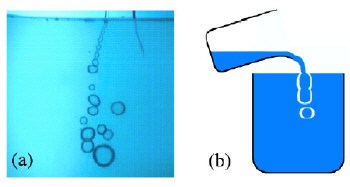
A bubble is a spherical film of liquid that surrounds a pocket of air, and which is in turn surrounded by air itself. An antibubble, as its name suggests, is a spherical shell of air with liquid on both its inside and outside (figure 1).

To make their antibubbles, Dorbolo and colleagues slowly poured a small amount of a solution made of soap and water over the surface of a large glass tray that contained the same liquid. They observed that a jet of liquid globules formed beneath the surface, and that this jet then broke up to form a stream of antibubbles that lasted up to two minutes (figure 2).

The antibubbles then collapsed in a way that is similar to the way that ordinary bubbles burst (figure 3). Dorbolo and co-workers say that both the formation and collapse of the antibubbles are due to fluid instabilities – the so-called “Rayleigh-Plateau” and “Rychtmeyer-Meshkov” instabilities.

The team also created antibubbles in salt solutions and in beer “for fun”.

A BRIL-I-NT new game for C-R-STMAS

In the game, players are presented with two rows of three letters, where each letter is spaced by a single blank. The aim is to make as many words as possible using the sequence of letters and blanks in a given length of time. So, for example, the letters I-blank-C-blank-R could be used to make INCUR, PINCERS or MINCE, while the letters O-blank-S-blank-L could be used to make CAROUSEL, DORSAL or TONSILITIS. Longer words score more points.

Although Briggs and Ramsay say that Blank is simple, a lot of physics knowledge was needed to build the game. The letters are presented to players on a special figure-of-eight track made of plastic, which allows them to be shuffled before each player’s turn and so provide millions of possible combinations. Each letter appears on a chip – made of plastic rod cut into a disk.

“We had to be able to predict how the different materials would ‘bind’ to each other during operation because the mechanical forces between them are very complicated and have to be modelled”, says Briggs. “The game had to have a low enough total friction to be operated effortlessly by hand. We also had to decide how to get mathematical variation into the game without having to constantly bring in new letters from a bag or shuffle the letters.”

Briggs and Ramsay decided to invent Blank because they wanted something that improved on what they felt were unsatisfactory aspects of other word games. “For instance Scrabble is good, but it is boring if there are more than two of you playing.” Briggs told PhysicsWeb. “There is no strategy because you cannot influence the other players. We also wanted to be able to use all the words in the dictionary and not be limited to words of merely seven or eight letters.”

The duo hope that the game will appeal to physicists and non-physicists alike. “We designed the game to appeal to ourselves, so it should attract people from a similar background,” says Briggs. “Words of any length can be played so you would be free to use all the interesting and elegant words you use in your own field of science.”

Copyright © 2026 by IOP Publishing Ltd and individual contributors