NMR breakthrough for bone fracture

NMR is already widely used to measure porosity in materials such as rocks, concrete and wood. Magnetic pulses are first used to align the spins of certain nuclei in the sample. The nuclei then relax and emit ‘echoes’ – lasting up to seconds – which show how abundant that particular nucleus is in the sample.

Ni and colleagues have now used a low field (0.5 Tesla) pulsed NMR to analyse the relaxation time of hydrogen nuclei (protons) in samples of bone taken from donors aged 19 to 89 years. These protons are present in the water-like fluid inside the pores of bone. The relaxation time is proportional to the amount of liquid inside the pores and thus the porosity of the bone. Moreover, the data can also provide information about the distribution of pore sizes.

The researchers found that the average porosity was about 8.5% for samples less than 45 years old, and about 17% for those over 63. The average pore size in older bone was also larger – between 50 and 100 microns, compared with 10-50 microns for younger samples (see micrographs). The results agree with measurement made with routinely used – but destructive – methods. “Since this NMR technique is non-invasive and non-destructive, it has great potential in the biomedical fields, particularly in bone-related research and applications,” says Ni.

Superstrings

As I sit down to write this article I feel that I have taken on a task rather like trying to summarize the history of the world in 10 pages. It is just too large a subject, with too many lines of thought and too many threads to weave together. In the 34 years since it began, string theory has developed into an enormous body of knowledge that touches on every aspect of theoretical physics.

String theory is a theory of composite hadrons, an aspiring theory of elementary particles, a quantum theory of gravity, and a framework for understanding black holes. It is also a powerful technical tool for taming strongly interacting quantum field theories and, perhaps, a basis for formulating a fundamental theory of the universe. It even touches on problems in condensed-matter physics, and has also provided a whole new world of mathematical problems and tools.

All I can do with this gargantuan collection of material is to make my own guess about which aspects of string theory are most likely to form the core of a future physical theory, perhaps 100 years from now. It will come as no surprise to my friends that my choice revolves around those things that have most interested me in the last several years. No doubt many of them will disagree with my judgement. Let them write their own articles.

String theory is considered to be a branch of high-energy or elementary particle physics. However, a high-energy theorist from the 1950s, 1960s or 1970s would be surprised to read a recent string-theory paper and find not a single Feynman diagram, cross-section or particle decay rate. Nor would there be any mention of protons, neutrinos or Higgs bosons in the majority of current literature. What the reader would find are black-hole metrics, Einstein equations, Kaluza-Klein theories and plenty of fancy geometry and topology. The energy scales of interest are not MeV, GeV or even TeV, but energies at the Planck scale – the scale at which the classical concepts of space and time break down.

The Planck energy is equal to h-bar5/G, where h-bar is Planck’s constant divided by 2π, c is the speed of light and G is the gravitational constant, and it corresponds to masses that are some 19 orders of magnitude larger than the proton mass. This is the energy of the universe when it was just 10-43s old, and it will probably be forever out of range of any particle accelerator. To understand physics at the Planck scale we need a quantum theory of gravity.

In the days when my career was beginning, a typical colloquium on high-energy physics would often begin by stating that there are four forces in nature – electromagnetic, weak, strong and gravitational – followed by a statement that the gravitational force is much too weak to be of any importance in particle physics so we will ignore it from now on. That has all changed.

Today the other three forces are described by the gauge theories of quantum chromodynamics (QCD) and quantum electrodynamics (QED), which together make up the Standard Model of particle physics. These quantum field theories describe the fundamental forces between particles as being due to the exchange of field quanta: the photon for the electromagnetic force, the W and Z bosons for the weak force, and the gluon for the strong force. In the string-theory community, however, the electromagnetic, strong and weak forces are generally considered to be manifestations of certain “compactifications” of space from 10 or 11 dimensions to the four familiar dimensions of space-time. But before I report on the status of string theory, I want to tell you how it came about that so many otherwise sensible high-energy theorists became interested in quantum gravity.

Why quantum gravity?

Elementary particles have far too many properties – such as spin, charge, colour, parity and hypercharge – to be truly elementary. Particles obviously have some kind of internal machinery at some scale. Protons and mesons reveal their “parts” at the modestly small distance of about 10-15 m, but quarks, leptons and photons hide their structure much more effectively. Indeed, no experiment has ever seen direct evidence of size or structure for any of these particles.

The first indication that the true scale of elementary particles might be somewhere in the neighbourhood of the Planck scale came in the 1970s. Howard Georgi and Sheldon Glashow, then at Harvard University, showed that the very successful, but somewhat contrived, Standard Model could be elegantly unified into a single theory by enlarging its symmetry group. The new construction was astonishingly compact and most particle theorists assumed that there must be some truth to it. But its predictions for the coupling constants – the constants that describe the strengths of the strong, weak and electromagnetic interactions – were wrong.

Georgi, along with Helen Quinn and Steven Weinberg, also at Harvard, soon solved this problem when they realized that the coupling constants are not really constants at all – they vary with energy. If the known couplings are extrapolated they all intersect the predictions of the unified theory at roughly the same scale. Moreover, this scale is close to the Planck scale. The implication of this was clear: the scale of the internal machinery of elementary particles is the Planck scale. And since the gravitational constant, G, appears in the definition of the Planck energy, to many of us this inevitably meant that gravitation must play an essential role in determining the properties of particles.

The earliest attempts to reconcile gravity and quantum mechanics – notably by Richard Feynman, Paul Dirac and Bryce DeWitt, who is now at the University of Texas at Austin – were based on trying to fit Einstein’s general theory of relativity into a quantum field theory like the hugely successful QED. The goal was to find a set of rules for calculating scattering amplitudes in which the photons of QED are replaced by the quanta of the gravitational field: gravitons. But gravitational forces become increasingly strong as the energy of the participating quanta increases, and the theory proved to be wildly out of control. Attempting to treat the graviton as a point particle simply gave rise to far too many degrees of freedom at short distances.

In a sense the failure of this “quantum gravity” theory was a good sign. The theory itself gave no insight into the internal machinery of elementary particles, and it offered no explanation for the other forces of nature. At best it was more of the same: an effective (but not very) description of gravitation with no deeper insight into the origin of particle properties. At worst, it was mathematical nonsense.

Strings as hadrons

We all know that science is full of surprising twists, but the discovery of string theory was particularly serendipitous. The theory grew out of attempts in the 1960s to describe the interactions of hadrons – particles that contain quarks, such as the proton and neutron. This was a problem that had nothing to do with gravity. Gabriele Veneziano, now at CERN, and others had written down a simple mathematical expression for scattering amplitudes that had certain properties that were fashionable at that time. It was soon discovered by Yoichiro Nambu of the University of Chicago and myself, and in a slightly different form by Holger Bech Nielsen at the Niels Bohr Institute, that these amplitudes were the solution of a definite physical system that consists of extended 1D elastic strings.

For the two years that followed, string theory was the theory of hadrons. One of the spectacular discoveries made in this early period was that the mathematical infinities that occur in quantum field theory are completely absent in string theory. However, from the very beginning there were big problems in interpreting hadrons as strings. For example, the earliest version of the theory could only accommodate bosons, whereas many hadrons – including the proton and neutron – are fermions.

The distinction between bosons and fermions is one of the most important in physics. Bosons are particles that have integer spins, such as 0, h-bar and 2h-bar, whereas fermions have half-integer spins of h-bar/2, 3h-bar/2 and so on. All fundamental matter particles, such as quarks and leptons, are fermions, while the particles that carry fundamental forces – the photon, W and Z, and so on – are all bosons.

Fermionic versions of string theory were soon discovered and, moreover, they turned out to have a surprising symmetry called supersymmetry that is now totally pervasive in high-energy physics. In supersymmetric theories all bosons have a fermionic superpartner and vice versa. The early development of “superstring” theory was due to pioneering work by John Schwarz of Caltech, Andrei Neveu of the University of Montpellier II, Michael Green of Cambridge and Pierre Ramond of the University of Florida, and much of the subsequent technical development was carried out in a famous series of papers by Green and Schwarz in the 1980s.

Another apparently serious problem with the string theory of hadrons concerned dimensions. Although the original assumptions in string theory were simple enough, the mathematics proved internally inconsistent, at least if the number of dimensions of space-time was four. The source of this problem was quite deep, but, strangely, if space-time has 10 dimensions it contrives to cancel out. The reasons were not at all easy to understand, but the extraordinary mathematical consistency of superstring theory in 10 dimensions was compelling. However, so was the obvious fact that space-time has four dimensions, not 10.

Thus by about 1972 theorists were beginning to question the relevance of string theory for hadrons. In fact, there were other serious physical shortcomings in addition to the bizarre need for 10 dimensions. A mathematical string can vibrate in many patterns, which represent a different type of particle, and among these are certain patterns that represent massless particles. But most dangerous of all were massless particles with two units of spin angular momentum (“spin-two”). There are certainly spin-two hadrons, but none that have anything like zero mass. Despite all efforts, the massless spin-two particle could not be removed or made massive.

Eventually, mathematical string theory gave way to QCD as a theory of hadrons, which had its own explanation of the string-like behaviour of these particles without the bad side effects. For most high-energy theorists, string theory had lost its reason for existence. But a few bold souls saw opportunity in the debacle. A massless spin-two field might not be good for hadronic physics, but it is just what was needed for quantum gravity, albeit in 10D. This is because just as the photon is the quantum of the electromagnetic field, the graviton is the quantum of the gravitational field. But the gravitational field is a symmetric tensor rather than a vector, and this means the graviton is spin-two, rather than spin-one like the photon. This difference in spin is the principal reason why early attempts to quantize gravity based on QED did not work.

A theory of everything

The massless spin-two graviton led to a radical shift in perspective among theorists. The focus of mainstream high-energy physics at the time was on energy scales anywhere from the hadronic scale of a few GeV to the weak interaction scale of a few hundred GeV. But to explore the idea that string theory governs gravity, the energy scale of string excitations has to jump from the hadronic scale to the Planck scale. In other words, with barely a blink of the eye, string theorists would leapfrog 19 orders of magnitude, and therefore completely abandon the idea that progress in physics proceeds incrementally. Heady stuff, but also the source of much irritation in the rest of the physics community.

Another reason for annoyance was somebody’s idea to start referring to string theory as a “theory of everything”. Even string theorists found this irritating, but there is actually a technical sense in which string theory can either be a theory of everything or a theory of nothing. One of the problems in describing hadrons with strings was that it proved impossible to allow for the hadrons to interact with other fields, such as electromagnetic fields, as they clearly do experimentally. This was a deadly flaw for a theory of hadrons, but not for a theory in which all matter, including photons, are strings. In other words, either all matter is strings, or string theory is wrong. This is one of the most exciting features of the theory.

But what about the problem of dimensions? Here again, a sow’s ear was turned into a silk purse. The basic idea goes back to Theodor Kaluza in 1919, who tried to unify Einstein’s gravitational theory with electrodynamics by introducing a compact space-like fifth dimension. Kaluza discovered the beautiful fact that the extra components of the gravitational field tensor in 5 dimensions behaved exactly like the electromagnetic field plus one additional scalar field. Somewhat later, in 1938, Oskar Klein and then Wolfgang Pauli generalized Kaluza’s work so that the single compact dimension was replaced by a 2D space. If the 2D space is the surface of a sphere then a remarkable thing happens when Kaluza’s procedure is followed. Instead of electrodynamics, Klein and Pauli discovered the first “non-Abelian” gauge theory, which was later rediscovered by Chen Ning Yang and Robert Mills. This is exactly the same class of theories that is so successful in describing the strong and electromagnetic interactions in the Standard Model.

One may ask whether particles move in the extra dimensions. For example, can a particle that appears to be standing still in our usual 3D space have velocity or momentum components in the compact dimensions? The answer is yes, and the corresponding components of momentum define new conserved quantities (figure 1). What is more, these quantities are quantized in discrete units. In short, they are “charges” similar to electric charge, isospin and all the other internal quantum numbers of elementary particles. The answer to the problem of dimensions in string theory is obvious: six of the 10 dimensions should be wrapped up into some very small compact space, and the corresponding quantized components of momenta become part of the internal machinery of elementary particles that determines their quantum numbers.

Life in six dimensions

Much of the development of string theory is therefore concerned with 6D spaces. These spaces, which can be thought of as generalized Kaluza-Klein compactification spaces, were originally studied by mathematicians and are known as Calabi-Yau spaces. They are tremendously complicated and are not completely understood. But in the process of studying how strings move on them, physicists have created an unexpected revolution in the study of Calabi-Yau spaces.

In particular, it was discovered that a compactification radius of size R is completely equivalent to a space with size 1/R from the point of view of string theory. This connection, which is known as T-duality, has a mathematically profound generalization called mirror symmetry, which states that there is an equivalence between small and large spaces (see box above). Mirror symmetry of Calabi-Yau spaces – which are not only of different sizes but have completely different topologies – was completely unsuspected before physicists began studying quantum strings moving on them.

I wish it was possible to draw a Calabi-Yau space but they are tremendously complicated. They are six-dimensional, which is three more than I can visualize, and they have very complicated topologies, including holes, tunnels and handles. Furthermore, there are thousands of them, each with a different topology. And even when their topology is fixed there are hundreds of parameters called moduli that determine the shape and size of the various dimensions. Indeed, it is the complexity of Calabi-Yau geometry that makes string theory so intimidating to an outsider. However, we can abstract a few useful things from the mathematics, one of them being the idea of moduli.

The simplest example of a modulus is just the compactification radius, R, when there is only a single compact dimension. In more complicated cases, the moduli determine the sizes and shapes of the various features of the geometry. The moduli are not constants but depend on the geometry of the space itself, in the same way that the radius of the universe changes with time in a manner that is controlled by dynamical equations of motion. Since the compact dimensions are too small to see, the moduli can simply be thought of as fields in space that determine the local conditions. Electric and magnetic fields are examples of such fields but the moduli are even simpler: they are scalar fields (i.e. they have only one component), rather than vector fields. String theory always has lots of scalar-field moduli and these can potentially play important roles in particle physics and cosmology.

All of this raises an interesting question: what determines the compactification moduli in the real world of experience? Is there some principle that selects a special value of the moduli of a particular Calabi-Yau space and therefore determines the parameters of the theory, such as the masses of particles, the coupling constants of the forces, and so on? The answer seems to be no: all values of the moduli apparently give rise to mathematically consistent theories. Whether or not this is a good thing, it is certainly surprising.

Ordinarily we might expect the vacuum or ground state of the world to be the state of lowest energy. Furthermore, in the absence of very special symmetries, the energy of a region of space will depend non-trivially on the values of the fields in that region. Finding the true vacuum is then merely an exercise in computing the energy for a given field configuration and minimizing it. This is, to be sure, a difficult task, but it is possible in principle. In string theory, however, we know from the beginning that the potential energy stored in a given configuration has no dependence on the moduli fields.

The reason that the field potential is exactly zero for every value of the moduli is that string theory is supersymmetric. Supersymmetry has both desirable and undesirable consequences. Its most obvious drawback is the requirement that for every fermion there is a boson with exactly the same mass, which is clearly not a property of our world.

A more subtle difficulty involves the aforementioned fact that the vacuum energy is independent of the moduli. As well as telling us that we cannot determine the moduli by minimizing the energy, supersymmetry also tells us that the quanta of the moduli fields are exactly massless. No such massless fields are known in nature and, furthermore, such fields are very dangerous. Indeed, massless moduli would probably lead to long-range forces that would compete with gravity and violate the equivalence principle – the cornerstone of general relativity – at an observable level.

On the plus side, the vanishing vacuum energy that is implied by supersymmetry ensures that the cosmological constant vanishes. If it were not for supersymmetry, the vacuum would have a huge zero-point energy density that would make the radius of curvature of space-time not much bigger than the Planck scale – a most undesirable situation. Supersymmetry also stabilizes the vacuum against various hypothetical instabilities, and it allows us to make exact mathematical conclusions. Indeed, T-duality and mirror symmetry are examples of those exact consequences.


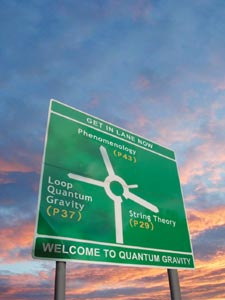
Welcome to quantum gravity

Physics in the 20th century was built on two great revolutions: the general theory of relativity and quantum mechanics. These two theories have profoundly changed the way we think about space, time and the meaning of reality, and both have been verified to extraordinary precision. However, the two theories are also completely incompatible with one another.


Three of the four known forces in nature – the electromagnetic, weak and strong interactions – are described by quantum field theories. These theories, which make up the highly successful Standard Model of particle physics, explain fundamental interactions in terms of the exchange of field particles between elementary matter particles. Gravity, on the other hand, does not fit into this framework. Einstein’s elegant description of gravity is classical, and gravitational forces result from the curvature of the space-time continuum.

But there is something deeply unsettling about this whole picture. Ever since Maxwell unified electricity and magnetism with a single set of equations, finding a general theory that can describe everything that we observe in the physical world has been one of the primary goals in theoretical physics. A unified description of the electromagnetic and weak interactions was achieved in the 1960s, but a true theory of quantum gravity would be a giant step towards this goal. Moreover, a theory of quantum gravity is needed to understand what happens in circumstances when both gravitational and quantum effects are large – such as in the very early universe.

Strings and loops

There are two obvious routes to quantum gravity. The first, and most beaten path so far, is to formulate general relativity into a quantum field theory in which the gravitational force is carried by the exchange of gravitons. The problem is that gravitons carry mass and energy, which are the source of the gravitational field in the first place. This leads to infinities that render calculations meaningless.

One way round this problem is to replace the idea of point-like particles with infinitesimal 1D strings. In “Superstrings” Leonard Susskind describes how string theory is not only our best bet for a theory of quantum gravity at present, it naturally incorporates the other three forces of nature as well. A major problem is the fact that string theory seems to offer too many, rather than too few, possibilities for a theory of quantum gravity – see “The string-theory landscape”. However, developments such as D-branes and M-theory are helping theorists get a better handle on what the theory actually means. Meanwhile, Gerard ‘t Hooft, Nobel laureate and sometime collaborator with Susskind, is pioneering a new deterministic approach to quantum theory (see article on p12, print version only).

Mastering string theory is about understanding higher dimensions. The theory lives in 10 dimensions, six of which are compactified into strange spaces that conceal the fundamental properties of particles. But do not be put off – Susskind can only visualize three dimensions too.

String theory is based on conventional quantum mechanics and assumes that space-time is a fixed background on which particles move and interact. The second route to quantum gravity, however, starts with general relativity and involves completely rewriting quantum theory. In loop quantum gravity there is no such thing as space – only fields. In “Loop quantum gravity” Carlo Rovelli explains how he arrived at a background-independent quantum field theory by treating the gravitational field in terms of closed lines or loops.

A remarkable prediction of loop gravity is that space-time is quantized in elementary “grains” at scales of about 1.6 x 10⁻³⁵ m – the Planck length. However, like string theory, loop gravity is still a long way from making concrete predictions about the mass of fundamental particles and the strength of the different interactions between them.

Theory and experiment

Will we ever be able to detect or measure the effects of quantum gravity? In order to do this we need to study processes in which both quantum effects and gravity play a role. By definition, this is the point at which both general relativity and quantum theory break down: the Planck scale.

A particle accelerator that could probe energies at the Planck scale – about 1028 eV – would need to be as big as the universe itself. In “Quantum-gravity phenomenology” Giovanni Amelino-Camelia describes a more practical approach – the emerging field of quantum-gravity phenomenology. For instance, if space-time is quantized then photons with different energies should travel at slightly different speeds, and space-based observatories such as GLAST should be able to detect these differences in observations of gamma-ray bursts. Similar effects might also be observable in cosmic rays.

Despite all this progress, there is still some way to go. Indeed, the “grand unification” of the strong and electroweak interactions has still to be achieved. Quantum theory and general relativity will only truly be unified when theory finally agrees with experiment – an event that will define the path of physics in the 21st century.

The string-theory landscape

Einstein introduced the cosmological constant to his equations of general relativity because he believed the universe was static. Faced with evidence that the universe was actually expanding, however, he decided to remove it, later referring to the cosmological constant as the biggest blunder of his life. Recent observations suggest that the expansion of the universe is accelerating, which favours a small, but non-zero, positive cosmological constant with a value of 10-120 in Planck units (see article on p3, print version only).

But perhaps Einstein’s most serious mistake regarding the cosmological constant, Λ, was to actually believe that he had the right to decide whether or not it should be included in his equations in the first place. If Λ is very small or zero, its value has to be explained. This is probably the greatest puzzle in modern theoretical physics.

De Sitter’s solution

Without a cosmological constant, the most symmetric solution of Einstein’s equations in the vacuum is the flat, 4D Minkowski space-time of special relativity. In 1917 the Dutch astronomer Willem de Sitter found the analogous solution if the cosmological constant is non-zero. If Λ is positive, the solution is called “de Sitter space” and Λ is the vacuum energy that curves space-time (a negative value of Λ corresponds to what is called anti-de Sitter space).

Einstein immediately rejected the de Sitter solution because it went against his intuition – it implied that space-time can be curved in the absence of matter – although he ended up accepting the idea after some debate.

In de Sitter space the universe expands exponentially, which is the basis of the inflationary model of the universe. Inflation describes an extremely short period of rapid expansion that is thought to have taken place shortly after the Big Bang. The inflationary model solves many of the cosmological problems of the Big Bang model, and has also received strong support from the latest measurements of the cosmic microwave background. In addition to describing inflation, de Sitter space also provides an explanation for the acceleration of universal expansion. In this scenario a very small value of the cosmological constant is the “dark energy” that is driving the expansion of the universe.

Obtaining a de Sitter solution is therefore a major challenge for string theory, which has been the main candidate for a fundamental theory of the universe for almost 20 years. String theory is believed to be a unique theory that unifies all the particles and forces in nature – including gravity – by treating them as infinitesimal 1D strings (see “Superstrings”).

But even if the theory is unique, the number of different universes that appear as solutions to its equations is extremely large. One solution, for example, is a flat Minkowski space-time in 10 dimensions. Another is a universe similar to ours that has four flat space-time dimensions and an additional six dimensions that are curled up at extremely small scales.

These “hidden” dimensions correspond to a class of spaces known as Calabi-Yau spaces. The crux of string theory is that these 6D spaces can fix the physical properties of the observable universe, such as the type and number of elementary particles and the forces that act between them. There are at least 10,000 different Calabi-Yau spaces, each of which is defined by a number of parameters called moduli that determine its size and shape.

Each value of these parameters gives rise to different physics in the 4D observable world, but the trouble is that all values are equally valid solutions. In other words, they all lead to the same vacuum energy (Λ = 0) in four dimensions.

Flat land

We can picture this range of solutions as a very boring landscape in which the east-west and north-south directions are the values of the moduli and height is the energy. Since the energy vanishes for each point, this landscape looks like a big, motionless, flat ocean. But in four dimensions the moduli – which come from the full 10D gravitational field – manifest themselves as massless particles called moduli fields. This is a big problem for string theory because nobody has observed such particles. Furthermore, the moduli fields correspond to a multitude of values for observable physical quantities, such as the strength of the electromagnetic interaction, which we know to have essentially fixed values.

An outstanding challenge in string theory is therefore to find ways to “lift” the shape of this landscape and fix the value of the moduli fields by minimizing their energy. If this energy is positive it would indicate a de Sitter solution. Now, Shamit Kachru, Renata Kallosh and Andrei Linde from Stanford University in the US, and Sandip Trivedi from the Tata Institute in India have found evidence for such a solution. The methods they used have all been developed before by string theorists, but their merit was to put together the different techniques in a self-consistent manner. One of the main ingredients of their construction is fluxes of fields that are higher-dimensional generalizations of electromagnetic fields (S Kachru et al. 2003 Phys. Rev. D 68 046005).

Unstable universes

This new solution has several important implications. De Sitter space is only a local minimum of the energy, whereas the global minimum corresponds to a flat 10D space-time. We therefore know that the de Sitter minimum has to be unstable, and that it will ultimately decay to the stable flat 10D minimum via quantum tunnelling (see figure). Fortunately its lifetime is far greater than the age of the universe.

Once we know that there is one de Sitter solution, it is easy to find many more of them by just changing the values of the fluxes. Sujay Ashok and Michael Douglas of Rutgers University have recently estimated the number of different solutions to be at least 10100, which indicates an extremely rich landscape with many mountains, valleys, oceans and even volcanoes. Each minimum-energy point represents a different universe, and the height of that point is the value of the cosmological constant for that universe. Viewing the solution this way, the probability that one of these universes has a cosmological constant that is as small as is indicated by current experiments is actually non-zero.

This points to an anthropic approach to the cosmological-constant problem: out of the enormous number of solutions of string theory that represent different universes, we happen to live in one that allows our existence (see Physics World October 2001 pp23-25). This is an idea that Leonard Susskind of Stanford University has coined “the anthropic landscape of string theory”.

However, mentioning anthropic arguments in physics guarantees heated debates, and this is not an exception. At the moment we cannot deny the existence of these numerous solutions. The best we can do is to learn from de Sitter, rather than Einstein, and to follow what the theory has to tell us without prejudice.

Do’s and don’ts for authors


Fabrication, plagiarism and a range of other offences – duplicate submissions, conflicts of interest and referee misconduct – were among the topics discussed at a recent workshop on scientific misconduct organized by the International Union of Pure and Applied Physics (IUPAP). Failure to cite the work of others adequately is also an offence, so I should point out that many of the presentations and discussions at the workshop have informed this article.

The task currently facing the IUPAP working group on communication in physics is to formulate a list of guidelines and recommendations aimed at publishers, journals, editors, authors, referees, learned societies, funding agencies and research institutions. Dealing with misconduct is currently a time-consuming and at times haphazard affair: a clear definition of what actually constitutes the various types of misconduct and clear procedures for investigating misconduct when it is suspected would be of great benefit to the physics community.

One area where individual physicists could take the lead is the issue of co-authorship. There are two basic classes of misconduct here: improper exclusion and improper inclusion. Improper exclusion – when someone who should appear as a co-author does not – is the more difficult to tackle. Greater awareness of the problem and reliable mechanisms for journals to ensure that authors who have been improperly excluded receive belated credit would help. Moreover, institutions and senior physicists have a duty to ensure that such exclusion does not happen.

Improper inclusion comes in different forms: a senior researcher can, for instance, insist that their name is added to a paper, even though their contribution has not been significant. In an ideal world the physicists who do this would settle for a “thank you” in the acknowledgements (e.g. for raising the funds). Journals could also ask the authors to explicitly state who did what in the acknowledgements.

Improper inclusion can also occur when a junior author offers “gift authorship” to a senior colleague. Again the solution would be simple in an ideal world: the junior scientist would resist the impulse or pressure to offer gift authorship, and the senior colleague would decline. In practice, physicists would be more reluctant to accept gift authorship if they had heard the editor of the British Medical Journal tell the IUPAP workshop how the careers of several distinguished medical professors were effectively ended when they accepted gift authorship on papers that turned out to contain fabricated results.

Meanwhile, some authors include established physicists as co-authors to help their paper through the peer-review process, even though the unwitting co-author knows absolutely nothing about the paper. If journals routinely sent acknowledgements to all the authors on a paper, it would help to flush out such behaviour.

Publishers might argue that sending acknowledgments to all authors will make running a journal even more complicated than it is already. Senior physicists, meanwhile, might resent having their name on fewer papers or having to spend more time negotiating who appears on the author list. However, for as long as we do not know the full extent of scientific misconduct in physics, the whole community will have to suffer slightly more paperwork. No-one is suggesting that misconduct is rife in physics, but just one more major case of fabrication or plagiarism would be very bad news for our subject.

Railways and the roots of relativity

Einstein’s Clocks, Poincaré’s Maps: Empires of Time
Peter Galison
2003 Sceptre/Norton 384pp £16.99/$23.95hb

Compared with other books on history of science, Peter Galison’s current offering has drawn a lot of attention in the general press. The New York Times, for example, ran a glowing two-page feature article on the book and its author. It later published a lead review. Meanwhile, some historians of physics have received Galison’s approach with an apparent cold shoulder and a bit of disdain. In conversation, for example, and off-the-record, one historian unfairly described the book as “a travesty”.

So what is all the fuss about? On the face of it, Einstein’s Clocks, Poincaré’s Maps may seem to be just another book about the historical roots of special relativity. But the plot thickens.

Recall that the origins of relativity can be traced back to the 1890s when the theorist Hendrik Lorentz – to account for problems in the optics and electrodynamics of moving bodies – hypothesized that all moving lengths contract imperceptibly as they plough through the all-pervasive but undetectable ether. He also proposed mathematical fictions called “local times”, as opposed to true time. Lorentz’s theory was further developed by the mathematician Henri Poincaré, who even argued (in a journal on metaphysics) that our common notions of time are mere conventions.

In 1905 Einstein then carried out thought experiments concerning the synchronization of ideal clocks, perhaps located on imaginary trains. Such thoughts led him to conclude that there exists no univocal simultaneity between distant events, suggesting that Lorentz’s infinitely many local times are actually true. Accordingly, objects have no one true length, moving clocks runs slow, and light waves (if waves they be) travel in a medium of nothing. The mathematician Hermann Minkowski later argued that space and time are inextricably united, and that time should be construed as a kind of fourth dimension.

These developments may seem to constitute key moments in the rise of theoretical physics – major triumphs of abstract thought and idealizations of physical relations that were carried mathematically to their imponderable consequences. Einstein emerges as part theoretical physicist, part philosopher. Alongside this perspective – rather than at its expense – Galison now advances another point of view, by analysing these historical developments from a technological perspective.

The young Einstein was not, of course, employed in the academic world but in the Swiss Patent Office. And Switzerland, as we know, was a centre of invention and innovation in clock technologies. The patent office at Bern was a clearing-house for new timing technologies, and Einstein’s job afforded him a veritable grandstand seat from which to become acquainted with new electro-technological advances.

Moreover, every day Einstein saw an abundance of public clocks on his way to and from work – on storefronts, on baroque towers, at the train station. How to synchronize such clocks was a widespread concern all over Europe and America. Engineers, scientists and businessmen needed to synchronize clocks effectively in order to solve important problems, ranging from determining longitude at sea to preventing train crashes.

Galison’s book is thus about the history of the problem of co-ordinating clocks, from the 1800s to the early 1900s. As he points out, this period was characterized by many efforts to unify, by convention, a plethora of standards of lengths and time. Geographical regions – even within a single country such as Germany – were distinguished by their own “local times”. Railway lines defined and distributed time, bringing distant times into conflict with local times. Engineers struggled to pinpoint and unite locations and times. Chronometers transported aboard ships failed to keep the time of stationary clocks. Underwater telegraphic cables were laid across the Atlantic Ocean to transmit not only messages, but also time, from observatories in Europe to Africa, Newfoundland, Brazil and beyond. Poincaré was even a member and sometime president of the French Bureau of Longitude, where he laboured to revise time-keeping conventions.

Local times, synchrony conventions, moving clocks that do not keep proper time, the diversity and unification of lengths and time. Were these remarkable coincidences? Or were there causal connections between breakthroughs in theoretical physics and prior techno-cultural developments? Galison’s narrative implies a resounding “yes”, but he cautiously avoids any outright claims of historical causation. His aim is not to reduce the emergence of relativity to such developments, but to place it in a context where the interests of engineers, physicists, philosophers, entrepreneurs and even politicians converged.

Despite Galison’s good intentions, his middle-of-the-road outlook does not counterbalance the direction of his research and the drift of his book. While claiming that special relativity emerged from physics, philosophy and technology, his book highlights the technological dimension, seemingly at the expense of the others. Readers who are not well acquainted with the roots of special relativity in optics and electrodynamics might therefore get the exaggerated impression that its crucial origins lay in the techno-culture of clock synchrony.

Be warned, moreover, that the patent offices were not the only possible source of technological imagery. Even before 1900, discussions of kinematics included references to clocks, observers, the measurement of length and time, and even trains. For example, in the 17th century, imagery of ships cruising rectilinearly served to illustrate the equivalence of physical processes on board to those on land, while by the late 19th century imagery of trains had become widespread. Such factors have to be subtracted before injecting Galison’s circumstantial findings into a general history of physics. How much weight to give to the techno-cultural aspects will now challenge historians of special relativity.

I recommend this book to readers who are interested in the history of clock synchronization or in Poincaré’s activities beyond pure mathematics. It will also appeal to people who want to see how concrete technologies, social conventions and abstract concepts combine.

William Gilbert: forgotten genius

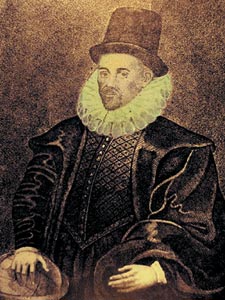
portrait of William Gilbert

When William Gilbert of Colchester died on 30 November 1603, England lost one of its greatest Elizabethan scientists. Three years earlier he had published a book called De Magnete, which was nothing less than the first ever work of experimental physics. Its fuller title, translated from the original Latin, was On the Magnet, Magnetic Bodies and that Great Magnet the Earth. In 1651 a collection of Gilbert’s manuscripts, which had been edited by his half brother, was posthumously published. Going under the title De Mundo Nostro Sublunari Philosophia Nova, the book provided “a new philosophy of our sublunary world”.

Despite the revolutionary nature of both of these works, Gilbert has in recent years sunk – quite unfairly we believe – into the footnotes of history. So why is his revolutionary achievement in creating the science of magnetism not better known?

A mind made for magnetism

Gilbert’s story began in Colchester, Essex, where he was born in 1544. He went up to Cambridge University at the age of 14, where he followed the standard undergraduate course of the day. It was here that he met, and subsequently rejected, the current scientific orthodoxy of Aristotle’s natural philosophy, Galen’s medicine and Ptolemy’s astronomy. The latter placed an immovable Earth at the centre of the universe, around which the planets and stars revolved in crystal spheres.

In contrast to the academic conservatism of Cambridge, Gilbert found in London – where he became a physician in the early 1570s – a booming centre of navigational expertise, technology and applied mathematics. Gilbert’s research into magnetism, as well as his medical practice, led him – unusually for the time – to seek out navigators and skilled instrument makers, collating their magnetic data and discoveries about lodestones and compass needles. Also in these circles were Copernicans who fuelled Gilbert’s then radical belief that the Earth was just one planet in an infinite universe.

Gilbert used his leisure and status as a court physician to launch his attack on traditional university science of the Earth by the publication of De Magnete in 1600. This single volume was organized into six separate books, each of which contained numerous chapters. The centrepiece was a hypothesis, which he had probably formed in the early 1580s, that the Earth is a giant magnet. Indeed, Gilbert had spent many years and much money – said to be £5000 – proving this hypothesis in a new, experimental way.

These experiments mainly involved using a spherical magnetic lodestone (known as a terella, or “little Earth”) and a freely pivoting miniature compass needle (or versorium). The London instrument maker Robert Norman had already discovered in 1581 that a standard compass needle points at a certain dip, or inclination, below the horizontal, in addition to pointing roughly north and south. However, he had no idea what this dip might be elsewhere on Earth. By studying how the dip of a versorium varies at different points around a terella, Gilbert successfully predicted that this relationship between dip and latitude on a terella models the dip of a compass needle around the Earth. In book 5 of De Magnete Gilbert was therefore able to propose a law for the dip of a compass needle at all points on the globe.

Nautical challenges

De Magnete also announced a new instrument called an inclinometer, with which navigators could keep a rough check on their latitude in cloudy weather. The instrument is illustrated in De Magnete, and several European sailors reported successful sea trials, although the technique ultimately proved of less use in practice.

A more ambitious scheme was to correlate longitude with “magnetic variation”, which is the deviation of magnetic north from true (astronomical) north. Unfortunately, this work foundered after the discovery in 1634 (inspired, ironically, by Gilbert’s research) of the time-dependence of this magnetic variation. This value was found to have decreased from 11° east of true north in 1580 to 4° east by 1634 – a discovery that shocked all European experts of the age.

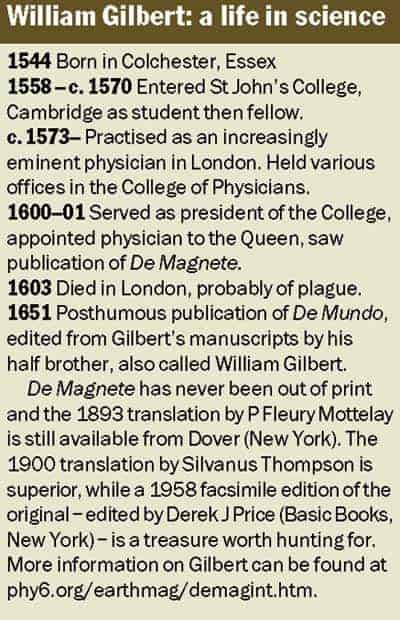
William Gilbert facts

Despite these subsequent setbacks, Gilbert’s navigational aims were endorsed by the mathematician Edward Wright in 1600 in his laudatory preface to De Magnete. “In truth, in my opinion,” he wrote, “there is no subject matter of higher importance or of greater utility to the human race.”

Gilbert carried out many other experiments, including the study of spherical lodestones that were floated on water in small wooden boats. This work showed that magnetic forces often produce circular motion, which led him to develop a magnetic cosmology of the rotating Earth. We now believe this cosmology was his main motivation for the study of magnetism.

Having shown that the Earth, which he called tellus or “Mother Earth”, has an immaterial magnetic force, Gilbert credited the Earth with a soul (anima) – then a common explanation for planets and other “self-moving” entities. In his view, the Earth’s magnetic soul rotated the planet around its axis, which was magnetically stabilized to a point near the Pole Star. Magnetism, in other words, caused the Earth’s Copernican diurnal rotation.

As Gilbert hinted in De Magnete (and expanded upon in De Mundo), he believed that animate forces of all the celestial bodies “conspired” dynamically to produce the regular but non-circular celestial motions. This first Copernican physics, elaborated in the final book of De Magnete and in De Mundo, was, of course, superseded some 80 years later by Newton’s work on gravitation. The grand aim of De Magnete – to take magnetism beyond the simple use of the compass to find north – was not as successful as Gilbert and Wright had hoped. His magnetic cosmology was also soon superseded. However, we do not believe that Gilbert’s contributions to navigation and to cosmology should simply be discounted. Gilbert’s magnetic Earth is the foundation of geomagnetism. He showed experimentally that magnetism involves a force at a distance, which encouraged other astronomers and physicists like Johann Kepler, Robert Hooke, Christopher Wren – and possibly Newton himself – to think of universal gravitation as analogous to magnetism.

Suppose, however, that we do discount the two grand aims of De Magnete and also ignore the chapters on navigation, practical instruments and on mathematical constructions, which might have been the work of his collaborator Edward Wright. Even then, in our view, the core that remains still stands as the first great work of experimental physics.

Consider the achievements that can undoubtedly be attributed to Gilbert at a time when the only magnetic materials known were lodestone (magnetite), iron and steel, and when the whole framework of modern science was still to be invented. The most famous, and rightly so, is his demonstration in De Magnete that the Earth is a great magnet. He showed this by means of what we would now call model experiments, including those on dip mentioned above, in which he showed that the behaviour of the versorium and terrella simulate that of the compass needle and the Earth.

Meanwhile, Gilbert’s qualitative discussion of magnetostatics is just about complete and carefully based in experiment. The direction of the internal field, the polarity of a cut magnet, as well as the processes of magnetization and demagnetization are all explored in detail. In chapter 11 of book 5, for example, Gilbert even comes close to the idea of a magnetic field and makes a very good shot at describing the dipolar field of the terrella. What is lacking is any attempt at the difficult problem of quantifying magnetic attractions beyond his comparisons of “weak” and “strong” lodestones.

De Magnete plate

The interaction between temperature and magnetism also receives penetrating and accurate discussion in several sections. The final main achievement is the account of electrostatics in a chapter of book 2 entitled “Of the attraction exerted by amber”. This appears partly to distinguish electric from magnetic effects, and establishes the very large number of “electrics”. Although Gilbert made no distinction between positive and negative charges – this would take another 150 years – this single chapter is still enough to have won him the title of “father of electrical science”.

When considering magnetism, the physicist and polymath William Whewell wrote in 1859: “Gilbert’s work contains all the fundamental facts of the science, so fully examined, indeed, that even at this day we have little to add to them.”

Gilbert’s deployment of experiment was deliberate, considered and groundbreaking. The first sentence of his preface starts: “In the discovery of secret things and in the investigation of hidden causes, stronger reasons are obtained from sure experiments and demonstrated arguments than from probable conjectures and the opinions of philosophical speculators of the common sort.”

The organization of De Magnete also has a very modern feel. Each topic is introduced by a careful review of previous work followed by an account of new experiments. Gilbert, however, was very much a man of his age in his mastery of invective. For example, when criticizing claims for magnetic perpetual-motion machines, he writes: “May the gods damn all such sham, pilfered, distorted works, which do but muddle the minds of students.”

Fallen star

Gilbert was more celebrated in his tercentenary year than he will be today. The great enthusiast Silvanus P Thompson was the leading light of the Gilbert Club, which found a considerable amount of new information on Gilbert. The members were perhaps not disinterested; the rising electric power industry could only benefit from acclaiming the eminent Englishman Dr Gilbert as the father of electrical science. Two translations of De Magnete appeared; although Thompson began first, he was pre-empted by P Fleury Mottelay’s 1893 edition.

Derek Price, who edited a 1958 reprint of Thompson’s Gilbert Club edition, eloquently describes Gilbert’s achievements. “One might well feel that Gilbert had invented the whole process of modern science rather than merely discovering the basic laws of magnetism and static electricity,” he writes. “Certainly he was the first to have the tenacity to work through a whole segment of physics methodically, appealing to experiment and reason throughout. Gilbert’s work formed the pattern for the subsequent treatment of other parts of physics, and much later for chemistry and biological subjects.”

Gilbert’s star has, however, fallen in recent decades for several reasons. It is not so fashionable to seek heroic ancestors. Historians, meanwhile, no longer see the scientific era of Gilbert, Kepler and Galileo as quite so “modern” and it is now impossible to dismiss Gilbert’s pre-modern hypotheses about the Earth’s and other planetary souls as irrelevant to his experiments. But the legacy of his magnetic science is still profound. Just look at De Magnete and judge this sharply written and profoundly innovative work for yourself.

  • Both authors, together with the historian Nigel Goose, will be speaking at a day school about the life of Gilbert on 29 November in Colchester, organized by the Colchester Museums Service and the University of Essex

Photonic crystals boost semiconductor lasers

Conventional semiconductor lasers emit photons when electrons in the conduction band and holes in the electron band recombine. The wavelength or energy of the photon is determined by the energy difference between the conduction and valance bands – which is a fundamental property of the semiconductor.

Quantum cascade lasers, on the other hand, emit light when electrons fall from a higher to a lower energy level in a quantum well. Since the quantum well can contain a whole series of levels, the same electron can emit a large number of photons as it cascades down through the levels. Moreover, the wavelength depends on the width of the quantum well which means that photons of more than one wavelength can be emitted by the same device. However, quantum cascade lasers can only emit light in certain directions and cannot emit vertically from the semiconductor surface.

Using dry etching and lithography, Colombelli (now at the University of Paris-Sud) and colleagues have now embedded a tiny photonic crystal – a material that only transmits certain wavelengths of light – in the active region of a quantum cascade laser. The photonic crystal acts as a microcavity that provides feedback for laser action when an electric current is applied. Moreover, the cavity diffracts light vertically from the semiconductor surface so that the new device can emit light in the vertical direction.

The researchers say that such devices could be used to make large arrays, where each laser emits at a different wavelength, for chemical sensing and optoelectronics applications. They now hope to improve the performance of the new devices so that they will work as well as standard quantum cascade lasers.

A new spin on black holes

Astronomers believe that a supermassive black hole exists at the centre of every galaxy in the universe. Recent X-ray observations and measurements of the orbits of stars around Sagittarius A* – a powerful radio source at the centre of our galaxy – confirm that it is a black hole that is 3.6 million times more massive than the Sun.

Now, for the first time, Genzel and colleagues have detected periodic bursts of infrared radiation from Sagittarius A* with the Very Large Telescope (VLT) in Chile. Moreover, they found that these bright flares arrived periodically – roughly every 17 minutes. This can only happen if the accretion disk of hot gas around the black hole is rotating, which means that the black hole itself must be rotating.

Genzel and colleagues have calculated that the black hole is spinning at roughly half the maximum rate allowed by theory. Moreover, they have shown that the infrared signals are coming from within a few thousandths of an arcsecond – or few light hours – of the event horizon.

“Such measurements will provide a fundamental test of general relativity,” says Genzel. The team says that it will now confirm the periodicities of the flares. It also plans to study them more closely and investigate if they are associated with events already detected at X-ray and sub-millimetre wavelengths.

Gold plating on the cheap

Gold is routinely used to electroplate components in products such as computers and mobile phones because it has excellent conducting properties and is relatively stable when exposed to the atmosphere. The gold is usually combined with elements such as nickel, cobalt, iron or arsenic to reduce costs and to improve its hardness.

Nitrides are typically more durable than their parent metal so researchers have long believed that gold nitride could be used an alternative to gold itself. However, gold nitride has proved difficult to synthesize – despite twenty years of effort.

Siller and co-workers have now used a technique known as ion implantation to make gold nitride. The researchers directed low-energy nitrogen ions – from an ion gun that contained pure nitrogen gas – onto gold crystals, films or foils under ultrahigh vacuum conditions. They confirmed the presence of the nitride with photoemission spectroscopy and found that it had a novel triclinic structure. This structure is predicted to be metallic and should therefore be suitable for applications.

“Our method produces harder, conductive gold coatings – which do not require the addition of environmentally damaging trace elements – by a relatively ‘clean’ and inexpensive process,” says Siller. Moreover, gold nitride is more hard-wearing than the materials currently used, which means that manufacturing costs can be reduced by using thinner plating layers. The Newcastle researchers say that the method could readily be scaled up to industrial levels of production and have applied for a patent on the process.

Copyright © 2026 by IOP Publishing Ltd and individual contributors