

Cosmic-ray detector breaks size record

Cosmic rays are particles from outer space that continually bombard the Earth. A cascade of particles known as an “air shower” is created when the cosmic rays interact with particles in the Earth’s atmosphere, and it is this air shower – which can grow to several kilometres across by the time it reaches the Earth – that is detected in cosmic-ray experiments.

Physicists believe that cosmic rays with low-to-medium energies come from supernovae explosions. However, a small number of ultrahigh-energy cosmic rays – particles with energies above 1020 electron volts (eV) – have been detected by the AGSA experiment in Japan and the Hi-Res experiment in the US. However, the results from these two experiments – which use completely different detection methods– do not agree with each other. Moreover, theory predicts that the rays should have a maximum energy of about 5×10¹⁹ eV.

The AGASA experiment relies on measuring the Cerenkov radiation that is generated when particles in the air shower pass through large tanks of pure water. Hi-Res, meanwhile, detects the fluorescence that is produced when the air shower interacts with nitrogen in the Earth’s atmosphere. The Auger observatory will be much bigger than either of these experiments and will employ both detection techniques in an attempt to find out how and where ultrahigh-energy cosmic rays are accelerated to such high energies.
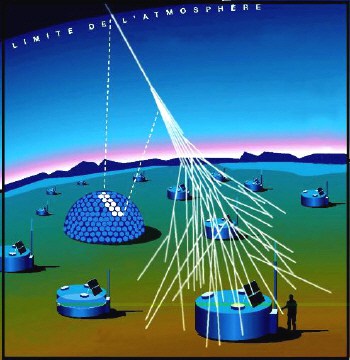
When the observatory is completed in 2005 it will contain 1600 water detectors and 24 fluorescence telescopes. Each detector will be separated by about 1.5 km and the entire array will occupy an area 3000 square kilometres, making it the largest experiment ever built. Ultrahigh-energy cosmic rays strike the Earth once per century per square kilometre, so Auger should record about 30 of these events per year, along with large numbers of lower-energy cosmic-rays. The Auger collaboration is also preparing a proposal to build a second detector of the same design in the US.

Super-cool detector spots single photons

Astronomers routinely use charge-coupled detectors (CCDs) in telescopes to capture and measure the light emitted by stars and galaxies. However, these detectors cannot simultaneously detect individual photons and record their energy because of noise. Single-photon detectors would significantly improve the performance of telescopes and other astrophysical experiments, such as measurement of the cosmic microwave background.

Jonas Zmuidzinas and colleagues at the Jet Propulsion Laboratory and the California Institute of Technology made their detector from a single layer of superconducting aluminium about 2 angstroms thick. At temperatures near 1 kelvin a resistance-free current flows in the film due to the movement of Cooper pairs of electrons. When photons hit the film, however, some of these pairs break up and this causes a reduction in the supercurrent. Zmuidzinas and colleagues measured this change with a microwave probe, which allowed them to calculate the energies of individual photons.

The detector operates at low temperatures to eliminate the thermal effects that would otherwise disrupt a single-photon signal. However, the device is relatively simple to fabricate, so it could easily be made into a large array that contains hundreds of pixels. Comparable existing devices contain only about 40 pixels.

The team is now working to improve the sensitivity of the detector. “With about an order of magnitude improvement in sensitivity, the detectors would be compatible with the most demanding applications,” team member Peter Day told PhysicsWeb. “We are looking forward to building a prototype instrument using this technology for a telescope such as the Caltech Submillimetre Observatory (CSO).”

Extracting electricity from water

When a liquid, like water, comes into contact with a non-conducting solid, the solid surface becomes charged with a thin layer. The dimensions of the microchannels used in the Canadian experiments were comparable with the thickness of this charged layer. This means that if water is then forced through the channel, ions with an opposite charge to the surface preferentially pass through it, and ions with a like charge stay behind. This results in the channel becoming positive at one end and negative at the other – like a battery.

If the channel ends are connected together by a wire, current flows. Although the current through an individual channel is very small – about a nanoamp – it can be increased by forcing the water through a large number of parallel channels.

Kostiuk and co-workers used a glass disk 2 centimetres in diameter that contained 450 000 circular microchannels, each between 10 and 16 microns across. They held a reservoir of water 30 centimetres above the array and allowed it to flow through the disc under hydrostatic pressure, generating a current of 1500 nanoamps in the process. The power output could be improved by increasing the pressure drop, adjusting the size of the microchannels, decreasing the thickness of the glass disk or using a liquid with a higher salt concentration.

What might the new device be used for? “Applications are hard to foresee because we need to first characterize the voltage/current possibilities,” says Kostiuk. Potential applications could include batteries for small electronic devices such as mobile phones.

Negative-index materials made easy

First proposed over thirty years ago, negative refractive index materials bend light in the opposite direction to ordinary materials. However, they were not demonstrated experimentally until 2000. Although some physicists argued at the time that only the phase velocity of the light was negatively refracted, rather than the group velocity, recent experiments and computer simulations have overcome this and other objections. Nevertheless, researchers have only ever observed negative refraction in complicated ‘meta-materials’ so far.

Now, Yong Zhang and co-workers have demonstrated total negative refraction in a ‘twinned’ alloy that contains yttrium, vanadium and oxygen. This commonly found ferroelastic material contains two uniaxial crystals whose optical axes are oriented symmetrically with respect to the interface. The researchers found that the interface could refract light of any frequency and electron waves as well. This is an improvement on previous negative-index materials that only worked for microwave radiation. Furthermore, depending on the angle of incidence, the interface could also positively refract light.

“This is the first time that both total refraction, that is zero reflection, and amphoteric refraction – both positive and negative refraction – have been seen in the same material,” Zhang told PhysicsWeb. “Reflection is sometimes thought of as the penalty electromagnetic waves must pay when they are refracted. Our result shows that this does not have to be the case.”

By demonstrating negative refraction in such a simple material, the researchers believe that it should now be easier to study new optical phenomena – such as the reversal of the Doppler effect and Cerenkov radiation. They say that their crystal could also be used to steer electron beams in nanoelectronic devices, and to transport high-power laser beams in reflection-free lenses.

Frogs turn to physics

Xenopus relies on about 200 so-called lateral-line organs to navigate and detect prey. These organs are located along the sides of its body, and also around its eyes, head and neck. Each lateral-line organ contains 4 to 8 small gelatinous ‘cupulae’, which can be deflected by local movements in the water. This deflection stimulates sensory hair cells at the base of each cupula, which then generate a neuronal response.

Now, Jan-Moritz Franosch and co-workers have created a ‘minimal model’ of the frog’s neuronal activity using a simple algorithm. This model first eliminates noise effects caused by the non-identical wave patterns produced by an insect. It then explains how the frog can reconstruct the shape of a water wave – its ‘waveform’ – to determine the direction of the prey, as well as information about its size and shape. Moreover, the model shows how Xenopus can resolve two overlapping waves – from two different insects for example – with different frequencies because it is able to separate out the component waveforms.

“We found that the frog’s detection system is very robust because it functions even if half of the organs are not working,” team leader Leo van Hemmen told PhysicsWeb. “We hope that by proving that the frog performs waveform reconstruction, biologists will now be able to work out its underlying neuroanatomy.” The team also hopes to apply its results to other aquatic amphibians, fish and even reptiles such as crocodiles.

New conductor stands the heat

Most materials exhibit positive thermal expansion and expand when heated, although a small number display negative thermal expansion and contract instead. If combined, these two types of material can form a composite that does not expand at all as the temperature is changed. Such ‘zero-expansion’ composites are useful because they can withstand rapid variations in temperature.

Now Mercouri Kanatzidis and colleagues at Michigan State University have discovered that a non-composite material made of ytterbium, gallium and germanium can also exhibit zero-expansion behaviour. Moreover, the new compound conducts electricity, whereas previous zero-expansion materials were insulators. Furthermore, the effect is observed over a wide temperature range – between 100 and 400 Kelvin.

Kanatzidis and co-workers speculate that as the sample cools, delocalized electrons in the valence band associated with the gallium atoms become localized on ytterbium atoms, which expand as they accept the electrons. The gallium atoms, on the other hand, contract. Since the gallium atoms only contract by a small amount, this leads to a positive thermal expansion coefficient in one direction. However, the material can be prepared and processed so that there is an almost equal and opposite contraction in the other two directions. This results in a negligible overall volume change in the unit cell.

“We hope that these results will allow us to look for zero-expansion materials among semiconductors and intermetallic compounds, which had not been thought of before now,” Kanatzidis told PhysicsWeb. “Perhaps new systems that take advantage of such valence transitions could be considered. This is a fresh approach to such materials.”

Nanothermometers feel the heat

Last year Yihau Gao and Yoshio Bando at the National Institute for Materials Science in Tsukuba found that the height of a column of liquid gallium in a nanotube – a sheet of graphite rolled into a cylinder – varies linearly with temperature. This is analogous to the behaviour of mercury in a conventional thermometer, albeit on a scale that is a billion times smaller. Researchers therefore ‘read’ the temperature with an electron microscope.

This nanothermometer, which consisted of a nanotube closed at both ends, could record temperatures between 323 and 823 kelvin. In contrast, existing nanoscale devices are only able to operate between 4 and 80 kelvin. However, the original device had only been demonstrated inside the high vacuum conditions of an electron microscope.

Now the same team has shown that if the nanotube is left open at one of its ends, the thermometer can operate in air. At high temperatures, the liquid gallium forms a thin oxide layer that sticks to the inner walls of the nanotube near the open end. The position at which the layer forms corresponds to the height of the gallium meniscus just before it oxidized. This oxide layer remains in place even after the thermometer has cooled down.

The researchers tested the device by placing it in a furnace and comparing the temperature it recorded with that measured by a thermocouple. They found that the two measurements agreed with each other to within 5 to 10%. Gao and co-workers say that the device is still in an early stage of development. However, it already shows promise for use in micro- and nanoscale environments where it would be impossible to use a conventional thermometer.

Darmstadt gets credit for new elements

Sigurd Hofmann and co-workers first created element 111 in December 1994 by colliding a beam of nickel-64 nuclei with a target made of bismuth-209. The GSI team observed three chains of events that signalled the production and decay of nuclei that contained 111 protons and 161 neutrons.

However IUPAC – the organization that is responsible for assessing such claims – was reluctant to accept this result as conclusive proof for the discovery of a new element because two of the decay chains involved isotopes that were unknown at the time: meitnerium-268, which contains 109 protons, and bohrium-264 (107 protons). The next members of the chain – dubnium-206 (105 protons) and lawrencium-256 (103 protons) – were known but the group was unable to unambiguously measure their decay.

In 2000, the GSI team repeated their experiment with an improved set-up and observed another three decay chains. Moreover, this time Hofmann and co-workers succeeded in detecting isotopes all the way down to lawrencium-256 and the IUPAC-IUPAP working party accepted the new result (P Karol et al. 2003 Pure Appl. Chem. 75 1601).

“IUPAC will now ask us to suggest a name for element 111 and we are in the process of discussing this at GSI,” Hofmann told PhysicsWeb.

However, the working party reported that further results will be needed before credit can be assigned for the discovery of elements 112, 114 and 116. Evidence for these new elements has been seen at GSI and in experiments by Yuri Oganessian’s group at the Dubna Laboratory of Heavy Ion Nuclear Reactions in Russia. Claims by a US team to have created element 118 in 1999 were subsequently retracted after it emerged that the results had been fabricated by one member of the team.

Is the universe a dodecahedron?

The cosmic microwave background provides a picture of the universe as it was some 400 000 years after the big bang. By this time the universe had cooled down enough for atoms to form, which meant that there were no longer any free electrons to scatter the photons produced in the early universe. Any variations or anisotropy in the temperature of the background radiation therefore reflect variations in the density of the universe at this time.

These temperature fluctuations can be expressed as a sum of spherical harmonics, and astrophysicists plot the relative strength of these harmonics as a function of angle. The height and positions of the peaks in this so-called ‘power spectrum’ are related to basic astrophysical properties of the universe.

Data from the first year of the WMAP satellite – unveiled in February – agreed with the predictions of the standard big bang plus inflation model of cosmology for regions of space separated by small angles. However, on larger angular scales – greater than 60° – the WMAP observations were significantly lower than this model predicted (figure 1).

Jean-Pierre Luminet of the Observatoire de Paris and colleagues believe that the finite size of the universe itself is responsible for this behaviour. Moreover, they show that the predictions of a model in which space consists of 12 curved pentagons joined together in a sphere agrees with the WMAP observations (figure 2). Their ‘small’, closed universe should be about 30 billion light years across.

“Our work really addresses this ancient question of whether the universe is finite or infinite,” team member Jeff Weeks, a freelance mathematician based in New York, told PhysicsWeb. “The exciting point is that this is no longer pure speculation – we now have real data.”

The team says that its result, if confirmed, will have implications for theories and models of quantum gravity, inflation and the big bang itself. However, the model needs to be tested further by studying the microwave background at larger angles using more data from WMAP and the Planck Surveyor, which is due to be launched later this decade.

Nobel prize goes to low-temperature theorists

At low temperatures most metals allow electric currents to flow without any resistance – a phenomenon known as superconductivity. However, metals stop being superconductors when they are placed in a strong enough magnetic field.

Type-I and type-II superconductors respond to magnetic fields in different ways. Type-I materials completely repel magnetic fields, whereas superconductivity and magnetism can co-exist in type-II materials, which means that they can remain superconducting in higher magnetic fields. This is a distinct advantage because many applications of superconductivity involve the production of magnetic fields – in magnetic resonance imaging (MRI) scanners and particle accelerators, for instance.

The theory of type-I superconductors was developed by Bardeen, Cooper and Schrieffer (BCS) in the 1950s and recognized with the 1972 Nobel prize for physics. In the 1950s Ginzburg developed a theory for type-I superconductors that was later extended by Abrikosov to explain the behaviour of the type-II materials.

Superfluidity – in which a fluid can flow without any viscosity – is another phenomenon that is only observed at temperatures near absolute zero. Superfluidity in helium-4 was discovered in the 1930s. However, it came as a complete surprise when superfluidity was observed in experiments in helium-3 in the early 1970s – a result that earned the 1996 Nobel prize for David Lee, Douglas Osheroff and Robert Richardson. Shortly afterwards Leggett provided an explanation by showing that the helium-3 atoms form pairs in the same way that electrons form Cooper pairs in the BCS theory of superconductivity.

Both Abrikosov and Ginzburg were born in Moscow, while Leggett was born in London. The prize, which is worth 10 million Swedish kroner, will be shared equally between the three.

Copyright © 2026 by IOP Publishing Ltd and individual contributors