Biomolecule behaves like a wave

The classic signature of wave-particle duality in quantum particles is the wave-like interference pattern that is produced when a beam of particles passes through a ‘double-slit’. Researchers have seen wave-particle duality in electrons, atoms and small molecules but it has never been seen in the macroscopic world. This is because the quantum – or de Broglie – wavelength is so small for large objects that we cannot detect their interference in a practical experiment.

In 1999, Anton Zeilinger’s group at the University of Vienna observed wave properties in carbon-60 molecules – buckminsterfullerenes or ‘buckyballs’ – and in their larger counterparts, carbon-70 molecules. At the time, these were the largest objects ever to have exhibited de Broglie wave behaviour but with a diameter of about 1 nm they were still over 6 orders of magnitude smaller than real macroscopic objects.

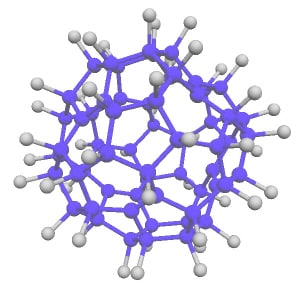
The Vienna team, now jointly led by Zeilinger and Markus Arndt, has performed a new experiment on tetraphenylporphyrin molecules. These biological molecules are present in chlorophyll and haemoglobin. They have a diameter of about 2 nm (figure 1), which is over twice as big as a carbon-60 molecule.

In the experiment, porphyrin molecules that had been submlimated in an oven were passed through a new type of interferometer containing three sets of diffraction gratings, each separated from each other by about 38 cm. The first grating produces a coherent beam of molecules. The second produces the interference pattern, and the third images this pattern by counting the number of transmitted molecules. The slits in the diffraction gratings were about 500 nm wide and the grating itself had a period of about 1000 nm.

The researchers observed a high-quality interference fringe pattern characteristic of quantum behaviour. “We expected these molecules to couple easily with their environment – which would have ultimately destroyed the interference – but our experiment proves the contrary,” Arndt told PhysicsWeb.

The team then repeated the experiment with a fullerene compound that contains 60 carbon and 48 fluorine atoms (figure 2). “Although the experiments were much more demanding for this object – because of count rate and background noise – we again observed interference fringes,” said Arndt. This molecule is twice as large as carbon-60 and with 108 atoms is the most complex object to show wave-like properties .

The group say their results probe even further the length scales at which quantum behaviour breaks down and classical physics takes over. They now hope to study molecular interference patterns in larger objects like proteins or small nanocrystals by modifying their apparatus. The researchers speculate that in the long term such molecular nanopatterns might even find use as the building blocks in opto-electronic nanodevices or to nanostructure surfaces.

A new place to store toxic waste?

Bernard Marty and colleagues at the Centre de Recherches Pétrographiques et Géochimiques (CRPG) and the Ecole Nationale Supérieure de Géologie performed their studies on the eastern Paris basin near Nancy in France. This natural site contains a layer of low-permeability ‘aquitard’ rock sandwiched between two water-bearing layers of rock called ‘aquifers’. The upper aquifer layer (Dogger) is separated from the lower layer (Trias) by about 600 metres of aquitard rock made of shales and clays (see figure).

The researchers analyzed the movement of groundwater between the two aquifer layers by monitoring the presence of helium-3 isotopes. Helium-3, which is chemically inert and has a small atomic radius, is one of the most mobile isotopes in nature. The presence or absence of the tracer would indicate how water has moved over the ages.


Using samples taken from drill holes made by the French Nuclear Waste Agency, Marty and co-workers found, as expected, the presence of helium-3 in the Trias aquifer. It exists in the Trias aquifer because it has accumulated the isotope from the Earth’s crust and mantle. However, the Dogger layer was found to contain no helium-3, despite there being water in the two aquifer layers for several million years. The team concludes that helium-3 has not flowed into it due to the “the isolating properties of the intermediate aquitard”.

The researchers calculated that the mass transfer of isotopes through aquitards is negligible on geological time scales. Any flow in the basin takes place only where there are naturally occurring faults or fractures. These would inevitably allow some substances to seep through, they say.

“This work has implications for potential waste storage in these impermeable layers, but of course our results do not provide a definite answer to this,” says Marty.

Entanglement goes macroscopic

Entanglement is a feature of quantum mechanics that allows particles with two distinct quantum states to share a much closer relationship than classical physics allows. If two particles are entangled, then we can know the state of one particle by measuring the state of the other. For example, if one particle has a spin ‘up’ then the other automatically has a spin ‘down’. Entanglement is crucial for quantum computing and teleportation but its effects are not generally seen beyond the scale of subatomic particles.

Thomas Rosenbaum at the University of Chicago and colleagues performed their experiment on a single crystal of a simple magnetic salt that contains lithium, holmium, yttrium and fluorine (figure 1). The holmium atoms in this salt all behave like tiny magnets and, in the absence of a magnetic field, their magnetic moments point in random directions. When a field is applied, however, the moments align up with the direction of the field (figure 2).

The researchers measured the ease with which the magnetic moments aligned with the field at different temperatures. They then compared this ‘susceptibility’ to the material’s ability to absorb heat and found that the two properties were very different.

The susceptibility increases smoothly as the sample cooled while the heat absorption varies in a more irregular way. This is in contrast to ordinary materials and, according to the researchers, can only be explained if there is quantum mechanical mixing – or entanglement – of the different magnetic states in the system. This is because entanglement effects contribute much more strongly to the susceptibility than to the heat absorption.

To confirm their findings the researchers combined their experimental results with computer simulations and theory. The salt’s susceptibility was found to match theoretical values that had been predicted to take quantum entanglement into account.

The researchers say that their work shows that entanglement can occur in a disordered solid that is far from perfect. “We see these dense, solid state magnets as promising systems for both fundamental quantum mechanics and potential quantum computing applications,” Rosenbaum told PhysicsWeb. “The challenge remains to manipulate the entanglement to perform actual quantum logic operations.”

Dark matter deficiency puts theory in the shade

Dark matter was originally proposed to explain why galaxies rotate as though they contain much more matter than astronomers can detect with telescopes. The existence of this invisible mass – and its gravitational pull on ordinary baryonic matter – has become a cornerstone of modern cosmology, but now Romanowsky and colleagues have cast doubt on its existence in certain galaxies.

For three elliptical galaxies, the researchers measured how the rotational speed changed from the centre of the galaxy to its outer edge. To do this, they used the 4.2-metre Herschel telescope in La Palma to look for planetary nebulas – shells of gas ejected by sun-like stars at the end of their lives. The spectra emitted by these shells contain well-known absorption lines, which are red-shifted for nebulas receding from Earth and blue-shifted for those approaching us. The degree of this Doppler shift enabled the researchers to calculate the velocities of hundreds of nebulas, and therefore their galactic neighbourhoods.

To their surprise, Romanowsky and colleagues found that the rotational speed of the galaxies fell towards their outer edges – a result that Johannes Kepler would have predicted long before the advent of dark matter. In contrast, the rotational speed of matter beyond the visible edge of spiral galaxies remains constant. Astronomers believe this arises from the gravitational effect of ‘halos’ of dark matter around spiral galaxies. Now they must explain why certain types of galaxy appear to be rich in dark matter while others seem to be deficient.

Incidentally, planetary nebulas have nothing to do with planets – the term is a misnomer that dates back to their discovery in 1764.

Jemma targets the world of physics

Planetjemma.com is an innovative and creative site that has been designed to encourage more young women to study physics at university. Launched earlier this year by the UK’s lottery-funded National Endowment for Science, Technology and the Arts (NESTA), the site is aimed at girls aged between 14 and 16. It centres on the activities of Jemma Campbell, a fictitious first-year physics student at the imaginary Wells University.

Rather than merely being a source of information, the site has an online video diary made by Jemma, and includes interactive features like daily e-mails and text-message games from Jemma herself. There are also profiles of female physicists – like fusion scientist Yasmin Andrews from the Joint European Torus project – as well as notes on weird and wonderful aspects of physics like black holes or quantum entanglement.

As a depiction of life as a female physics undergraduate, parts of the video diary ring horribly true. Geeky course mates, disastrous practicals and sexist lab demonstrators all featured in my degree. On the other hand, having an inspirational teacher like Jemma’s astrophysics tutor Dr Shepherd would have been great. So does the site appeal to teenagers?

My 16-year-old sister Hannah finds the interactive aspects of the site the most appealing, but her main grudge is the lack of physics on the site. “The ‘physics notes’ sections do not include much of a real scientific explanation,” she says. As for encouraging girls to study physics, the danger is that the site could merely appeal to the converted. “It did not put me off physics, but then I am already interested in the subject,” adds Hannah. “I do not think it will make much of a difference to girls who did not like physics already. It might, however, encourage some girls to go to university because it makes doing a degree look achievable.”

This article was written by Bekki Pearce who is completing an MSc in science, culture and communication at the University of Bath, UK, e-mail bekki_pearce@hotmail.com

Planetjemma.com details the life of a 19-year-old student called Jemma from the Isle of Wight, who is currently doing a degree in physics and astrophysics. As we are interested in studying physics ourselves, we found it particularly useful to have an insight into Jemma’s world and how she copes with life, study and even romance.

After signing in, users are free to roam the many pages and menus incorporated within the site. Jemma even sends a personal daily e-mail, so you do not miss anything. The site is extremely well animated, futuristic and would therefore definitely appeal to younger people. The menus are easy to use and the site is relatively simple to navigate. However, it took us quite a while to find an area of the site that focuses on physics. Another problem is that the site does not emphasize the course structures and interesting topics that Jemma has covered.

Although there are a few links to items on the BBC website about quantum teleportation, the site lacks links to related articles and there is little substance to it. Jemma could also have said more about college life, which would help people like ourselves who are thinking of going to university. Another idea would be some sort of forum to allow people – especially students from different universities – to share their views. This would help to give a broader insight into the different physics courses that are available.

Tessa Bircham, Hannah Gilbert, Emily Graham,Lindsey Mehrer and Nicola Wood are year-12 pupils at Parkstone Grammar School, Poole, Dorset, UK

New look for a classic lab guide

Here is a classic in new clothing. Some 37 years ago Adrian Melissinos wrote a guide for physics students taking a senior-year lab course. It was an instant success, partly because it was unique. It was not a laboratory manual and it was not a textbook in modern physics. Instead, it provided background material that students would need to know in order to perform a wide variety of experiments in modern physics.

Since that first edition of Experiments in Modern Physics appeared there have been several revolutions in our understanding of the micro and macro worlds. There remains, however, a permanent foundation of theoretical models and experimental techniques. A student must master these in order to take the next steps in research.

Although Melissinos’ book is not out of date and still provides a lucid summary of many of the foundations of physics, experimental techniques – even in undergraduate labs – have changed dramatically. Transistors have replaced vacuum tubes, and computers are now used to analyse data and plot graphs. This new version of the book, now by Melissinos and Jim Napolitano, brings the student laboratory up to date.

The authors assume that students can use calculus easily and that they are taking a concurrent course in modern physics. The first few chapters are relatively straightforward and might be used in the third year of an undergraduate physics degree. Topics include experiments on electrons in solids (resistivity, the Hall effect, superconductors), electronics and data acquisition (simple measurements, Johnson noise, chaos), lasers (basic properties, interferometers), optics (diffraction, Fourier series, the Faraday effect) and quantization.

Most of these lab exercises could be done as one session per week. The more difficult problems in the second part of the book would, however, take several weeks of class discussion and laboratory work with paired students. This section includes experiments with high-resolution spectroscopy, magnetic resonance, particle detectors, scattering and statistical analysis.

One of the more familiar exercises involves repeating Millikan’s oil-drop experiment to demonstrate quantization and to measure the charge on an electron. These days the trickiest part of the experiment can be avoided by using plastic spheres rather than oil droplets. Produced commercially for calibrating electron microscopes, the spheres are guaranteed to have a diameter of 1 µm ± 1%. Millikan, and thousands of physics students since, did not have such spheres available.

The challenge for students is how to measure the diameter – and hence the weight – of the droplet. But because the diameter must not be much larger than the wavelength of light, diffraction cannot be used to measure the dimension optically. Millikan resorted to measuring each droplet’s drift velocity, which, according to Stokes’ law, depends on the diameter. Melissinos and Napolitano do the same, providing the derivation for using Stokes’ law complete with error analysis.

The chapter on electronics and data acquisition starts at a fairly low level, designed to establish logical concepts, step by step. The reader is even reminded about the sum rules for resistors and capacitors. Basic electronic equipment is described, including oscilloscopes, digitizers and operational amplifiers. With the preliminaries established, the lab work involves the measurement of Johnson noise, the production and analysis of chaos, and the behaviour of computer interfaces.

The nature of the book can be best illustrated by describing the topics of the major section on particle detectors. Instead of starting with a description of the construction and uses of ionization or scintillation devices, the authors first summarize the theory of the several kinds of particle energy loss.

They first explain how charged particles ionize material through which they pass. The rate of energy loss is a function of the particle velocity, the density and atomic number of the material, and the square of the particle charge. Particles travelling slowly therefore ionize strongly, but when the particles are moving at speeds close to that of light, the rate of ionization passes through a minimum. Photons lose energy through stochastic processes – the photoelectric effect, Compton scattering and pair production. Particles with zero charge, such as the neutron or the neutrino, can be detected only by observing the charged particles that result from a collision of the neutral particle and a nucleus. In addition to ionization, electrons also lose energy through bremsstrahlung – the production of X-rays as an electron is accelerated by passing close to a nucleus.

These preliminary facts about particle behaviour serve as a review of nuclear physics. The authors then apply these facts to describe the operation of gas ionization chambers, including the Geiger counter, scintillation detectors and solid-state detectors. The lab exercises that follow the theory do not, however, include track devices such as cloud or bubble chambers, emulsions or wire chambers. In the last 40 years these have either become obsolete or have become part of giant arrays in the targets of large accelerators.

The book’s appendices provide useful warnings about the dangers of lasers and radioactivity. There is also a short introduction to MATLAB software, although the authors point out that the text procedures are compatible with many other computer programs. The book has no end-of-chapter problems, but the final appendix does contain a large assortment of exercises that can be used as homework problems or as take-home tests.

The level of maths used in Experiments in Modern Physics takes it out of the range of the casual reader. Even the background material assumes that sophistication at the level of a third-year undergraduate. Although this background material is very well written, it would be wasted if the reader were not also doing the experiments. But when used as the authors intend, the new version of this classic text continues to set the standard as an introduction to experimental methods in physics.

Astronomy of the invisible

Legend has it that when word reached Copenhagen of the discovery of the neutron in 1932, Niels Bohr threw a great party at his home. Among his guests was a young Russian named Lev Landau, who is said to have quietly remarked that “stars could be made with this new particle”. Astronomers like to think that this was said in earnest – and not under the influence of Danish hospitality – because we now know that neutron stars really do exist.

The characteristics of neutron stars were first described two years later by Walter Baade and Fritz Zwicky at the California Institute of Technology, but astronomers had to wait until 1968 to actually detect one. That was when Jocelyn Bell, then a PhD student, and her supervisor Anthony Hewish (the only person to get a share of the 1974 Nobel prize for the discovery) came across a series of faint, pulsed radio signals while studying quasars at Cambridge University. The period of these signals was so precise that they were initially thought to be signs of extraterrestrial intelligence.

After further sources were detected, Franco Pacini – who later became president of the International Astronomical Union – and Tommy Gold interpreted the signals as a “lighthouse” effect. Although Pacini and Gold were both at Cornell University at the time, they concluded independently that the radio beams were being emitted by a rotating, highly magnetized neutron star.

This explanation – in which the radio waves are produced by synchrotron radiation from relativistic particles that are accelerated by the star’s magnetic field – was quickly verified, but not soon enough to prevent rotating, magnetized neutron stars from being called “pulsars”. This term – a contraction of “pulsating star” – was coined by a journalist from the Daily Telegraph who was present during the first discussions about the mysterious radio pulses. Had he waited a week or so for the correct interpretation to emerge, what would we be calling pulsars now – rotars? neutrars?

Compact stars

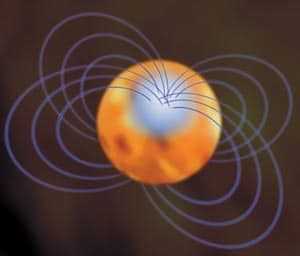
Neutron stars are compact objects that pack a mass comparable to that of the Sun into a volume about 20 km across (figure 1). They are thought to originate in supernova explosions as the result of a gravitational collapse, and can be said to be one stop short of a black hole in the evolution of a massive star. The structure of a neutron star is determined by an equation of state – which relates its pressure to its density – and constraining this equation of state is a major goal in neutron-star astronomy.

The density of a neutron star is close to that of a nucleus, but depending on its precise equation of state, the composition of a neutron star can vary from neutrons and protons to hyperons – particles that contain strange quarks – and possibly even free quarks. A neutron star that weighs more than 1.6 solar masses, for example, would require an equation of state that incorporated “exotic” matter. However, most neutron stars have a mass of about 1.35 solar masses, albeit with interesting exceptions. So far no evidence has arisen for “strange” stars – neutron stars that contain strange quarks – but the search is on, and the equation of state is our best tool in the hunt.

The magnetic field of a neutron star, which is boosted to about 108 T by its gravitational collapse, is also an important factor in determining its equation of state. Furthermore, the conservation of angular momentum implies that neutron stars and their magnetic fields rotate rapidly, with periods varying from milliseconds to seconds. This means that neutron stars are formidable radiation emitters and particle accelerators.

In 1970 Riccardo Giacconi and colleagues at American Science and Engineering stumbled across a new class of celestial X-ray sources that were bright and variable with a fast periodicity. Giacconi, who shared the 2002 Nobel Prize for Physics, was on his way to showing that neutron stars could be bound in binary systems along with normal stars. However, the extreme density of neutron stars makes their orbits much tighter, and their periods much shorter, than those of normal star-meets-star binaries.

Moreover, the gravitational attraction of a neutron star is so strong that it actually pulls some of the external layers of the normal star onto itself. This accretion process follows the laws of celestial mechanics and gravitation, and the in-falling matter can organize itself into a disk that rotates around the neutron star. The temperature of this disk can be as high as 106 K due to internal viscosity and friction, which makes it visible in the X-ray region. The disk can also be eclipsed and give rise to spectacular variations in the star’s X-ray flux, which provides an excellent hook for understanding a binary system. To paraphrase what John Wheeler is supposed to have said after the discovery of neutron stars, “who suspected that they would come equipped with a bell and a handle?”.

An enormous amount of data at various wavelengths has been collected from binary systems in the three decades since their discovery, and they remain one of the most important sources of neutron-star phenomenology. In particular, astronomers can calculate the mass of a neutron star by studying the gravitational interaction of the binary system.

In 1974 Russell Hulse and Joe Taylor, then at the University of Massachusetts, discovered the first binary system that contained two neutron stars. The dynamical behaviour of this extreme system provided the first indirect evidence for gravitational waves, for which Hulse and Taylor shared the 1993 Nobel Prize for Physics.

Today some 10 neutron-star-neutron-star binaries have been discovered, and radio astronomy has accumulated a spectacular database of more than 1500 pulsars. Indeed, radio astronomy can also be used to study the equation of state of neutron stars. Since 1969 astronomers have found 25 pulsars that show “glitches” in their rotation periods, which are normally extremely precise. These glitches are thought to be caused by the transfer of angular momentum from the fast-rotating, superfluid core of a neutron star to its solid crust.

Andrew Lyne’s group at the University of Manchester has recently observed intermittent behaviour in the radio pulsar PSRB1828-11. This could be the first example of a freely precessing, or “wobbling”, neutron star – something ruled out by many equations of state (see Physics World October 2000 pp27-28). Meanwhile, Curt Cutler at the Max Planck Institute for Gravitational Physics in Germany and co-workers at Caltech and Montana State University have analysed the impact of the behaviour of PSRB1828-11 on the rigidity of its crust. They concluded that the crust of the star is under significant stress, which has far-reaching implications. Stay tuned for more broadcasts from this new radio station.

High-energy window

Neutron stars do not have any nuclear fuel so they do not shine like other stars. But this does not mean that we cannot see them. Indeed, neutron stars are tailor-made for multi-wavelength astronomy, and their extremely high temperatures make them especially interesting sources of high-energy astrophysics. Just as no one doubts that the ancient Chinese invented gunpowder for shooting pheasants, I firmly believe that X-ray and gamma-ray astronomy were invented for studying neutron stars.

After Giacconi and colleagues made the first satellite measurements of binary systems, a crescendo of observational missions took place. Particularly important were the Einstein Observatory, the German ROSAT mission and a number of impressive Japanese missions. More recently two higher-energy gamma-ray observatories were launched – Italy’s BeppoSAX and NASA’s Rossi XTE. These missions were named in honour of two lifelong friends, Beppo Occhialini and Bruno Rossi.

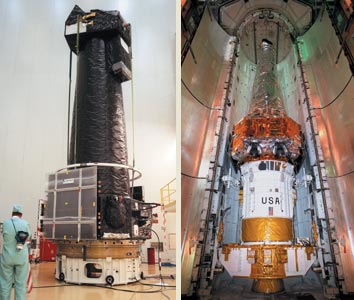
The hot news in neutron-star astronomy, very much in the literal sense, has come from the two great X-ray observatories XMM-Newton and Chandra (figure 2). Until recently, many astronomers thought that neutron stars contained a complex atmosphere that would modify their black-body-like surface radiation. However, this view has now changed thanks to striking X-ray measurements of the surface of isolated neutron stars, which can reach temperatures of a few million degrees.

Isolated neutron stars, as opposed to those in binary pairs, appear to have featureless, black-body spectra that do not contain any telltale atmospheric features – at least not for the dozen cases for which we have good enough data. The only notable exception is 1E1207.4-5209. Recent data from XMM-Newton show that the absorption spectrum of this neutron star contains a series of intriguing features, which occur at energies that are integer multiples of 0.7 keV (see Physics World July 2003 p3). To neutron-star astronomers this is immediately recognizable as being due to cyclotron resonance absorption – a process whereby electrons or protons at the surface of the neutron star oscillate due to the star’s magnetic field, which causes them to absorb photons at a particular energy.

The immediate consequence of this is that the magnetic field of an isolated neutron star can be directly measured for the first time, and not just evaluated according to models of a rotating dipole. Furthermore, if the particles responsible are electrons – as most astronomers believe – the measured magnetic field for 1E1207.4-5209 works out to be just 8 x 10⁶ T. Although huge by terrestrial standards, this is much lower than expected, and the discrepancy is still not understood. It might involve fine-tuning the theory that describes the generation and decay of magnetic fields in isolated neutron stars. However, it could also be due to a trapped-particle belt around the star – much like the Van Allen belts surrounding the Earth – or even a disk of debris orbiting the star.

Atmospheric results

Any debris that surrounds a neutron star is good news for astronomers. Indeed, the first extrasolar planets to be discovered were in orbit around the pulsar PSR1257+12 (see Physics World July 1997 pp31-36). An atmosphere that forms by the accretion of gaseous material can enhance and even distort the high-temperature phenomena that take place near a neutron star. It is therefore our best diagnostic tool for understanding neutron-star physics.

A case in point is a recent measurement of the atmosphere of EXO0748-676 – a neutron star with a low-mass companion star – which emits frequent bursts of intense X-rays. Jean Cottam at NASA’s Goddard Space Flight Center, Fritz Paerels at Columbia University in New York and Mariano Mendez at the SRON Institute for Space Research in the Netherlands measured the gravitational redshift of the X-ray lines that are emitted close to the surface of this neutron star for the first time. From this they were able to estimate the ratio of the star’s mass to its radius, and thus constrain its equation of state (see Cottam et al. in further reading).

The fact that this low-mass X-ray binary system undergoes significant “bursting” activity is probably due to its intermittent accretion. More than 20 bursts were observed by XMM-Newton in early 2000, and the quality of the spectra was so good that several atomic absorption lines of iron and oxygen could be seen. To identify them, however, Cottam and co-workers had to systematically shift the lines to longer wavelengths by a redshift z = 0.35. This is precisely the value that would be expected for a photon trying to overcome the gravitational field of a “standard” neutron star. The researchers were able to constrain the mass of the neutron star to be between 1.4 and 1.8 solar masses and its radius to be 9-12 km, thereby ruling out equations of state based on exotic states of matter, such as strange quarks.

Meanwhile, Craig Heinke and co-workers at the Harvard-Smithsonian Center for Astrophysics have used the Chandra X-ray satellite to study neutron stars in two binary system in the globular cluster 47 Tucanae. These objects undergo periodic accretion and as a result they probably have a hydrogen atmosphere that may even contain metals. More interestingly, however, one of these neutron stars appears to have a mass that is about 1.8 times larger than the mass of the Sun and a radius that is between 9 and 16 km.

If confirmed, this observation would place a severe constraint on the neutron-star equation of state. In particular, it would rule out a “soft” equation of state for the core of the star, which includes Bose-Einstein condensates of kaons, hyperons and pions. The result is also compatible with the mass range found by Cottam and co-workers using the gravitational-redshift data, which supports a non-exotic picture of the composition of neutron stars.

Mystery star

The latest demonstration of the power of modern X-ray observatories has come from measurements of the neutron star Geminga, which is located in the Gemini constellation. Geminga was discovered in 1973 by the NASA gamma-ray observatory SAS-2, but it remained a mystery for the next 20 years. Indeed, its name derives from a pun in Milanese dialect in which “Gh’é minga” means “it does not exist”. The X-ray emission of Geminga later revealed an isolated neutron star that pulsated with period of 237 ms, and ground-based observations in the optical region showed that this star was travelling relatively fast – a strong indication of its local nature. The Hubble Space Telescope revealed that Geminga is 522 light-years away, and also provided an absolute measure of its luminosity.

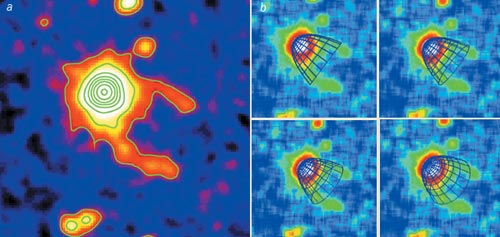
A few months ago the European Photon Imaging Camera on board XMM-Newton recorded a stunning image of Geminga (figure 3). This showed that the neutron star is trailed by a diffuse X-ray emission in the shape of two “tails” that are accurately aligned with the object’s motion in the sky. This tale of two tails is best told by considering that Geminga travels through the interstellar medium at about 20 times the local speed of sound. The star is therefore surrounded by a strong “bow shock”, which compresses its magnetic field and traps high energy electrons that it emits as it rotates. Astonishingly, the combination of these ultrahigh-energy 1014 eV electrons and the 10-5 G field is just right for producing the keV photons that XMM-Newton is sensitive to (see Caraveo et al. in further reading).

The mechanism behind the emission of these photons is magneto-synchrotron radiation, whereby an electron emits photons when it gyrates in a magnetic field. In fact, the radius of this Larmour gyration turns out to be precisely the same as the thickness of Geminga’s tails – about 6 x 10¹⁴ m. And the time it takes for electrons to lose most of their energy via synchrotron radiation in the compressed magnetic field is calculated to be about 1000 years, which is precisely the time it takes for the star to travel a distance equal to the length of its tails.

A dim future

The X-ray tails of Geminga were therefore probably ignited around the time of the Battle of Hastings. It would be pushing things, however, to claim that the Bayeux tapestry mistook Geminga for Halley’s comet! Astronomers should be content with having notched up yet another first with Geminga. Its tails allows us to probe the physics of the interaction between an isolated neutron star and the interstellar medium. They also provide solid evidence for the acceleration of ultrahigh-energy particles in a local magnetic field, which, in turn, provides a direct measurement of the field.

Where the next Nobel prize in neutron-star astronomy will come from we do not know, but the immediate future of the field looks particularly promising. Chandra and XMM-Newton are almost certain to find more telltale spectral features and perhaps bow shocks in other neutron stars. Great expectations are also being raised by the International Gamma-Ray Astronomy Laboratory (INTEGRAL), which was launched by ESA in October 2002. Meanwhile, the world’s largest astronomical facility – ESO’s Very Large Telescope – is preparing a second generation of instruments that are geared to fainter and fainter objects.

Neutron stars, alas, fall into that category. Geminga might be one of the best understood isolated neutron stars that we have found, but it has the same luminous flux as a candle on the Moon, which means that it will test these new telescopes to the limit.


Prospecting for oil with an optical nose

Dust, sandstorms and extreme variations in temperature make the desert one of the worst places on Earth to perform a delicate optical experiment. However, if that experiment can help to sniff out oil reserves, then it is well worth trying. Physicists from Shell and Glasgow University in the UK have recently returned from Oman, where they have been testing an ultra-sensitive “optical nose” that can detect trace concentrations of ethane. As well as promising a more efficient method of searching for the Earth’s ever-decreasing oil reserves, the new device may also prove effective in diagnosing lung cancer.

Underground oil and gas reserves give rise to microseepage of gases – principally methane and ethane – which escape from cracks in the ground. Unfortunately, due to various organic processes, methane is present throughout the Earth’s atmosphere at a concentration of between 1 and 2 parts per million, and this makes it impossible to distinguish any methane seepage from the background. Ethane, on the other hand, is not produced in organic processes and as long as there are no large cities or petrochemical stocks nearby, the background concentration of ethane is less than one part per billion. An ethane concentration in excess of this may therefore reveal an underground reservoir.

Historically, oil and gas deposits were identified by visible oil seepages at the surface. But as these deposits have became depleted, various techniques have been developed to identify new drill sites. Today most searches for oil rely on explosives or large mechanical “thumpers”, which transmit sound waves into the ground. However, interpreting the reflected sound waves in these seismic surveys takes several months, after which the majority of exploratory drills still turn out to be fruitless. And since it can cost several million pounds to drill an exploratory well, any techniques that can improve the “strike rate” are extremely valuable.

The smell of success

The ethane nose project – which was recently exhibited at the Royal Society’s summer science exhibition in London – began in the late 1990s. Bill Hirst of Shell Global Solutions contacted Graham Gibson and the present author to help develop an ultra-sensitive gas detector that could be used to search for oil in real time (see Physics World August 1998 pp37-40).

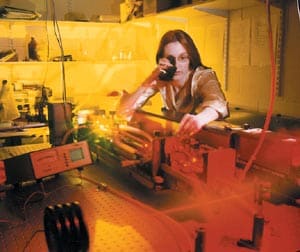
At the heart of the sensor is a liquid-nitrogen-cooled laser diode, which generates infrared light at the same wavelength as a molecular transition in ethane. Any molecules of ethane that are present in the sensor will absorb this light, and therefore be detectable. Air is drawn into a 1 m long sample tube, and mirrors at each end of the tube pass the laser light back and forth over 100 times. This creates an absorption length of over 200 m, which means that concentrations of ethane as low as 100 parts per trillion will produce a measurable absorption.

In the laboratory, such an instrument could be regularly tweaked to give optimum operation – an impossible task in the middle of the desert. Instead, sophisticated computer control keeps the mirrors aligned and also monitors the light passing through a reference cell filled with ethane. The complete instrument has a response time of 1 s and is housed within a four-wheel-drive vehicle with a portable generator.

Measuring the gas concentration is one thing; deducing where it has come from is another. To solve this problem we also measure the speed and direction of the wind, from which the ethane concentration at any given downwind position can be predicted. However, “inverting” this problem to find the upwind position – which could be a small source close by or a large source far away – is not possible. Instead, multiple measurements are made at different positions under various wind directions, and this allows an iterative “best guess” solution for the distribution of the gas emissions to be calculated.

The recent trial was our second trip to the Middle East, and the first time that the entire system was tested in the field. By “hiding” an ethane cylinder within the search area we were able to verify that the technique worked.

The desert is an interesting place in which to travel, although driving in the support vehicle feels more like a funfair ride than a scientific experiment. In order to negotiate the sand dunes the tyres have to be deflated to about 15 psi. Working during the summer under such conditions is nearly impossible, but plans are now in place for further surveys in cooler weather, when various oil-prospecting techniques will be compared. The real test of the device, of course, will be when drilling starts.

Spin off

The device could also have applications in a completely different, and slightly more pleasant, environment. While visiting the Glasgow lab, Chris Longbottom of Dundee University surprised us by pointing out that ethane is not just of interest to oil prospectors – it is also a significant bio-marker of oxidative stress. The body’s level of oxidative stress is increased by a variety of diseases, including cancer. In response to the cancer, free radicals in the body increasingly break down cell membranes into hydrocarbons that include ethane, which can be detected in exhaled breath.

Ken Skeldon from Glasgow is now working with Longbottom and his colleagues at Dundee to develop an instrument for breath analysis and the possible detection of lung cancer. The sensor is being used in preliminary trials at Ninewells Hospital, where volunteer patients are providing breath samples for subsequent analysis. In the longer term, breath analysis may also be useful for the detection and monitoring a range of conditions, including cardio-vascular diseases, Alzheimer’s and attention deficit hyperactivity disorder.

So you think physics is funny?

Q: Why won’t Heisenberg’s operators live in the suburbs?
A: They don’t commute.
Q: What do you get if you cross a pig with a rat?
A: Pig rat sine theta.
So this neutron walks into a bar, orders a pint of lager and begins to open his wallet when the barman says, “For you, no charge!”.

These jokes may make you laugh, grimace or groan – but they may also inspire you to wonder about the raw material for humour in physics, which may not be obvious at first glance. Where are the wordplays, repressed desires and bodily functions that normally propel jokes? The sex, aggression and death?

Close inspection, however, reveals uncanny similarities between physics and humour. Both, for instance, prize invention and the unexpected. Small wonder, then, that practising physicists find the field alive with wit, jokes, and laughter.

Things that make you go ha ha…

Much physics laughter takes standard forms, including cartoons, spoofs, limericks and one-liners. Many have been explored in the “Zero Gravity” column in the American Physical Society’s monthly newsletter. These have included physics product warnings (“This product warps space and time in its vicinity”), pick-up lines (“I want you to diagonalize my inertia tensor”) and jokes contrasting the various reactions of different professionals to the same situation.

The latter, which might be called “trio” jokes, often contrast the actions of a physicist with those of an engineer, who is eminently practical, and a mathematician, who is wholly impractical. The physicist usually comes off as being abstract but partly practical – but as wholly impractical when a farmer or carpenter replaces the mathematician, and poor-but-virtuous when the other two companions are an accountant and a lawyer.

A physics-limerick contest in the Zero Gravity column produced almost 200 entries. The best entries to a slogan contest were turned into badges, including: “Flirt harder, I’m a physicist”, “Know a good quantum mechanic?” and “Don’t drink and derive”. One, written in white lettering on a red background, became a bumper sticker: “If this sticker looks blue, you are driving too fast.”

The above material either belongs to a stock genre or has been around a while. Still, a well told joke is a treasure, however well worn or old, and enough new material keeps cropping up to satisfy physicists.

…or ha ha and then hmm

A different sort of humour in science – including physics – has been featured for the past 12 years at the annual Ig Nobel ceremony. Sponsored by the Annals of Improbable Research, the event takes place every October at Harvard University. The ceremony includes a mini-opera, a “Win a date with a Nobel laureate” contest, and so much paper airplane flying that, to keep the event moving, the organizers recruit someone whose job it is to clear the projectiles from the stage.

The highlight of the ceremony are the Ig Nobel awards themselves. These celebrate what the journal’s editor Marc Abrahams calls “found humour” in science – analogously to “found art”, or things stumbled across unexpectedly. Found humour, then, does not mean jokes. “It is”, says Abrahams, “about things that, when you hear about them, first make you laugh, then make you think.” It also often inspires one to check out the original research, whether out of intrigue or incredulity (see “Ig Nobels prove to be more than a joke” Physics World April 2003 p12).

The 2001 Ig Nobel prize for medicine, for example, was awarded to Peter Barss for his study of “injuries due to falling coconuts”. Barss carried out his study after noticing that a full 2.5% of trauma admissions to his hospital in Papua New Guinea were coconut-related (1984 Journal of Trauma 21 990-1). Coconuts can weigh as much as 4 kg and are formidable projectiles when they fall from treetops. Some victims, sustaining a force to the head of 1000 N, have required craniotomy, while others have died. Quite a few of the victims were highlanders, who had little experience with coconut trees and had chosen to sleep beneath the pleasant-looking palms while visiting relatives on the coast.

Meanwhile, Michael Berry from Bristol University shared the 2000 physics prize with Andre Geim, who was then at the University of Nijmegen, for “using magnets to levitate a frog” (1997 Eur. J. Phys. 18 307). Another physicist to have won a prize is Arnd Leike of the Ludwig Maximilians University in Munich, who showed that the height of beer froth in a glass decays exponentially (2002 Eur. J. Phys. 23 21).

The kind of humour on display at the Ig Nobel ceremonies is, I think, distinctive to science. Making sense of the world requires entering an arena in which the fanciful and the factual, the ridiculous and the true can often be momentarily indistinguishable. With such material, who needs bodily functions?

The critical point

When it comes to laughing at themselves, at each other, and at their field, physicists are as hearty and possess as advanced a sense of humour as anyone else. And I suspect that many of you are sitting on even better material than I have included here.

Do you have a new physics joke, a fresh form of physics wit, or a case of “found humour” in physics? I will describe the results of your contributions in a forthcoming column and send the person with the best entry in each category a copy of my forthcoming book, The Prism and the Pendulum: The Ten Most Beautiful Experiments in Science. The book is about the list I drew up based on responses to my readers’ poll last year (Physics World May 2002 p17; September 2002 pp19-20). I’ll also pass on good examples of found humour to the Ig Nobel committee.

Who knows – you may be a contender.

• New jokes, fresh forms of physics wit and examples of “found humour” in physics – plus any thoughts you have on why physics humour is distinctive – should be sent to Robert P Crease at the address or e-mail given below, or by fax to +1 631 632 7522

History revisited


Surveys routinely reveal that Physics World readers enjoy articles about the history of physics and would like more of the same. Such articles are popular, I assume, because they are easier to understand than articles about the cutting edge of research. As Enrico Fermi once said: “Never underestimate the joy people derive from hearing something they already know.” Such articles are also enjoyable because many of the personalities appear larger than life. Of course, a paper in a history of science journal would never celebrate the achievements of a physicist in the same way that Physics World would, but that is one of the many differences between journals, which are intended to be learned, and magazines, which should be popular.

Articles about history also appeal because they provide the opportunity to explore wrong turns and give credit to those whose work has been overlooked. In a standard feature article, on the other hand, the author might write that Einstein developed the special theory of relativity in 1905. This potted history is true, of course, but it overlooks the contributions of Poincaré and Lorentz. However, if every article had to give full credit for every advance in the history of physics, there would be little room for what is going on today.

A curious example of a wrong turn in the early days of nuclear physics is described by Jeff Hughes in “Occultism and the atom” (pages 31-35). Hughes relates how the popular history of the discovery of isotopes completely overlooks how Francis Aston initially used the name “meta-neon” to describe the new form of neon that he had observed. Aston – who went on to receive the Nobel Prize for Chemistry in 1922 – took the name from a book written by two “occult chemists” who claimed to be able to see inside atoms using a form of clairvoyance.

Interest in the history of physics looks set to increase in the near future with the science community – and maybe even the world at large – preparing to celebrate the 100th anniversary of Einstein’s first papers on special relativity, the photoelectric effect and the existence of atoms in 2005. Meanwhile, books about Newton (by Patricia Fara and James Gleick, for instance) continue to be widely reviewed, and Einstein’s Clocks, Poincaré’s Maps by Peter Galison is also making headlines. Should physicists be worried that these books are being written by journalists and historians, rather than physicists, and that they may be questioning many of the “facts” that we hold dear? The answer to this question is no. First, some historians of science have formidable backgrounds in physics. And second, as Sheldon Glashow, the Nobel-prize-winning theorist, once told a conference on the history of particle physics: “Beware! We can no more be our own historians than actors can be their own critics.”

Copyright © 2026 by IOP Publishing Ltd and individual contributors