

Quantum effect improves tomography

OCT is an imaging technique that uses a broadband light source to generate an optical cross-section of biological tissue. It is becoming increasingly widespread in commercial medical applications, particularly for ophthalmology. But unlike the conventional method, the new quantum technique uses two “entangled” photons that are produced when a 406 nm beam from a krypton-ion laser strikes a lithium iodate crystal. Entanglement is a property of quantum theory that allows two particles to display much stronger correlations than are possible in classical physics.

In the experiment one photon from each pair is directed along a beam path towards the sample, and the other is sent towards a mirror. These beams are then recombined via a beam splitter onto a pair of photon-counting detectors to generate an interferogram. In this way, the technique resembles a two-photon interferometer, with the sample placed in one arm of the apparatus.

Teich and colleagues imaged a piece of fused silica sandwiched between two zinc selenide windows to demonstrate the effect on resolution. With standard OCT, the silica windows could be imaged to a resolution of 92 microns. However, this improved to 18.5 microns when quantum OCT was used.

Using entangled photons improves the resolution in two ways, explains Teich. First, there is an automatic improvement simply by using two photons for imaging instead of one. When the photons are entangled, it improves axial resolution by a factor of two.

The second improvement is due to the elimination of dispersion effects. In conventional OCT, resolution is enhanced by increasing the bandwidth of the illuminating light source. However, the broader bandwidth introduces more group-velocity dispersion, which has a detrimental effect on resolution. Using entangled photons automatically cancels out the dispersion effects. The overall effect is to improve the resolution by a factor of five.
Turbulent breakthrough in superfluid helium

A superfluid consists of two components: a viscous normal component and a frictionless superfluid that can flow without any viscosity. Helium-3 becomes a superfluid when it is cooled below 2.7 mK, and enters a so-called “B-phase” when it is cooled below a critical temperature of 2.2 mK.

Another characteristic of a superfluid is that its rotational motion is quantized into vortex filaments. Finne and co-workers used nuclear magnetic resonance techniques to investigate the behaviour of “loops” of vortex filament injected into a rotating superfluid as a function of temperature.

For temperatures above 60% of the critical temperature they found that the loops grew longer and aligned themselves with the axis of rotation. However, below 60% of the critical temperature, the loops grew into a turbulent tangle, although they eventually straightened themselves out. Numerical simulations suggest that the growth of Kelvin waves on the loops may be responsible for the turbulence. This breakthrough could help shed new light on turbulence in classical liquids.

This work is described in more detail in Waves and turbulence cause a stir in superfluids in the August issue of Physics World.

Cold molecules come of age

Bose-Einstein condensation occurs when a gas of atoms is cooled until the de Broglie wavelength of the atoms is comparable with the distance between them. When this happens, all the atoms collapse into the same quantum ground state. Researchers made the first condensate of atoms in 1995, and since then condensates have been produced in a total of eight different elements.

The techniques used to cool atoms do not work with molecules so the preferred approach to making an ultracold molecular gas has been to use laser or magnetic fields to make the atoms form molecules. So far this approach has only worked with rubidium-85. Earlier this year physicists also formed ultracold molecules of potassium-40, which is actually a fermionic atom and therefore forms a degenerate Fermi gas rather than a Bose condensate.

Grimm and co-workers started with about 60,000 ultracold cesium atoms in an optical trap, and then applied a magnetic field to produce a weakly bound state known as a ‘Feshbach resonance’. By carefully tuning the value of the magnetic field, the resonance energy can be made equal to the energy of the atoms and this leads to the formation of molecules.

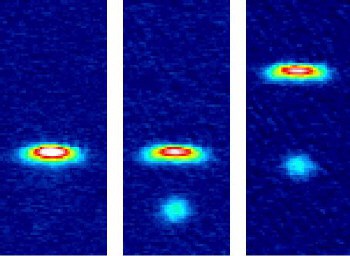
The Innsbruck team then applied a magnetic levitation field to the sample and switched off the optical trap. Since the molecules have a smaller magnetic moment than the atoms, they start falling and this allows them to be detected. The detection scheme involved splitting the molecules back into atoms with a reverse magnetic field and immediately imaging the atoms with a short laser pulse. This reveals the profile of the molecular cloud (see figure).

Grimm and co-workers observed a slow expansion of the molecules, which they say is indicative of a macroscopic matter wave – or molecular Bose-Einstein condensate. “We can’t prove this at the moment, but we are working on interferometric experiments to verify the coherent nature of this wave packet,” said Grimm. “The race is on to make a Bose condensate of molecules and we expect that many other groups will adopt the tricks we used. This may be the advent of a new field of research in molecular quantum gases.”

The Paris team created giant helium molecules by using a laser to bring ultracold atoms in a magnetic trap together. The molecules had a minimum size of 8 nanometers and a maximum size of about 60 nanometres – making them the largest diatomic molecules ever formed by a factor of five.

The Paris team exploited a novel calorimetric detection scheme based on heating of the gas caused by the decay of the molecules. Spectroscopic measurements of the molecules also agreed with theoretical predictions. The neutral helium atoms would not normally form molecules but the laser causes a short-lived separation of positive and negative charge in the atoms, and these dipoles cause the atoms to attract each other.

Carbonates found on Mars

Carbonates naturally form in the presence of carbon dioxide and liquid water, and could therefore provide important evidence for the presence of liquid water – and possibly life – in the Martian past. Although researchers have already detected carbonates in some meteorites from Mars, they have never yet found them on the surface of the planet.


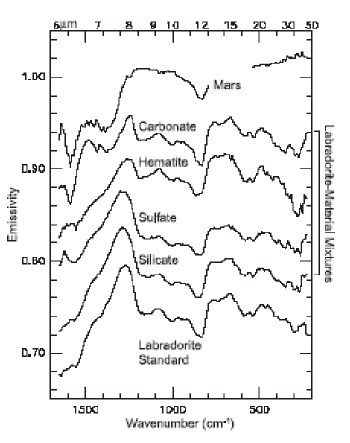
Bandfield and co-workers used the Thermal Emission Spectrometer (TES) on board the Mars Global Surveyor to measure the spectra in different areas of the Martian surface at varying angles. This technique allows the researchers to analyze a single region through different amounts of atmosphere, and so separate surface and atmospheric contributions to the spectra. The Arizona team found an anomaly in the spectra near a wavelength of 7 microns, which they compared with spectra taken from various Earth minerals. Only mixtures containing carbonates matched the Martian spectra (see graph).

The team also observed that the carbonates were widely distributed in the surface dust with no indication of a concentrated source – such as limestone in basins. “This implies that large bodies of water were not common in Mars’ past,” Bandfield told PhysicsWeb. “It confirms an emerging paradigm: that the planet may never have had a significant warm and wet epoch.” The carbonates can also store significant amounts of carbon dioxide. “This may have been an important sink for a past, thicker carbon dioxide atmosphere that is now locked up in rocks,” added Bandfield.

The group now hopes to completely characterize the minerals they found. It also plans to take more precise measurements with the mini-TES instruments on NASA’s Mars Exploration Rovers.

Nanotubes boost ceramic performance

Materials scientists have used nanotubes to improve the tensile strength, conductivity and thermal properties of various materials in the past. However, combining nanotubes with ceramic materials has proved difficult. Zhan and colleagues first mixed a nanotube-ethanol suspension with alumina (aluminium oxide) for 24 hours, and then used a spark-plasma sintering technique to fuse the constituents together. “Unlike other sintering methods, this technique allows consolidation of the mixture at fairly low temperatures – so the nanotubes were not damaged by the process,” Zhan told PhysicsWeb

The researchers found that the electrical conductivity increased with increasing nanotube content and temperature – in contrast to earlier findings. They observed a maximum conductivity of 3375 siemens per metre at 77°C in samples that were 15% nanotube by volume. Transmission electron microscopy of the final microstructure revealed that the nanotubes had self-organized into “ropes” held together by van der Waals forces that were entangled within the alumina grains (see figure). The improved conductivity is a result of these ropes forming a continuous, interlinked electrical pathway throughout the composite. The ropes also make the structure strong and more resistant to corrosion.

The Davis team says the composites could be used in high-performance materials that have to withstand extreme conditions of temperature, mechanical stress and exposure to chemicals. These materials are widely used in components for the automotive, aerospace and defence industries. Other potential applications include micro- and nanoelectronics, and various medical devices such as implants and prostheses.

Squeezed light breaks quantum barrier

Laser beams suffer from quantum noise and until recently researchers believed that this noise would set a fundamental limit on the resolution of devices. However, it is possible to overcome these limitations by squeezing the fluctuations (that is, reducing the uncertainty) in one of the variables describing the beam, at the expense of increasing the fluctuations in another variable.

Bachor and colleagues mixed a standard laser beam with two squeezed light beams. They found that the fluctuation amplitude of the laser beam decreased from 2.3 Angstroms – the standard quantum noise limit – to 1.6 Angstroms. The researchers managed to order the photons in the squeezed beams in two different transverse directions at the same time. This cancels out the quantum noise in a particular measurement position.

“Such an effect had been predicted but has never been seen until now,” team member Nicolas Treps told PhysicsWeb. “What finally made this work possible was the merging of the beams in an optical cavity and the ability to operate the two sources of squeezed light simultaneously.”

The team now hopes to exploit the technique in atomic force microscopy, measurements of refractive index and studies of molecules in living cells. However, Treps and co-workers say that the technique still requires more fundamental work and that real applications will follow only after researchers have developed easy-to-use, efficient sources of squeezed light.

Microscope sketches quantum circuits

Rolf Crook and colleagues used an atomic force microscope to define quantum electronic components – such as quantum wires and dots – on the surface of a gallium arsenide wafer. The tip of the microscope, which was biased to –6 volts, “drew” patterns of charge on the surface, and these patterns depleted electrons from a two-dimensional “sheet” of electrons in a layer of aluminium gallium arsenide beneath the surface (see figure). The experiments were carried out at 20 mK.

The technique allows the team to tailor properties of the components, such as their size and shape, and to link individual components into more complex circuits. The patterns can be erased by going over them again with the tip biased to +3 volts, or the whole surface can be erased by illuminating it with red light.

“The most exciting feature of erasable electrostatic lithography (EEL) is the complete freedom to change device geometry during the experiment,” Crook told PhysicsWeb. “For example, we could change the shape of a quantum dot from square to triangular because EEL is performed in the same low-temperature high-vacuum environment as the measurement. This is simply not possible using any other lithographic technique.” The Cambridge team now plans to improve the resolution of the technique by using a smaller probe, or by moving the electron sheet closer to the surface, and to investigate phenomena such as quantum decoherence and fractals in quantum dots.

Crook and colleagues also believe that EEL could be used to make a quantum computer based on arrays of quantum dots. “A quantum computer would require an array of almost identical quantum dots,” he said, “but inherent material defects make it hard to see how this could be achieved with using conventional techniques such as electron-beam lithography. Erasable electrostatic lithography would vastly simplify the fabrication of such devices.”

Lasers tackle radioactive waste

Ken Ledingham and colleagues from Strathclyde University, Glasgow University, Imperial College, the Rutherford Appleton Laboratory and the Institute for Transuranium Elements in Karlsruhe, Germany, illuminated a small gold target with a 360 Joule laser pulse from the VULCAN glass laser at Rutherford. The pulse had a duration of 0.7 picosecond and was focussed to give an intensity of 5×10²⁰ Watts per square centimetre.

The laser ionized the gold to form a plasma and then accelerated the electrons in the plasma to relativistic energies. When the electrons struck the solid gold of the target they emitted gamma-rays as bremsstrahlung radiation. Ledingham and colleagues then placed a sample of nuclear waste containing radioactive iodine behind the gold target. Transmutation occurs when a gamma-ray ejects a neutron from a iodine-129 nucleus to leave behind short-lived iodine-128. Each laser shot produced about 3 million iodine-128 nuclei.

“We have shown for the first time that we can transmute isotopes with lasers,” said Ledingham. “Now we need to scale up our methods so that we can deal with the sort of volumes likely to be produced by the nuclear industry in the future. Using lasers is a relatively cheap and very efficient way of disposing of nuclear waste.” Laser-induced nuclear reactions could also have applications in the production of medical isotopes.

The field of nuclear physics with lasers took off in 1999 when Ledingham and co-workers, and an independent team using the Petawatt laser at the Lawrence Livermore National Laboratory in the US observed laser-induced nuclear fission in uranium-238 for the first time, along with a variety of other laser-induced nuclear reactions. Earlier this year a team at Friedrich Schiller University in Jena, Germany, managed to achieve photo-induced fission in U-238 and thorium-232 with a much smaller “table-top” laser. The Jena team has also observed the transmutation of iodine-129 with its system (J Magill et al. 2003 Applied Physics B77 387)

Amino acid detected in space

Glycine – CH2NH2COOH – is the simplest of all the 20 amino acids. Yi-Jehng Kuan of the National Taiwan Normal University and co-workers from the NASA Ames Research Center and the Polish Academy of Sciences searched for the molecule in the hot cores of three giant molecular clouds, which are regions of active star formation. They measured the spectral lines of the clouds – Sagittarius-B2, Orion-KL and W51 – over a four-year period using the 12-metre telescope at the National Radio Astronomy Observatory (NRAO) in Arizona.

The frequencies of certain transitions in glycine, which are known from experiments in the lab, provide a characteristic signature for the molecule. Knowing this spectral “fingerprint”, the researchers were able to identify 27 glycine lines at frequencies between 90 and 265 GHz in the clouds. This confirms the results of earlier searches for interstellar glycine in which tantalizing evidence was provided by a handful of spectral lines.

Observing the spectral lines in these clouds – which are tens of thousand of light-years away – is not easy because the lines are very weak. Moreover, the molecular transitions that cause them can be contaminated by emissions from “interloper” molecules in the surrounding medium. To overcome these difficulties, Kuan and co-workers concentrated on high-frequency molecular transitions that occur in warm, dense regions of the clouds. The chemical process that actually produces glycine in the interstellar medium is not understood, although lab-based experiments suggest that amino acids can be created by exposing organic molecules in interstellar ice to ultraviolet radiation.

The researchers claim that the discovery of glycine is the first step in establishing the crucial link between amino acids in space and the emergence of life in the solar system or, indeed, elsewhere in the galaxy. The molecular spectra seen in interstellar gas clouds closely matches those found in comets and meteorites, and comparing them could in principle allow astronomers – or exobiologists – to trace the origin of the Earth’s early chemistry to its parent gas cloud.

Dirac Medal recognizes work on turbulence

Kraichnan and Zakharov were recognized for “their distinct contributions to the theory of turbulence, particularly the exact results and the prediction of inverse cascades, and for identifying classes of turbulence problems for which in-depth understanding has been achieved.”

Kraichnan has spent most of his career as a consultant, working for organizations such as NASA and the Department of Energy. His most profound contributions, according to the ICTP, have been his pioneering work on field-theoretic approaches to turbulence and other non-equilibrium systems, including his insights into the inverse cascade in two-dimensional turbulence. Kraichnan was also one of Einstein’s last assistants at the Institute for Advanced Study in Princeton.

Zakharov has worked on many problems in plasma physics, hydrodynamics and optics, and his main contributions to turbulence have been in the field of weak wave turbulence. He has taught many students, who now constitute the “Zakharov school”, and also holds a position at the University of Arizona in the US.

The Dirac Medal is to awarded to scientists who have made significant contributions to theoretical physics and mathematics, and in recent years it has recognized theorists working in cosmology, biophysics and particle physics.

Copyright © 2026 by IOP Publishing Ltd and individual contributors