There is a small problem in the universe: matter. The stars, planets and life itself are all made of the stuff. But if physicists are to believe what they see in experiments at particle accelerators, the universe should contain no matter at all. It is thought that equal amounts of matter and antimatter were created in the Big Bang about 14 billion years ago, and this matter and antimatter should have completely annihilated each other soon afterwards to leave just a cloud of photons. Instead, matter prevailed. Antimatter is almost completely absent from today’s universe – being found in only the tiniest quantities for fleeting moments in collisions between cosmic particles. So where did it all go?
The key to answering this question was provided in 1965 by the Russian physicist and dissident Andrei Sakharov. He proposed that a tiny asymmetry that had been observed between the microscopic properties of matter and antimatter – a process called charge-parity violation – could be responsible for the preponderance of matter over antimatter. Now two “B-factory” experiments have shed new light on this mysterious phenomenon. The BABAR experiment at the Stanford Linear Accelerator Center (SLAC) in the US and the BELLE experiment at the KEK laboratory in Japan have collected data from more than 150 million matter-antimatter collisions, and the results have pinned down the effect with unprecedented precision.
The appeal of symmetry
The definition of matter and antimatter is purely conventional. The particles that occur in everyday matter and their heavier cousins are labelled matter, while their corresponding antiparticles are labelled antimatter (see “Particles and antiparticles” in Further information). In the theory that describes the interactions between elementary particles – the Standard Model of particle physics – antimatter is related to matter by an operation called charge conjugation, C, which transforms a particle into its corresponding antiparticle. Whether or not there is an exact symmetry between matter and antimatter is a very interesting question.
Symmetry is important in physics because it can simplify the description of a system. A circle, for example, has rotational symmetry because it looks the same if we rotate it around its centre. Mathematically, all we need to know to be able to define the circle are the co-ordinates of its centre, relative to some co-ordinate system, and its radius. But a system that possesses symmetry usually hides something too. If we want to define and measure the orientation of our circle, for example, we first need to distort it in some way. We might add a blob at one point on its circumference, which would break or “violate” its rotational symmetry. The orientation of the circle could then be determined in terms of the position of the blob. However, we now have more things to measure. The mathematical description of the modified circle is not as simple as it was before because we need to include the co-ordinates of the blob.
Just as geometrical figures can exhibit symmetries, so can whole dynamical systems. But there is one important difference. Most symmetries of dynamical systems have the profound consequence that some quantity in the system is conserved. This was proved by the German mathematician Emmy Noether in 1915 when she showed that a symmetry implies a conservation law, and vice versa.
For example, the results of experiments do not depend on where the experiments are performed, or on the orientation of the apparatus. The consequence of these particular symmetries is that linear and angular momenta are both conserved. Similarly, the laws of physics do not depend on the time at which they are determined, a symmetry which has the consequence that energy is conserved. Furthermore, experiments are insensitive to the overall phase of quantum-mechanical wavefunctions – a property known as gauge invariance – which leads to the conservation of electric charge.
All scientific measurements rely on a co-ordinate system. If we want to measure the distance between two masses, for example, we need a ruler. But it would be absurd if the laws of physics were to depend on the ruler’s origin or orientation. Indeed, the equivalence of different co-ordinate systems is the most fundamental principle of relativity. However, we must perform experiments to test whether or not a given physical phenomenon respects a particular symmetry. And it is an empirical fact that our description of nature is simply not the same when its co-ordinates are reflected in a mirror.
Nature’s left and right
A co-ordinate system is not just defined by its origin and orientation. We also have to chose its “handedness”, as any undergraduate who has toiled with electromagnetism will affirm. In particle physics, left- and right-handed co-ordinate systems are related by what is called the parity transformation, P. This operation reverses the signs of the three spatial co-ordinates – x, y and z – in the same way that the charge-conjugation operator, C, reverses the sign of the electric charge of a particle. At the beginning of the 1950s it was considered to be self-evident that the laws of physics should not depend on the handedness of the co-ordinate system used. In other words, particle interactions should conserve parity. But this was subsequently proved to be wrong.
In 1956 Chien-Shiung Wu and co-workers famously showed that the radioactive beta decay of particular cobalt nuclei – which have been polarized so that their spin angular momenta all point in the same direction – is not symmetric under the parity transformation. The electrons that were produced in the decays were found to be emitted preferentially in the opposite direction to the polarization of the nucleus. This means that the weak radioactive decays that we observe in nature occur with a higher probability than their mirror images (see Wu et al. in further reading).
This result was put into a wider context soon afterwards. Analogous experiments were performed with muons, which decay via the weak force to an electron, a muon-neutrino and an electron-antineutrino. Once again it was found that the electrons produced in the decays had a preference for the direction opposite to that of the muon polarization, thereby providing further evidence for parity violation in the weak interaction. However, when the experiment was repeated using antimuons, the positrons (antielectrons) that were produced favoured the same direction as the antimuon polarization (figure 1). This meant that the symmetry between matter and antimatter – symmetry under the C transformation – was violated. So, C and P were both violated by the weak interaction.
Further observations of muon and antimuon decays had remarkable consequences. The number of times that an antimuon emits a positron in the same direction as its polarization was found to be equal to the number of times that a muon emits an electron in the opposite direction. In other words, the physics looked the same for antimatter using a right-handed co-ordinate system as it did for matter using a left-handed co-ordinate system. Symmetry under the combined operation of C and P seemed to be respected. The appealing principle that all co-ordinate systems should be equivalent was restored, albeit in a slightly weaker form, because one could not distinguish between a left-handed description of matter and a right-handed description of antimatter.
If the laws of physics did respect CP symmetry, the associated quantity – the CP quantum number – would be conserved in all particle interactions, according to Noether’s theorem. But in 1963 James Christenson, James Cronin, Val Fitch and Rene Turlay working at the Brookhaven National Laboratory in the US put the final nail in the coffin of the equivalence of left- and right-handed co-ordinate systems. They found that a type of kaon called a K-long – a long-lived neutral meson consisting of a mixture of a down quark and an anti-strange quark with a strange quark and an anti-down quark – occasionally decays into a pair of pions. If CP were conserved, the K-long system would have a CP quantum number of -1, while a pair of pions has a CP value of +1, and, therefore, this decay would be forbidden.
This demonstrated for the first time that the combined CP symmetry is violated by the weak interaction. The effect is very tiny, which explains why it had not been detected sooner. However, it left no doubt that the description of the weak force depends on whether you use a left-handed or right-handed co-ordinate system, and on your definition of matter and antimatter. But could this explain the matter-antimatter asymmetry in the universe?
The search for asymmetry
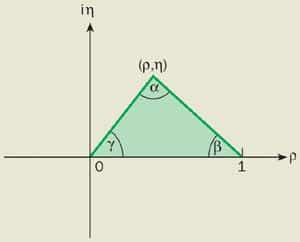
In the Standard Model, all observable CP-violating quantities in nature are proportional to the height of a particular triangle (figure 2). This “unitarity” triangle represents complex numbers that describe how particles interact with each other, and it would not exist if CP symmetry was respected.
Interactions between quarks are described by a “coupling strength”, which is a number that represents the strength of the force between them. It turns out that if the coupling strength of an interaction is not a real number but a complex one, then the interaction generally violates CP symmetry. In the Standard Model the couplings between the light (up and down) quarks and the heavy (bottom and top) quarks are proportional to the lengths of the sides of the triangle in the complex plane. The imaginary parts of these complex numbers are therefore equal to the height of the triangle.
However, determining the height of this triangle from the CP-violating effects that are observed in kaon decays is extremely difficult, and the calculation has so far eluded theorists. It has therefore been impossible to pin down this fundamental measure of CP violation despite several decades of kaon experiments. This situation prompted researchers to study CP violation in a new context – the decays of neutral B-mesons. B-mesons are similar to neutral kaons but consist of an anti-down quark and a heavy bottom quark.
Just after the neutral B-meson, B0, was discovered in 1981, Ashton Carter and Tony Sanda at Rockefeller University in the US predicted that it should decay in a different way to its antimatter partner, the anti-B0 meson. They proposed that CP violation, combined with a quantum-mechanical effect that causes a B0-meson to oscillate into an anti-B0 meson and vice versa, would cause the mean lifetimes of the two mesons to appear different for certain decays. B-mesons can decay into a variety of different daughter states, each of which has a certain probability of occurring. However, the total lifetimes of the B0 and anti-B0 meson are the same because the small variations in the rates of their individual decays cancel out overall.
Carter and Sanda calculated that the asymmetry between the B0 and anti-B0 meson decay rates would be a simple sinusoidal function of the time between the production of a B-meson and its decay about a trillionth of a second later. Furthermore, they determined that in certain special decays – in which the B0 and anti-B0 meson decay into the same daughter particles – the amplitude of the sinusoid would be sin2β, where β is one of the three angles of the unitarity triangle.
Measuring any two of these three angles would completely define the triangle, and thereby determine the CP-violation measure of the Standard Model. But this, of course, assumes that the angles of the triangle add up 180°. To really test the whole Standard Model picture of CP violation we need to measure all three angles. This will allow us to prove whether the triangle is, in fact, really a triangle and not something more complicated.
All that was left to do was to get hold of some B-mesons and antimesons, and to measure their decay-time distributions. The trouble is that one needs an awful lot of them because their CP-violating decays are very rare.
Enter the B-factory
A B-factory is a particle accelerator that is devoted to the production of B-mesons. Two such facilities were completed in 1999: PEP-II at the SLAC laboratory in California and KEK-B sited at the KEK laboratory in Japan. Both of these machines collide electrons and positrons at a combined energy close to11 GeV, which is the optimum energy to produce B0 and anti-B0 meson pairs. This is equal to the mass of what is called the γ resonance – a bound state of a bottom quark and an anti-bottom quark.
The crucial difference between these and other electron-positron accelerators, such as the former LEP collider at CERN, is that they are asymmetric. The electron and positron beams are accelerated to different energies before being made to collide with each other, which allows the effects of CP violation to be measured. Once a B0 -anti-B0 meson pair is produced inside the detector, the mesons travel in roughly the same direction at about half the speed of light (figure 3). They then decay independently, allowing the distance between their decay positions to be measured.
Both of the asymmetric B-factories hosts a single experimental detector: BABAR at PEP-II and BELLE at KEK-B. They are currently neck-and-neck in terms of the quality of measurements made, each detector having collected data from about 80 million B0 -anti-B0 meson pairs. The experiments measure the momenta and positions of the particles that the B-mesons decay into, enabling researchers to determine the difference in lifetime between the B0 and the anti-B0 meson.
The best way to measure CP violation at the two experiments is to study B-meson decays that produce a J/ψ particle – a charm quark and a anti-charm quark – plus a short-lived neutral kaon, K-short. This decay allows researchers to measure the angle β in the unitarity triangle. However, it is only observable in about 5 out of every 100,000 decays of B-meson pairs, and the finite efficiency of the detectors means that we can obtain sufficient information about just one of these. In order to measure CP violation with any precision from the time distribution of the B-meson decays, about 100 such events are required, which is why we need at least 10 million B-mesons in total.
And there is another major challenge in detecting CP violation – how to determine whether the J/ψ-K-short pair came from a B0 or an anti-B0 meson. This is overcome by a technique known as flavour-tagging. When one of the B-mesons decays into a J/ψ-K-short final state, the other decays into a different combination of particles. By examining the electric charges and types of these “tagging” particles, it is possible to determine whether their parent was a B0 or an anti-B0 meson. The charge of a particle, for example, is determined simply from the curvature of the tracks in the magnetic field inside the detector.
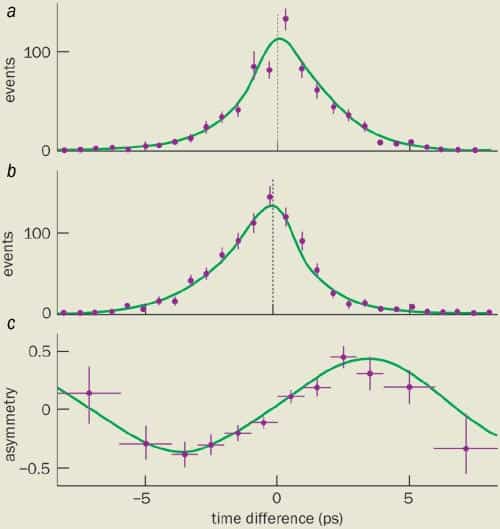
The difference in decay-time distributions between the “tagged-Bs” and the “CP-Bs” can then be measured for two samples: events where the B0 was tagged and events where the anti-B0 meson was tagged (figure 4). A definite asymmetry can be seen between the two samples, which is made explicit by dividing the difference between the two distributions by their sum. The sinusoidal modulation of the B-meson decay rate is clear, and a fit to the data from the BABAR experiment gives its amplitude as sin2β = 0.741 ± 0.067 ± 0.034, where the first uncertainty is statistical and the second is systematic. The BELLE experiment finds a consistent value of sin2β = 0.719 ± 0.074 ± 0.035. These results are an impressive achievement and confirm the first direct observation of CP violation outside the kaon system.
To date it has only been possible for the B-factory experiments to make statistically significant confirmed measurements of sin2β. However, measurements that will determine the other angles of the unitary triangle are under way. These require considerably more data because the relevant decays are much rarer than the J/ψ-K-short, and the theoretical calculation in terms of the angles of the unitarity triangle is also more difficult. In January 2003 the BELLE collaboration also found evidence for CP violation in the decay of a B-meson into a pair of pions, although this has not yet been observed at the BABAR experiment (see Nakadaira et al. in further reading).
The combined measurements from BABAR and BELLE are in agreement with earlier, less precise determinations of sin2β. This provides an important test of the Standard Model picture of CP violation because the previous values of sin2β are indirect – based only on measurements of the lengths of the sides of the unitarity triangle. If the Standard Model was wrong, then the direct and indirect measurements would not necessarily agree. The results have also allowed the shape of the unitarity triangle to be pinned down much more precisely than ever before.
A little is not enough
There is, however, one glaring problem with the outcome. Although CP violation is still thought to be a key ingredient in the explanation of the matter-antimatter asymmetry in the universe, the amount of CP violation in the Standard Model is insufficient to account for all of it. And not just by a factor of two or three but by several orders of magnitude. There must be additional sources of CP violation that have simply not been seen in our experiments. Researchers at BELLE and BABAR are currently hoping to find evidence for a new source of CP violation that could manifest itself in B-meson decays to different final states. And a new B-factory called LHC-B will come on line when the Large Hadron Collider at CERN starts taking data in 2007. This will provide even more precise tests of the Standard Model picture of CP violation.
However, the answer to the mystery of the matter-antimatter asymmetry in the universe may lie beyond the Standard Model altogether. A new potential source of CP violation has recently been identified in neutrinos (see Murayama in further reading). There is compelling evidence that neutrinos “oscillate” between their three different flavours – electron, muon and tau – just like the mixing between quarks that causes the B0 and anti-B0 meson mesons to transform into one another. This implies that neutrinos have mass, whereas they are massless in the Standard Model, and offers the intriguing possibility that CP violation may also appear in the coupling strengths between different neutrinos.
Furthermore, if it turns out that neutrinos are equivalent to their own antiparticles, super-heavy neutrinos may have propagated throughout the early universe. And their interactions could have easily violated CP symmetry enough to explain the matter-antimatter imbalance that we see today.
The exciting new possibility of CP violation in neutrino oscillations will hopefully be addressed by a future particle accelerator – a neutrino factory. But that is an altogether different matter.
Further information
Particles and antiparticles
Everyday matter is composed of just three types of particles: up quarks, down quarks and electrons. Quarks are bound together by the strong nuclear force to form protons and neutrons in atomic nuclei, while the electromagnetic force holds electrons in orbits around the nucleus. Some atoms can undergo radioactive beta decay, in which a neutron decays into a proton, an electron and an electron-antineutrino via the weak nuclear force.
It turns out that nature uses a broader range of fundamental building blocks than those found in ordinary matter. These include the charm and top quarks, which are heavy copies of the up quark, and the strange and bottom quarks, which are heavy copies of the down quark. The electron is also joined by two more massive cousins – the muon and tau leptons – and each of these also has a corresponding neutrino. These heavier particles are mostly unstable and decay quickly into ordinary particles, which explains why they are not found in everyday life. However, they do occur naturally in extreme conditions, and were present in abundance in the early universe.
Each particle is also known to have a corresponding antiparticle, which has the same mass but an opposite electric charge and magnetic moment. Antiparticles were predicted to exist by the British physicist Paul Dirac in 1928, when he combined the principles of special relativity with quantum mechanics. The first to be observed was the positron (antielectron) in 1933, and the antiproton was discovered 22 years later. The antiproton is composed of two anti-up quarks and an anti-down quark, and has a charge of -1 in terms of the charge of the electron. The antineutron, although neutral like the neutron, is distinguishable from the neutron because it is composed of two anti-down quarks and one anti-up quark.
Some particles, such as photons, correspond to their own antiparticle. They are electrically neutral and cannot be characterized as either matter or antimatter.