Variations in the gravitational potential of the Earth can cause two “perfect” clocks at two different locations to differ in frequency, an effect known as the gravitational redshift. This is a direct consequence of Einstein’s equivalence principle – the principle that underpins general relativity – and means that clocks run slower the closer they are to the Earth’s surface. A second relativistic effect is due to the velocity of the clock, and, because the Earth is rotating, this velocity changes with latitude.
Now Nikolaos Pavlis from Raytheon ITSS Corporation in Maryland and Marc Weiss from the National Institute of Standards and Technology in Boulder, Colorado have computed the value of the relativistic shift for “NIST-F1” at Boulder – one of the most accurate clocks in the world (Metrologia40 66-73).
In the July issue of Physics World Gérard Petit from the Bureau International des Poids et Mesures (BIPM) in Paris explains how measurements made with atomic clocks will eventually have to take geophysical effects into account.
Cosmologists and fossil hunters have more in common than it might first appear. Palaeontologists analyse fossil records of the last 3.5 billion years to track the evolution of life on Earth. Motivated by a similar curiosity, astronomers are searching for chemical elements in stars and cosmic gas to understand the origin of the chemistry of the universe, and how it has developed since the Big Bang.
The basic theoretical framework of the universe’s chemistry has been in place for half a century. The lightest elements – hydrogen and helium, along with trace amounts of deuterium and lithium – were created within a few minutes of the Big Bang. All of the other elements were assembled at much later times by the fusion of hydrogen and helium nuclei in the interior of stars. Some of these elements were dispersed through space in the violent supernova explosions with which some stars end their lives. They were then condensed into subsequent generations of stars, and into the planets that formed around them. Some of these elements were eventually incorporated into organic structures and became essential for life on Earth.
This cosmic cycle continues to the present day. The closest region of active star formation is the Orion nebula, which is visible to anyone who looks up at the sky on a clear winter’s night. But the details of the cycle are still far from clear. For example, we do not know when most of the elements were produced in the universe as a whole, or which stars were responsible for producing which elements. In order to unravel the path of chemical evolution we have to shift our attention to much further away than the Orion nebula.
Traditionally, astronomers have looked for clues about stellar chemistry in stars of different ages and at different locations within our galaxy – the Milky Way. Stars in the halo of the Milky Way probably formed a very long time ago. Those that are still around us bear the imprint of the chemical composition of the protogalaxy in their atmospheres, like living fossils of a bygone era in the history of the Earth. But this is only part of the story. The Milky Way is just one of several billion galaxies and its stellar population therefore gives us only a limited window on the process of galactic chemical evolution.
Thanks to recent technological advances, astronomers have now begun to extend their studies of chemical abundances beyond the Milky Way. In a major development, we are now able to see nearly all the way back to the Big Bang. Large telescopes, such as the Very Large Telescope at the European Southern Observatory in Chile and the Keck telescopes on Hawaii, are so efficient at gathering and recording light that astronomers are able to study galaxies at the edge of the observable universe.
The light that falls on these telescopes left some galaxies when the universe was just 1 or 2 billion years old. We know this from its redshift – an increase in the apparent wavelength of the light due to the expansion of the universe. These galaxies therefore appear not as they are today, but as they were 12 billion years ago – just what the galactic fossil hunters are looking for.
Some of the galaxies can be seen directly, while others are only observable by the shadow that they cast in the light of more distant and brighter objects. These two techniques for studying high-redshift galaxies are highly complementary.
When a galaxy is bright enough that its starlight can be seen directly, we can use spectroscopy to discern its chemical composition and are able to relate it to nearby galaxies around us today. However, the furthest galaxies are generally too faint to reveal their chemical composition in detail. For this we need to use high-resolution spectroscopy. But this is only possible when the light from something much brighter – such as a quasar – shines through the galaxy, thanks to a chance alignment of the two objects as seen from Earth.
One such alignment was recently discovered by a team of astronomers in the US. Jason Prochaska of the University of California at Santa Cruz, and Chris Howk and Artie Wolfe at the University of California in San Diego have been systematically searching for such galaxy-quasar pairs and following up the most promising candidates with the Keck telescopes. This is the first pair that they have found in over a 100 candidates (Nature423 57-59).
The pair consists of a quasar that shines through a dense region in a foreground galaxy, which means that the number of atoms available to absorb the quasar light is unusually large. The spectral signatures of the quasar occur in a different part of the spectrum to those of the foreground galaxy due to their different redshifts. The spectral lines of the quasar are also broader than those of the intervening galaxy because they are produced by a hot, as opposed to the cold galactic, gas. The team found that the intervening galaxy is surprisingly advanced along the path of chemical evolution.
Elemental abundance
The redshift of the galaxy is 2.626 – which corresponds to looking back in time some 12 billion years. Stars in our galaxy that are this old contain only small amounts of chemical elements, typically just one-tenth to one-hundredth of the amounts in the Sun. This is generally taken as a sign that little star formation took place in the proto-Milky Way.
But we now have a quite different example of a galaxy that underwent a significant amount of star formation in just 2.5 billion years, during which its chemical composition became similar to that of the Sun. In particular, the abundance of oxygen in the stars of this galaxy had already grown to one-third of the solar value.
The Milky Way is a spiral galaxy and observations show that in most “spirals”, star formation has proceeded at a relatively steady pace over their entire existence. But there are other galaxies in the nearby universe that astronomers suspect have squandered most of their resources in their youth, by forming stars at much faster rates. These are the elliptical galaxies, which have very little gas left and contain a predominantly old collection of stars.
Prochaska and colleagues may well have found the progenitor of one of today’s elliptical galaxies, and observed it at an early stage of its evolution. The importance of such a link between the past and the present, and between different classes of galaxies, is hard to overestimate.
It tells us that galaxies formed stars at different rates and at different times. Some formed slowly and at an even pace, while others were born in one major episode of star formation that took place a long time ago. This is what we had suspected from the way galaxies look today, but Prochaska and co-workers have found a concrete example that confirms some of these ideas.
Furthermore, the rare combination of high gas density and high element abundances in this particular quasar-galaxy pair produces an extraordinarily rich spectrum. This brings within reach a number of atomic transitions that are normally far too weak to be detected. Prochaska’s team has measured 25 chemical elements in this distant galaxy ranging from the relatively light elements boron and nitrogen to real heavyweights such as tin and lead (see figure).
Extragalactic heat
Many of these elements had never been seen before outside the Milky Way. They therefore provide an unprecedented opportunity to study the complex pattern of element abundances in a galaxy that is in a very different place and time in the universe.
This pattern is surprisingly similar to that in the Sun, which is a strong clue that the same basic physical processes that synthesize chemical elements inside stars here and now were operating there and then. It also means that some universal law – which is roughly invariant in time and space – must determine the relative numbers of stars of different masses that form in a galaxy. Stars that have different masses produce different amounts of each chemical element, yet the final mix seems to be approximately the same. Since stars of different masses synthesize different elements in different proportions, this need not be the case.
The challenge now is to extend this type of measurement to galaxies with even higher redshifts. This will allow astronomers to look for chemical traces that were left over from the very first generation of stars to form in the universe – perhaps only a few 100 million years after the Big Bang.
These redshifts are so high that the wavelength of the starlight will be shifted not into the visible region – as in the galaxy studied by Prochaska and collaborators – but all the way into the infrared. Advanced plans are already in place to construct near-infrared spectrographs for most large telescopes, and the first of these will be in operation in just a couple of years.
Clear choice Transparency is paramount in the evaluation of women at every stage in their careers.
Women are greatly under-represented in physics. Of all the sciences, physics is the subject in which the increase in the number of women involved has been particularly slow. Many bright young people do not get the chance to learn about physics and to prepare themselves for a career in the field. Others are simply discouraged from studying physics altogether.
However, the problem is worse than that. Many of the women who do take physics end up running away from it. Statistics show that a higher proportion of women than men leave physics at each stage of their career – a phenomenon that is often dubbed the “leaky pipeline”.
But why should we care? After all, why should women do physics? The answer is that women who have a passion for the subject have the right to make a living from it and have a successful career in the field. What is more, science is changing and becoming more interdisciplinary, requiring a diversity of thought and strategies to solve different types of problems. By excluding female researchers, we are limiting the available pool of talented people to half of humanity and eliminating diversity. Physics needs women to survive.
Finally, in a society in which technology is increasingly governing our everyday life, exposing women to science leads to a more scientifically literate public.
In an attempt to tackle these problems, last year the International Union of Pure and Applied Physics (IUPAP) held the first ever international conference on women in physics (Physics World April 2002 p6). The meeting in Paris, organized by IUPAP’s women-in-physics group, brought together over 300 participants from 65 countries – about 15% of whom were men. Discussions focused on how to attract girls into physics, how to launch a successful career in physics, and how to improve the climate for women in scientific institutions. The meeting also looked at how to balance family and career, how to get more women into leadership positions, and how participation rates vary around the world.
Delegates returned home with two messages. The first was for women themselves – that networking can help them to overcome the isolation that they often feel as physicists. The second was addressed in the form of eight resolutions directed towards schools, universities, research institutes, industrial labs, professional societies, governments, granting agencies and IUPAP itself. The resolutions emphasized the importance of equity and transparency at all levels – from the way that physics is taught at school to the methods used to evaluated scientists throughout their careers.
Progress since Paris
Over a year on from the meeting, it is natural to ask what has been achieved since then? First, delegates at the conference are now part of a network of some 65 national – and sometimes continent-wide – working groups. In many of these countries, ranging from Albania to South Korea, the groups are an official part of their national physical societies (see Physics World June 2003 p41 for the response from the Institute of Physics). The European Physical Society, meanwhile, has set up a working group on gender and equality in physics, co-ordinated by Gillian Gehring from Sheffield University, who led the UK delegation at the Paris meeting. All of these teams are in contact with each other to publicize and advocate the resolutions, to monitor how they are implemented, and to evaluate their impact on the climate for women in physics internationally.
Links between women in physics are also growing beyond those who were at the Paris meeting. Groups of women in specific areas of physics, for example, are working together to build up strategies to overcome the barriers that they face. Indeed, the 22nd IUPAP International Statistical Physics Conference, which takes place in Bangalore next year, will have a session on women in physics, co-ordinated by Neelima Gupte, India’s team member at the Paris meeting. Various national physical societies – from Brazil to Norway – are also holding sessions on the topic at their conferences.
However, increasing awareness about the problem it is not enough. We also need action to ensure that women are evaluated with fairness and transparency at every stage of their careers. Everyone has a natural tendency to mix with and look for collaborators, co-workers and students who are like themselves. What this means in a male-dominated field like physics is that women receive less mentoring, have fewer role models, and are more likely to be excluded from the community.
Moreover, many practices that have nothing to do with the quality of the research – but do not appear as outright discrimination – can affect women’s careers in a damaging way. Examples include a lack of transparency in the hiring process and in the way staff are promoted, as well as double standards. For example, a character trait that may be viewed as a virtue in a man is often regarded in a negative light when displayed by a woman. A persistent man is seen as tough, while a persistent woman is seen as pushy.
Another problem is that many male scientists take a narrow view of “scientific excellence”, in which they place too much emphasis on aggressiveness and competitiveness. Women, in contrast, generally tend to examine a problem from all angles before making a statement on it. So rather than jumping into a debate during someone else’s talk, for example, a woman may prefer to discuss the matter privately with the speaker after the seminar is over. This, however, is usually seen as a sign of insecurity.
These are the major causes of the leaky pipeline that affects women in particular and excludes anyone who does not fit into the “tough boys’ club”. This situation is not only unfair for women but also dangerous because physics needs a diverse community of people.
Searching for solutions
So how can we address this problem? Changes in hiring and promotion practices are achieved faster when women take part in the decision-making process. With this in mind, the IUPAP women-in-physics group brought this issue to the union’s general assembly in Berlin last October.
IUPAP now recommends that its member physical societies should appoint women to the organization’s liaison committees, which represent these societies within IUPAP. It has also called for gender to be considered when nominations to its commissions and the council are made. Finally, IUPAP expects that women should be included on the programme committees of IUPAP-sponsored conferences.
Similar actions are being taken by IUPAP working groups in their individual countries. Women will as a result become more visible in the scientific community. Other female students and researchers – inspired by these new role models of the 21st century – will hopefully then be attracted to physics.
Unfortunately, transparency alone will not guarantee that women remain in physics research. Family matters are another issue that has to be addressed. Although having a family does not necessarily prevent women from carving out a successful scientific career, children do hinder a woman’s career more than they do for a man. Childcare is still largely the responsibility of women. Moreover, childhood usually coincides with the precious few years in which the roots of one’s career have to be laid down. Taken together, these two factors reduce the scientific productivity of women during their child-rearing period.
However, a recent study carried out by the Japanese delegation in Paris – reported by Masako Bando from Aichi University – shows that the scientific productivity of women after a child-rearing period greatly surpasses that of colleagues who are at the same stage in their careers. Even though this study is not conclusive, it does highlight the fact that the careers of men and women are different and should not be treated with equality – but with equity.
Institutions should therefore launch initiatives to allow scientists to choose flexible career paths. Funds should be provided to enable scientists – women and men alike – to return to work after a career break. In Taiwan, for example, the women-in-physics working group recently established the Wu-Chien-Hsiung scholarship, which offers annual grants of up to $600 per year to female graduate students. The group is now planning to ask the country’s national science council to extend the scheme to young women who have taken long-term maternity leave. Other countries’ working groups are also asking grant-awarding bodies to review their recruitment criteria and grant-funding mechanisms to ensure that women who have taken time off to have children are not put at a disadvantage.
Women face a more difficult situation in developing nations. Since science funding in these regions is often limited, the chance that a woman will have access to grants becomes even less. Acknowledging this, the IUPAP women-in-physics group – with the support of UNESCO’s regional bureau for science in Europe – last year launched a programme to help women from developing nations to attend scientific conferences. This programme is being renewed this year with the support of individual donations and the cosmetics giant L’Oréal, which we hope will become its permanent sponsor.
Women in Africa face the hardest situation of all. Very few women there become scientists because society expects them to bear the brunt of childcare and to look after elderly parents. The few active researchers who do exist have no funding, which prevents them from collaborating with other African scientists let alone participating in the international community. Recognizing that only a strong network of women in Africa will overcome this sense of isolation, the IUPAP working group on women in physics is now looking for funds to set up such a project.
A fair future
The first IUPAP international conference of women in physics is still very much a work in progress. By bringing together physicists from so many different countries and regions, it has become clear that the issues facing women in physics are complex and appear at many different scales. The only way to solve this highly nonlinear problem is to make sure that each branch of this growing network of women actively brings the issues of transparency and equity to light. Solutions to the problem will not only help women’s participation in physics, but will also ensure that all physicists – men and women alike – are treated fairly. Only then we will guarantee the survival of physics itself.
Of course, researchers could just return to their laboratories and hope that the public starts to worry about something else. But that would be misguided. The closure of the High Flux Beam Reactor (HFBR) at Brookhaven in the US in 1997 on grounds that most scientists consider to the completely without foundation illustrates the dangers of the blinkered approach. The tritium leak at Brookhaven did not constitute a health risk, but it did frighten some of the lab’s high-profile neighbours and the HFBR is now history (Physics World May p19). The management of Gran Sasso in Italy – from which 50 kg of hazardous solvent recently leaked into a local river – must make sure that history does not repeat itself.
So what can the nanotechnology community do to reassure the public? First, it must confront the problem and resist the temptation to make glib statements like “Nano-sized self-replicating objects already exist – they’re called bacteria and viruses!” Second, it must not expect the public to distinguish between different types of nanotechnology, even if they are as different as chalk and cheese. This might seem unfair on, say, physicists working in nanoelectronics, but scientists of all sorts have been happy to stick the “nanotech” label on their grant proposals when they wanted to benefit from government enthusiasm for all things nano.
And third, researchers must embrace and support efforts to understand the public’s reaction to nanotechnology, such as the investigation into “the potential benefits and possible problems associated with nanotechnology and nanoscience” being carried out for the UK government by the Royal Society and the Royal Academy of Engineering. In addition to summarizing the current state of nanoscience and the likely future applications of nanotechnology, this working group intends to attempt three other tasks: to assess the potential health, safety and environmental applications of nanotechnology; to consider ethical and social issues related to nanotechnology; and to identify areas where additional regulation needs to be considered.
So what is the working group likely to recommend when it completes its report by next spring? More research on the social and ethical implications of nanotechnology for one thing, if the results of similar exercises in the US are any guide. Most witnesses at a recent congressional hearing on the “societal implications of nanotechnology” cited the example of the Human Genome Project, which allocated 5% of its budget to ethical, legal and other societal implications of the project. Despite headlines about human cloning and designer babies, the generally positive reaction to the project is in marked contrast to the near outright rejection of GM foods in many parts of the world.
US programmes looking at the ethical implications of nanotechnology have not been overwhelmed by applications. However, it is important to get the relevant experts to look into these issues – if only to show that the questions raised by nanotechnology are the same as those that accompany any other new technology. And if it can also be demonstrated to the public that nanotechnology presents no dangers to our health or the environment, any nascent opposition should start to fade.
Last year Takashi Nakano and colleagues in the Laser Electron Photon experiment at SPring-8 (LEPS) collaboration reported evidence for a so-called pentaquark with a mass of 1.54 GeV at a conference in Japan. The particle was observed in experiments in which high-energy gamma rays were scattered off neutrons in a carbon nucleus. Both the mass of the particle and the width of the particle peak – less than 25 MeV – were in agreement with theoretical predictions made by Dmitri Diakonov of the Petersburg Nuclear Physics Institute and co-workers in 1997.
Now the CLAS collaboration at the Thomas Jefferson National Accelerator Facility in the US has reported evidence for a pentaquark with a similar mass and width. The US team scattered gamma-rays from a deuterium nucleus. The DIANA collaboration at the ITEP laboratory in Moscow has also found evidence for pentaquarks, and other groups searching for particles containing five quarks include the HERMES experiment at DESY in Germany.
The statistical significance of the Japanese and US experiments are 4.6 and 5.4 standard deviations respectively, which means that the chances of the observations being statistical flukes are extremely low. It is not yet clear if the pentaquark observed in the experiments is a tightly bound five-quark state or a sort of molecule made of a kaon and a neutron.
In the Japanese experiment low-energy photons from a laser were scattered from 8 GeV electrons in the storage ring of the SPring-8 synchrotron radiation facility to produce gamma-rays. These gamma-rays, which had energies of up to 2.4 GeV, were then directed at a plastic target. The LEPS team searched for evidence of collisions in which a gamma-ray photon interacted with a neutron to produce a negative kaon and a pentaquark, which subsequently decayed into a positive kaon and a neutron.
The gamma-rays in the CLAS experiment were produced by sending an electron beam into a solid cryogenic target, and the gamma-ray-neutron interactions took place in a separate target made of deuterium. Like the LEPS experiment the CLAS team also searched for evidence of collisions that produced two kaons in the final state.
In April physicists at the BaBar experiment at Stanford reported evidence for an new D-meson that might contain four quarks, although this interpretation has not been confirmed. And earlier this month three experiments at the Relativistic Heavy Ion Collider at Brookhaven reported that they might have produced a quark-gluon plasma – a state of matter in which quarks are no longer confined inside other particles. However, the properties of the strong force mean that single quarks are unlikely to be seen in experiments any time soon.
Infinities is an exciting new addition to the recent wave of plays that address “hard” science. Written by the Cambridge cosmologist John Barrow, directed by Luca Ronconi and developed in conjunction with Milan’s Teatro Piccolo and the Sigma Tau Foundation, Infinities is remarkable in its seamless merging of form and content. It gives new meaning to the concept of “science plays” through its highly visual exploration of various mathematical and philosophical postulations about infinity.
The play premiered in Milan in March 2002, moved to Valencia the following month, and was revived in Milan again this May. Performed entirely in Italian and staged in an old warehouse in Milan’s Bovisa area, where sets and costumes for La Scala productions were once kept, the play presents five scenarios on different ideas of infinity. Barrow draws on a number of writers – from Friedrich Nietzsche to Stephen Hawking – to create not so much a narrative as a set of ideas.
A huge, soaring performance space is integral to the texture of a play that deliberately rejects such mainstays of traditional theatre as plot and characterization. The vast building is divided into five separate stages of varying sizes, and the audience is admitted to a new scenario in small groups every 15 minutes. Viewers can, in principle, see the five scenarios in any order and revisit some if they wish. This makes the play infinite in its structure as it lacks a beginning, middle and end – an open-endedness that neatly captures its thematic core. Although some scenarios work better than others, Infinities offers a new experience for actors and audience alike, in which the language of drama and the language of science spectacularly meet.
The first scenario – “Welcome to the Hotel Infinity” – dramatizes a famous mathematical thought experiment. At Hilbert’s Hotel, an overwrought manager with an infinite number of rooms must accommodate increasing numbers of guests in increasingly complex numerical arrangements, from one new guest to whole galaxies of new arrivals. The actors explain the complex mathematics with the help of a huge monitor displaying the equations necessary to work the solutions out. With tongue only slightly in cheek, Barrow concludes with a cosmological moral: if the universe is infinite and began from nothing, maybe it will one day return to nothing after it gets too complicated and unmanageable to keep it running any more.
The audience’s next stop – if viewers choose to see each scenario in order – is about living forever, and is staged in a black box full of impossibly old people languidly reading while sitting in their wheelchairs or under hairdryers. The stifled atmosphere and long monologues create a sense of monotony that effectively emphasizes the idea of perpetuity and shows how oppressive it would be to live forever.
The third scenario is, by contrast, a tour de force, dramatizing Jose Luis Borges’ parable of the Library of Babel – a metaphorical universe containing book after book in endless hexagonal galleries. Visually inventive staging – involving the use of mirrors at the ends of several corridors lined with drawers that are large enough to hold a human body – creates the illusion of an infinite library. The audience is invited to wander from corridor to corridor, while the voices of the actors resound around them, and we suddenly notice that these actors are all identically masked and clothed. With the dialogue suggesting the impossibility of uniqueness and individuality, a disturbing effect is achieved by having the actors endlessly replicated.
After a fourth scenario dramatizing the conflict between the 19th-century mathematicians Cantor and Kronecker about the nature of infinity, the audience enters another gigantic open space for the final scenario, which is about time travel. A grandmother teeters across the stage, narrowly missing her grandson speeding towards her in his wheelchair – thereby illustrating the “grandmother paradox” by which you logically cannot go back in time and kill your grandmother or shoot yourself as a baby. The concept of time travel is made real through the use of a train car complete with dining passengers and seats facing in both directions, as if to suggest literal conveyance between epochs on so ordinary a time machine as a train.
These are some of the director’s few concessions to audience expectations of realism. Ronconi prefers to rely on more abstract elements such as symbolic movements that suggest infinity: straight lines (actors moving perpetually forward and backward) or circles (actors sitting or walking endlessly around). Although each scenario is distinct in style and substance, the thread connecting them all is, of course, the concept of infinity. Certain visual elements do, however, provide continuity as well, such as the use of mostly black costumes with startlingly white faces wearing white half-masks – leaving the mouth and eyes visible but grotesquely exaggerating the cheeks and nose.
Infinities places exhaustive demands on its large cast, which is made up of at least 12 professional actors plus dozens of student “extras”. They often have to rush from one scenario to another and take turns rotating roles throughout the run of the show to avoid becoming complacent and predictable. There is a great deal of complicated text for the actors to memorize, yet no linear plot and no characterization. The actors are constantly moving, whether crossing the stage hanging upside down from a thin metal track or leaping across a vast expanse of books, and they need to be almost acrobatic and have great stamina to perform these feats.
There is little comic relief in the play. Indeed, audience members seemed to be concentrating very hard on the ideas during the performance that I attended. But the serious faces may also have been due to the vulnerable position that Ronconi deliberately puts us in: we are left as visible as the performers, who move among the viewers and address us directly. Most interesting is the unfamiliar territory we get to explore – both in terms of ideas and in the kind of theatre performed here. Whether or not the audience (or indeed the actors) fully understands the ideas in the play is not the point. What is important is the feeling of having been briefly and intensely immersed in these ideas and having shared them with fellow spectators and the actors.
The play has been well received in Italy and Spain, but there are no firm plans as yet to produce it elsewhere, mainly because it seems so organically tied to the space in Milan, where it originated. Still, the spatial requirements and the need for so many professional actors should not prevent its performance elsewhere. Surely some comparably vast site could be found for its English-language premiere – perhaps London’s Millennium Dome? – so that audiences outside Italy and Spain can see a play where the stunning combination of mathematics, philosophy and the resources of live theatre is exhilarating and unforgettable.
Entanglement is a property of quantum theory that allows two particles to display much stronger correlations than are possible in classical physics. For instance, two photons can be entangled such that if one is vertically polarized, the other is always horizontally polarized. Since the polarization of an individual photon is not known until it is measured, entanglement means that a measurement on one photon will automatically determine the polarization of the other photon — even if it is hundreds of metres away.
This apparent action-at-a-distance led Einstein and other physicists to doubt the validity of quantum theory. However, entanglement has been demonstrated in countless experiments and is now being exploited, along with many of the other counter-intuitive predictions of quantum theory, in the blossoming field of quantum information.
The Vienna team used a crystal with nonlinear optical properties to split photons with a wavelength of 405 nanometres into pairs of photons with wavelengths of 810 nanometres. These photons then passed through optical fibres to “telescopes” that focussed them onto a second pair of telescopes. One of the receiving telescopes was 500 metres away on the opposite side of the Danube, while the other was about 150 metres away. By comparing the photons detected by the two receiving telescopes, the Vienna team was able to confirm that the photons had remained entangled over a distance of 600 metres in free space. There was no direct line of sight between the receiving telescopes.
Entanglement has been demonstrated over distances of up to 10 kilometres with optical fibre, but the losses incurred in such fibres mean that the maximum distance possible will be around 100 kilometres. Free-space techniques offer the possibility of using satellites to extend entanglement to longer distances. However, at present most free-space experiments are carried out at night because the background counts from sunlight are too high.
In similar experiments physicists have been able distribute quantum “keys” for cryptography over distances of 23.4 kilometres in free space and 100 kilometres along optical fibre. These experiments are less difficult than the entanglement experiments in that they involve the transmission and detection of single photons, rather than pairs of photons.
Hydrogen, students are told, is the simplest of all atoms. Yet hydrogen has a complex history, full of pitfalls and surprises, and is a notoriously difficult element to handle in the lab. Of all the atoms, it was the one that guided us through many of the complexities of modern physics. It was simple and kept us modest. As John Rigden writes: “H stands for hydrogen…and humility”. It is a feeling that anyone who has ever contemplated an experiment with hydrogen will immediately recognize.
Here in Les Houches, where I am writing this review with a magnificent view of Mont Blanc, hydrogen seems irresistible. Like climbing the mountain itself, reading Hydrogen: The Essential Element will bring both beauty and pain. You will visit the camps of those who went before you, and you will have to climb far before you find an unexplored track. The climb, however, will leave you a richer person.
Rigden’s book is basically a history of 20th-century physics, in which he uses the hydrogen atom as guide and sherpa. Each chapter covers a key discovery in physics that involved hydrogen and contains a pleasant mix of narrative and background information. Ironically, quantum gases in low dimensions – the theme of the meeting in Les Houches that I am currently attending – is one of the many fields in which hydrogen has left its trace.
The chapters are arranged chronologically but can also be read independently – enabling impatient readers to jump straight to the end, where Rigden takes us to the current summit of our knowledge of physics. There is sufficient drama to bring the personalities alive and to convey the amazement about the developments as they occurred. As Rigden makes clear, many major scientific events proved to be mere foothills en route to higher summits, the real view from which was only later realized.
This approach highlights the human element of some of the fascinating developments in science, and reminds the reader that we should not merely glorify a selected few champions of our profession. The book will appeal to many readers – both to those who have worked on hydrogen and to non-scientists as well. It will be particularly useful for physicists who want to refresh their memory on a specific topic or who are looking for some historical perspective to mix into a lecture course.
The book begins with the work of William Prout, who discovered that the atomic masses of the elements are all integral multiples of that of hydrogen, and of Johann Jacob Balmer, who devised a formula for the spectral lines of the Sun. There then follows a compelling description of the development of quantum mechanics, which was kept in register by feedback from spectroscopy experiments – first at optical frequencies and then in the microwave and radio regimes. The development of quantum electrodynamics was the culmination of this effort.
The role of hydrogen in cosmology gets the proper attention that it deserves. Is it not a beautiful insight that only hydrogen, helium and lithium were synthesized in the Big Bang? As my astrophysics colleague Ed van de Heuvel puts it: “We are made of stardust” – plus a little bit of hydrogen, of course.
Being from a younger generation than Rigden, I paid particular attention to the last few chapters of the book. Discussing exotic hydrogen atoms – in particular antihydrogen and Bose-Einstein condensation – these chapters show that the impact of hydrogen is far from finished at the start of the 21st century. However, they also reveal the difficulty of writing a book like the present one. History is still too fresh to have it condense around the names of a few individuals who are glorified to almost god-like proportions.
Anyone who knows science will be aware of these distortions, which often leave the work of many unnamed individuals associated with only a few heroes. Although these chapters are worthwhile to read, in my view the author leaves an inaccurate impression through his selection of “model” scientists. He has missed some remarkable events and scientists who have made decisive contributions and commitments that were no less worthy than the ones selected.
For example, I find it incredible that the commitment and guiding experiments of Jerry Gabrielse from Harvard University towards the formation of thermal samples of antihydrogen are not singled out. Furthermore, why has the author failed to mention that atomic hydrogen and deuterium were the first quantum gases to be created in experiments initiated by Ike Silvera in Amsterdam? After all, this was a major milestone towards Bose-Einstein condensation in dilute quantum gases.
I am also not sure why Rigden has singled out the work of Lene Hau from Harvard on slowing light in Bose-Einstein condensates. This has little to do with Bose-Einstein condensation and can be investigated much better in other systems. On the other hand, the beautiful work of Wolfgang Ketterle, in which the coherence of Bose-Einstein condensed matter was first established, is not even mentioned. Such experiments can only be done with the quantum gases.
Another quibble is that Rigden appears to have little affinity with condensed-matter problems. Important and beautiful topics such as solid hydrogen, hydrogen in metals, hydrogen bonding and hydrogen-like excitons in semiconductors are not mentioned anywhere at all. The hydrogen bomb, however, is a story in itself, and I agree with the author that its inclusion would not have fitted into the format of the book.
In summary, Rigden serves up a high-quality history of 20th-century science. He writes in a compelling style and offers a variety of deep insights into the physics of our universe. I recommend this book for your personal bookshelf or as a gift for non-specialist readers who have a keen interest in the physical world around us.
Single-walled carbon nanotubes have enormous potential as the building blocks in nanoscale electronics. Nanotubes are essentially rolled up sheets of graphite, and they can be metallic or semiconducting depending on the direction in which the sheet has been rolled up. Metallic tubes could function as nanoscale leads, and semiconducting tubes as nanoscale transistors. However, until now, no efficient separation techniques have been reported.
Krupke and Hennrich wired a microelectrode array, which provides a strongly inhomogeneous electric field, to a radio frequency generator and then applied a drop of solution containing the nanotube mixture to the electrodes. They observed that the metallic tubes were attracted towards the microelectrode array, while the semiconducting tubes remained in the solution.
The two types of nanotubes move in different directions along the electric field gradient because the semiconducting nanotubes have a smaller dielectric constant than that of the solvent, while the metallic nanotubes have a larger constant. Raman spectroscopy confirmed that separation had taken place.
The researchers say that their technique, which can remove metallic nanotubes with about 80% purity, “marks a major advance towards the realization of nanotube-based electronics”. They also believe that any applications of nanotubes that are based on optical properties – which are closely connected to electronic properties – could also benefit from the method. At present, the separation only works for small volumes, but the team hopes to upscale its experiment by using microfluidic techniques that are commonly used in biology.
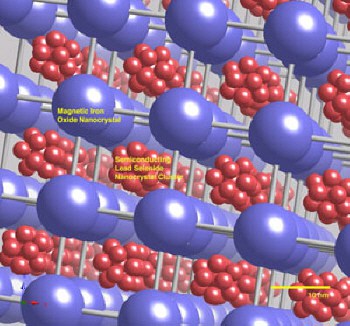
The properties of a metamaterial depend on the characteristics and interactions of the different nanocrystals used to make it. Metamaterials with improved magnetic, optical, electrical and mechanical properties could be used in applications as diverse as electric drives, motors and generators.
Redl and co-workers varied the sizes of the two different types of nanocrystal, as well as the processing conditions, to optimize the properties of the final ‘superlattice’ structure. Images taken with a transmission electron microscope confirm that two main types of superlattice were created (see figures 1 and 2). The best structures formed when the diameter of the lead-selenium quantum dots was 55% that of the iron oxide nanocrystals.
The average cubic unit cell in the superlattice was found to contain 8 iron oxide nanocrystals and 104 lead-selenium quantum dots, giving a total of about 4.5 million atoms per unit cell. Moreover, long-range order was seen in an area that extended up to 2 microns squared, whereas most metamaterials made in the lab so far have exhibited short-range order.
“We now are investigating magneto-optic phenomena in these materials to make new optical modulators and switches that could serve as building blocks for future telecommunications,” Redl told PhysicsWeb. “The unique combination of magnetic and semiconductor properties may also have an impact in magneto-electronics where both the charge of electron and its magnetic spin are exploited to carry out electronic operations.”